7th conference of European Penitentiary Training
Academies
7th conference of European Penitentiary Training
Academies
Dynamic security in the penal institutions
25 – 27 June 2014
Barcelona, Catalonia, Spain
Dynamic security in the penal institutions
25 – 27 June 2014
Barcelona, Catalonia, Spain
7th conference of European Penitentiary Training
Academies
7th conference of European Penitentiary Training
Academies
Presented by Danko Bakić
Governor
Training centre for Prison Staff
Prison Administration, Ministry of Justice
Republic of Croatia
Presented by Danko Bakić
Governor
Training centre for Prison Staff
Prison Administration, Ministry of Justice
Republic of Croatia
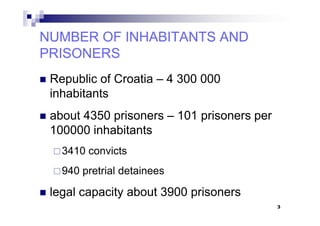
Republic of Croatia – 4 300 000
inhabitants
about 4350 prisoners – 101 prisoners per
NUMBER OF INHABITANTS ANDNUMBER OF INHABITANTS AND
PRISONERSPRISONERS
NUMBER OF INHABITANTS ANDNUMBER OF INHABITANTS AND
PRISONERSPRISONERS
about 4350 prisoners – 101 prisoners per
100000 inhabitants
3410 convicts
940 pretrial detainees
legal capacity about 3900 prisoners
3
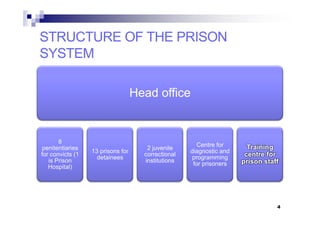
Head office
STRUCTURE OF THE PRISON
SYSTEM
STRUCTURE OF THE PRISON
SYSTEM
8
penitentiaries
for convicts (1
is Prison
Hospital)
13 prisons for
detainees
2 juvenile
correctional
institutions
Centre for
diagnostic and
programming
for prisoners
TrainingTraining
centre forcentre for
prison staffprison staff
4
EMPLOYEE STRUCTUREEMPLOYEE STRUCTURE
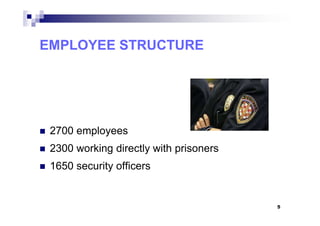
2700 employees
2300 working directly with prisoners
1650 security officers
5
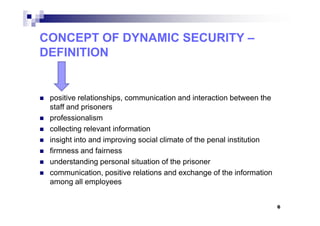
CONCEPT OF DYNAMIC SECURITY –
DEFINITION
positive relationships, communication and interaction between the
staff and prisoners
professionalism
collecting relevant information
insight into and improving social climate of the penal institution
firmness and fairness
understanding personal situation of the prisoner
communication, positive relations and exchange of the information
among all employees
6
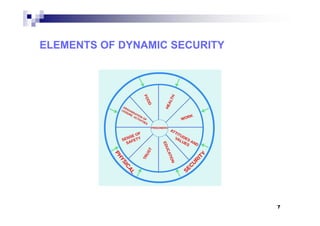
ELEMENTS OF DYNAMIC SECURITY
7
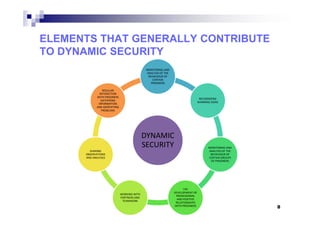
ELEMENTS THAT GENERALLY CONTRIBUTE
TO DYNAMIC SECURITY
MONITORING AND
ANALYSIS OF THE
BEHAVIOUR OF
CERTAIN
PRISONERS
RECOGNIZING
WARNING SIGNS
REGULAR
INTERACTION
WITH PRISONERS
GATHERING
INFORMATION
AND IDENTIFYING
PROBLEMS
DYNAMIC
SECURITY MONITORING AND
ANALYSIS OF THE
BEHAVIOUR OF
CERTAIN GROUPS
OF PRISONERS
THE
DEVELOPMENT OF
PROSESSIONAL
AND POSITIVE
RELATIONSHIPS
WITH PRISONERS
WORKING WITH
PARTNERS AND
TEAMWORK
SHARING
OBSERVATIONS
AND ANALYSES
8
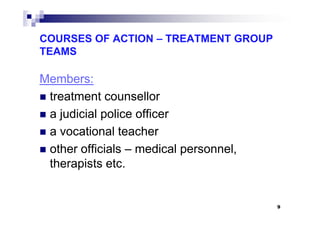
COURSES OF ACTION – TREATMENT GROUP
TEAMS
Members:
treatment counsellor
a judicial police officera judicial police officer
a vocational teacher
other officials – medical personnel,
therapists etc.
9
COURSES OF ACTION – ORGANIZATIONAL
STRUCTURES - TREATMENT GROUP TEAMS
Positive effects on dynamic security
information exchange and coordination
getting to know each other better andgetting to know each other better and
encouraging cooperation between officers
transferring specialist knowledge to other team
members
joint programming of further work with prisoners
10
COURSES OF ACTION – EDUCATION AND
TRAINING
Desirable areas of influence
employees' understanding of the purpose of prison
sentence
insight into the content of the tasks of all officers andinsight into the content of the tasks of all officers and
encouraging communication and cooperation – positive
atmosphere
motivation for constructive work with prisoners
adopting required social and communication skills and
knowledge
11
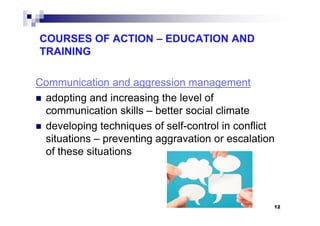
COURSES OF ACTION – EDUCATION AND
TRAINING
Communication and aggression management
adopting and increasing the level of
communication skills – better social climatecommunication skills – better social climate
developing techniques of self-control in conflict
situations – preventing aggravation or escalation
of these situations
12
COURSES OF ACTION – EDUCATION AND
TRAINING
Teamwork of officers of penal institutions – areas
getting to know the tasks and challenges
encountered in work by all types of officers
recommendations on how employees of
particular services can contribute to the
successful job performance of other services
practical workshop
13
COURSES OF ACTION – EDUCATION AND
TRAINING
Teamwork recommendations for treatment officers
forwarding relevant information within the jurisdiction of the treatment department to security
services – transfer, privileges, parole, extension of remand, new sentence, etc.
informing judicial police officers and other authorized officers about relevant data on prisoners that
may affect safety – personality traits, case history, etc.
supporting the dignity of judicial police officerssupporting the dignity of judicial police officers
the expeditious resolution of prisoners’ problems before weekends or holidays, so that these
problems would not escalate at the worst possible moment for the penal institution
planning prisoners’ leisure activities
assessing the degree of risk during accommodation, determining privileges and activities inside
and outside the institution
undertaking all preliminary actions related to conveying prisoners outside the institution due to
some special circumstances – going to a funeral, sports match, bank, etc.
informing prisoners promptly and professionally on decisions related to privileges – visits, phones,
leaving the facility, etc.
14
COURSES OF ACTION – EDUCATION AND
TRAINING
Teamwork recommendations for health care officers
the prompt forwarding of information on the health status of prisoners in order to prevent self-
harm, suicide, the spread of infectious diseases, etc.
the organization of therapy distribution under the supervision of professional staff,
timely response to prisoners’ applications for medical examinations or treatment (e.g., a prisoner’stimely response to prisoners’ applications for medical examinations or treatment (e.g., a prisoner’s
toothache can become a security issue),
the coordination of views on the distribution and form of a particular therapy (crushing tablets,
method of observation, etc.)
the organization of admission, accommodation and medical escort when conveying prisoners
outside the facility for medical treatment and medical care in an outer medical institution, and
when they are discharged from the same.
ensuring the availability of a prison doctor outside working hours,
acting in accordance with the legal obligations relating to examination and observation with
particular disciplinary measures, the application of coercive measures, etc.
implementing the examination of body orifices and excrements (detecting and preventing the entry
of illegal substances and items)
15
COURSES OF ACTION – EDUCATION AND
TRAINING
Teamwork recommendations for vocational instructors
the commitment of vocational teachers to learn all the data on prisoners that is important for work
from the security aspect,
the inclusion of vocational teachers in education programs that relate to their role in the dynamic
security of penitentiaries and prisons,security of penitentiaries and prisons,
providing feedback on the work of prisoners, which is essential for the operation of the security
department,
preventing the abuse of work activities by prisoners (the manufacture and transfer of tools and
weapons, etc.)
quickly, effectively and independently identifying and solving a problem, that directly affects the
maintenance of order and security (e.g. changing defective light bulbs, which, if it is not done in a
timely manner, can become a security issue during the night!)
the implementation of measures for guarding and monitoring tools and dangerous substances and
materials entrusted to them for performing work activities
16
COURSES OF ACTION – EDUCATION AND TRAINING
Teamwork recommendations for legal affairs departments/sections
the timely implementation of activities related to the transfer of money and other
valuables,
continuous forwarding and interpretation of amended and new regulations pertaining
to the operation of the security department,to the operation of the security department,
taking a common view on undertaking any actions in disciplinary proceedings.
participation in planning security measures for particular working activities,
the careful selection of prisoners for work,
planning and modifying security measures in long-term working activities,
timely legal assistance for prisoners
17
COURSES OF ACTION – EDUCATION AND
TRAINING
Teamwork – desirable effects
reducing the likelihood of insufficient quality work,reducing the likelihood of insufficient quality work,
failures and non-uniform influences
avoid providing prisoners with inaccurate or contradictory
information
reducing or elimination of conflicts between officers
18
CONCLUSION
„Simple“ recipes
individualized approach
understanding
firmness
justness
respect of the rights and reasonable needs
good organization
prevention of mutual abuse
quality, joint and synchronized work
19
Thank you for
your attention!your attention!
20

Dynamic security in penal institutions (Croàcia)

  • 1.
    7th conference ofEuropean Penitentiary Training Academies 7th conference of European Penitentiary Training Academies Dynamic security in the penal institutions 25 – 27 June 2014 Barcelona, Catalonia, Spain Dynamic security in the penal institutions 25 – 27 June 2014 Barcelona, Catalonia, Spain
  • 2.
    7th conference ofEuropean Penitentiary Training Academies 7th conference of European Penitentiary Training Academies Presented by Danko Bakić Governor Training centre for Prison Staff Prison Administration, Ministry of Justice Republic of Croatia Presented by Danko Bakić Governor Training centre for Prison Staff Prison Administration, Ministry of Justice Republic of Croatia
  • 3.
    Republic of Croatia– 4 300 000 inhabitants about 4350 prisoners – 101 prisoners per NUMBER OF INHABITANTS ANDNUMBER OF INHABITANTS AND PRISONERSPRISONERS NUMBER OF INHABITANTS ANDNUMBER OF INHABITANTS AND PRISONERSPRISONERS about 4350 prisoners – 101 prisoners per 100000 inhabitants 3410 convicts 940 pretrial detainees legal capacity about 3900 prisoners 3
  • 4.
    Head office STRUCTURE OFTHE PRISON SYSTEM STRUCTURE OF THE PRISON SYSTEM 8 penitentiaries for convicts (1 is Prison Hospital) 13 prisons for detainees 2 juvenile correctional institutions Centre for diagnostic and programming for prisoners TrainingTraining centre forcentre for prison staffprison staff 4
  • 5.
    EMPLOYEE STRUCTUREEMPLOYEE STRUCTURE 2700employees 2300 working directly with prisoners 1650 security officers 5
  • 6.
    CONCEPT OF DYNAMICSECURITY – DEFINITION positive relationships, communication and interaction between the staff and prisoners professionalism collecting relevant information insight into and improving social climate of the penal institution firmness and fairness understanding personal situation of the prisoner communication, positive relations and exchange of the information among all employees 6
  • 7.
  • 8.
    ELEMENTS THAT GENERALLYCONTRIBUTE TO DYNAMIC SECURITY MONITORING AND ANALYSIS OF THE BEHAVIOUR OF CERTAIN PRISONERS RECOGNIZING WARNING SIGNS REGULAR INTERACTION WITH PRISONERS GATHERING INFORMATION AND IDENTIFYING PROBLEMS DYNAMIC SECURITY MONITORING AND ANALYSIS OF THE BEHAVIOUR OF CERTAIN GROUPS OF PRISONERS THE DEVELOPMENT OF PROSESSIONAL AND POSITIVE RELATIONSHIPS WITH PRISONERS WORKING WITH PARTNERS AND TEAMWORK SHARING OBSERVATIONS AND ANALYSES 8
  • 9.
    COURSES OF ACTION– TREATMENT GROUP TEAMS Members: treatment counsellor a judicial police officera judicial police officer a vocational teacher other officials – medical personnel, therapists etc. 9
  • 10.
    COURSES OF ACTION– ORGANIZATIONAL STRUCTURES - TREATMENT GROUP TEAMS Positive effects on dynamic security information exchange and coordination getting to know each other better andgetting to know each other better and encouraging cooperation between officers transferring specialist knowledge to other team members joint programming of further work with prisoners 10
  • 11.
    COURSES OF ACTION– EDUCATION AND TRAINING Desirable areas of influence employees' understanding of the purpose of prison sentence insight into the content of the tasks of all officers andinsight into the content of the tasks of all officers and encouraging communication and cooperation – positive atmosphere motivation for constructive work with prisoners adopting required social and communication skills and knowledge 11
  • 12.
    COURSES OF ACTION– EDUCATION AND TRAINING Communication and aggression management adopting and increasing the level of communication skills – better social climatecommunication skills – better social climate developing techniques of self-control in conflict situations – preventing aggravation or escalation of these situations 12
  • 13.
    COURSES OF ACTION– EDUCATION AND TRAINING Teamwork of officers of penal institutions – areas getting to know the tasks and challenges encountered in work by all types of officers recommendations on how employees of particular services can contribute to the successful job performance of other services practical workshop 13
  • 14.
    COURSES OF ACTION– EDUCATION AND TRAINING Teamwork recommendations for treatment officers forwarding relevant information within the jurisdiction of the treatment department to security services – transfer, privileges, parole, extension of remand, new sentence, etc. informing judicial police officers and other authorized officers about relevant data on prisoners that may affect safety – personality traits, case history, etc. supporting the dignity of judicial police officerssupporting the dignity of judicial police officers the expeditious resolution of prisoners’ problems before weekends or holidays, so that these problems would not escalate at the worst possible moment for the penal institution planning prisoners’ leisure activities assessing the degree of risk during accommodation, determining privileges and activities inside and outside the institution undertaking all preliminary actions related to conveying prisoners outside the institution due to some special circumstances – going to a funeral, sports match, bank, etc. informing prisoners promptly and professionally on decisions related to privileges – visits, phones, leaving the facility, etc. 14
  • 15.
    COURSES OF ACTION– EDUCATION AND TRAINING Teamwork recommendations for health care officers the prompt forwarding of information on the health status of prisoners in order to prevent self- harm, suicide, the spread of infectious diseases, etc. the organization of therapy distribution under the supervision of professional staff, timely response to prisoners’ applications for medical examinations or treatment (e.g., a prisoner’stimely response to prisoners’ applications for medical examinations or treatment (e.g., a prisoner’s toothache can become a security issue), the coordination of views on the distribution and form of a particular therapy (crushing tablets, method of observation, etc.) the organization of admission, accommodation and medical escort when conveying prisoners outside the facility for medical treatment and medical care in an outer medical institution, and when they are discharged from the same. ensuring the availability of a prison doctor outside working hours, acting in accordance with the legal obligations relating to examination and observation with particular disciplinary measures, the application of coercive measures, etc. implementing the examination of body orifices and excrements (detecting and preventing the entry of illegal substances and items) 15
  • 16.
    COURSES OF ACTION– EDUCATION AND TRAINING Teamwork recommendations for vocational instructors the commitment of vocational teachers to learn all the data on prisoners that is important for work from the security aspect, the inclusion of vocational teachers in education programs that relate to their role in the dynamic security of penitentiaries and prisons,security of penitentiaries and prisons, providing feedback on the work of prisoners, which is essential for the operation of the security department, preventing the abuse of work activities by prisoners (the manufacture and transfer of tools and weapons, etc.) quickly, effectively and independently identifying and solving a problem, that directly affects the maintenance of order and security (e.g. changing defective light bulbs, which, if it is not done in a timely manner, can become a security issue during the night!) the implementation of measures for guarding and monitoring tools and dangerous substances and materials entrusted to them for performing work activities 16
  • 17.
    COURSES OF ACTION– EDUCATION AND TRAINING Teamwork recommendations for legal affairs departments/sections the timely implementation of activities related to the transfer of money and other valuables, continuous forwarding and interpretation of amended and new regulations pertaining to the operation of the security department,to the operation of the security department, taking a common view on undertaking any actions in disciplinary proceedings. participation in planning security measures for particular working activities, the careful selection of prisoners for work, planning and modifying security measures in long-term working activities, timely legal assistance for prisoners 17
  • 18.
    COURSES OF ACTION– EDUCATION AND TRAINING Teamwork – desirable effects reducing the likelihood of insufficient quality work,reducing the likelihood of insufficient quality work, failures and non-uniform influences avoid providing prisoners with inaccurate or contradictory information reducing or elimination of conflicts between officers 18
  • 19.
    CONCLUSION „Simple“ recipes individualized approach understanding firmness justness respectof the rights and reasonable needs good organization prevention of mutual abuse quality, joint and synchronized work 19
  • 20.
    Thank you for yourattention!your attention! 20