Dynamic Entanglements:
Complex Systems in
Emergency
Management
Operational Coherence
Gregory Vigneaux, M.S.
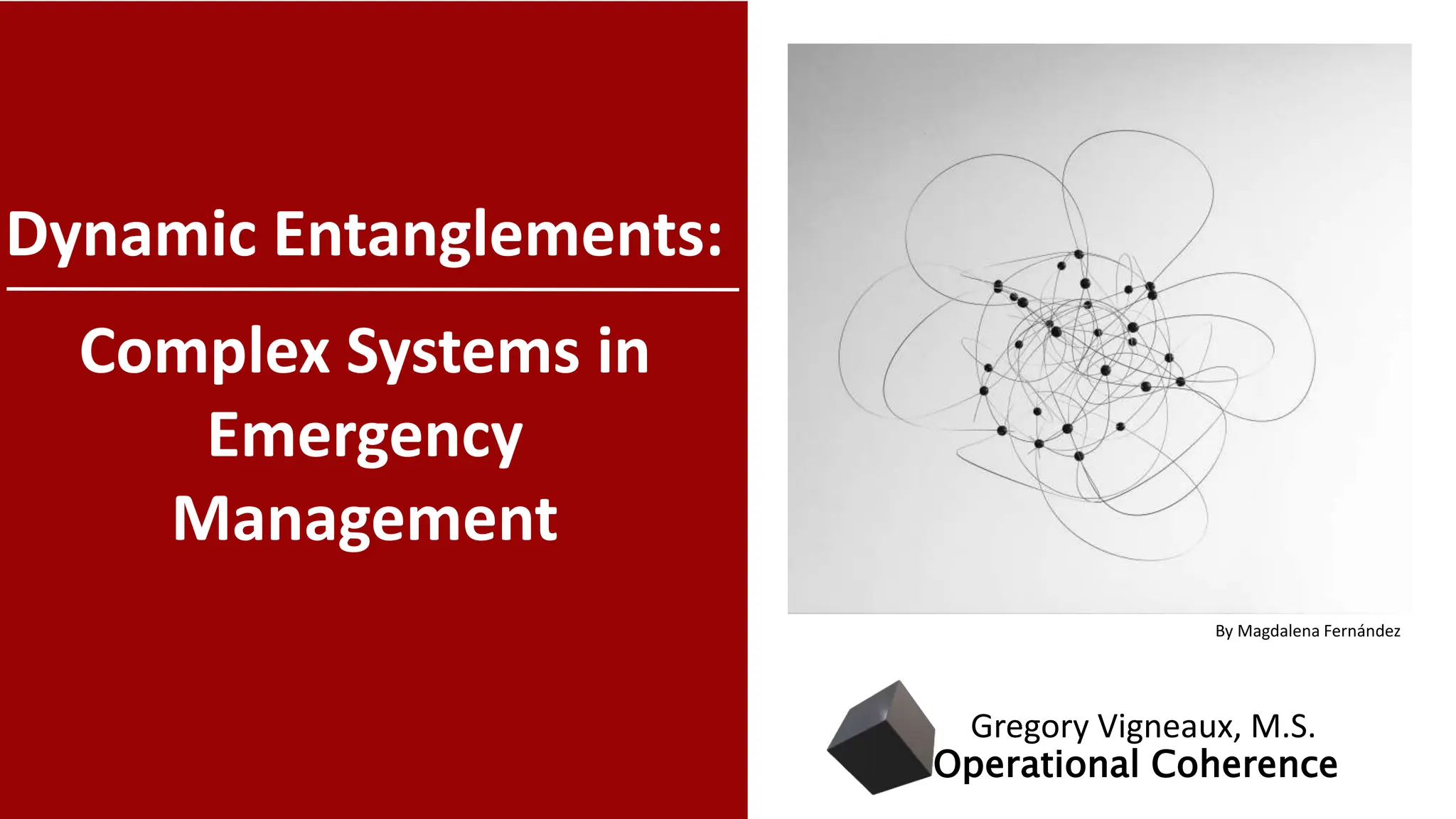
By Magdalena Fernández
John Holland
Computational/Mathematical
approach to complexity.
A founding Member of
the Santa Fe Institute.
Paul Cilliers
Philosophical Approach
to Complexity. Famously authored the book
Complexity and Postmodernism. He then served
as editor for several books following
the complexity and philosophy narrative.
Edgar Morin
A philosopher working around
complexity and beyond.
Pre-dates the popularization
of complexity but published
only in French. Ongoing efforts
to move his work to English.
Dispositional Complexity
Operational Coherence
GregoryVig.com
• A complex system’s past remains active in its present. Its past, along with its travel through time, is
responsible for the pattern of interaction among the actors, the nature of the actors themselves,
and the system structure.
• A system’s complexity is a product of rich, self-organizing interactions of simple actors reacting to
limited information. These interactions (physical, not physical, such as the passing of information)
follow overlapping and twisting pathways, producing a dynamic entanglement.
• Complex systems have emergent properties created through the interaction of actors that none of
the actors could create alone. Emergent properties created at one level are foundational to
emergent properties at the next level.
• Interactions between systems and systems, systems and the environment, and the actors belonging
to the system are non-linear. Outcomes are not proportionate and may be distant in time and space.
Complex Characteristics
• Actors function on locally available information and are ignorant of the system’s behavior as a whole.
• All systems have a boundary. It does not have to be linear. The boundary is open to the influx of information,
materials, and energy but closed in terms of outside forces dictating the system’s operations.
• Drawing from the constant flow of energy into the system and the movement of the actors within it, a
complex system is always on the go and never stays put. Optimal states are ephemeral.
• Feedback loops connect action and the outcome of that action in a circular pattern (circles of causality).
• It is inconceivable that one actor can hold in their head total knowledge of the system and its complexity
(Cilliers, 1998).
Complex Characteristics
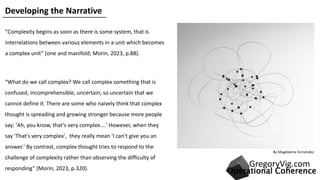
By Magdalena Fernández​
"Complexity begins as soon as there is some system, that is
interrelations between various elements in a unit which becomes
a complex unit” (one and manifold; Morin, 2023, p.88).
“What do we call complex? We call complex something that is
confused, incomprehensible, uncertain; so uncertain that we
cannot define it. There are some who naively think that complex
thought is spreading and growing stronger because more people
say: 'Ah, you know, that's very complex....' However, when they
say 'That's very complex', they really mean 'I can't give you an
answer.' By contrast, complex thought tries to respond to the
challenge of complexity rather than observing the difficulty of
responding” (Morin, 2023, p.320).
Developing the Narrative
Operational Coherence
GregoryVig.com
.
“That beyond death nothing should arise, and that beyond death
there should be only death.....Because death is death and life
without death is only emptiness.” –Humberto R. Maturana
“It is evidently when life takes form that birth and death will
take on a deep meaning.” –Edgar Morin
Injury, Death, and Complexity
Operational Coherence
GregoryVig.com
.
References
Cilliers, P. (1998). Complexity & postmodernism: Understanding complex systems. London: Routledge.
Cilliers, P. (2006). On the importance of a certain slowness. Emergence: Complexity and Organization, 8(3), 105-112.
Holland, J. H. (1992). Complex adaptive systems. Daedalus, 121(1), 17-30.
Maturana, H. R. (n.d.). Introduction. In Autopoiesis and cognition: The realization of living (pp. xi-xxx). Dordrecht, Holland: D. Reidel
Publishing Company.
Morin, E. (1992). Method: toward a study of humankind: the nature of nature (Vol. 1). (B. J.L Roland, Trans.) New York, NY: Peter Lang.
Morin, E. (1999). Seven complex lessons in education for the future. (N. Poller, Trans.) Paris, France: United Nations, Scientific and
cultural organization.
Morin, E. (2023). Epistemology-complexity. In E. Morin, & A. Heath-Carpentier (Ed.), The challenge of complexity: Essays by Edgar Morin
(pp. 86-108). Chicago, Illinois: Sussex Academic Press.
Morin, E. (2023). Realism and utopia. In A. Heath-Carpenter (Ed.), The challenge of complexity: Essays by Edgar Morin (pp. 316-324).
Chicago, Illinois: Sussex Academic Press.
Waldrop, M. M. (1992). The emerging science at the edge of order and chaos. New York, NY: Touchstone.

Dynamic Entanglements Complex Systems in Emergency Management.pptx

  • 1.
    Dynamic Entanglements: Complex Systemsin Emergency Management Operational Coherence Gregory Vigneaux, M.S. By Magdalena Fernández
  • 2.
    John Holland Computational/Mathematical approach tocomplexity. A founding Member of the Santa Fe Institute. Paul Cilliers Philosophical Approach to Complexity. Famously authored the book Complexity and Postmodernism. He then served as editor for several books following the complexity and philosophy narrative. Edgar Morin A philosopher working around complexity and beyond. Pre-dates the popularization of complexity but published only in French. Ongoing efforts to move his work to English. Dispositional Complexity Operational Coherence GregoryVig.com
  • 3.
    • A complexsystem’s past remains active in its present. Its past, along with its travel through time, is responsible for the pattern of interaction among the actors, the nature of the actors themselves, and the system structure. • A system’s complexity is a product of rich, self-organizing interactions of simple actors reacting to limited information. These interactions (physical, not physical, such as the passing of information) follow overlapping and twisting pathways, producing a dynamic entanglement. • Complex systems have emergent properties created through the interaction of actors that none of the actors could create alone. Emergent properties created at one level are foundational to emergent properties at the next level. • Interactions between systems and systems, systems and the environment, and the actors belonging to the system are non-linear. Outcomes are not proportionate and may be distant in time and space. Complex Characteristics
  • 4.
    • Actors functionon locally available information and are ignorant of the system’s behavior as a whole. • All systems have a boundary. It does not have to be linear. The boundary is open to the influx of information, materials, and energy but closed in terms of outside forces dictating the system’s operations. • Drawing from the constant flow of energy into the system and the movement of the actors within it, a complex system is always on the go and never stays put. Optimal states are ephemeral. • Feedback loops connect action and the outcome of that action in a circular pattern (circles of causality). • It is inconceivable that one actor can hold in their head total knowledge of the system and its complexity (Cilliers, 1998). Complex Characteristics
  • 5.
    By Magdalena Fernández​ "Complexitybegins as soon as there is some system, that is interrelations between various elements in a unit which becomes a complex unit” (one and manifold; Morin, 2023, p.88). “What do we call complex? We call complex something that is confused, incomprehensible, uncertain; so uncertain that we cannot define it. There are some who naively think that complex thought is spreading and growing stronger because more people say: 'Ah, you know, that's very complex....' However, when they say 'That's very complex', they really mean 'I can't give you an answer.' By contrast, complex thought tries to respond to the challenge of complexity rather than observing the difficulty of responding” (Morin, 2023, p.320). Developing the Narrative Operational Coherence GregoryVig.com
  • 6.
    . “That beyond deathnothing should arise, and that beyond death there should be only death.....Because death is death and life without death is only emptiness.” –Humberto R. Maturana “It is evidently when life takes form that birth and death will take on a deep meaning.” –Edgar Morin Injury, Death, and Complexity Operational Coherence GregoryVig.com
  • 7.
    . References Cilliers, P. (1998).Complexity & postmodernism: Understanding complex systems. London: Routledge. Cilliers, P. (2006). On the importance of a certain slowness. Emergence: Complexity and Organization, 8(3), 105-112. Holland, J. H. (1992). Complex adaptive systems. Daedalus, 121(1), 17-30. Maturana, H. R. (n.d.). Introduction. In Autopoiesis and cognition: The realization of living (pp. xi-xxx). Dordrecht, Holland: D. Reidel Publishing Company. Morin, E. (1992). Method: toward a study of humankind: the nature of nature (Vol. 1). (B. J.L Roland, Trans.) New York, NY: Peter Lang. Morin, E. (1999). Seven complex lessons in education for the future. (N. Poller, Trans.) Paris, France: United Nations, Scientific and cultural organization. Morin, E. (2023). Epistemology-complexity. In E. Morin, & A. Heath-Carpentier (Ed.), The challenge of complexity: Essays by Edgar Morin (pp. 86-108). Chicago, Illinois: Sussex Academic Press. Morin, E. (2023). Realism and utopia. In A. Heath-Carpenter (Ed.), The challenge of complexity: Essays by Edgar Morin (pp. 316-324). Chicago, Illinois: Sussex Academic Press. Waldrop, M. M. (1992). The emerging science at the edge of order and chaos. New York, NY: Touchstone.

Editor's Notes

  • #7 Without threats, work is meaningless
  • #8 Without threats, work is meaningless