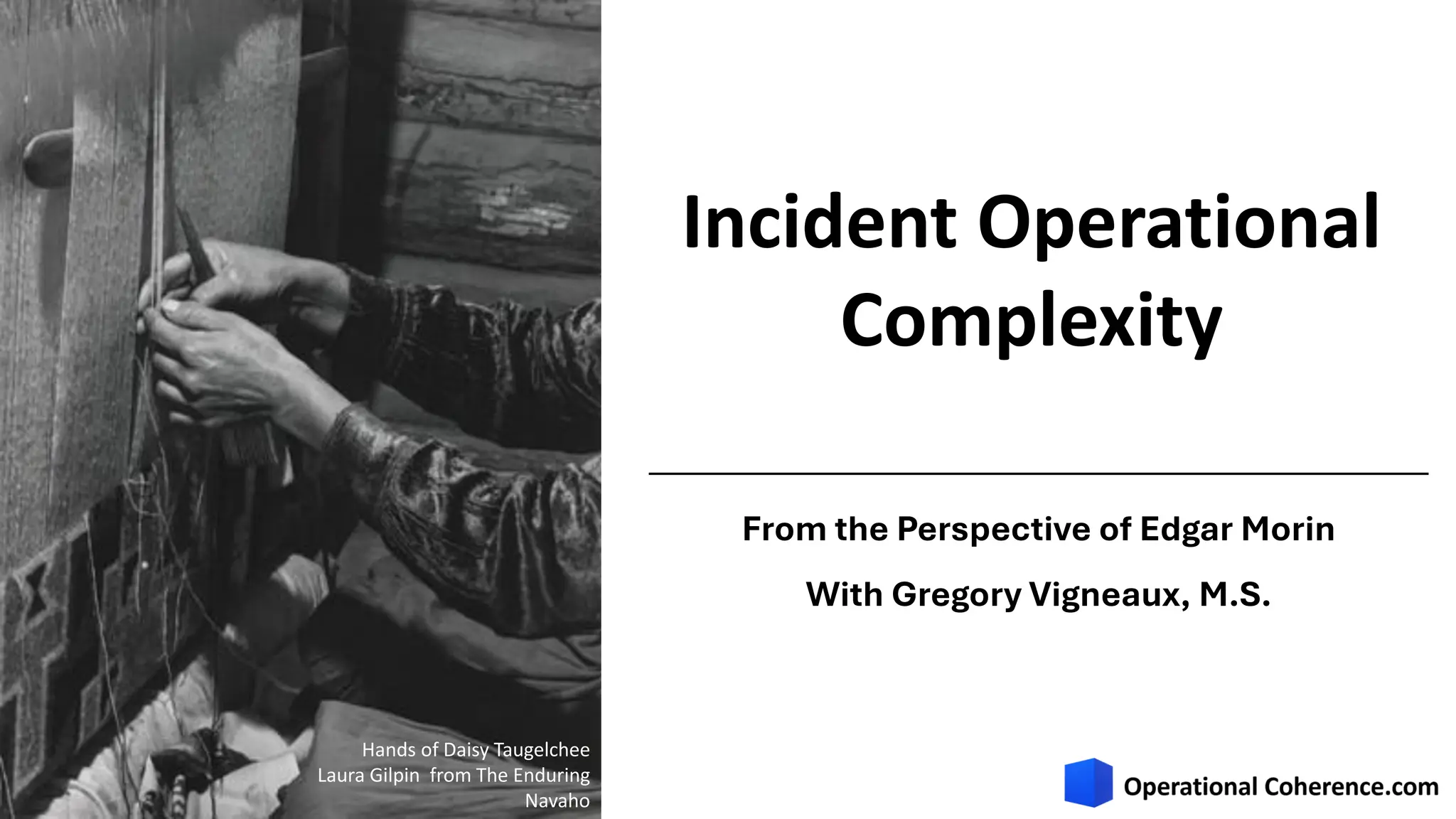
Hands of Daisy Taugelchee
Laura Gilpin from The Enduring
Navaho
Incident Operational
Complexity
From the Perspective of Edgar Morin
With Gregory Vigneaux, M.S.
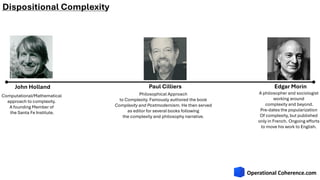
John Holland
Computational/Mathematical
approach to complexity.
A founding Member of
the Santa Fe Institute.
Paul Cilliers
Philosophical Approach
to Complexity. Famously authored the book
Complexity and Postmodernism. He then served
as editor for several books following
the complexity and philosophy narrative.
Edgar Morin
A philosopher and sociologist
working around
complexity and beyond.
Pre-dates the popularization
Of complexity, but published
only in French. Ongoing efforts
to move his work to English.
Dispositional Complexity
The Incident:“Using the term [incident] merely allows someone to say that something is wrong.
The Operations: “To live to survive, to survive to live” (Morin, 1979/1992, p.265)
The Thinking:
we cannot define it. [Some] people say: ‘Ah you know, that’s very complex….’ However, when they say ‘That’s very complex,’
they really mean: ‘I can’t give you an answer.’ By contrast, complex thought tries to respond to the challenge of complexity
rather than observing the difficulty of responding” (Morin, 1996, p.320).
“We call something complex that is confused incomprehensible…so uncertain that
The term is now used to name that which cannot be named” (Morin, 1993, p.231).
What is
Complexity I ?
• “At first glance, complexity is a fabric
(complexus: that which is woven together) of
heterogeneous constituents that are
inseparably associated: complexity poses the
paradox of the one and the many.
• “But complexity presents itself with the
disturbing traits of a mess, of the inextricable
of disorder, of ambiguity, of uncertainty”
(Morin, 2008, p.5).”
What is Complexity II ?
• “But complexity is not only quantities of units and
interactions that defy our possibilities of calculation; it
is also made up of uncertainty, indetermination, and
random phenomena. Complexity is, in a sense,
always about chance.
• Complexity coincides with a part of uncertainty
that arises from the limits our ability to comprehend,
or with a part of uncertainty inscribed in phenomena.
• But complexity cannot be reduced to uncertainty;
it is uncertainty at the heart of richly organized
systems….Complexity is…linked to a certain mixture
of disorder and order” (Morin, 2008, p.20).
What is Complex
Thought?
• “Simple thought solves simple problems….
Complex thought doesn't in itself resolve problems,
but it constitutes an aid to a strategy that can resolve
them.
• What complex thought can do is to give everyone
a memento, a reminder, that says 'Don't forget that
reality is changing, don’t forget that something new
can (and will) spring up’” (Morin, 2008, p.57).”
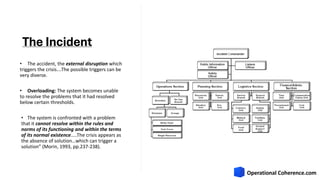
The Incident
• The accident, the external disruption which
triggers the crisis….The possible triggers can be
very diverse.
• Overloading: The system becomes unable
to resolve the problems that it had resolved
below certain thresholds.
• The system is confronted with a problem
that it cannot resolve within the rules and
norms of its functioning and within the terms
of its normal existence…..The crisis appears as
the absence of solution…which can trigger a
solution” (Morin, 1993, pp.237-238).
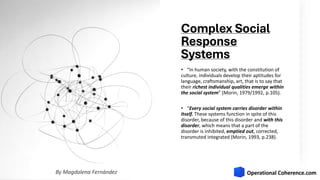
Complex Social
Response
Systems
• “In human society, with the constitution of
culture, individuals develop their aptitudes for
language, craftsmanship, art, that is to say that
their richest individual qualities emerge within
the social system” (Morin, 1979/1992, p.105).
• “Every social system carries disorder within
itself. These systems function in spite of this
disorder, because of this disorder and with this
disorder, which means that a part of the
disorder is inhibited, emptied out, corrected,
transmuted integrated (Morin, 1993, p.238).
By Magdalena Fernández
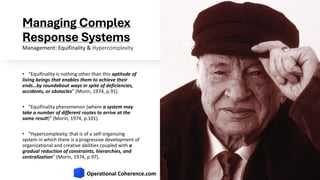
Managing Complex
Response Systems
• “Equifinality is nothing other than this aptitude of
living beings that enables them to achieve their
ends…by roundabout ways in spite of deficiencies,
accidents, or obstacles” (Morin, 1974, p.91).
• “Equifinality phenomenon (where a system may
take a number of different routes to arrive at the
same result)” (Morin, 1974, p.101).
• “Hypercomplexity, that is of a self-organizing
system in which there is a progressive development of
organizational and creative abilities coupled with a
gradual reduction of constraints, hierarchies, and
centralization” (Morin, 1974, p.97).
Management: Equifinality & Hypercomplexity
Managing Complex
Response Systems
• ʺA program is a sequence of predetermined actions that
must function in circumstances that allow their completion. If
the external circumstances are unfavorable, the program
stops or fails.
• “The advantage of a program is obviously a great
economy: we don’t have to think, everything is done
automatically. (Morin, 2008, p.63).
Planning: Programs
Managing Complex
Response Systems
• “Strategy is the rational guidance of an action in a situation and
context that is ill defined and perhaps dangerous. Strategies are
elaborated according to goals and principles, consider various
possible scripts for the unfolding action, and select the one that
appears to be dictated by the situation” (Morin & Kern, 1999, p.
115).
• “But a strategy, in order for it to be carried out by an
organization, requires that the organization not be conceived to
obey a program” (Morin, 2008, p.63)
Planning: Strategy
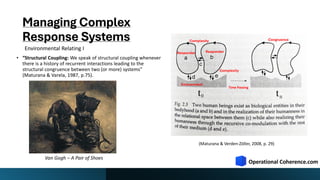
• “Structural Coupling: We speak of structural coupling whenever
there is a history of recurrent interactions leading to the
structural congruence between two (or more) systems”
(Maturana & Varela, 1987, p.75).
Managing Complex
Response Systems
Environmental Relating I
(Maturana & Verden-Zöller, 2008, p. 29)
Van Gogh – A Pair of Shoes
Responder
Environment
Complexity
Complexity
Responder
Congruence
Time Passing
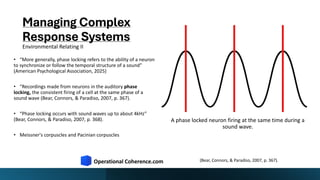
• “More generally, phase locking refers to the ability of a neuron
to synchronize or follow the temporal structure of a sound”
(American Psychological Association, 2025)
• “Recordings made from neurons in the auditory phase
locking, the consistent firing of a cell at the same phase of a
sound wave (Bear, Connors, & Paradiso, 2007, p. 367).
• “Phase locking occurs with sound waves up to about 4kHz”
(Bear, Connors, & Paradiso, 2007, p. 368).
• Meissner's corpuscles and Pacinian corpuscles
Managing Complex
Response Systems
Environmental Relating II
(Bear, Connors, & Paradiso, 2007, p. 367).
A phase locked neuron firing at the same time during a
sound wave.
Managing Complex
Response Systems
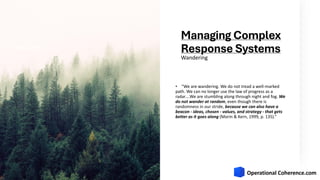
• “We are wandering. We do not tread a well-marked
path. We can no longer use the law of progress as a
radar….We are stumbling along through night and fog. We
do not wander at random, even though there is
randomness in our stride, because we can also have a
beacon - ideas, chosen - values, and strategy - that gets
better as it goes along (Morin & Kern, 1999, p. 135).”
Wandering
Wandering
Managing Complex
Response Systems
• “The presence of purposes, aims, or expectations in a
relationship denies [acceptance], as these become the center
of attention and care. Such purposes, expectations, and aims
generate blindness with respect to the participants in the
relationship, whoever or whatever these may be.
• That is, by attending to what one expects the other to
do, the other disappears and the relationship” (Maturana &
Verden-Zöller, 2008, p. 224) takes place in manipulation.
Wandering
Measurement
American Psychological Association. (2025). Phase locking. APA Dictionary of Psychology. Retrieved from https://dictionary.apa.org/phase-locking
Bear, M. F., Connors, B. W., & Paradiso, M. A. (2007). The auditory and vestibular systems (Third ed.). Philadelphia, PA: Lippincott Williams & Wilkins.
Healey, V. (2025). The hearing mechanism. Oslo, NO: Publifye AS.
Maturana, H. R. (2005). The origin and conservation of self‐consciousness: Reflections on four questions by Heinz von Foerster. Kybernetes, 34(1/2), 54-88.
doi:https://doi.org/10.1108/03684920510575744
Maturana, H. R., & Verden-Zöller, G. (2008). The origin of humanness in the biology of love. (B. Pille, Ed.) Exeter, Devon, UK: Imprint Academic.
Møller, A. R. (2006). Hearing: Anatomy, physiology, and disorders of the auditory system (Second ed.). Burlington, MA: Academic Press.
Morin , E. (1993). For a crisology. In E. Morin, & A. Heath-Carpentier (Ed.), The challenge of complexity: Essays by edgar morin (T. C. Pauchant, Trans., pp. 231-245).
Brighton: Sussex Academic Press. Retrieved 2024
Morin , E. (2008). On complexity. (R. Postel, Trans.) Cresskill, NJ: Hampton Press.
Morin, E. (1974). Epistemology - complexity. In E. Morin, & A. Heath-Carpentier (Ed.), The challenge of complexity: Essays by Edgar Morin (pp. 86-108).
Brighton: Sussex Academic Press.
Morin, E. (11979/992). Method: toward a study of humankind: the nature of nature (Vol. 1). (B. J.L Roland, Trans.) New York, NY: Peter Lang.
Morin, E. (1999). Organization and complexity. Annals of the New York Academy of Sciences, 879(1), 115-221. doi:10.1111/j.1749-6632.1999.tb10410.x
Morin, E. (2006). Realism and utopia. In E. Morin, & A. Heath-Carpentier (Ed.), The challenge of complexity: Essays by Edgar Morin (pp. 316-324). Sussex: Sussex.
Morin, E., & Kern, A. B. (1999). Homeland earth: A manifesto for the new millennium. (S. M. Kelly, & R. LaPointe, Trans.) Cresskill, NJ: Hampton Press.
Rescher, N. (1998). Complexity: A philosophical overview. New Brunswick, NJ: Transaction Publishers.
Uhlhaas, P. J., & Singer, W. (2010). Role of neuronal synchrony in normal and pathological brain functions. In G. Koob, M. Le Moal, & R. Thompson (Eds.),
Encyclopedia of behavioral neuroscience (pp. 180-186). Amsterdam, North Holland: Elsevier Academic Press.
Waldrop, M. M. (1992). The emerging science at the edge of order and chaos. New York, NY: Touchstone.

Gregory Vigneaux: Incident Operational Complexity.pdf

  • 1.
    Hands of DaisyTaugelchee Laura Gilpin from The Enduring Navaho Incident Operational Complexity From the Perspective of Edgar Morin With Gregory Vigneaux, M.S.
  • 2.
    John Holland Computational/Mathematical approach tocomplexity. A founding Member of the Santa Fe Institute. Paul Cilliers Philosophical Approach to Complexity. Famously authored the book Complexity and Postmodernism. He then served as editor for several books following the complexity and philosophy narrative. Edgar Morin A philosopher and sociologist working around complexity and beyond. Pre-dates the popularization Of complexity, but published only in French. Ongoing efforts to move his work to English. Dispositional Complexity
  • 3.
    The Incident:“Using theterm [incident] merely allows someone to say that something is wrong. The Operations: “To live to survive, to survive to live” (Morin, 1979/1992, p.265) The Thinking: we cannot define it. [Some] people say: ‘Ah you know, that’s very complex….’ However, when they say ‘That’s very complex,’ they really mean: ‘I can’t give you an answer.’ By contrast, complex thought tries to respond to the challenge of complexity rather than observing the difficulty of responding” (Morin, 1996, p.320). “We call something complex that is confused incomprehensible…so uncertain that The term is now used to name that which cannot be named” (Morin, 1993, p.231).
  • 4.
    What is Complexity I? • “At first glance, complexity is a fabric (complexus: that which is woven together) of heterogeneous constituents that are inseparably associated: complexity poses the paradox of the one and the many. • “But complexity presents itself with the disturbing traits of a mess, of the inextricable of disorder, of ambiguity, of uncertainty” (Morin, 2008, p.5).”
  • 5.
    What is ComplexityII ? • “But complexity is not only quantities of units and interactions that defy our possibilities of calculation; it is also made up of uncertainty, indetermination, and random phenomena. Complexity is, in a sense, always about chance. • Complexity coincides with a part of uncertainty that arises from the limits our ability to comprehend, or with a part of uncertainty inscribed in phenomena. • But complexity cannot be reduced to uncertainty; it is uncertainty at the heart of richly organized systems….Complexity is…linked to a certain mixture of disorder and order” (Morin, 2008, p.20).
  • 6.
    What is Complex Thought? •“Simple thought solves simple problems…. Complex thought doesn't in itself resolve problems, but it constitutes an aid to a strategy that can resolve them. • What complex thought can do is to give everyone a memento, a reminder, that says 'Don't forget that reality is changing, don’t forget that something new can (and will) spring up’” (Morin, 2008, p.57).”
  • 7.
    The Incident • Theaccident, the external disruption which triggers the crisis….The possible triggers can be very diverse. • Overloading: The system becomes unable to resolve the problems that it had resolved below certain thresholds. • The system is confronted with a problem that it cannot resolve within the rules and norms of its functioning and within the terms of its normal existence…..The crisis appears as the absence of solution…which can trigger a solution” (Morin, 1993, pp.237-238).
  • 8.
    Complex Social Response Systems • “Inhuman society, with the constitution of culture, individuals develop their aptitudes for language, craftsmanship, art, that is to say that their richest individual qualities emerge within the social system” (Morin, 1979/1992, p.105). • “Every social system carries disorder within itself. These systems function in spite of this disorder, because of this disorder and with this disorder, which means that a part of the disorder is inhibited, emptied out, corrected, transmuted integrated (Morin, 1993, p.238). By Magdalena Fernández
  • 9.
    Managing Complex Response Systems •“Equifinality is nothing other than this aptitude of living beings that enables them to achieve their ends…by roundabout ways in spite of deficiencies, accidents, or obstacles” (Morin, 1974, p.91). • “Equifinality phenomenon (where a system may take a number of different routes to arrive at the same result)” (Morin, 1974, p.101). • “Hypercomplexity, that is of a self-organizing system in which there is a progressive development of organizational and creative abilities coupled with a gradual reduction of constraints, hierarchies, and centralization” (Morin, 1974, p.97). Management: Equifinality & Hypercomplexity
  • 10.
    Managing Complex Response Systems •ʺA program is a sequence of predetermined actions that must function in circumstances that allow their completion. If the external circumstances are unfavorable, the program stops or fails. • “The advantage of a program is obviously a great economy: we don’t have to think, everything is done automatically. (Morin, 2008, p.63). Planning: Programs
  • 11.
    Managing Complex Response Systems •“Strategy is the rational guidance of an action in a situation and context that is ill defined and perhaps dangerous. Strategies are elaborated according to goals and principles, consider various possible scripts for the unfolding action, and select the one that appears to be dictated by the situation” (Morin & Kern, 1999, p. 115). • “But a strategy, in order for it to be carried out by an organization, requires that the organization not be conceived to obey a program” (Morin, 2008, p.63) Planning: Strategy
  • 12.
    • “Structural Coupling:We speak of structural coupling whenever there is a history of recurrent interactions leading to the structural congruence between two (or more) systems” (Maturana & Varela, 1987, p.75). Managing Complex Response Systems Environmental Relating I (Maturana & Verden-Zöller, 2008, p. 29) Van Gogh – A Pair of Shoes Responder Environment Complexity Complexity Responder Congruence Time Passing
  • 13.
    • “More generally,phase locking refers to the ability of a neuron to synchronize or follow the temporal structure of a sound” (American Psychological Association, 2025) • “Recordings made from neurons in the auditory phase locking, the consistent firing of a cell at the same phase of a sound wave (Bear, Connors, & Paradiso, 2007, p. 367). • “Phase locking occurs with sound waves up to about 4kHz” (Bear, Connors, & Paradiso, 2007, p. 368). • Meissner's corpuscles and Pacinian corpuscles Managing Complex Response Systems Environmental Relating II (Bear, Connors, & Paradiso, 2007, p. 367). A phase locked neuron firing at the same time during a sound wave.
  • 14.
    Managing Complex Response Systems •“We are wandering. We do not tread a well-marked path. We can no longer use the law of progress as a radar….We are stumbling along through night and fog. We do not wander at random, even though there is randomness in our stride, because we can also have a beacon - ideas, chosen - values, and strategy - that gets better as it goes along (Morin & Kern, 1999, p. 135).” Wandering Wandering
  • 15.
    Managing Complex Response Systems •“The presence of purposes, aims, or expectations in a relationship denies [acceptance], as these become the center of attention and care. Such purposes, expectations, and aims generate blindness with respect to the participants in the relationship, whoever or whatever these may be. • That is, by attending to what one expects the other to do, the other disappears and the relationship” (Maturana & Verden-Zöller, 2008, p. 224) takes place in manipulation. Wandering Measurement
  • 16.
    American Psychological Association.(2025). Phase locking. APA Dictionary of Psychology. Retrieved from https://dictionary.apa.org/phase-locking Bear, M. F., Connors, B. W., & Paradiso, M. A. (2007). The auditory and vestibular systems (Third ed.). Philadelphia, PA: Lippincott Williams & Wilkins. Healey, V. (2025). The hearing mechanism. Oslo, NO: Publifye AS. Maturana, H. R. (2005). The origin and conservation of self‐consciousness: Reflections on four questions by Heinz von Foerster. Kybernetes, 34(1/2), 54-88. doi:https://doi.org/10.1108/03684920510575744 Maturana, H. R., & Verden-Zöller, G. (2008). The origin of humanness in the biology of love. (B. Pille, Ed.) Exeter, Devon, UK: Imprint Academic. Møller, A. R. (2006). Hearing: Anatomy, physiology, and disorders of the auditory system (Second ed.). Burlington, MA: Academic Press. Morin , E. (1993). For a crisology. In E. Morin, & A. Heath-Carpentier (Ed.), The challenge of complexity: Essays by edgar morin (T. C. Pauchant, Trans., pp. 231-245). Brighton: Sussex Academic Press. Retrieved 2024 Morin , E. (2008). On complexity. (R. Postel, Trans.) Cresskill, NJ: Hampton Press. Morin, E. (1974). Epistemology - complexity. In E. Morin, & A. Heath-Carpentier (Ed.), The challenge of complexity: Essays by Edgar Morin (pp. 86-108). Brighton: Sussex Academic Press. Morin, E. (11979/992). Method: toward a study of humankind: the nature of nature (Vol. 1). (B. J.L Roland, Trans.) New York, NY: Peter Lang. Morin, E. (1999). Organization and complexity. Annals of the New York Academy of Sciences, 879(1), 115-221. doi:10.1111/j.1749-6632.1999.tb10410.x Morin, E. (2006). Realism and utopia. In E. Morin, & A. Heath-Carpentier (Ed.), The challenge of complexity: Essays by Edgar Morin (pp. 316-324). Sussex: Sussex. Morin, E., & Kern, A. B. (1999). Homeland earth: A manifesto for the new millennium. (S. M. Kelly, & R. LaPointe, Trans.) Cresskill, NJ: Hampton Press. Rescher, N. (1998). Complexity: A philosophical overview. New Brunswick, NJ: Transaction Publishers. Uhlhaas, P. J., & Singer, W. (2010). Role of neuronal synchrony in normal and pathological brain functions. In G. Koob, M. Le Moal, & R. Thompson (Eds.), Encyclopedia of behavioral neuroscience (pp. 180-186). Amsterdam, North Holland: Elsevier Academic Press. Waldrop, M. M. (1992). The emerging science at the edge of order and chaos. New York, NY: Touchstone.