Unit 4: Roles and Responsibilities of Nurses in Addressing Domestic Violence Rosa Maria Gonzalez-Guarda, PhD, MPH, RN, CPH Assistant Professor School of Nursing & Health Studies University of Miami [email_address]
How do nurses address family violence? Prevention of domestic violence Screening for domestic violence Intervening if domestic violence is identified or suspected Helping clients develop a  safety plan Reporting abuse Making  referrals  to other providers (e.g., mental health counselor) and community resources
I. Prevention Educating women, children & societies that violence is wrong Promoting healthy parent-child & partner relationships (e.g., enhancing communication) Promoting stress reduction, problem solving & skill development programs  School-based programs targeting gender equality and healthy relationships Policies discouraging abuse and gender inequities
II. Recommended Screening for Domestic Violence Screen female and male adolescents and adults, parents and caregivers Screening conducted by qualified and trained health care providers with established rapport with patients, including nurses In in-patient and out-patient health care settings such as primary care, emergency departments, family planning and women’s health clinics, mental health settings, pediatric settings (The Family Violence Prevention Fund, 2004) New guidelines for requiring complete insurance coverage, without co-pays, of DV screening and counseling as part of women’s health care (Department of Health & Human Services, 2011)
II. Screening for Abuse Should: Screen male and female adolescents, adults, parents, and caregivers Be part of a routine assessment Be part of a face-to-face health care encounter Included in written or computer based questionnaires Inquire about current and lifetime victimization Be direct and nonjudgmental, using culturally appropriate language Take place in private Be confidential- make sure to disclose reporting requirements Use professional translator The Family Violence Prevention Fund, 1999
II. Assessing for Danger/Risk for Homicide If abuse is identified, the severity and danger of that abuse needs to be assessed The Danger Assessment (Campbell, 1995, 2000)- Nurse developed screening tool to assess for risk of homicide www.dangerassessment.org The 5 most dangerous signs of abuse (in order) Partner used or threatened with a weapon  Partner threatened to kill  Partner tried to choke/strangle  Partner violently and constantly jealous Forced sex  (Campbell et al., 1995, 2000)
III. Intervention Provide validation of abuse and risk “ I am concerned for your safety”; “You are not alone” Provide information Respond to safety issue by assisting in safety planning (Slide 8) Referrals to local and national resources (Slide 13-14)
III. The Safety Plan Recognize that most dangerous period for a battered woman is when she is in the process of leaving Safety Plan: Cell phone with number to hotlines & contact information Pack emergency bag, copy of important documents, keys, hidden money, etc. Identify a Safe House to escape to Obtain restraining orders Collaborate with social workers, physicians, psychologist and others
III. Mandatory Reporting for Nurses Mandatory if  suspected : Child Abuse IPV and Elder/Vulnerable adult (e.g., disabled) abuse Mandatory reporting in FL: Child & Elder/Vulnerable Adult needs to be reported IPV is not mandated unless  Children are witnessing it- considered child abuse There are firearm injuries or life-threatening wounds Reporting suspected domestic violence without the informed consent of the woman is unethical and may cause the abuser to retaliate; however, if children are at risk, then it must be reported by law
III. How to Report By phone (1-800-96ABUSE), fax or web ( http://state.fl.us/cf_web ) Be Prepared to Provide:   Victim name, address or location, approximate age, race and sex;  Physical, mental or behavioral indications that the person is infirm or disabled;  Signs or indications of harm or injury, including a physical description if possible;  Relationship of the alleged perpetrator to the victim, if possible. If the relationship is unknown, a report will still be taken if other reporting criteria are met.
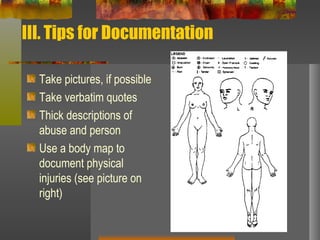
III. Tips for Documentation Take pictures, if possible Take verbatim quotes Thick descriptions of abuse and person Use a body map to document physical injuries (see picture on right)
III. Caring for Victims and Perpetrators Treatment for long-term physical and psychological effects Finding alternative coping strategies (e.g., spirituality, helping other victims) Preventing reoccurrence Batter’s Intervention Programs Substance Abuse Treatment Mutual-help groups Respite care for caretakers
III. Referral Resources Local  Coordinated Victim Assistance Center (CVAC) 2400 South Dixie Highway Miami, FL 33133-4309 (305) 285-5900 Victims Response, Inc/The Lodge  Hotline number: 305-693-0232 PO Box 470728  Miami, FL 33147  Admin Phone: 305-693-0499  Admin Fax: 305-542-4128  National National DV Hotline (800) 799-SAFE, TTY (800) 787-3224
III. Referal Resources National Center for Violence Prevention & Control, CDC:  http://www.cdc.gov/ncipc/dvp/dvp.htm The Family Violence Prevention Fund:  http://endabuse.org/resources/facts/ The World Health Organization:  http://www.who.int/topics/violence/en/ Florida Department of Children & Families:  http://www.myflorida.com/cf_web
References Centers for Disease Control & Prevention, CDC (2010). Intimate partner violence: Definitions. Retrieved on August, 8 2011, from  http://www.cdc.gov/violenceprevention/intimatepartnerviolence/definitions.html Department of Health & Human Services (2011). Affordable care act ensures women receive preventive services at no additional cost. Retreived on August 17, 2011, from  http://www.hhs.gov/news/press/2011pres/08/20110801b.html Eleventh Judicial Circuit of Florida,  http://www.jud11.flcourts.org Family Violence Prevention Fund, FVPF (2004). National consensus guidelines on identifying and responding to domestic violence in health care settings. FVPF: San Francisco, CA. Humphreys, J. & Campbell, J. (2010). Family Violence and Nursing Practice, 2nd Edition. New York, NY: Springer. Sheridan, D. J. & Nash, K. R. (2007). Acute Injury Patterns of Domestic Violence Victims. Trauma, Violence and Abuse, 8 (3), 281-289. Available at:  http://tva.sagepub.com/cgi/content/refs/8/3/281   Wrangle, J., Fisher, J. W. & Paranjape, A. (2008). He Sentido Sola? Culturally Competent Screening for Intimate Partner Violence in Latina Women. Journal of Women's Health, 17 (2), 261-267.

Dv training unit 4 10.18.11

  • 1.
    Unit 4: Rolesand Responsibilities of Nurses in Addressing Domestic Violence Rosa Maria Gonzalez-Guarda, PhD, MPH, RN, CPH Assistant Professor School of Nursing & Health Studies University of Miami [email_address]
  • 2.
    How do nursesaddress family violence? Prevention of domestic violence Screening for domestic violence Intervening if domestic violence is identified or suspected Helping clients develop a safety plan Reporting abuse Making referrals to other providers (e.g., mental health counselor) and community resources
  • 3.
    I. Prevention Educatingwomen, children & societies that violence is wrong Promoting healthy parent-child & partner relationships (e.g., enhancing communication) Promoting stress reduction, problem solving & skill development programs School-based programs targeting gender equality and healthy relationships Policies discouraging abuse and gender inequities
  • 4.
    II. Recommended Screeningfor Domestic Violence Screen female and male adolescents and adults, parents and caregivers Screening conducted by qualified and trained health care providers with established rapport with patients, including nurses In in-patient and out-patient health care settings such as primary care, emergency departments, family planning and women’s health clinics, mental health settings, pediatric settings (The Family Violence Prevention Fund, 2004) New guidelines for requiring complete insurance coverage, without co-pays, of DV screening and counseling as part of women’s health care (Department of Health & Human Services, 2011)
  • 5.
    II. Screening forAbuse Should: Screen male and female adolescents, adults, parents, and caregivers Be part of a routine assessment Be part of a face-to-face health care encounter Included in written or computer based questionnaires Inquire about current and lifetime victimization Be direct and nonjudgmental, using culturally appropriate language Take place in private Be confidential- make sure to disclose reporting requirements Use professional translator The Family Violence Prevention Fund, 1999
  • 6.
    II. Assessing forDanger/Risk for Homicide If abuse is identified, the severity and danger of that abuse needs to be assessed The Danger Assessment (Campbell, 1995, 2000)- Nurse developed screening tool to assess for risk of homicide www.dangerassessment.org The 5 most dangerous signs of abuse (in order) Partner used or threatened with a weapon Partner threatened to kill Partner tried to choke/strangle Partner violently and constantly jealous Forced sex (Campbell et al., 1995, 2000)
  • 7.
    III. Intervention Providevalidation of abuse and risk “ I am concerned for your safety”; “You are not alone” Provide information Respond to safety issue by assisting in safety planning (Slide 8) Referrals to local and national resources (Slide 13-14)
  • 8.
    III. The SafetyPlan Recognize that most dangerous period for a battered woman is when she is in the process of leaving Safety Plan: Cell phone with number to hotlines & contact information Pack emergency bag, copy of important documents, keys, hidden money, etc. Identify a Safe House to escape to Obtain restraining orders Collaborate with social workers, physicians, psychologist and others
  • 9.
    III. Mandatory Reportingfor Nurses Mandatory if suspected : Child Abuse IPV and Elder/Vulnerable adult (e.g., disabled) abuse Mandatory reporting in FL: Child & Elder/Vulnerable Adult needs to be reported IPV is not mandated unless Children are witnessing it- considered child abuse There are firearm injuries or life-threatening wounds Reporting suspected domestic violence without the informed consent of the woman is unethical and may cause the abuser to retaliate; however, if children are at risk, then it must be reported by law
  • 10.
    III. How toReport By phone (1-800-96ABUSE), fax or web ( http://state.fl.us/cf_web ) Be Prepared to Provide: Victim name, address or location, approximate age, race and sex; Physical, mental or behavioral indications that the person is infirm or disabled; Signs or indications of harm or injury, including a physical description if possible; Relationship of the alleged perpetrator to the victim, if possible. If the relationship is unknown, a report will still be taken if other reporting criteria are met.
  • 11.
    III. Tips forDocumentation Take pictures, if possible Take verbatim quotes Thick descriptions of abuse and person Use a body map to document physical injuries (see picture on right)
  • 12.
    III. Caring forVictims and Perpetrators Treatment for long-term physical and psychological effects Finding alternative coping strategies (e.g., spirituality, helping other victims) Preventing reoccurrence Batter’s Intervention Programs Substance Abuse Treatment Mutual-help groups Respite care for caretakers
  • 13.
    III. Referral ResourcesLocal Coordinated Victim Assistance Center (CVAC) 2400 South Dixie Highway Miami, FL 33133-4309 (305) 285-5900 Victims Response, Inc/The Lodge Hotline number: 305-693-0232 PO Box 470728 Miami, FL 33147 Admin Phone: 305-693-0499 Admin Fax: 305-542-4128 National National DV Hotline (800) 799-SAFE, TTY (800) 787-3224
  • 14.
    III. Referal ResourcesNational Center for Violence Prevention & Control, CDC: http://www.cdc.gov/ncipc/dvp/dvp.htm The Family Violence Prevention Fund: http://endabuse.org/resources/facts/ The World Health Organization: http://www.who.int/topics/violence/en/ Florida Department of Children & Families: http://www.myflorida.com/cf_web
  • 15.
    References Centers forDisease Control & Prevention, CDC (2010). Intimate partner violence: Definitions. Retrieved on August, 8 2011, from http://www.cdc.gov/violenceprevention/intimatepartnerviolence/definitions.html Department of Health & Human Services (2011). Affordable care act ensures women receive preventive services at no additional cost. Retreived on August 17, 2011, from http://www.hhs.gov/news/press/2011pres/08/20110801b.html Eleventh Judicial Circuit of Florida, http://www.jud11.flcourts.org Family Violence Prevention Fund, FVPF (2004). National consensus guidelines on identifying and responding to domestic violence in health care settings. FVPF: San Francisco, CA. Humphreys, J. & Campbell, J. (2010). Family Violence and Nursing Practice, 2nd Edition. New York, NY: Springer. Sheridan, D. J. & Nash, K. R. (2007). Acute Injury Patterns of Domestic Violence Victims. Trauma, Violence and Abuse, 8 (3), 281-289. Available at: http://tva.sagepub.com/cgi/content/refs/8/3/281 Wrangle, J., Fisher, J. W. & Paranjape, A. (2008). He Sentido Sola? Culturally Competent Screening for Intimate Partner Violence in Latina Women. Journal of Women's Health, 17 (2), 261-267.