Dr. Md. Rakibul Hoque
University of Dhaka
MIS
Disruptive and Emerging
Technology
Disruptive Technology
 Today’s innovative technology can become obsolete
tomorrow. What we have learned today or use may no
longer be useful in a decade or two. An innovation that
destroys another is known as ‘destructive innovation.’
 Learning the ever changing job related skills and know-
how is more important.
 According to PricewaterhouseCoopers (PwC) by 2030 many
corporations around the world will use drugs on their employees
to enhance productivity and may enhance their profitability by 24
per cent. Dunham Corp., a company that produces gifts in US
has increased their productivity by 4 per cent through
administering drugs on their employees.
Disruptive Technology
 Accordingly the World Bank, 47 per cent of our
degree holders are unemployed. In India it is 33 per
cent whereas in Sri Lanka it is 7.8 per cent. The
primary reason for this dismal picture is due to
degree centric education both in Bangladesh and
India. Acquiring work related skills is always a low
priority amongst the young generation. While the
‘educated’ unemployment rate is so high in
Bangladesh officially six hundred thousand
foreigners working in Bangladesh remit about six
billion dollars annually from Bangladesh.
Disruptive Technology
 Most of the foreign workers working in Bangladesh are in the
IT, RMG and service sector and come from India,
Pakistan, Sri Lanka, China, Korea, Nigeria, Nepal and
even Honduras and Columbia. Three million Filipinos remit
ninety billion dollars annually from outside the country as
they sell more of their skills unlike their Bangladeshi
counterparts who have only cheap labour to sell. A person
with the right type of skill will be in demand anywhere in the
world but demand for physical labour is constantly in the
wane due to use of artificial intelligence and IT related
technology. Driverless trains and cars are a reality.
Agriculture in most countries, including Bangladesh is being
mechanised at a faster speed as it is less costly.
Disruptive Technology
 A disruptive technology is one that
displaces an established technology and
shakes up the industry or a ground-
breaking product that creates a completely
new industry.
 Technologies with disruptive impact on
industries and businesses, rendering
existing products, services and business
model obsolete.
Disruptive Technology
 Disruptive technologies
 Technology that brings about sweeping
change to businesses, industries, markets
 Examples: personal computers, word
processing software, the Internet, the
PageRank algorithm
 First movers and fast followers
First movers—inventors of disruptive
technologies
Fast followers—firms with the size and
resources to capitalize on that technology
Disruptive Technology
 The personal computer (PC) displaced the
typewriter and forever changed the way we work
and communicate.
 The Windows operating system's combination of
affordability and a user-friendly interface was
instrumental in the rapid development of the personal
computing industry in the 1990s. Personal computing
disrupted the television industry, as well as a great
number of other activities.
 Email transformed the way we communicating,
largely displacing letter-writing and disrupting the
postal and greeting card industries.
Disruptive Technology
 Cell phones made it possible for people to call us
anywhere and disrupted the telecom industry.
 The laptop computer and mobile computing made a
mobile workforce possible and made it possible for
people to connect to corporate networks and
collaborate from anywhere. In many organizations,
laptops replaced desktops.
 Smartphones largely replaced cell phones and PDAs
and, because of the available apps, also disrupted:
pocket cameras, MP3 players, calculators and
GPS devices, among many other possibilities. For
some mobile users, smartphones often replace laptops.
Disruptive Technology
 Cloud computing has been a hugely disruptive
technology in the business world, displacing
many resources that would conventionally
have been located in-house or provided as a
traditionally hosted service.
 Social networking has had a major impact on
the way we communicate and -- especially for
personal use -- has disrupted telephone,
email, instant messaging and event planning.
10
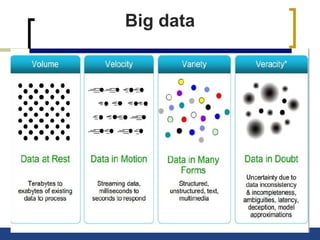
 Huge volumes of data which is in
-> Terabytes(1024 Gigabytes)
-> Petabytes(1024 Terabytes)
-> Exabytes(1024 Petabytes)
-> Zettabytes(1024 Exabytes)
-> Yottabytes(1024 Zettabytes)
-> Brontobytes(1024 yottabytes)
Big Data
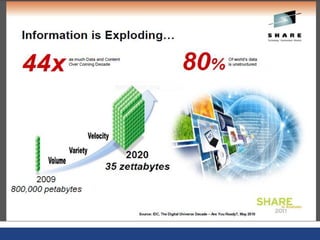
About 2.5 quintillion bytes of data are generated
every day and almost 90% of the global existing
data has been created during the past two years.
Data is growing faster than ever before and by the
year 2020, about 1.7 megabytes of new
information will be created every second for every
human being on the planet.
This volume of data equates to 2-hourlong HD
movies, which one person would need 47 million
years to watch in their entirety.
Big Data
 Every second we create new data. For example, we
perform 40,000 search queries every second
(on Google alone), which makes it 3.5 searches per
day and 1.2 trillion searches per year
 By 2020, nearly 85% of photos will be taken on
smart phones.
 Black Box Data: It is a component of helicopter,
airplanes, and jets, etc. It captures voices of the flight
crew, recordings of microphones and earphones,
and the performance information of the aircraft.
Big Data
Facebook users generating 90 pieces of
contents (notes, photos, link, stories,
posts), while 600 million active users of
social platform spent over 9.3 billion hours
a month on the site
Every minute 24 hours of video is
uploaded in YouTube
Big Data
Big Data is a collection of large and complex
data sets which are difficult to process using
common database management tools or
traditional data processing applications. The
US Congress defines big data as “a term that
describes large volumes of high velocity,
complex, and variable data that require
advanced techniques and technologies to
enable the capture, storage, distribution,
management, and analysis of the
information.”
Big Data
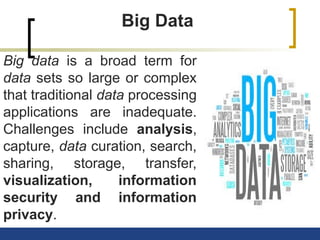
Big data is a broad term for
data sets so large or complex
that traditional data processing
applications are inadequate.
Challenges include analysis,
capture, data curation, search,
sharing, storage, transfer,
visualization, information
security and information
privacy.
Big data
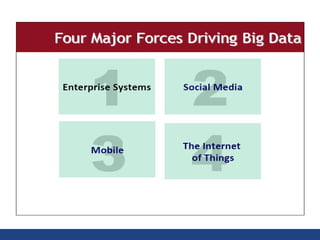
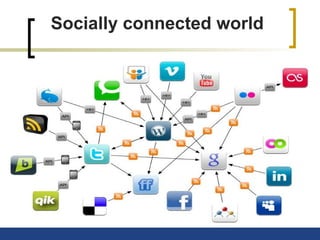
Socially connected world
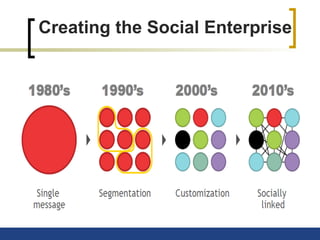
Creating the Social Enterprise
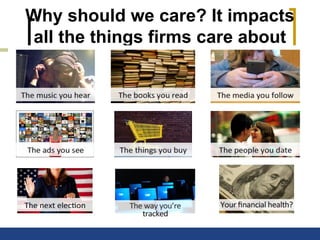
Why should we care? It impacts
all the things firms care about
Business Analytics from Social
Media: Social Listening
Big Data Analytics: Customer Insights via
Automated Text Mining
Product feature extraction from customer
comments
Sentiment analysis from customer comments
Linguistic style analysis of customer comments
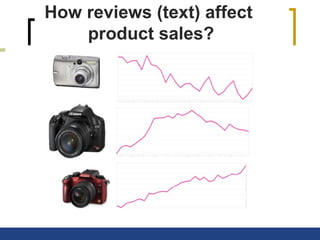
How reviews (text) affect
product sales?
Did you know?
Big Data Hits Real Life
http://www.nytimes.com/video/business/
100000002206849/big-data-hits-real-life.html
Big Data
 Almost 7 billion cell phones (6,800,000,000).
 The global smartphone audience surpassed 1.75
billion worldwide this year.
 Over half of mobile phone users globally will have
smartphones in 2019
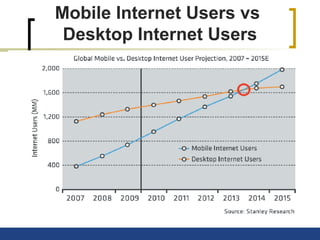
 Mobile internet user is forecasted to reach 71% by
2019
 There are 1 million apps available, which have been
downloaded more than 100 billion times.
 192 countries have active 3G mobile network
Mobile Internet Users vs
Desktop Internet Users
Huge Potential in Mobile
Advertising
The mobile device has become the central
control system in consumers‘ lives.”
Traditional BA focuses on "what happened".
Data science and big data analytics focuses
on "what will happen".
Explosion of Big Data
From Mobile
Consumers increasingly use mobile devices to locate
and buy products.
47% of users would provide their location to receive
relevant offers and discounts.
Total value of real-- time mobile location-- based
‐‑ ‐‑
advertising will grow from $1.66B in 2013 to $14.8B in
2018 (Berg Insight).
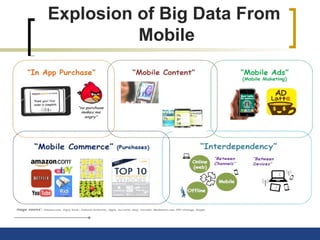
Explosion of Big Data From
Mobile
Mobile Marketing Analytics
Do you know where you will be 285 days from now at 2
pm?
We (data scientists) do!
Predictable in our movements.
Use Big Data to predict with very high accuracy the
correct location of individuals even months into the
future.
Used experiments to offer causal explanations into
human behavior and help enterprises with IT and
marketing strategies.
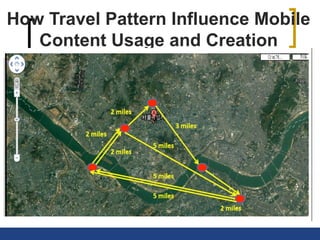
How Travel Pattern Influence Mobile
Content Usage and Creation
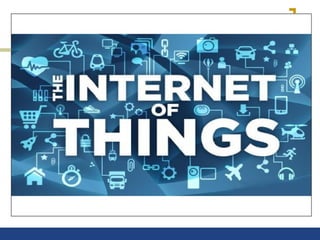
Internet of Things
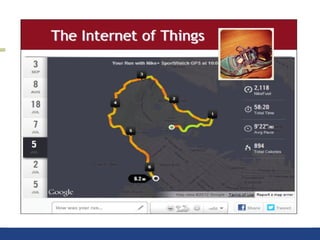
 The Internet of Things (IoT) is a scenario in
which objects, animals or people are provided
with unique identifiers and the ability to transfer
data over a network without requiring
human-to-human or human-to-computer
interaction.
 According to Gartner, Inc. (a technology
research and advisory corporation), there will
be nearly 26 billion devices on the Internet of
Things by 2020
Internet of Everything
Hopefully this will be the year where everything becomes
connected. Your Nest thermostat could connect with your
Fitbit or Apple Watch. Knowing that you're coming back from
an intense run on a hot day, it'll ensure you walk into a nice,
cool house. When you start to run low on Gatorade, your
smart fridge can alert Amazon's Alexa to order a new case.
If 2016 was the year that the Internet of Things became a
realistic goal, 2017 was the year that the Internet of
Everything starts to take over.
Automated Everything
 Uber has already started the trend, moving
toward driverless vehicles. In this upcoming
year, we'll likely see more and more menial
tasks shifted to automation. The technology
will continue to evolve so automation goes
beyond marketing and self-driving cars. We'll
see more practical in-home and in-office uses
of automation, boosting productivity by
allowing people to focus on big-picture ideas
instead of getting bogged down.
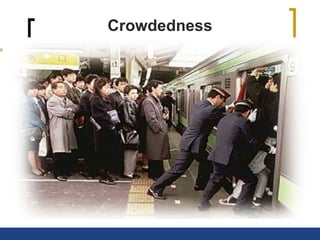
Crowdedness
Crowdsourcing
 Crowdsourcing is the process of obtaining needed
services, ideas, or content by soliciting contributions from
a large group of people, and especially from an online
community, rather than from traditional employees or
suppliers.
 Wikipedia – perhaps the pioneers of crowdsourcing. The
not-for-profit Wikipedia Foundation launched its free, web-
based, multilingual and collaborative encyclopaedia in
2001. It has over 17m articles written collaboratively by
the community and is the most popular reference site on
the internet.
Crowdsourcing
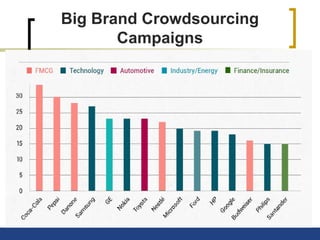
 Top brands like Pepsi, Coca-Cola and Oreo are turning to
the crowd. It’s not only the popular (and cheap) thing to do.
It’s good marketing.
 Last year Coke made a big splash when it announced that
it would shift it’s business model to be more open. Since
then the company has been working with customers to
enhance communications and even rely on consumers for
product development. Last year the company asked its 50
million fans on Facebook (at the time) to suggest an
invention, cause or social app that could spread happiness.
Crowdsourcing
 Starbucks – an ideas forum where
customers are invited to share, vote, discuss
and see – “You know better than anyone else
what you want from Starbucks. So tell us.
What’s your Starbucks Idea? Revolutionary
or simple – we want to hear it. Share your
ideas, tell us what you think of other people’s
ideas and join the discussion. We’re here,
and we’re ready to make ideas happen. Let’s
get started.”
Big Brand Crowdsourcing
Campaigns
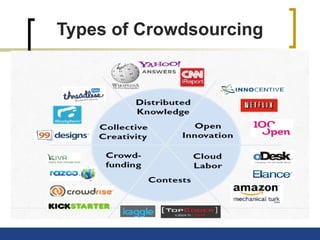
Types of Crowdsourcing
Crowdfunding
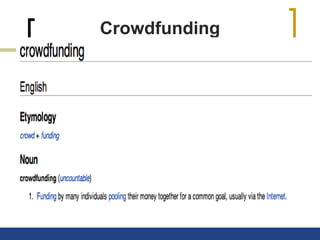
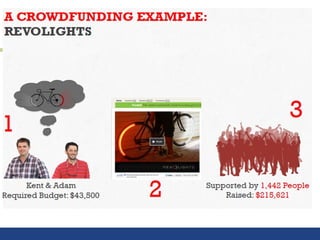
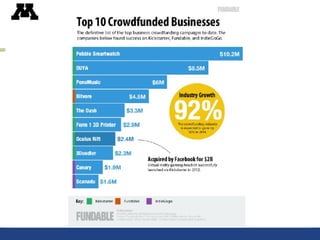
 Crowdfunding is the practice of funding a
project or venture by raising monetary
contributions from a large number of people,
typically via the internet.
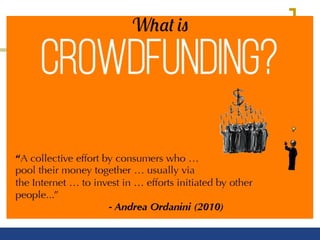
 A collective effort by consumers who network
and pool their money together, usually via
the Internet, in order to invest in and support
efforts initiated by other people or
organizations.
Crowdfunding
Smart City
 By 2030, roughly 66%, or 5 billion people will live in
urban areas. It is about 80% of the urban population in
Western and Industrialized countries. It is expected
that Asia and Africa will reach at 50% of urban
population by 2020 and 2035, respectively. The urban
life is consisting of various environmental hazards like,
lower level of sustainability, more energy consumption,
more population and more waste generation etc. This
not only represents a massive challenge in how we
build and manage cities but a significant opportunity to
improve the lives of billions of people.
Smart City
 Rising to that challenge, engineers worldwide are
turning to new technology such as the Cyber
‐
Physical Systems, 5G, AI and data analytics ‐
searching for new approaches and solutions that
will improve city transportation, water and waste
management, energy usage, and a host of other
infrastructure is sues that underpin the operation
of cities and the lifestyle of urban citizens. The city
should be “Smart” after practicing these ways
through smart programming and planning
management.
Smart City
 A smart city is an innovative city that uses
information and communication
technologies (ICTs) and other means to
improve quality of life, efficiency of urban
operation and services, and
competitiveness, while ensuring that it
meets the needs of present and future
generations with respect to economic,
social and environmental aspects.
Smart City
 A smart city is an urban area that uses
different types of electronic data collection
sensors to supply information which is
used to manage assets and resources
efficiently.
 A smart city may therefore be more
prepared to respond to challenges than
one with a simple "transactional"
relationship with its citizens.
Smart City
 Smart city as high-tech intensive and advanced
city that connects people, information, and
city elements using new technologies in order
to create a sustainable, greener city,
competitive and innovative commerce and
increased life quality.
 Smart city means using all available
technologies and resources, investing in human
and social capital for improving the quality of
life for everyone.
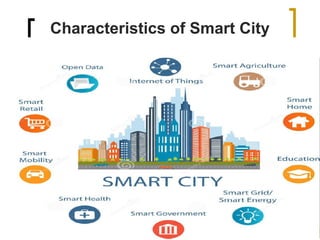
Characteristics of Smart City
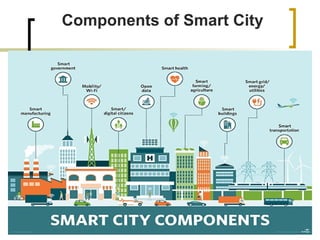
Components of Smart City
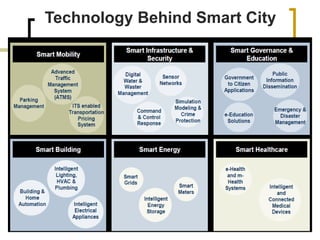
Technology Behind Smart City
 https://www.youtube.com/watch?
v=Br5aJa6MkBc
Technologies of Smart City
 Open-data initiatives: New York City's BigApps
competition, which produce useful and resource-
saving apps to improve cities and keep citizens
informed. Things like air quality, restaurant
sanitation scores, building inspection scores and
impending legislation should be readily available
for all citizens.
 Parking apps that show drivers where the nearest
available parking spot it. These will save
commuters time, gas, emissions and money, while
also easing the flow of traffic.
Technologies of Smart City
 Apps that let users "adopt" city property — trash cans,
call boxes, trees, fire hydrants, etc. — so the city doesn't
have to spend money sending personnel to tend to them.
Boston and Honolulu already have something similar in
place, through Code for America, and these projects
make citizens feel more invested in their neighborhood.
 High-tech waste management systems.
Pay As You Throw (PAYT) garbage disposal would
encourage people to recycle more and waste less,
while using tools like RFID could improve sorting so
recyclable plastic bottles don't end up in landfills.
Technologies of Smart City
 All-digital and easy-to-use parking payment systems — think
EZ-pass for parking. We don't want to put receipts on the
dashboard or be confined to time limits that make us run out
to put more coins in the meter (if you're going to keep money
meters, at least let us add money via an app). It's fine that
you charge for parking, but improve the system.
 A city guide app, with information about museums, parks,
landmarks, public art, restaurants and real-time traffic data.
These apps help citizens and tourists alike improve their
experience in the city.
Technologies of Smart City
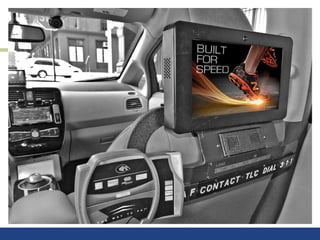
 Touchscreens around the city — whether it's a kiosk to buy a
MetroCard or the TVs in taxis — should be bacteria-resistant.
 Wi-Fi in subway stations and on trains, along with weather
information at every station.
 Sustainable and energy efficient residential and commercial
real estate.
 Dynamic kiosks that display real-time information, concerning
traffic, weather and local news, like Urbanflow in Helsinki.
 App or social media-based emergency alert and crisis
response systems — every citizen should have access to vital
information. Whether it's an alert about a crime that just
happened or advice for a storm approaching the city.
Technologies of Smart City
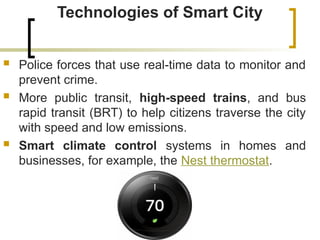
 Police forces that use real-time data to monitor and
prevent crime.
 More public transit, high-speed trains, and bus
rapid transit (BRT) to help citizens traverse the city
with speed and low emissions.
 Smart climate control systems in homes and
businesses, for example, the Nest thermostat.
Technologies of Smart City
Nest was one of the most famous and successful artificial
intelligence startups and it was acquired by Google in 2014 for
$3.2 billion. The Nest Learning Thermostat uses behavioral
algorithms to save energy based on your behavior and schedule.
It employs a very intelligent machine learning process that
learns the temperature you like and programs itself in about a
week. Moreover, it will automatically turn off to save energy, if
nobody is at home.
In fact, it is a combination of both – artificial intelligence as well
as Bluetooth low-energy.
Technologies of Smart City
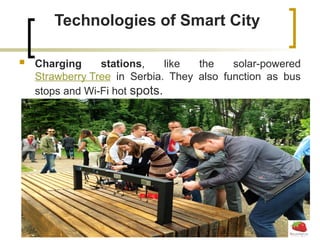
 Charging stations, like the solar-powered
Strawberry Tree in Serbia. They also function as bus
stops and Wi-Fi hot spots.
Technologies of Smart City
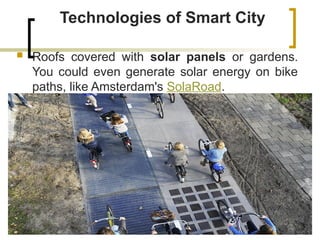
 Roofs covered with solar panels or gardens.
You could even generate solar energy on bike
paths, like Amsterdam's SolaRoad.
Technologies of Smart City
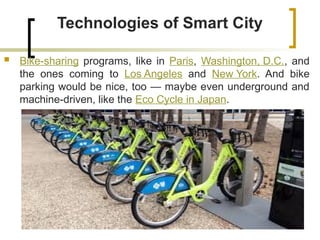
 Bike-sharing programs, like in Paris, Washington, D.C., and
the ones coming to Los Angeles and New York. And bike
parking would be nice, too — maybe even underground and
machine-driven, like the Eco Cycle in Japan.
Technologies of Smart City
 A sharing economy, instead of a buying
economy. If we share or rent from each
other, we each need to buy and store
fewer goods — think Rent the Runway,
Netflix, Airbnb. On a similar note, there
should be apps to help you find charities
that actually need the stuff you want to
toss, such as Zealous Good in Chicago.
Technologies of Smart City
 Airbnb is an American company which operates an
online marketplace and hospitality service for people
to lease or rent short-term lodging including
holiday cottages, apartments, homestays, hostel
beds, or hotel rooms, to participate in or facilitate
experiences related to tourism such as walking tours
, and to make reservations at restaurants. The
company does not own any real estate or conduct
tours; it is a broker which receives percentage
service fees in conjunction with every booking. Like
all hospitality services, Airbnb is an example of
collaborative consumption and sharing
Technologies of Smart City
 Netflix specializes in and provides streaming media
and video-on-demand online and DVD by mail. In
2013, Netflix expanded into film and
television production as well as online distribution.
 It is a widely popular content-on-demand service that
uses predictive technology to offer recommendations
on the basis of consumers’ reaction, interests,
choices, and behavior. The technology examines from
a number of records to recommend movies based on
your previous liking and reactions.
Technologies of Smart City
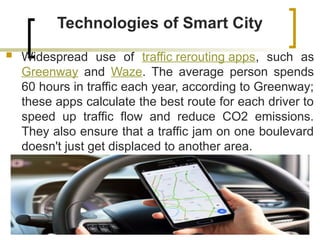
 Widespread use of traffic rerouting apps, such as
Greenway and Waze. The average person spends
60 hours in traffic each year, according to Greenway;
these apps calculate the best route for each driver to
speed up traffic flow and reduce CO2 emissions.
They also ensure that a traffic jam on one boulevard
doesn't just get displaced to another area.
Technologies of Smart City
 Water-recycling systems, because while
water covers 70% of the earth, we're not
preserving the resource the way we should.
 Crowdsourced urban planning, like
Brickstarter.
Brickstarter is a Finland-based
civic crowdfunding website. The site focuses
on crowdfunding urban renewal,
architectural and public art projects
Technologies of Smart City
 Broadband Internet access for all citizens —
maybe Google Fiber? — which will reduce
the digital divide and spur economic growth.
 Mobile payments. Everywhere. For food,
apparel and public transportation.
 Ride-sharing programs: Because it's a waste
of money and gas to have two cars go the
same place when neither is filled to capacity.
Uber, Pathao
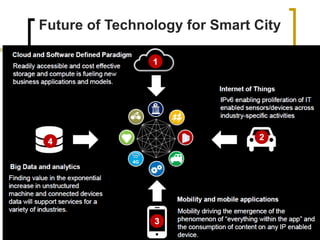
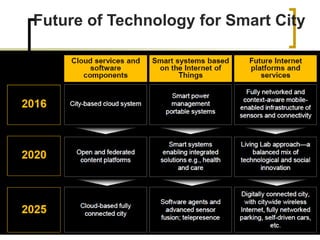
Future of Technology for Smart City
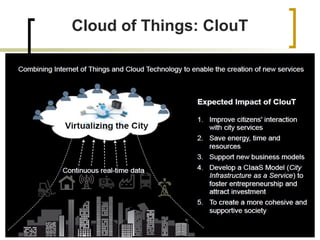
Cloud of Things: ClouT
 ClouT’s overall concept is leveraging the
Cloud Computing as an enabler to bridge the
Internet of Things with Internet of People via
Internet of Services, to establish an efficient
communication and collaboration platform
exploiting all possible information sources to
make the cities smarter and to help them
facing the emerging challenges such as
efficient energy management, economic
growth and development.
Future of Technology for Smart City
Smart Home
 A home equipped with lighting, heating, and
electronic devices that can be controlled remotely
by smartphone or computer.
 Smart Home" is the term commonly used to define a
residence that has appliances, lighting, heating, air
conditioning, TVs, computers, entertainment audio
& video systems, security, and camera systems that
are capable of communicating with one another and
can be controlled remotely by a time schedule, from
any room in the home, as well as remotely from any
location in the world by phone or internet.
Smart Home Devices
 Many smart home devices now include the ability
to learn your behavior patterns and help you save
money by adjusting the settings on your
thermostat or other appliances in an effort to
increase convenience and save energy. For
example, turning your oven on when you leave
work instead of waiting to get home is a very
convenient ability. A thermostat that knows when
you’re home and adjusts the temperature
accordingly can help you save money by not
heating the house when you’re out.
Smart Home Devices
 Lighting is another place where you might
see basic artificial intelligence; by setting
defaults and preferences, the lights around
your house (both inside and outside) might
adjust based on where you are and what
you’re doing; dimmer for watching TV,
brighter for cooking, and somewhere in the
middle for eating, for example. The uses of
AI in smart homes are limited only by our
imagination.
Artificial intelligence
 Artificial intelligence (AI) is an area of
computer science that emphasizes the
creation of intelligent machines that work
and react like humans. Some of the
activities computers with artificial
intelligence are designed for include:
 Speech recognition
 Learning
 Planning
 Problem solving
Artificial Intelligence
 Facebook CEO Mark Zuckerberg has already
showed us what is possible with artificial
intelligence, as he took this year to code a
virtual assistant for his house.
 While having AI make sure we turned the oven
off before we leave the house might be a couple
years away for most of us, there's no doubt the
technology will change our lives.
Gartner recently pointed to AI and machine
learning as two disruptive trends on 2017.
Artificial intelligence
 Artificial intelligence is the simulation of
human intelligence processes by machines,
especially computer systems. These
processes include learning (the acquisition
of information and rules for using the
information), reasoning (using the rules to
reach approximate or definite conclusions),
and self-correction. Particular applications
of AI include expert systems, speech
recognition and machine vision.
Types of artificial intelligence
 Type 1: Reactive machines. An example is Deep
Blue, the IBM chess program that beat Garry
Kasparov in the 1990s. Deep Blue can identify
pieces on the chess board and make predictions,
but it has no memory and cannot use past
experiences to inform future ones. It analyzes
possible moves -- its own and its opponent -- and
chooses the most strategic move. Deep Blue and
Google's AlphaGO were designed for narrow
purposes and cannot easily be applied to another
situation.
Types of artificial intelligence
 Type 2: Limited memory. These AI systems can use
past experiences to inform future decisions. Some of
the decision-making functions in autonomous vehicles
have been designed this way. Observations used to
inform actions happening in the not-so-distant future,
such as a car that has changed lanes. These
observations are not stored permanently.
 Type 3: Theory of mind. This is a psychology term. It
refers to the understanding that others have their own
beliefs, desires and intentions that impact the
decisions they make. This kind of AI does not yet exist.
Types of artificial intelligence
 Type 4: Self-awareness. In this
category, AI systems have a sense of
self, have consciousness. Machines with
self-awareness understand their current
state and can use the information to infer
what others are feeling. This type of AI
does not yet exist.
Examples of AI technology
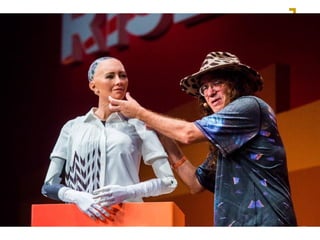
 Robotics is also a major field related to AI. Robots require
intelligence to handle tasks such as object manipulation
and navigation, along with sub-problems of localization,
motion planning and mapping.
 Robotics is an interdisciplinary branch of engineering
and science that includes mechanical engineering,
electrical engineering, computer science, and others.
Robotics deals with the design, construction, operation,
and use of robots, as well as computer systems for their
control, sensory feedback, and information processing.
 https://www.youtube.com/watch?
v=dMrX08PxUNY&feature=youtu.be
Examples of AI technology
 Machine learning is a type of artificial intelligence (AI)
that allows software applications to become more
accurate in predicting outcomes without being
explicitly programmed. The basic premise of machine
learning is to build algorithms that can receive input
data and use statistical analysis to predict an output
value within an acceptable range.
 Machine learning is a method of data analysis that
automates analytical model building. It is a branch of
artificial intelligence based on the idea that machines
should be able to learn and adapt through experience.
Examples of AI technology
 Machine Learning is the science of getting
computers to learn and act like humans do, and
improve their learning over time in autonomous
fashion, by feeding them data and information in the
form of observations and real-world interactions.”
 Machine learning is the science of getting a
computer to act without programming.
 Mathematical analysis of machine learning
algorithms and their performance is a well-defined
branch of theoretical computer science often referred
to as computational learning theory.
Examples of AI technology
 Machine learning algorithms are often categorized as being
supervised or unsupervised. Supervised algorithms require
humans to provide both input and desired output, in
addition to furnishing feedback about the accuracy of
predictions during training. Once training is complete, the
algorithm will apply what was learned to new data.
Unsupervised algorithms do not need to be trained with
desired outcome data. Instead, they use an iterative
approach called deep learning to review data and arrive at
conclusions. Unsupervised learning algorithms are used
for more complex processing tasks than supervised learning
systems.
Examples of AI technology
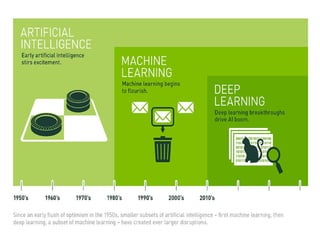
 Deep learning is a subset of machine learning
that, in very simple terms, can be thought of as
the automation of predictive analytics.
 Deep learning (also known as deep structured
learning or hierarchical learning) is part of a
broader family of machine learning methods
based on learning data representations, as
opposed to task-specific algorithms. Learning can
be supervised, semi-supervised or unsupervised.
Examples of AI technology
 The processes involved in machine learning are similar to
that of data mining and predictive modeling. Both require
searching through data to look for patterns and adjusting
program actions accordingly. Many people are familiar with
machine learning from shopping on the internet and being
served ads related to their purchase. This happens
because recommendation engines use machine learning to
personalize online ad delivery in almost real time. Beyond
personalized marketing, other common machine learning
use cases include fraud detection, spam filtering, network
security threat detection, predictive maintenance and
building news feeds.
Examples of AI technology
 Facebook's News Feed, for example, uses machine
learning to personalize each member's feed. If a
member frequently stops scrolling to read or "like" a
particular friend's posts, the News Feed will start to
show more of that friend's activity earlier in the feed.
Behind the scenes, the software is simply using
statistical analysis and predictive analytics to identify
patterns in the user's data and use those patterns to
populate the News Feed. Should the member no
longer stop to read, like or comment on the friend's
posts, that new data will be included in the data set
and the News Feed will adjust accordingly.
Examples of AI technology
 Artificial Intelligence (AI) and Machine Learning (ML)
are two very hot buzzwords right now, and often
seem to be used interchangeably.
 They are not quite the same thing, but the
perception that they are can sometimes lead to
some confusion. So I thought it would be worth
writing a piece to explain the difference.
 Both terms crop up very frequently when the topic is
Big Data, analytics, and the broader waves of
technological change which are sweeping through
our world.
Examples of AI technology
 In short, the best answer is that:
 Artificial Intelligence is the broader concept
of machines being able to carry out tasks in
a way that we would consider “smart”.
 And,
 Machine Learning is a current application of
AI based around the idea that we should
really just be able to give machines access
to data and let them learn for themselves.
AI applications
 AI in healthcare. The biggest bets are on improving patient
outcomes and reducing costs. Companies are applying
machine learning to make better and faster diagnoses than
humans. One of the best known healthcare technologies is
IBM Watson. It understands natural language and is capable
of responding to questions asked of it. The system mines
patient data and other available data sources to form a
hypothesis, which it then presents with a confidence scoring
schema. Other AI applications include chatbots, a computer
program used online to answer questions and assist
customers, to help schedule follow-up appointments or
aiding patients through the billing process, and virtual health
assistants that provide basic medical feedback.
AI applications
 AI in business. Robotic process automation is
being applied to highly repetitive tasks normally
performed by humans. Machine learning algorithms
are being integrated into analytics and CRM
platforms to uncover information on how to better
serve customers. Chatbots have been incorporated
into websites to provide immediate service to
customers. Automation of job positions has also
become a talking point among academics and IT
consultancies such as Gartner and Forrester.
AI applications
 AI in education. AI can automate grading, giving educators
more time. AI can assess students and adapt to their needs,
helping them work at their own pace. AI tutors can provide
additional support to students, ensuring they stay on track. AI
could change where and how students learn, perhaps even
replacing some teachers.
 AI in finance. AI applied to personal finance applications,
such as Mint or Turbo Tax, is upending financial institutions.
Applications such as these could collect personal data and
provide financial advice. Other programs, IBM Watson being
one, have been applied to the process of buying a home.
AI applications
 AI in law. The discovery process, sifting through of
documents, in law is often overwhelming for humans.
Automating this process is a better use of time and a more
efficient process. Startups are also building question-and-
answer computer assistants that can sift programmed-to-
answer questions by examining the taxonomy and ontology
associated with a database.
 AI in manufacturing. This is an area that has been at the
forefront of incorporating robots into the workflow. Industrial
robots used to perform single tasks and were separated from
human workers, but as the technology advanced that
changed.
AI applications
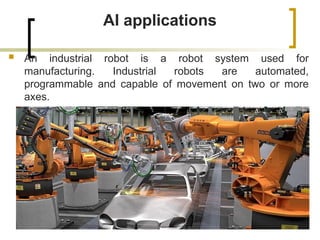
 An industrial robot is a robot system used for
manufacturing. Industrial robots are automated,
programmable and capable of movement on two or more
axes.
Virtual Personal Assistants
We know of Siri for iPhone, Cortana for Windows and Google Now
for Android, all of which are AIs who are our intelligent virtual
personal assistants. When we say load the latest news they do. To
listen to our favourite we just ask them to play it. They are
programmed to follow your instructions textual or voice or both and
based on inputs performs requisite tasks making them good examples
of AI in everyday use. In short, they help find useful information when
you ask for it using your voice; you can say “Where’s the nearest
Chinese restaurant?”, “What’s on my schedule today?”, “Remind
me to call Jerry at eight o’clock,” and the assistant will respond by
finding information, relaying information from your phone, or sending
commands to other apps.
Virtual Personal Assistants
 Siri is one of the most popular personal assistant offered by
Apple in iPhone and iPad. The friendly female voice-activated
assistant interacts with the user on a daily routine. She assists
us to find information, get directions, send messages, make
voice calls, open applications and add events to the calendar.
 Siri uses machine-learning technology in order to get smarter
and capable-to-understand natural language questions and
requests. It is surely one of the most iconic examples of
machine learning abilities of gadgets.
Virtual Personal Assistants
AI is important in these apps, as they collect information on
your requests and use that information to better recognize
your speech and serve you results that are tailored to your
preferences. Microsoft says that Cortana “continually
learns about its user” and that it will eventually develop the
ability to anticipate users’ needs. Virtual personal
assistants process a huge amount of data from a variety of
sources to learn about users and be more effective in
helping them organize and track their information.
Virtual Personal Assistants
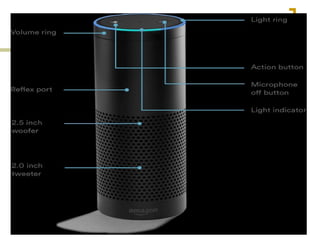
Echo was launched by Amazon, which is
getting smarter and adding new features. It is
a revolutionary product that can help you to
search the web for information, schedule
appointments, shop, control lights, switches,
thermostats, answers questions, reads
audiobooks, reports traffic and weather,
gives info on local businesses, provides sports
scores and schedules, and more using the
Alexa Voice Service.
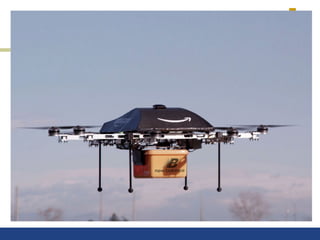
Flying Drones
The flying drones are already shipping products to customers
home – though on a test mode. They indicate a powerful
machine learning system that can translate the environment into
a 3D model through sensors and video cameras.
The sensors and cameras are able to notice the position of the
drones in the room by attaching them to the ceiling. Trajectory
generation algorithm guides the drone on how and where to
move. Using a Wi-Fi system, we can control the drones and use
them for specific purposes – product delivery, video-making, or
news reporting.
Industry 4.0
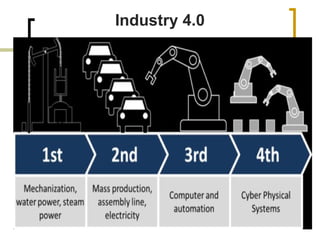
 Industry 4.0 is a name for the current trend of
automation and data exchange in manufacturing
technologies. It includes cyber-physical systems,
the Internet of things, cloud computing and
cognitive computing. Industry 4.0 is commonly
referred to as the fourth industrial revolution.
 A cyber-physical (also styled cyberphysical)
system (CPS) is a mechanism that is controlled or
monitored by computer-based algorithms, tightly
integrated with the Internet and its users.
Industry 4.0
FinTech
 FinTech is a computer programs and other
technology used to support or enable
banking and financial services. "fintech is
one of the fastest-growing areas for venture
capitalists"
 Financial technology (FinTech or fintech) is
the new technology and innovation that
aims to compete with traditional financial
methods in the delivery of financial
services.
Blockchain
 This is a distributed ledger technology that makes Bitcoin,
Stellar (Lumens), Ethereum, and others possible by
providing a record of transactions and confirming who
has what at any given moment. Its security is assured by
the sophisticated cryptographic processes. The
immediate impact of blockchain technology may not be
clear for the non-technological eye, however it will
certainly improve existing systems within society at large.
 Blockchain is the world's leading software platform for
digital assets. Offering the largest production block chain
platform in the world
Bitcoin
 Bitcoin is a cryptocurrency and worldwide
payment system. It is the first
decentralized digital currency, as the
system works without a central bank or
single administrator. A global network of
computers uses blockchain technology
to jointly manage the database that
records Bitcoin transactions. That is,
Bitcoin is managed by its network, and not
any one central authority.
Bitcoin
 Bitcoin is a digital currency created in 2009. It
follows the ideas set out in a white paper by the
mysterious Satoshi Nakamoto, whose true identity
has yet to be verified. Bitcoin offers the promise of
lower transaction fees than traditional online
payment mechanisms and is operated by a
decentralized authority, unlike government-issued
currencies. Today's market cap for all bitcoin
(abbreviated BTC or, less frequently, XBT) in
circulation exceeds $7 billion.
Recommendation System
 A recommender system or a recommendation system is a
subclass of information filtering system that seeks to predict
the "rating" or "preference" a user would give to an item.
 It is a tool that lets algorithm developers predict what a user
may or may not like among a list of given items.
Recommendation engines are a pretty interesting alternative
to search fields, as recommendation engines help users
discover products or content that they may not come across
otherwise. This makes recommendation engines a great part
of web sites and services such as Facebook, YouTube,
Amazon, and more.
Li-Fi
 Li-Fi is a short form of light fidelity. It is a new
technology for transmitting data from one device to
another device. Li-Fi technology uses light to
transmit data between devises instead of radio
frequency like Wi-Fi. In technical terms, Li-Fi is a
visible light communications system that is capable
of transmitting data at high speeds over the visible
light spectrum, ultraviolet and infrared radiation.
 The end use “Li-Fi” technology is similar to Wi- Fi
technology.
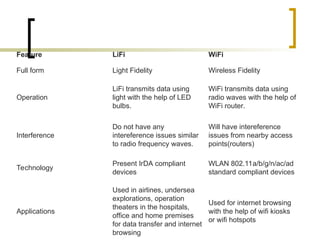
Feature LiFi WiFi
Full form Light Fidelity Wireless Fidelity
Operation
LiFi transmits data using
light with the help of LED
bulbs.
WiFi transmits data using
radio waves with the help of
WiFi router.
Interference
Do not have any
intereference issues similar
to radio frequency waves.
Will have intereference
issues from nearby access
points(routers)
Technology
Present IrDA compliant
devices
WLAN 802.11a/b/g/n/ac/ad
standard compliant devices
Applications
Used in airlines, undersea
explorations, operation
theaters in the hospitals,
office and home premises
for data transfer and internet
browsing
Used for internet browsing
with the help of wifi kiosks
or wifi hotspots
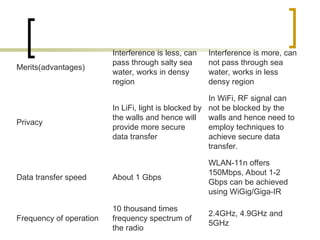
Merits(advantages)
Interference is less, can
pass through salty sea
water, works in densy
region
Interference is more, can
not pass through sea
water, works in less
densy region
Privacy
In LiFi, light is blocked by
the walls and hence will
provide more secure
data transfer
In WiFi, RF signal can
not be blocked by the
walls and hence need to
employ techniques to
achieve secure data
transfer.
Data transfer speed About 1 Gbps
WLAN-11n offers
150Mbps, About 1-2
Gbps can be achieved
using WiGig/Giga-IR
Frequency of operation
10 thousand times
frequency spectrum of
the radio
2.4GHz, 4.9GHz and
5GHz
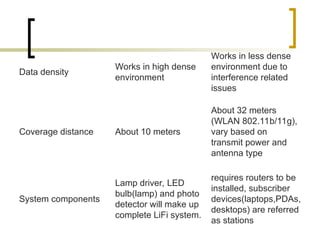
Data density
Works in high dense
environment
Works in less dense
environment due to
interference related
issues
Coverage distance About 10 meters
About 32 meters
(WLAN 802.11b/11g),
vary based on
transmit power and
antenna type
System components
Lamp driver, LED
bulb(lamp) and photo
detector will make up
complete LiFi system.
requires routers to be
installed, subscriber
devices(laptops,PDAs,
desktops) are referred
as stations
Thank
You

DU Disruptive and Recent Technology.ppt

  • 1.
    Dr. Md. RakibulHoque University of Dhaka MIS Disruptive and Emerging Technology
  • 2.
    Disruptive Technology  Today’sinnovative technology can become obsolete tomorrow. What we have learned today or use may no longer be useful in a decade or two. An innovation that destroys another is known as ‘destructive innovation.’  Learning the ever changing job related skills and know- how is more important.  According to PricewaterhouseCoopers (PwC) by 2030 many corporations around the world will use drugs on their employees to enhance productivity and may enhance their profitability by 24 per cent. Dunham Corp., a company that produces gifts in US has increased their productivity by 4 per cent through administering drugs on their employees.
  • 3.
    Disruptive Technology  Accordinglythe World Bank, 47 per cent of our degree holders are unemployed. In India it is 33 per cent whereas in Sri Lanka it is 7.8 per cent. The primary reason for this dismal picture is due to degree centric education both in Bangladesh and India. Acquiring work related skills is always a low priority amongst the young generation. While the ‘educated’ unemployment rate is so high in Bangladesh officially six hundred thousand foreigners working in Bangladesh remit about six billion dollars annually from Bangladesh.
  • 4.
    Disruptive Technology  Mostof the foreign workers working in Bangladesh are in the IT, RMG and service sector and come from India, Pakistan, Sri Lanka, China, Korea, Nigeria, Nepal and even Honduras and Columbia. Three million Filipinos remit ninety billion dollars annually from outside the country as they sell more of their skills unlike their Bangladeshi counterparts who have only cheap labour to sell. A person with the right type of skill will be in demand anywhere in the world but demand for physical labour is constantly in the wane due to use of artificial intelligence and IT related technology. Driverless trains and cars are a reality. Agriculture in most countries, including Bangladesh is being mechanised at a faster speed as it is less costly.
  • 5.
    Disruptive Technology  Adisruptive technology is one that displaces an established technology and shakes up the industry or a ground- breaking product that creates a completely new industry.  Technologies with disruptive impact on industries and businesses, rendering existing products, services and business model obsolete.
  • 6.
    Disruptive Technology  Disruptivetechnologies  Technology that brings about sweeping change to businesses, industries, markets  Examples: personal computers, word processing software, the Internet, the PageRank algorithm  First movers and fast followers First movers—inventors of disruptive technologies Fast followers—firms with the size and resources to capitalize on that technology
  • 7.
    Disruptive Technology  Thepersonal computer (PC) displaced the typewriter and forever changed the way we work and communicate.  The Windows operating system's combination of affordability and a user-friendly interface was instrumental in the rapid development of the personal computing industry in the 1990s. Personal computing disrupted the television industry, as well as a great number of other activities.  Email transformed the way we communicating, largely displacing letter-writing and disrupting the postal and greeting card industries.
  • 8.
    Disruptive Technology  Cellphones made it possible for people to call us anywhere and disrupted the telecom industry.  The laptop computer and mobile computing made a mobile workforce possible and made it possible for people to connect to corporate networks and collaborate from anywhere. In many organizations, laptops replaced desktops.  Smartphones largely replaced cell phones and PDAs and, because of the available apps, also disrupted: pocket cameras, MP3 players, calculators and GPS devices, among many other possibilities. For some mobile users, smartphones often replace laptops.
  • 9.
    Disruptive Technology  Cloudcomputing has been a hugely disruptive technology in the business world, displacing many resources that would conventionally have been located in-house or provided as a traditionally hosted service.  Social networking has had a major impact on the way we communicate and -- especially for personal use -- has disrupted telephone, email, instant messaging and event planning.
  • 10.
  • 11.
     Huge volumesof data which is in -> Terabytes(1024 Gigabytes) -> Petabytes(1024 Terabytes) -> Exabytes(1024 Petabytes) -> Zettabytes(1024 Exabytes) -> Yottabytes(1024 Zettabytes) -> Brontobytes(1024 yottabytes)
  • 12.
    Big Data About 2.5quintillion bytes of data are generated every day and almost 90% of the global existing data has been created during the past two years. Data is growing faster than ever before and by the year 2020, about 1.7 megabytes of new information will be created every second for every human being on the planet. This volume of data equates to 2-hourlong HD movies, which one person would need 47 million years to watch in their entirety.
  • 13.
    Big Data  Everysecond we create new data. For example, we perform 40,000 search queries every second (on Google alone), which makes it 3.5 searches per day and 1.2 trillion searches per year  By 2020, nearly 85% of photos will be taken on smart phones.  Black Box Data: It is a component of helicopter, airplanes, and jets, etc. It captures voices of the flight crew, recordings of microphones and earphones, and the performance information of the aircraft.
  • 14.
    Big Data Facebook usersgenerating 90 pieces of contents (notes, photos, link, stories, posts), while 600 million active users of social platform spent over 9.3 billion hours a month on the site Every minute 24 hours of video is uploaded in YouTube
  • 16.
    Big Data Big Datais a collection of large and complex data sets which are difficult to process using common database management tools or traditional data processing applications. The US Congress defines big data as “a term that describes large volumes of high velocity, complex, and variable data that require advanced techniques and technologies to enable the capture, storage, distribution, management, and analysis of the information.”
  • 17.
    Big Data Big datais a broad term for data sets so large or complex that traditional data processing applications are inadequate. Challenges include analysis, capture, data curation, search, sharing, storage, transfer, visualization, information security and information privacy.
  • 18.
  • 28.
  • 29.
  • 30.
    Why should wecare? It impacts all the things firms care about
  • 31.
    Business Analytics fromSocial Media: Social Listening Big Data Analytics: Customer Insights via Automated Text Mining Product feature extraction from customer comments Sentiment analysis from customer comments Linguistic style analysis of customer comments
  • 32.
    How reviews (text)affect product sales?
  • 33.
    Did you know? BigData Hits Real Life http://www.nytimes.com/video/business/ 100000002206849/big-data-hits-real-life.html
  • 34.
    Big Data  Almost7 billion cell phones (6,800,000,000).  The global smartphone audience surpassed 1.75 billion worldwide this year.  Over half of mobile phone users globally will have smartphones in 2019  Mobile internet user is forecasted to reach 71% by 2019  There are 1 million apps available, which have been downloaded more than 100 billion times.  192 countries have active 3G mobile network
  • 37.
    Mobile Internet Usersvs Desktop Internet Users
  • 39.
    Huge Potential inMobile Advertising The mobile device has become the central control system in consumers‘ lives.” Traditional BA focuses on "what happened". Data science and big data analytics focuses on "what will happen".
  • 40.
    Explosion of BigData From Mobile Consumers increasingly use mobile devices to locate and buy products. 47% of users would provide their location to receive relevant offers and discounts. Total value of real-- time mobile location-- based ‐‑ ‐‑ advertising will grow from $1.66B in 2013 to $14.8B in 2018 (Berg Insight).
  • 42.
    Explosion of BigData From Mobile
  • 43.
    Mobile Marketing Analytics Doyou know where you will be 285 days from now at 2 pm? We (data scientists) do! Predictable in our movements. Use Big Data to predict with very high accuracy the correct location of individuals even months into the future. Used experiments to offer causal explanations into human behavior and help enterprises with IT and marketing strategies.
  • 44.
    How Travel PatternInfluence Mobile Content Usage and Creation
  • 46.
    Internet of Things The Internet of Things (IoT) is a scenario in which objects, animals or people are provided with unique identifiers and the ability to transfer data over a network without requiring human-to-human or human-to-computer interaction.  According to Gartner, Inc. (a technology research and advisory corporation), there will be nearly 26 billion devices on the Internet of Things by 2020
  • 55.
    Internet of Everything Hopefullythis will be the year where everything becomes connected. Your Nest thermostat could connect with your Fitbit or Apple Watch. Knowing that you're coming back from an intense run on a hot day, it'll ensure you walk into a nice, cool house. When you start to run low on Gatorade, your smart fridge can alert Amazon's Alexa to order a new case. If 2016 was the year that the Internet of Things became a realistic goal, 2017 was the year that the Internet of Everything starts to take over.
  • 56.
    Automated Everything  Uberhas already started the trend, moving toward driverless vehicles. In this upcoming year, we'll likely see more and more menial tasks shifted to automation. The technology will continue to evolve so automation goes beyond marketing and self-driving cars. We'll see more practical in-home and in-office uses of automation, boosting productivity by allowing people to focus on big-picture ideas instead of getting bogged down.
  • 57.
  • 58.
    Crowdsourcing  Crowdsourcing isthe process of obtaining needed services, ideas, or content by soliciting contributions from a large group of people, and especially from an online community, rather than from traditional employees or suppliers.  Wikipedia – perhaps the pioneers of crowdsourcing. The not-for-profit Wikipedia Foundation launched its free, web- based, multilingual and collaborative encyclopaedia in 2001. It has over 17m articles written collaboratively by the community and is the most popular reference site on the internet.
  • 59.
    Crowdsourcing  Top brandslike Pepsi, Coca-Cola and Oreo are turning to the crowd. It’s not only the popular (and cheap) thing to do. It’s good marketing.  Last year Coke made a big splash when it announced that it would shift it’s business model to be more open. Since then the company has been working with customers to enhance communications and even rely on consumers for product development. Last year the company asked its 50 million fans on Facebook (at the time) to suggest an invention, cause or social app that could spread happiness.
  • 60.
    Crowdsourcing  Starbucks –an ideas forum where customers are invited to share, vote, discuss and see – “You know better than anyone else what you want from Starbucks. So tell us. What’s your Starbucks Idea? Revolutionary or simple – we want to hear it. Share your ideas, tell us what you think of other people’s ideas and join the discussion. We’re here, and we’re ready to make ideas happen. Let’s get started.”
  • 61.
  • 62.
  • 63.
    Crowdfunding  Crowdfunding isthe practice of funding a project or venture by raising monetary contributions from a large number of people, typically via the internet.  A collective effort by consumers who network and pool their money together, usually via the Internet, in order to invest in and support efforts initiated by other people or organizations.
  • 64.
  • 71.
    Smart City  By2030, roughly 66%, or 5 billion people will live in urban areas. It is about 80% of the urban population in Western and Industrialized countries. It is expected that Asia and Africa will reach at 50% of urban population by 2020 and 2035, respectively. The urban life is consisting of various environmental hazards like, lower level of sustainability, more energy consumption, more population and more waste generation etc. This not only represents a massive challenge in how we build and manage cities but a significant opportunity to improve the lives of billions of people.
  • 72.
    Smart City  Risingto that challenge, engineers worldwide are turning to new technology such as the Cyber ‐ Physical Systems, 5G, AI and data analytics ‐ searching for new approaches and solutions that will improve city transportation, water and waste management, energy usage, and a host of other infrastructure is sues that underpin the operation of cities and the lifestyle of urban citizens. The city should be “Smart” after practicing these ways through smart programming and planning management.
  • 73.
    Smart City  Asmart city is an innovative city that uses information and communication technologies (ICTs) and other means to improve quality of life, efficiency of urban operation and services, and competitiveness, while ensuring that it meets the needs of present and future generations with respect to economic, social and environmental aspects.
  • 74.
    Smart City  Asmart city is an urban area that uses different types of electronic data collection sensors to supply information which is used to manage assets and resources efficiently.  A smart city may therefore be more prepared to respond to challenges than one with a simple "transactional" relationship with its citizens.
  • 75.
    Smart City  Smartcity as high-tech intensive and advanced city that connects people, information, and city elements using new technologies in order to create a sustainable, greener city, competitive and innovative commerce and increased life quality.  Smart city means using all available technologies and resources, investing in human and social capital for improving the quality of life for everyone.
  • 76.
  • 77.
  • 78.
  • 79.
  • 80.
    Technologies of SmartCity  Open-data initiatives: New York City's BigApps competition, which produce useful and resource- saving apps to improve cities and keep citizens informed. Things like air quality, restaurant sanitation scores, building inspection scores and impending legislation should be readily available for all citizens.  Parking apps that show drivers where the nearest available parking spot it. These will save commuters time, gas, emissions and money, while also easing the flow of traffic.
  • 81.
    Technologies of SmartCity  Apps that let users "adopt" city property — trash cans, call boxes, trees, fire hydrants, etc. — so the city doesn't have to spend money sending personnel to tend to them. Boston and Honolulu already have something similar in place, through Code for America, and these projects make citizens feel more invested in their neighborhood.  High-tech waste management systems. Pay As You Throw (PAYT) garbage disposal would encourage people to recycle more and waste less, while using tools like RFID could improve sorting so recyclable plastic bottles don't end up in landfills.
  • 82.
    Technologies of SmartCity  All-digital and easy-to-use parking payment systems — think EZ-pass for parking. We don't want to put receipts on the dashboard or be confined to time limits that make us run out to put more coins in the meter (if you're going to keep money meters, at least let us add money via an app). It's fine that you charge for parking, but improve the system.  A city guide app, with information about museums, parks, landmarks, public art, restaurants and real-time traffic data. These apps help citizens and tourists alike improve their experience in the city.
  • 83.
    Technologies of SmartCity  Touchscreens around the city — whether it's a kiosk to buy a MetroCard or the TVs in taxis — should be bacteria-resistant.  Wi-Fi in subway stations and on trains, along with weather information at every station.  Sustainable and energy efficient residential and commercial real estate.  Dynamic kiosks that display real-time information, concerning traffic, weather and local news, like Urbanflow in Helsinki.  App or social media-based emergency alert and crisis response systems — every citizen should have access to vital information. Whether it's an alert about a crime that just happened or advice for a storm approaching the city.
  • 84.
    Technologies of SmartCity  Police forces that use real-time data to monitor and prevent crime.  More public transit, high-speed trains, and bus rapid transit (BRT) to help citizens traverse the city with speed and low emissions.  Smart climate control systems in homes and businesses, for example, the Nest thermostat.
  • 85.
    Technologies of SmartCity Nest was one of the most famous and successful artificial intelligence startups and it was acquired by Google in 2014 for $3.2 billion. The Nest Learning Thermostat uses behavioral algorithms to save energy based on your behavior and schedule. It employs a very intelligent machine learning process that learns the temperature you like and programs itself in about a week. Moreover, it will automatically turn off to save energy, if nobody is at home. In fact, it is a combination of both – artificial intelligence as well as Bluetooth low-energy.
  • 86.
    Technologies of SmartCity  Charging stations, like the solar-powered Strawberry Tree in Serbia. They also function as bus stops and Wi-Fi hot spots.
  • 87.
    Technologies of SmartCity  Roofs covered with solar panels or gardens. You could even generate solar energy on bike paths, like Amsterdam's SolaRoad.
  • 88.
    Technologies of SmartCity  Bike-sharing programs, like in Paris, Washington, D.C., and the ones coming to Los Angeles and New York. And bike parking would be nice, too — maybe even underground and machine-driven, like the Eco Cycle in Japan.
  • 89.
    Technologies of SmartCity  A sharing economy, instead of a buying economy. If we share or rent from each other, we each need to buy and store fewer goods — think Rent the Runway, Netflix, Airbnb. On a similar note, there should be apps to help you find charities that actually need the stuff you want to toss, such as Zealous Good in Chicago.
  • 90.
    Technologies of SmartCity  Airbnb is an American company which operates an online marketplace and hospitality service for people to lease or rent short-term lodging including holiday cottages, apartments, homestays, hostel beds, or hotel rooms, to participate in or facilitate experiences related to tourism such as walking tours , and to make reservations at restaurants. The company does not own any real estate or conduct tours; it is a broker which receives percentage service fees in conjunction with every booking. Like all hospitality services, Airbnb is an example of collaborative consumption and sharing
  • 91.
    Technologies of SmartCity  Netflix specializes in and provides streaming media and video-on-demand online and DVD by mail. In 2013, Netflix expanded into film and television production as well as online distribution.  It is a widely popular content-on-demand service that uses predictive technology to offer recommendations on the basis of consumers’ reaction, interests, choices, and behavior. The technology examines from a number of records to recommend movies based on your previous liking and reactions.
  • 92.
    Technologies of SmartCity  Widespread use of traffic rerouting apps, such as Greenway and Waze. The average person spends 60 hours in traffic each year, according to Greenway; these apps calculate the best route for each driver to speed up traffic flow and reduce CO2 emissions. They also ensure that a traffic jam on one boulevard doesn't just get displaced to another area.
  • 93.
    Technologies of SmartCity  Water-recycling systems, because while water covers 70% of the earth, we're not preserving the resource the way we should.  Crowdsourced urban planning, like Brickstarter. Brickstarter is a Finland-based civic crowdfunding website. The site focuses on crowdfunding urban renewal, architectural and public art projects
  • 94.
    Technologies of SmartCity  Broadband Internet access for all citizens — maybe Google Fiber? — which will reduce the digital divide and spur economic growth.  Mobile payments. Everywhere. For food, apparel and public transportation.  Ride-sharing programs: Because it's a waste of money and gas to have two cars go the same place when neither is filled to capacity. Uber, Pathao
  • 95.
    Future of Technologyfor Smart City
  • 96.
  • 97.
    Cloud of Things:ClouT  ClouT’s overall concept is leveraging the Cloud Computing as an enabler to bridge the Internet of Things with Internet of People via Internet of Services, to establish an efficient communication and collaboration platform exploiting all possible information sources to make the cities smarter and to help them facing the emerging challenges such as efficient energy management, economic growth and development.
  • 98.
    Future of Technologyfor Smart City
  • 99.
    Smart Home  Ahome equipped with lighting, heating, and electronic devices that can be controlled remotely by smartphone or computer.  Smart Home" is the term commonly used to define a residence that has appliances, lighting, heating, air conditioning, TVs, computers, entertainment audio & video systems, security, and camera systems that are capable of communicating with one another and can be controlled remotely by a time schedule, from any room in the home, as well as remotely from any location in the world by phone or internet.
  • 100.
    Smart Home Devices Many smart home devices now include the ability to learn your behavior patterns and help you save money by adjusting the settings on your thermostat or other appliances in an effort to increase convenience and save energy. For example, turning your oven on when you leave work instead of waiting to get home is a very convenient ability. A thermostat that knows when you’re home and adjusts the temperature accordingly can help you save money by not heating the house when you’re out.
  • 101.
    Smart Home Devices Lighting is another place where you might see basic artificial intelligence; by setting defaults and preferences, the lights around your house (both inside and outside) might adjust based on where you are and what you’re doing; dimmer for watching TV, brighter for cooking, and somewhere in the middle for eating, for example. The uses of AI in smart homes are limited only by our imagination.
  • 102.
    Artificial intelligence  Artificialintelligence (AI) is an area of computer science that emphasizes the creation of intelligent machines that work and react like humans. Some of the activities computers with artificial intelligence are designed for include:  Speech recognition  Learning  Planning  Problem solving
  • 103.
    Artificial Intelligence  FacebookCEO Mark Zuckerberg has already showed us what is possible with artificial intelligence, as he took this year to code a virtual assistant for his house.  While having AI make sure we turned the oven off before we leave the house might be a couple years away for most of us, there's no doubt the technology will change our lives. Gartner recently pointed to AI and machine learning as two disruptive trends on 2017.
  • 104.
    Artificial intelligence  Artificialintelligence is the simulation of human intelligence processes by machines, especially computer systems. These processes include learning (the acquisition of information and rules for using the information), reasoning (using the rules to reach approximate or definite conclusions), and self-correction. Particular applications of AI include expert systems, speech recognition and machine vision.
  • 105.
    Types of artificialintelligence  Type 1: Reactive machines. An example is Deep Blue, the IBM chess program that beat Garry Kasparov in the 1990s. Deep Blue can identify pieces on the chess board and make predictions, but it has no memory and cannot use past experiences to inform future ones. It analyzes possible moves -- its own and its opponent -- and chooses the most strategic move. Deep Blue and Google's AlphaGO were designed for narrow purposes and cannot easily be applied to another situation.
  • 106.
    Types of artificialintelligence  Type 2: Limited memory. These AI systems can use past experiences to inform future decisions. Some of the decision-making functions in autonomous vehicles have been designed this way. Observations used to inform actions happening in the not-so-distant future, such as a car that has changed lanes. These observations are not stored permanently.  Type 3: Theory of mind. This is a psychology term. It refers to the understanding that others have their own beliefs, desires and intentions that impact the decisions they make. This kind of AI does not yet exist.
  • 107.
    Types of artificialintelligence  Type 4: Self-awareness. In this category, AI systems have a sense of self, have consciousness. Machines with self-awareness understand their current state and can use the information to infer what others are feeling. This type of AI does not yet exist.
  • 108.
    Examples of AItechnology  Robotics is also a major field related to AI. Robots require intelligence to handle tasks such as object manipulation and navigation, along with sub-problems of localization, motion planning and mapping.  Robotics is an interdisciplinary branch of engineering and science that includes mechanical engineering, electrical engineering, computer science, and others. Robotics deals with the design, construction, operation, and use of robots, as well as computer systems for their control, sensory feedback, and information processing.
  • 110.
  • 111.
    Examples of AItechnology  Machine learning is a type of artificial intelligence (AI) that allows software applications to become more accurate in predicting outcomes without being explicitly programmed. The basic premise of machine learning is to build algorithms that can receive input data and use statistical analysis to predict an output value within an acceptable range.  Machine learning is a method of data analysis that automates analytical model building. It is a branch of artificial intelligence based on the idea that machines should be able to learn and adapt through experience.
  • 112.
    Examples of AItechnology  Machine Learning is the science of getting computers to learn and act like humans do, and improve their learning over time in autonomous fashion, by feeding them data and information in the form of observations and real-world interactions.”  Machine learning is the science of getting a computer to act without programming.  Mathematical analysis of machine learning algorithms and their performance is a well-defined branch of theoretical computer science often referred to as computational learning theory.
  • 113.
    Examples of AItechnology  Machine learning algorithms are often categorized as being supervised or unsupervised. Supervised algorithms require humans to provide both input and desired output, in addition to furnishing feedback about the accuracy of predictions during training. Once training is complete, the algorithm will apply what was learned to new data. Unsupervised algorithms do not need to be trained with desired outcome data. Instead, they use an iterative approach called deep learning to review data and arrive at conclusions. Unsupervised learning algorithms are used for more complex processing tasks than supervised learning systems.
  • 114.
    Examples of AItechnology  Deep learning is a subset of machine learning that, in very simple terms, can be thought of as the automation of predictive analytics.  Deep learning (also known as deep structured learning or hierarchical learning) is part of a broader family of machine learning methods based on learning data representations, as opposed to task-specific algorithms. Learning can be supervised, semi-supervised or unsupervised.
  • 115.
    Examples of AItechnology  The processes involved in machine learning are similar to that of data mining and predictive modeling. Both require searching through data to look for patterns and adjusting program actions accordingly. Many people are familiar with machine learning from shopping on the internet and being served ads related to their purchase. This happens because recommendation engines use machine learning to personalize online ad delivery in almost real time. Beyond personalized marketing, other common machine learning use cases include fraud detection, spam filtering, network security threat detection, predictive maintenance and building news feeds.
  • 116.
    Examples of AItechnology  Facebook's News Feed, for example, uses machine learning to personalize each member's feed. If a member frequently stops scrolling to read or "like" a particular friend's posts, the News Feed will start to show more of that friend's activity earlier in the feed. Behind the scenes, the software is simply using statistical analysis and predictive analytics to identify patterns in the user's data and use those patterns to populate the News Feed. Should the member no longer stop to read, like or comment on the friend's posts, that new data will be included in the data set and the News Feed will adjust accordingly.
  • 118.
    Examples of AItechnology  Artificial Intelligence (AI) and Machine Learning (ML) are two very hot buzzwords right now, and often seem to be used interchangeably.  They are not quite the same thing, but the perception that they are can sometimes lead to some confusion. So I thought it would be worth writing a piece to explain the difference.  Both terms crop up very frequently when the topic is Big Data, analytics, and the broader waves of technological change which are sweeping through our world.
  • 119.
    Examples of AItechnology  In short, the best answer is that:  Artificial Intelligence is the broader concept of machines being able to carry out tasks in a way that we would consider “smart”.  And,  Machine Learning is a current application of AI based around the idea that we should really just be able to give machines access to data and let them learn for themselves.
  • 120.
    AI applications  AIin healthcare. The biggest bets are on improving patient outcomes and reducing costs. Companies are applying machine learning to make better and faster diagnoses than humans. One of the best known healthcare technologies is IBM Watson. It understands natural language and is capable of responding to questions asked of it. The system mines patient data and other available data sources to form a hypothesis, which it then presents with a confidence scoring schema. Other AI applications include chatbots, a computer program used online to answer questions and assist customers, to help schedule follow-up appointments or aiding patients through the billing process, and virtual health assistants that provide basic medical feedback.
  • 121.
    AI applications  AIin business. Robotic process automation is being applied to highly repetitive tasks normally performed by humans. Machine learning algorithms are being integrated into analytics and CRM platforms to uncover information on how to better serve customers. Chatbots have been incorporated into websites to provide immediate service to customers. Automation of job positions has also become a talking point among academics and IT consultancies such as Gartner and Forrester.
  • 122.
    AI applications  AIin education. AI can automate grading, giving educators more time. AI can assess students and adapt to their needs, helping them work at their own pace. AI tutors can provide additional support to students, ensuring they stay on track. AI could change where and how students learn, perhaps even replacing some teachers.  AI in finance. AI applied to personal finance applications, such as Mint or Turbo Tax, is upending financial institutions. Applications such as these could collect personal data and provide financial advice. Other programs, IBM Watson being one, have been applied to the process of buying a home.
  • 123.
    AI applications  AIin law. The discovery process, sifting through of documents, in law is often overwhelming for humans. Automating this process is a better use of time and a more efficient process. Startups are also building question-and- answer computer assistants that can sift programmed-to- answer questions by examining the taxonomy and ontology associated with a database.  AI in manufacturing. This is an area that has been at the forefront of incorporating robots into the workflow. Industrial robots used to perform single tasks and were separated from human workers, but as the technology advanced that changed.
  • 124.
    AI applications  Anindustrial robot is a robot system used for manufacturing. Industrial robots are automated, programmable and capable of movement on two or more axes.
  • 125.
    Virtual Personal Assistants Weknow of Siri for iPhone, Cortana for Windows and Google Now for Android, all of which are AIs who are our intelligent virtual personal assistants. When we say load the latest news they do. To listen to our favourite we just ask them to play it. They are programmed to follow your instructions textual or voice or both and based on inputs performs requisite tasks making them good examples of AI in everyday use. In short, they help find useful information when you ask for it using your voice; you can say “Where’s the nearest Chinese restaurant?”, “What’s on my schedule today?”, “Remind me to call Jerry at eight o’clock,” and the assistant will respond by finding information, relaying information from your phone, or sending commands to other apps.
  • 126.
    Virtual Personal Assistants Siri is one of the most popular personal assistant offered by Apple in iPhone and iPad. The friendly female voice-activated assistant interacts with the user on a daily routine. She assists us to find information, get directions, send messages, make voice calls, open applications and add events to the calendar.  Siri uses machine-learning technology in order to get smarter and capable-to-understand natural language questions and requests. It is surely one of the most iconic examples of machine learning abilities of gadgets.
  • 127.
    Virtual Personal Assistants AIis important in these apps, as they collect information on your requests and use that information to better recognize your speech and serve you results that are tailored to your preferences. Microsoft says that Cortana “continually learns about its user” and that it will eventually develop the ability to anticipate users’ needs. Virtual personal assistants process a huge amount of data from a variety of sources to learn about users and be more effective in helping them organize and track their information.
  • 128.
    Virtual Personal Assistants Echowas launched by Amazon, which is getting smarter and adding new features. It is a revolutionary product that can help you to search the web for information, schedule appointments, shop, control lights, switches, thermostats, answers questions, reads audiobooks, reports traffic and weather, gives info on local businesses, provides sports scores and schedules, and more using the Alexa Voice Service.
  • 130.
    Flying Drones The flyingdrones are already shipping products to customers home – though on a test mode. They indicate a powerful machine learning system that can translate the environment into a 3D model through sensors and video cameras. The sensors and cameras are able to notice the position of the drones in the room by attaching them to the ceiling. Trajectory generation algorithm guides the drone on how and where to move. Using a Wi-Fi system, we can control the drones and use them for specific purposes – product delivery, video-making, or news reporting.
  • 131.
    Industry 4.0  Industry4.0 is a name for the current trend of automation and data exchange in manufacturing technologies. It includes cyber-physical systems, the Internet of things, cloud computing and cognitive computing. Industry 4.0 is commonly referred to as the fourth industrial revolution.  A cyber-physical (also styled cyberphysical) system (CPS) is a mechanism that is controlled or monitored by computer-based algorithms, tightly integrated with the Internet and its users.
  • 132.
  • 133.
    FinTech  FinTech isa computer programs and other technology used to support or enable banking and financial services. "fintech is one of the fastest-growing areas for venture capitalists"  Financial technology (FinTech or fintech) is the new technology and innovation that aims to compete with traditional financial methods in the delivery of financial services.
  • 134.
    Blockchain  This isa distributed ledger technology that makes Bitcoin, Stellar (Lumens), Ethereum, and others possible by providing a record of transactions and confirming who has what at any given moment. Its security is assured by the sophisticated cryptographic processes. The immediate impact of blockchain technology may not be clear for the non-technological eye, however it will certainly improve existing systems within society at large.  Blockchain is the world's leading software platform for digital assets. Offering the largest production block chain platform in the world
  • 135.
    Bitcoin  Bitcoin isa cryptocurrency and worldwide payment system. It is the first decentralized digital currency, as the system works without a central bank or single administrator. A global network of computers uses blockchain technology to jointly manage the database that records Bitcoin transactions. That is, Bitcoin is managed by its network, and not any one central authority.
  • 136.
    Bitcoin  Bitcoin isa digital currency created in 2009. It follows the ideas set out in a white paper by the mysterious Satoshi Nakamoto, whose true identity has yet to be verified. Bitcoin offers the promise of lower transaction fees than traditional online payment mechanisms and is operated by a decentralized authority, unlike government-issued currencies. Today's market cap for all bitcoin (abbreviated BTC or, less frequently, XBT) in circulation exceeds $7 billion.
  • 137.
    Recommendation System  Arecommender system or a recommendation system is a subclass of information filtering system that seeks to predict the "rating" or "preference" a user would give to an item.  It is a tool that lets algorithm developers predict what a user may or may not like among a list of given items. Recommendation engines are a pretty interesting alternative to search fields, as recommendation engines help users discover products or content that they may not come across otherwise. This makes recommendation engines a great part of web sites and services such as Facebook, YouTube, Amazon, and more.
  • 138.
    Li-Fi  Li-Fi isa short form of light fidelity. It is a new technology for transmitting data from one device to another device. Li-Fi technology uses light to transmit data between devises instead of radio frequency like Wi-Fi. In technical terms, Li-Fi is a visible light communications system that is capable of transmitting data at high speeds over the visible light spectrum, ultraviolet and infrared radiation.  The end use “Li-Fi” technology is similar to Wi- Fi technology.
  • 139.
    Feature LiFi WiFi Fullform Light Fidelity Wireless Fidelity Operation LiFi transmits data using light with the help of LED bulbs. WiFi transmits data using radio waves with the help of WiFi router. Interference Do not have any intereference issues similar to radio frequency waves. Will have intereference issues from nearby access points(routers) Technology Present IrDA compliant devices WLAN 802.11a/b/g/n/ac/ad standard compliant devices Applications Used in airlines, undersea explorations, operation theaters in the hospitals, office and home premises for data transfer and internet browsing Used for internet browsing with the help of wifi kiosks or wifi hotspots
  • 140.
    Merits(advantages) Interference is less,can pass through salty sea water, works in densy region Interference is more, can not pass through sea water, works in less densy region Privacy In LiFi, light is blocked by the walls and hence will provide more secure data transfer In WiFi, RF signal can not be blocked by the walls and hence need to employ techniques to achieve secure data transfer. Data transfer speed About 1 Gbps WLAN-11n offers 150Mbps, About 1-2 Gbps can be achieved using WiGig/Giga-IR Frequency of operation 10 thousand times frequency spectrum of the radio 2.4GHz, 4.9GHz and 5GHz
  • 141.
    Data density Works inhigh dense environment Works in less dense environment due to interference related issues Coverage distance About 10 meters About 32 meters (WLAN 802.11b/11g), vary based on transmit power and antenna type System components Lamp driver, LED bulb(lamp) and photo detector will make up complete LiFi system. requires routers to be installed, subscriber devices(laptops,PDAs, desktops) are referred as stations
  • 142.