Insulator Design of
Overhead lines,
Towers and supports,
Conductors,
Dampers and Foundations
Submitted To-
Dr. A.R.Gupta
NIT Kurukshetra
Submitted by -
Abhinesh Kr. Lal Karn(32014302)
Gunjesh Tahiliani (32014306)
Index
 1. Introduction
 2. Brief Background
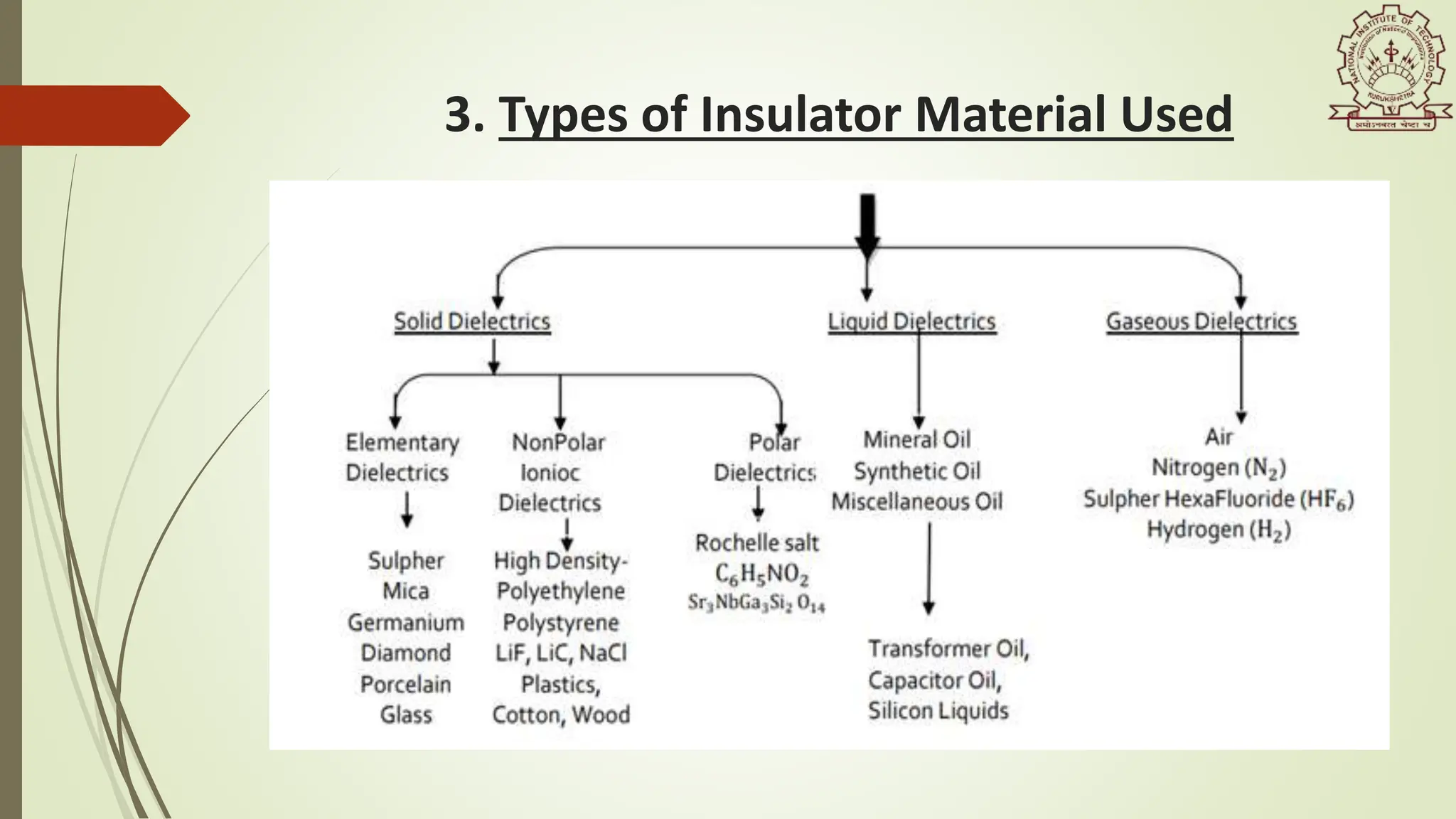
 3. Types of Insulators Material Used
 4. Applications of Insulators
 5. Basics of Design of Insulators
 6. Design of Insulators for various Apparatus
6.1 Design for Overhead Transmission Lines
6.2 Design for Foundations
6.3 Design for Dampers
6.4 Design for Transmission Towers
6.5 Design for Conductors
 7. Recent Developments
 8. References
1. Introduction
 An insulator is a poor conductor that mechanically supports
an electricity transmission line and increases the electric leakage
distance along with the striking distance. Insulators were
introduced because of the needs of the telegraph industry in the
1850s. [1]
OR
 According with IEC-60050-471, an insulator is: “a device intended for electrical
insulation and mechanical fixing of equipment or conductors which are subject
to electric potential differences”. [2]
2. Brief Background
 late 1890s – For the first time ceramic insulators were introduced. [1]
 1950s - First non-ceramic insulators were introduced, which were composed of
epoxy resins.[1]
 late 1970 and early 1980 - Polymer insulators were used primarily as special
designs for extreme applications at a premium cost to the utilities.
 In 1991 the first composite insulators having a silicone rubber housing were used
as inter-phase spacers for 66-kV duty,
 In 1994 their use was extended to 275-kV service with a unit 7 m in length--the
world's largest.
3. Types of Insulator Material Used
1. IN POWER TRANSFORMERS
2. IN ROTATING MACHINES
3. IN CIRCUIT BREAKERS
4. IN CABLES
5. IN POWER CAPACITORS
6. IN HIGH-VOLTAGE BUSHINGS
7. IN FRACTIONAL HORSEPOWER MOTORS
4. Applications of Insulators [3]
5. Basics of Design of Insulators
 The electrical breakdown of an insulator due to excessive voltage can occur in
one of two ways:
1. Puncture voltage
2. Flashover voltage
 High voltage insulators are designed with a lower flashover voltage than
puncture voltage, so they will flashover before they puncture, to avoid damage.
 High voltage insulators for outdoor use are shaped to maximize the length of the
leakage path along the surface from one end to the other, called the Creepage
length, to minimize these leakage currents.[4]
6. Design of Insulators for various apparatus
6.1 Design of Insulators for Overhead Lines
 For the conventional design transmission lines the insulation problems depend
on the following 3 factors[7]-
1. Limitation of switching overvoltage
2. Occurrence of overvoltage close to design value die to fault or switching
operation
3. The possible non-linearity of the performance of long insulator strings
at service voltage under pollution conditions.
 The most widely used insulators in the overhead lines is Composite insulators.
 It is because of it’s weather resistance,which is virtually permanent, and its
hydrophobic properties, which allow improvement in the maximum withstand
voltage of pollution.
 DESIGN OF COMPOSITE INSULATORS
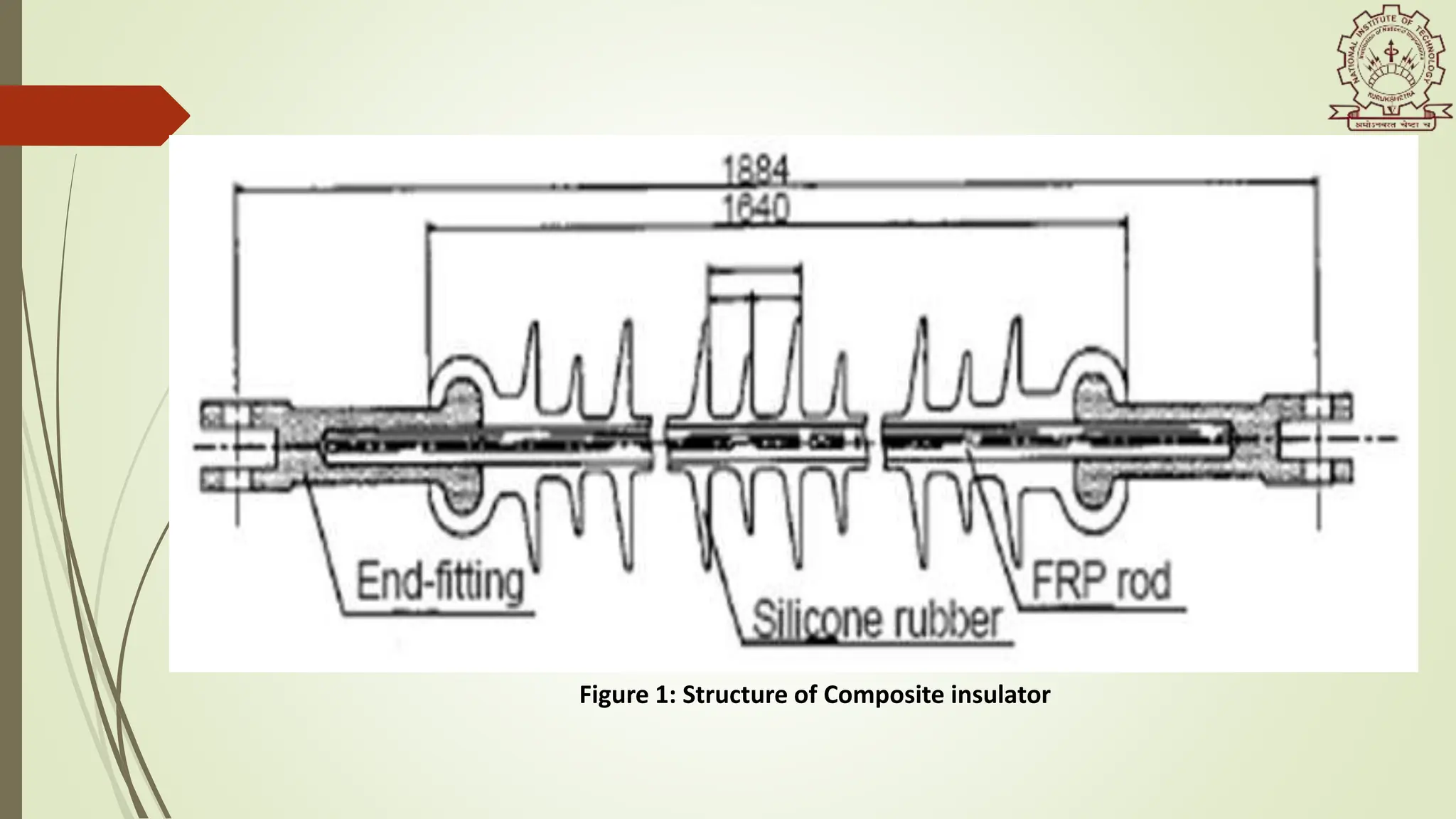
In the figure 1, the basic structure of an composite insulator used in OH line is
shown. The core is of FRP (Fibre Reinforced Polymer) to distribute the tensile
load. The reinforcing fibers used in FRP are glass (E or ECR) and epoxy resin is
used for the matrix. [5]
Figure 1: Structure of Composite insulator
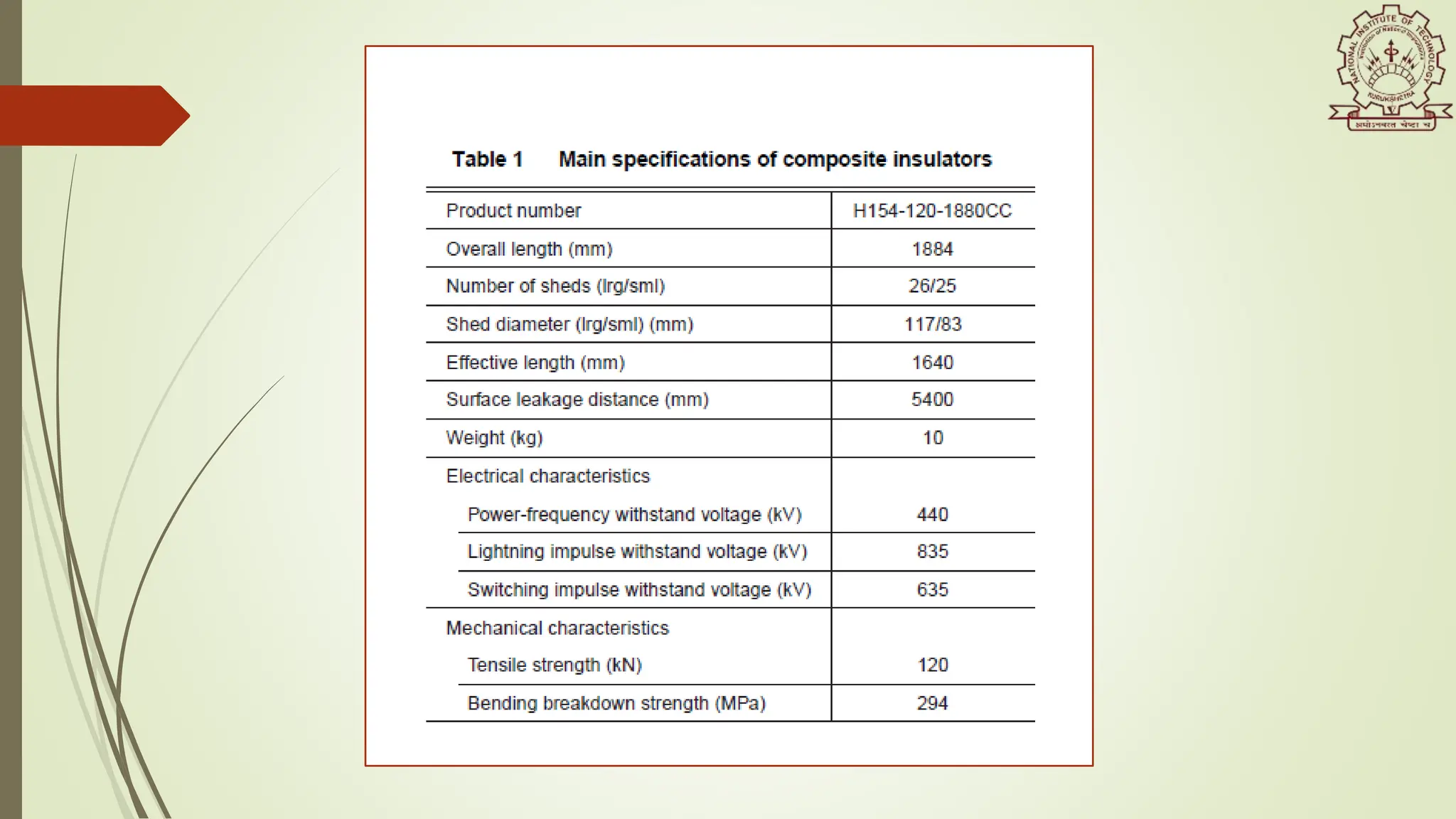
 The design specification of Composite Insulators can be observed
in the following ways –
 OVERALL PERFORMANCE
(1) To have satisfactory electrical characteristics in outdoor use, and to be free of
degradation and crackingof the housing.
(2) To be free of the penetration of moisture into the interfaces of the end-fitting
during long-term outdoor use.
(3) To possess long-term tensile withstand load characteristics.
(4) To be free of voids and other defects in the corematerial.
(5) To be non-igniting and non-flammable when exposed to flame for short periods.
 Electrical performance (insulator alone)
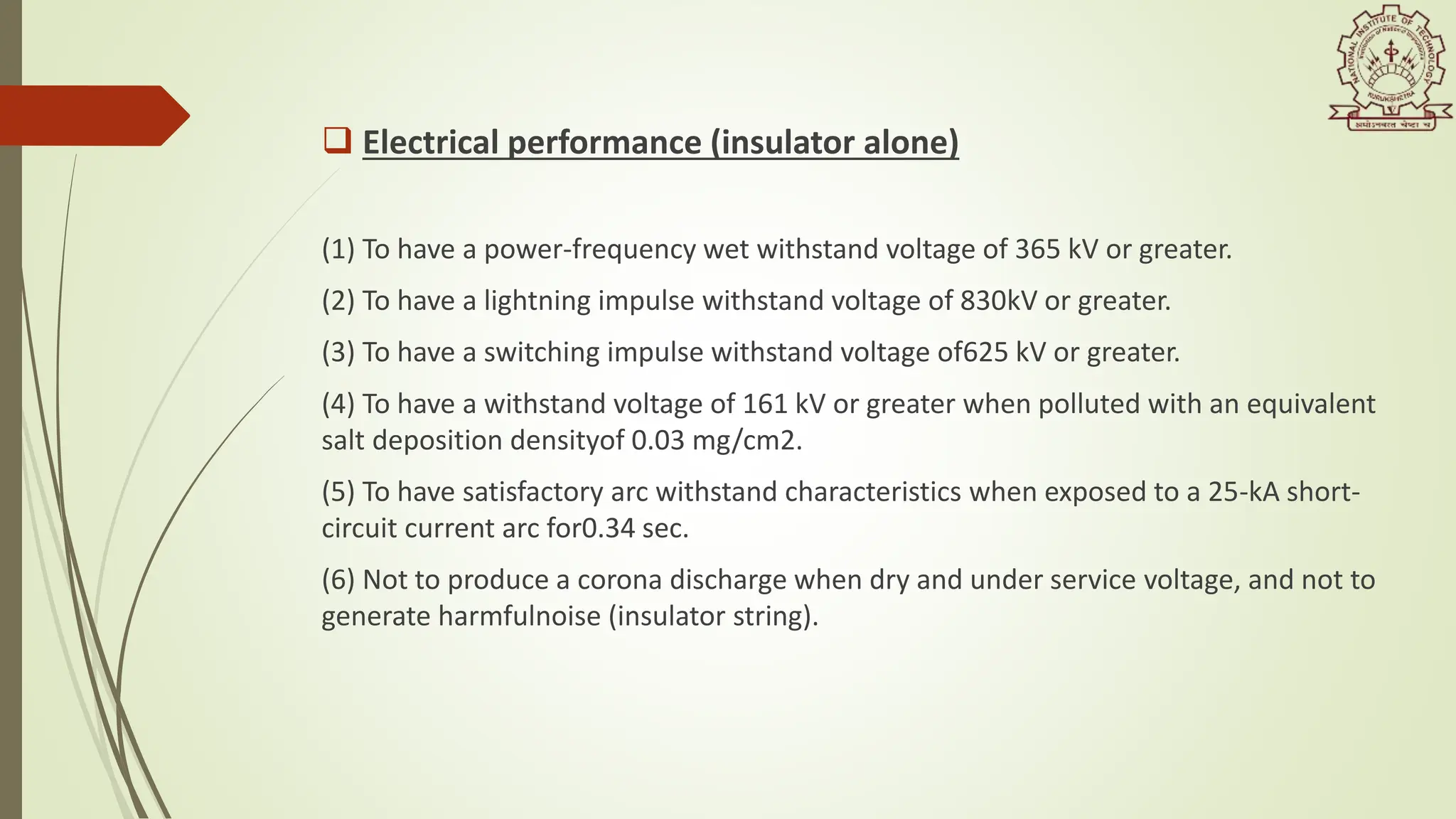
(1) To have a power-frequency wet withstand voltage of 365 kV or greater.
(2) To have a lightning impulse withstand voltage of 830kV or greater.
(3) To have a switching impulse withstand voltage of625 kV or greater.
(4) To have a withstand voltage of 161 kV or greater when polluted with an equivalent
salt deposition densityof 0.03 mg/cm2.
(5) To have satisfactory arc withstand characteristics when exposed to a 25-kA short-
circuit current arc for0.34 sec.
(6) Not to produce a corona discharge when dry and under service voltage, and not to
generate harmfulnoise (insulator string).
 Mechanical performance (insulator alone)
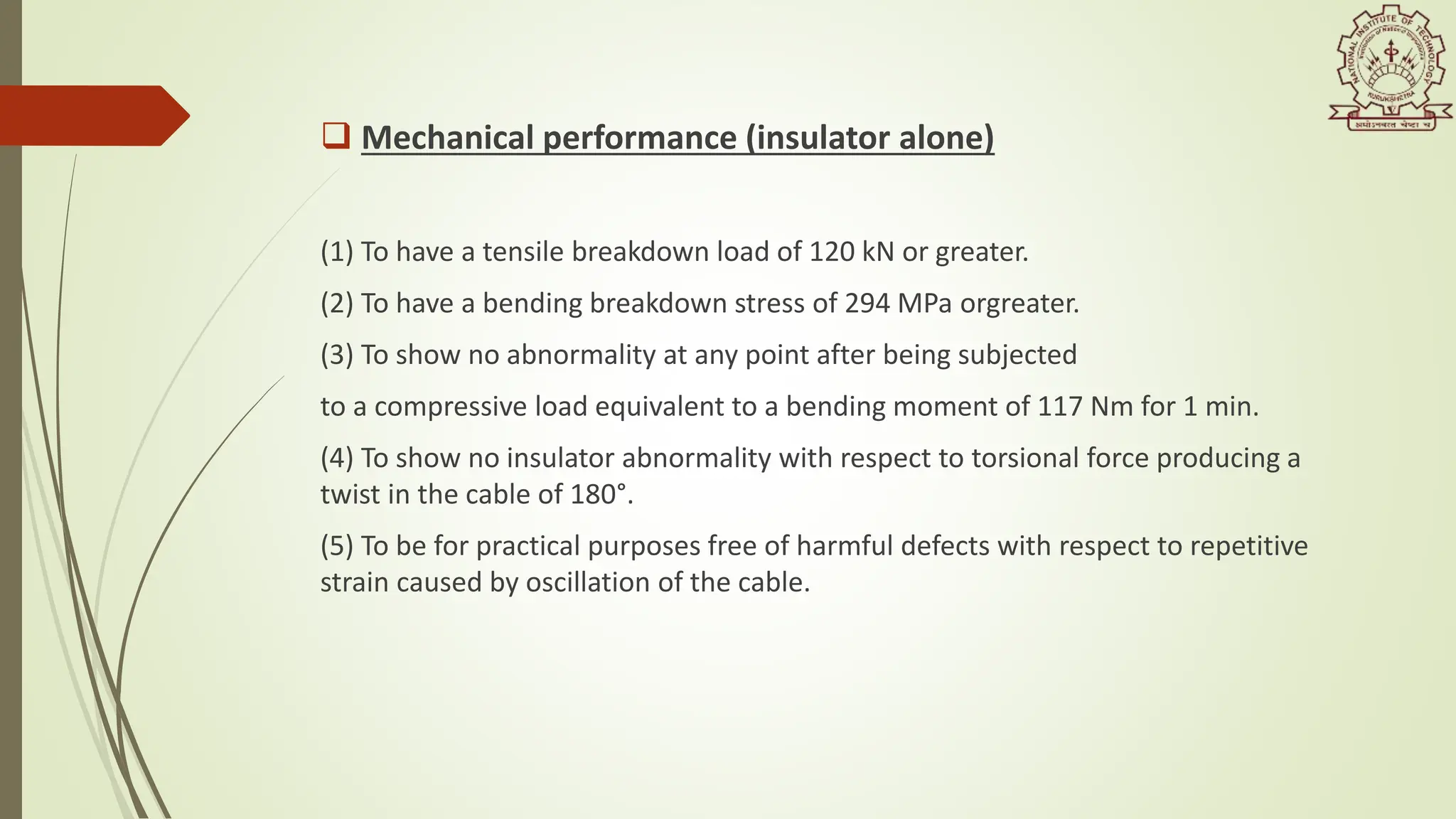
(1) To have a tensile breakdown load of 120 kN or greater.
(2) To have a bending breakdown stress of 294 MPa orgreater.
(3) To show no abnormality at any point after being subjected
to a compressive load equivalent to a bending moment of 117 Nm for 1 min.
(4) To show no insulator abnormality with respect to torsional force producing a
twist in the cable of 180°.
(5) To be for practical purposes free of harmful defects with respect to repetitive
strain caused by oscillation of the cable.
 Some various other tests done for designing are:-
1. Test of Interface and Connection of the End-fitting (according to IEC 61109)
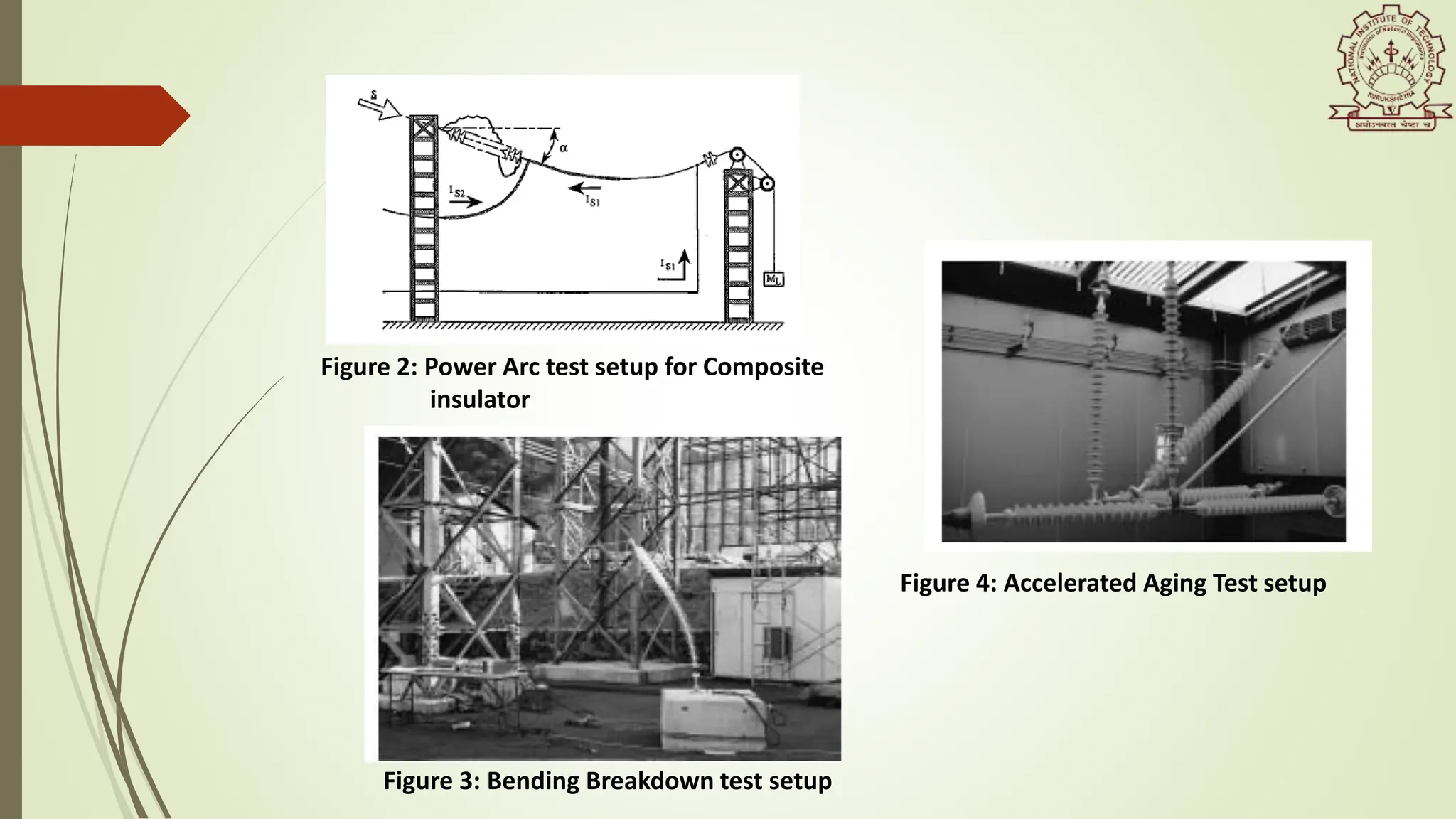
2. Power Arc-withstand Characteristics (figure 2)
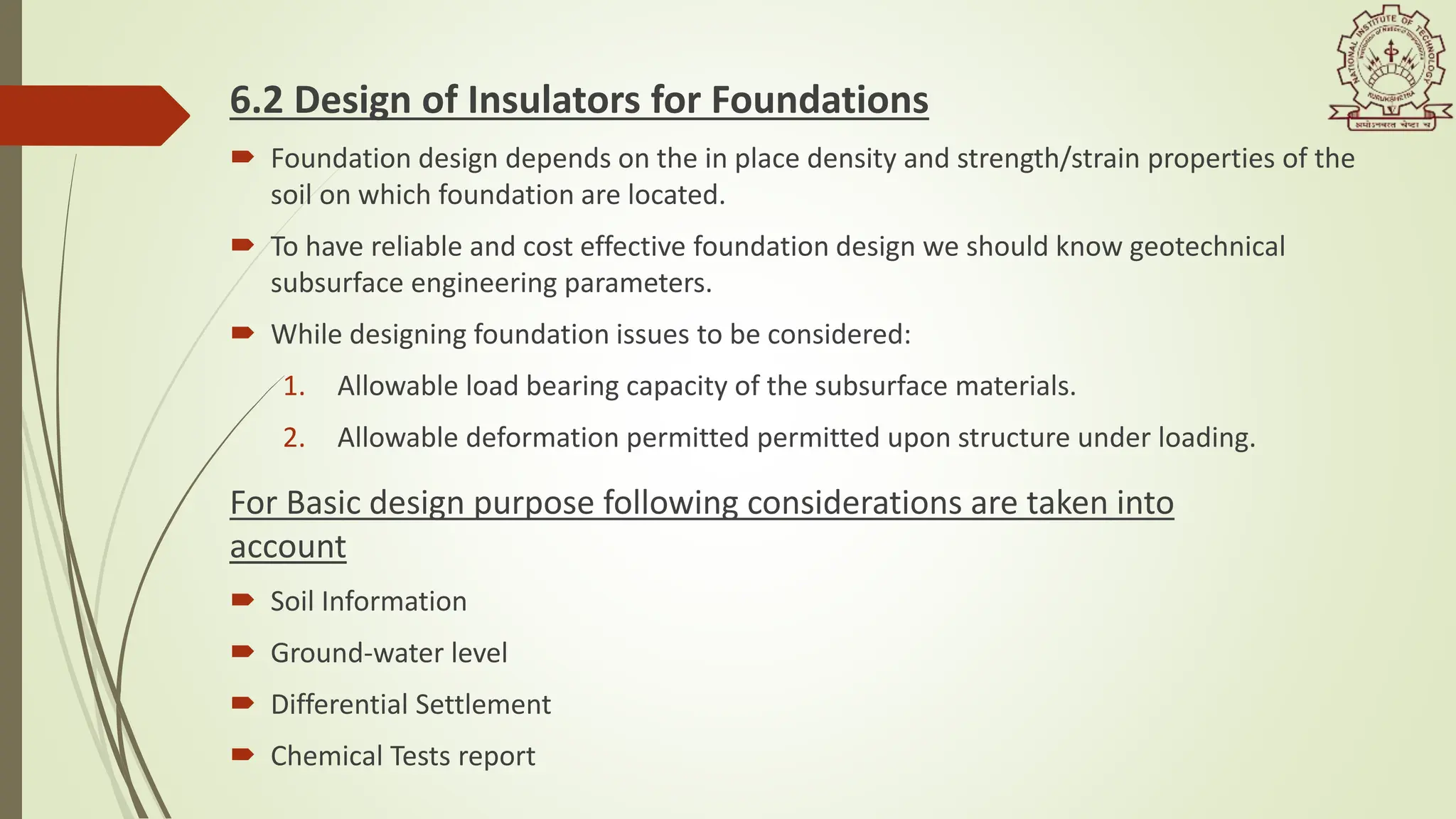
3. Bending Characteristics (figure 3)
4. Longitudinal Vibration-fatigue Tests
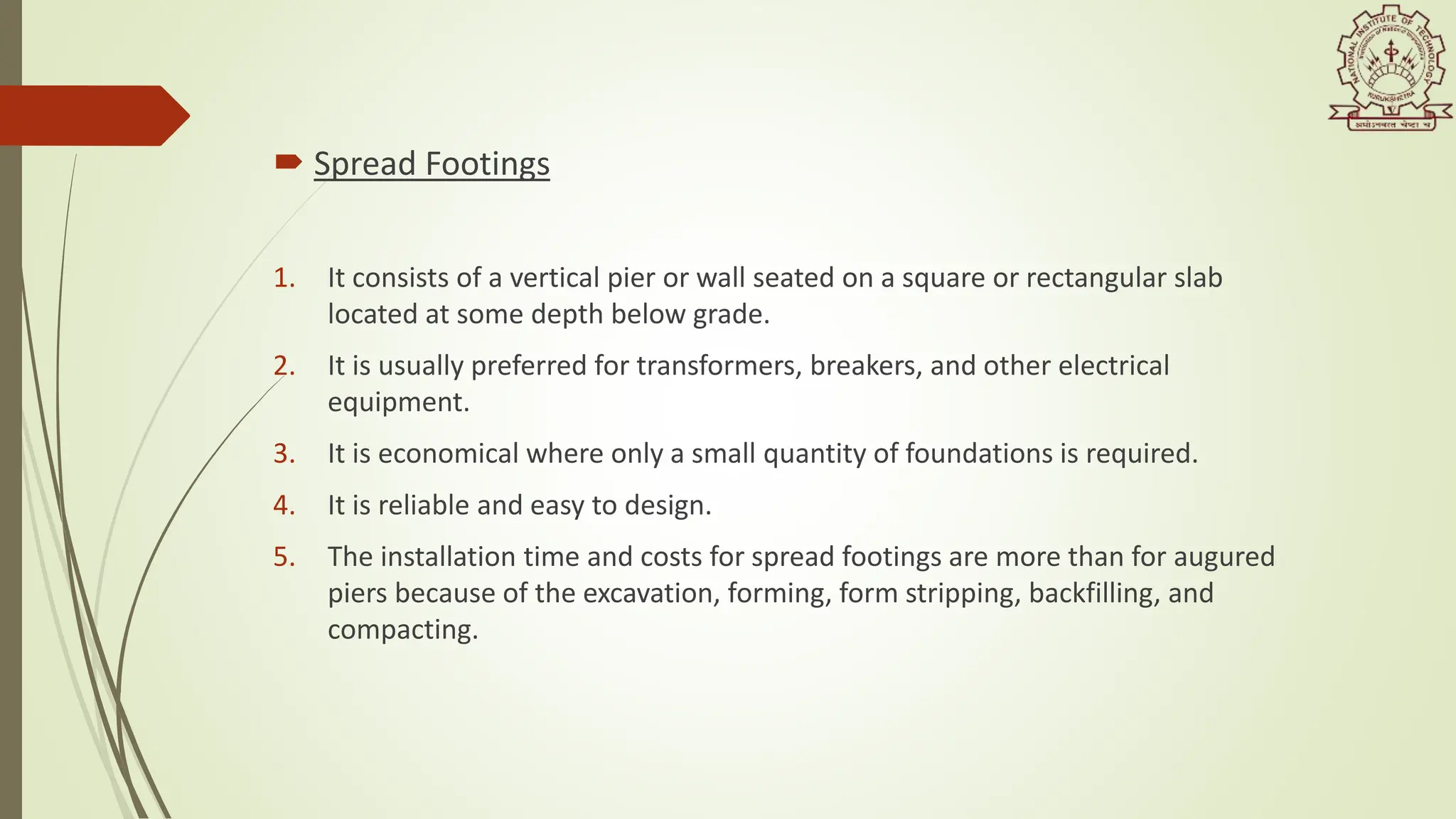
5. Accelerated Aging Tests (according to IEC 61109) (figure 4)
Figure 2: Power Arc test setup for Composite
insulator
Figure 4: Accelerated Aging Test setup
Figure 3: Bending Breakdown test setup
6.2 Design of Insulators for Foundations
 Foundation design depends on the in place density and strength/strain properties of the
soil on which foundation are located.
 To have reliable and cost effective foundation design we should know geotechnical
subsurface engineering parameters.
 While designing foundation issues to be considered:
1. Allowable load bearing capacity of the subsurface materials.​
2. Allowable deformation permitted permitted upon structure under loading.
For Basic design purpose following considerations are taken into
account
 Soil Information
 Ground-water level
 Differential Settlement
 Chemical Tests report
Types of Foundations Insulation Design [7]
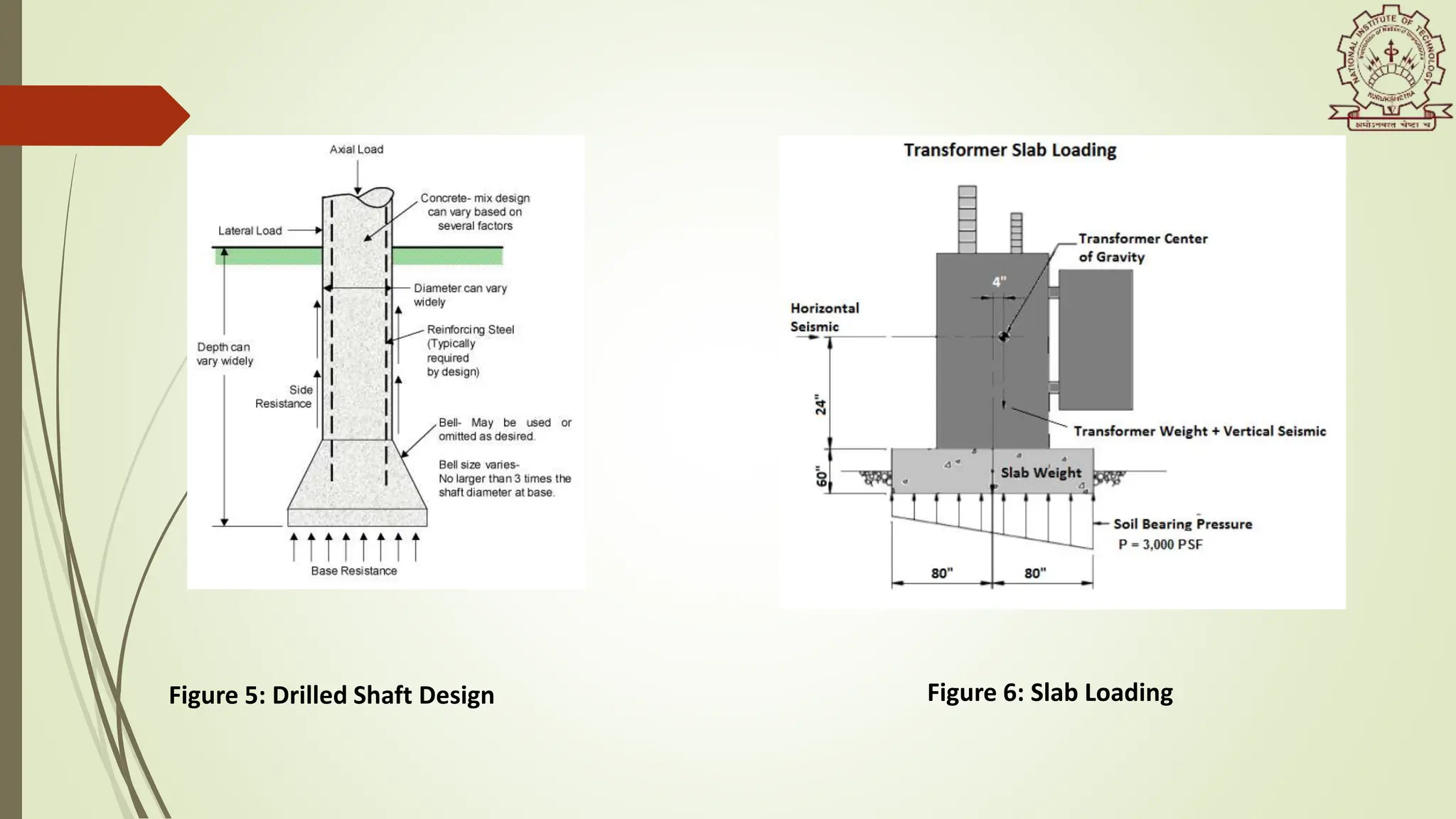
 Drilled shafts
1. It is constructed by auguring, drilling, or coring a hole in the ground, placing
reinforcing steel, and filling with concrete
2. Drilled shafts are best suited to resist overturning shears and moments
3. It is more economical than other types because of the “assembly line”
installation procedure
4. Common size for substation foundation ranges from 24 inches to 60 inches in
diameter, in 6- inch increments. Drilled shafts above 84 inches in diameter are
typically installed in 12-inch increments with a maximum diameter of 120
inches available for extreme substation applications.
 Spread Footings
1. It consists of a vertical pier or wall seated on a square or rectangular slab
located at some depth below grade.
2. It is usually preferred for transformers, breakers, and other electrical
equipment.
3. It is economical where only a small quantity of foundations is required.
4. It is reliable and easy to design.
5. The installation time and costs for spread footings are more than for augured
piers because of the excavation, forming, form stripping, backfilling, and
compacting.
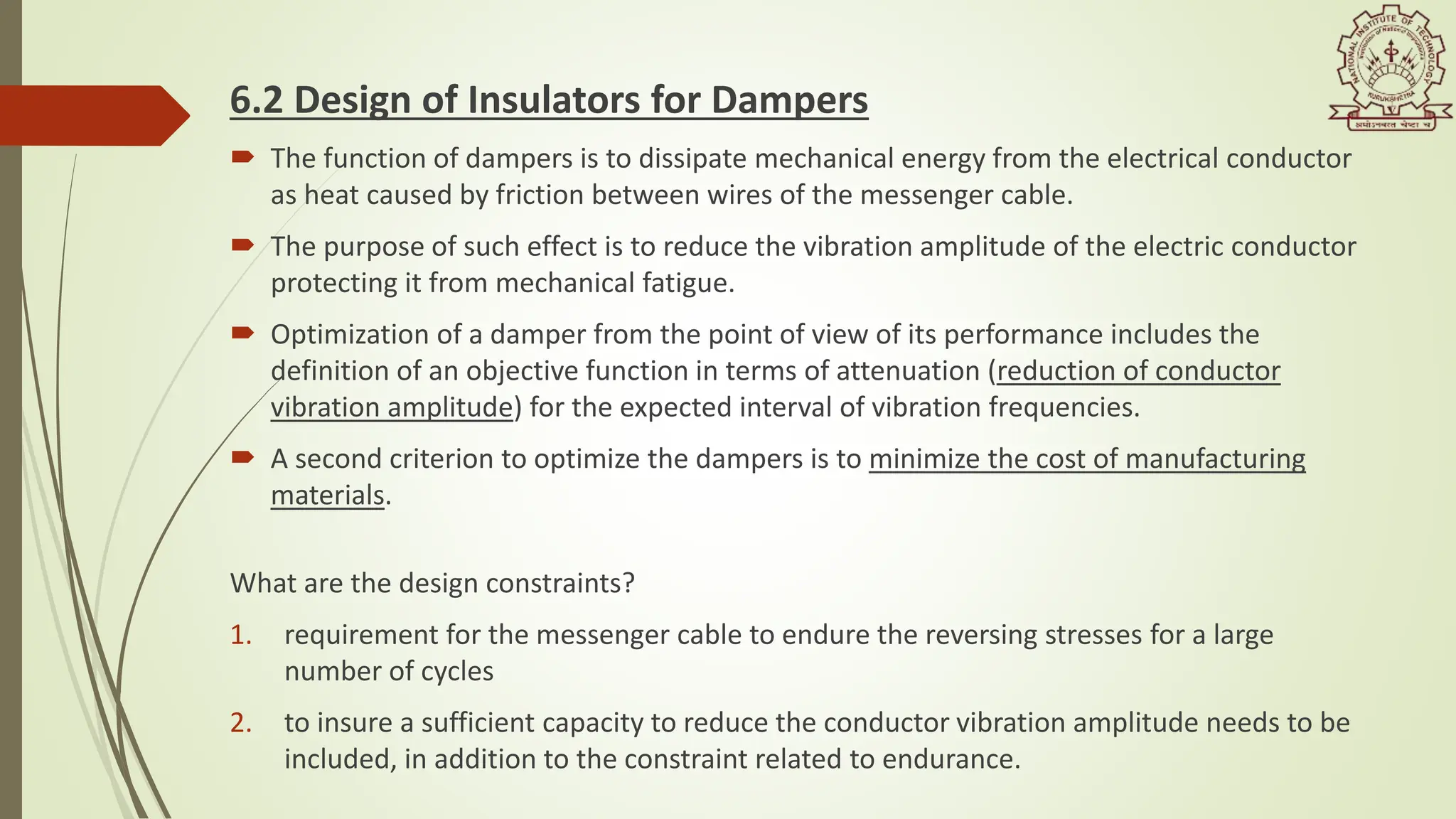
 Slabs on Grade
1. It is used as foundations for miscellaneous equipment supports, switchgear,
breaker, and power transformers
2. Slabs usually vary in thickness between 12 and 24 inches depending on the
various design parameters. The slab should bear on the prepared subgrade and
not on site stone or stone in oil retention sumps.
3. In the absence of subsurface information, a reasonable range can be taken
between 1,000 and 1,500 psf.
4. Similar to spread footings, slab-on-grade foundations have to be designed to
not exceed the allowable soil pressure for the site
Figure 5: Drilled Shaft Design Figure 6: Slab Loading
6.2 Design of Insulators for Dampers
 The function of dampers is to dissipate mechanical energy from the electrical conductor
as heat caused by friction between wires of the messenger cable.
 The purpose of such effect is to reduce the vibration amplitude of the electric conductor
protecting it from mechanical fatigue.
 Optimization of a damper from the point of view of its performance includes the
definition of an objective function in terms of attenuation (reduction of conductor
vibration amplitude) for the expected interval of vibration frequencies.
 A second criterion to optimize the dampers is to minimize the cost of manufacturing
materials.
What are the design constraints?
1. requirement for the messenger cable to endure the reversing stresses for a large
number of cycles
2. to insure a sufficient capacity to reduce the conductor vibration amplitude needs to be
included, in addition to the constraint related to endurance.
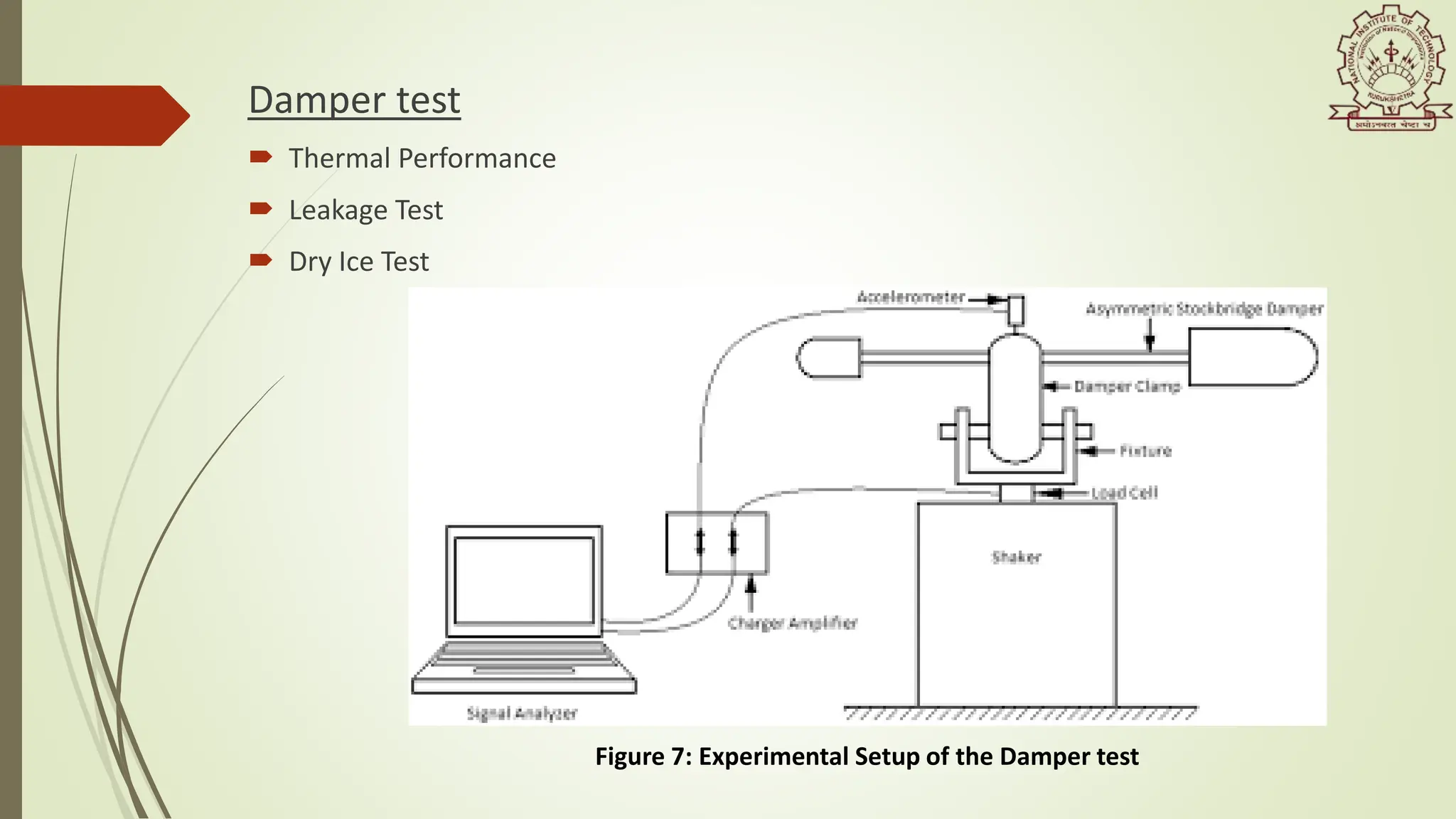
Damper test
 Thermal Performance
 Leakage Test
 Dry Ice Test
Figure 7: Experimental Setup of the Damper test
6.4 Design of Electric Power Transmission Tower
 A typical electric power transmission tower is a steel lattice structure which is used to
prop overhead power lines right from the electric power generating station switchyard to
electric load substations[8].
 The Power Grid Corporation of India Limited (PGCIL) - key organization entrusted within
Indian Power Sector framework for implementing and performing all kind of assignments
related with design, installation, operation and smooth evacuation of electric power
through EHV Transmission Systems network [8].
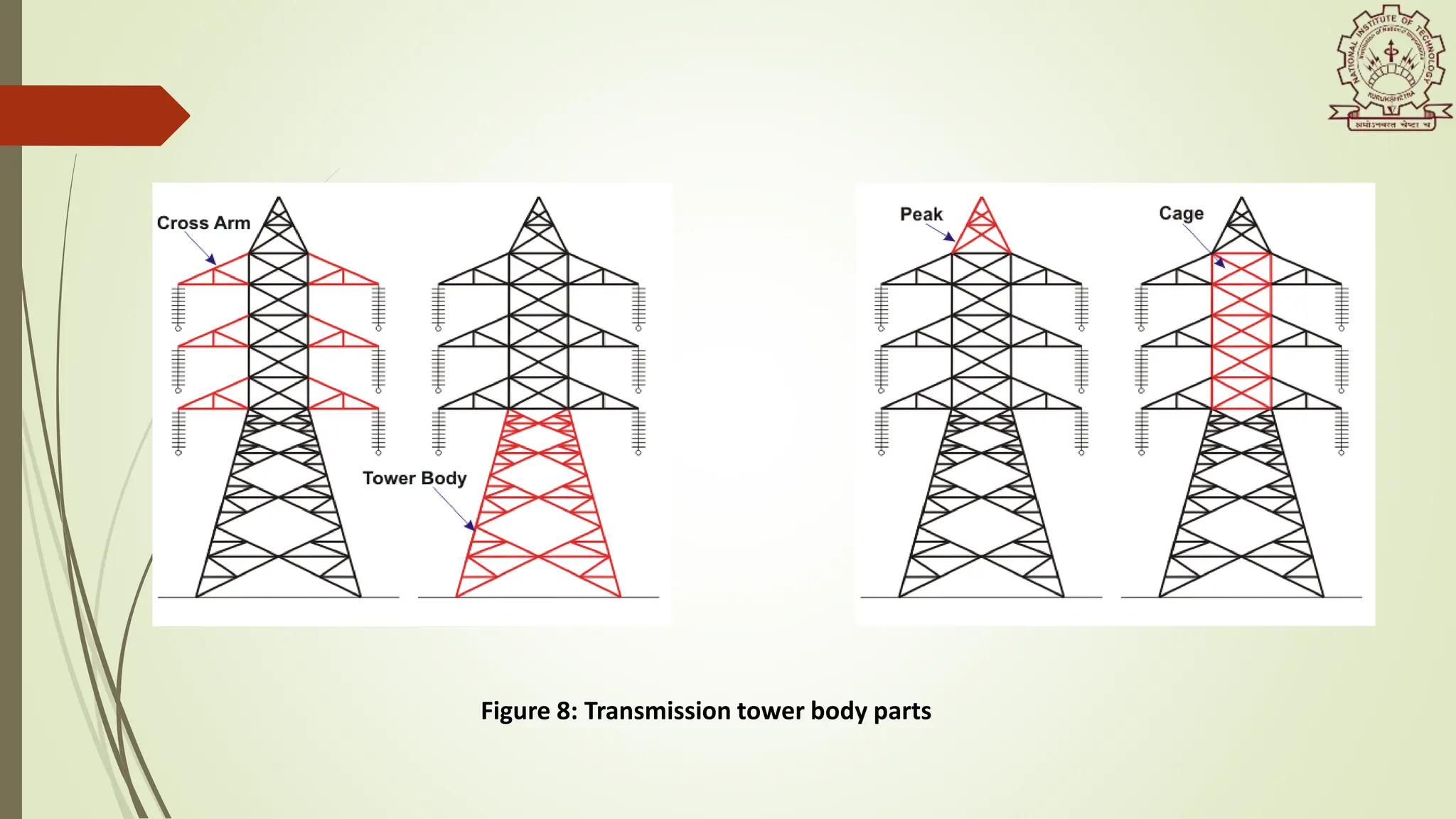
 Transmission tower body parts
1. The peak of the transmission tower
2. The cross arm of the transmission tower
3. The boom of transmission tower
4. Cage of transmission tower
5. Transmission Tower Body
6. Leg of transmission tower
7. Stub/Anchor Bolt and Baseplate assembly of the transmission tower.
Figure 8: Transmission tower body parts
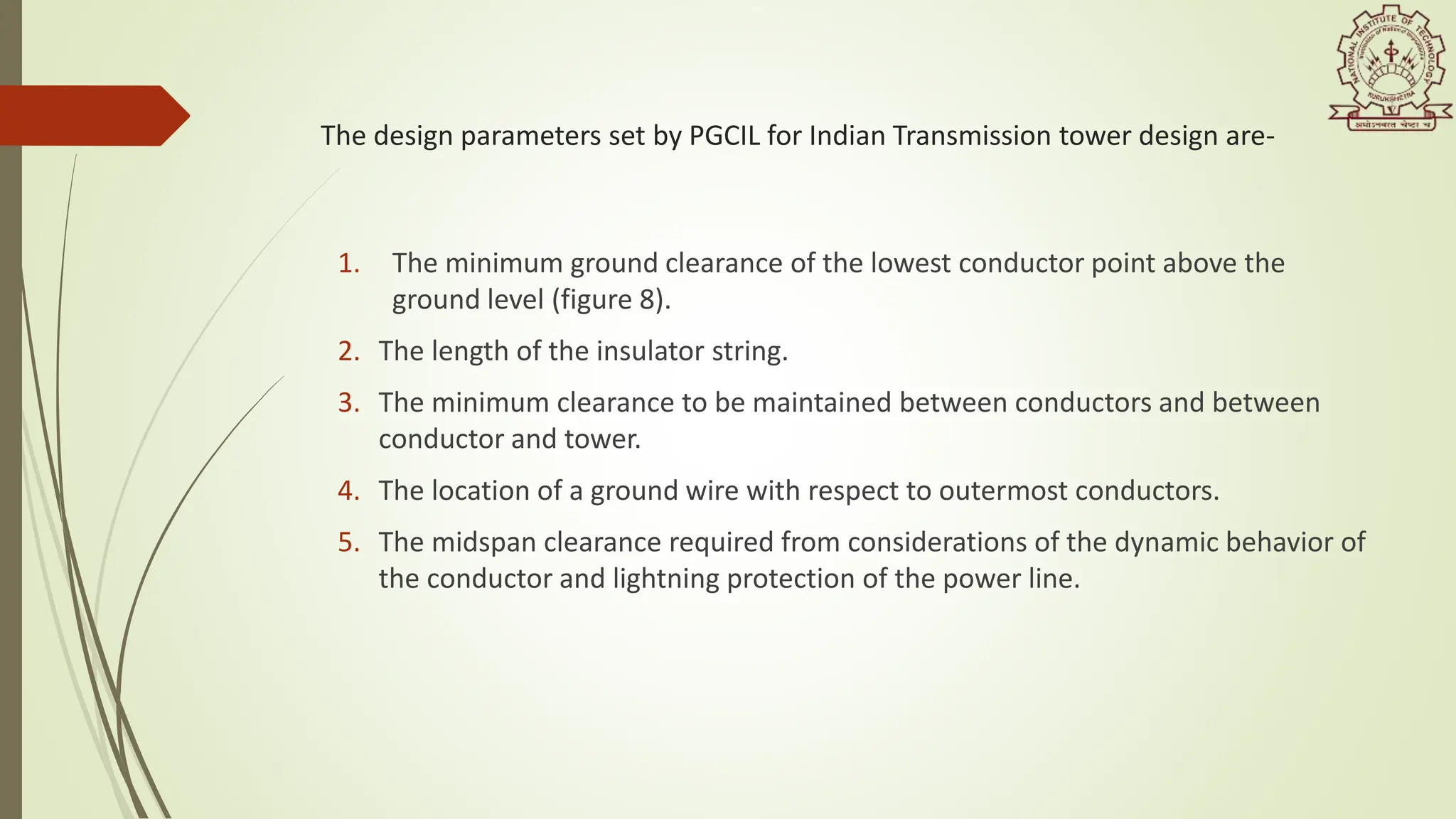
The design parameters set by PGCIL for Indian Transmission tower design are-
1. The minimum ground clearance of the lowest conductor point above the
ground level (figure 8).
2. The length of the insulator string.
3. The minimum clearance to be maintained between conductors and between
conductor and tower.
4. The location of a ground wire with respect to outermost conductors.
5. The midspan clearance required from considerations of the dynamic behavior of
the conductor and lightning protection of the power line.
Figure 9: Permissible values of ground and
horizontal clearance [8]
Figure 10: Indian standards on Tower Design [8]
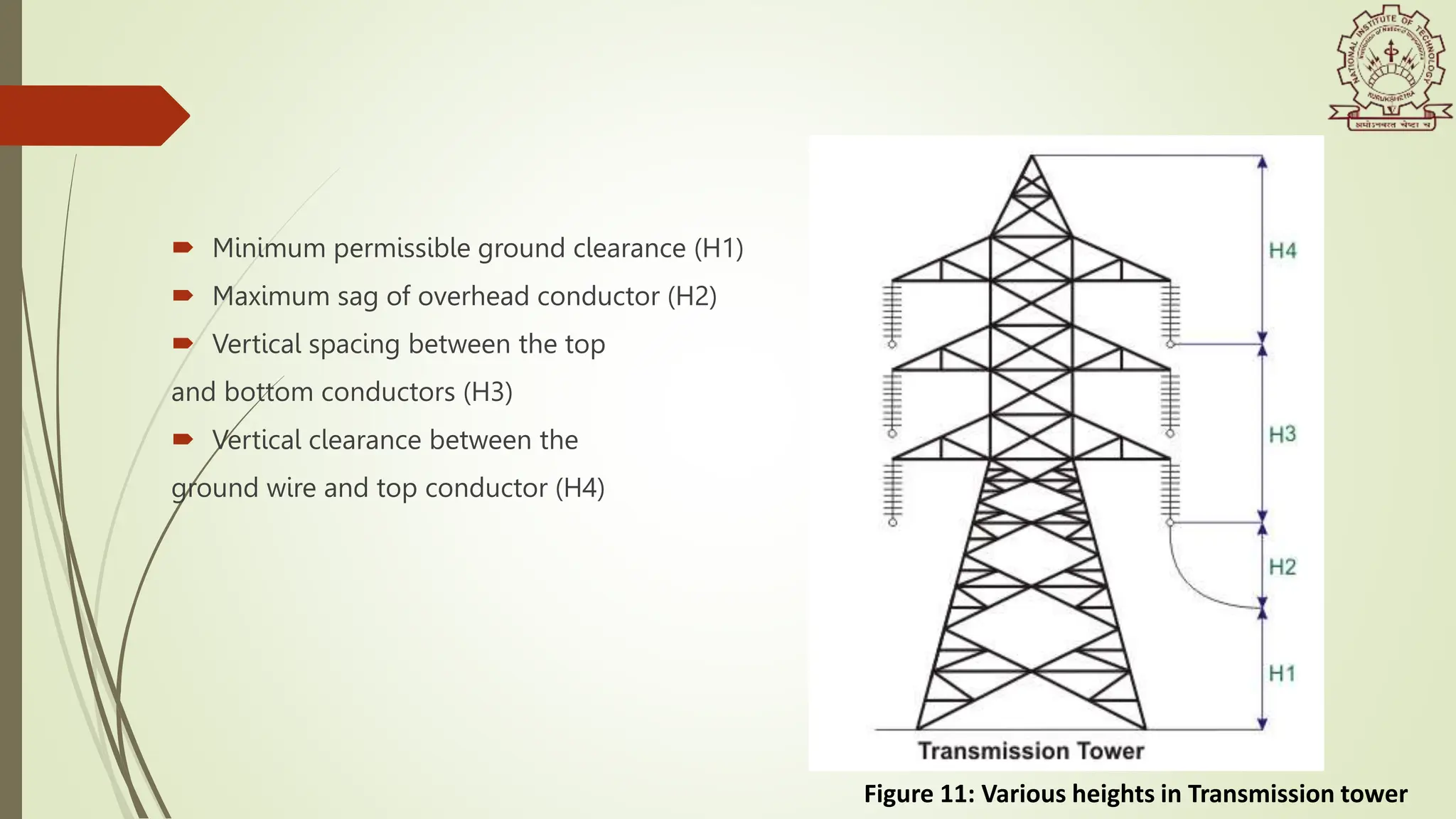
 Minimum permissible ground clearance (H1)
 Maximum sag of overhead conductor (H2)
 Vertical spacing between the top
and bottom conductors (H3)
 Vertical clearance between the
ground wire and top conductor (H4)
Figure 11: Various heights in Transmission tower
6.5 Design for Conductors
 To select the best insulator for the conductor of transmission line we first need to consider the following
constraints-
1. Voltage of line​
2. Load to be transmitted​
3. Value of power losses on the line​
4. Corona and radio interference​
5. Mechanical strength of the conductor​
6. Electrical conductivity​
7. Availability of materials used in conductor
 To design a conductor factors to be considered:​
1. Heights and location​
2. Span length​
3. Conductor Sags and tensions​
4. Ground clearances.
7. Recent Development
 The recent trend in the development of the insulator material is the HYBRID
Insulator.
 This development is emerging due to extreme environment pollution condition,
which can lead to electrical activity on the insulators including current leakage.
WHAT IS HYBRID INSULATOR ?
According to IEC 62896 [1], Hybrid insulators consist of an insulating core bearing
the mechanical load, protected by a polymeric housing.
 Hybrid insulators are used as overhead line, post or hollow core equipment
insulators
Figure 12: Chart explaining hybrid definition [9]
Figure 13: PPC Santana hybrid insulator[9]
 The Hybrid insulator is typically one-half to one-quarter of the weight of a
conventional porcelain insulator, which reduces transport costs and
transport/installation breakages and eases installation.
 The core material is not susceptible to moisture ingress problems. If the housing
is damaged, the porcelain core itself remains unaffected by moisture ingress.
 Hybrid insulators combine the advantages of a porcelain core (undisputed
superiority of high mechanical strength, stability & longevity) with the excellent
performance of silicone housings, which provides an ideal solution for use in
highly contaminated service conditions
What are the advantages of the hybrid insulators?
Figure 14: Comparison of various insulators [10]
References
[1] Mustafa Ali, He Yadong and Jiang Lilong 2017/10/01. Design and testing of an improved
profile for silicone rubber composite insulators. IEEE Transactions on Dielectrics and Electrical
Insulation.
[2] https://www.inmr.com/insulator-design-standards-operating-parameters/
[3] Naidu MS, Kama Raju V 2013. High Voltage Engineering 5e. McGraw Education Pvt. Ltd.
[4] Holtzhausen, J.P. High Voltage Insulators, IDC Technologies. Retrieved February 16, 2009.
[5] Satoshi Kobayashi, Yutaka Matsuzaki ,Hiroshi Masuya, Yoshihiro Arashitani and Ryuzo Kimat
1999. Development of Composite Insulators for Overhead Lines
[6] Dr. K.N.Ravi, N.Vasudev, A.K.Majumdar, Dr. Channakeshava 2000. Design of Line Insulation
for Transmission Line.
[7] Substation Design Volume VIII Site & Foundation Design 2015. PDH Online Course E475
[8] Atul Jaysing Patil, Arush Singh, R. K. Jarial 2019. Some Aspects of Design and Condition
Monitoring of Electric Power Transmission Towers. IJISSET
[9] Eduardo R. Hilsdorf ,Guilherme Cunha da Silva 2019. Hybrid Insulators for Distribution
Lines:Definitions, Advantages& Application Experience. INMR World Congress, U.S.A.
[10] https://www.inmr.com/technical-review-hybrid-insulators/
DTHVE - Design & Testing in High Voltage Engineering

DTHVE - Design & Testing in High Voltage Engineering

  • 1.
    Insulator Design of Overheadlines, Towers and supports, Conductors, Dampers and Foundations Submitted To- Dr. A.R.Gupta NIT Kurukshetra Submitted by - Abhinesh Kr. Lal Karn(32014302) Gunjesh Tahiliani (32014306)
  • 2.
    Index  1. Introduction 2. Brief Background  3. Types of Insulators Material Used  4. Applications of Insulators  5. Basics of Design of Insulators  6. Design of Insulators for various Apparatus 6.1 Design for Overhead Transmission Lines 6.2 Design for Foundations 6.3 Design for Dampers 6.4 Design for Transmission Towers 6.5 Design for Conductors  7. Recent Developments  8. References
  • 3.
    1. Introduction  Aninsulator is a poor conductor that mechanically supports an electricity transmission line and increases the electric leakage distance along with the striking distance. Insulators were introduced because of the needs of the telegraph industry in the 1850s. [1] OR  According with IEC-60050-471, an insulator is: “a device intended for electrical insulation and mechanical fixing of equipment or conductors which are subject to electric potential differences”. [2]
  • 4.
    2. Brief Background late 1890s – For the first time ceramic insulators were introduced. [1]  1950s - First non-ceramic insulators were introduced, which were composed of epoxy resins.[1]  late 1970 and early 1980 - Polymer insulators were used primarily as special designs for extreme applications at a premium cost to the utilities.  In 1991 the first composite insulators having a silicone rubber housing were used as inter-phase spacers for 66-kV duty,  In 1994 their use was extended to 275-kV service with a unit 7 m in length--the world's largest.
  • 5.
    3. Types ofInsulator Material Used
  • 6.
    1. IN POWERTRANSFORMERS 2. IN ROTATING MACHINES 3. IN CIRCUIT BREAKERS 4. IN CABLES 5. IN POWER CAPACITORS 6. IN HIGH-VOLTAGE BUSHINGS 7. IN FRACTIONAL HORSEPOWER MOTORS 4. Applications of Insulators [3]
  • 7.
    5. Basics ofDesign of Insulators  The electrical breakdown of an insulator due to excessive voltage can occur in one of two ways: 1. Puncture voltage 2. Flashover voltage  High voltage insulators are designed with a lower flashover voltage than puncture voltage, so they will flashover before they puncture, to avoid damage.  High voltage insulators for outdoor use are shaped to maximize the length of the leakage path along the surface from one end to the other, called the Creepage length, to minimize these leakage currents.[4]
  • 8.
    6. Design ofInsulators for various apparatus 6.1 Design of Insulators for Overhead Lines  For the conventional design transmission lines the insulation problems depend on the following 3 factors[7]- 1. Limitation of switching overvoltage 2. Occurrence of overvoltage close to design value die to fault or switching operation 3. The possible non-linearity of the performance of long insulator strings at service voltage under pollution conditions.
  • 9.
     The mostwidely used insulators in the overhead lines is Composite insulators.  It is because of it’s weather resistance,which is virtually permanent, and its hydrophobic properties, which allow improvement in the maximum withstand voltage of pollution.  DESIGN OF COMPOSITE INSULATORS In the figure 1, the basic structure of an composite insulator used in OH line is shown. The core is of FRP (Fibre Reinforced Polymer) to distribute the tensile load. The reinforcing fibers used in FRP are glass (E or ECR) and epoxy resin is used for the matrix. [5]
  • 10.
    Figure 1: Structureof Composite insulator
  • 11.
     The designspecification of Composite Insulators can be observed in the following ways –  OVERALL PERFORMANCE (1) To have satisfactory electrical characteristics in outdoor use, and to be free of degradation and crackingof the housing. (2) To be free of the penetration of moisture into the interfaces of the end-fitting during long-term outdoor use. (3) To possess long-term tensile withstand load characteristics. (4) To be free of voids and other defects in the corematerial. (5) To be non-igniting and non-flammable when exposed to flame for short periods.
  • 12.
     Electrical performance(insulator alone) (1) To have a power-frequency wet withstand voltage of 365 kV or greater. (2) To have a lightning impulse withstand voltage of 830kV or greater. (3) To have a switching impulse withstand voltage of625 kV or greater. (4) To have a withstand voltage of 161 kV or greater when polluted with an equivalent salt deposition densityof 0.03 mg/cm2. (5) To have satisfactory arc withstand characteristics when exposed to a 25-kA short- circuit current arc for0.34 sec. (6) Not to produce a corona discharge when dry and under service voltage, and not to generate harmfulnoise (insulator string).
  • 13.
     Mechanical performance(insulator alone) (1) To have a tensile breakdown load of 120 kN or greater. (2) To have a bending breakdown stress of 294 MPa orgreater. (3) To show no abnormality at any point after being subjected to a compressive load equivalent to a bending moment of 117 Nm for 1 min. (4) To show no insulator abnormality with respect to torsional force producing a twist in the cable of 180°. (5) To be for practical purposes free of harmful defects with respect to repetitive strain caused by oscillation of the cable.
  • 15.
     Some variousother tests done for designing are:- 1. Test of Interface and Connection of the End-fitting (according to IEC 61109) 2. Power Arc-withstand Characteristics (figure 2) 3. Bending Characteristics (figure 3) 4. Longitudinal Vibration-fatigue Tests 5. Accelerated Aging Tests (according to IEC 61109) (figure 4)
  • 16.
    Figure 2: PowerArc test setup for Composite insulator Figure 4: Accelerated Aging Test setup Figure 3: Bending Breakdown test setup
  • 17.
    6.2 Design ofInsulators for Foundations  Foundation design depends on the in place density and strength/strain properties of the soil on which foundation are located.  To have reliable and cost effective foundation design we should know geotechnical subsurface engineering parameters.  While designing foundation issues to be considered: 1. Allowable load bearing capacity of the subsurface materials.​ 2. Allowable deformation permitted permitted upon structure under loading. For Basic design purpose following considerations are taken into account  Soil Information  Ground-water level  Differential Settlement  Chemical Tests report
  • 18.
    Types of FoundationsInsulation Design [7]  Drilled shafts 1. It is constructed by auguring, drilling, or coring a hole in the ground, placing reinforcing steel, and filling with concrete 2. Drilled shafts are best suited to resist overturning shears and moments 3. It is more economical than other types because of the “assembly line” installation procedure 4. Common size for substation foundation ranges from 24 inches to 60 inches in diameter, in 6- inch increments. Drilled shafts above 84 inches in diameter are typically installed in 12-inch increments with a maximum diameter of 120 inches available for extreme substation applications.
  • 19.
     Spread Footings 1.It consists of a vertical pier or wall seated on a square or rectangular slab located at some depth below grade. 2. It is usually preferred for transformers, breakers, and other electrical equipment. 3. It is economical where only a small quantity of foundations is required. 4. It is reliable and easy to design. 5. The installation time and costs for spread footings are more than for augured piers because of the excavation, forming, form stripping, backfilling, and compacting.
  • 20.
     Slabs onGrade 1. It is used as foundations for miscellaneous equipment supports, switchgear, breaker, and power transformers 2. Slabs usually vary in thickness between 12 and 24 inches depending on the various design parameters. The slab should bear on the prepared subgrade and not on site stone or stone in oil retention sumps. 3. In the absence of subsurface information, a reasonable range can be taken between 1,000 and 1,500 psf. 4. Similar to spread footings, slab-on-grade foundations have to be designed to not exceed the allowable soil pressure for the site
  • 21.
    Figure 5: DrilledShaft Design Figure 6: Slab Loading
  • 22.
    6.2 Design ofInsulators for Dampers  The function of dampers is to dissipate mechanical energy from the electrical conductor as heat caused by friction between wires of the messenger cable.  The purpose of such effect is to reduce the vibration amplitude of the electric conductor protecting it from mechanical fatigue.  Optimization of a damper from the point of view of its performance includes the definition of an objective function in terms of attenuation (reduction of conductor vibration amplitude) for the expected interval of vibration frequencies.  A second criterion to optimize the dampers is to minimize the cost of manufacturing materials. What are the design constraints? 1. requirement for the messenger cable to endure the reversing stresses for a large number of cycles 2. to insure a sufficient capacity to reduce the conductor vibration amplitude needs to be included, in addition to the constraint related to endurance.
  • 23.
    Damper test  ThermalPerformance  Leakage Test  Dry Ice Test Figure 7: Experimental Setup of the Damper test
  • 24.
    6.4 Design ofElectric Power Transmission Tower  A typical electric power transmission tower is a steel lattice structure which is used to prop overhead power lines right from the electric power generating station switchyard to electric load substations[8].  The Power Grid Corporation of India Limited (PGCIL) - key organization entrusted within Indian Power Sector framework for implementing and performing all kind of assignments related with design, installation, operation and smooth evacuation of electric power through EHV Transmission Systems network [8].  Transmission tower body parts 1. The peak of the transmission tower 2. The cross arm of the transmission tower 3. The boom of transmission tower 4. Cage of transmission tower 5. Transmission Tower Body 6. Leg of transmission tower 7. Stub/Anchor Bolt and Baseplate assembly of the transmission tower.
  • 25.
    Figure 8: Transmissiontower body parts
  • 26.
    The design parametersset by PGCIL for Indian Transmission tower design are- 1. The minimum ground clearance of the lowest conductor point above the ground level (figure 8). 2. The length of the insulator string. 3. The minimum clearance to be maintained between conductors and between conductor and tower. 4. The location of a ground wire with respect to outermost conductors. 5. The midspan clearance required from considerations of the dynamic behavior of the conductor and lightning protection of the power line.
  • 27.
    Figure 9: Permissiblevalues of ground and horizontal clearance [8] Figure 10: Indian standards on Tower Design [8]
  • 28.
     Minimum permissibleground clearance (H1)  Maximum sag of overhead conductor (H2)  Vertical spacing between the top and bottom conductors (H3)  Vertical clearance between the ground wire and top conductor (H4) Figure 11: Various heights in Transmission tower
  • 29.
    6.5 Design forConductors  To select the best insulator for the conductor of transmission line we first need to consider the following constraints- 1. Voltage of line​ 2. Load to be transmitted​ 3. Value of power losses on the line​ 4. Corona and radio interference​ 5. Mechanical strength of the conductor​ 6. Electrical conductivity​ 7. Availability of materials used in conductor  To design a conductor factors to be considered:​ 1. Heights and location​ 2. Span length​ 3. Conductor Sags and tensions​ 4. Ground clearances.
  • 30.
    7. Recent Development The recent trend in the development of the insulator material is the HYBRID Insulator.  This development is emerging due to extreme environment pollution condition, which can lead to electrical activity on the insulators including current leakage. WHAT IS HYBRID INSULATOR ? According to IEC 62896 [1], Hybrid insulators consist of an insulating core bearing the mechanical load, protected by a polymeric housing.  Hybrid insulators are used as overhead line, post or hollow core equipment insulators
  • 31.
    Figure 12: Chartexplaining hybrid definition [9] Figure 13: PPC Santana hybrid insulator[9]
  • 32.
     The Hybridinsulator is typically one-half to one-quarter of the weight of a conventional porcelain insulator, which reduces transport costs and transport/installation breakages and eases installation.  The core material is not susceptible to moisture ingress problems. If the housing is damaged, the porcelain core itself remains unaffected by moisture ingress.  Hybrid insulators combine the advantages of a porcelain core (undisputed superiority of high mechanical strength, stability & longevity) with the excellent performance of silicone housings, which provides an ideal solution for use in highly contaminated service conditions What are the advantages of the hybrid insulators?
  • 33.
    Figure 14: Comparisonof various insulators [10]
  • 34.
    References [1] Mustafa Ali,He Yadong and Jiang Lilong 2017/10/01. Design and testing of an improved profile for silicone rubber composite insulators. IEEE Transactions on Dielectrics and Electrical Insulation. [2] https://www.inmr.com/insulator-design-standards-operating-parameters/ [3] Naidu MS, Kama Raju V 2013. High Voltage Engineering 5e. McGraw Education Pvt. Ltd. [4] Holtzhausen, J.P. High Voltage Insulators, IDC Technologies. Retrieved February 16, 2009. [5] Satoshi Kobayashi, Yutaka Matsuzaki ,Hiroshi Masuya, Yoshihiro Arashitani and Ryuzo Kimat 1999. Development of Composite Insulators for Overhead Lines [6] Dr. K.N.Ravi, N.Vasudev, A.K.Majumdar, Dr. Channakeshava 2000. Design of Line Insulation for Transmission Line. [7] Substation Design Volume VIII Site & Foundation Design 2015. PDH Online Course E475 [8] Atul Jaysing Patil, Arush Singh, R. K. Jarial 2019. Some Aspects of Design and Condition Monitoring of Electric Power Transmission Towers. IJISSET [9] Eduardo R. Hilsdorf ,Guilherme Cunha da Silva 2019. Hybrid Insulators for Distribution Lines:Definitions, Advantages& Application Experience. INMR World Congress, U.S.A. [10] https://www.inmr.com/technical-review-hybrid-insulators/