Lesson Objectives
By theend of this lesson, students should be able to:
Define architecture and explain its importance
Identify different types of architectural drawings
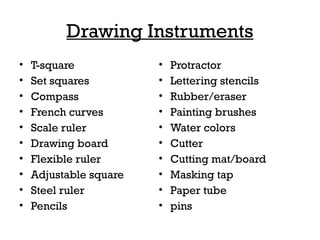
List and demonstrate the correct use of basic drawing
instruments
Apply basic line types and lettering in a simple drafting
exercise
4.
What is Architecture?
•Architecture is the art and science of designing
buildings and spaces where people live, learn, work,
and play.
Art 🎨 → Architecture is creative (beautiful buildings, inspiring
spaces). Example: A church, mosque, or cultural center
that inspires people.
Science 🔬 → Architecture uses knowledge of materials, structure, and
environment. Example: A house that stands strong in rain or
wind.
For People 🏠 →Architecture is always about people’s needs: comfort,
safety, and use. Example: A classroom that allows students to
see the board clearly and get fresh air.
Drafting Standards
• LineTypes:
- Construction line
- Object line
- Hidden line
- Center line
• Lettering styles and sizes for architectural drawings
Architectural drawings use a unique language to communicate
our idea about the built form. We use lines, text, symbols,
hatching and color in certain combinations and ways. These
different drawing conventions come together to communicate
specific information.
18.
What Are LineTypes and Line
Weights?
One of the biggest challenges architecture students have is
using the correct line weights and line types in their drawings.
Incorrect drawing conventions can cause problems because
people cannot read drawings properly when you present
drawings with inaccurate line weights and line types.
Your ideas are unclear, they don’t get adequately
communicated, and you do not know if people understand
your work correctly.
19.
Let’s start byclarifying what line types
and line weights are.
• Line type is the style of a line. Line types can be a pattern of
dots, dashes, text and symbols and be broken and not
continuous. Or they can be solid and continuous.
• Line weight is the thickness of a line.
• Line color is the color of the line when printed. Note that CAD
programs will allow you to set up your lines in an infinite range
of colors on the screen. Color helps you identify different layers
of information while you are working. But our final drawings
will be printed in black, white and grey. When we cannot rely
on color, we must rely on our line types and weights!
20.
Architectural Line Types
Everyline in your drawing is going to be a particular type. We
start with some simple line types:
1. Solid – Elements that are seen or visible.
2. Dashed – Elements that exist but are not seen or visible help
explain the 3-dimensional form and spaces. For example:
– On a plan, we may show the edge of the roof dashed over
or the edge of an overhead cupboard above a kitchen
bench.
– On a plan, you may show the outline of a significant
basement level below the ground.
– On an elevation or section, you may show the outline of a
significant element hidden behind.
21.
Architectural Line Types(Cont…)
3. Long dash-short dash – Reference points that do not exist as
a physical element but are points in space that help us locate
our design. These can appear on plans, sections and
elevations. When read across multiple drawings help us
understand the three-dimensional volume of space that we
design and build within. Long dash-short dash lines include:
– Site Boundaries – The edges of the site and the area you can
design and build within.
– Boundaries Setbacks – The extent of the area you need to set
the building back from the boundary to comply with local
building regulations.
22.
Architectural Line Types(Cont…)
– Grid references – A dimensioned grid set out from a
critical point on the site boundary defines points from
which to set out the building. A grid reference is
dimensioned and locates points in space through an X and
Y-axis grid.
• Plans show grid reference as letters left to right
horizontally across the page and numbers vertically top
to bottom down the page.
• Sections and elevations will either show a numbered or
letters grid reference across them, depending on how
they are oriented.
23.
Class Activity
1. Arrangedrawing instruments
2. Draw border lines on A3 paper
3. Practice horizontal and vertical lines
4. Practice architectural lettering (block letters)
Homework
• Research different types of architectural drawings
- Bring 3 printed examples next class
• Practice lettering (1 page A3 sheet)