DRUG TARGETS AND
DRUG DESIGN
Ms. Sanchi Dua
M. Tech. Biotechnology (2009-11)
Introduction: Alzheimer's Disease
• Progressive Neurodegenerative Disorder
• Acute Cognitive Decline

Neuronal
Cell
Dysfunction

Memory
Loss

Poorly
understood
Amyloid Beta (Aβ)

Aβ (betaamyloid
peptide)

Hallmark of
Alzheimer's
disease (AD)

Yeast Cells
used to study
harmful
effects
Pathological Characterization
• Accumulation of extracellular beta amyloid (Aβ) plaques
• Intracellular tau tangles
• Gliosis
• Neuronal cell death
Research Objective
Identify
biomarkers

• Peripheral
Biomarkers
• Blood samples easy
to obtain

Novel cognitive- • Increased Efficacy
and Safety
enhancing
therapeutic
strategies
Existing clinical methods of diagnosis
Brain Imaging

Characterizing
fluid biomarkers

Cerebrospinal
fluid (CSF)
Blood-based biomarkers
Potential sources
Platelets

Small, anuclear fragments
derived from megakaryocytes in
the bone marrow

Platelets
Respond to
neurotransmitters

Enzymes responsible
for generating the Aβ
peptide.

High concentration of
amyloid precursor
protein (APP)
Methodology for identifying Biomarkers
Validation of Cooccurrence of other
pooled analyte
changes consistent
with previous
biomarker studies

Platelet isolation
and membrane
protein enrichment

Quantification of
membrane-enriched
proteome
Cognitive Aging

Aging

Cognitive
functions
decline
Current drug targets
To improve cognitive function

Inhibit acetylcholinesterase
(AChE)

N-methyl-D-aspartate
receptor
Novel cognitive-enhancing therapeutic
strategies

To slow disease
progression in AD patients
To enhance cognitive
function
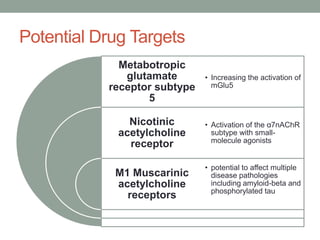
Potential Drug Targets
Metabotropic
glutamate
receptor subtype
5

• Increasing the activation of
mGlu5

Nicotinic
acetylcholine
receptor

• Activation of the α7nAChR
subtype with smallmolecule agonists

M1 Muscarinic
acetylcholine
receptors

• potential to affect multiple
disease pathologies
including amyloid-beta and
phosphorylated tau
Potential Drug Targets
• Indirect cholinergic
5Hydroxytryptamine stimulation through
5-hydroxytryptamine
receptors
(5-HT) receptors
6

Norepinephrine

• Noradrenergic
neurons: vulnerable
during aging

Cyclic adenosine
monophosphate

• cAMP signaling is
increased with aging
Experimental Techniques
• Immunostaining
• Immunoblot
• Indirect ELISA Assay
• Mass spectrometry (MS)-based proteomics

Drug target