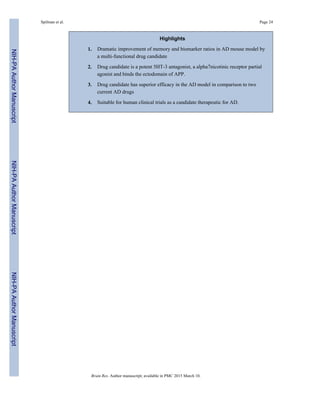
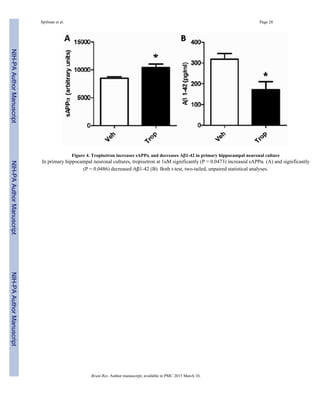
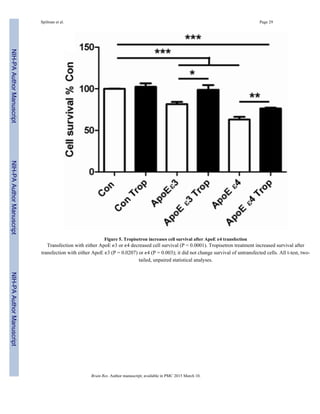
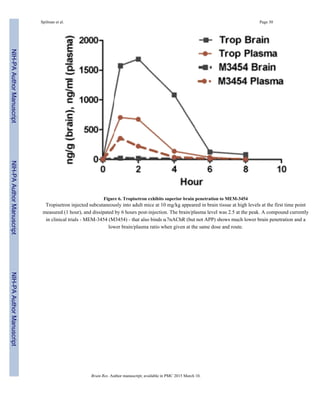
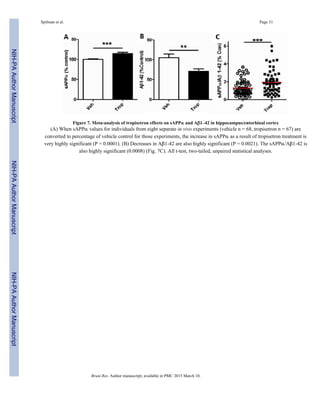
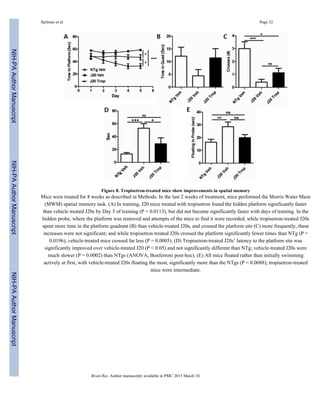
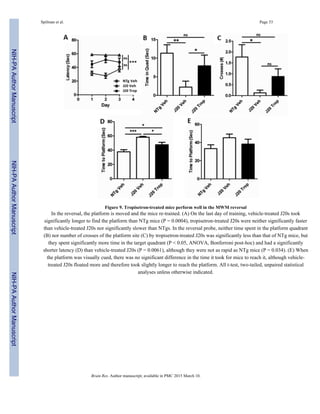
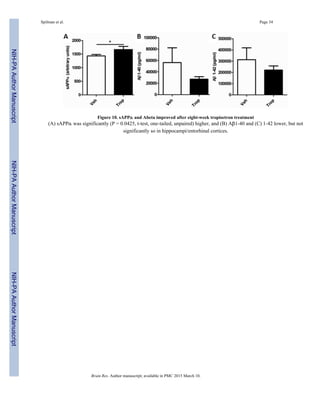
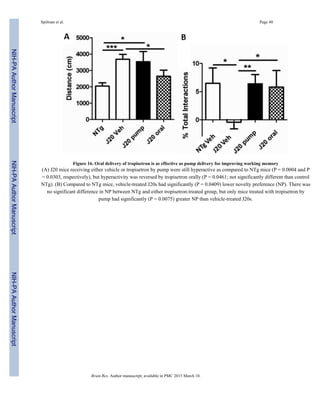
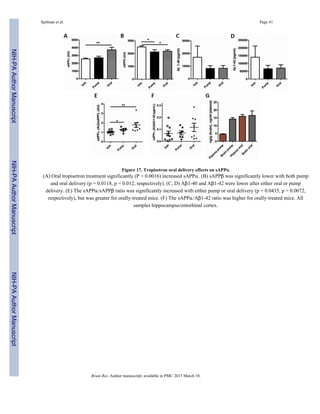
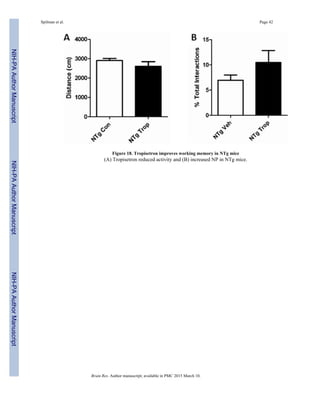
This document summarizes a study that identified the drug tropisetron as a potential therapeutic for Alzheimer's disease (AD) through its ability to increase the ratio of sAPPα to Aβ peptides in the brain. Tropisetron was found to bind to and act on the α7 nicotinic acetylcholine receptor, 5-HT3 serotonin receptor, and amyloid precursor protein (APP). In a mouse model of AD, tropisetron treatment improved memory and normalized aberrant APP processing at a dose equivalent to the current human dose used to treat nausea. The results suggest tropisetron may be suitable for clinical trials in AD and mild cognitive impairment due to its multi-target effects and established safety profile

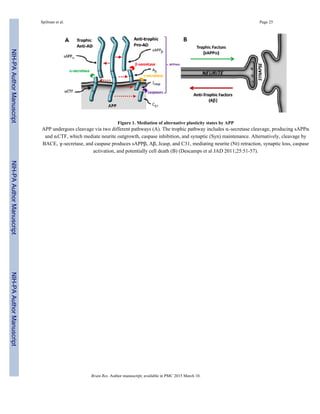
![Such agents would not necessarily target secretases involved in the proteolytic processing of
APP to Aβ or sAPPα directly, but could be pleiotropic in their mechanisms of action. To
identify such compounds we screened a variety of small molecule libraries, including a
clinical compound library comprised of molecules already FDA-approved for other
indications. For our screen, we used a single readout to identify a ‘hit’: an increase in
sAPPα over control. The ‘hits’ then went through secondary assay screening using primary
hippocampal neurons from transgenic (Tg) J20 mice (APPSwe, Ind) mouse embryos. In the
primary cultures, both sAPPα and Aβ1–42 were measured, in order to identify candidates
that increased the sAPPα/Aβ ratio. Compounds that increased the ratio in primary cultures
went into pharmacokinetic analysis for determination of brain uptake, and this was followed
by pharmacodynamic analysis of selected candidates in mouse models of AD. Tropisetron
((1R, 5S)-8-methyl-8-azabicyclo [3.2.1] octan-3-yl 1methyl-indole-3-carboxylate) was a
consistently successful candidate compound in this screen. It underwent initial pilot testing
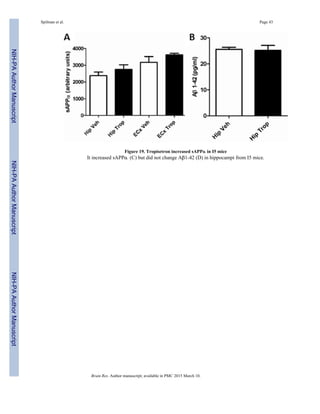
for effects on sAPPα and Aβ in the J20 mouse model. As J20 mice express human APP
with two mutations - Swedish (K670N, M671L) and Indiana (V717F) - we also wished to
determine whether similar biochemical alterations in sAPPα and Aβ could be seen upon
treatment in a model expressing wildtype human APP (the I5 model), since the vast majority
of human patients diagnosed with AD will have the wildtype sequence. (In this model
tropisetron did not decrease the already very low Aβ levels, but did increase sAPPα.)
Subsequent to this, further long-term testing in J20 mice was performed, using mice between
4.5-6 months of age, the time during which Aβ production is amplified and behavioral
abnormalities are present, but prior to overt plaque formation. De novo Aβ production is
more readily discernible from pre-existing plaque-bound Aβ at this stage. The Aβ pathology
is in some aspects akin to the MCI stage of the disease in humans at this point, although it
should be noted that many other AD-like symptoms (e.g., cognitive impairment) and
pathological hallmarks (e.g., increased tau phosphorylation, reduction in calbindin, cFos,
and synapse load) precede plaque formation in these mice (Hsia et al., 1999; Mucke et al.,
2000; Palop et al., 2003). In these mice, short-term working memory and spatial memory
improvements were determined using the Novel Object Recognition (NOR) and the Morris
Water Maze (MWM) tests, respectively. The former became our testing paradigm of choice
as it was found to be a more versatile, rapid, and useful method for pharmacological
development, as has been noted previously (Alkam et al., 2011; Dere et al., 2007; Zhang et
al., 2012).
To compare the efficacy of tropisetron to existing therapeutics for AD directly, additional
testing was done in head-to-head comparisons with the NMDA receptor antagonist
memantine (Namenda) and the acetylcholinesterase inhibitor donepezil (Aricept).
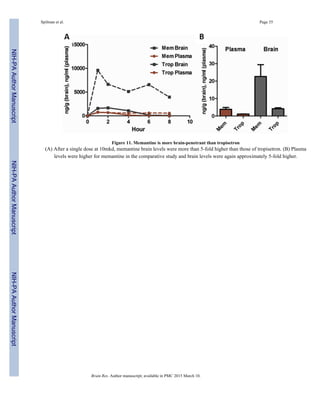
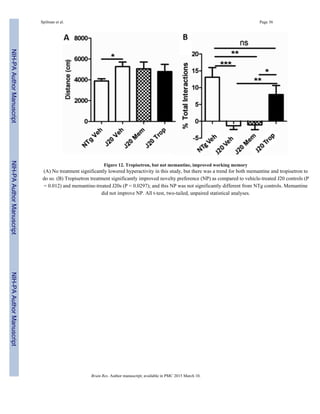
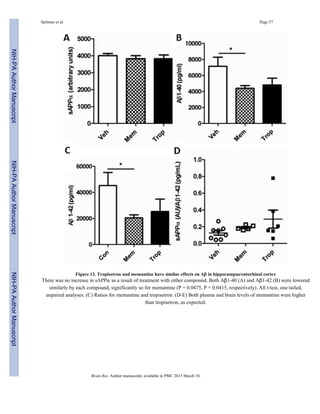
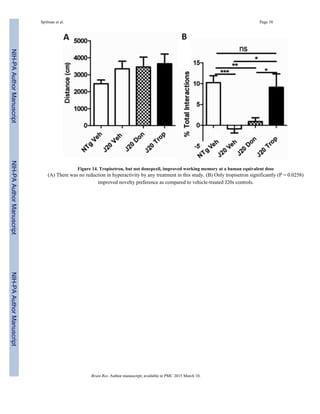
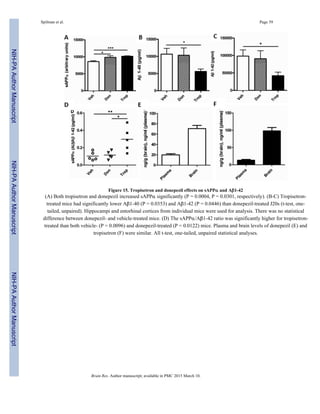
Tropisetron, memantine, and donepezil all improved the sAPPα/Aβ1-42 ratio at similar
doses, but only tropisetron improved working memory. These were subchronic studies using
relatively low doses, and only served to show that under the conditions of these experiments,
tropisetron exerted superior effects on memory.
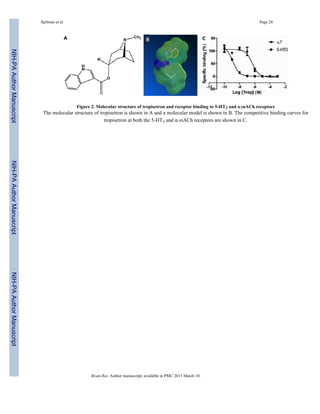
Tropisetron is a dual-receptor binding molecule, and our studies herein (Fig. 2) showed
binding to the 5-HT3 receptor (Ki ~ 3nM) and α7-nicotinic acetylcholine receptor
(α7nAChR) (Ki ~ 470nM). Tropisetron increased the trophic APP peptide ratio upon
Spilman et al. Page 3
Brain Res. Author manuscript; available in PMC 2015 March 10.
NIH-PAAuthorManuscriptNIH-PAAuthorManuscriptNIH-PAAuthorManuscript](https://image.slidesharecdn.com/9e8343de-43a9-4645-b052-74d797eaf974-161106221455/85/Spilman-tropisetron-brain-research-3-320.jpg)
![treatment in our AD mouse model at 0.5 mpk per day. In functional studies, tropisetron has
been shown to be a 5-HT3 antagonist and a partial α7-nicotinic receptor agonist, with low
affinity for other nicotinic receptor subtypes (Macor et al., 2001). In addition to these
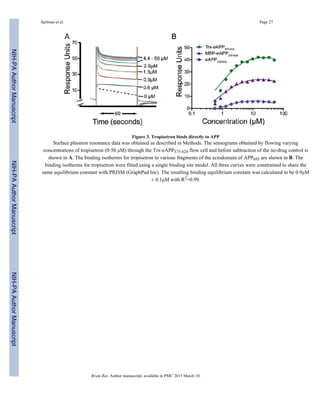
interactions, we determined that tropisetron binds to the ectodomain of APP (Kd ~ 0.9uM,
Fig. 3).
Both α7nAChRs and the 5-HT3 serotonin receptors belong to the Cys-loop ligand-gated ion
channel receptor superfamily; other members of this receptor family include GABAA,
GABAC, and glycine receptors. The α7nAChRs and 5-HT3 receptors are highly expressed in
the frontal cortex and hippocampus, and are believed to play important roles in cognition
and schizophrenia (Barnes and Sharp, 1999). Agonists of α7nAChRs have been shown to
exert neuroprotective and neurotrophic actions, while Aβ binding has been reported to
inhibit the activity of these receptors (Nagele et al., 2002). The 5-HT3 receptor is unique
within the serotonin family of receptors, since all other 5-HT receptors are serpentine G-
protein coupled receptors. Our in vivo screening revealed that a potent 5-HT3 antagonist,
such as tropisetron, that is also an α7nAChR partial agonist, can reverse the AD phenotype
in the mouse model, suggesting a therapeutic role for both of these receptors in the disease.
Nicotinic activity is not general for this class of 5-HT3 receptor antagonists, as two other
high-affinity 5-HT3 receptor antagonists - ondansetron and dolasetron - have no α7nAChR
agonist activity (Toyohara and Hashimoto, 2010). Furthermore, as described below, we also
discovered that tropisetron interacts directly with APP, with a sub-micromolar affinity.
Thus, tropisetron interacts with three receptor targets that potentially modulate the AD
phenotype, and this multi-functional mechanism makes it a unique candidate to develop as a
potential therapeutic for AD and MCI (mild cognitive impairment).
Tropisetron is currently used primarily in the treatment of patients with chemotherapy-
induced or post-operative nausea and vomiting (PONV) (Morrow et al., 1995). Treatment
generally lasts for one week. Tropisetron has an excellent safety profile, is almost
completely absorbed from the gastrointestinal tract after oral dosing, and is highly brain
permeable. After the discovery of tropisetron in our in vitro screens, we hypothesized that
treatment of our AD model mice with a human equivalent dose of tropisetron would be
sufficient to induce both an improvement in memory and normalization of the aberrant APP
processing resulting from the Swedish and Indiana mutations. The results of our studies
presented here support our hypothesis, and suggest that tropisetron is an excellent candidate
for clinical testing in AD and MCI. The data also suggest that other molecules with similar
multifunctional properties (5-HT3R antagonist, α7nAChR agonist, and APP interactor)
could be novel candidates as AD therapeutics.
2. Results
2.1 Tropisetron
Tropisetron is a tropinol ester: (1R, 5S)-8-methyl-8-azabicyclo [3.2.1] octan-3-yl 1methyl-
indole-3-carboxylate hydrochloride (C17H20N2O2) with a molecular weight of 320.82 g/mol
(as the HCl salt form). The chemical structure is shown in Fig. 2A and a molecular model in
Fig. 2B.
Spilman et al. Page 4
Brain Res. Author manuscript; available in PMC 2015 March 10.
NIH-PAAuthorManuscriptNIH-PAAuthorManuscriptNIH-PAAuthorManuscript](https://image.slidesharecdn.com/9e8343de-43a9-4645-b052-74d797eaf974-161106221455/85/Spilman-tropisetron-brain-research-4-320.jpg)
![2.2 Tropisetron receptor binding studies
Tropisetron displaced binding of the α7nAChR antagonist [125I]-α-bungarotoxin (α-bgt),
with a Ki value of 470 nM (n = 3) in SH-SY5Y cells. Our studies also demonstrated
selectivity for α7nAChRs, as it binds α4nACh receptors with a Ki ~ 20uM (n=3) and the
muscle-type nicotinic (α1β1γδ nACh) receptor Ki ~ 15uM (n=3) similar to that reported
previously (Macor et al., 2001). In a binding assay using human recombinant 5-HT3R
expressed in CHO cells, tropisetron was shown to displace [3H]- BRL-43694, a 5-HT3R
selective antagonist. In this study, tropisetron showed high affinity for 5-HT3Rs with a Ki
value of 3 nM (n=3) (Fig. 2C).
2.3 Tropisetron binding to APP
Surface plasmon resonance (SPR) showed that tropisetron bound to APP. Fig. 3A shows
example sensograms obtained with Trx-eAPP575-624 before subtraction of the 0μM
sensogram. Fig. 3B compares the response for all three eAPP fragments. The different
maximal responses reflect the varying amounts of protein cross-linked to the CM5 chip.
TRX-eAPP575-624 was the densest at 11,700 RU, while eAPP230-624 was the least dense.
Comparison of the curves obtained for the three fragments was performed with PRISM
(GraphPad Inc., www.graphpad.com). The curves were fitted to a single-site saturation
binding model in which the background and the non-significant binding contributions were
constrained to be the same for all three proteins. The calculated KD was not significantly
different between the proteins, suggesting that the binding site of ADDN-FO3 is most likely
to be between residues 575-624 of the ectodomain of APP. Constraining the KD to be the
same for all three proteins resulted in a value of 0.9μM ± 0.1 μM with R2=0.99.
2.4 Primary high-throughput screening
We used an AlphaLISA-based HTS formatable primary screening assay where we detected
increases in sAPPα induced by a hit candidate in the cell media. The AlphaLISA-based
primary assay works well with either CHO-7W cells or B103 APP cells stably transfected
with wildtype human APP (APP 770), as well as SH-SY5Y neuroblastoma cells that express
APP endogenously. For the assay that led to the identification of tropisetron, we used
CHO-7W cells. As described in Methods, media from cells treated for 24 hours with
compounds from an FDA-approved clinical compound library were assayed for sAPPα
using a custom AlphaLISA assay and any compound that caused at least a 20% increase in
sAPPα was considered a hit. All compounds were tested in triplicate with a reproducibility
z-value ~ 0.6. The screen had a good signal over background (s/b) ratio of ~3.0. This screen
yielded several initial ‘hits,’ with a hit-rate ~ 0.5%. Tropisetron increased sAPPα in media
from 7W cells by ~ 30%, and was therefore tested in primary neuronal culture.
2.5 Secondary screening in primary hippocampal neuronal culture
As part of our iterative screening approach, hits identified in the primary assay were next
evaluated in the secondary assay using primary neuronal assay. In the J20 model of AD, the
hippocampus (Hip) and entorhinal cortex (ECx) show the most obvious pathological
changes, and therefore hippocampal neurons were used for this secondary screen. As
Spilman et al. Page 5
Brain Res. Author manuscript; available in PMC 2015 March 10.
NIH-PAAuthorManuscriptNIH-PAAuthorManuscriptNIH-PAAuthorManuscript](https://image.slidesharecdn.com/9e8343de-43a9-4645-b052-74d797eaf974-161106221455/85/Spilman-tropisetron-brain-research-5-320.jpg)
![the reduction of Aβ production should also have benefits in AD. Pilot studies have already
been performed using very old (12-15 m.o.) J20 mice, and not only were Aβ and sAPPβ
reduced, but behavior in NOR was improved from pre-treatment baseline (Supplementary
Figs. S3 and S4). Future studies include treatment for a longer duration to be able to
quantify plaque reduction, as well as complete extensive pathological analysis including
calbindin expression, synaptic load, and level of tau phosphorylation.
In summary, our studies show that tropisetron has excellent oral bioavailability, brain
penetration, cognitive effects, and biomarker effects at currently used human equivalent
doses, offering strong support for further evaluation of tropisetron in clinical trials in MCI
and AD patients. Based on these results we have received approval to proceed with clinical
testing of tropisetron in MCI patients. Tropisetron could potentially be useful as a single
agent or in combination with complementary therapeutics for the treatment of Alzheimer’s
disease and MCI.
Materials and Methods
Drugs
Tropisetron hydrochloride was obtained from Tocris Biosciences (cat# 2459) and stored
with moisture absorbent drierite at 4°C. For the in vitro studies tropisetron was prepared as a
1mM stock solution in dimethylsulfoxide (DMSO, SigmaAldrich). For in vivo testing using
subcutaneous injection, tropisetron hydrochloride was dissolved in 100% DMSO to generate
a 5mg/ml stock solution. For Alzet pump studies, tropisetron was dissolved in 25% DMSO
and 75% physiological saline (0.9%, pH 7.8) to give 5mg/ml. MEM3454 was obtained from
Aquila Pharmatech (cat #: 411104). Memantine and donepezil were both purchased from
Sigma-Aldrich (D6821 and M9292, respectively) and were prepared in the same way as
tropisetron.
4.1 In Vitro testing
4.1.1 Receptor saturation and competition binding studies—Saturation binding
analysis of the α7nAChR was carried out using endogenously expressed α7nAChRs in SH-
SY5Y cells with increasing concentrations of the classical antagonist [125I]α-bungarotoxin
(α-Bgt, 0.05nM). The competition assay was performed with 0.1nM-10uM tropisetron. The
non-specific binding was defined by 1uM α-Bgt. Receptor binding for 5-HT3R was assessed
using human recombinant 5-HT3 receptors expressed in CHO cells. Tropisetron was tested
at 0.1nM-10uM to displace [3H]-BRL-43694 (Granisetron; 2 nM), a 5-HT3R selective
antagonist. The non-specific binding was assessed with MDL-72222, a selective 5-HT3R
antagonist and was defined as 10uM. Additional binding studies with α4nACh receptors and
muscle-type nicotinic receptors ((α1β1γδ nACh) were also performed. All of the in vitro
pharmacology studies with tropisetron were done at CEREP (Celle l’Eves cault, France).
4.1.2 Surface plasmon resonance (SPR)—SPR data were obtained with a Biacore
T100 (GE Healthcare); the surfaces of all four flow cells (FC1, FC2, FC3, FC4) of a
carboxymethylated-dextran (CM-5) chip were washed sequentially with 50mM NaOH,
1mM HCl, 0.05% H3PO4, and 20mM sodium phosphate pH 7.4, 125 mM sodium chloride
Spilman et al. Page 12
Brain Res. Author manuscript; available in PMC 2015 March 10.
NIH-PAAuthorManuscriptNIH-PAAuthorManuscriptNIH-PAAuthorManuscript](https://image.slidesharecdn.com/9e8343de-43a9-4645-b052-74d797eaf974-161106221455/85/Spilman-tropisetron-brain-research-12-320.jpg)
![our hands, measurement of a soluble versus non-soluble fraction of Aβ in these very old
mice did not prove to be useful, since very little soluble Aβ could be detected.
Supplementary Material
Refer to Web version on PubMed Central for supplementary material.
Acknowledgments
This research was supported by funding from the Douglas and Ellen Rosenberg Foundation, the Joseph Drown
Foundation, and the NIH (AG034427 to D.E.B.). We thank Rowena Abulencia for her assistance in preparation of
the manuscript. We thank Dr. Barbara Jagodzinska for the tropisetron model. We thank Dr. Edward Koo for
providing the CHO cell line that overexpresses APP (7W) and Dr. Todd Golde for the neural cell line that
overexpresses APP (H4APPwt).
References
Alkam T, Hiramatsu M, Mamiya T, Aoyama Y, Nitta A, Yamada K, Kim HC, Nabeshima T.
Evaluation of object-based attention in mice. Behav Brain Res. 2011; 220:185–93. [PubMed:
21277334]
Aracava Y, Pereira EF, Maelicke A, Albuquerque EX. Memantine blocks alpha7* nicotinic
acetylcholine receptors more potently than n-methyl-D-aspartate receptors in rat hippocampal
neurons. J Pharmacol Exp Ther. 2005; 312:1195–205. [PubMed: 15522999]
Barnes NM, Sharp T. A review of central 5-HT receptors and their function. Neuropharmacology.
1999; 38:1083–152. [PubMed: 10462127]
Bevins RA, Besheer J. Object recognition in rats and mice: a one-trial non-matching-to-sample
learning task to study ‘recognition memory’. Nat Protoc. 2006; 1:1306–11. [PubMed: 17406415]
Bianchi C, Siniscalchi A, Beani L. 5-HT1A agonists increase and 5-HT3 agonists decrease
acetylcholine efflux from the cerebral cortex of freely-moving guinea-pigs. Br J Pharmacol. 1990;
101:448–52. [PubMed: 2147866]
Bredesen DE. Neurodegeneration in Alzheimer’s disease: caspases and synaptic element
interdependence. Mol Neurodegener. 2009; 4:27. [PubMed: 19558683]
Chen G, Chen KS, Knox J, Inglis J, Bernard A, Martin SJ, Justice A, McConlogue L, Games D,
Freedman SB, Morris RG. A learning deficit related to age and beta-amyloid plaques in a mouse
model of Alzheimer’s disease. Nature. 2000; 408:975–9. [PubMed: 11140684]
Cheng IH, Scearce-Levie K, Legleiter J, Palop JJ, Gerstein H, Bien-Ly N, Puolivali J, Lesne S, Ashe
KH, Muchowski PJ, Mucke L. Accelerating amyloid-beta fibrillization reduces oligomer levels and
functional deficits in Alzheimer disease mouse models. J Biol Chem. 2007; 282:23818–28.
[PubMed: 17548355]
Claasen AM, Guevremont D, Mason-Parker SE, Bourne K, Tate WP, Abraham WC, Williams JM.
Secreted amyloid precursor protein-alpha upregulates synaptic protein synthesis by a protein kinase
G-dependent mechanism. Neurosci Lett. 2009; 460:92–6. [PubMed: 19463893]
Dere E, Huston JP, De Souza Silva MA. The pharmacology, neuroanatomy and neurogenetics of one-
trial object recognition in rodents. Neurosci Biobehav Rev. 2007; 31:673–704. [PubMed:
17368764]
Dong H, Csernansky CA, Martin MV, Bertchume A, Vallera D, Csernansky JG. Acetylcholinesterase
inhibitors ameliorate behavioral deficits in the Tg2576 mouse model of Alzheimer’s disease.
Psychopharmacology (Berl). 2005; 181:145–52. [PubMed: 15778881]
Doody RS, Corey-Bloom J, Zhang R, Li H, Ieni J, Schindler R. Safety and tolerability of donepezil at
doses up to 20 mg/day: results from a pilot study in patients with Alzheimer’s disease. Drugs
Aging. 2008; 25:163–74. [PubMed: 18257603]
Flores CM, Rogers SW, Pabreza LA, Wolfe BB, Kellar KJ. A subtype of nicotinic cholinergic receptor
in rat brain is composed of alpha 4 and beta 2 subunits and is up-regulated by chronic nicotine
treatment. Mol Pharmacol. 1992; 41:31–7. [PubMed: 1732720]
Spilman et al. Page 19
Brain Res. Author manuscript; available in PMC 2015 March 10.
NIH-PAAuthorManuscriptNIH-PAAuthorManuscriptNIH-PAAuthorManuscript](https://image.slidesharecdn.com/9e8343de-43a9-4645-b052-74d797eaf974-161106221455/85/Spilman-tropisetron-brain-research-19-320.jpg)
![Garbe C, Drechsler S, Fiedler H, Tilgen W, Landthaler M, Schroeder K, Kuehne KH, Faerber L. Dose
comparison of tropisetron (Navoban) 5 mg and 10 mg orally in the prophylaxis of dacarbazine-
induced nausea and emesis. Semin Oncol. 1994; 21:12–6. [PubMed: 9113121]
Hodges H, Sowinski P, Turner JJ, Fletcher A. Comparison of the effects of the 5-HT3 receptor
antagonists WAY-100579 and ondansetron on spatial learning in the water maze in rats with
excitotoxic lesions of the forebrain cholinergic projection system. Psychopharmacology (Berl).
1996; 125:146–61. [PubMed: 8783389]
Holmes C, Boche D, Wilkinson D, Yadegarfar G, Hopkins V, Bayer A, Jones RW, Bullock R, Love S,
Neal JW, Zotova E, Nicoll JA. Long-term effects of Abeta42 immunisation in Alzheimer’s
disease: follow-up of a randomised, placebo-controlled phase I trial. Lancet. 2008; 372:216–23.
[PubMed: 18640458]
Holtzman DM, Morris JC, Goate AM. Alzheimer’s disease: the challenge of the second century. Sci
Transl Med. 2011; 3:77sr1. [PubMed: 21471435]
Hsia AY, Masliah E, McConlogue L, Yu GQ, Tatsuno G, Hu K, Kholodenko D, Malenka RC, Nicoll
RA, Mucke L. Plaque-independent disruption of neural circuits in Alzheimer’s disease mouse
models. Proc Natl Acad Sci U S A. 1999; 96:3228–33. [PubMed: 10077666]
Ju Yeon B, Yeon Hee S. Blockade of 5-HT(3) receptor with MDL 72222 and Y 25130 reduces beta-
amyloid protein (25--35)-induced neurotoxicity in cultured rat cortical neurons. Eur J Pharmacol.
2005; 520:12–21. [PubMed: 16150439]
Kawa K. Distribution and functional properties of 5-HT3 receptors in the rat hippocampal dentate
gyrus: a patch-clamp study. J Neurophysiol. 1994; 71:1935–47. [PubMed: 7520482]
Klunk WE, Mathis CA, Price JC, Lopresti BJ, DeKosky ST. Two-year follow-up of amyloid
deposition in patients with Alzheimer’s disease. Brain. 2006; 129:2805–7. [PubMed: 17071918]
Lee DH, Wang HY. Differential physiologic responses of alpha7 nicotinic acetylcholine receptors to
beta-amyloid1-40 and beta-amyloid1-42. J Neurobiol. 2003; 55:25–30. [PubMed: 12605456]
Libeu CP, Poksay KS, John V, Bredesen DE. Structural and Functional Alterations in Amyloid-beta
Precursor Protein Induced by Amyloid-beta Peptides. J Alzheimers Dis. 2011; 25:547–66.
[PubMed: 21471643]
Macor JE, Gurley D, Lanthorn T, Loch J, Mack RA, Mullen G, Tran O, Wright N, Gordon JC. The 5-
HT3 antagonist tropisetron (ICS 205-930) is a potent and selective alpha7 nicotinic receptor partial
agonist. Bioorg Med Chem Lett. 2001; 11:319–21. [PubMed: 11212100]
Marcello E, Saraceno C, Musardo S, Vara H, de la Fuente AG, Pelucchi S, Di Marino D, Borroni B,
Tramontano A, Perez-Otano I, Padovani A, Giustetto M, Gardoni F, Di Luca M. Endocytosis of
synaptic ADAM10 in neuronal plasticity and Alzheimer’s disease. J Clin Invest. 2013; 123:2523–
38. [PubMed: 23676497]
Marrero MB, Papke RL, Bhatti BS, Shaw S, Bencherif M. The neuroprotective effect of 2-(3-
pyridyl)-1-azabicyclo[3.2.2]nonane (TC-1698), a novel alpha7 ligand, is prevented through
angiotensin II activation of a tyrosine phosphatase. J Pharmacol Exp Ther. 2004; 309:16–27.
[PubMed: 14722323]
Mintun MA, Larossa GN, Sheline YI, Dence CS, Lee SY, Mach RH, Klunk WE, Mathis CA,
DeKosky ST, Morris JC. [11C]PIB in a nondemented population: potential antecedent marker of
Alzheimer disease. Neurology. 2006; 67:446–52. [PubMed: 16894106]
Morales M, Battenberg E, de Lecea L, Sanna PP, Bloom FE. Cellular and subcellular
immunolocalization of the type 3 serotonin receptor in the rat central nervous system. Brain Res
Mol Brain Res. 1996; 36:251–60. [PubMed: 8965645]
Morales M, Bloom FE. The 5-HT3 receptor is present in different subpopulations of GABAergic
neurons in the rat telencephalon. J Neurosci. 1997; 17:3157–67. [PubMed: 9096150]
Morris JC, Price JL. Pathologic correlates of nondemented aging, mild cognitive impairment, and
early-stage Alzheimer’s disease. J Mol Neurosci. 2001; 17:101–18. [PubMed: 11816784]
Morris R. Developments of a water-maze procedure for studying spatial learning in the rat. J Neurosci
Methods. 1984; 11:47–60. [PubMed: 6471907]
Morrow GR, Hickok JT, Rosenthal SN. Progress in reducing nausea and emesis. Comparisons of
ondansetron (Zofran), granisetron (Kytril), and tropisetron (Navoban). Cancer. 1995; 76:343–57.
[PubMed: 8625113]
Spilman et al. Page 20
Brain Res. Author manuscript; available in PMC 2015 March 10.
NIH-PAAuthorManuscriptNIH-PAAuthorManuscriptNIH-PAAuthorManuscript](https://image.slidesharecdn.com/9e8343de-43a9-4645-b052-74d797eaf974-161106221455/85/Spilman-tropisetron-brain-research-20-320.jpg)
![Mucke L, Masliah E, Yu GQ, Mallory M, Rockenstein EM, Tatsuno G, Hu K, Kholodenko D,
Johnson-Wood K, McConlogue L. High-level neuronal expression of abeta 1-42 in wild-type
human amyloid protein precursor transgenic mice: synaptotoxicity without plaque formation. J
Neurosci. 2000; 20:4050–8. [PubMed: 10818140]
Nagele RG, D’Andrea MR, Anderson WJ, Wang HY. Intracellular accumulation of beta-
amyloid(1-42) in neurons is facilitated by the alpha 7 nicotinic acetylcholine receptor in
Alzheimer’s disease. Neuroscience. 2002; 110:199–211. [PubMed: 11958863]
Orgogozo JM, Gilman S, Dartigues JF, Laurent B, Puel M, Kirby LC, Jouanny P, Dubois B, Eisner L,
Flitman S, Michel BF, Boada M, Frank A, Hock C. Subacute meningoencephalitis in a subset of
patients with AD after Abeta42 immunization. Neurology. 2003; 61:46–54. [PubMed: 12847155]
Palop JJ, Jones B, Kekonius L, Chin J, Yu GQ, Raber J, Masliah E, Mucke L. Neuronal depletion of
calcium-dependent proteins in the dentate gyrus is tightly linked to Alzheimer’s disease-related
cognitive deficits. Proc Natl Acad Sci U S A. 2003; 100:9572–7. [PubMed: 12881482]
Parsons CG, Danysz W, Quack G. Memantine is a clinically well tolerated N-methyl-D-aspartate
(NMDA) receptor antagonist--a review of preclinical data. Neuropharmacology. 1999; 38:735–67.
[PubMed: 10465680]
Piguet P, Galvan M. Transient and long-lasting actions of 5-HT on rat dentate gyrus neurones in vitro.
J Physiol. 1994; 481(Pt 3):629–39. [PubMed: 7707231]
Pitsikas N, Brambilla A, Borsini F. DAU 6215, a novel 5-HT3 receptor antagonist, improves
performance in the aged rat in the Morris water maze task. Neurobiol Aging. 1993; 14:561–4.
[PubMed: 8295658]
Prickaerts J, van Goethem NP, Chesworth R, Shapiro G, Boess FG, Methfessel C, Reneerkens OA,
Flood DG, Hilt D, Gawryl M, Bertrand S, Bertrand D, Konig G. EVP-6124, a novel and selective
alpha7 nicotinic acetylcholine receptor partial agonist, improves memory performance by
potentiating the acetylcholine response of alpha7 nicotinic acetylcholine receptors.
Neuropharmacology. 2012; 62:1099–110. [PubMed: 22085888]
Rakonczay Z. Potencies and selectivities of inhibitors of acetylcholinesterase and its molecular forms
in normal and Alzheimer’s disease brain. Acta Biol Hung. 2003; 54:183–9. [PubMed: 14535624]
Rammes G, Rupprecht R, Ferrari U, Zieglgansberger W, Parsons CG. The N-methyl-D-aspartate
receptor channel blockers memantine, MRZ 2/579 and other amino-alkyl-cyclohexanes antagonise
5-HT(3) receptor currents in cultured HEK-293 and N1E-115 cell systems in a non-competitive
manner. Neurosci Lett. 2001; 306:81–4. [PubMed: 11403963]
Reagan-Shaw S, Nihal M, Ahmad N. Dose translation from animal to human studies revisited. FASEB
J. 2008; 22:659–61. [PubMed: 17942826]
Revah F, Bertrand D, Galzi JL, Devillers-Thiery A, Mulle C, Hussy N, Bertrand S, Ballivet M,
Changeux JP. Mutations in the channel domain alter desensitization of a neuronal nicotinic
receptor. Nature. 1991; 353:846–9. [PubMed: 1719423]
Ropert N, Guy N. Serotonin facilitates GABAergic transmission in the CA1 region of rat hippocampus
in vitro. J Physiol. 1991; 441:121–36. [PubMed: 1687746]
Sabbagh MN. Drug development for Alzheimer’s disease: where are we now and where are we
headed? Am J Geriatr Pharmacother. 2009; 7:167–85. [PubMed: 19616185]
Seguela P, Wadiche J, Dineley-Miller K, Dani JA, Patrick JW. Molecular cloning, functional
properties, and distribution of rat brain alpha 7: a nicotinic cation channel highly permeable to
calcium. J Neurosci. 1993; 13:596–604. [PubMed: 7678857]
Serrano-Pozo A, William CM, Ferrer I, Uro-Coste E, Delisle MB, Maurage CA, Hock C, Nitsch RM,
Masliah E, Growdon JH, Frosch MP, Hyman BT. Beneficial effect of human anti-amyloid-beta
active immunization on neurite morphology and tau pathology. Brain. 2010; 133:1312–27.
[PubMed: 20360050]
Shimohama S, Kihara T. Nicotinic receptor-mediated protection against beta-amyloid neurotoxicity.
Biol Psychiatry. 2001; 49:233–9. [PubMed: 11230874]
Simpson K, Spencer CM, McClellan KJ. Tropisetron: an update of its use in the prevention of
chemotherapy-induced nausea and vomiting. Drugs. 2000; 59:1297–315. [PubMed: 10882164]
Sine SM, Engel AG. Recent advances in Cys-loop receptor structure and function. Nature. 2006;
440:448–55. [PubMed: 16554804]
Spilman et al. Page 21
Brain Res. Author manuscript; available in PMC 2015 March 10.
NIH-PAAuthorManuscriptNIH-PAAuthorManuscriptNIH-PAAuthorManuscript](https://image.slidesharecdn.com/9e8343de-43a9-4645-b052-74d797eaf974-161106221455/85/Spilman-tropisetron-brain-research-21-320.jpg)
![Strittmatter WJ, Roses AD. Apolipoprotein E and Alzheimer’s disease. Annu Rev Neurosci. 1996;
19:53–77. [PubMed: 8833436]
Sugaya K, Giacobini E, Chiappinelli VA. Nicotinic acetylcholine receptor subtypes in human frontal
cortex: changes in Alzheimer’s disease. J Neurosci Res. 1990; 27:349–59. [PubMed: 2097379]
Tecott LH, Maricq AV, Julius D. Nervous system distribution of the serotonin 5-HT3 receptor mRNA.
Proc Natl Acad Sci U S A. 1993; 90:1430–4. [PubMed: 8434003]
Theendakara V, Patent A, Peters-Libeu C, Philpot B, Flores S, Descamps O, Poksay K, Zhang Q,
Cailing G, Hart M, John V, Rao R, Bredesen D. Neuroprotective sirtuin ratio reversed by ApoE4.
PNAS. 2013
Thompson AJ, Lummis SC. The 5-HT3 receptor as a therapeutic target. Expert Opin Ther Targets.
2007; 11:527–40. [PubMed: 17373882]
Tietje KR, Anderson DJ, Bitner RS, Blomme EA, Brackemeyer PJ, Briggs CA, Browman KE, Bury D,
Curzon P, Drescher KU, Frost JM, Fryer RM, Fox GB, Gronlien JH, Hakerud M, Gubbins EJ,
Halm S, Harris R, Helfrich RJ, Kohlhaas KL, Law D, Malysz J, Marsh KC, Martin RL, Meyer
MD, Molesky AL, Nikkel AL, Otte S, Pan L, Puttfarcken PS, Radek RJ, Robb HM, Spies E,
Thorin-Hagene K, Waring JF, Ween H, Xu H, Gopalakrishnan M, Bunnelle WH. Preclinical
characterization of A-582941: a novel alpha7 neuronal nicotinic receptor agonist with broad
spectrum cognition-enhancing properties. CNS Neurosci Ther. 2008; 14:65–82. [PubMed:
18482100]
Tiseo PJ, Foley K, Friedhoff LT. The effect of multiple doses of donepezil HCl on the
pharmacokinetic and pharmacodynamic profile of warfarin. Br J Clin Pharmacol. 1998; 46(Suppl
1):45–50. [PubMed: 9839766]
Toyohara J, Hashimoto K. alpha7 Nicotinic Receptor Agonists: Potential Therapeutic Drugs for
Treatment of Cognitive Impairments in Schizophrenia and Alzheimer’s Disease. Open Med Chem
J. 2010; 4:37–56. [PubMed: 21249164]
Van Dam D, Coen K, De Deyn PP. Cognitive evaluation of disease-modifying efficacy of donepezil in
the APP23 mouse model for Alzheimer’s disease. Psychopharmacology (Berl). 2008; 197:37–43.
[PubMed: 18008065]
Wallace TL, Callahan PM, Tehim A, Bertrand D, Tombaugh G, Wang S, Xie W, Rowe WB, Ong V,
Graham E, Terry AV Jr, Rodefer JS, Herbert B, Murray M, Porter R, Santarelli L, Lowe DA.
RG3487, a novel nicotinic alpha7 receptor partial agonist, improves cognition and sensorimotor
gating in rodents. J Pharmacol Exp Ther. 2011; 336:242–53. [PubMed: 20959364]
Wang HY, Lee DH, D’Andrea MR, Peterson PA, Shank RP, Reitz AB. beta-Amyloid(1-42) binds to
alpha7 nicotinic acetylcholine receptor with high affinity. Implications for Alzheimer’s disease
pathology. J Biol Chem. 2000; 275:5626–32. [PubMed: 10681545]
Wang HY, Li W, Benedetti NJ, Lee DH. Alpha 7 nicotinic acetylcholine receptors mediate beta-
amyloid peptide-induced tau protein phosphorylation. J Biol Chem. 2003; 278:31547–53.
[PubMed: 12801934]
Zhang R, Xue G, Wang S, Zhang L, Shi C, Xie X. Novel object recognition as a facile behavior test
for evaluating drug effects in AbetaPP/PS1 Alzheimer’s disease mouse model. J Alzheimers Dis.
2012; 31:801–12. [PubMed: 22710911]
Abbreviations
AD Alzheimer’s Disease
APP Amyloid precursor protein
Aβ amyloid beta
sAPPα soluble amyloid precursor protein alpha
sAPPβ soluble amyloid precursor protein beta
CHO 7W Chinese hamster ovary cells stably transfected with human APP wildtype
Spilman et al. Page 22
Brain Res. Author manuscript; available in PMC 2015 March 10.
NIH-PAAuthorManuscriptNIH-PAAuthorManuscriptNIH-PAAuthorManuscript](https://image.slidesharecdn.com/9e8343de-43a9-4645-b052-74d797eaf974-161106221455/85/Spilman-tropisetron-brain-research-22-320.jpg)