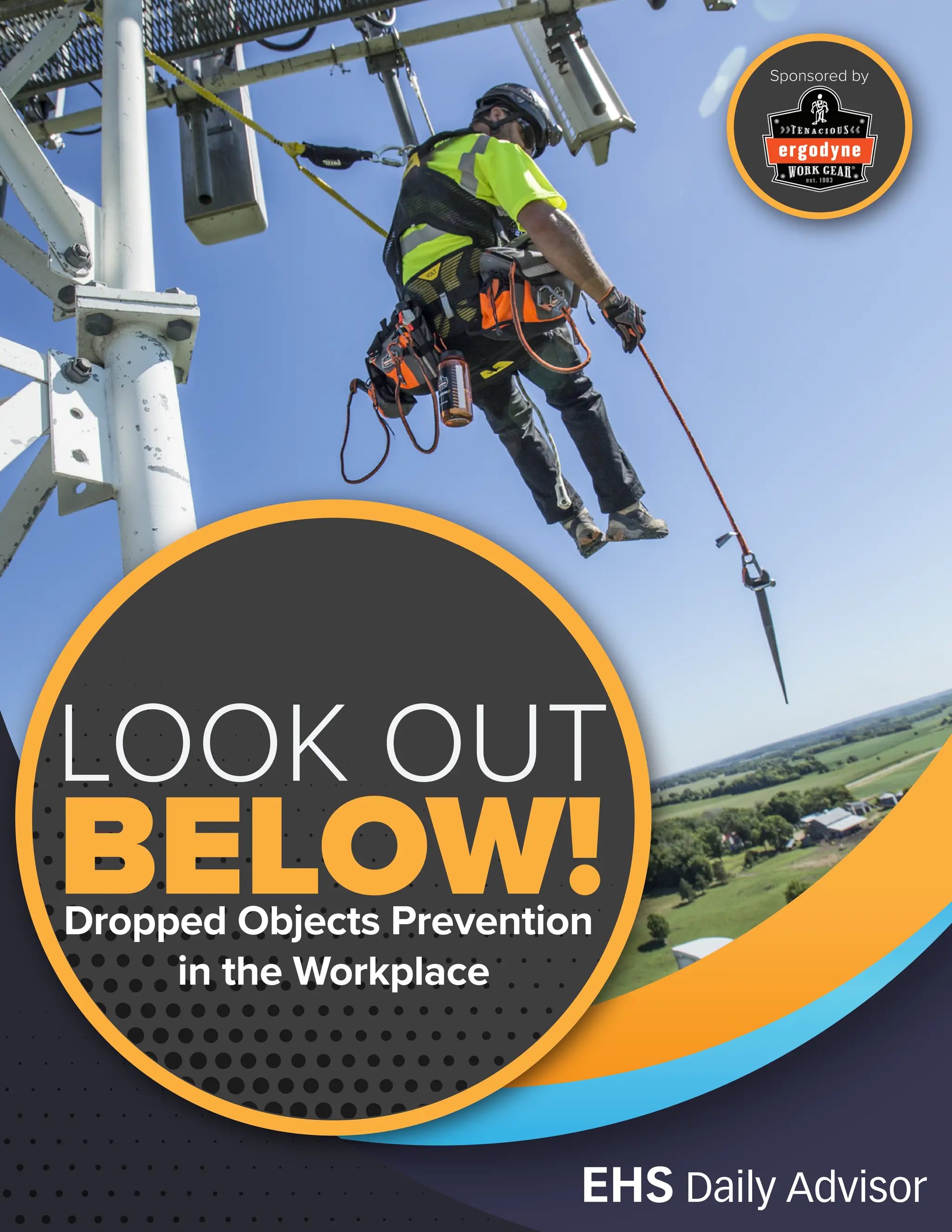
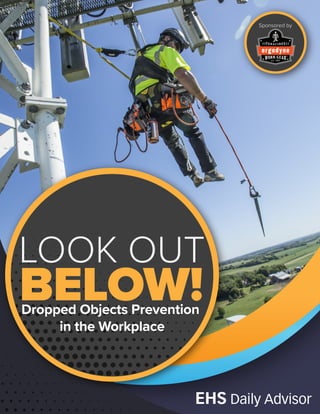
LOOK OUT
BELOW!
Dropped Objects Prevention
in the Workplace
Sponsored by
2
ABOUT THE DROPPED OBJECTS
PREVENTION SURVEY
Our Dropped Objects Prevention Survey sponsored
by Ergodyne® was launched in March 2019 and by
the time the survey closed over one month later, 370
environmental, health, and safety (EHS) professionals
had shared their insights into how their companies are
addressing the hazards presented by objects dropped
from height.
Ergodyne and the EHS Daily Advisor Research Team
would like to thank all of the professionals who chose
to participate in the survey, and also to our readers for
their interest in making their workplaces safer for all
employees.
All percentages in the following report have been
rounded to the nearest whole percent. If you have any
questions or comments about the survey, its data, or the
report, please let us know via e-mail at
media@simplifycompliance.com.
ABOUT ERGODYNE
Since 1983, Ergodyne has pioneered the development
of products that Make The Workplace A Betterplace™.
What started with just one product has grown into a line
of top flight, battle-tested, Tenacious Work Gear®; all
precision crafted to provide protection, promote preven-
tion, and manage the elements for workers on jobsites
the world over.
3
CONTENTS
About the Dropped Objects Prevention Survey....................2
Dropped Objects Prevention Survey Results........................4
Dropped Object Incidents................................................................................... 4
Do You Have a Prevention Plan?...................................................................... 5
The Dropped Objects Standard........................................................................ 6
Tools and Instrumentation....................................................................................7
Dropped Objects and PPE Training................................................................. 8
How Serious Is the Safety Issue?.....................................................................10
Who Responded?....................................................................... 11
A Message from Our Sponsor................................................ 12
4
DROPPED OBJECT INCIDENTS
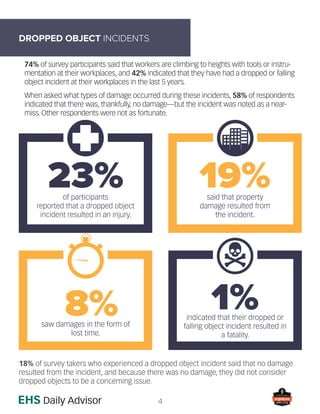
74% of survey participants said that workers are climbing to heights with tools or instru-
mentation at their workplaces, and 42% indicated that they have had a dropped or falling
object incident at their workplaces in the last 5 years.
When asked what types of damage occurred during these incidents, 58% of respondents
indicated that there was, thankfully, no damage—but the incident was noted as a near-
miss. Other respondents were not as fortunate.
18% of survey takers who experienced a dropped object incident said that no damage
resulted from the incident, and because there was no damage, they did not consider
dropped objects to be a concerning issue.
23% 19%
8% 1%
of participants
reported that a dropped object
incident resulted in an injury.
said that property
damage resulted from
the incident.
saw damages in the form of
lost time.
indicated that their dropped or
falling object incident resulted in
a fatality.
5
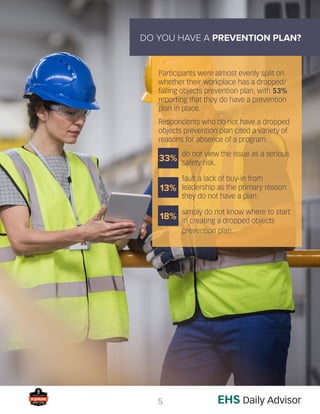
DO YOU HAVE A PREVENTION PLAN?
Participants were almost evenly split on
whether their workplace has a dropped/
falling objects prevention plan, with 53%
reporting that they do have a prevention
plan in place.
Respondents who do not have a dropped
objects prevention plan cited a variety of
reasons for absence of a program.
do not view the issue as a serious
safety risk.
fault a lack of buy-in from
leadership as the primary reason
they do not have a plan.
simply do not know where to start
in creating a dropped objects
prevention plan.
33%
13%
18%
6
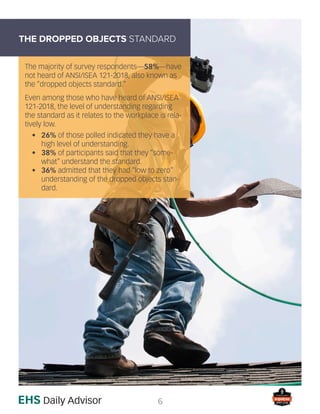
The majority of survey respondents—58%—have
not heard of ANSI/ISEA 121-2018, also known as
the “dropped objects standard.”
Even among those who have heard of ANSI/ISEA
121-2018, the level of understanding regarding
the standard as it relates to the workplace is rela-
tively low.
• 26% of those polled indicated they have a
high level of understanding.
• 38% of participants said that they “some-
what” understand the standard.
• 36% admitted that they had “low to zero”
understanding of the dropped objects stan-
dard.
THE DROPPED OBJECTS STANDARD
7
TOOLS AND INSTRUMENTATION
Tools and instrumentation typically do not
come without concerns, however. While
24% of participants said they had no con-
cerns regarding tethering tools and instru-
mentation, four other concerns regarding
these dropped object prevention devices
stood out within the response pool.
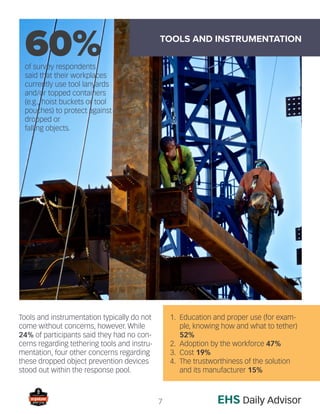
of survey respondents
said that their workplaces
currently use tool lanyards
and/or topped containers
(e.g., hoist buckets or tool
pouches) to protect against
dropped or
falling objects.
1. Education and proper use (for exam-
ple, knowing how and what to tether)
52%
2. Adoption by the workforce 47%
3. Cost 19%
4. The trustworthiness of the solution
and its manufacturer 15%
60%
8
DROPPED OBJECTS AND
PPE TRAINING
92% of survey participants indicated they
have some role in safety, PPE, and/or
dropped objects prevention training and
education, whether it be educating man-
agement about safety/PPE programs; plan-
ning, developing, and delivering training to
workers; or providing training and educa-
tion to both employees and management.
The majority of respondents also had gen-
erally positive views of their training efforts
surrounding dropped or falling objects
prevention.
agreed or strongly agreed that their
employees have a strong level of
knowledge regarding dropped/
falling objects prevention.
agreed or strongly agreed that their
companies have regular, ongoing,
and complete training opportunities
for new workers on dropped/falling
objects prevention.
agreed or strongly agreed that their
companies provide periodic re-
fresher courses in dropped/falling
objects prevention for all workers.
agreed or strongly agreed that
dropped/falling objects prevention
is frequently discussed in toolbox
talks or general safety training at
their organizations.
73%
59%
58%
65%
9
DROPPED OBJECTS AND
PPE TRAINING
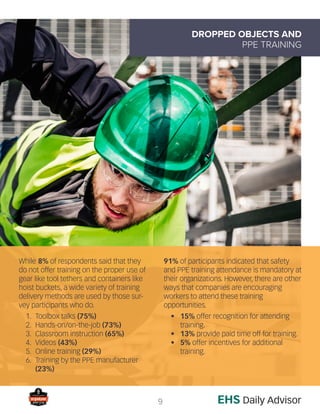
While 8% of respondents said that they
do not offer training on the proper use of
gear like tool tethers and containers like
hoist buckets, a wide variety of training
delivery methods are used by those sur-
vey participants who do.
1. Toolbox talks (75%)
2. Hands-on/on-the-job (73%)
3. Classroom instruction (65%)
4. Videos (43%)
5. Online training (29%)
6. Training by the PPE manufacturer
(23%)
91% of participants indicated that safety
and PPE training attendance is mandatory at
their organizations. However, there are other
ways that companies are encouraging
workers to attend these training
opportunities.
• 15% offer recognition for attending
training.
• 13% provide paid time off for training.
• 5% offer incentives for additional
training.
10
HOW SERIOUS IS THE
SAFETY ISSUE?
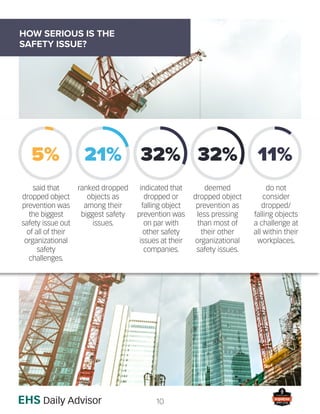
5% 21% 32% 32% 11%
said that
dropped object
prevention was
the biggest
safety issue out
of all of their
organizational
safety
challenges.
ranked dropped
objects as
among their
biggest safety
issues.
indicated that
dropped or
falling object
prevention was
on par with
other safety
issues at their
companies.
deemed
dropped object
prevention as
less pressing
than most of
their other
organizational
safety issues.
do not
consider
dropped/
falling objects
a challenge at
all within their
workplaces.
11
WHO RESPONDED?
The 370 participants in the Dropped Ob-
jects Prevention Survey work in a variety of
job positions, the majority of whom (56%)
are Safety or EHS managers. A further
12% of respondents are directors of Safe-
ty, EHS, or human resources (HR), 9% are
staff-level employees, and 7% are frontline
supervisors. The rest of the response pool
was made up of executives (VPs or high-
er), managers of departments outside of
the EHS function, purchasing/procurement
staff, lab safety/chemical protection spe-
cialists, and consultants/contractors.
40% of respondents work at organizations
that employ 500 or more employees, while
35% reported from smaller companies of
99 or fewer employees. The remaining 25%
work at businesses that employ between
100 and 499 workers.
The top industry represented in the survey
was manufacturing, which made up 27%
of the response pool. Other industries with
a strong presence in the Dropped Objects
Prevention Survey included construction
(25%), oil and gas (11%), and power genera-
tion and/or distribution (6%).
A large portion of respondents (9%) spec-
ified other industries of which they are a
part, including:
• Facilities
• Entertainment
• Mining
• Agricultural
DroppedObjectsPrevention and safety requirements

DroppedObjectsPrevention and safety requirements

  • 1.
    LOOK OUT BELOW! Dropped ObjectsPrevention in the Workplace Sponsored by
  • 2.
    2 ABOUT THE DROPPEDOBJECTS PREVENTION SURVEY Our Dropped Objects Prevention Survey sponsored by Ergodyne® was launched in March 2019 and by the time the survey closed over one month later, 370 environmental, health, and safety (EHS) professionals had shared their insights into how their companies are addressing the hazards presented by objects dropped from height. Ergodyne and the EHS Daily Advisor Research Team would like to thank all of the professionals who chose to participate in the survey, and also to our readers for their interest in making their workplaces safer for all employees. All percentages in the following report have been rounded to the nearest whole percent. If you have any questions or comments about the survey, its data, or the report, please let us know via e-mail at media@simplifycompliance.com. ABOUT ERGODYNE Since 1983, Ergodyne has pioneered the development of products that Make The Workplace A Betterplace™. What started with just one product has grown into a line of top flight, battle-tested, Tenacious Work Gear®; all precision crafted to provide protection, promote preven- tion, and manage the elements for workers on jobsites the world over.
  • 3.
    3 CONTENTS About the DroppedObjects Prevention Survey....................2 Dropped Objects Prevention Survey Results........................4 Dropped Object Incidents................................................................................... 4 Do You Have a Prevention Plan?...................................................................... 5 The Dropped Objects Standard........................................................................ 6 Tools and Instrumentation....................................................................................7 Dropped Objects and PPE Training................................................................. 8 How Serious Is the Safety Issue?.....................................................................10 Who Responded?....................................................................... 11 A Message from Our Sponsor................................................ 12
  • 4.
    4 DROPPED OBJECT INCIDENTS 74%of survey participants said that workers are climbing to heights with tools or instru- mentation at their workplaces, and 42% indicated that they have had a dropped or falling object incident at their workplaces in the last 5 years. When asked what types of damage occurred during these incidents, 58% of respondents indicated that there was, thankfully, no damage—but the incident was noted as a near- miss. Other respondents were not as fortunate. 18% of survey takers who experienced a dropped object incident said that no damage resulted from the incident, and because there was no damage, they did not consider dropped objects to be a concerning issue. 23% 19% 8% 1% of participants reported that a dropped object incident resulted in an injury. said that property damage resulted from the incident. saw damages in the form of lost time. indicated that their dropped or falling object incident resulted in a fatality.
  • 5.
    5 DO YOU HAVEA PREVENTION PLAN? Participants were almost evenly split on whether their workplace has a dropped/ falling objects prevention plan, with 53% reporting that they do have a prevention plan in place. Respondents who do not have a dropped objects prevention plan cited a variety of reasons for absence of a program. do not view the issue as a serious safety risk. fault a lack of buy-in from leadership as the primary reason they do not have a plan. simply do not know where to start in creating a dropped objects prevention plan. 33% 13% 18%
  • 6.
    6 The majority ofsurvey respondents—58%—have not heard of ANSI/ISEA 121-2018, also known as the “dropped objects standard.” Even among those who have heard of ANSI/ISEA 121-2018, the level of understanding regarding the standard as it relates to the workplace is rela- tively low. • 26% of those polled indicated they have a high level of understanding. • 38% of participants said that they “some- what” understand the standard. • 36% admitted that they had “low to zero” understanding of the dropped objects stan- dard. THE DROPPED OBJECTS STANDARD
  • 7.
    7 TOOLS AND INSTRUMENTATION Toolsand instrumentation typically do not come without concerns, however. While 24% of participants said they had no con- cerns regarding tethering tools and instru- mentation, four other concerns regarding these dropped object prevention devices stood out within the response pool. of survey respondents said that their workplaces currently use tool lanyards and/or topped containers (e.g., hoist buckets or tool pouches) to protect against dropped or falling objects. 1. Education and proper use (for exam- ple, knowing how and what to tether) 52% 2. Adoption by the workforce 47% 3. Cost 19% 4. The trustworthiness of the solution and its manufacturer 15% 60%
  • 8.
    8 DROPPED OBJECTS AND PPETRAINING 92% of survey participants indicated they have some role in safety, PPE, and/or dropped objects prevention training and education, whether it be educating man- agement about safety/PPE programs; plan- ning, developing, and delivering training to workers; or providing training and educa- tion to both employees and management. The majority of respondents also had gen- erally positive views of their training efforts surrounding dropped or falling objects prevention. agreed or strongly agreed that their employees have a strong level of knowledge regarding dropped/ falling objects prevention. agreed or strongly agreed that their companies have regular, ongoing, and complete training opportunities for new workers on dropped/falling objects prevention. agreed or strongly agreed that their companies provide periodic re- fresher courses in dropped/falling objects prevention for all workers. agreed or strongly agreed that dropped/falling objects prevention is frequently discussed in toolbox talks or general safety training at their organizations. 73% 59% 58% 65%
  • 9.
    9 DROPPED OBJECTS AND PPETRAINING While 8% of respondents said that they do not offer training on the proper use of gear like tool tethers and containers like hoist buckets, a wide variety of training delivery methods are used by those sur- vey participants who do. 1. Toolbox talks (75%) 2. Hands-on/on-the-job (73%) 3. Classroom instruction (65%) 4. Videos (43%) 5. Online training (29%) 6. Training by the PPE manufacturer (23%) 91% of participants indicated that safety and PPE training attendance is mandatory at their organizations. However, there are other ways that companies are encouraging workers to attend these training opportunities. • 15% offer recognition for attending training. • 13% provide paid time off for training. • 5% offer incentives for additional training.
  • 10.
    10 HOW SERIOUS ISTHE SAFETY ISSUE? 5% 21% 32% 32% 11% said that dropped object prevention was the biggest safety issue out of all of their organizational safety challenges. ranked dropped objects as among their biggest safety issues. indicated that dropped or falling object prevention was on par with other safety issues at their companies. deemed dropped object prevention as less pressing than most of their other organizational safety issues. do not consider dropped/ falling objects a challenge at all within their workplaces.
  • 11.
    11 WHO RESPONDED? The 370participants in the Dropped Ob- jects Prevention Survey work in a variety of job positions, the majority of whom (56%) are Safety or EHS managers. A further 12% of respondents are directors of Safe- ty, EHS, or human resources (HR), 9% are staff-level employees, and 7% are frontline supervisors. The rest of the response pool was made up of executives (VPs or high- er), managers of departments outside of the EHS function, purchasing/procurement staff, lab safety/chemical protection spe- cialists, and consultants/contractors. 40% of respondents work at organizations that employ 500 or more employees, while 35% reported from smaller companies of 99 or fewer employees. The remaining 25% work at businesses that employ between 100 and 499 workers. The top industry represented in the survey was manufacturing, which made up 27% of the response pool. Other industries with a strong presence in the Dropped Objects Prevention Survey included construction (25%), oil and gas (11%), and power genera- tion and/or distribution (6%). A large portion of respondents (9%) spec- ified other industries of which they are a part, including: • Facilities • Entertainment • Mining • Agricultural