Dramathink:

Teaching Thinking Skills
    through Drama
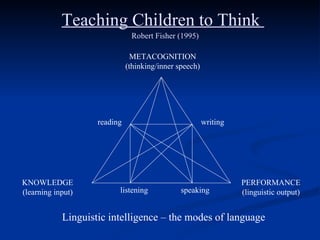
Teaching Children to Think
                               Robert Fisher (1995)

                                METACOGNITION
                              (thinking/inner speech)


                    reading                             writing


KNOWLEDGE                                                         PERFORMANCE
(learning input)          listening            speaking           (linguistic output)


            Linguistic intelligence – the modes of language
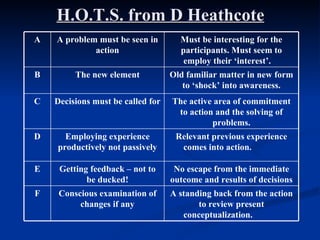
H.O.T.S. from D Heathcote
A   A problem must be seen in        Must be interesting for the
             action                  participants. Must seem to
                                      employ their ‘interest’.
B        The new element           Old familiar matter in new form
                                      to ‘shock’ into awareness.
C   Decisions must be called for   The active area of commitment
                                    to action and the solving of
                                             problems.
D     Employing experience          Relevant previous experience
    productively not passively       comes into action.

E    Getting feedback – not to      No escape from the immediate
            be ducked!             outcome and results of decisions
F    Conscious examination of      A standing back from the action
          changes if any                  to review present
                                      conceptualization.
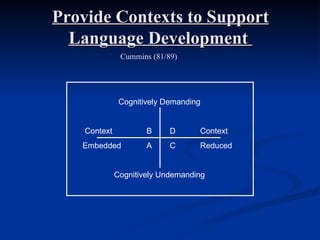
Provide Contexts to Support
  Language Development
               Cummins (81/89)


               Cognitively Demanding


    Context           B     D      Context
   Embedded           A     C      Reduced


              Cognitively Undemanding
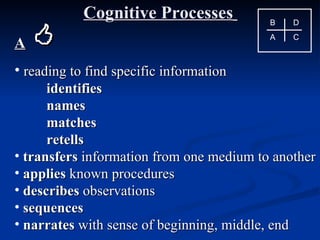
Cognitive Processes           B   D

A                                        A   C


• reading to find specific information
      identifies
      names
      matches
      retells
• transfers information from one medium to another
• applies known procedures
• describes observations
• sequences
• narrates with sense of beginning, middle, end
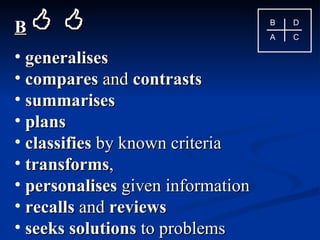
B                                B
                                   A
                                       D
                                       C

• generalises
• compares and contrasts
• summarises
• plans
• classifies by known criteria
• transforms,
• personalises given information
• recalls and reviews
• seeks solutions to problems
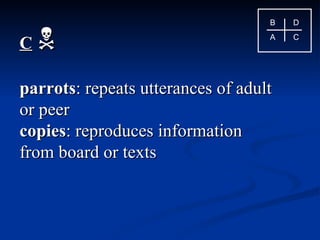
B   D

C                                 A   C


parrots: repeats utterances of adult
or peer
copies: reproduces information
from board or texts
D                                        B
                                            A
                                                 D
                                                 C

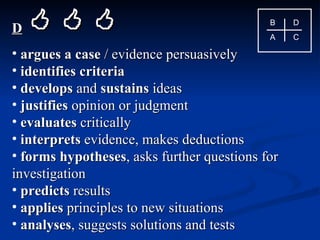
• argues a case / evidence persuasively
• identifies criteria
• develops and sustains ideas
• justifies opinion or judgment
• evaluates critically
• interprets evidence, makes deductions
• forms hypotheses, asks further questions for
investigation
• predicts results
• applies principles to new situations
• analyses, suggests solutions and tests
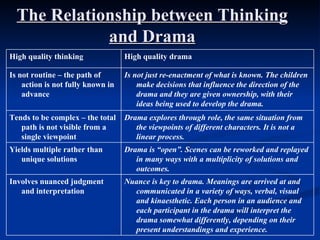
The Relationship between Thinking
             and Drama
High quality thinking              High quality drama

Is not routine – the path of       Is not just re-enactment of what is known. The children
    action is not fully known in       make decisions that influence the direction of the
    advance                            drama and they are given ownership, with their
                                       ideas being used to develop the drama.
Tends to be complex – the total    Drama explores through role, the same situation from
   path is not visible from a         the viewpoints of different characters. It is not a
   single viewpoint                   linear process.
Yields multiple rather than        Drama is “open”. Scenes can be reworked and replayed
   unique solutions                   in many ways with a multiplicity of solutions and
                                      outcomes.
Involves nuanced judgment          Nuance is key to drama. Meanings are arrived at and
   and interpretation                communicated in a variety of ways, verbal, visual
                                     and kinaesthetic. Each person in an audience and
                                     each participant in the drama will interpret the
                                     drama somewhat differently, depending on their
                                     present understandings and experience.
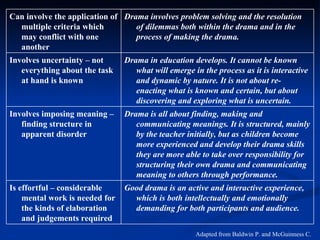
Can involve the application of Drama involves problem solving and the resolution
  multiple criteria which         of dilemmas both within the drama and in the
  may conflict with one           process of making the drama.
  another
Involves uncertainty – not      Drama in education develops. It cannot be known
   everything about the task       what will emerge in the process as it is interactive
   at hand is known                and dynamic by nature. It is not about re-
                                   enacting what is known and certain, but about
                                   discovering and exploring what is uncertain.
Involves imposing meaning –     Drama is all about finding, making and
   finding structure in            communicating meanings. It is structured, mainly
   apparent disorder               by the teacher initially, but as children become
                                   more experienced and develop their drama skills
                                   they are more able to take over responsibility for
                                   structuring their own drama and communicating
                                   meaning to others through performance.
Is effortful – considerable     Good drama is an active and interactive experience,
    mental work is needed for     which is both intellectually and emotionally
    the kinds of elaboration      demanding for both participants and audience.
    and judgements required
                                                     Adapted from Baldwin P. and McGuinness C.

Dramathink: Teaching Thinking Skills through Drama

  • 1.
  • 2.
    Teaching Children toThink Robert Fisher (1995) METACOGNITION (thinking/inner speech) reading writing KNOWLEDGE PERFORMANCE (learning input) listening speaking (linguistic output) Linguistic intelligence – the modes of language
  • 3.
    H.O.T.S. from DHeathcote A A problem must be seen in Must be interesting for the action participants. Must seem to employ their ‘interest’. B The new element Old familiar matter in new form to ‘shock’ into awareness. C Decisions must be called for The active area of commitment to action and the solving of problems. D Employing experience Relevant previous experience productively not passively comes into action. E Getting feedback – not to No escape from the immediate be ducked! outcome and results of decisions F Conscious examination of A standing back from the action changes if any to review present conceptualization.
  • 4.
    Provide Contexts toSupport Language Development Cummins (81/89) Cognitively Demanding Context B D Context Embedded A C Reduced Cognitively Undemanding
  • 5.
    Cognitive Processes B D A  A C • reading to find specific information identifies names matches retells • transfers information from one medium to another • applies known procedures • describes observations • sequences • narrates with sense of beginning, middle, end
  • 6.
    B  B A D C • generalises • compares and contrasts • summarises • plans • classifies by known criteria • transforms, • personalises given information • recalls and reviews • seeks solutions to problems
  • 7.
    B D C  A C parrots: repeats utterances of adult or peer copies: reproduces information from board or texts
  • 8.
    D  B A D C • argues a case / evidence persuasively • identifies criteria • develops and sustains ideas • justifies opinion or judgment • evaluates critically • interprets evidence, makes deductions • forms hypotheses, asks further questions for investigation • predicts results • applies principles to new situations • analyses, suggests solutions and tests
  • 9.
    The Relationship betweenThinking and Drama High quality thinking High quality drama Is not routine – the path of Is not just re-enactment of what is known. The children action is not fully known in make decisions that influence the direction of the advance drama and they are given ownership, with their ideas being used to develop the drama. Tends to be complex – the total Drama explores through role, the same situation from path is not visible from a the viewpoints of different characters. It is not a single viewpoint linear process. Yields multiple rather than Drama is “open”. Scenes can be reworked and replayed unique solutions in many ways with a multiplicity of solutions and outcomes. Involves nuanced judgment Nuance is key to drama. Meanings are arrived at and and interpretation communicated in a variety of ways, verbal, visual and kinaesthetic. Each person in an audience and each participant in the drama will interpret the drama somewhat differently, depending on their present understandings and experience.
  • 10.
    Can involve theapplication of Drama involves problem solving and the resolution multiple criteria which of dilemmas both within the drama and in the may conflict with one process of making the drama. another Involves uncertainty – not Drama in education develops. It cannot be known everything about the task what will emerge in the process as it is interactive at hand is known and dynamic by nature. It is not about re- enacting what is known and certain, but about discovering and exploring what is uncertain. Involves imposing meaning – Drama is all about finding, making and finding structure in communicating meanings. It is structured, mainly apparent disorder by the teacher initially, but as children become more experienced and develop their drama skills they are more able to take over responsibility for structuring their own drama and communicating meaning to others through performance. Is effortful – considerable Good drama is an active and interactive experience, mental work is needed for which is both intellectually and emotionally the kinds of elaboration demanding for both participants and audience. and judgements required Adapted from Baldwin P. and McGuinness C.