LESSON:- Drama Lesson 1
Date: 20/10/2017 Term: 4 Week: 2 Year Level: 5/6
Time/length: 45 minutes Learning area focus:
Context:
To introduce drama, this first lesson will explore the students’ understanding of the elements of drama. While we know that they partake in weekly
rotations, it is still unknown how confident the students are in their skills of drama. Therefore for this lesson, students will engage with a variety of
activities to build their confidence in understanding certain elements of drama (voice, movement, focus) through building and developing characters.
Individual learning considerations:
In our group, some students have been identified as EAL/D or students with low literacy levels. To support these students, teachers will scribe peer
feedback.
Content Descriptions:
Develop skills and techniques of voice and movement to create character,mood and atmosphere and focus dramatic action (ACADRM036)
Lesson outcomes/Learning intentions:
- Students will be able to experiment with
dramatic action and voice to develop a
range of sustained roles, using character
stereotypes
- Students will be able to collaborate to
convey dramatic meaning by responding
abstractly to represent ideas, feelings,
objects and situations
- Students will understand the role the
audience can play in drama and will be
able to respond critically to a range of
character works and communicate
opinions about a range of drama works
created by themselves and others
Reflection: Howwill you evaluate your lesson
Indicators: Howwill you knowthe students have understood the concepts specified in your
learning intentions?
- As an audience, students can discuss with their peers about the character performances and
provide suggestions on how enhance their own drama work and the work of others
- Students can work collaboratively to use the elements of drama (role and character,situation)
to shape character,voice and movement in improvisation and performances of devised drama
for an audience
- Students use voice and movement skills to convey meaning about a character to an audience.
- Students makes decisions about role interactions
- Students will use improvisation and movement to interpret and respond to a dramatic context
- Students will be able to experiment with dramatic action (movement) and voice to develop the role
of a given character in a given scenario
Howwill you make the activity physical verbal and visual
Throughout the lesson, physical, verbal and visual aspects will be embedded. Students will be moving
and talking as they develop their characters and will provide feedback on one another.
Assessment for/as/oflearning:
for teacher effectiveness and student learning Students will be assessed informally through verbal peer feedback of character development focal
activity. Teachers will scribe from student feedback for record of documentation. Use of rubric
TEACHING AND LEARNING ACTIONS
Timing
5 minutes
15 minutes
Warm up-
Begin by discussing the safety needs of drama and the expectation to have a go -
Drama is not about creating actorsbut building self-esteem. Ensure to make it
clear to students that it will be a no putdown zone!
Drama Element: Role and Character Building
Ask students how actors portray characters- what aspectsdo you have to consider
(voice- loud/soft, walk- fast/slow, gestures etc).
Introduce skill-
Lead with different Body Parts (movement and environment)
This activity is used as a warm up for students, while exploring the use of
movement and space.
Students are to walk in various directions at different speeds in a given space. The
teacher tells the students to imagine a string is attached to their nose which is being
pulled. The children continue walking around leading their body with their nose.
The students then walk normally again until the teacher calls out a new body part
to lead with.
Extension: Explore expressions through scenarios (walk how you would feel if you
won a million dollars), or character movements (like a pirate etc).
Voice & Dialogue Warm Up - Pass the Word
Students are to sit in a circle and are to pass a particular word around the circle,
each taking it in turns to say the word. As students pass the word around, each
student is required to change the dynamics, speed,or tone of the word or add a
gesture, in order to affect the meaning of it. E.g. ‘Hello’, ‘Elephant’ (ask students
Resources/Teachers notes
https://www.dramanotebook.com/drama-
games/movement-games/lead-with-different-parts-
of-body/
https://www.dramanotebook.com/drama-
games/hot-seat/
20 minutes
5mins
for suggestions). Students are to repeat this but are to pass a phrase or a tongue
twister around the circle (experiment with adding pauses or silence to affect
meaning) - E.g. ‘She sells sea shells by the sea shore’,‘Unique New York’
Activity incorporating skill- Hot Seat- Developing Characters
This activity is about incorporating the use of body and voice - elements
previously explored to become a character. These characterswill be drawn from
hat and three students are to walk over to the chairs (taking on the characteristics of
their character) and sit in front of their peers (the audience). The characters and the
audience are given a few minutes to prepare how to act as well as what questions to
ask. The audience is to ask them questions to try to figure out what character they
are portraying. To do this the selected students are to answer the questions using
the characteristics of their character.
Character selections include job roles and animals i.e. cat (smug, lazy), lion
(proud), puppy (energetic), mouse (quiet), teacher,scientist (nerdy) etc.
Possible option for adapting the activity and give each scenario a purpose: set a
scene i.e they are on trial, in space,swimming in a pool
Reflection- After the characters are guessed the students are to reflect on how the
selected students used their body/voice/characteristics to create their character.
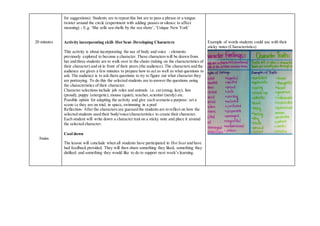
Each student will write down a character trait on a sticky note and place it around
the selected character.
Cool down
The lesson will conclude when all students have participated in Hot Seat and have
had feedback provided. They will then share something they liked, something they
disliked and something they would like to do to support next week’s learning.
Example of words students could use with their
sticky notes (Characteristics)
Assessmentmaybe like this? But tailored? Or we
write down group feedbackfrom activity reflection?

Drama lesson plan 1

  • 1.
    LESSON:- Drama Lesson1 Date: 20/10/2017 Term: 4 Week: 2 Year Level: 5/6 Time/length: 45 minutes Learning area focus: Context: To introduce drama, this first lesson will explore the students’ understanding of the elements of drama. While we know that they partake in weekly rotations, it is still unknown how confident the students are in their skills of drama. Therefore for this lesson, students will engage with a variety of activities to build their confidence in understanding certain elements of drama (voice, movement, focus) through building and developing characters. Individual learning considerations: In our group, some students have been identified as EAL/D or students with low literacy levels. To support these students, teachers will scribe peer feedback. Content Descriptions: Develop skills and techniques of voice and movement to create character,mood and atmosphere and focus dramatic action (ACADRM036) Lesson outcomes/Learning intentions: - Students will be able to experiment with dramatic action and voice to develop a range of sustained roles, using character stereotypes - Students will be able to collaborate to convey dramatic meaning by responding abstractly to represent ideas, feelings, objects and situations - Students will understand the role the audience can play in drama and will be able to respond critically to a range of character works and communicate opinions about a range of drama works created by themselves and others Reflection: Howwill you evaluate your lesson Indicators: Howwill you knowthe students have understood the concepts specified in your learning intentions? - As an audience, students can discuss with their peers about the character performances and provide suggestions on how enhance their own drama work and the work of others - Students can work collaboratively to use the elements of drama (role and character,situation) to shape character,voice and movement in improvisation and performances of devised drama for an audience - Students use voice and movement skills to convey meaning about a character to an audience. - Students makes decisions about role interactions - Students will use improvisation and movement to interpret and respond to a dramatic context - Students will be able to experiment with dramatic action (movement) and voice to develop the role of a given character in a given scenario Howwill you make the activity physical verbal and visual Throughout the lesson, physical, verbal and visual aspects will be embedded. Students will be moving and talking as they develop their characters and will provide feedback on one another. Assessment for/as/oflearning:
  • 2.
    for teacher effectivenessand student learning Students will be assessed informally through verbal peer feedback of character development focal activity. Teachers will scribe from student feedback for record of documentation. Use of rubric TEACHING AND LEARNING ACTIONS Timing 5 minutes 15 minutes Warm up- Begin by discussing the safety needs of drama and the expectation to have a go - Drama is not about creating actorsbut building self-esteem. Ensure to make it clear to students that it will be a no putdown zone! Drama Element: Role and Character Building Ask students how actors portray characters- what aspectsdo you have to consider (voice- loud/soft, walk- fast/slow, gestures etc). Introduce skill- Lead with different Body Parts (movement and environment) This activity is used as a warm up for students, while exploring the use of movement and space. Students are to walk in various directions at different speeds in a given space. The teacher tells the students to imagine a string is attached to their nose which is being pulled. The children continue walking around leading their body with their nose. The students then walk normally again until the teacher calls out a new body part to lead with. Extension: Explore expressions through scenarios (walk how you would feel if you won a million dollars), or character movements (like a pirate etc). Voice & Dialogue Warm Up - Pass the Word Students are to sit in a circle and are to pass a particular word around the circle, each taking it in turns to say the word. As students pass the word around, each student is required to change the dynamics, speed,or tone of the word or add a gesture, in order to affect the meaning of it. E.g. ‘Hello’, ‘Elephant’ (ask students Resources/Teachers notes https://www.dramanotebook.com/drama- games/movement-games/lead-with-different-parts- of-body/ https://www.dramanotebook.com/drama- games/hot-seat/
  • 3.
    20 minutes 5mins for suggestions).Students are to repeat this but are to pass a phrase or a tongue twister around the circle (experiment with adding pauses or silence to affect meaning) - E.g. ‘She sells sea shells by the sea shore’,‘Unique New York’ Activity incorporating skill- Hot Seat- Developing Characters This activity is about incorporating the use of body and voice - elements previously explored to become a character. These characterswill be drawn from hat and three students are to walk over to the chairs (taking on the characteristics of their character) and sit in front of their peers (the audience). The characters and the audience are given a few minutes to prepare how to act as well as what questions to ask. The audience is to ask them questions to try to figure out what character they are portraying. To do this the selected students are to answer the questions using the characteristics of their character. Character selections include job roles and animals i.e. cat (smug, lazy), lion (proud), puppy (energetic), mouse (quiet), teacher,scientist (nerdy) etc. Possible option for adapting the activity and give each scenario a purpose: set a scene i.e they are on trial, in space,swimming in a pool Reflection- After the characters are guessed the students are to reflect on how the selected students used their body/voice/characteristics to create their character. Each student will write down a character trait on a sticky note and place it around the selected character. Cool down The lesson will conclude when all students have participated in Hot Seat and have had feedback provided. They will then share something they liked, something they disliked and something they would like to do to support next week’s learning. Example of words students could use with their sticky notes (Characteristics)
  • 4.
    Assessmentmaybe like this?But tailored? Or we
  • 5.
    write down groupfeedbackfrom activity reflection?