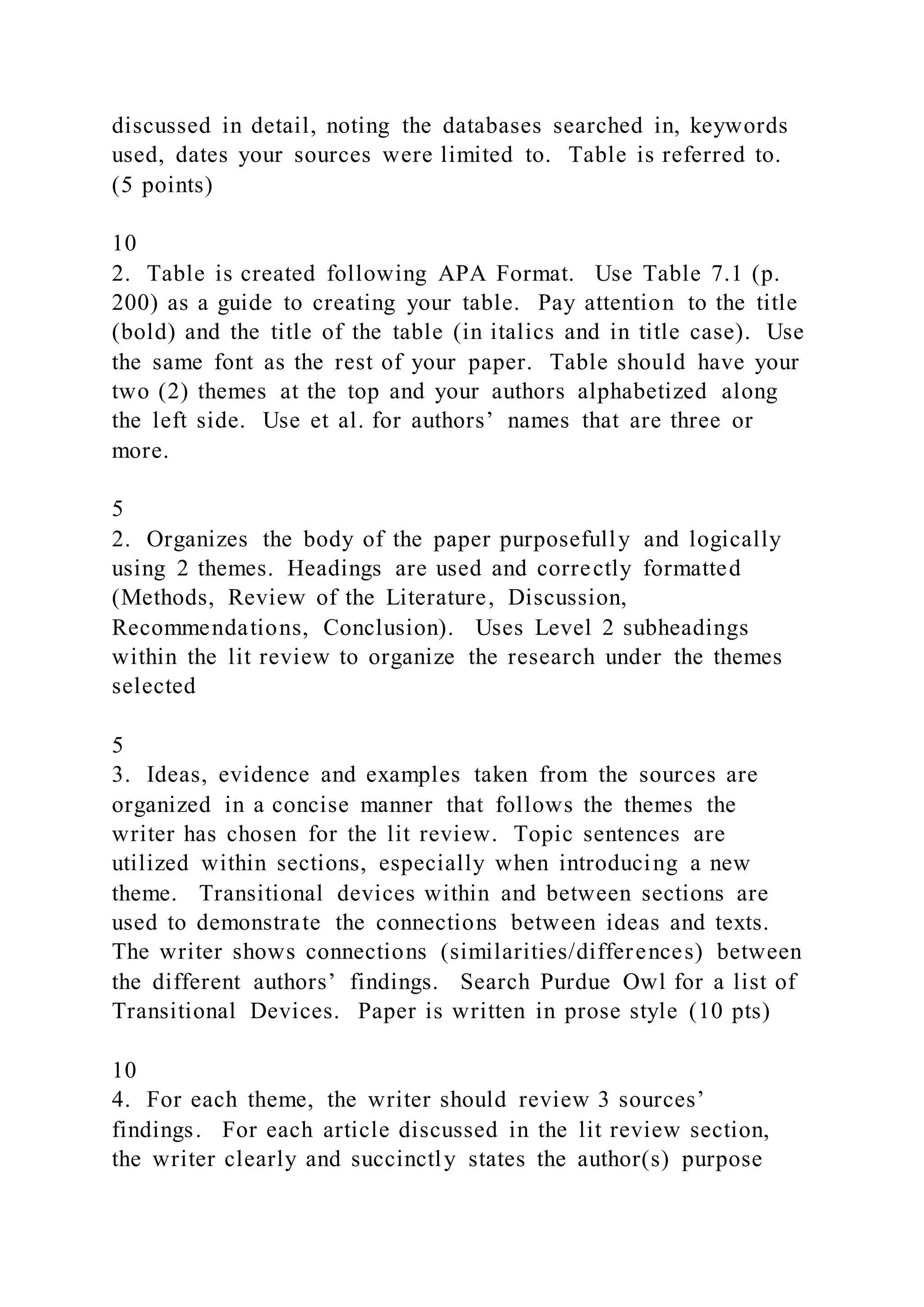
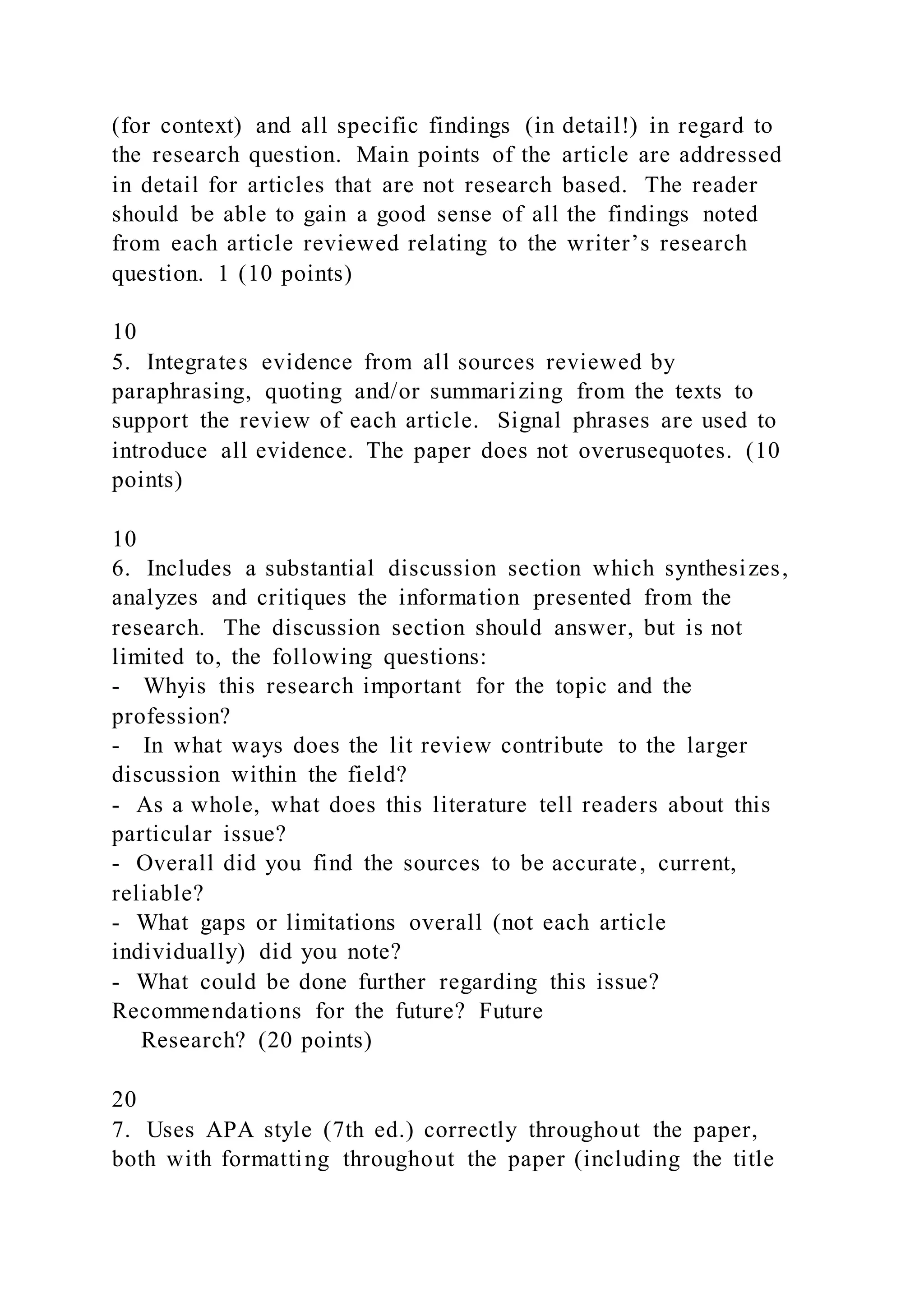
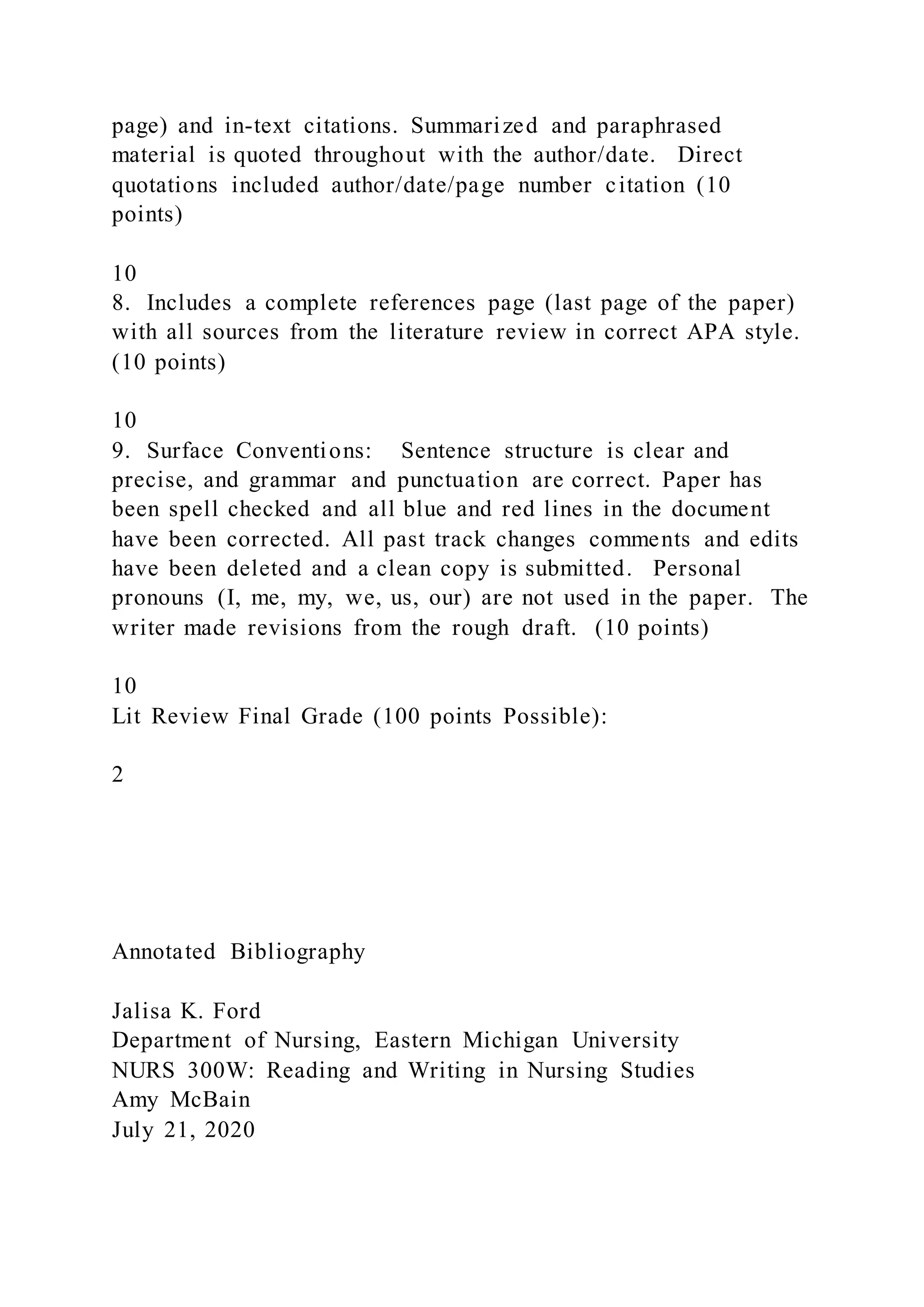
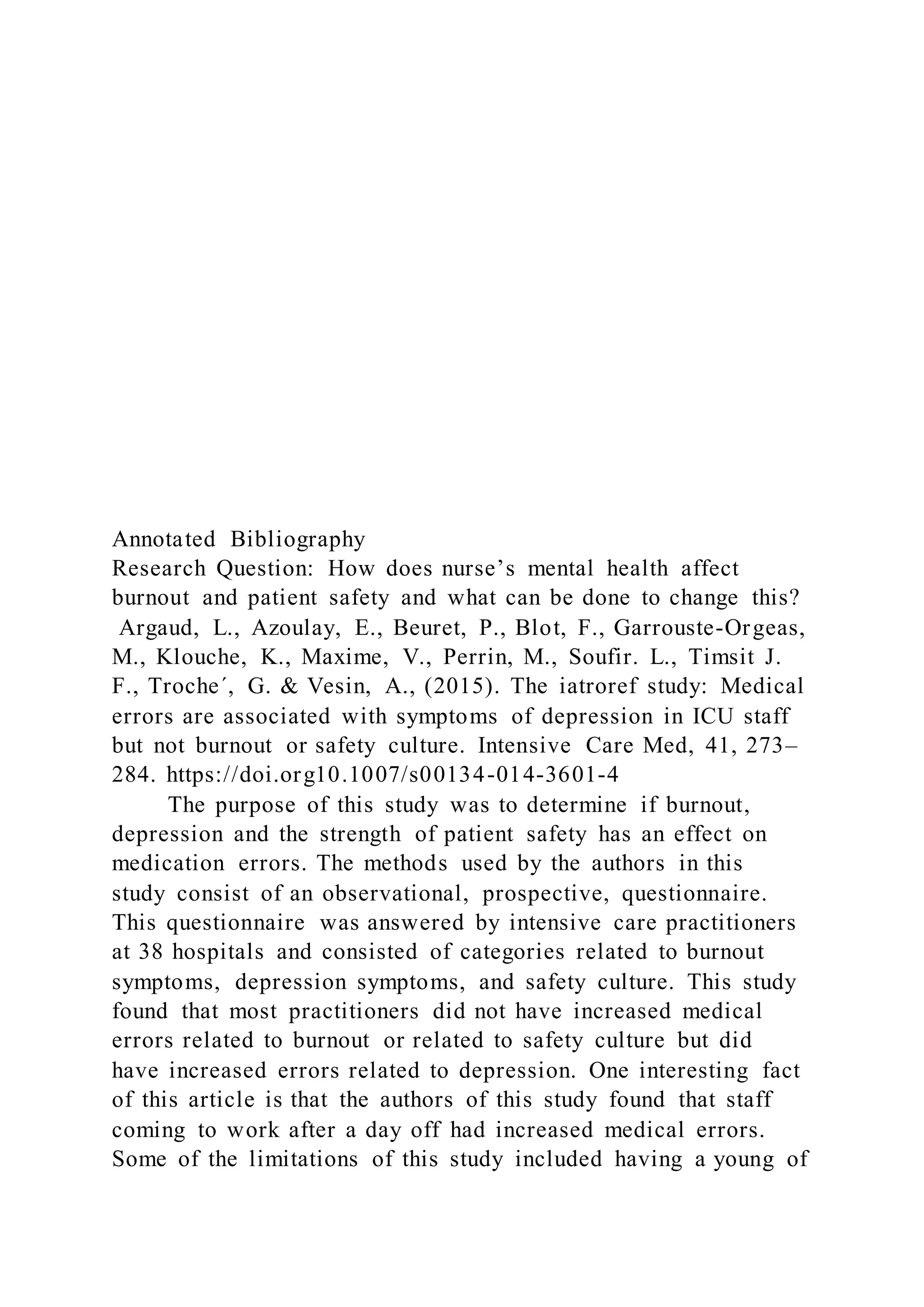
Drafting the Lit Review - Helpful Tips
Helpful tips regarding the Lit Review Paper: Please read
through the end carefully!
Just a reminder that the lit review section (Review of the
Literature heading) of your paper should be organized by
themes (threads) that you have chosen for your paper based on
the main ideas found within all of the literature that you
reviewed in regards to your research question. They are the
main points that you have noticed your sources discussing in
relation to your research question. Two themes should be used
for this paper (please do not use more than two themes). You
must use these as Level 2 headings within your paper, and you
can see how this is set up within the Student Sample papers.
You should havethree sources (their findings) to review under
each theme to provide a thorough review of the literature and to
show similarities/differences within the literature you found.
Each review of the findings of the source must be in detail and
list all of the findings within the article in relation to the
research question, not just one or two sentences. Your readers
should be able to get a good sense of what the particular sources
you've found in your lit searches have written about in relation
to your research question, along with making those important
connections between the sources so show similarities and
differences within the findings.
For example, if I was writing on the nursing shortage and my
research question was "What are the factors that contribute to
the nursing shortage?" I would then look at my Annotated
Bibliography to see what all of my sources said about this
particular question. Then I would choose the top two factors
(themes) that all authors stated about this research question.
Let's say out of all of my sources that I reviewed, the top
factors that contribute to the nursing shortage that all authors
talked about in answer to my research question was: 1. Faculty
Shortage 2. Nurse Burnout/Dissatisfaction. Those two themes
would actually become the Level 2 headings underneath the
Review of the Literature Section of my paper (see student
sample). Then, within each heading, I would review the sources
that mentioned something about each particular theme under
that heading. I would review their studies (their purpose in
only one or two sentences maximum!) and the findings in detail
using paraphrases and summaries and some quotations regarding
what each author had to say under that particular
theme/heading. You should have a mixture of paraphrases,
quotes and summary in your paper, with more weight leaning
towards paraphrasing as that is preferred by APA. Avoid over-
quoting in your paper. Your reader should get a good sense of
what the literature out there says about this particular theme and
the connections (similarities/differences) between the
sources. Do not copy from your Annotated Bibliography, as
that is considered self-plagiarism, but you can certainly refer to
it to help you weave together the main points from the articles
to show readers a glimpse into what the literature has to say
about the particular theme. Remember, in the literature review
section, you are reviewing what the literature/authors stated on
the issue only in relation to your research question, and you
should be paraphrasing often and quoting some, too, by bringing
in examples from the texts.
You should also be showing connections between your sources
as you are reviewing them, using Transitional Devices to link
and transition into new paragraphs (words like: in addition,
further, moreover, similarly, in contrast, etc.) You must cite
everything that you take from the sources. Direct quotes should
include a page number citation. Keep in mind that it is not
enough to just have a citation at the beginning or the end of a
paragraph in APA. You will be citing often in this section of
the paper since you're reviewing other sources so don't worry
about having too many citations here -- it really is just a
convention of APA Style.
In a formal paper in APA, you should not use the first-person
"I" in the Review of the Literature or other personal pronouns
such as "me, we, us, our, etc.." Many professors in the program
do not allow the use of personal pronouns in the paper and most
scholarly sources avoid this as well. Just remember that your
reader knows it's you talking as it's your paper, so there really
is no reason to use "I" in formal writing. I would encourage
you to start practicing this now in this class as you will most
likely run into this later in the program.
In the Review of the Literature section, you should review only
the articles related to that theme within that section of your
paper. Please see the student sample and how it is set up with
headings so that you can follow that structure. In other words,
you may not use all five of your sources in your review section,
especially if one source does not fit within a theme you
selected, though you most likely could use the source in your
introduction or some other area of your paper like the
Discussion section. You may only end up with four sources on
your final lit review, or you may need to find another source,
and that is just fine. You must use at least 4 sources for this lit
review. You should have three sources to review for each
theme. Again, you might have one source that doesn't fit within
one of your themes, but it could be used in the introduction of
your paper to show the history/background of the problem and
to show the importance of the issue; these are all items that
should be part of the introduction so don't skimp on the intro!
Keep quotes to a minimum in the introduction, but providing a
surprising statistic or a really good short quote about your topic
is often effective in the introduction of the paper to help
provide some context for the rest of the paper and to
demonstrate the importance of your topic. (Refer back to your
APA manual for how to write effective introductions).
Very Important: Please be careful about paraphrasing your
sources and remember anytime you use even a string of even
three or four words exactly from the text you must put the
words in quotation marks and cite the author/date and the page
number of where you found the source. If you completely
paraphrase or summarize in your own words, you
should not include the page number. Also watch for patchwork
phrasing as this is considered plagiarism (See the University of
Wisconsin Handout on Acknowledging sources).
Please take a look at the student example Lit Review with my
notes on it, please do so to help you with the formatting of your
paper. Your paper should have these sections: An introductory
paragraph (no heading is used for the introduction though in
APA), a Methods section (how you went about searching in the
databases for your articles, what years you limited your article s
to, etc.) your Review of the Literature section (a Level 1
heading) and then your subheadings/themes (Level 2 headings)
with all of your sources reviewed for your reader,
a Discussion/Recommendations section (you can separate these
two if you'd like) and finally a short Conclusion. If you take a
look at the student sample, you will be able to see how these
headings are set up. Below is a basic outline of the headings.
Level 1 headings are centered and in bold and each word
besides those three letters or less would be capitalized. Level 2
headings (your themes) are flush to the left Margin, in bold and
capitalized. There is no heading for the introduction -- you just
note your title again and then indent for new paragraphs for the
introduction. It would look something like the following (and
again see the student sample for more details).
Title of Your Paper Centered on Line One of Page
Two (not in bold)
Your introductory paragraphs (indent all paragraphs) would
come next. See the section on writing introductions in the APA
manual, but you should be providing the background of your
topic, any important statistics that might show the importance
of it, and then noting the research question that prompted your
lit search in the first place or a sentence about the purpose of
the paper for readers.
Methods
Review of the Literature
Theme 1
Theme 2
Discussion/Recommendations
Conclusion
References (this
begins on a new page)
All papers should include recommendations either within the
Discussion heading or in its own heading. You should include
your table as part of the Lit Review under the Methods section
and be sure to title it and refer your reader to it. Just remember
everything in APA should be double spaced. The title of your
paper should only be 12 words long in APA and the Running
head can be no more than 50 characters, including spaces. Each
introduction should provide the necessary background and
context for the issue you've chosen and be thorough and the
research question that prompted your search in the first place so
that the reader can see the importance of the topic and your
main focus for the review. See the Lit Review Rubric as well
for help with this and in writing the Discussion section of your
paper. There are some questions on the rubric that you should
answer that will help you write the Discussion section.
IMPORTANT: You should have a variety of
summaries/paraphrases and quotes from all of the sources
related to a particular theme for each section of the review part
of your paper. You wouldn't use many quotes in your discussion
section or in your conclusion, because this is your place to
synthesize and analyze (critique) the literature on your own. Be
sure to use signal phrases before every quote to introduce
it (you never want to start a sentence with quotation marks) and
cite all of your sources correctly in APA format. Remember to
include author/date/page number for a direct quote and only the
author/date for a paraphrase and summary. ****Please
remember that even a string of even three or four words copied
directly from a source must be placed in quotation marks and
cited with the page number. A paraphrase is more than just
changing a few words around -- it is a complete change of
wording/structure. This is very important to avoid plagiarism.
You might also want to review the Video/PowerPoint on
Integrating Sources that is within Panopto Recordings and take
a look at the section on patchwork phrasing as noted above in
the handout "Acknowledging Sources" from the University of
Wisconsin to avoid doing this in your paper. Don't forget the
UWC Online is there to review your papers as well and provide
you help along the way if you need more help citing your
sources!
International Relations
2016, Vol. 30(4) 409 –431
© The Author(s) 2015
Reprints and permissions:
sagepub.co.uk/journalsPermissions.nav
DOI: 10.1177/0047117815601201
ire.sagepub.com
The International Criminal
Court and the lawfare of
judicial intervention
Alana Tiemessen
Endicott College
Abstract
The contentious concept of ‘lawfare’ has proliferated to various
foreign policy areas and
permeated a discourse on the function and legitimacy of law in
conflict. The concept seems
particularly apt to the International Criminal Court’s (ICC)
judicial interventions. In this
context, I define lawfare as the coercive and strategic element
of international criminal justice
in which the ICC’s judicial interventions are used as a tool of
lawfare for States Parties and
the United Nations Security Council to pursue political ends. I
argue that there are two
types of political ends being pursued with this lawfare: conflict
resolution and politicized
prosecutions. First, the ICC’s spokespersons, advocates, and
supporting states have cultivated
a discourse that justice is a means to peace. As a result, the ICC
has been used as a means
of intervention in ongoing conflicts with the expectation that
the indictments, arrests, and
trials of elite perpetrators have deterrence and preventive
effects for atrocity crimes. Despite
these legitimate intentions and great expectations, there is little
evidence of the efficacy of
justice as a means to peace. Second, the other manifestation of
lawfare represents an abuse
or manipulation of the ICC for political gain. Specifically,
States Parties have strategically
referred their conflict situations to the ICC with the expectation
that the referral will result
in the removal of their rivals and sanction the impunity of
ruling elites. This politicization of
international justice has been successful in that most of the
ICC’s prosecutions are unjustly one
sided. Evidence of politicized prosecutions has damaged the
ICC’s credibility as an impartial
institution and raises questions about the desirability of state
referrals. Consequently, the
ICC’s efficacy and credibility are suffering from lawfare.
Keywords
conflict resolution, International Criminal Court, international
criminal law, judicial intervention,
lawfare, prosecutions
Corresponding author:
Alana Tiemessen, Endicott College, 376 Hale St., Beverly, MA
01915, USA.
Email: [email protected]
601201 IRE0010.1177/0047117815601201International
RelationsTiemessen
research-article2015
Article
mailto:[email protected]
https://sagepub.co.uk/journalsPermissions.nav
https:// doi: 10.1177/0047117815601201
https://ire.sagepub.com
410 International Relations 30(4)
The contentious concept of ‘lawfare’ has proliferated to various
foreign policy areas and
permeated a discourse on the function and legitimacy of law in
conflict. Lawfare hap-
pens when legal institutions become coercive and strategic tools
for states and nonstate
actors to pursue a variety of political and operational
objectives. The concept seems
particularly apt to the International Criminal Court’s (ICC)
judicial interventions.1 The
ICC’s interventions have occurred in eight African states so far
and resulted in 22 cases
against notorious perpetrators of atrocity crimes, including
warlords, rebel leaders, polit-
ical officials, and sitting and former heads of state. While some
praise the ICC’s ambi-
tious goals of accountability for elite perpetrators and its
expectation that justice can be
a means to peace, others condemn the ICC for not only being
ineffective but also ‘politi-
cized’. The concept of lawfare makes for a useful analytical
lens through which we can
provide some theoretical precision and empirical evidence for
these criticisms that have
obscured the ICC’s many achievements.
In the context of the ICC, lawfare manifests as a strategic use of
judicial intervention
by states and the United Nations Security Council (UNSC) to
achieve political ends. It is
notable that the ICC’s judicial mandate of accountability for
atrocity crimes, by means of
trial and punishment, is rarely contested. But whether the ICC’s
judicial intervention can
and should be used for political ends is very much contested. I
argue that there are two
types of political ends pursued by states and the UNSC, who use
judicial intervention as
a tool of lawfare: conflict resolution and the removal of
political rivals through politi-
cized prosecutions. Therefore, the agency for lawfare lies with
external actors and not
with the ICC itself. Beyond identifying what constitutes lawfare
in this context, I also
seek to distinguish between efficacy and credibility challenges
that result from this law-
fare. While the intentions of using justice as a means to peace
have been perceived as
legitimate, there is little evidence of successful conflict
resolution and deterrence so far.
Ruling elites in states that have referred their conflicts to the
ICC have effectively limited
prosecutions to their rivals and protected their own impunity but
at a cost for the ICC’s
credibility as an impartial institution.
This article proceeds in the following manner. First, I outline
the scope of the ICC’s
judicial interventions and a brief overview of its successes and
criticisms. Second, I sur-
vey commonalities and differences in lawfare’s usage and then
derive from this a con-
ception of lawfare that is applicable to international judicial
interventions. This represents
the first empirical application of lawfare to this field. Finally,
the bulk of the analysis
provides theoretical explanations and empirical evidence of the
two dimensions of law-
fare in the context of the ICC across most, but not all, of the
conflict situations subject to
judicial intervention.
ICC’s judicial interventions: progress and politicization
The ICC, established by the Rome Statute in 1998, has a
mandate to hold accountable
those most responsible for committing atrocity crimes, that is,
war crimes, genocide, and
crimes against humanity. To date, the ICC has intervened in
nine conflict ‘situations’:2
Uganda, the Democratic Republic of Congo (DRC), Central
African Republic (CAR) I
and II, Darfur, Kenya, Côte d’Ivoire, Libya, and Mali. These
judicial interventions vary in
terms of how the conflict situations were referred to the ICC
and the range of individuals
Tiemessen 411
that the Office of the Prosecutor (OTP) has targeted.3 For all
but three situations – Sudan,
Kenya, and Libya – the ICC was invited by States Parties to the
Rome Statute to investi-
gate atrocities and prosecute those most responsible. The OTP’s
prosecutorial strategy has
targeted perpetrators that include sitting and former heads of
state, senior political and
military officials, warlords, and leaders of nonstate armed
groups. The ICC has been
lauded for many achievements across these situations and cases,
such as advancing inter-
national criminal law by setting important legal precedents,
institutionalizing a norm of
accountability, boldly pursuing notorious and elite perpetrators
of atrocities irrespective
of their positions of power, successfully completing its first
trials and convictions, and
complementing retributive prosecutions with restorative justice
processes of reparations
and outreach to victim communities. Human rights and justice
advocates even contend
that the ICC has had positive impact on conflict prevention and
resolution, by altering the
behavior of perpetrators and affecting ‘positive
complementarity’ by encouraging rule of
law reform.
Despite these successes and precedents, the ICC is perceived to
be in a near constant
state of crisis with respect to its capacity, efficacy, and
credibility. The ICC has been
plagued by institutional shortcomings. Programs to help
witnesses and victims, through
protection and reparation assistance, are in their early stages of
planning and implemen-
tation. Investigations and trials have been slow and costly. The
OTP is responsible for
numerous blunders with respect to handling evidence, protecting
witnesses, and follow-
ing trial procedure. A relatively small budget and staff limit the
ICC’s capacity to con-
duct investigations and outreach, yet its caseload continues to
increase following requests
from States Parties and the UNSC to open new investigations.
At best, the OTP can only
manage six ongoing investigations and two cases a year.4 The
ICC also has no indige-
nous capacity to make arrests and transfer the accused for trial
and is entirely dependent
on states and international organizations to do so. The ICC is,
therefore, hampered by the
realities of a state-centric international system, although
perhaps no more than any other
international institution. These institutional problems can likely
be rectified over time if
the ICC learns from past mistakes and if it receives the
necessary financial and political
support from the international community.
Beyond capacity problems, ICC is increasingly perceived as a
‘politicized’ institution.
But those who accuse the ICC of being ‘political’ often do so in
a superficial and careless
manner by failing to acknowledge the different dimensions and
mechanisms of politici-
zation. Accusations of politicization imply a normative
assumption that the ICC should
be apolitical and guided only by judicial criteria when choosing
where to intervene and
whom to prosecute. The empirical reality is that the ICC can
neither entirely insulate
itself from domestic and international political opportunities
and constraints nor afford
to dismiss the political implications of its judicial interventions.
One potential type of politicization is reflected in the argument
that the ICC is biased
against Africa – unfairly intervening only in African states and
not in other cases of
atrocities deserving of justice, such as Syria, Iraq, North Korea,
and the Middle East.
Those who support this view argue that the ICC is a neo-
colonial institution and violates
states sovereignty. But the jurisdiction and mandate of the ICC
explain and justify the
focus on Africa, so far. The atrocities committed in many of
these conflict situations are
grave enough to warrant the ICC’s attention. The ICC also has a
strong jurisdiction in
412 International Relations 30(4)
Africa, whereas its jurisdiction is weaker in Asia and the
Middle East.5 Indeed, most of
the interventions have been at the invitation of these states, and
so, it makes little sense
to suggest that the ICC is deliberately targeting Africa alone.
The ‘Africa bias’ argument
largely stems from the strategic political rhetoric of some
African heads of states and
political officials and cannot be assumed to represent the views
of the general popula-
tion, let alone victim communities. The OTP is also conducting
preliminary examina-
tions in nine other countries, seven of which are outside of
Africa. It is also quite likely
that the OTP will begin full investigations and possibly
indictments in non-African situ-
ations in the next year or so.6
A more significant type of politicization, and the focus of this
article, points to the fact
that external actors use the ICC’s judicial intervention as a tool
to seek political ends
through judicial means. I argue that this phenomenon is best
characterized as lawfare.
Given lawfare is often a misunderstood and contested concept,
it is worth elaborating on its
origins and usage prior to a theoretical and empirical
application to international justice.
Lawfare: a contested concept
The conceptual proliferation of lawfare has paralleled the
increasing legalization of
international politics and warfare.7 While lawfare remains a
contested concept, most of
those who invoke it acknowledge that law and judicial
institutions can be used strategi-
cally to both enable and constrain conflict.8 For many,
‘lawfare’ was popularized with
Charles J. Dunlap’s definition: ‘the use of law as a weapon of
war’.9 He subsequently
revised the definition to be ‘the strategy of using – or misusing
– law as a substitute for
traditional military means to achieve an operational
objective’.10 Dunlap intended the
concept to be ‘ideologically neutral’,11 but its contemporary
use is often pejorative and
ideological. For example, lawfare has been rhetorically
employed to question the legality
of US policies and tactics in the ‘War on Terror’, to discredit
claims of Israeli war crimes
in Gaza12 and related agendas of non-governmental
organizations (NGOs), to describe a
‘weapon of the weak’ for insurgents engaged in asymmetric
warfare,13 and to question to
the credibility of international criminal justice.
Lawfare has also been more broadly applied to explain the role
of law in the context
of warfare. David Kennedy’s analysis is most instructive in this
regard when he explains
lawfare as the ‘waging of war by law’, meant to ‘invoke
violence … that stands behind
legal authority’.14 Therefore, Kennedy contrasts what most see
as the restraining effects
of law on war with the ‘war-generative functions of law’.15
This understanding is most
relevant to lawfare controversies as they relate to US national
security policies. One
influential source of analysis in this context is the Lawfare
blog.16 The blog’s founders
argue that the original conception of lawfare as a ‘weapon of
war’ does not require a
negative connotation: ‘all of the combatants in this “war”
believe they are fighting on
behalf the international rule of law, properly understand, and all
use legal argument stra-
tegically to achieve this end’.17 Nevertheless, many ‘thought of
the term as a kind of
“political slur” that equated legal challenges to government
policies as tools of America’s
enemies’.18 In the context of US national security, the United
States is portrayed as both
a perpetrator and a victim of lawfare. On one hand, American
officials use the law to
legalize and legitimize waging war and also various military
tactics used win war. On the
Tiemessen 413
other hand, lawfare is allegedly used against the United States
as ‘weapon of the weak’
by small states and nonstate actors to discredit legal strategies
that justify abuses in war
or to use the law to constrain US actions in war. For example,
accusations of lawfare
have been leveled at critical responses to the war on terrorism,
specifically to discredit
the legality of US policies on torture, Guantanamo, targeted
killings, and other counter-
terrorism tactics. Particularly because of its association with the
War on Terror, it is often
mistakenly assumed that lawfare was born and bred from the
ideology of the Bush
administration at the time. Nevertheless, this context
demonstrates that there is little
consensus on whether lawfare is an enabling or constraining
force on power.19 Lawfare
is also, of course, relevant to American foreign policies on
international justice. The rise
of universal jurisdiction and the ‘legalization’ of international
politics have been per-
ceived as threats to US sovereignty and interests,20 but at the
same time, the US was an
‘architect’21 of several international tribunals and has
increasingly come to see the stra-
tegic benefits of cooperating with the ICC.22
Lawfare in international justice
International justice scholars and practitioners have been
reluctant to associate interna-
tional courts with lawfare. This reluctance is partly because the
pejorative understanding
of lawfare undercuts the normative assumptions that the rule of
law should remain neu-
tral, technocratic, and on a moral high ground to political
strategy. Nevertheless, several
prominent international justice scholars and practitioners have
weighed in on the rele-
vance of lawfare to their field.23 For example, contributors to a
symposium and special
journal issue, titled Lawfare!,24 offered varied interpretations,
including lawfare as the
‘antithesis of warfare’,25 political interference in international
criminal law,26 and
using international tribunals to ‘bring down’ rebels and state
leaders responsible for
atrocities.27 David Scheffer (former US Ambassador for War
Crimes and lead US nego-
tiator at the Rome Treaty negotiations) does not accept that the
ICC’s mandate or inter-
ventions constitute lawfare in the pejorative sense. Yet Scheffer
also concedes that
lawfare was a complement or substitute for militarized conflict
resolution:
I plead guilty to being a major perpetrator of lawfare, on behalf
of the US Government, during
the 1990s. My mission … was to use the power of the United
States to build international and
hybrid criminal tribunals that would subject the leaders of other
nations and rebel movements
engaged in warfare, including internal armed conflicts, to
international criminal justice. I used
the law aggressively and continuously and sometimes such
actions served as at least a partial
rationale for avoiding the use of American armed might or more
political negotiations.28
Similarly, Louise Arbour (former Chief Prosecutor of the
International Criminal
Tribunals for the Former Yugoslavia and Rwanda) argues that
there are two manifesta-
tions of lawfare:
… through threatening the prosecution of senior figures
allegedly involved in violations … or
by highlighting abuses in the court of public opinion. In that
sense it is akin to propaganda as a
military tool, or as others might put it, a form of ‘hearts and
minds’ initiative.29
414 International Relations 30(4)
Finally, David Kennedy also extends lawfare to the domain of
international justice by
suggesting that the ‘victor’s justice’ dilemma, which is common
when re-establishing the
rule of law in states transiting from violence to peace, is akin to
lawfare:
When special courts are established by victors to adjudicate the
criminality of opponents, it can
be dressed up as a ‘return’ of law and peace – but it is hard to
avoid thinking that law is also the
continuation of war by other means … The situation is similar
when a hegemonic ‘international
community’ sets up a court of general instance to try those who
have, in their eyes, lost their
‘legitimacy’ as sovereigns.30
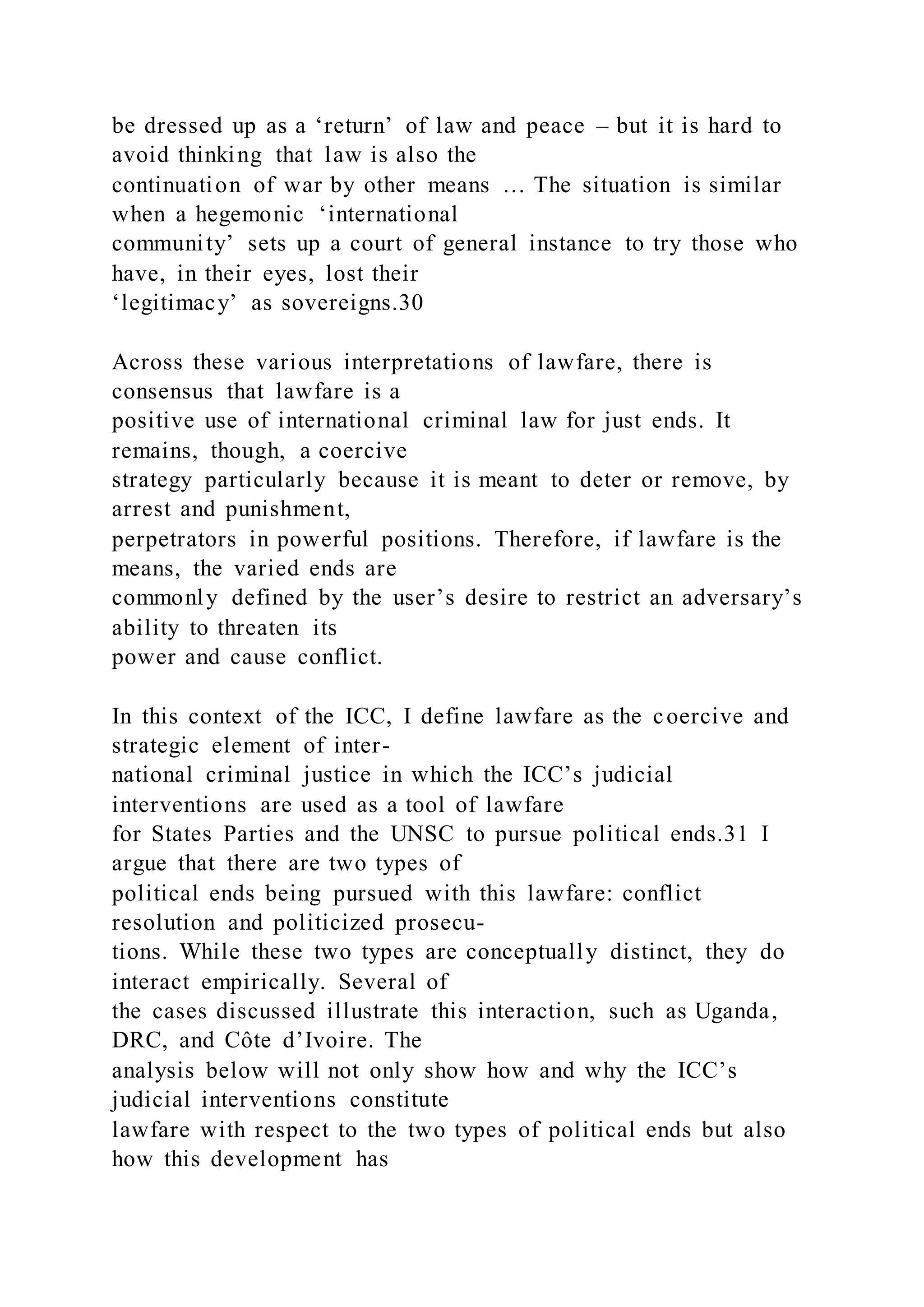
Across these various interpretations of lawfare, there is
consensus that lawfare is a
positive use of international criminal law for just ends. It
remains, though, a coercive
strategy particularly because it is meant to deter or remove, by
arrest and punishment,
perpetrators in powerful positions. Therefore, if lawfare is the
means, the varied ends are
commonly defined by the user’s desire to restrict an adversary’s
ability to threaten its
power and cause conflict.
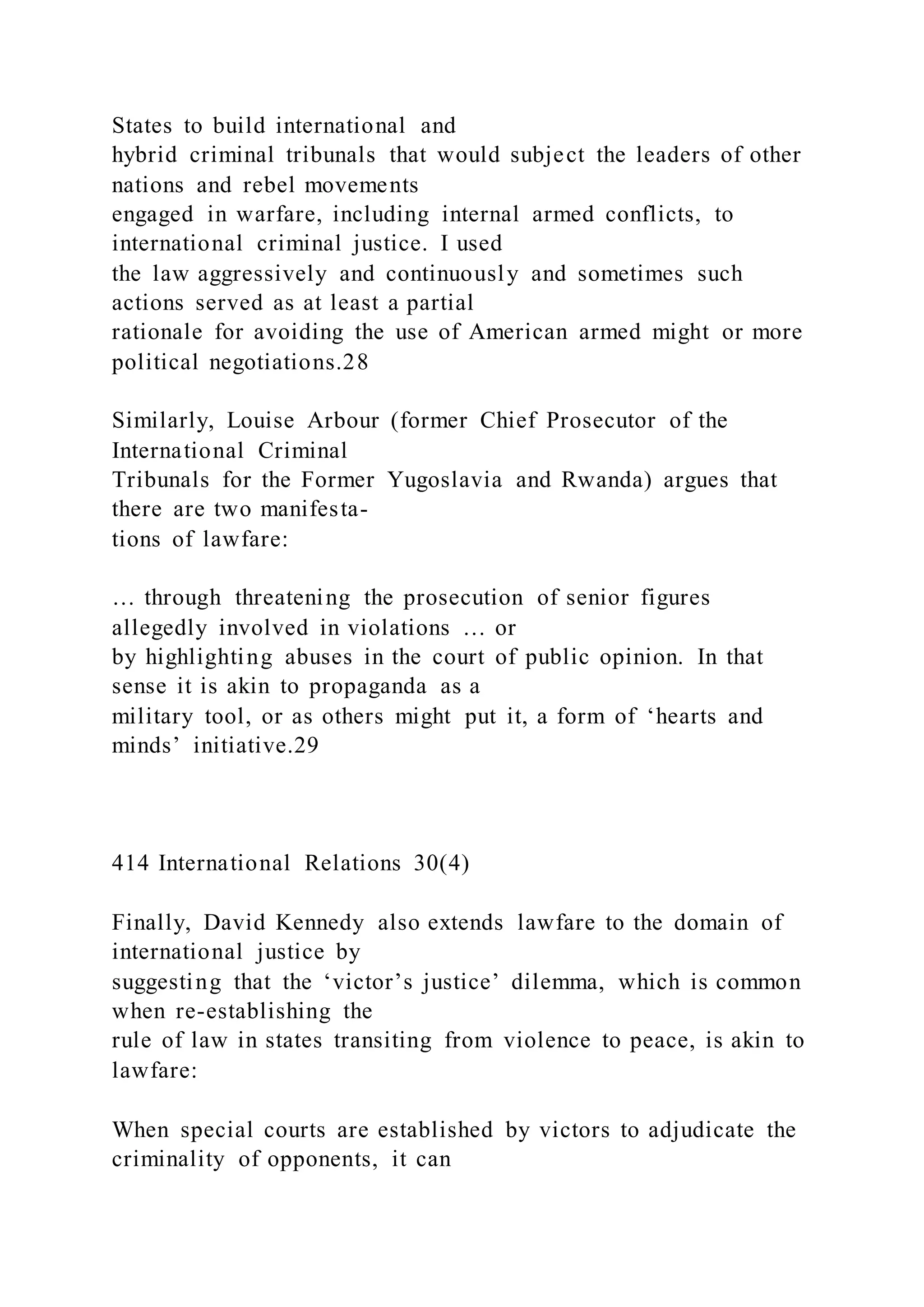
In this context of the ICC, I define lawfare as the coercive and
strategic element of inter-
national criminal justice in which the ICC’s judicial
interventions are used as a tool of lawfare
for States Parties and the UNSC to pursue political ends.31 I
argue that there are two types of
political ends being pursued with this lawfare: conflict
resolution and politicized prosecu-
tions. While these two types are conceptually distinct, they do
interact empirically. Several of
the cases discussed illustrate this interaction, such as Uganda,
DRC, and Côte d’Ivoire. The
analysis below will not only show how and why the ICC’s
judicial interventions constitute
lawfare with respect to the two types of political ends but also
how this development has
impeded the ICC’s efficacy and credibility. Consequently, the
ICC is suffering from lawfare.
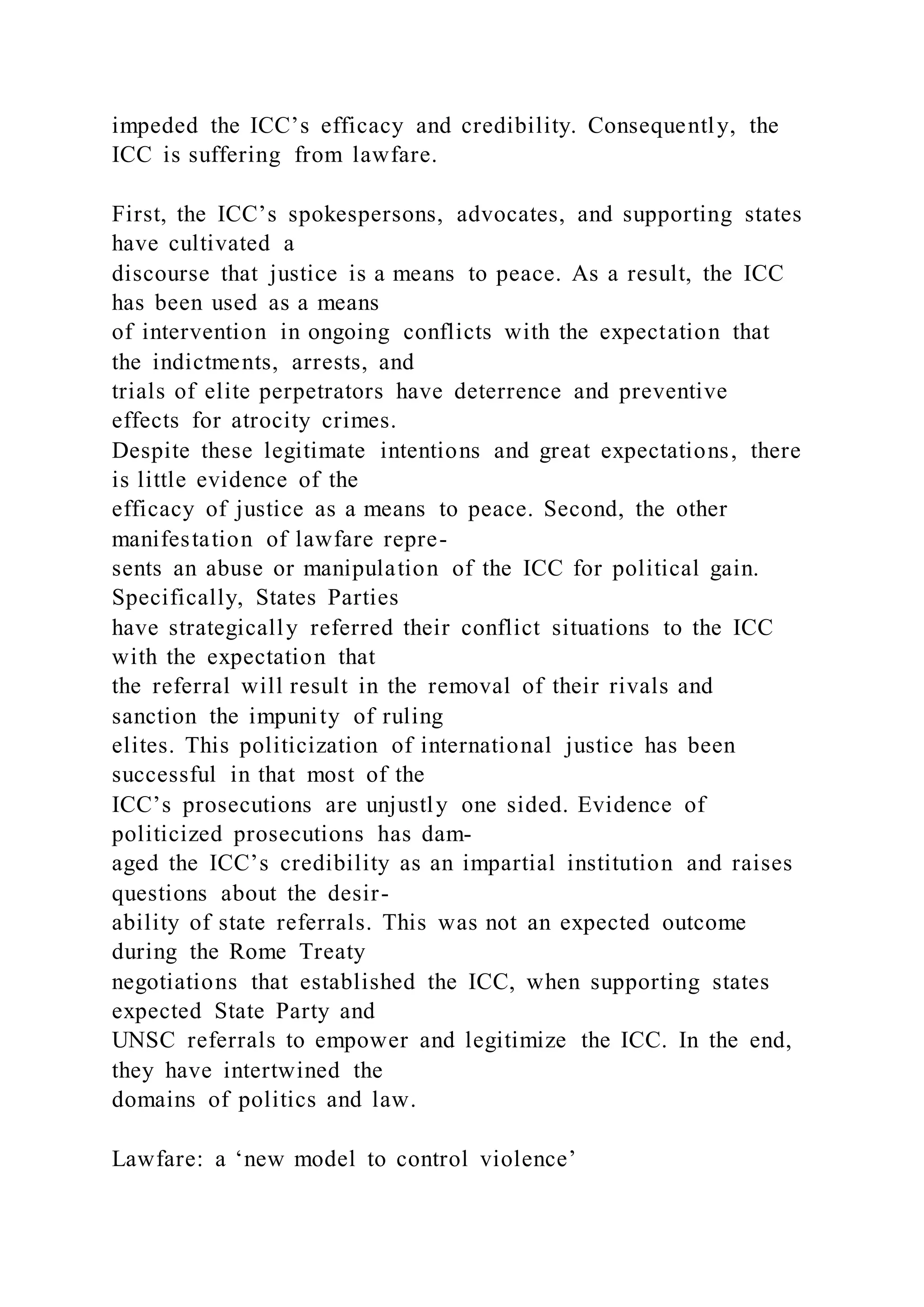
First, the ICC’s spokespersons, advocates, and supporting states
have cultivated a
discourse that justice is a means to peace. As a result, the ICC
has been used as a means
of intervention in ongoing conflicts with the expectation that
the indictments, arrests, and
trials of elite perpetrators have deterrence and preventive
effects for atrocity crimes.
Despite these legitimate intentions and great expectations, there
is little evidence of the
efficacy of justice as a means to peace. Second, the other
manifestation of lawfare repre-
sents an abuse or manipulation of the ICC for political gain.
Specifically, States Parties
have strategically referred their conflict situations to the ICC
with the expectation that
the referral will result in the removal of their rivals and
sanction the impunity of ruling
elites. This politicization of international justice has been
successful in that most of the
ICC’s prosecutions are unjustly one sided. Evidence of
politicized prosecutions has dam-
aged the ICC’s credibility as an impartial institution and raises
questions about the desir-
ability of state referrals. This was not an expected outcome
during the Rome Treaty
negotiations that established the ICC, when supporting states
expected State Party and
UNSC referrals to empower and legitimize the ICC. In the end,
they have intertwined the
domains of politics and law.
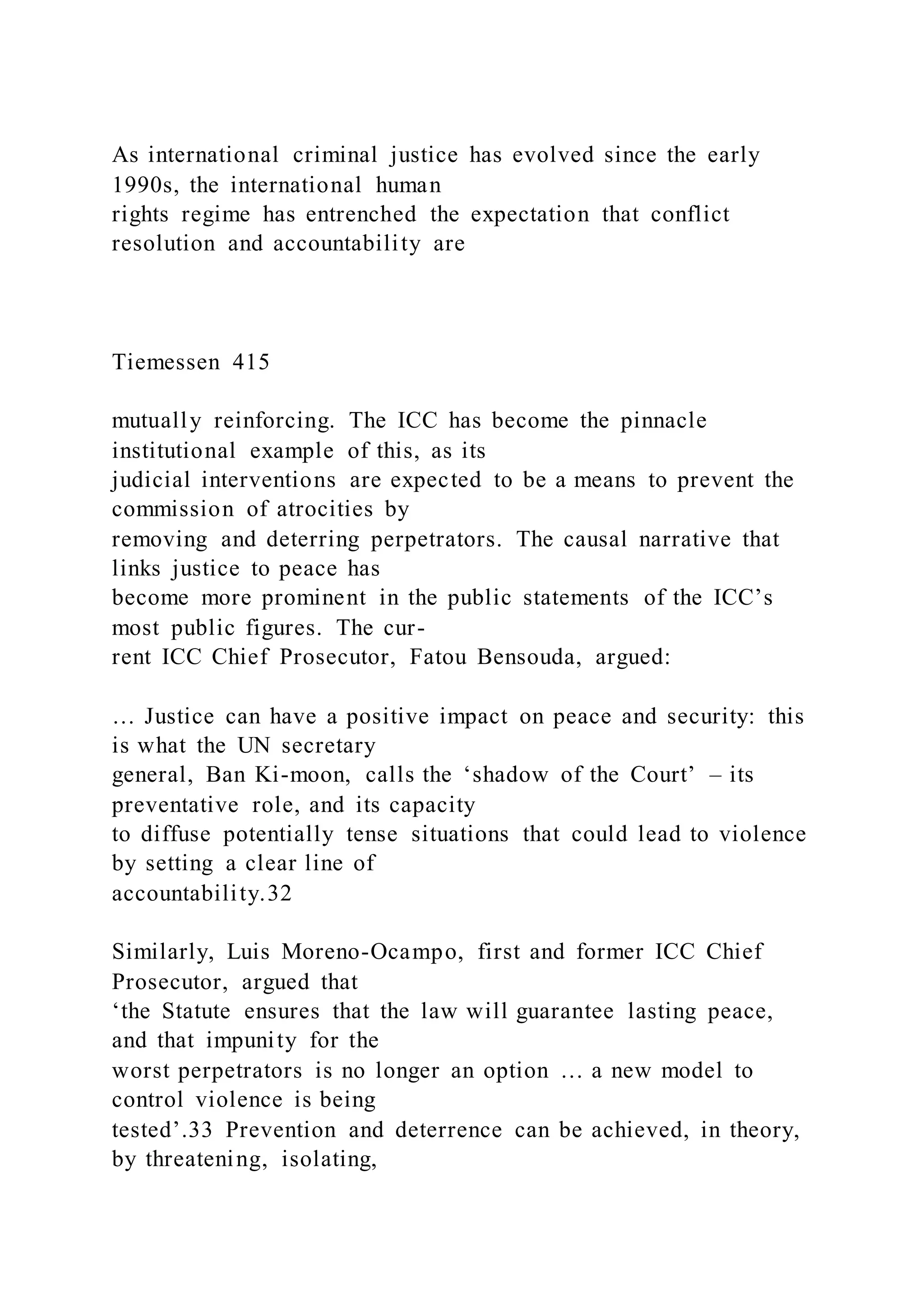
Lawfare: a ‘new model to control violence’
As international criminal justice has evolved since the early
1990s, the international human
rights regime has entrenched the expectation that conflict
resolution and accountability are
Tiemessen 415
mutually reinforcing. The ICC has become the pinnacle
institutional example of this, as its
judicial interventions are expected to be a means to prevent the
commission of atrocities by
removing and deterring perpetrators. The causal narrative that
links justice to peace has
become more prominent in the public statements of the ICC’s
most public figures. The cur-
rent ICC Chief Prosecutor, Fatou Bensouda, argued:
… Justice can have a positive impact on peace and security: this
is what the UN secretary
general, Ban Ki-moon, calls the ‘shadow of the Court’ – its
preventative role, and its capacity
to diffuse potentially tense situations that could lead to violence
by setting a clear line of
accountability.32
Similarly, Luis Moreno-Ocampo, first and former ICC Chief
Prosecutor, argued that
‘the Statute ensures that the law will guarantee lasting peace,
and that impunity for the
worst perpetrators is no longer an option … a new model to
control violence is being
tested’.33 Prevention and deterrence can be achieved, in theory,
by threatening, isolating,
marginalizing, and arresting perpetrators. Moreover, judicial
intervention can be done in
conjunction with or as a substitute for military force but can be
a more efficient and less
costly means of conflict resolution compared to military force if
it is backed with politi-
cal support. This type of lawfare is meant to prevent and end
conflict, not provoke it,
entrench it, or restrain legitimate uses of military force to
protect civilians. It is clearly a
political end to the means of the lawfare but one that is rarely
contested as legitimate in
its intentions. The problem for the ICC is really one of efficacy.
The intention of this lawfare, to use justice as a means to peace,
is evident in two
respects. First, all of the situations referred to the ICC were
ones of ongoing conflicts.34
As Mark Kersten argues, the ‘ICC was made – and is
predisposed – to intervene in active
and ongoing conflicts and has been directed to by individual
states and the UN Security
Council’.35 The ICC has also recently shown a penchant for
intervening early and quickly
as conflict escalates, as it did in Côte d’Ivoire, Libya, and Mali,
in order to deter further
atrocities. Judicial intervention in ongoing conflicts is a notable
departure from the
norms and past practice of international and transitional
justice.36 Similarly, as part of a
more recent deterrence strategy, Chief Prosecutor Bensouda
issued public warnings
about escalating violence in countries that are not yet, but could
be, under investigation,
such as Nigeria and Burundi. Second, the UNSC and the
International Criminal Court
are linked in several respects that demonstrate the interrelated
nature of peace and jus-
tice. The UNSC can refer conflict situations to the ICC for
investigation, as it did with
Darfur and Libya, if such situations represent a threat to
international peace and security.
Human rights advocates and the UN Human Rights Council
continue to press the UNSC
to use the ICC as a peacemaking tool in other contexts, calling
for referrals of the Syria,
North Korea, and other conflicts. These conflict situations have
strengthened a norma-
tive consensus that judicial intervention should complement
military and/or humanitar-
ian intervention.37
I argue that this lawfare poses a challenge for the ICC because
it has been ineffective
in its consequences, not illegitimate in its intention. The
efficacy of this lawfare has been
hampered in numerous respects. First, the relationship between
the ICC and the UNSC
has not been productive in terms of turning referrals and
investigations into arrests and
trials. UNSC referrals to the ICC theoretically have more ‘teeth’
for enforcement of arrests
416 International Relations 30(4)
because, as they are mandated by Chapter VII resolutions, states
are required to cooperate
them. But the UNSC has not backed up its referrals to the ICC
with any other kind of
logistical, political, or financial support. In their yearly reports
to the UNSC on the status
of its cases, the former and current Chief Prosecutors have
pleaded for the UNSC to more
effectively coerce states into cooperating and supporting the
ICC.38
Second, the ‘peace versus justice’ debate frames these two
ideals as alternatives and
not complementary objectives of the ICC when it intervenes in
ongoing conflict.39 On
the one hand, justice advocates and ICC officials caution
against using justice as a bar-
gaining chip. A statement by the OTP to the 2010 Review
Conference of the Rome
Statute illustrates this sentiment:
Justice contributes to peace and prevention when it is not
conceived as an instrument of either
and on condition that it is pursued for its own sake. If the ICC
is contemplated simply as a lever,
it will be undermined as some will expect it to be turned on and
off as political circumstances
dictate …40
One the other hand, the ICC cannot avoid operating in a
political environment where
there are pressures to sacrifice or delay justice so that warring
parties have an incentive
to negotiate. In cases of ongoing conflict, treating perpetrators
as ‘spoilers’ of peace may
require sacrificing justice in favor of offering amnesties, exile,
and political inclusion of
perpetrators.41
Finally, despite the ICC’s claims that it can deter perpetrators
of atrocities, there is
scant evidence that it can do so.42 It is unlikely that the ICC
can provide for specific
deterrence, and is more likely to provide general deterrence.
That is to say, for specific
deterrence, individuals already committing atrocities or likely
to in the near future will
not be deterred by the threat of an ICC prosecution. General
deterrence may work by
changing a culture of impunity in the long term. Deterrence
effects also depend on the
types of perpetrators targeted. As Kate Cronin-Furman argues,
only ‘commanders who
permit or fail to punish their subordinates’ for committing
atrocities are likely to be
deterred by an ‘adequately high risk of prosecution’ and not
commanders who explicitly
order atrocity crimes.43 The nature of the perpetrators,
specifically their rationality, also
affects deterrence. Committing atrocities is often part of a
military and political strategy
in civil wars, but in some cases, it is difficult to determine
whether the cost–benefit cal-
culus of perpetrators, such as Joseph Kony of the Lord’s
Resistance Army (LRA), is
indeed entirely rational or whether the possibility of arrest and
trial by the ICC poses a
sufficiently high enough risk relative to the benefits of war -
making.
Evidence from the Uganda, DRC, Sudan, Libya, and Côte
d’Ivoire situations is used
below to show how the ICC is used as a means to the political
end of conflict resolution
and also an analysis of whether this lawfare strategy has been
effective.
Intentions and efficacy of justice as a means to peace
As the ICC’s first intervention in a conflict situation, the
Uganda case set an important
precedent and inflated expectations about how judicial
intervention could accomplish what
would otherwise be a military and political objective –
defeating the LRA. After several
Tiemessen 417
unsuccessful military operations against the LRA and stalled
peace negotiations, Uganda’s
President Museveni referred the conflict situation to the ICC in
late 2003. In 2005, follow-
ing its investigations to establish who was most responsible for
some of the most notorious
massacres in the conflict, the ICC issued arrest warrants for five
individuals representing
the leadership of the LRA. The Ugandan government ‘perceived
the referral of the LRA to
the ICC as a new means to defeat the relentless Ugandan rebel
movement’.44
Following the arrest warrants, an international and local ‘peace
versus justice’ debate
shaped both praise and criticism of the ICC’s intervention.
Those opposed to the inter-
vention argued that the ICC was a ‘spoiler’ in the peace process
by pointing out that the
LRA refused to participate in peace negotiations unless the ICC
arrest warrants were
dropped. Opponents also warned of escalation of the conflict if
the military were to step
up its operations in order to make arrests and/or if the LRA
retaliated with more violence
against civilians and child abductions.45 Those in favor of
judicial intervention argued
that justice could not wait nor be sacrificed for political and
military objectives and that
any amnesty for senior LRA would set a dangerous precedent of
impunity. A compro-
mise position also emerged, positing that the ICC’s timing was
ill-advised and, as a mat-
ter of sequencing, justice should wait until violence had ceased.
There has not been any resolution of the ‘peace versus justice’
debate based on the
Uganda situation. There is some evidence that judicial
intervention pushed the LRA to
the negotiating table and became part of the LRA leadership’s
decision-making
calculus.46 But the arrest warrants had no apparent deterrence
effects on the LRA as the
conflict did not abate until 2006, and the LRA continued to be
active and commit atroci-
ties in neighboring countries after 2006. In the end, quelling the
LRA threat to northern
Uganda and central Africa owes more to joint military efforts in
the region than it does
to the coercive effects of judicial intervention.47
Similar to the Uganda circumstances, the DRC government self-
referred its situation
to the ICC in 2004, and the ICC continues to pursue
investigations and trials while con-
flict in the eastern region routinely re-escalates. This is a region
where the central gov-
ernment has little effective control over ‘ungoverned’ space and
neither the military nor
a UN peacekeeping force has been able to sufficiently protect
civilians. While deterrence
remains elusive, it was hoped that the arrest of rebel leaders
would halt ongoing abuses
in the short term. But there is also an explicit assumption that
the scope of ICC’s indict-
ments, arrests, and trials would counter a history and culture of
impunity in the region
and contribute to the long-term goals of building the peace and
rule of law.48 The ICC has
not been considered an impediment to peace in the DRC in part
because its intervention
has had little effect on conflict resolution at all. Nevertheless,
conflict continued after the
ICC’s intervention when more rebel groups emerged and
splintered to compete for
resources, land, and power, resulting in persistent violence
against civilians and displace-
ment. Given the high number of perpetrators in this conflict
situation combined with the
ICC’s limited capacity for investigations and trials, there is an
insufficiently high risk of
prosecutions for deterrence to work. The only scant evidence of
deterrence effects is with
respect to the use of child soldiers; Thomas Lubanga, the
accused in the ICC’s first suc-
cessfully completed trial and conviction, was charged with this
crime. In doing so, some
suggest that the Lubanga case made rebels aware of the
possibility of prosecution if they
use children in combat and altered their behavior.49
418 International Relations 30(4)
The Darfur and Libya cases are similar in that they were both
referred to the ICC by
a Chapter VII UNSC resolution. Three out of five permanent
members of the UNSC
(China, Russia, and the US) are not States Parties to the Rome
Statute, but they still
either voted for or did not obstruct the referrals.50 As these
cases demonstrate, the UNSC
perceives the ICC as a complement, if not means, to conflict
resolution as other coercive
measure of sanctions and the use of force were also approved
for Sudan and Libya.
The Darfur conflict in Sudan is widely recognized as
constituting war crimes, crimes
against humanity and possibly genocide; the mass violence
against civilians has been
met with weak and ineffective responses from the international
community, including
sanctions and a small UN-sanctioned African Union
peacekeeping force. Given Sudan is
not a State Party to the Rome Statute, the UNSC referral in
2005 and the ICC’s subse-
quent issuing of arrest warrants for regime and Janjaweed
leaders, including President
Bashir, underscore that judicial intervention can be a coercive
instrument. Proponents of
the UNSC’s referral of the Darfur situation argued that such an
intervention would mar-
ginalize and deter perpetrators from committing further
atrocities. Now 10 years after the
referral, the ICC has had no discernible impact on conflict
resolution in Darfur.
It is also possible that the ICC’s intervention has exacer bated
the conflict in some
respects, by reducing the chances of a political settlement and
inciting tension between
the ICC and the Sudanese regime and African leaders. In 2009,
President Bashir tempo-
rarily expelled aid agencies from Darfur in response to ICC
arrest warrant against him
and won the support of the African Union and other political
elites on the continent who
see the ICC as a neo-colonial means of regime change.51 Now,
in the absence of deter-
rence and arrests of the perpetrators, the civil war and violence
against civilians are
resurgent. In the first half of 2013, violence escalated again in
Darfur, producing 300,000
newly displaced persons, and a high-profile ICC indictee
(Kushayb) was allegedly at the
scene of recent atrocities.52 Violence increased again in 2015,
producing 150,000 newly
displaced persons.
The ICC’s ability to affect peace through justice has largely
failed in Darfur because
it has not been bolstered by any further coercive action or
diplomacy from the UNSC. As
Kenneth A. Rodman argues, ‘international criminal justice
cannot end impunity in an
ongoing war as long as states and intergovernmental
organizations are unwilling to take
enforcement actions’.53 Since the 2005 referral, the Chief
Prosecutors have expressed
their frustration with the UNSC’s seeming abandonment of the
Darfur cases in their
yearly reports. This came to a head in December 2014, when
Chief Prosecutor Bensouda
reported to the UNSC her decision to ‘hibernate’ the Darfur
cases and faulting the
Council’s failure to enforce arrests. In her words, ‘we find
ourselves in a stalemate that
can only embolden perpetrators continue their brutality … What
is needed is a dramatic
shift in the Council’s approach to arresting Darfur suspects’.54
Therefore, the ICC’s coer-
cive power to make arrests and put perpetrators on trial, and
therefore its deterrent power,
cannot be realized if states and the UNSC do not cooperate in
enforcement or provide
further political support.
Libya is the only other instance of a UNSC referral to the ICC
and, as in the other
cases discussed above, it was done for a situation of ongoing
conflict. In response to
escalating violence against civilian protestors, UNSC
Resolution 1970 imposed sanc-
tions on Libya and referred the situation to the ICC to
investigate possible war crimes
Tiemessen 419
and crimes against humanity that had been committed in Libya
since 15 February
2011.55 The international community reacted quickly to the
situation as the resolution
was passed a mere 10 days after the protests and crackdown
occurred. A North Atlantic
Treaty Organization (NATO) military intervention followed the
request for judicial
intervention.
Disagreement over the sequencing of peace and justice was
revived with the Libya
case. Some critics argued that such interventions would
embolden the Libyan regime and
ensure that Gaddafi would ‘fight to the death’ or, at least,
eschew any political settlement
that could not credibly assure his impunity.56 But there is little
evidence to suggest that
the Libyan leader changed his behavior in response to military
and judicial intervention.
As Mark Kersten explains:
it can neither be said that the ICC’s intervention gave Gaddafi
an incentive to negotiate a
peaceful resolution to the conflict nor that the ICC prevented
negotiations from taking place. It
is, furthermore, not possible to suggest that the arrest warrant
against Gaddafi led to the failure
of the peace negotiations.57
Moreover, Gaddafi did not entertain the idea of exile, despite
speculation, and thus his
ICC arrest warrant cannot be blamed for taking this option off
the table. One possible
effect of the intervention, however, is that it may have further
marginalized the Libyan
leader by affecting the calculus of central officials in his
regime, several of whom
defected. In the long run, however, central governance and
stability continue to deterio-
rate in Libya, and the ICC, as in the case of Sudan, has received
no coercive backing
from the international community to make either justice or
peace possible.
Finally, Côte d’Ivoire makes for an interesting case to assess
whether justice could be
a means to peace, given the ICC has twice intervened there. In
2004, the ICC warned
ruling elites of potential investigations and prosecutions when
the government, under
former President Gbagbo, was battling his rivals by inciting
ethnic hate speech. Tensions
and violence de-escalated shortly thereafter. Payam Akhavan
claims, ‘the ICC’s impact
on the civil war in Côte d’Ivoire is a compelling demonstration
of how international tri-
bunals can help prevent human rights abuses from escalating
into mass murder merely
by threats of prosecutions’.58 But even if the ICC can be
credited with deterring the com-
mission atrocities in the short term, this initial intervention did
not have long-term deter-
rence effects. After disputed election results in 2010, defeated
President Laurent Gbagbo
refused to step down and concede to his long-time rival,
Alassane Ouattara. Côte d’Ivoire
then descended into violence between pro-Gbagbo and pro-
Ouattara forces. Civilians on
both sides of the political and ethnic divide were targeted,
resulting in approximately
1000 civilian deaths. In December 2010 and while the conflict
was ongoing, the ICC
Prosecutor announced the OTP would begin investigating those
who were criminally
responsible for atrocities. Judicial and military interventions
were not explicitly coordi-
nated in this instance, yet UN and French forces aided
Ouattara’s rebel forces in ousting
Gbagbo who was later captured and taken into custody and
transferred to the ICC. As in
the cases of Sudan and Libya, there is insufficient evidence to
suggest that that judicial
intervention caused the cessation of violence or factored i nto
the decision-making calcu-
lus of perpetrators, such as Presidents Gbagbo or Ouattara and
their supporting forces.
420 International Relations 30(4)
The ICC’s intervention did remove Gbagbo and also his second
in command, but the
stability the country is presently enjoying owes more to
Ouattara’s victory and his inter-
national support.
A relatively new strategy by the Chief Prosecutor lends further
credence to judicial
intervention as lawfare: issuing public warnings to those most
responsible for escalating
cases of violence and reminding perpetrators of the criminal
consequences of their
actions. This happened for Mali, Kenya, Nigeria, Central
African Republic, and Burundi.
It also demonstrates that the ICC, but specifically the Chief
Prosecutor, may have some
agency in lawfare but only in instances where the ICC can act
on its own and without
referral from a state or the UNSC.
In sum, referrals of conflict situations to the ICC, by both states
and the UNSC,
reflect the intentions of these actors to use the ICC as tool of
lawfare, which in these
instances is to use judicial interventions as a means to remove
and deter of perpetra-
tors in ongoing conflicts. As the analysis above has outlined,
there is little evidence to
suggest that this strategy has been effective. Another form of
lawfare, with less legiti-
mate intentions but greater efficacy, has emerged from the
ICC’s judicial interven-
tions. This form of lawfare pertains specifically to the ICC’s
prosecutions and shows
that referring states and their ruling elites exercise a great deal
of strategic agency in
judicial interventions.
Lawfare: politicized prosecutions
Within a pejorative understanding of lawfare, one can point to
the politicization of the
ICC’s prosecutions as evidence of how law and legal
institutions can be manipulated
as political tools. There is now sufficient evidence to suggest
that the ICC has been
instrumentalized and politicized in that its prosecutorial
strategy reflects the interests
of ruling elites in states who can use judicial intervention to
eliminate their political
and military rivals. The type of lawfare occurs when States
Parties to the Rome Statute
self-refer their conflict situations to the ICC and subsequently
place limits on the
prosecutorial strategy by ensuring that arrests and trials are
dependent on their coop-
eration. For these ruling elites, inviting the ICC’s judicial
intervention has become an
opportunity to not only stigmatize and remove rivals but also
ensure their own impu-
nity by strategically directing the ICC’s attention only to the
opposing side in a con-
flict. These referring states rhetorically support justice and
human rights norms and
pledge to cooperate with the ICC but implicitly only as long as
their own crimes are
ignored. This is lawfare – it is a strategic use of law and a legal
institution for political
objectives.
It is not the intention nor in the interests of the ICC to serve as
a tool of lawfare in this
manner. The ICC’s spokespersons contribute to a problematic
discourse that it is an
impartial institution that is guided by judicial priorities and
criteria. The Rome Statute
does not allow for a state, via their referrals, to restrict the
ICC’s investigations and
indictments to only one party of a conflict – the OTP is
technically free to investigate any
and all those responsible for atrocity crimes within its
jurisdiction.59 And the ICC’s Chief
Prosecutors have adamantly defended that the ICC is impartial
and acts independently of
the external actors’ interests. For example, Moreno-Ocampo,
stated:
Tiemessen 421
The prosecutor’s duty is to apply the law without bowing to
political considerations, and I will
not adjust my practices to political considerations. It is time for
political actors to adjust to the
law … we have no police and no army but we have
legitimacy.60
Many legal and political science scholars are skeptical,
however, that an apolitical
court is possible, even if it is the ideal.61 As Sarah Nouwen and
Wouter Werner have
noted, ‘the more successfully (the ICC) portrays itself as
neutral, universal, and above
politics, the more attractive it will become as an instrument for
the labeling and neutrali-
zation of enemies of a particular political group’.62 ICC
officials themselves often pri-
vately acknowledge that the OTP must consider how
international and domestic political
dynamics will affect investigations and trials.63 Even advocates
of the ICC increasingly
express concern that the ICC has become politicized. In a recent
statement, Human
Rights Watch (HRW) argued that ‘the Court’s successes have
led some countries to seek
to use it for political ends rather than to support its independent
judicial mandate’.64
If it is the intention of States Parties to use their ability ( under
the Rome Statute) to
refer their own conflict to eliminate rivals and sanction their
own crimes, then these are
clearly political ends being pursued through judicial means.
Strategic benefits of partial justice
To date, four States Parties have referred their conflict
situations to the ICC: Uganda,
DRC, Central African Republic, and Mali. Also, the conflict
situation in Côte d’Ivoire
was technically initiated by the Chief Prosecutor but is
considered a de facto state
referral.65 The remainder of this section will discuss the ICC’s
interventions and indict-
ments for Uganda, the DRC, and Côte d’Ivoire, in order to
determine the extent to which
the strategic interests of ruling elites have biased the ICC’s
intervention.66
As previously mentioned, Uganda’s referral of its conflict
situation was largely an
effort to end the conflict by arresting the LRA leadership and/or
pressuring them to nego-
tiate. While there is no doubt that the LRA leaders accused by
the ICC should be held
accountable for their war crimes and crimes against humanity,
there is sound criticism that
President Museveni instrumentalized the ICC by self-referring
the conflict situation; with
the OTP’s encouragement of the referral, Museveni was rightly
assured that the ICC
would target only LRA crimes.67 What is more, Uganda’s
referral was announced at a joint
press conference with President Museveni and former Chief
Prosecutor Moreno-Ocampo;
this diplomatic maneuver raised ‘the possibility that the ICC
was being enlisted on one
side of the internal conflict’.68 The OTP only indicted five
LRA leaders on charges of
crimes against humanity and war crimes, which include killings,
rape, and use of child
soldiers, among other atrocities. At the time of writing, only
Joseph Kony remains at
large; Dominic Ongwen – the child soldier turned rebel leader –
turned himself in, and the
remaining indictees are confirmed deceased. However, the ICC
has not indicted any sen-
ior officials in the Ugandan government and military (Uganda
People’s Defence Force
(UPDF)) who are considered responsible for attacks against
civilians, use of child sol-
diers, and forcible population displacement of 90% of Acholi
communities. The ICC’s
subsequent assurances that the crimes of all parties will be
investigated has been chal-
lenged by the prevalent view among Acholis and other critics
that ‘the Office of the
422 International Relations 30(4)
Prosecutor is acting on behalf of President Museveni, and will
not attempt to punish the
UPDF as well as the LRA’.69 The result has been a
prosecutorial strategy that is imbal-
anced and partial, empowering the Ugandan government’s fight
against the LRA, remov-
ing challenges to its rule, and sanctioning its crimes.
As in the case of Uganda, the DRC government strategically
self-referred its conflict
situation to the ICC, and what has followed is a similar pattern
of partiality and imbal-
ance in the ICC’s prosecutorial strategy. To date, the ICC has
targeted many warlords and
rebel leaders of various nonstate armed groups that have
ordered and committed atroci-
ties against civilians. Following its investigations into atrocities
in the Ituri and Kivu
regions, only one of six indictees remain at large and two have
been convicted. The
multiple arrests and surrenders of rebel leaders are important
milestones for the ICC.
Nevertheless, human rights groups and victims communities
have criticized the prosecu-
torial strategy for the DRC as selective and partial in deference
to the interests of ruling
elites in the government and military. Such critics also warn of
the consequences of such
partial justice for renewing a cycle of impunity and
violence.70All of those indicted and
arrested by the ICC are rivals of President Kabila who contest,
politically and with armed
force, his governance and territorial control of the eastern
regions of the DRC. The array
of rebel groups and their notorious leaders have undoubtedly
committed atrocities and
are justifiably the targets of international prosecutions. But
atrocities committed by the
DRC military, one notorious for its human rights abuses, and
the command responsibility
of the government and other regional actors has not been
subject to indictments.
Investigative reports from the United Nations71 and human
rights groups concur that
‘key political and military figures in Kinshasa, as well as
Uganda and Rwanda, played a
prominent role in creating, supporting and arming the militias
associated with (ICC
indictees) Lubanga, Ntaganda, Katanga, and Ngudjolo, among
others’.72 Even though
the crimes of ruling elites in the DRC and other governments
are well known, the ICC
continues to pursue a prosecutorial strategy that is partial and
imbalanced with strategic
benefits for president’s rule.
There are both political and legal reasons why the OTP has
pursued perpetrators on
only one side of the conflict, leaving the crimes of those in
power unaccounted for. As a
legal justification, the OTP contends that the alleged crimes of
the Ugandan and DRC
governments and militaries do not meet the gravity threshold –
relative to the crimes of
the LRA and Congolese warlords – to justify indictments.73 In
Uganda, the crimes of the
LRA undoubtedly warrant justice, but scholars, human rights
advocates, and victim com-
munities assert that this was a two-sided conflict in which the
government and military
also committed atrocities, even if such atrocities were less
grave than those of the LRA.74
The gravity threshold has failed to justify these imbalances in
the prosecutorial strategy
for the DRC and Uganda and is most problematic given the
ICC’s mandate is to prose-
cute those ‘most responsible’ for atrocities, irrespective of what
is political possible and
desirable.
The ICC’s necessary dependence on state cooperation provides
some explanation
for this imbalance and partiality in prosecutions. State
cooperation affects the OTP’s
ability to access witnesses and evidence, conduct outreach
activities and, most impor-
tantly, ensure arrests and transfers of the accused to The Hague.
Since the ICC opened
investigations into Uganda, the government has repeatedly
threatened to withdraw
Tiemessen 423
cooperation if anyone in the government was to be indicted, and
President Museveni
has become increasingly hostile to the ICC.75 The DRC
government has selectively
supported and cooperated with the ICC only when it has been in
its interest to do so.
This is most clearly illustrated with respect to the ICC’s
indictment and arrest of Bosco
Ntaganda – a notorious warlord whose position of leadership,
ability to rival the
Congolese government and military, and commission of mass
atrocities made him a
high-profile target for the Chief Prosecutor. The ICC issued an
arrest warrant for
Ntaganda in 2006, but he remained at large while the
government falsely claimed it
was unable to arrest him.76 In 2009, he allied with the
government and was given a
prestigious position as a commander in the DRC military.
Ironically, Ntaganda was
then protected by the government and from the reaches of the
ICC until his defection
in 2012. President Kabila finally ordered Ntaganda’s arrest in
April 2012 but – shun-
ning the ICC – insisted that the warlord be tried in the DRC.
Ntaganda’s unexpected
surrender and transfer to the ICC (at his own request) in March
2013 was likely, in part,
a result of his broken ties with both the DRC and Rwandan
governments.77 Past and
pending arrests of those indicted in this conflict situation are
dependent on the coop-
eration and strategic interests of the DRC and other
governments in the region. As is
the challenge with Uganda, the government is cooperative with
the ICC so long as the
ICC targets rebels and not government or military officials.
There is also evidence to suggest that ruling elites in Côte
d’Ivoire have used the
ICC’s judicial intervention as a tool of lawfare. The current and
internationally sanc-
tioned Ivorian President, Alassane Ouattara, invited and
supported the ICC’s interven-
tion and the subsequent arrest and transfer of his long-time
rival, former President
Gbagbo, to stand trial at The Hague. In tandem with the
international community’s sanc-
tioning of his ascent to power, Ouattara’s request came
alongside his publicly rhetorical
commitment to justice, reconciliation, and respect for human
rights.78 Both he and the
ICC have pledged to pursue whoever is most responsible for the
post-election violence
on both sides of the political and ethnic divides.
Investigative reports from international human rights groups, a
UN Commission of
Inquiry, and even Côte d’Ivoire’s own Commission of Inquiry
documented that massive
human rights violations were committed by both sides and
potentially with the instruc-
tion and sanction of Gbagbo and Ouattara themselves. To date,
the ICC has only indicted
Gbagbo, his wife, and the leader of his youth militia, and there
has been no little domes-
tic accountability for crimes committed by forces loyal to
Ouattara. By August 2012, all
of the nearly 150 individuals charged by domestic prosecutors
for crimes during the
post-election violence are allied with Gbagbo.79 The
government refused to transfer
Simone Gbagbo to the ICC and recently tried and convicted her
in a domestic court. One
individual loyal to Ouattara – a warlord known to have
committed massacres – was
arrested in May 2013. In July 2015, only two pro-Ouattara
fighers were among the 20
individuals charged for the post-election violence—the
remainder were pro-Gbagbo
fighters. In contrast, members of the new security forces
suspected of human rights
abuses have been promoted in Ouattara’s government and enjoy
de facto impunity. HRW
has been at the forefront of pressuring both the international
community and Ouattara for
fair and impartial justice, lest Gbagbo’s supporters have cause
for vengeful violence.
According to HRW’s report:
424 International Relations 30(4)
In stark contrast to the prosecution of those from Gbagbo’s side,
no member of (Ouattara’s)
Republican Forces has been arrested on charges for crimes
committed during the conflict …
While President Ouattara and Justice Minister Kouadio
Ahoussou have consistently promised
that all crimes will be punished, the gap between rhetoric and
reality risk a reversion to impunity.80
Gbagbo’s supporters have been publicly critical of the ICC,
claiming the ICC has
unfairly singled out the former leader and sanctioned the crimes
of those in power.
Political and social divisions in post-conflict Côte d’Ivoire have
become further
entrenched with the recognition that both internatio nal justice
and domestic justice are
imbalanced, partial, and politically subservient to ruling elites.
The OTP has indicated
that others could be indicted and insists that the Côte d’Ivoire
government must cooper-
ate regardless of who is indicted.81 Unlike the situations in
Uganda and DRC, the ICC
appears eager to resist its use as a tool of lawfare for ruling
elites in states under its
jurisdiction.
The above examples are only instances of state referrals to the
ICC. Some of the
ICC’s most vociferous critics have suggested that when the
UNSC referred the Darfur
and Libya conflicts to the ICC and placed restrictions on the
OTP’s prosecutorial strat-
egy, it was doing so with the intention of regime change by
marginalizing Bashir and
Gaddafi. If this were the case, it would also constitute lawfare
in the way that the above
state referral cases have. But this concern is largely without
cause. Both Bashir’s and
Gaddafi’s regimes were already marginalized and considered
pariahs in the international
community – Gaddafi more than Bashir in the his regime’s latter
years. The UNSC did
not need the ICC for that. Moreover, unlike in the above cases,
UNSC powers were not
major parties to the conflicts they referred, nor were they
responsible for committing
mass atrocities in them and also deserving of justice. The
accusations of regime change
have gained traction mostly because of Russia and China, who
have used these examples
to ward off ICC intervention in Syria.
In sum, this type of lawfare has emerged in instances of state
referrals where ruling
elites in these states have derived strategic benefits from partial
prosecutions. These
elites are, therefore, the primary agents of lawfare, and judicial
intervention becomes a
tool to ensure their own impunity and the punishment and
removal of their rivals.
Conclusion
The concept of lawfare has empirical relevance to a variety of
issue areas where law,
conflict, and politics intersect. In an attempt to rescue the
concept of lawfare from its
association with the ideology and strategies in the War on
Terror, I have briefly surveyed
its origins and usage to come to a consensus on what constitutes
lawfare in theory and in
practice. In so doing, I have argued that aspects of the ICC’s
judicial interventions con-
stitute lawfare: it is a coercive and strategic element of
international criminal justice in
which the ICC’s judicial interventions are a means to political
ends. Therefore, this anal-
ysis represents the first empirical application of the concept of
lawfare to the ICC, with
the goal of identifying what constitutes ‘politicization’ of
judicial intervention.
To date, the political ends pursued by states and the UNSC are
conflict resolution and
politicized prosecutions. Despite the legitimate intention of
pairing justice with conflict
Tiemessen 425
resolution, the ICC has had little success in deterring and
removing elite perpetrators of
atrocities with its judicial interventions in Uganda, the DRC,
Sudan, Libya, and Côte
d’Ivoire – given that waning state cooperation has hampered
arrests and most conflicts
are ongoing despite the ICC. With respect to politicized
prosecutions, the intentions of
referring states to remove their rivals and protect their own
impunity have been realized.
The second type of lawfare identified here is the
instrumentalization of the ICC’s pros-
ecutions by ruling elites in referring states; this pattern of
politicization has been consist-
ent across the cases of Uganda, the DRC, and Côte d’Ivoire.
This is immensely damaging
to the ICC’s credibility, which hinges on its ability to remain
impartial even when the
necessary trade-off is cooperation with ruling elites.
In both these respects, I have argued here that the ICC is
suffering from lawfare
largely as a result of its ties to States Parties and the UNSC.
This is an important conclu-
sion as, during the Rome Treaty negotiations and ICC’s early
years, it was assumed that
State Party and UNSC referrals would empower and legitimize
the ICC and act as a
check on a potentially ‘politicized’ prosecutor. Paradoxically,
the ICC now operates in an
environment whereby overtures from these actors have invited
politicization, and the
best hope for an apolitical ICC lies with prosecutorial
independence.
An important clarification to this argument is that not every use
of international crimi-
nal justice constitutes lawfare. Nor is every ICC judicial
intervention lawfare. For exam-
ple, indictments in the Kenya case were relatively impartial, and
since intervention was
post-conflict, the intended outcome was primarily trial and
punishment, not conflict
resolution. As other investigations and cases arise, there are
many indications that the
ICC will take a different approach to its prosecutorial strategy
and that the international
community’s expectations for judicial intervention will be
tempered by reality. And this
implies room for change and progress. If expectations of the
ICC’s impact are limited to
judicial outcomes of trial and punishment, and prosecutorial
strategies prioritize impar-
tiality, the ICC will not only be more effective but also be
perceived as a credible institu-
tion that seeks justice above and despite politics.
Acknowledgements
My thanks goes to Mark Kersten, Chris Tenove, Elizabeth
Stubbins-Bates, Eric Leonard, Henry
(Chip) Carey, Michael Ben-Josef Hirsch, and this journal’s
anonymous reviewers for their con-
structive comments on previous drafts. Earlier versions of this
article were presented at the 2015
annual convention of the International Studies Association in
New Orleans, LA, and the Transitional
Justice Working Group at the Carr Center for Human Rights
Policy, Harvard Kennedy School.
Funding
The interview data used in this research was made possible with
the support of funding from a
Faculty Development Committee grant at Bowdoin College.
Notes
1. I use the term ‘judicial intervention’ to refer to the
International Criminal Court’s (ICC) activ-
ities when intervening in conflict situations, including
investigations, indictments, arrests,
and trials but excluding preliminary examinations. Judicial
intervention does not necessarily
imply that the affected state does not consent but merely that an
outside actor, namely, an
426 International Relations 30(4)
international court, has become involved in a state’s
administering of the rule of law and
conflict resolution and has the power to apprehend its nationals.
2. The Rome Statute and ICC use the term ‘situations’ to refer
to specific conflict situations, as
opposed to states and as distinct from cases against accused
individuals.
3. Without universal jurisdiction, the ICC can only proceed
with a case against an individual if
(a) that individual is a citizen of a State Party or (b) if the
crimes were committed on the ter-
ritory of a State Party or (c) if the United Nations Security
Council (UNSC) refers a conflict
situation in a State or non-State Party to the ICC.
4. Interview with ICC Official.
5. In the Rome Treaty negotiations, the Africa group provided
strong support for the creation of
the ICC and was second only to European states in their support
and subsequent implement-
ing legislation.
6. Interview with ICC official.
7. There is a vast literature on the legalization of international
relations. See, for example, Judith
Goldstein, Miles Kahler, Robert O. Keohane, and Anne-Marie
Slaughter, ‘Introduction:
Legalization and World Politics’, International Organization,
54(3), 2000, pp. 385–99.
8. For a similar concept, see Peter Maguire’s definition of
‘strategic legalism’ in Peter Maguire,
Law and War: International Law and American History (New
York: Columbia University
Press, 2000), p. 9.
9. Charles J. Dunlap, Law and Military Interventions:
Preserving Humanitarian Values in
21st Century Conflicts (Cambridge, MA: Carr Center for Human
Rights Policy, Harvard
University, 2001), p. 2.
10. Charles J. Dunlap, ‘Lawfare Today: A Perspective’, Yale
Journal of International Affairs,
Winter, 2008, pp. 146–54.
11. Charles J. Dunlap, ‘Does Lawfare Need an Apologia?’, Case
Western Reserve Journal of
International Law, 43(1–2), 2011, pp. 121–43.
12. This refers to the ‘Goldstone report’ and the Palestinian
Authority’s intention to request an
ICC investigation into war crimes in Gaza.
13. Jeremy Waldron defines lawfare in the context of
asymmetric conflict, wherein insurgents
may ‘transfer part of their struggle to courts, either domestic or
international courts, to
try to embarrass the power they’re struggling against or secure
some advantage’. Jeremy
Waldron, ‘Asymmetric War: Lawfare and Provocation in an
Insurgency’, Keynote Address
(Asymmetric Warfare: A Symposium, Mahindra Humanities
Center, Harvard University,
Cambridge, MA, 30 March 2015).
14. David Kennedy, Of War and Law (Princeton, NJ: Princeton
University Press, 2006),
pp. 12, 22.
15. Kennedy, Of War and Law, p. 32.
16. The Lawfare blog was founded in September 2010 by
Benjamin Wittes, Jack Goldsmith and
Robert Chesney and can be found here:
http://www.lawfareblog.com
17. ‘About Lawfare – A Brief History of the Term and Site’,
Lawfare Blog, available at: http://
www.lawfareblog.com/about/ (accessed 1 June 2015).
18. ‘About Lawfare’, available at:
http://www.lawfareblog.com/about/ (accessed 1 June 2015).
19. See Gabrielle Blum and Philip B. Heymann, Laws, Outlaws,
and Terrorists: Lessons from the
War on Terrorism (Belfer Center Studies in International
Security) (Cambridge, MA: MIT
Press, 2010), pp. 41–2; Eric A. Posner, ‘Dockets of War’, The
National Interest, March/April,
2011, p. 26.
20. John R. Bolton, former US Ambassador to the UN, is the
public figure most notable for his
vehement distrust and opposition to the ICC. Additionally,
many legal scholars align with con-
servative foreign policy-makers who reject the ICC as,
paradoxically, too weak to be effective
http://www.lawfareblog.com
http://www.lawfareblog.com/about/
Tiemessen 427
or strong enough to threaten US interests. See, John R. Bolton,
‘The Risks and Weaknesses
of the International Criminal Court from America’s
Perspective’, Law and Contemporary
Problems, 64(1), 2001, pp. 167–80; Posner, ‘Dockets of War’.
21. As quoted from David Scheffer in Pamela Yates, The
Reckoning: The Battle for the
International Criminal Court (USA: Skylight Pictures, 2009).
22. David Bosco argues that major powers’ behavior toward the
Court has been characterized
as control, even for the US, who is not a State Party. In return,
the Chief Prosecutor has
been strategic and pragmatic in his or her behavior with major
powers, resulting in ‘mutual
accommodation’ between the two sides. David Bosco, Rough
Justice: The International
Criminal Court in a World of Power Politics (Oxford: Oxford
University Press, 2013),
pp. 20–2.
23. Lawfare is not necessarily restricted to the international
sphere, as Jens Meierhenrich shows
with the political use and abuse of transitional justice in post-
genocide Rwanda. See, Jens
Meierhenrich, Lawfare: The Formation and Deformation of
Gacaca Jurisdictions in Rwanda,
1994-2012 (Cambridge: Cambridge University Press,
forthcoming).
24. The symposium was held at Case Western University School
of Law on 10 September 2010,
and contributors’ articles were subsequently published in The
Case Western Reserve Journal
of International Law, vol. 43, no. 1–2, 2011.
25. Justice James Ogoola, ‘Lawfare: Where Justice Meets
Peace’, Case Western Reserve Journal
of International Law, 43(1–2), 2011, pp. 181–8.
26. Robert Petit, ‘Lawfare and International Tribunals: A
Question of Definition? A Reflection on
the Creation of the “Khmer Rouge Tribunal”’, Case Western
Reserve Journal of International
Law, 43(1–2), 2011, pp. 189–99.
27. David Crane, ‘The Take Down: Case Studies Regarding
“Lawfare” in International Justice’,
Case Western Reserve Journal of International Law, 43(1–2),
2011, pp. 201–14.
28. David J. Scheffer, ‘Whose Lawfare Is It, Anyway?’, Case
Western Reserve Journal of
International Law, 43(1–2), 2011, pp. 215–27.
29. Louise Arbour, ‘The Laws of War: Under Siege or Gaining
Ground?’ (Speech on the occasion
of the Kirby lecture at the Australian National University,
Canberra, ACT, Australia, 23 June
2011).
30. David Kennedy, ‘Lawfare and Warfare’, in James Crawford
and Martti Koskenniemi (eds),
The Cambridge Companion to International Law (Cambridge:
Cambridge University Press,
2012), pp. 158–84.
31. The ICC is more of a tool than an agent of lawfare. The ICC
and specifically the Chief
Prosecutor do have the ability to initiate investigations through
their proprio motu power,
but this has been rare so far. All of the conflict situations
discussed in this article were ones
referred by States Parties or the UNSC.
32. Fatou Bensouda, ‘International Justice and Diplomacy’, The
New York Times, 19 March 2013,
available at:
http://www.nytimes.com/2013/03/20/opinion/global/the-role-of-
the-icc-in-inter-
national-justice-and-diplomacy.html
33. Luis Moreno-Ocampo, ‘The International Criminal Court:
Seeking Global Justice’, Case
Western Reserve Journal of International Law, 40(1–2), 2008,
pp. 215–25.
34. Only the Kenyan situation was post-conflict, and this was
not referred but rather initiated by
the Chief Prosecutor.
35. Mark Kersten, ‘Justice in Conflict: The ICC in Libya and
Northern Uganda’ (Doctoral
Dissertation, London School of Economics, London, 2015), p.
12.
36. Nicholas Waddell and Phil Clark, ‘Introduction’, in
Nicholas Waddell and Phil Clark (eds),
Courting Conflict? Justice, Peace and the ICC in Africa
(London: Royal African Society,
2008), pp. 7–12.
http://www.nytimes.com/2013/03/20/opinion/global/the-role-of-
the-icc-in-international-justice-and-diplomacy.html
http://www.nytimes.com/2013/03/20/opinion/global/the-role-of-
the-icc-in-international-justice-and-diplomacy.html
428 International Relations 30(4)
37. This has been explained well by those who focus on the
areas of normative and empirical
convergence between the ICC and the Responsibility to Protect
(R2P). Both the ICC and
R2P are meant to address to situations of atrocity crimes, and
their interventions are limited
to states that are ‘unwilling’ or ‘unable’ to address such crimes.
So far, R2P has been invoked
in three of the conflict situations where the ICC has also
intervened (Darfur, Côte d’Ivoire,
and Libya). See Kristen Ainley, ‘The Responsibility to Protect
and the International Criminal
Court: Counteracting the Crisis’, International Affairs, 9(1),
2015, pp. 37–54; Frédéric
Mégret, ‘ICC, R2P, and the International Community’s
Evolving Interventionist Toolkit’, The
Finnish Yearbook of International Law, 21(1), 2010, pp. 21–51;
Kurt Mills, ‘R2P and the
ICC: At Odds or In Sync?’, Criminal Law Forum, 26, 2015, 73–
99.
38. ‘Security Council Urged to Take Steps to Ensure Arrest of
Sudanese Leaders for War
Crimes’, UN News Centre, 5 June 2012, available at:
http://www.un.org/apps/news/story.
asp?NewsID=42154#.VbxPf_Oqqko; ‘Security Council Must
Urgently Take Action to End
Impunity in Darfur – ICC Prosecutor’, UN News Centre, 5 June
2013, available at: http://
www.un.org/apps/news/story.asp?NewsID=45090#.VbxPnfOqqk
o.
39. See Payam Akhavan, ‘Beyond Impunity: Can International
Criminal Justice Prevent Future
Atrocities?’, The American Journal of International Law, 95(1),
2001, pp. 7–31; Human
Rights Watch (HRW), Selling Justice Short: Why
Accountability Matters for Peace (New
York: HRW, 2009); Hun Joon Kim and Kathryn Sikkink,
‘Explaining the Deterrent Effect
of Human Rights Prosecutions for Transitional Countries’,
International Studies Quarterly,
54(4), 2010, pp. 939–63; Jack Snyder and Leslie Vinjamuri,
‘Trials and Errors: Principle
and Pragmatism in Strategies of International Justice’,
International Security, 28(3), 2003–
2004, pp. 5–44; Leslie Vinjamuri, ‘Deterrence, Democracy, and
the Pursuit of International
Justice’, Ethics and International Affairs, 24(2), 2010, pp. 191–
211; Nicholas Waddell and
Phil Clark (eds), Courting Conflict? Justice, Peace and the ICC
in Africa (London: Royal
African Society, 2008); Chandra Lekha Sriram, Confronting
Past Human Rights Violations:
Justice vs. Peace in Times of Transition (New York: Frank
Cass, 2004).
40. International Criminal Court, ‘The Importance of Justice in
Securing Peace’, Review
Conference of the Rome Statute (Kampala, Uganda: Office of
the Prosecutor, International
Criminal Court, 30 May 2010), pp. 6–7.
41. See Snyder and Vinjamuri, ‘Trials and Errors’; Vinjamuri,
‘Deterrence, Democracy, and the
Pursuit of International Justice’.
42. United Nations General Assembly, ‘Report of the
International Criminal Court’, United
Nations A/60/177, 1 August 2005, p. 2.
43. Kate Cronin-Furman, ‘Managing Expectations: International
Criminal Trials and the
Prospects for Deterrence of Mass Atrocity’, The International
Journal of Transitional Justice,
7, 2013, 434–54.
44. Sarah M.H. Nouwen and Wouter G. Werner, ‘Doing Justice
to the Political: The International
Criminal Court in Uganda and Sudan’, The European Journal of
International Law, 21(4),
2011, pp. 941–65.
45. Tim Allen, Trial Justice: The Interna tional Criminal Court
and the Lord’s Resistance Army
(London: Zed Books, 2006), p. 123.
46. Nick Grono and Adam O’Brien, ‘Justice in Conflict? The
ICC and Peace Processes’, in
Nicholas Waddell and Phil Clark (eds), Courting Conflict?
Justice, Peace and the ICC in
Africa (London: Royal African Society, 2008), pp. 13–20;
Kersten, ‘Justice in Conflict’.
47. Joint military efforts were conducted by the Ugandan
military and its neighboring states to
track down and defeat the LRA. The US has also provided
special forces to assist these efforts
by way of training and intelligence. The LRA has allegedly
been reduced to just a few hun-
dred forces and is thought to be based in the Central African
Republic.
http://www.un.org/apps/news/story.asp?NewsID=42154#.VbxPf
_Oqqko
http://www.un.org/apps/news/story.asp?NewsID=42154#.VbxPf
_Oqqko
http://www.un.org/apps/news/story.asp?NewsID=45090#.VbxPn
fOqqko
http://www.un.org/apps/news/story.asp?NewsID=45090#.VbxPn
fOqqko
Tiemessen 429
48. HRW, Selling Justice Short, pp. 43–53.
49. HRW, Selling Justice Short, pp. 125–6.
50. The UNSC’s referral of the Sudan situation (Resolution
1593 in 2005) passed with P5 absten-
tions from the United States and China, and the referral of the
Libya situation (Resolution
1970 in 2011) passed unanimously with no abstentions.
51. ‘Sudan to Expel Foreign Aid Groups’, Al Jazeera, 16 March
2009, available at: http://www.
aljazeera.com/news/africa/2009/03/2009316131925285761.html
52. Ishma’il Kushkush, ‘New Strife in Darfur Leaves Many
Seeking Refuge’, The New York
Times, 23 May 2013, available at:
http://www.nytimes.com/2013/05/24/world/africa/new -
strife-in-darfur-leaves-many-seeking-refuge.html; HRW (HRW),
Sudan: ICC Suspect at
Scene of Fresh Crimes (New York: HRW, 3 June 2013).
53. Kenneth A. Rodman, ‘Darfur and the Limits of Legal
Deterrence’, Human Rights Quarterly,
30(3), 2008, pp. 529–60.
54. Fatou Bensouda, Statement to the United Nations Security
Council on the Situation in Darfur,
Pursuant to UNSCR 1593 (2005) (New York: Office of the
Prosecutor, The International
Criminal Court, 12 December 2014).
55. UNSC, ‘Resolution 1970’, United Nations S/Res/1970
(2011), 26 February 2011.
56. Max Boot, ‘Gaddafi Exile Unlikely’, Commentary
Magazine, 23 March 2011, available at:
https://www.commentarymagazine.com/2011/03/23/qaddafi-
exile-unlikely/
57. Mark Kersten, ‘The ICC in Libya: Beyond Peace versus
Justice’, Justice in Conflict Blog,
20 May 2012, available at:
http://justiceinconflict.org/2012/05/10/the-icc-in-libya-beyond-
peace-vs-justice/ (accessed 1 June 2015).
58. Payam Akhavan, ‘Are International Criminal Tribunals a
Disincentive to Peace?: Reconciling
Judicial Romanticism with Political Realism’, Human Rights
Quarterly, 31, 2009, pp. 624–54.
59. See Antonio Marchesi, ‘Article 14 Referrals of a Situation
by a State Party’, in Otto Triffterer
(ed.), Commentary on the Rome Statute of the International
Criminal Court: Observers’
Notes, Article by Article (Oxford: Hart Publishing, 2008), pp.
305-13.
60. Moreno-Ocampo, ‘The International Criminal Court’, p.
224.
61. The critical legal studies literature acknowledges that law
and politics cannot be entirely
separate domains, and many of these theoretical insights can
only be applied to the ICC.
See Christine Schwöbel (ed.), Critical Approaches to
International Criminal Law: An
Introduction (New York: Routledge, 2014). Judith Shklar’s
seminal work is also, of course,
known for its analysis of legalism and ‘political trials’. See
Judith N. Shklar, Legalism: Law,
Morals, and Political Trials (Cambridge, MA: Harvard
University Press, 1964).
62. Nouwen and Werner, ‘Doing Justice to the Political’, p. 963.
These scholars make a simi-
lar argument about the politicized nature of prosecutions and
provide astute evidence with
the Uganda and Sudan cases. My analysis complements and
extends theirs by addressing a
broader range of cases and contextualizes its significance within
the conceptual framework of
lawfare.
63. Interviews with ICC officials.
64. HRW, ICC: New Prosecutor Takes Reins (New York: HRW,
14 June 2012).
65. The Chief Prosecutor technically initiated investigations
into the Côte d’Ivoire situation with
his proprio motu power because Côte d’Ivoire was not a State
Party to the Rome Statute at
the time. But this instance can be considered a de facto, but not
de jure, case of state referral
because Ouattara publicly invited and supported and ICC
intervention and subsequently reaf-
firmed a 2003 government declaration that gave the ICC
jurisdiction over crimes committed
after September 19, 2002.
66. The Central African Republic and Mali situations were also
instances of state referrals but
will not be discussed here because there are too few cases from
which to assess the degree of
http://www.aljazeera.com/news/africa/2009/03/20093161319252
85761.html
http://www.aljazeera.com/news/africa/2009/03/20093161319252
85761.html
http://www.nytimes.com/2013/05/24/world/africa/new -strife-in-
darfur-leaves-many-seeking-refuge.html
http://www.nytimes.com/2013/05/24/world/africa/new -strife-in-
darfur-leaves-many-seeking-refuge.html
https://www.commentarymagazine.com/2011/03/23/qaddafi -
exile-unlikely/
http://justiceinconflict.org/2012/05/10/the-icc-in-libya-beyond-
peace-vs-justice/
http://justiceinconflict.org/2012/05/10/the-icc-in-libya-beyond-
peace-vs-justice/
430 International Relations 30(4)
impartiality and independence in the prosecutorial strategy. The
ICC has only indicted one
individual for the conflict in the CAR, and there are no
indictments for the conflict in Mali
yet.
67. Adam Branch presents a thorough and convincing argument
for this politicization. Adam
Branch, ‘Uganda’s Civil War and the Politics of ICC
Intervention’, Ethics and International
Affairs, 21(2), 2007, pp. 179–98.
68. Benjamin N. Schiff, Building the International Criminal
Court (Cambridge: Cambridge
University Press, 2008), p. 200.
69. Allen, Trial Justice, p. 97.
70. HRW, Unfinished Business: Closing Gaps in the Selection
of ICC Cases (New York: HRW,
2011), pp. 9–22.
71. See Office of the United Nations High Commissioner for
Human Rights (OHCHR), ‘Democratic
Republic of the Congo, 1993-2003: Report of the Mapping
Exercise Documenting the Most
Serious Violations of Human Rights and International
Humanitarian Law Committed within
the Territory of the Democratic Republic of the Congo between
March 1993 and June 2003’
(United Nations, 2010), available at:
http://www.genocidewatch.org/images/DRC10_06_xx_
Report_Draft_Democratic_Republic_of_the_Congo_1993-
2003.pdf
72. HRW, Unfinished Business, p. 12.
73. The ICC’s judges and Chief Prosecutor use a gravity
threshold for crimes as one criterion
to select both conflict situations and cases against individuals,
which is meant to guide the
ICC toward the most serious cases of atrocities. It is, however,
a vague and inconsistently
applied criterion that is more prominent in the Prosecutor’s
public discourse to justify case
selection than it is a robust legal criterion. See Susana SaCouto
and Katherine A. Cleary, ‘The
Gravity Threshold of the International Criminal Court’,
American Journal of International
Law Review, 23(5), 2008, pp. 807–54; William A. Schabas,
‘Prosecutorial Discretion and
Gravity’, in Carsten Stahn and Goran Sluiter (eds), The
Emerging Practice of the International
Criminal Court (Leiden: Martinus Nijhoff Publishers, 2009), pp.
229–46.
74. Amnesty International, ‘Uganda: First Steps to Investigate
Crimes Must be Part of a
Comprehensive Plan to End Impunity’, in Public Statement
(London: Amnesty International,
30 January 2004), available at:
https://www.amnesty.org/en/documents/AFR59/001/2004/
en/; Branch, ‘Uganda’s Civil War and the Politics of ICC
Intervention’; Phil Clark, ‘Law,
Politics and Pragmatism: The ICC and Case Selection in the
Democratic Republic of Congo
and Uganda’, in Nicholas Waddell and Phil Clark (eds),
Courting Conflict? Justice, Peace and
the ICC in Africa (London: Royal African Society, 2008), pp.
37–46; HRW, ICC: Investigate
All Sides in Uganda (New York: HRW, 4 February 2004).
75. For example, President Museveni accused the ICC of
‘blackmail’ with respect to its indictment
of recently elected Kenyan leaders. AFP, ‘Uganda’s Museveni
Praises Kenya for Rejecting ICC
“Blackmail”’, The Daily Nation, 9 April 2013, available at:
http://www.nation.co.ke/News/
politics/Ugandas-Museveni-praises-Kenya-for-rejecting-ICC-
blackmail/-/1064/1743650/-/
envd36/-/index.html
76. Mac McClelland, ‘I Can Find an Indicted Warlord. So Why
Isn’t He in The Hague?’, Mother
Jones, September/October, 2011, available at:
http://www.motherjones.com/politics/2011/09/
bosco-ntaganda-congo-warlord
77. Ntaganda’s ties to Rwanda are well known. He is a former
member of the Rwandan Patriotic
Army and former leader of several Rwanda-backed rebel groups
in the DRC. When he
defected from the DRC military in 2012, he became a leader of
the M23 rebel group that is
known to be militarily and financially supported by Rwanda.
When Ntaganda turned himself
in, he did so by going to the US Embassy in Kigali, and
Rwandan authorities ensured his
transfer to The Hague.
http://www.genocidewatch.org/images/DRC10_06_xx_Report_D
raft_Democratic_Republic_of_the_Congo_1993-2003.pdf
http://www.genocidewatch.org/images/DRC10_06_xx_Report_D
raft_Democratic_Republic_of_the_Congo_1993-2003.pdf
https://www.amnesty.org/en/documents/AFR59/001/2004/en/
http://www.nation.co.ke/News/politics/Ugandas-Museveni-
praises-Kenya-for-rejecting-ICC-blackmail/-/1064/1743650/-
/envd36/-/index.html
http://www.nation.co.ke/News/politics/Ugandas-Museveni-
praises-Kenya-for-rejecting-ICC-blackmail/-/1064/1743650/-
/envd36/-/index.html
http://www.nation.co.ke/News/politics/Ugandas-Museveni-
praises-Kenya-for-rejecting-ICC-blackmail/-/1064/1743650/-
/envd36/-/index.html
http://www.motherjones.com/politics/2011/09/bosco-ntaganda-
congo-warlord
http://www.motherjones.com/politics/2011/09/bosco-ntaganda-
congo-warlord
Tiemessen 431
78. Barbara Plett, ‘Ouattara Vows to Temper Justice with
Reconciliation’, BBC News, 23 May
2011, available at: http://www.bbc.co.uk/news/world-africa-
13508356; ‘Ivorian President
Vows Reconciliation’, France 24, 28 January 2012, available at:
http://www.france24.com/
en/20120127-ivory-coast-ouattara-heal-rifts-reconciliation-
gbagbo-sarkozy/
79. James Bouverie, ‘The Ivory Coast: In Search of Impartial
Justice’, Think Africa Press, 15
August 2012, available at:
http://www.ocnus.net/artman2/publish/Africa_8/The-Ivory-
Coast-
In-Search-of-Impartial-Justice.shtml
80. HRW, ‘They Killed Them Like It Was Nothing’: The Need
for Justice for Côte d’Ivoire’s Post-
Election Crimes (New York: HRW, 2011). See also Nico
Colombant, ‘Ivory Coast Struggles
with Reconciliation Deepen’, VOA News, June 15, 2012,
available at: http://www.voanews.
com/content/ivory-coast-struggles-with-reconciliation-
deepen/1211798.html
81. ‘ICC Prosecutor to Probe Six in Ivory Coast’, Radio
Netherlands Worldwide, 16 October 2011,
available at: http://allafrica.com/stories/201110171795.html;
Fatou Bensouda, ‘Statement to
the Press by the Prosecutor of the International Criminal Court’,
International Criminal Court
(Abidjan, Côte d’Ivoire, 20 July 2013).
Author biography
Alana Tiemessen is presently an Assistant Professor of Security
Studies at Endicott College. She
was previously a Visiting Assistant Professor at Bowdoin
College and a post-doctoral fellow at
The University of Chicago. Her research interests are in the
field of international and transitional
justice, the International Criminal Court, conflict resolution,
human rights, and failed states. Her
publications include ‘The International Criminal Court and the
politics of prosecutions’ in The
International Journal of Human Rights (May 2014).
http://www.bbc.co.uk/news/world-africa-13508356
http://www.france24.com/en/20120127-ivory-coast-ouattara-
heal-rifts-reconciliation-gbagbo-sarkozy/
http://www.france24.com/en/20120127-ivory-coast-ouattara-
heal-rifts-reconciliation-gbagbo-sarkozy/
http://www.ocnus.net/artman2/publish/Africa_8/The-Ivory-
Coast-In-Search-of-Impartial-Justice.shtml
http://www.ocnus.net/artman2/publish/Africa_8/The-Ivory-
Coast-In-Search-of-Impartial-Justice.shtml
http://www.voanews.com/content/ivory-coast-struggles-with-
reconciliation-deepen/1211798.html
http://www.voanews.com/content/ivory-coast-struggles-with-
reconciliation-deepen/1211798.html
http://allafrica.com/stories/201110171795.html
1
Fall Risk Factors in Hospitalized Acute Stroke Patients: A
Literature Review
Firstname I. Lastname
Department of Nursing, Eastern Michigan University
NURS 300W: Reading and Writing in Nursing Studies
Professor Amy McBain
January 10, 2020
Commented [BA1]: The full title appears in the upper 1/3
of the title page in title case and centered.
See this link for more information.
https://apastyle.apa.org/style-grammar-guidelines/paper-
format/title-page
Commented [BA2]: Note that there is a specific context
for the research: a narrowed focus within the larger topic.
Commented [BA3]: The entire APA paper should be
consistently double-spaced (except for the text in tables,
which can be single, 1.5, or double spaced; try and keep
each table on a single page and make them easily readable
for your audience).
Also, be sure to check your Paragraph formatting to make
sure the spacing “Before” and “After” are both set at “0pt.”
https://apastyle.apa.org/style-grammar-guidelines/paper-
format/title-page
https://apastyle.apa.org/style-grammar-guidelines/paper-
format/title-page
2
Fall Risk Factors in Hospitalized Acute Stroke Patients: A
Literature Review
Stroke has been classified as the most disabling chronic disease
with deleterious
consequences for individuals, families, and society (Schmid et
al., 2010a). Stroke patients,
sometimes already devastatingly compromised, are susceptible
to several complications. Despite
increased supervision, falls are the most common hospital -
acquired condition in patients with
neurological disease (Cox et al., 2017). While the length of stay
in the hospital setting is
decreasing, patients who have suffered a cerebral infarction still
spend 4-5 days on an acute
stroke unit undergoing testing, medical stabilization, and
rehabilitation evaluations (Cox et al.,
2017); understanding fall risk factors are essential to providing
appropriate nursing care to these
patients.
The percentage rate of patient falls in the stroke unit has been
found to be as high as
12.9% with 15.4% of those falls causing visible physical
damage (Persson et al., 2017).
Consequences of falls include broken bones, soft tissue injuries,
head injuries, as well as an
inability to perform activities of daily living (ADLs), including
eating, dressing, bathing, and
toileting (Cho et al., 2015). Patient falls can even result in
death. Patients who fell also had an
increased length of stay, tripling their hospital days (Schmid et
al., 2010a), which can leave them
potentially immobile, make them vulnerable to further
complications, and potentially exhaust
their limited insurance and financial resources. Much of the
responsibility for the patients’ safety
resides with their nurse. This literature review will examine
patient risk factors for falling in an
acute stoke unit.
Methods
The methods used to find literature consisted of a search using
several variations of the
same keywords in the CINAHL, Google Scholar, and PubMed
databases. Keywords included in
the searches were: fall risk in stroke unit, patient fall risks and
stroke or cerebrovascular
accident (CVA), and characteristics of stroke patients who fall.
Also used were the search terms
functional status and postural control; the latter two search
terms provided definitions to clarify
Commented [BA4]: The full title appears bold and
centered as the first line on p. 2 and should be the same
exact wording as appears on the title page.
“introduction” is not used as a heading in APA papers.
Commented [BA5]: When sources have 3 or more
authors, use et al. for in text citations. See this link for the
in-text citation rules and examples.
https://apastyle.apa.org/style-grammar-
guidelines/citations/basic-principles/author-date
Remember “et al.” is a Latin abbreviation for et alli, which
means “and others.” Since alli is abbreviated to al. there is
always a period.
Also, parenthetical in-text citations have a comma between
the authors’ names and the year of publication.
Commented [AM6]: Notice that the introduction
provides information and background about the topic
providing some context for the review that will follow. The
purpose of the paper is clearly noted within the
introduction.
Commented [BA7]: This is the correct formatting for an
APA level one heading.
See this link for more information.
https://apastyle.apa.org/style-grammar-guidelines/paper-
format/headings
Commented [BA8]: The writer in this section notes the
databases that were used to find all of the sources, notes
the keywords and lets readers know what years were
limited within the search.
https://apastyle.apa.org/style-grammar-
guidelines/citations/basic-principles/author-date
https://apastyle.apa.org/style-grammar-
guidelines/citations/basic-principles/author-date
https://apastyle.apa.org/style-grammar-guidelines/paper-
format/headings
https://apastyle.apa.org/style-grammar-guidelines/paper-
format/headings
3
information found in the review of the literature. The search
was restricted to peer-reviewed
journal articles written between 2010 and 2018. Table 1
summarizes the common themes that
developed as a result of this research.
Table 1
Risk Factors for Falls in Hospitalized Acute Stroke Patients
Source
Decreased functional
status
Stroke severity
Cho et al. (2015)
X
Cox et al. (2017)
X
X
Ingeman et al. (2011)
Persson et al. (2018)
X
Schmid et al. (2010a)
X
X
Schmid et al. (2010b)
X
X
Review of the Literature
Careful review of the literature revealed two prevalent themes
of risk factors associated
with hospitalized acute stroke patients: decreased functional
status and stroke severity. These
two risk factors are demonstrated in the research to be
important to consider when developing
fall risk prevention plans.
Decreased Functional Status
Functional status is an individual's ability to perform normal
daily activities required to
meet basic needs, fulfill usual roles, and maintain health and
well-being (American Thoracic
Society, 2007). Persson et al. (2018) found that patients who
required the use of a walking aid
such as a cane or walker more than doubled the risk of fall.
Similarly, a study by Cox et al.
(2017) found that patients who needed assistance with
ambulation at the time of discharge were
Commented [CS9]: The format is in APA format, with the
label Table 1 above in bold; a title in title case and italicized.
Commented [BA10]: The table has two themes, with at
least three sources per theme; the stub head (see p. 200 in
your APA Manual) is left aligned with the authors listed as
the first citation in text; the column headings are centered
and in sentence case. The authors’ names are alphabetized.
See this resource for more info:
https://apastyle.apa.org/style-grammar-guidelines/tables-
figures/sample-tables
Commented [BA11]: Use the same font for your tables as
in the rest of your paper; remember consistency in your
document design.
Commented [BA12]: Typically, students include a brief
overview after the Review of Literature heading before the
first theme. The overview would just be 1-3 sentences
indicating why the themes were selected and what the
themes are.
Commented [BA13]: Notice how the author discussed
these themes below in the same order as presented here to
offer readers parallelism.
Commented [BA14]: This level two heading titles the
section on the first theme. Level two headings are sub-
categories of the level one heading under which they
appear.
Again, see this resource for more on APA headings:
https://apastyle.apa.org/style-grammar-guidelines/paper-
format/headings
Commented [BA15]: Notice how the topic sentences are
about ideas instead of individual sources. The topic
sentence should provide your readers with an introduction
to this topic and an overview of the main points of this
paragraph.
https://apastyle.apa.org/style-grammar-guidelines/tables-
figures/sample-tables
https://apastyle.apa.org/style-grammar-guidelines/tables-
figures/sample-tables
https://apastyle.apa.org/style-grammar-guidelines/paper-
format/headings
https://apastyle.apa.org/style-grammar-guidelines/paper-
format/headings
4
statistically more likely to have experienced falling in the
inpatient setting. Schmid et al. (2010b)
associated a loss of functional status as identified by ataxia,
aphasia, gait abnormality, brainstem
stroke, previous CVA, history of anxiety, history of urinary
tract infection, and history of
syncope to a fall in the hospital. Additionally, loss of functional
status leads to a self-care deficit.
Functional status is closely tied with dependence in ADLs in
that dependency in ADLs is
a measurement indicative of a loss of functional status.
Dependence in ADLs is defined as the
amount of assistance one needs to perform basic self-care tasks
such as dressing, eating, going to
the bathroom, grooming and transferring; postural control, in
turn, affects a patient’s functional
status, because the ability to maintain, achieve or restore a state
of balance impacts one’s ability
to perform ADLs (Persson et al., 2018). Cho et al. (2015) found
that ADL performance was the
most statistically relevant variable of several tested in
measuring patient fall risk. They measured
bowel control, bladder control, grooming, toilet use, feeding,
transferring, walking, dressing,
bathing, and climbing stairs using the Modified Barthel Index to
get these results. Similar to the
study by Cox et al. (2017), Schmid et al. (2010b) found that
formerly independent stroke patients
who were discharged with a loss in the above-mentioned status
were statistically more likely to
have fallen during their hospitalization. Similarly, Schmid et al.
(2010a) measured ADL
independence using the Functional Independence Measure, a
universally recognized tool in
measuring functional ability in disabled persons, statistically
correlating requiring help with
ADLs to an increased risk of falls. It is not surprising that the
highest incidence of falls occurred
during transfers to and from the toilet and toileting devices
(Cox et al., 2017). To emphasize the
importance of independence in ADLs, Cox et al. (2017) also
found that most falls took place
during the day shift when many patients were engaging in their
daily routines.
Stroke Severity
The National Institutes of Health Stroke Scale (NIHSS) was
originally developed in 1989
and tests stroke severity by measuring 15 different cognitive
and physical abilities (Schmid et al.,
2010b). A higher NIHSS scale indicates a more severe stroke,
with the highest possible score
Commented [BA16]: Connections and transitions lead
the reader from one idea to the next.
See the tables on these websites as useful tools listing
transitions and the relationships they establish:
https://owl.purdue.edu/engagement/ged_preparation/part
_1_lessons_1_4/transitions.html
https://writingcenter.unc.edu/tips-and-tools/transitions/
Commented [BA17]: A key finding is presented clearly
here.
Commented [BA18]: The methods are smoothly
integrated into the paragraph and do not overtake the
discussion. One sentence should be enough to describe the
methods for the lit review paper.
Commented [BA19]: Unlike the annotated bibliography
where each source is addressed one paragraph at a time, in
the literature review, each paragraph contains references to
many sources that are related and synthesized according to
thematic connections.
Commented [BA20]: The expected finding is
contextualized here.
Commented [BA21]: In the first reference to an
organization, the name is fully spelled out with the acronym
following in parentheses.
Commented [BA22]: This author clearly defines
important information before digging into the results to
provide context for the reader and the significance of the
research.
Commented [BA23]: In the second and each subsequent
reference to an organization, just the acronym is used.
https://owl.purdue.edu/engagement/ged_preparation/part_1_less
ons_1_4/transitions.html
https://owl.purdue.edu/engagement/ged_preparation/part_1_less
ons_1_4/transitions.html
https://writingcenter.unc.edu/tips-and-tools/transitions/
5
being 42; a stroke scale score of greater than 8, which indicates
a moderate to severe stroke, was
associated with a risk of falling while in the acute hospital
phase of recovery (Schmid et al.,
2010a). Similarly, a study conducted on outpatients using data
from both their inpatient medical
records and current outpatient assessments found that those with
a higher stroke scale were at
greater risk for falls. To give an example, of that high-risk
group those with a stroke scale score
of greater than 4 had the highest risk for falls (Schmid et al.,
2010b). Cox et al. (2017) found that
patients who presented with new onset weakness as a symptom
of stroke, an NIHSS
measurement, were also more likely to experience a fall. These
findings are in contrast to those
of Persson et al. (2017) who found no statistical association
between falling and stroke scale
score. However, several of the motor-control-based attributes
which would lead to a higher
rating on the stroke scale could also contribute to dependency in
ADLs. Persson et al. (2017)
failed to address this possible confounding factor in their data,
which may explain why in this
regard Persson et al.’s findings are both counterintuitive and in
conflict with the findings of other
studies.
Discussion
Stroke victims remain vulnerable to falls throughout their
hospital admission. It is worth
noting that at least one of the hospitals in the above-mentioned
studies was using an evidence-
based fall prevention program with 100% participation, yet still
sustained patient falls (Cox et
al., 2017). Schmid et al. (2010b) suggests the possibility of
allotting special resources for those
with NIHSS scores of 8 and over which may lead to a decrease
in falls in the latter stages of
recovery. Schmid et al. (2010b) argue for the use of a
neuroscience specific fall risk assessment
tool. The risk factors discussed in this review—functional status
and dependency in ADLs—are
very closely related to each other and to the items in the NIHSS
score suggesting that the NIHSS
score may be used as a quick snapshot of fall risk.
Commented [BA24]: Sources do not have to agree or
have the same findings to be connected thematically in the
literature review. Pointing out the differences in results is
important to educating the reader on the issue, too.
Commented [BA25]: This shows a nuanced look at the
limitations of the research.
Commented [BA26]: Notice how robust of a section this
author’s Discussion section is.
Commented [BA27]: This point responds to the question:
“Why is this research important for the issue presented and
to the nursing profession?”
Commented [BA28]: Calling attention to important
elements in the research allows the writer to highlight ideas
that are central to the research question explored. It also
responds to the question: “In what ways does the literature
review contribute to the larger discussion within the field?”
Commented [BA29]: This point responds to the question:
“As a whole, what does this literature tell readers about this
particular issue?”
6
There is little research addressing the issue of patient falls in
an acute stroke unit setting.
Most studies focus on patients in a rehabilitation setting or
patients living in the community after
returning home. Two studies used in this review, in fact, used
data from both an acute hospital
setting and that of either rehabilitation or home. At least one of
the studies excluded patients who
had received tissue plasminogen activator (TPA) and
endovascular procedures such as
mechanical thrombectomy and intra-arterial TPA. These
patients represent a growing number of
stroke patients and will only increase. A number of existing
studies focusing on the acute
hospitalization period are nearly 20 years old or older.
Therefore, they do not take into
consideration changes in the average length of stay or current
interventions in the treatment of
acute stroke such as endovascular procedures and the
administration of tissue plasminogen
activator (TPA). More research is needed to identify patient fall
risk factors in the acute setting
where patients spend on average 4 to 5 days (Cox et al., 2017).
For this review, only two current
studies measuring fall risk in stroke patients during the acute
hospitalization period were found.
A third study used was conducted on a unit that cared for both
acute stroke patients and those in
rehabilitation.
Two recent studies, Persson et al. (2017) and Cox et al. (2017),
have findings that future
research could address and corroborate. Despite the fact that
more women have strokes than
men, both studies found that male stroke patients were at higher
risk for falls (Cox et al., 2017).
Persson et al. (2017) found that male study participants had an
88% higher risk of falling than
females. This finding is corroborated anecdotally by many
nurses, particularly by stroke floor
nurses, and warrants further investigation.
Lastly, the subject of comorbidities leading to a risk for falls
also warrants further
research. Stroke patients often have more than one chronic
condition. Studies have identified
several diseases that increase fall risk among stroke patients.
However, each study found
different conditions to cause a risk for falls. Schmid et al.
(2010a) found that patients with a
history of anxiety and urinary tract infection were more likely
to fall. Cox et al. (2017) found that
Commented [BA30]: This point responds to the question:
“Are there any limitations or gaps in the research that you
noticed and that need to be addressed?”
Commented [BA31]: This point responds to the question:
“What could be done further regarding this issue?”
Commented [BA32]: This point responds to the question:
“What studies/research do you feel still need to be done in
this area? Be specific here.”
7
males with a history of heart disease or renal insufficiency to be
at a very high risk for falls. The
above conditions were also found to contribute to fall risk in a
large Dutch study that took place
in 1992. More studies need to be done to see if the specific
results can be repeated under current
conditions.
Conclusion
This literature review reinforces the need for falls assessment,
patient and caregiver
education, and planning early in the admission by a team made
up of physical therapists,
occupational therapist, nurses, and physicians who can
maximize patient safety throughout their
admission to the acute stroke unit. Early identification of
patients’ functional status can prevent
falls with immediate implementation of safety interventions.
Planning for assistance in ADLs by
nurses will also contribute to preventing falls. The NIHSS score
provides nurses with a tool to
quickly measure their patient’s deficits and has been found to
be statistically significant in
predicting a patient’s risk of falling in addition to standard unit
protocols. Nurses should check
their patients’ previous NIHSS score and assess them
throughout the shift for changes in this
score. There is also room for further research to identify
potential fall risk by comorbidity and
gender.
Commented [BA33]: The succinct conclusion highlights
the important findings of the literature review while
indicating what research remains to be done.
Commented [BA34]: Connecting the research to practice
is essential.
8
References
American Thoracic Society. (2007). Functional status.
http://qol.thoracic.org/sections/key-
concepts/functional-status.html
Cho, C., Yu, J., & Rhee, H. (2015). Risk factors related to
falling in stroke patients: A cross-
sectional study. Journal of Physical Therapy Science, 27(6),
1751-1753.
https://doi.org/10.1589/jpts.27.1751
Cox, R., Buckholtz, B., Bradas, C., Bowden, V., Kerber, K., &
McNett, M. M. (2017). Risk
factors for falls among hospitalized acute post-ischemic stroke
patients. Journal of
Neuroscience Nursing, 49(6), 355-360.
https://doi.org/10.1097/JNN.000000000000322
Ingeman, A., Andersen, G., Hundborg, H. H., Svendsen, M. L.,
& Johnsen, S. P. (2011). In-
hospital medical complications, length of stay, and mortality
among stroke unit patients.
Stroke, 42, 3214-3218.
https://doi.org/10.1161/STROKE.AHA.110.610881
Persson, C. U., Kjellberg, S., Lernfelt, B., Westerlind, E.,
Cruce, M., & Hanson, P. O. (2018).
Risk of falling in a stroke unit after acute stroke: The fall study
of Gothenburg. Clinical
Rehabilitation, 32(3), 398-409.
https://doi.org/10.1177/0269215517728325
Schmid, A. A., Kapoor, J. R., Dallas, M., & Bravata, D. M.
(2010a). Association between stroke
severity and fall risk among stroke patients.
Neuroepidemiology, 34, 158-162.
https://doi.org/10.1159/000279332
Schmid, A. A., Wells, C. K., Concato, J., Dallas, M. I., Lo, A.
C., Nadeau, S. E., Williams, L. S.,
Peixoto, A. J., Gorman, M., Boice, J. L., Struve, F., McClain,
V., & Bravata,
D. M. (2010b). Prevalence, predictors, and outcomes of
poststroke falls in acute hospital
setting. Journal of Rehabilitation Research & Development,
47(6), 553-562.
https://doi.org/10.1682/JRRD.2009.08.013 3
Commented [BA35]: The heading “References” is
centered and bolded.
Commented [BA36]: When the organization that
published the source is also listed as the author, this is the
correct formatting. See this resource for more info:
http://blog.apastyle.org/apastyle/2010/01/the-generic-
reference-who.html
Commented [BA37]: Hanging indents are used for each
source. See this video for instructions:
https://www.youtube.com/watch?v=FBv7gWpOiP4
Commented [BA38]: In APA 7th edition, all DOIs should
be formatted the same way; see this resource for more info
and examples: https://apastyle.apa.org/style-grammar-
guidelines/references/dois-urls
Commented [BA39]: When presenting the title of an
article in a bibliographic entry, you should follow these
conventions: capitalize only the first letter of the first word
of a title and subtitle, the first word after a colon or a dash
in the title, and proper nouns.
Commented [BA40]: The volume number is italicized,
and the issue number is in plain font in parentheses, and
there is no space or label in-between the two.
Commented [BA41]: Sources should be alphabetized, so
this source (which starts with a “P”) would come after
Ingeman, A., Andersen, G., Hundborg, H. H., Svendsen, M.
L., & Johnsen, S. P. (2011) and so on.
At the same time, you should never ever change the order
of the authors’ names from the way they originally appear
on the article—even if they are not in alphabetic order.
Commented [BA42]: Notice the 2010a here versus the
next source’s 2010b—this is necessary because, while
these two sources are not written by the exact same
team of authors (although they do include some of the
same people, i.e. Schmid, when the in-text citations of
this source are used in the body of the paper they will
appear as Schmid et al. (2010a) and as Schmid et al.
(2010b) so your readers can tell these two sources
apart from one another.
More information:
Two or More Works by the Same Author in the
Same Year
If you are using more than one reference by the same
author (or the same group of authors listed in the same
order) published in the same year, organize them in the
reference list alphabetically by the title of the article or
chapter. Then assign letter suffixes to the year. Refer
to these sources in your essay as they appear in your ...
Commented [BA43]: In APA 7th edition, up to 20 authors
are listed. See this link for more information.
https://apastyle.apa.org/style-grammar-
guidelines/references/elements-list-entry#author
https://doi.org/10.1589/jpts.27.1751
https://doi.org/10.1097/JNN.000000000000322
https://doi.org/10.1161/STROKE.AHA.110.610881
https://doi.org/10.1177/0269215517728325
https://doi.org/10.1159/000279332
https://doi.org/10.1682/JRRD.2009.08.0133
http://blog.apastyle.org/apastyle/2010/01/the-generic-reference-
who.html
http://blog.apastyle.org/apastyle/2010/01/the-generic-reference-
who.html
https://www.youtube.com/watch?v=FBv7gWpOiP4
https://apastyle.apa.org/style-grammar-
guidelines/references/dois-urls
https://apastyle.apa.org/style-grammar-
guidelines/references/dois-urls
https://apastyle.apa.org/style-grammar-
guidelines/references/elements-list-entry#author
https://apastyle.apa.org/style-grammar-
guidelines/references/elements-list-entry#author
Criteria for Literature Review (Total 100 points)
The 6-7-page paper, should include the following:
Points Possible
1. Introduction clearly states the research question and the topic
of the literature review. Provides background of the issue and
establishes the importance for the field (see 3.4 - APA Manual).
The purpose of the paper is noted (5 points). Methods are
discussed in detail, noting the databases searched in, keywords
used, dates your sources were limited to. Table is referred to.
(5 points)
10
2. Table is created following APA Format. Use Table 7.1 (p.
200) as a guide to creating your table. Pay attention to the title
(bold) and the title of the table (in italics and in title case). Use
the same font as the rest of your paper. Table should have your
two (2) themes at the top and your authors alphabetized along
the left side. Use et al. for authors’ names that are three or
more.
5
2. Organizes the body of the paper purposefully and logically
using 2 themes. Headings are used and correctly formatted
(Methods, Review of the Literature, Discussion,
Recommendations, Conclusion). Uses Level 2 subheadings
within the lit review to organize the research under the themes
selected
5
3. Ideas, evidence and examples taken from the sources are
organized in a concise manner that follows the themes the
writer has chosen for the lit review. Topic sentences are
utilized within sections, especially when introducing a new
theme. Transitional devices within and between sections are
used to demonstrate the connections between ideas and texts.
The writer shows connections (similarities/differences) between
the different authors’ findings. Search Purdue Owl for a list of
Transitional Devices. Paper is written in prose style (10 pts)
10
4. For each theme, the writer should review 3 sources’
findings. For each article discussed in the lit review section,
the writer clearly and succinctly states the author(s) purpose
(for context) and all specific findings (in detail!) in regard to
the research question. Main points of the article are addressed
in detail for articles that are not research based. The reader
should be able to gain a good sense of all the findings noted
from each article reviewed relating to the writer’s research
question. 1 (10 points)
10
5. Integrates evidence from all sources reviewed by
paraphrasing, quoting and/or summarizing from the texts to
support the review of each article. Signal phrases are used to
introduce all evidence. The paper does not overusequotes. (10
points)
10
6. Includes a substantial discussion section which synthesizes,
analyzes and critiques the information presented from the
research. The discussion section should answer, but is not
limited to, the following questions:
- Whyis this research important for the topic and the
profession?
- In what ways does the lit review contribute to the larger
discussion within the field?
- As a whole, what does this literature tell readers about this
particular issue?
- Overall did you find the sources to be accurate, current,
reliable?
- What gaps or limitations overall (not each article
individually) did you note?
- What could be done further regarding this issue?
Recommendations for the future? Future
Research? (20 points)
20
7. Uses APA style (7th ed.) correctly throughout the paper,
both with formatting throughout the paper (including the title
page) and in-text citations. Summarized and paraphrased
material is quoted throughout with the author/date. Direct
quotations included author/date/page number citation (10
points)
10
8. Includes a complete references page (last page of the paper)
with all sources from the literature review in correct APA style.
(10 points)
10
9. Surface Conventions: Sentence structure is clear and
precise, and grammar and punctuation are correct. Paper has
been spell checked and all blue and red lines in the document
have been corrected. All past track changes comments and edits
have been deleted and a clean copy is submitted. Personal
pronouns (I, me, my, we, us, our) are not used in the paper. The
writer made revisions from the rough draft. (10 points)
10
Lit Review Final Grade (100 points Possible):
2
Annotated Bibliography
Jalisa K. Ford
Department of Nursing, Eastern Michigan University
NURS 300W: Reading and Writing in Nursing Studies
Amy McBain
July 21, 2020
Annotated Bibliography
Research Question: How does nurse’s mental health affect
burnout and patient safety and what can be done to change this?
Argaud, L., Azoulay, E., Beuret, P., Blot, F., Garrouste-Orgeas,
M., Klouche, K., Maxime, V., Perrin, M., Soufir. L., Timsit J.
F., Troche´, G. & Vesin, A., (2015). The iatroref study: Medical
errors are associated with symptoms of depression in ICU staff
but not burnout or safety culture. Intensive Care Med, 41, 273–
284. https://doi.org10.1007/s00134-014-3601-4
The purpose of this study was to determine if burnout,
depression and the strength of patient safety has an effect on
medication errors. The methods used by the authors in this
study consist of an observational, prospective, questionnaire.
This questionnaire was answered by intensive care practitioners
at 38 hospitals and consisted of categories related to burnout
symptoms, depression symptoms, and safety culture. This study
found that most practitioners did not have increased medical
errors related to burnout or related to safety culture but did
have increased errors related to depression. One interesting fact
of this article is that the authors of this study found that staff
coming to work after a day off had increased medical errors.
Some of the limitations of this study included having a young of
age population pool, the fact that most of the safety scores
showed little change and that they previous performed a study
with this same group, which could have biases. One of the
similarities I noticed between this study and Baggs et al. (2018)
they both agree that a higher workload increases the chances of
having medication errors. This study appears useful because it
unlike the other articles believe that burnout is not a factor of
patient safety but believes depression is. The theme being
noticed between articles is that they all have different reasons
of how patient safety is affected by nurses mental health but in
different ways.
Baggs, J. G., Liu, J., Liu, K., Liu, X., Wu, Y., You, L., &
Zheng, J. (2018). Hospital nursing organizational factors,
nursing care left undone, and nurse burnout as predictors of
patient safety: A structural equation modeling analysis.
International Journal of Nursing Studies,86(2018), 82–89.
https://doi.org/10.1016/j.ijnurstu.2018.05.005
The purpose of this article is to evaluate how excessive amounts
of non-nursing duties, tasks left incomplete, work atmosphere,
and work assignment affect the mental exhaustion of nurses and
decrease patient safety. The methods used by these authors
include a cross-sectional study conducted across south China.
This study sampled over 1,500 nurses who answered an
anonymous questionnaire. The findings of this study concluded
that nurses who had improved work atmospheres and fewer non-
nursing tasks, were able to complete more essential nursing
tasks, feel less exhausted and have increased patient safety
ratings. The authors of this article believe dissatisfaction with
work atmospheres and the increase in non-nurses’ tasks cause
nurses to feel overwhelmed by incomplete tasks causing burnout
which increases incidents in patient safety. The limitations of
this study include effects of patient safety not being reported,
self-reporting, which could lead to biases and time variances of
data collection. The difference seen in this article is this it
looks at the nurse’s environment which causes burnout then
decreased patient safety whereas De Witte et al. (2016) seeks to
look at the patient incident as the cause for dissatisfaction and
exhaustion. This source is helpful because it answers the
question of why there is exhaustion and dissatisfaction in the
nurse before the patient incident occurs. The theme noticed in
relation to the research question is what can be done to decrease
burnout in nurses so patient safety can be improved.
Cooper L. B., Halbesleben, J. R. B., Wakefield B. J. &
Wakefield D. S., (2008). Nurse burnout and patient safety
outcomes: Nurse safety perception versus reporting behavior.
Western Journal of
Nursing Research, 30(5), 560-577.
https://doiorg.ezproxy.emich.edu/10.1177/0193945907311322
The purpose of this study is to analyze practitioner burnout
and their discernment of patient safety. It seeks to understand if
practitioner burnout decreases their desire and motivation to go
the extra mile to provide exceptional patient care resulting in
sub-par care and leading to decreased patient safety. This study
also seeks to understand if burnout will decrease the amount of
errors reported by staff. The methods used in this study includes
a cross-sectional survey mailed to and filled out by 148
practitioners on their own time. It asks question related to
exhaustion, personal accomplishments, depersonalization,
patient safety perception and reporting. This study found a
decreased in the amount of reporting of medication errors
related to burnout and that practitioners with increased burnout
discerned they had a less safe environment. Some limitations
include practitioners not knowing what possible should be a
reportable offense, practitioners self-reporting could be biased
and that this study only included one hospital. One of the main
differences I see between this article and Argaud et al. (2015)
they have an opposite view as to what causes burnout, one
believes burnout solely comes from depression and isn’t
associated with burnout at all, were this one solely believes it is
because of burnout. This source could be useful because it helps
to give a comparison in oppositional views. The theme noticed
is burnout does show a decrease in patient safety.
De Witte, H., Dierickx, S., Euwema, M., Godderis, L., Sermeus,
W., Vandenbroeck, S., Vander Elst, T., Van Gerven, E., &
Vanhaecht, K. (2016). Increased risk of burnout for physicians
and nurses involved in a patient safety incident. Medical Care,
54(10), 937-943.
https://doi.org/10.1097/mlr.0000000000000582
The purpose of this study is to evaluate how the measures of
harm to patients can lead to feeling overwhelmed, less-
confident, withdrawn and exhausted practitioners. The methods
the authors’ used were a multicentered cross-sectional study
design were data was collected by several organizations; Nurses
and physicians currently working in the hospital were surveyed
filling out an online questionnaire. The participants were asked
to answer questions about causing patient injury, thoughts of
leaving their current profession, symptoms of burnout
(emotional exhaustion, depersonalization, and personal
accomplishment) and problematic medication use. The authors
found that as the degree of patient harm increased so did the
practitioners feeling of burnout and alcohol use. This put the
practitioner at a greater risk for future incidents in patient
safety and even more burnout and decreased feelings of skill
satisfaction. However, once the harm of a patient lead to death
the overall health of the practitioner was less stressful than
permanent harm. A few limitations of this study include not
having a fully represented sample of the practitioners, a short
six-month period time-frame and skewed results related to being
self-reported by practitioners. The connection seen between this
study and Baggs et al. (2018) is trying to understand what
causes decreased patient safety. This source will be useful in
helping to better understand how the mental health of nurses is
affected by their job and what can be done to decrease burnout
which increases patient safety. The theme noticed in relation to
presented research question is patient incidents increase burnout
and can continue to increase it if not resolved.
Drafting the Lit Review - Helpful TipsHelpful tips regarding the

Drafting the Lit Review - Helpful TipsHelpful tips regarding the

  • 1.
    Drafting the LitReview - Helpful Tips Helpful tips regarding the Lit Review Paper: Please read through the end carefully! Just a reminder that the lit review section (Review of the Literature heading) of your paper should be organized by themes (threads) that you have chosen for your paper based on the main ideas found within all of the literature that you reviewed in regards to your research question. They are the main points that you have noticed your sources discussing in relation to your research question. Two themes should be used for this paper (please do not use more than two themes). You must use these as Level 2 headings within your paper, and you can see how this is set up within the Student Sample papers. You should havethree sources (their findings) to review under each theme to provide a thorough review of the literature and to show similarities/differences within the literature you found. Each review of the findings of the source must be in detail and list all of the findings within the article in relation to the research question, not just one or two sentences. Your readers should be able to get a good sense of what the particular sources you've found in your lit searches have written about in relation to your research question, along with making those important connections between the sources so show similarities and differences within the findings. For example, if I was writing on the nursing shortage and my research question was "What are the factors that contribute to the nursing shortage?" I would then look at my Annotated Bibliography to see what all of my sources said about this particular question. Then I would choose the top two factors (themes) that all authors stated about this research question. Let's say out of all of my sources that I reviewed, the top factors that contribute to the nursing shortage that all authors talked about in answer to my research question was: 1. Faculty Shortage 2. Nurse Burnout/Dissatisfaction. Those two themes
  • 2.
    would actually becomethe Level 2 headings underneath the Review of the Literature Section of my paper (see student sample). Then, within each heading, I would review the sources that mentioned something about each particular theme under that heading. I would review their studies (their purpose in only one or two sentences maximum!) and the findings in detail using paraphrases and summaries and some quotations regarding what each author had to say under that particular theme/heading. You should have a mixture of paraphrases, quotes and summary in your paper, with more weight leaning towards paraphrasing as that is preferred by APA. Avoid over- quoting in your paper. Your reader should get a good sense of what the literature out there says about this particular theme and the connections (similarities/differences) between the sources. Do not copy from your Annotated Bibliography, as that is considered self-plagiarism, but you can certainly refer to it to help you weave together the main points from the articles to show readers a glimpse into what the literature has to say about the particular theme. Remember, in the literature review section, you are reviewing what the literature/authors stated on the issue only in relation to your research question, and you should be paraphrasing often and quoting some, too, by bringing in examples from the texts. You should also be showing connections between your sources as you are reviewing them, using Transitional Devices to link and transition into new paragraphs (words like: in addition, further, moreover, similarly, in contrast, etc.) You must cite everything that you take from the sources. Direct quotes should include a page number citation. Keep in mind that it is not enough to just have a citation at the beginning or the end of a paragraph in APA. You will be citing often in this section of the paper since you're reviewing other sources so don't worry about having too many citations here -- it really is just a convention of APA Style. In a formal paper in APA, you should not use the first-person "I" in the Review of the Literature or other personal pronouns
  • 3.
    such as "me,we, us, our, etc.." Many professors in the program do not allow the use of personal pronouns in the paper and most scholarly sources avoid this as well. Just remember that your reader knows it's you talking as it's your paper, so there really is no reason to use "I" in formal writing. I would encourage you to start practicing this now in this class as you will most likely run into this later in the program. In the Review of the Literature section, you should review only the articles related to that theme within that section of your paper. Please see the student sample and how it is set up with headings so that you can follow that structure. In other words, you may not use all five of your sources in your review section, especially if one source does not fit within a theme you selected, though you most likely could use the source in your introduction or some other area of your paper like the Discussion section. You may only end up with four sources on your final lit review, or you may need to find another source, and that is just fine. You must use at least 4 sources for this lit review. You should have three sources to review for each theme. Again, you might have one source that doesn't fit within one of your themes, but it could be used in the introduction of your paper to show the history/background of the problem and to show the importance of the issue; these are all items that should be part of the introduction so don't skimp on the intro! Keep quotes to a minimum in the introduction, but providing a surprising statistic or a really good short quote about your topic is often effective in the introduction of the paper to help provide some context for the rest of the paper and to demonstrate the importance of your topic. (Refer back to your APA manual for how to write effective introductions). Very Important: Please be careful about paraphrasing your sources and remember anytime you use even a string of even three or four words exactly from the text you must put the words in quotation marks and cite the author/date and the page number of where you found the source. If you completely paraphrase or summarize in your own words, you
  • 4.
    should not includethe page number. Also watch for patchwork phrasing as this is considered plagiarism (See the University of Wisconsin Handout on Acknowledging sources). Please take a look at the student example Lit Review with my notes on it, please do so to help you with the formatting of your paper. Your paper should have these sections: An introductory paragraph (no heading is used for the introduction though in APA), a Methods section (how you went about searching in the databases for your articles, what years you limited your article s to, etc.) your Review of the Literature section (a Level 1 heading) and then your subheadings/themes (Level 2 headings) with all of your sources reviewed for your reader, a Discussion/Recommendations section (you can separate these two if you'd like) and finally a short Conclusion. If you take a look at the student sample, you will be able to see how these headings are set up. Below is a basic outline of the headings. Level 1 headings are centered and in bold and each word besides those three letters or less would be capitalized. Level 2 headings (your themes) are flush to the left Margin, in bold and capitalized. There is no heading for the introduction -- you just note your title again and then indent for new paragraphs for the introduction. It would look something like the following (and again see the student sample for more details). Title of Your Paper Centered on Line One of Page Two (not in bold) Your introductory paragraphs (indent all paragraphs) would come next. See the section on writing introductions in the APA manual, but you should be providing the background of your topic, any important statistics that might show the importance of it, and then noting the research question that prompted your lit search in the first place or a sentence about the purpose of the paper for readers. Methods Review of the Literature Theme 1
  • 5.
    Theme 2 Discussion/Recommendations Conclusion References (this beginson a new page) All papers should include recommendations either within the Discussion heading or in its own heading. You should include your table as part of the Lit Review under the Methods section and be sure to title it and refer your reader to it. Just remember everything in APA should be double spaced. The title of your paper should only be 12 words long in APA and the Running head can be no more than 50 characters, including spaces. Each introduction should provide the necessary background and context for the issue you've chosen and be thorough and the research question that prompted your search in the first place so that the reader can see the importance of the topic and your main focus for the review. See the Lit Review Rubric as well for help with this and in writing the Discussion section of your paper. There are some questions on the rubric that you should answer that will help you write the Discussion section. IMPORTANT: You should have a variety of summaries/paraphrases and quotes from all of the sources related to a particular theme for each section of the review part of your paper. You wouldn't use many quotes in your discussion section or in your conclusion, because this is your place to synthesize and analyze (critique) the literature on your own. Be sure to use signal phrases before every quote to introduce it (you never want to start a sentence with quotation marks) and cite all of your sources correctly in APA format. Remember to include author/date/page number for a direct quote and only the author/date for a paraphrase and summary. ****Please remember that even a string of even three or four words copied directly from a source must be placed in quotation marks and cited with the page number. A paraphrase is more than just changing a few words around -- it is a complete change of wording/structure. This is very important to avoid plagiarism.
  • 6.
    You might alsowant to review the Video/PowerPoint on Integrating Sources that is within Panopto Recordings and take a look at the section on patchwork phrasing as noted above in the handout "Acknowledging Sources" from the University of Wisconsin to avoid doing this in your paper. Don't forget the UWC Online is there to review your papers as well and provide you help along the way if you need more help citing your sources! International Relations 2016, Vol. 30(4) 409 –431 © The Author(s) 2015 Reprints and permissions: sagepub.co.uk/journalsPermissions.nav DOI: 10.1177/0047117815601201 ire.sagepub.com The International Criminal Court and the lawfare of judicial intervention Alana Tiemessen Endicott College Abstract The contentious concept of ‘lawfare’ has proliferated to various foreign policy areas and permeated a discourse on the function and legitimacy of law in conflict. The concept seems particularly apt to the International Criminal Court’s (ICC)
  • 7.
    judicial interventions. Inthis context, I define lawfare as the coercive and strategic element of international criminal justice in which the ICC’s judicial interventions are used as a tool of lawfare for States Parties and the United Nations Security Council to pursue political ends. I argue that there are two types of political ends being pursued with this lawfare: conflict resolution and politicized prosecutions. First, the ICC’s spokespersons, advocates, and supporting states have cultivated a discourse that justice is a means to peace. As a result, the ICC has been used as a means of intervention in ongoing conflicts with the expectation that the indictments, arrests, and trials of elite perpetrators have deterrence and preventive effects for atrocity crimes. Despite these legitimate intentions and great expectations, there is little evidence of the efficacy of justice as a means to peace. Second, the other manifestation of lawfare represents an abuse or manipulation of the ICC for political gain. Specifically, States Parties have strategically referred their conflict situations to the ICC with the expectation that the referral will result in the removal of their rivals and sanction the impunity of ruling elites. This politicization of international justice has been successful in that most of the ICC’s prosecutions are unjustly one sided. Evidence of politicized prosecutions has damaged the ICC’s credibility as an impartial institution and raises questions about the desirability of state referrals. Consequently, the ICC’s efficacy and credibility are suffering from lawfare. Keywords
  • 8.
    conflict resolution, InternationalCriminal Court, international criminal law, judicial intervention, lawfare, prosecutions Corresponding author: Alana Tiemessen, Endicott College, 376 Hale St., Beverly, MA 01915, USA. Email: [email protected] 601201 IRE0010.1177/0047117815601201International RelationsTiemessen research-article2015 Article mailto:[email protected] https://sagepub.co.uk/journalsPermissions.nav https:// doi: 10.1177/0047117815601201 https://ire.sagepub.com 410 International Relations 30(4) The contentious concept of ‘lawfare’ has proliferated to various foreign policy areas and permeated a discourse on the function and legitimacy of law in conflict. Lawfare hap- pens when legal institutions become coercive and strategic tools for states and nonstate actors to pursue a variety of political and operational objectives. The concept seems particularly apt to the International Criminal Court’s (ICC) judicial interventions.1 The ICC’s interventions have occurred in eight African states so far and resulted in 22 cases against notorious perpetrators of atrocity crimes, including warlords, rebel leaders, polit-
  • 9.
    ical officials, andsitting and former heads of state. While some praise the ICC’s ambi- tious goals of accountability for elite perpetrators and its expectation that justice can be a means to peace, others condemn the ICC for not only being ineffective but also ‘politi- cized’. The concept of lawfare makes for a useful analytical lens through which we can provide some theoretical precision and empirical evidence for these criticisms that have obscured the ICC’s many achievements. In the context of the ICC, lawfare manifests as a strategic use of judicial intervention by states and the United Nations Security Council (UNSC) to achieve political ends. It is notable that the ICC’s judicial mandate of accountability for atrocity crimes, by means of trial and punishment, is rarely contested. But whether the ICC’s judicial intervention can and should be used for political ends is very much contested. I argue that there are two types of political ends pursued by states and the UNSC, who use judicial intervention as a tool of lawfare: conflict resolution and the removal of political rivals through politi- cized prosecutions. Therefore, the agency for lawfare lies with external actors and not with the ICC itself. Beyond identifying what constitutes lawfare in this context, I also seek to distinguish between efficacy and credibility challenges that result from this law- fare. While the intentions of using justice as a means to peace have been perceived as legitimate, there is little evidence of successful conflict resolution and deterrence so far.
  • 10.
    Ruling elites instates that have referred their conflicts to the ICC have effectively limited prosecutions to their rivals and protected their own impunity but at a cost for the ICC’s credibility as an impartial institution. This article proceeds in the following manner. First, I outline the scope of the ICC’s judicial interventions and a brief overview of its successes and criticisms. Second, I sur- vey commonalities and differences in lawfare’s usage and then derive from this a con- ception of lawfare that is applicable to international judicial interventions. This represents the first empirical application of lawfare to this field. Finally, the bulk of the analysis provides theoretical explanations and empirical evidence of the two dimensions of law- fare in the context of the ICC across most, but not all, of the conflict situations subject to judicial intervention. ICC’s judicial interventions: progress and politicization The ICC, established by the Rome Statute in 1998, has a mandate to hold accountable those most responsible for committing atrocity crimes, that is, war crimes, genocide, and crimes against humanity. To date, the ICC has intervened in nine conflict ‘situations’:2 Uganda, the Democratic Republic of Congo (DRC), Central African Republic (CAR) I and II, Darfur, Kenya, Côte d’Ivoire, Libya, and Mali. These judicial interventions vary in terms of how the conflict situations were referred to the ICC and the range of individuals
  • 11.
    Tiemessen 411 that theOffice of the Prosecutor (OTP) has targeted.3 For all but three situations – Sudan, Kenya, and Libya – the ICC was invited by States Parties to the Rome Statute to investi- gate atrocities and prosecute those most responsible. The OTP’s prosecutorial strategy has targeted perpetrators that include sitting and former heads of state, senior political and military officials, warlords, and leaders of nonstate armed groups. The ICC has been lauded for many achievements across these situations and cases, such as advancing inter- national criminal law by setting important legal precedents, institutionalizing a norm of accountability, boldly pursuing notorious and elite perpetrators of atrocities irrespective of their positions of power, successfully completing its first trials and convictions, and complementing retributive prosecutions with restorative justice processes of reparations and outreach to victim communities. Human rights and justice advocates even contend that the ICC has had positive impact on conflict prevention and resolution, by altering the behavior of perpetrators and affecting ‘positive complementarity’ by encouraging rule of law reform. Despite these successes and precedents, the ICC is perceived to be in a near constant state of crisis with respect to its capacity, efficacy, and
  • 12.
    credibility. The ICChas been plagued by institutional shortcomings. Programs to help witnesses and victims, through protection and reparation assistance, are in their early stages of planning and implemen- tation. Investigations and trials have been slow and costly. The OTP is responsible for numerous blunders with respect to handling evidence, protecting witnesses, and follow- ing trial procedure. A relatively small budget and staff limit the ICC’s capacity to con- duct investigations and outreach, yet its caseload continues to increase following requests from States Parties and the UNSC to open new investigations. At best, the OTP can only manage six ongoing investigations and two cases a year.4 The ICC also has no indige- nous capacity to make arrests and transfer the accused for trial and is entirely dependent on states and international organizations to do so. The ICC is, therefore, hampered by the realities of a state-centric international system, although perhaps no more than any other international institution. These institutional problems can likely be rectified over time if the ICC learns from past mistakes and if it receives the necessary financial and political support from the international community. Beyond capacity problems, ICC is increasingly perceived as a ‘politicized’ institution. But those who accuse the ICC of being ‘political’ often do so in a superficial and careless manner by failing to acknowledge the different dimensions and mechanisms of politici- zation. Accusations of politicization imply a normative
  • 13.
    assumption that theICC should be apolitical and guided only by judicial criteria when choosing where to intervene and whom to prosecute. The empirical reality is that the ICC can neither entirely insulate itself from domestic and international political opportunities and constraints nor afford to dismiss the political implications of its judicial interventions. One potential type of politicization is reflected in the argument that the ICC is biased against Africa – unfairly intervening only in African states and not in other cases of atrocities deserving of justice, such as Syria, Iraq, North Korea, and the Middle East. Those who support this view argue that the ICC is a neo- colonial institution and violates states sovereignty. But the jurisdiction and mandate of the ICC explain and justify the focus on Africa, so far. The atrocities committed in many of these conflict situations are grave enough to warrant the ICC’s attention. The ICC also has a strong jurisdiction in 412 International Relations 30(4) Africa, whereas its jurisdiction is weaker in Asia and the Middle East.5 Indeed, most of the interventions have been at the invitation of these states, and so, it makes little sense to suggest that the ICC is deliberately targeting Africa alone. The ‘Africa bias’ argument largely stems from the strategic political rhetoric of some African heads of states and
  • 14.
    political officials andcannot be assumed to represent the views of the general popula- tion, let alone victim communities. The OTP is also conducting preliminary examina- tions in nine other countries, seven of which are outside of Africa. It is also quite likely that the OTP will begin full investigations and possibly indictments in non-African situ- ations in the next year or so.6 A more significant type of politicization, and the focus of this article, points to the fact that external actors use the ICC’s judicial intervention as a tool to seek political ends through judicial means. I argue that this phenomenon is best characterized as lawfare. Given lawfare is often a misunderstood and contested concept, it is worth elaborating on its origins and usage prior to a theoretical and empirical application to international justice. Lawfare: a contested concept The conceptual proliferation of lawfare has paralleled the increasing legalization of international politics and warfare.7 While lawfare remains a contested concept, most of those who invoke it acknowledge that law and judicial institutions can be used strategi- cally to both enable and constrain conflict.8 For many, ‘lawfare’ was popularized with Charles J. Dunlap’s definition: ‘the use of law as a weapon of war’.9 He subsequently revised the definition to be ‘the strategy of using – or misusing – law as a substitute for traditional military means to achieve an operational
  • 15.
    objective’.10 Dunlap intendedthe concept to be ‘ideologically neutral’,11 but its contemporary use is often pejorative and ideological. For example, lawfare has been rhetorically employed to question the legality of US policies and tactics in the ‘War on Terror’, to discredit claims of Israeli war crimes in Gaza12 and related agendas of non-governmental organizations (NGOs), to describe a ‘weapon of the weak’ for insurgents engaged in asymmetric warfare,13 and to question to the credibility of international criminal justice. Lawfare has also been more broadly applied to explain the role of law in the context of warfare. David Kennedy’s analysis is most instructive in this regard when he explains lawfare as the ‘waging of war by law’, meant to ‘invoke violence … that stands behind legal authority’.14 Therefore, Kennedy contrasts what most see as the restraining effects of law on war with the ‘war-generative functions of law’.15 This understanding is most relevant to lawfare controversies as they relate to US national security policies. One influential source of analysis in this context is the Lawfare blog.16 The blog’s founders argue that the original conception of lawfare as a ‘weapon of war’ does not require a negative connotation: ‘all of the combatants in this “war” believe they are fighting on behalf the international rule of law, properly understand, and all use legal argument stra- tegically to achieve this end’.17 Nevertheless, many ‘thought of the term as a kind of “political slur” that equated legal challenges to government
  • 16.
    policies as toolsof America’s enemies’.18 In the context of US national security, the United States is portrayed as both a perpetrator and a victim of lawfare. On one hand, American officials use the law to legalize and legitimize waging war and also various military tactics used win war. On the Tiemessen 413 other hand, lawfare is allegedly used against the United States as ‘weapon of the weak’ by small states and nonstate actors to discredit legal strategies that justify abuses in war or to use the law to constrain US actions in war. For example, accusations of lawfare have been leveled at critical responses to the war on terrorism, specifically to discredit the legality of US policies on torture, Guantanamo, targeted killings, and other counter- terrorism tactics. Particularly because of its association with the War on Terror, it is often mistakenly assumed that lawfare was born and bred from the ideology of the Bush administration at the time. Nevertheless, this context demonstrates that there is little consensus on whether lawfare is an enabling or constraining force on power.19 Lawfare is also, of course, relevant to American foreign policies on international justice. The rise of universal jurisdiction and the ‘legalization’ of international politics have been per- ceived as threats to US sovereignty and interests,20 but at the same time, the US was an
  • 17.
    ‘architect’21 of severalinternational tribunals and has increasingly come to see the stra- tegic benefits of cooperating with the ICC.22 Lawfare in international justice International justice scholars and practitioners have been reluctant to associate interna- tional courts with lawfare. This reluctance is partly because the pejorative understanding of lawfare undercuts the normative assumptions that the rule of law should remain neu- tral, technocratic, and on a moral high ground to political strategy. Nevertheless, several prominent international justice scholars and practitioners have weighed in on the rele- vance of lawfare to their field.23 For example, contributors to a symposium and special journal issue, titled Lawfare!,24 offered varied interpretations, including lawfare as the ‘antithesis of warfare’,25 political interference in international criminal law,26 and using international tribunals to ‘bring down’ rebels and state leaders responsible for atrocities.27 David Scheffer (former US Ambassador for War Crimes and lead US nego- tiator at the Rome Treaty negotiations) does not accept that the ICC’s mandate or inter- ventions constitute lawfare in the pejorative sense. Yet Scheffer also concedes that lawfare was a complement or substitute for militarized conflict resolution: I plead guilty to being a major perpetrator of lawfare, on behalf of the US Government, during the 1990s. My mission … was to use the power of the United
  • 18.
    States to buildinternational and hybrid criminal tribunals that would subject the leaders of other nations and rebel movements engaged in warfare, including internal armed conflicts, to international criminal justice. I used the law aggressively and continuously and sometimes such actions served as at least a partial rationale for avoiding the use of American armed might or more political negotiations.28 Similarly, Louise Arbour (former Chief Prosecutor of the International Criminal Tribunals for the Former Yugoslavia and Rwanda) argues that there are two manifesta- tions of lawfare: … through threatening the prosecution of senior figures allegedly involved in violations … or by highlighting abuses in the court of public opinion. In that sense it is akin to propaganda as a military tool, or as others might put it, a form of ‘hearts and minds’ initiative.29 414 International Relations 30(4) Finally, David Kennedy also extends lawfare to the domain of international justice by suggesting that the ‘victor’s justice’ dilemma, which is common when re-establishing the rule of law in states transiting from violence to peace, is akin to lawfare: When special courts are established by victors to adjudicate the criminality of opponents, it can
  • 19.
    be dressed upas a ‘return’ of law and peace – but it is hard to avoid thinking that law is also the continuation of war by other means … The situation is similar when a hegemonic ‘international community’ sets up a court of general instance to try those who have, in their eyes, lost their ‘legitimacy’ as sovereigns.30 Across these various interpretations of lawfare, there is consensus that lawfare is a positive use of international criminal law for just ends. It remains, though, a coercive strategy particularly because it is meant to deter or remove, by arrest and punishment, perpetrators in powerful positions. Therefore, if lawfare is the means, the varied ends are commonly defined by the user’s desire to restrict an adversary’s ability to threaten its power and cause conflict. In this context of the ICC, I define lawfare as the coercive and strategic element of inter- national criminal justice in which the ICC’s judicial interventions are used as a tool of lawfare for States Parties and the UNSC to pursue political ends.31 I argue that there are two types of political ends being pursued with this lawfare: conflict resolution and politicized prosecu- tions. While these two types are conceptually distinct, they do interact empirically. Several of the cases discussed illustrate this interaction, such as Uganda, DRC, and Côte d’Ivoire. The analysis below will not only show how and why the ICC’s judicial interventions constitute lawfare with respect to the two types of political ends but also how this development has
  • 20.
    impeded the ICC’sefficacy and credibility. Consequently, the ICC is suffering from lawfare. First, the ICC’s spokespersons, advocates, and supporting states have cultivated a discourse that justice is a means to peace. As a result, the ICC has been used as a means of intervention in ongoing conflicts with the expectation that the indictments, arrests, and trials of elite perpetrators have deterrence and preventive effects for atrocity crimes. Despite these legitimate intentions and great expectations, there is little evidence of the efficacy of justice as a means to peace. Second, the other manifestation of lawfare repre- sents an abuse or manipulation of the ICC for political gain. Specifically, States Parties have strategically referred their conflict situations to the ICC with the expectation that the referral will result in the removal of their rivals and sanction the impunity of ruling elites. This politicization of international justice has been successful in that most of the ICC’s prosecutions are unjustly one sided. Evidence of politicized prosecutions has dam- aged the ICC’s credibility as an impartial institution and raises questions about the desir- ability of state referrals. This was not an expected outcome during the Rome Treaty negotiations that established the ICC, when supporting states expected State Party and UNSC referrals to empower and legitimize the ICC. In the end, they have intertwined the domains of politics and law. Lawfare: a ‘new model to control violence’
  • 21.
    As international criminaljustice has evolved since the early 1990s, the international human rights regime has entrenched the expectation that conflict resolution and accountability are Tiemessen 415 mutually reinforcing. The ICC has become the pinnacle institutional example of this, as its judicial interventions are expected to be a means to prevent the commission of atrocities by removing and deterring perpetrators. The causal narrative that links justice to peace has become more prominent in the public statements of the ICC’s most public figures. The cur- rent ICC Chief Prosecutor, Fatou Bensouda, argued: … Justice can have a positive impact on peace and security: this is what the UN secretary general, Ban Ki-moon, calls the ‘shadow of the Court’ – its preventative role, and its capacity to diffuse potentially tense situations that could lead to violence by setting a clear line of accountability.32 Similarly, Luis Moreno-Ocampo, first and former ICC Chief Prosecutor, argued that ‘the Statute ensures that the law will guarantee lasting peace, and that impunity for the worst perpetrators is no longer an option … a new model to control violence is being tested’.33 Prevention and deterrence can be achieved, in theory, by threatening, isolating,
  • 22.
    marginalizing, and arrestingperpetrators. Moreover, judicial intervention can be done in conjunction with or as a substitute for military force but can be a more efficient and less costly means of conflict resolution compared to military force if it is backed with politi- cal support. This type of lawfare is meant to prevent and end conflict, not provoke it, entrench it, or restrain legitimate uses of military force to protect civilians. It is clearly a political end to the means of the lawfare but one that is rarely contested as legitimate in its intentions. The problem for the ICC is really one of efficacy. The intention of this lawfare, to use justice as a means to peace, is evident in two respects. First, all of the situations referred to the ICC were ones of ongoing conflicts.34 As Mark Kersten argues, the ‘ICC was made – and is predisposed – to intervene in active and ongoing conflicts and has been directed to by individual states and the UN Security Council’.35 The ICC has also recently shown a penchant for intervening early and quickly as conflict escalates, as it did in Côte d’Ivoire, Libya, and Mali, in order to deter further atrocities. Judicial intervention in ongoing conflicts is a notable departure from the norms and past practice of international and transitional justice.36 Similarly, as part of a more recent deterrence strategy, Chief Prosecutor Bensouda issued public warnings about escalating violence in countries that are not yet, but could be, under investigation, such as Nigeria and Burundi. Second, the UNSC and the International Criminal Court
  • 23.
    are linked inseveral respects that demonstrate the interrelated nature of peace and jus- tice. The UNSC can refer conflict situations to the ICC for investigation, as it did with Darfur and Libya, if such situations represent a threat to international peace and security. Human rights advocates and the UN Human Rights Council continue to press the UNSC to use the ICC as a peacemaking tool in other contexts, calling for referrals of the Syria, North Korea, and other conflicts. These conflict situations have strengthened a norma- tive consensus that judicial intervention should complement military and/or humanitar- ian intervention.37 I argue that this lawfare poses a challenge for the ICC because it has been ineffective in its consequences, not illegitimate in its intention. The efficacy of this lawfare has been hampered in numerous respects. First, the relationship between the ICC and the UNSC has not been productive in terms of turning referrals and investigations into arrests and trials. UNSC referrals to the ICC theoretically have more ‘teeth’ for enforcement of arrests 416 International Relations 30(4) because, as they are mandated by Chapter VII resolutions, states are required to cooperate them. But the UNSC has not backed up its referrals to the ICC with any other kind of logistical, political, or financial support. In their yearly reports
  • 24.
    to the UNSCon the status of its cases, the former and current Chief Prosecutors have pleaded for the UNSC to more effectively coerce states into cooperating and supporting the ICC.38 Second, the ‘peace versus justice’ debate frames these two ideals as alternatives and not complementary objectives of the ICC when it intervenes in ongoing conflict.39 On the one hand, justice advocates and ICC officials caution against using justice as a bar- gaining chip. A statement by the OTP to the 2010 Review Conference of the Rome Statute illustrates this sentiment: Justice contributes to peace and prevention when it is not conceived as an instrument of either and on condition that it is pursued for its own sake. If the ICC is contemplated simply as a lever, it will be undermined as some will expect it to be turned on and off as political circumstances dictate …40 One the other hand, the ICC cannot avoid operating in a political environment where there are pressures to sacrifice or delay justice so that warring parties have an incentive to negotiate. In cases of ongoing conflict, treating perpetrators as ‘spoilers’ of peace may require sacrificing justice in favor of offering amnesties, exile, and political inclusion of perpetrators.41 Finally, despite the ICC’s claims that it can deter perpetrators of atrocities, there is
  • 25.
    scant evidence thatit can do so.42 It is unlikely that the ICC can provide for specific deterrence, and is more likely to provide general deterrence. That is to say, for specific deterrence, individuals already committing atrocities or likely to in the near future will not be deterred by the threat of an ICC prosecution. General deterrence may work by changing a culture of impunity in the long term. Deterrence effects also depend on the types of perpetrators targeted. As Kate Cronin-Furman argues, only ‘commanders who permit or fail to punish their subordinates’ for committing atrocities are likely to be deterred by an ‘adequately high risk of prosecution’ and not commanders who explicitly order atrocity crimes.43 The nature of the perpetrators, specifically their rationality, also affects deterrence. Committing atrocities is often part of a military and political strategy in civil wars, but in some cases, it is difficult to determine whether the cost–benefit cal- culus of perpetrators, such as Joseph Kony of the Lord’s Resistance Army (LRA), is indeed entirely rational or whether the possibility of arrest and trial by the ICC poses a sufficiently high enough risk relative to the benefits of war - making. Evidence from the Uganda, DRC, Sudan, Libya, and Côte d’Ivoire situations is used below to show how the ICC is used as a means to the political end of conflict resolution and also an analysis of whether this lawfare strategy has been effective.
  • 26.
    Intentions and efficacyof justice as a means to peace As the ICC’s first intervention in a conflict situation, the Uganda case set an important precedent and inflated expectations about how judicial intervention could accomplish what would otherwise be a military and political objective – defeating the LRA. After several Tiemessen 417 unsuccessful military operations against the LRA and stalled peace negotiations, Uganda’s President Museveni referred the conflict situation to the ICC in late 2003. In 2005, follow- ing its investigations to establish who was most responsible for some of the most notorious massacres in the conflict, the ICC issued arrest warrants for five individuals representing the leadership of the LRA. The Ugandan government ‘perceived the referral of the LRA to the ICC as a new means to defeat the relentless Ugandan rebel movement’.44 Following the arrest warrants, an international and local ‘peace versus justice’ debate shaped both praise and criticism of the ICC’s intervention. Those opposed to the inter- vention argued that the ICC was a ‘spoiler’ in the peace process by pointing out that the LRA refused to participate in peace negotiations unless the ICC arrest warrants were dropped. Opponents also warned of escalation of the conflict if the military were to step
  • 27.
    up its operationsin order to make arrests and/or if the LRA retaliated with more violence against civilians and child abductions.45 Those in favor of judicial intervention argued that justice could not wait nor be sacrificed for political and military objectives and that any amnesty for senior LRA would set a dangerous precedent of impunity. A compro- mise position also emerged, positing that the ICC’s timing was ill-advised and, as a mat- ter of sequencing, justice should wait until violence had ceased. There has not been any resolution of the ‘peace versus justice’ debate based on the Uganda situation. There is some evidence that judicial intervention pushed the LRA to the negotiating table and became part of the LRA leadership’s decision-making calculus.46 But the arrest warrants had no apparent deterrence effects on the LRA as the conflict did not abate until 2006, and the LRA continued to be active and commit atroci- ties in neighboring countries after 2006. In the end, quelling the LRA threat to northern Uganda and central Africa owes more to joint military efforts in the region than it does to the coercive effects of judicial intervention.47 Similar to the Uganda circumstances, the DRC government self- referred its situation to the ICC in 2004, and the ICC continues to pursue investigations and trials while con- flict in the eastern region routinely re-escalates. This is a region where the central gov- ernment has little effective control over ‘ungoverned’ space and neither the military nor
  • 28.
    a UN peacekeepingforce has been able to sufficiently protect civilians. While deterrence remains elusive, it was hoped that the arrest of rebel leaders would halt ongoing abuses in the short term. But there is also an explicit assumption that the scope of ICC’s indict- ments, arrests, and trials would counter a history and culture of impunity in the region and contribute to the long-term goals of building the peace and rule of law.48 The ICC has not been considered an impediment to peace in the DRC in part because its intervention has had little effect on conflict resolution at all. Nevertheless, conflict continued after the ICC’s intervention when more rebel groups emerged and splintered to compete for resources, land, and power, resulting in persistent violence against civilians and displace- ment. Given the high number of perpetrators in this conflict situation combined with the ICC’s limited capacity for investigations and trials, there is an insufficiently high risk of prosecutions for deterrence to work. The only scant evidence of deterrence effects is with respect to the use of child soldiers; Thomas Lubanga, the accused in the ICC’s first suc- cessfully completed trial and conviction, was charged with this crime. In doing so, some suggest that the Lubanga case made rebels aware of the possibility of prosecution if they use children in combat and altered their behavior.49 418 International Relations 30(4)
  • 29.
    The Darfur andLibya cases are similar in that they were both referred to the ICC by a Chapter VII UNSC resolution. Three out of five permanent members of the UNSC (China, Russia, and the US) are not States Parties to the Rome Statute, but they still either voted for or did not obstruct the referrals.50 As these cases demonstrate, the UNSC perceives the ICC as a complement, if not means, to conflict resolution as other coercive measure of sanctions and the use of force were also approved for Sudan and Libya. The Darfur conflict in Sudan is widely recognized as constituting war crimes, crimes against humanity and possibly genocide; the mass violence against civilians has been met with weak and ineffective responses from the international community, including sanctions and a small UN-sanctioned African Union peacekeeping force. Given Sudan is not a State Party to the Rome Statute, the UNSC referral in 2005 and the ICC’s subse- quent issuing of arrest warrants for regime and Janjaweed leaders, including President Bashir, underscore that judicial intervention can be a coercive instrument. Proponents of the UNSC’s referral of the Darfur situation argued that such an intervention would mar- ginalize and deter perpetrators from committing further atrocities. Now 10 years after the referral, the ICC has had no discernible impact on conflict resolution in Darfur. It is also possible that the ICC’s intervention has exacer bated the conflict in some
  • 30.
    respects, by reducingthe chances of a political settlement and inciting tension between the ICC and the Sudanese regime and African leaders. In 2009, President Bashir tempo- rarily expelled aid agencies from Darfur in response to ICC arrest warrant against him and won the support of the African Union and other political elites on the continent who see the ICC as a neo-colonial means of regime change.51 Now, in the absence of deter- rence and arrests of the perpetrators, the civil war and violence against civilians are resurgent. In the first half of 2013, violence escalated again in Darfur, producing 300,000 newly displaced persons, and a high-profile ICC indictee (Kushayb) was allegedly at the scene of recent atrocities.52 Violence increased again in 2015, producing 150,000 newly displaced persons. The ICC’s ability to affect peace through justice has largely failed in Darfur because it has not been bolstered by any further coercive action or diplomacy from the UNSC. As Kenneth A. Rodman argues, ‘international criminal justice cannot end impunity in an ongoing war as long as states and intergovernmental organizations are unwilling to take enforcement actions’.53 Since the 2005 referral, the Chief Prosecutors have expressed their frustration with the UNSC’s seeming abandonment of the Darfur cases in their yearly reports. This came to a head in December 2014, when Chief Prosecutor Bensouda reported to the UNSC her decision to ‘hibernate’ the Darfur cases and faulting the
  • 31.
    Council’s failure toenforce arrests. In her words, ‘we find ourselves in a stalemate that can only embolden perpetrators continue their brutality … What is needed is a dramatic shift in the Council’s approach to arresting Darfur suspects’.54 Therefore, the ICC’s coer- cive power to make arrests and put perpetrators on trial, and therefore its deterrent power, cannot be realized if states and the UNSC do not cooperate in enforcement or provide further political support. Libya is the only other instance of a UNSC referral to the ICC and, as in the other cases discussed above, it was done for a situation of ongoing conflict. In response to escalating violence against civilian protestors, UNSC Resolution 1970 imposed sanc- tions on Libya and referred the situation to the ICC to investigate possible war crimes Tiemessen 419 and crimes against humanity that had been committed in Libya since 15 February 2011.55 The international community reacted quickly to the situation as the resolution was passed a mere 10 days after the protests and crackdown occurred. A North Atlantic Treaty Organization (NATO) military intervention followed the request for judicial intervention. Disagreement over the sequencing of peace and justice was
  • 32.
    revived with theLibya case. Some critics argued that such interventions would embolden the Libyan regime and ensure that Gaddafi would ‘fight to the death’ or, at least, eschew any political settlement that could not credibly assure his impunity.56 But there is little evidence to suggest that the Libyan leader changed his behavior in response to military and judicial intervention. As Mark Kersten explains: it can neither be said that the ICC’s intervention gave Gaddafi an incentive to negotiate a peaceful resolution to the conflict nor that the ICC prevented negotiations from taking place. It is, furthermore, not possible to suggest that the arrest warrant against Gaddafi led to the failure of the peace negotiations.57 Moreover, Gaddafi did not entertain the idea of exile, despite speculation, and thus his ICC arrest warrant cannot be blamed for taking this option off the table. One possible effect of the intervention, however, is that it may have further marginalized the Libyan leader by affecting the calculus of central officials in his regime, several of whom defected. In the long run, however, central governance and stability continue to deterio- rate in Libya, and the ICC, as in the case of Sudan, has received no coercive backing from the international community to make either justice or peace possible. Finally, Côte d’Ivoire makes for an interesting case to assess whether justice could be
  • 33.
    a means topeace, given the ICC has twice intervened there. In 2004, the ICC warned ruling elites of potential investigations and prosecutions when the government, under former President Gbagbo, was battling his rivals by inciting ethnic hate speech. Tensions and violence de-escalated shortly thereafter. Payam Akhavan claims, ‘the ICC’s impact on the civil war in Côte d’Ivoire is a compelling demonstration of how international tri- bunals can help prevent human rights abuses from escalating into mass murder merely by threats of prosecutions’.58 But even if the ICC can be credited with deterring the com- mission atrocities in the short term, this initial intervention did not have long-term deter- rence effects. After disputed election results in 2010, defeated President Laurent Gbagbo refused to step down and concede to his long-time rival, Alassane Ouattara. Côte d’Ivoire then descended into violence between pro-Gbagbo and pro- Ouattara forces. Civilians on both sides of the political and ethnic divide were targeted, resulting in approximately 1000 civilian deaths. In December 2010 and while the conflict was ongoing, the ICC Prosecutor announced the OTP would begin investigating those who were criminally responsible for atrocities. Judicial and military interventions were not explicitly coordi- nated in this instance, yet UN and French forces aided Ouattara’s rebel forces in ousting Gbagbo who was later captured and taken into custody and transferred to the ICC. As in the cases of Sudan and Libya, there is insufficient evidence to suggest that that judicial
  • 34.
    intervention caused thecessation of violence or factored i nto the decision-making calcu- lus of perpetrators, such as Presidents Gbagbo or Ouattara and their supporting forces. 420 International Relations 30(4) The ICC’s intervention did remove Gbagbo and also his second in command, but the stability the country is presently enjoying owes more to Ouattara’s victory and his inter- national support. A relatively new strategy by the Chief Prosecutor lends further credence to judicial intervention as lawfare: issuing public warnings to those most responsible for escalating cases of violence and reminding perpetrators of the criminal consequences of their actions. This happened for Mali, Kenya, Nigeria, Central African Republic, and Burundi. It also demonstrates that the ICC, but specifically the Chief Prosecutor, may have some agency in lawfare but only in instances where the ICC can act on its own and without referral from a state or the UNSC. In sum, referrals of conflict situations to the ICC, by both states and the UNSC, reflect the intentions of these actors to use the ICC as tool of lawfare, which in these instances is to use judicial interventions as a means to remove and deter of perpetra- tors in ongoing conflicts. As the analysis above has outlined,
  • 35.
    there is littleevidence to suggest that this strategy has been effective. Another form of lawfare, with less legiti- mate intentions but greater efficacy, has emerged from the ICC’s judicial interven- tions. This form of lawfare pertains specifically to the ICC’s prosecutions and shows that referring states and their ruling elites exercise a great deal of strategic agency in judicial interventions. Lawfare: politicized prosecutions Within a pejorative understanding of lawfare, one can point to the politicization of the ICC’s prosecutions as evidence of how law and legal institutions can be manipulated as political tools. There is now sufficient evidence to suggest that the ICC has been instrumentalized and politicized in that its prosecutorial strategy reflects the interests of ruling elites in states who can use judicial intervention to eliminate their political and military rivals. The type of lawfare occurs when States Parties to the Rome Statute self-refer their conflict situations to the ICC and subsequently place limits on the prosecutorial strategy by ensuring that arrests and trials are dependent on their coop- eration. For these ruling elites, inviting the ICC’s judicial intervention has become an opportunity to not only stigmatize and remove rivals but also ensure their own impu- nity by strategically directing the ICC’s attention only to the opposing side in a con- flict. These referring states rhetorically support justice and
  • 36.
    human rights normsand pledge to cooperate with the ICC but implicitly only as long as their own crimes are ignored. This is lawfare – it is a strategic use of law and a legal institution for political objectives. It is not the intention nor in the interests of the ICC to serve as a tool of lawfare in this manner. The ICC’s spokespersons contribute to a problematic discourse that it is an impartial institution that is guided by judicial priorities and criteria. The Rome Statute does not allow for a state, via their referrals, to restrict the ICC’s investigations and indictments to only one party of a conflict – the OTP is technically free to investigate any and all those responsible for atrocity crimes within its jurisdiction.59 And the ICC’s Chief Prosecutors have adamantly defended that the ICC is impartial and acts independently of the external actors’ interests. For example, Moreno-Ocampo, stated: Tiemessen 421 The prosecutor’s duty is to apply the law without bowing to political considerations, and I will not adjust my practices to political considerations. It is time for political actors to adjust to the law … we have no police and no army but we have legitimacy.60 Many legal and political science scholars are skeptical,
  • 37.
    however, that anapolitical court is possible, even if it is the ideal.61 As Sarah Nouwen and Wouter Werner have noted, ‘the more successfully (the ICC) portrays itself as neutral, universal, and above politics, the more attractive it will become as an instrument for the labeling and neutrali- zation of enemies of a particular political group’.62 ICC officials themselves often pri- vately acknowledge that the OTP must consider how international and domestic political dynamics will affect investigations and trials.63 Even advocates of the ICC increasingly express concern that the ICC has become politicized. In a recent statement, Human Rights Watch (HRW) argued that ‘the Court’s successes have led some countries to seek to use it for political ends rather than to support its independent judicial mandate’.64 If it is the intention of States Parties to use their ability ( under the Rome Statute) to refer their own conflict to eliminate rivals and sanction their own crimes, then these are clearly political ends being pursued through judicial means. Strategic benefits of partial justice To date, four States Parties have referred their conflict situations to the ICC: Uganda, DRC, Central African Republic, and Mali. Also, the conflict situation in Côte d’Ivoire was technically initiated by the Chief Prosecutor but is considered a de facto state referral.65 The remainder of this section will discuss the ICC’s interventions and indict-
  • 38.
    ments for Uganda,the DRC, and Côte d’Ivoire, in order to determine the extent to which the strategic interests of ruling elites have biased the ICC’s intervention.66 As previously mentioned, Uganda’s referral of its conflict situation was largely an effort to end the conflict by arresting the LRA leadership and/or pressuring them to nego- tiate. While there is no doubt that the LRA leaders accused by the ICC should be held accountable for their war crimes and crimes against humanity, there is sound criticism that President Museveni instrumentalized the ICC by self-referring the conflict situation; with the OTP’s encouragement of the referral, Museveni was rightly assured that the ICC would target only LRA crimes.67 What is more, Uganda’s referral was announced at a joint press conference with President Museveni and former Chief Prosecutor Moreno-Ocampo; this diplomatic maneuver raised ‘the possibility that the ICC was being enlisted on one side of the internal conflict’.68 The OTP only indicted five LRA leaders on charges of crimes against humanity and war crimes, which include killings, rape, and use of child soldiers, among other atrocities. At the time of writing, only Joseph Kony remains at large; Dominic Ongwen – the child soldier turned rebel leader – turned himself in, and the remaining indictees are confirmed deceased. However, the ICC has not indicted any sen- ior officials in the Ugandan government and military (Uganda People’s Defence Force (UPDF)) who are considered responsible for attacks against
  • 39.
    civilians, use ofchild sol- diers, and forcible population displacement of 90% of Acholi communities. The ICC’s subsequent assurances that the crimes of all parties will be investigated has been chal- lenged by the prevalent view among Acholis and other critics that ‘the Office of the 422 International Relations 30(4) Prosecutor is acting on behalf of President Museveni, and will not attempt to punish the UPDF as well as the LRA’.69 The result has been a prosecutorial strategy that is imbal- anced and partial, empowering the Ugandan government’s fight against the LRA, remov- ing challenges to its rule, and sanctioning its crimes. As in the case of Uganda, the DRC government strategically self-referred its conflict situation to the ICC, and what has followed is a similar pattern of partiality and imbal- ance in the ICC’s prosecutorial strategy. To date, the ICC has targeted many warlords and rebel leaders of various nonstate armed groups that have ordered and committed atroci- ties against civilians. Following its investigations into atrocities in the Ituri and Kivu regions, only one of six indictees remain at large and two have been convicted. The multiple arrests and surrenders of rebel leaders are important milestones for the ICC. Nevertheless, human rights groups and victims communities have criticized the prosecu-
  • 40.
    torial strategy forthe DRC as selective and partial in deference to the interests of ruling elites in the government and military. Such critics also warn of the consequences of such partial justice for renewing a cycle of impunity and violence.70All of those indicted and arrested by the ICC are rivals of President Kabila who contest, politically and with armed force, his governance and territorial control of the eastern regions of the DRC. The array of rebel groups and their notorious leaders have undoubtedly committed atrocities and are justifiably the targets of international prosecutions. But atrocities committed by the DRC military, one notorious for its human rights abuses, and the command responsibility of the government and other regional actors has not been subject to indictments. Investigative reports from the United Nations71 and human rights groups concur that ‘key political and military figures in Kinshasa, as well as Uganda and Rwanda, played a prominent role in creating, supporting and arming the militias associated with (ICC indictees) Lubanga, Ntaganda, Katanga, and Ngudjolo, among others’.72 Even though the crimes of ruling elites in the DRC and other governments are well known, the ICC continues to pursue a prosecutorial strategy that is partial and imbalanced with strategic benefits for president’s rule. There are both political and legal reasons why the OTP has pursued perpetrators on only one side of the conflict, leaving the crimes of those in power unaccounted for. As a
  • 41.
    legal justification, theOTP contends that the alleged crimes of the Ugandan and DRC governments and militaries do not meet the gravity threshold – relative to the crimes of the LRA and Congolese warlords – to justify indictments.73 In Uganda, the crimes of the LRA undoubtedly warrant justice, but scholars, human rights advocates, and victim com- munities assert that this was a two-sided conflict in which the government and military also committed atrocities, even if such atrocities were less grave than those of the LRA.74 The gravity threshold has failed to justify these imbalances in the prosecutorial strategy for the DRC and Uganda and is most problematic given the ICC’s mandate is to prose- cute those ‘most responsible’ for atrocities, irrespective of what is political possible and desirable. The ICC’s necessary dependence on state cooperation provides some explanation for this imbalance and partiality in prosecutions. State cooperation affects the OTP’s ability to access witnesses and evidence, conduct outreach activities and, most impor- tantly, ensure arrests and transfers of the accused to The Hague. Since the ICC opened investigations into Uganda, the government has repeatedly threatened to withdraw Tiemessen 423 cooperation if anyone in the government was to be indicted, and
  • 42.
    President Museveni has becomeincreasingly hostile to the ICC.75 The DRC government has selectively supported and cooperated with the ICC only when it has been in its interest to do so. This is most clearly illustrated with respect to the ICC’s indictment and arrest of Bosco Ntaganda – a notorious warlord whose position of leadership, ability to rival the Congolese government and military, and commission of mass atrocities made him a high-profile target for the Chief Prosecutor. The ICC issued an arrest warrant for Ntaganda in 2006, but he remained at large while the government falsely claimed it was unable to arrest him.76 In 2009, he allied with the government and was given a prestigious position as a commander in the DRC military. Ironically, Ntaganda was then protected by the government and from the reaches of the ICC until his defection in 2012. President Kabila finally ordered Ntaganda’s arrest in April 2012 but – shun- ning the ICC – insisted that the warlord be tried in the DRC. Ntaganda’s unexpected surrender and transfer to the ICC (at his own request) in March 2013 was likely, in part, a result of his broken ties with both the DRC and Rwandan governments.77 Past and pending arrests of those indicted in this conflict situation are dependent on the coop- eration and strategic interests of the DRC and other governments in the region. As is the challenge with Uganda, the government is cooperative with the ICC so long as the ICC targets rebels and not government or military officials.
  • 43.
    There is alsoevidence to suggest that ruling elites in Côte d’Ivoire have used the ICC’s judicial intervention as a tool of lawfare. The current and internationally sanc- tioned Ivorian President, Alassane Ouattara, invited and supported the ICC’s interven- tion and the subsequent arrest and transfer of his long-time rival, former President Gbagbo, to stand trial at The Hague. In tandem with the international community’s sanc- tioning of his ascent to power, Ouattara’s request came alongside his publicly rhetorical commitment to justice, reconciliation, and respect for human rights.78 Both he and the ICC have pledged to pursue whoever is most responsible for the post-election violence on both sides of the political and ethnic divides. Investigative reports from international human rights groups, a UN Commission of Inquiry, and even Côte d’Ivoire’s own Commission of Inquiry documented that massive human rights violations were committed by both sides and potentially with the instruc- tion and sanction of Gbagbo and Ouattara themselves. To date, the ICC has only indicted Gbagbo, his wife, and the leader of his youth militia, and there has been no little domes- tic accountability for crimes committed by forces loyal to Ouattara. By August 2012, all of the nearly 150 individuals charged by domestic prosecutors for crimes during the post-election violence are allied with Gbagbo.79 The government refused to transfer Simone Gbagbo to the ICC and recently tried and convicted her
  • 44.
    in a domesticcourt. One individual loyal to Ouattara – a warlord known to have committed massacres – was arrested in May 2013. In July 2015, only two pro-Ouattara fighers were among the 20 individuals charged for the post-election violence—the remainder were pro-Gbagbo fighters. In contrast, members of the new security forces suspected of human rights abuses have been promoted in Ouattara’s government and enjoy de facto impunity. HRW has been at the forefront of pressuring both the international community and Ouattara for fair and impartial justice, lest Gbagbo’s supporters have cause for vengeful violence. According to HRW’s report: 424 International Relations 30(4) In stark contrast to the prosecution of those from Gbagbo’s side, no member of (Ouattara’s) Republican Forces has been arrested on charges for crimes committed during the conflict … While President Ouattara and Justice Minister Kouadio Ahoussou have consistently promised that all crimes will be punished, the gap between rhetoric and reality risk a reversion to impunity.80 Gbagbo’s supporters have been publicly critical of the ICC, claiming the ICC has unfairly singled out the former leader and sanctioned the crimes of those in power. Political and social divisions in post-conflict Côte d’Ivoire have become further
  • 45.
    entrenched with therecognition that both internatio nal justice and domestic justice are imbalanced, partial, and politically subservient to ruling elites. The OTP has indicated that others could be indicted and insists that the Côte d’Ivoire government must cooper- ate regardless of who is indicted.81 Unlike the situations in Uganda and DRC, the ICC appears eager to resist its use as a tool of lawfare for ruling elites in states under its jurisdiction. The above examples are only instances of state referrals to the ICC. Some of the ICC’s most vociferous critics have suggested that when the UNSC referred the Darfur and Libya conflicts to the ICC and placed restrictions on the OTP’s prosecutorial strat- egy, it was doing so with the intention of regime change by marginalizing Bashir and Gaddafi. If this were the case, it would also constitute lawfare in the way that the above state referral cases have. But this concern is largely without cause. Both Bashir’s and Gaddafi’s regimes were already marginalized and considered pariahs in the international community – Gaddafi more than Bashir in the his regime’s latter years. The UNSC did not need the ICC for that. Moreover, unlike in the above cases, UNSC powers were not major parties to the conflicts they referred, nor were they responsible for committing mass atrocities in them and also deserving of justice. The accusations of regime change have gained traction mostly because of Russia and China, who have used these examples
  • 46.
    to ward offICC intervention in Syria. In sum, this type of lawfare has emerged in instances of state referrals where ruling elites in these states have derived strategic benefits from partial prosecutions. These elites are, therefore, the primary agents of lawfare, and judicial intervention becomes a tool to ensure their own impunity and the punishment and removal of their rivals. Conclusion The concept of lawfare has empirical relevance to a variety of issue areas where law, conflict, and politics intersect. In an attempt to rescue the concept of lawfare from its association with the ideology and strategies in the War on Terror, I have briefly surveyed its origins and usage to come to a consensus on what constitutes lawfare in theory and in practice. In so doing, I have argued that aspects of the ICC’s judicial interventions con- stitute lawfare: it is a coercive and strategic element of international criminal justice in which the ICC’s judicial interventions are a means to political ends. Therefore, this anal- ysis represents the first empirical application of the concept of lawfare to the ICC, with the goal of identifying what constitutes ‘politicization’ of judicial intervention. To date, the political ends pursued by states and the UNSC are conflict resolution and politicized prosecutions. Despite the legitimate intention of pairing justice with conflict
  • 47.
    Tiemessen 425 resolution, theICC has had little success in deterring and removing elite perpetrators of atrocities with its judicial interventions in Uganda, the DRC, Sudan, Libya, and Côte d’Ivoire – given that waning state cooperation has hampered arrests and most conflicts are ongoing despite the ICC. With respect to politicized prosecutions, the intentions of referring states to remove their rivals and protect their own impunity have been realized. The second type of lawfare identified here is the instrumentalization of the ICC’s pros- ecutions by ruling elites in referring states; this pattern of politicization has been consist- ent across the cases of Uganda, the DRC, and Côte d’Ivoire. This is immensely damaging to the ICC’s credibility, which hinges on its ability to remain impartial even when the necessary trade-off is cooperation with ruling elites. In both these respects, I have argued here that the ICC is suffering from lawfare largely as a result of its ties to States Parties and the UNSC. This is an important conclu- sion as, during the Rome Treaty negotiations and ICC’s early years, it was assumed that State Party and UNSC referrals would empower and legitimize the ICC and act as a check on a potentially ‘politicized’ prosecutor. Paradoxically, the ICC now operates in an environment whereby overtures from these actors have invited
  • 48.
    politicization, and the besthope for an apolitical ICC lies with prosecutorial independence. An important clarification to this argument is that not every use of international crimi- nal justice constitutes lawfare. Nor is every ICC judicial intervention lawfare. For exam- ple, indictments in the Kenya case were relatively impartial, and since intervention was post-conflict, the intended outcome was primarily trial and punishment, not conflict resolution. As other investigations and cases arise, there are many indications that the ICC will take a different approach to its prosecutorial strategy and that the international community’s expectations for judicial intervention will be tempered by reality. And this implies room for change and progress. If expectations of the ICC’s impact are limited to judicial outcomes of trial and punishment, and prosecutorial strategies prioritize impar- tiality, the ICC will not only be more effective but also be perceived as a credible institu- tion that seeks justice above and despite politics. Acknowledgements My thanks goes to Mark Kersten, Chris Tenove, Elizabeth Stubbins-Bates, Eric Leonard, Henry (Chip) Carey, Michael Ben-Josef Hirsch, and this journal’s anonymous reviewers for their con- structive comments on previous drafts. Earlier versions of this article were presented at the 2015 annual convention of the International Studies Association in New Orleans, LA, and the Transitional
  • 49.
    Justice Working Groupat the Carr Center for Human Rights Policy, Harvard Kennedy School. Funding The interview data used in this research was made possible with the support of funding from a Faculty Development Committee grant at Bowdoin College. Notes 1. I use the term ‘judicial intervention’ to refer to the International Criminal Court’s (ICC) activ- ities when intervening in conflict situations, including investigations, indictments, arrests, and trials but excluding preliminary examinations. Judicial intervention does not necessarily imply that the affected state does not consent but merely that an outside actor, namely, an 426 International Relations 30(4) international court, has become involved in a state’s administering of the rule of law and conflict resolution and has the power to apprehend its nationals. 2. The Rome Statute and ICC use the term ‘situations’ to refer to specific conflict situations, as opposed to states and as distinct from cases against accused individuals. 3. Without universal jurisdiction, the ICC can only proceed with a case against an individual if (a) that individual is a citizen of a State Party or (b) if the
  • 50.
    crimes were committedon the ter- ritory of a State Party or (c) if the United Nations Security Council (UNSC) refers a conflict situation in a State or non-State Party to the ICC. 4. Interview with ICC Official. 5. In the Rome Treaty negotiations, the Africa group provided strong support for the creation of the ICC and was second only to European states in their support and subsequent implement- ing legislation. 6. Interview with ICC official. 7. There is a vast literature on the legalization of international relations. See, for example, Judith Goldstein, Miles Kahler, Robert O. Keohane, and Anne-Marie Slaughter, ‘Introduction: Legalization and World Politics’, International Organization, 54(3), 2000, pp. 385–99. 8. For a similar concept, see Peter Maguire’s definition of ‘strategic legalism’ in Peter Maguire, Law and War: International Law and American History (New York: Columbia University Press, 2000), p. 9. 9. Charles J. Dunlap, Law and Military Interventions: Preserving Humanitarian Values in 21st Century Conflicts (Cambridge, MA: Carr Center for Human Rights Policy, Harvard University, 2001), p. 2. 10. Charles J. Dunlap, ‘Lawfare Today: A Perspective’, Yale Journal of International Affairs,
  • 51.
    Winter, 2008, pp.146–54. 11. Charles J. Dunlap, ‘Does Lawfare Need an Apologia?’, Case Western Reserve Journal of International Law, 43(1–2), 2011, pp. 121–43. 12. This refers to the ‘Goldstone report’ and the Palestinian Authority’s intention to request an ICC investigation into war crimes in Gaza. 13. Jeremy Waldron defines lawfare in the context of asymmetric conflict, wherein insurgents may ‘transfer part of their struggle to courts, either domestic or international courts, to try to embarrass the power they’re struggling against or secure some advantage’. Jeremy Waldron, ‘Asymmetric War: Lawfare and Provocation in an Insurgency’, Keynote Address (Asymmetric Warfare: A Symposium, Mahindra Humanities Center, Harvard University, Cambridge, MA, 30 March 2015). 14. David Kennedy, Of War and Law (Princeton, NJ: Princeton University Press, 2006), pp. 12, 22. 15. Kennedy, Of War and Law, p. 32. 16. The Lawfare blog was founded in September 2010 by Benjamin Wittes, Jack Goldsmith and Robert Chesney and can be found here: http://www.lawfareblog.com 17. ‘About Lawfare – A Brief History of the Term and Site’, Lawfare Blog, available at: http:// www.lawfareblog.com/about/ (accessed 1 June 2015).
  • 52.
    18. ‘About Lawfare’,available at: http://www.lawfareblog.com/about/ (accessed 1 June 2015). 19. See Gabrielle Blum and Philip B. Heymann, Laws, Outlaws, and Terrorists: Lessons from the War on Terrorism (Belfer Center Studies in International Security) (Cambridge, MA: MIT Press, 2010), pp. 41–2; Eric A. Posner, ‘Dockets of War’, The National Interest, March/April, 2011, p. 26. 20. John R. Bolton, former US Ambassador to the UN, is the public figure most notable for his vehement distrust and opposition to the ICC. Additionally, many legal scholars align with con- servative foreign policy-makers who reject the ICC as, paradoxically, too weak to be effective http://www.lawfareblog.com http://www.lawfareblog.com/about/ http://www.lawfareblog.com/about/ http://www.lawfareblog.com/about/ Tiemessen 427 or strong enough to threaten US interests. See, John R. Bolton, ‘The Risks and Weaknesses of the International Criminal Court from America’s Perspective’, Law and Contemporary Problems, 64(1), 2001, pp. 167–80; Posner, ‘Dockets of War’. 21. As quoted from David Scheffer in Pamela Yates, The Reckoning: The Battle for the International Criminal Court (USA: Skylight Pictures, 2009).
  • 53.
    22. David Boscoargues that major powers’ behavior toward the Court has been characterized as control, even for the US, who is not a State Party. In return, the Chief Prosecutor has been strategic and pragmatic in his or her behavior with major powers, resulting in ‘mutual accommodation’ between the two sides. David Bosco, Rough Justice: The International Criminal Court in a World of Power Politics (Oxford: Oxford University Press, 2013), pp. 20–2. 23. Lawfare is not necessarily restricted to the international sphere, as Jens Meierhenrich shows with the political use and abuse of transitional justice in post- genocide Rwanda. See, Jens Meierhenrich, Lawfare: The Formation and Deformation of Gacaca Jurisdictions in Rwanda, 1994-2012 (Cambridge: Cambridge University Press, forthcoming). 24. The symposium was held at Case Western University School of Law on 10 September 2010, and contributors’ articles were subsequently published in The Case Western Reserve Journal of International Law, vol. 43, no. 1–2, 2011. 25. Justice James Ogoola, ‘Lawfare: Where Justice Meets Peace’, Case Western Reserve Journal of International Law, 43(1–2), 2011, pp. 181–8. 26. Robert Petit, ‘Lawfare and International Tribunals: A Question of Definition? A Reflection on the Creation of the “Khmer Rouge Tribunal”’, Case Western Reserve Journal of International Law, 43(1–2), 2011, pp. 189–99.
  • 54.
    27. David Crane,‘The Take Down: Case Studies Regarding “Lawfare” in International Justice’, Case Western Reserve Journal of International Law, 43(1–2), 2011, pp. 201–14. 28. David J. Scheffer, ‘Whose Lawfare Is It, Anyway?’, Case Western Reserve Journal of International Law, 43(1–2), 2011, pp. 215–27. 29. Louise Arbour, ‘The Laws of War: Under Siege or Gaining Ground?’ (Speech on the occasion of the Kirby lecture at the Australian National University, Canberra, ACT, Australia, 23 June 2011). 30. David Kennedy, ‘Lawfare and Warfare’, in James Crawford and Martti Koskenniemi (eds), The Cambridge Companion to International Law (Cambridge: Cambridge University Press, 2012), pp. 158–84. 31. The ICC is more of a tool than an agent of lawfare. The ICC and specifically the Chief Prosecutor do have the ability to initiate investigations through their proprio motu power, but this has been rare so far. All of the conflict situations discussed in this article were ones referred by States Parties or the UNSC. 32. Fatou Bensouda, ‘International Justice and Diplomacy’, The New York Times, 19 March 2013, available at: http://www.nytimes.com/2013/03/20/opinion/global/the-role-of- the-icc-in-inter- national-justice-and-diplomacy.html
  • 55.
    33. Luis Moreno-Ocampo,‘The International Criminal Court: Seeking Global Justice’, Case Western Reserve Journal of International Law, 40(1–2), 2008, pp. 215–25. 34. Only the Kenyan situation was post-conflict, and this was not referred but rather initiated by the Chief Prosecutor. 35. Mark Kersten, ‘Justice in Conflict: The ICC in Libya and Northern Uganda’ (Doctoral Dissertation, London School of Economics, London, 2015), p. 12. 36. Nicholas Waddell and Phil Clark, ‘Introduction’, in Nicholas Waddell and Phil Clark (eds), Courting Conflict? Justice, Peace and the ICC in Africa (London: Royal African Society, 2008), pp. 7–12. http://www.nytimes.com/2013/03/20/opinion/global/the-role-of- the-icc-in-international-justice-and-diplomacy.html http://www.nytimes.com/2013/03/20/opinion/global/the-role-of- the-icc-in-international-justice-and-diplomacy.html 428 International Relations 30(4) 37. This has been explained well by those who focus on the areas of normative and empirical convergence between the ICC and the Responsibility to Protect (R2P). Both the ICC and R2P are meant to address to situations of atrocity crimes, and their interventions are limited to states that are ‘unwilling’ or ‘unable’ to address such crimes.
  • 56.
    So far, R2Phas been invoked in three of the conflict situations where the ICC has also intervened (Darfur, Côte d’Ivoire, and Libya). See Kristen Ainley, ‘The Responsibility to Protect and the International Criminal Court: Counteracting the Crisis’, International Affairs, 9(1), 2015, pp. 37–54; Frédéric Mégret, ‘ICC, R2P, and the International Community’s Evolving Interventionist Toolkit’, The Finnish Yearbook of International Law, 21(1), 2010, pp. 21–51; Kurt Mills, ‘R2P and the ICC: At Odds or In Sync?’, Criminal Law Forum, 26, 2015, 73– 99. 38. ‘Security Council Urged to Take Steps to Ensure Arrest of Sudanese Leaders for War Crimes’, UN News Centre, 5 June 2012, available at: http://www.un.org/apps/news/story. asp?NewsID=42154#.VbxPf_Oqqko; ‘Security Council Must Urgently Take Action to End Impunity in Darfur – ICC Prosecutor’, UN News Centre, 5 June 2013, available at: http:// www.un.org/apps/news/story.asp?NewsID=45090#.VbxPnfOqqk o. 39. See Payam Akhavan, ‘Beyond Impunity: Can International Criminal Justice Prevent Future Atrocities?’, The American Journal of International Law, 95(1), 2001, pp. 7–31; Human Rights Watch (HRW), Selling Justice Short: Why Accountability Matters for Peace (New York: HRW, 2009); Hun Joon Kim and Kathryn Sikkink, ‘Explaining the Deterrent Effect of Human Rights Prosecutions for Transitional Countries’, International Studies Quarterly, 54(4), 2010, pp. 939–63; Jack Snyder and Leslie Vinjamuri,
  • 57.
    ‘Trials and Errors:Principle and Pragmatism in Strategies of International Justice’, International Security, 28(3), 2003– 2004, pp. 5–44; Leslie Vinjamuri, ‘Deterrence, Democracy, and the Pursuit of International Justice’, Ethics and International Affairs, 24(2), 2010, pp. 191– 211; Nicholas Waddell and Phil Clark (eds), Courting Conflict? Justice, Peace and the ICC in Africa (London: Royal African Society, 2008); Chandra Lekha Sriram, Confronting Past Human Rights Violations: Justice vs. Peace in Times of Transition (New York: Frank Cass, 2004). 40. International Criminal Court, ‘The Importance of Justice in Securing Peace’, Review Conference of the Rome Statute (Kampala, Uganda: Office of the Prosecutor, International Criminal Court, 30 May 2010), pp. 6–7. 41. See Snyder and Vinjamuri, ‘Trials and Errors’; Vinjamuri, ‘Deterrence, Democracy, and the Pursuit of International Justice’. 42. United Nations General Assembly, ‘Report of the International Criminal Court’, United Nations A/60/177, 1 August 2005, p. 2. 43. Kate Cronin-Furman, ‘Managing Expectations: International Criminal Trials and the Prospects for Deterrence of Mass Atrocity’, The International Journal of Transitional Justice, 7, 2013, 434–54. 44. Sarah M.H. Nouwen and Wouter G. Werner, ‘Doing Justice to the Political: The International
  • 58.
    Criminal Court inUganda and Sudan’, The European Journal of International Law, 21(4), 2011, pp. 941–65. 45. Tim Allen, Trial Justice: The Interna tional Criminal Court and the Lord’s Resistance Army (London: Zed Books, 2006), p. 123. 46. Nick Grono and Adam O’Brien, ‘Justice in Conflict? The ICC and Peace Processes’, in Nicholas Waddell and Phil Clark (eds), Courting Conflict? Justice, Peace and the ICC in Africa (London: Royal African Society, 2008), pp. 13–20; Kersten, ‘Justice in Conflict’. 47. Joint military efforts were conducted by the Ugandan military and its neighboring states to track down and defeat the LRA. The US has also provided special forces to assist these efforts by way of training and intelligence. The LRA has allegedly been reduced to just a few hun- dred forces and is thought to be based in the Central African Republic. http://www.un.org/apps/news/story.asp?NewsID=42154#.VbxPf _Oqqko http://www.un.org/apps/news/story.asp?NewsID=42154#.VbxPf _Oqqko http://www.un.org/apps/news/story.asp?NewsID=45090#.VbxPn fOqqko http://www.un.org/apps/news/story.asp?NewsID=45090#.VbxPn fOqqko Tiemessen 429
  • 59.
    48. HRW, SellingJustice Short, pp. 43–53. 49. HRW, Selling Justice Short, pp. 125–6. 50. The UNSC’s referral of the Sudan situation (Resolution 1593 in 2005) passed with P5 absten- tions from the United States and China, and the referral of the Libya situation (Resolution 1970 in 2011) passed unanimously with no abstentions. 51. ‘Sudan to Expel Foreign Aid Groups’, Al Jazeera, 16 March 2009, available at: http://www. aljazeera.com/news/africa/2009/03/2009316131925285761.html 52. Ishma’il Kushkush, ‘New Strife in Darfur Leaves Many Seeking Refuge’, The New York Times, 23 May 2013, available at: http://www.nytimes.com/2013/05/24/world/africa/new - strife-in-darfur-leaves-many-seeking-refuge.html; HRW (HRW), Sudan: ICC Suspect at Scene of Fresh Crimes (New York: HRW, 3 June 2013). 53. Kenneth A. Rodman, ‘Darfur and the Limits of Legal Deterrence’, Human Rights Quarterly, 30(3), 2008, pp. 529–60. 54. Fatou Bensouda, Statement to the United Nations Security Council on the Situation in Darfur, Pursuant to UNSCR 1593 (2005) (New York: Office of the Prosecutor, The International Criminal Court, 12 December 2014). 55. UNSC, ‘Resolution 1970’, United Nations S/Res/1970 (2011), 26 February 2011. 56. Max Boot, ‘Gaddafi Exile Unlikely’, Commentary Magazine, 23 March 2011, available at:
  • 60.
    https://www.commentarymagazine.com/2011/03/23/qaddafi- exile-unlikely/ 57. Mark Kersten,‘The ICC in Libya: Beyond Peace versus Justice’, Justice in Conflict Blog, 20 May 2012, available at: http://justiceinconflict.org/2012/05/10/the-icc-in-libya-beyond- peace-vs-justice/ (accessed 1 June 2015). 58. Payam Akhavan, ‘Are International Criminal Tribunals a Disincentive to Peace?: Reconciling Judicial Romanticism with Political Realism’, Human Rights Quarterly, 31, 2009, pp. 624–54. 59. See Antonio Marchesi, ‘Article 14 Referrals of a Situation by a State Party’, in Otto Triffterer (ed.), Commentary on the Rome Statute of the International Criminal Court: Observers’ Notes, Article by Article (Oxford: Hart Publishing, 2008), pp. 305-13. 60. Moreno-Ocampo, ‘The International Criminal Court’, p. 224. 61. The critical legal studies literature acknowledges that law and politics cannot be entirely separate domains, and many of these theoretical insights can only be applied to the ICC. See Christine Schwöbel (ed.), Critical Approaches to International Criminal Law: An Introduction (New York: Routledge, 2014). Judith Shklar’s seminal work is also, of course, known for its analysis of legalism and ‘political trials’. See Judith N. Shklar, Legalism: Law, Morals, and Political Trials (Cambridge, MA: Harvard University Press, 1964).
  • 61.
    62. Nouwen andWerner, ‘Doing Justice to the Political’, p. 963. These scholars make a simi- lar argument about the politicized nature of prosecutions and provide astute evidence with the Uganda and Sudan cases. My analysis complements and extends theirs by addressing a broader range of cases and contextualizes its significance within the conceptual framework of lawfare. 63. Interviews with ICC officials. 64. HRW, ICC: New Prosecutor Takes Reins (New York: HRW, 14 June 2012). 65. The Chief Prosecutor technically initiated investigations into the Côte d’Ivoire situation with his proprio motu power because Côte d’Ivoire was not a State Party to the Rome Statute at the time. But this instance can be considered a de facto, but not de jure, case of state referral because Ouattara publicly invited and supported and ICC intervention and subsequently reaf- firmed a 2003 government declaration that gave the ICC jurisdiction over crimes committed after September 19, 2002. 66. The Central African Republic and Mali situations were also instances of state referrals but will not be discussed here because there are too few cases from which to assess the degree of http://www.aljazeera.com/news/africa/2009/03/20093161319252 85761.html http://www.aljazeera.com/news/africa/2009/03/20093161319252 85761.html
  • 62.
    http://www.nytimes.com/2013/05/24/world/africa/new -strife-in- darfur-leaves-many-seeking-refuge.html http://www.nytimes.com/2013/05/24/world/africa/new -strife-in- darfur-leaves-many-seeking-refuge.html https://www.commentarymagazine.com/2011/03/23/qaddafi- exile-unlikely/ http://justiceinconflict.org/2012/05/10/the-icc-in-libya-beyond- peace-vs-justice/ http://justiceinconflict.org/2012/05/10/the-icc-in-libya-beyond- peace-vs-justice/ 430 International Relations 30(4) impartiality and independence in the prosecutorial strategy. The ICC has only indicted one individual for the conflict in the CAR, and there are no indictments for the conflict in Mali yet. 67. Adam Branch presents a thorough and convincing argument for this politicization. Adam Branch, ‘Uganda’s Civil War and the Politics of ICC Intervention’, Ethics and International Affairs, 21(2), 2007, pp. 179–98. 68. Benjamin N. Schiff, Building the International Criminal Court (Cambridge: Cambridge University Press, 2008), p. 200. 69. Allen, Trial Justice, p. 97. 70. HRW, Unfinished Business: Closing Gaps in the Selection of ICC Cases (New York: HRW, 2011), pp. 9–22. 71. See Office of the United Nations High Commissioner for
  • 63.
    Human Rights (OHCHR),‘Democratic Republic of the Congo, 1993-2003: Report of the Mapping Exercise Documenting the Most Serious Violations of Human Rights and International Humanitarian Law Committed within the Territory of the Democratic Republic of the Congo between March 1993 and June 2003’ (United Nations, 2010), available at: http://www.genocidewatch.org/images/DRC10_06_xx_ Report_Draft_Democratic_Republic_of_the_Congo_1993- 2003.pdf 72. HRW, Unfinished Business, p. 12. 73. The ICC’s judges and Chief Prosecutor use a gravity threshold for crimes as one criterion to select both conflict situations and cases against individuals, which is meant to guide the ICC toward the most serious cases of atrocities. It is, however, a vague and inconsistently applied criterion that is more prominent in the Prosecutor’s public discourse to justify case selection than it is a robust legal criterion. See Susana SaCouto and Katherine A. Cleary, ‘The Gravity Threshold of the International Criminal Court’, American Journal of International Law Review, 23(5), 2008, pp. 807–54; William A. Schabas, ‘Prosecutorial Discretion and Gravity’, in Carsten Stahn and Goran Sluiter (eds), The Emerging Practice of the International Criminal Court (Leiden: Martinus Nijhoff Publishers, 2009), pp. 229–46. 74. Amnesty International, ‘Uganda: First Steps to Investigate Crimes Must be Part of a
  • 64.
    Comprehensive Plan toEnd Impunity’, in Public Statement (London: Amnesty International, 30 January 2004), available at: https://www.amnesty.org/en/documents/AFR59/001/2004/ en/; Branch, ‘Uganda’s Civil War and the Politics of ICC Intervention’; Phil Clark, ‘Law, Politics and Pragmatism: The ICC and Case Selection in the Democratic Republic of Congo and Uganda’, in Nicholas Waddell and Phil Clark (eds), Courting Conflict? Justice, Peace and the ICC in Africa (London: Royal African Society, 2008), pp. 37–46; HRW, ICC: Investigate All Sides in Uganda (New York: HRW, 4 February 2004). 75. For example, President Museveni accused the ICC of ‘blackmail’ with respect to its indictment of recently elected Kenyan leaders. AFP, ‘Uganda’s Museveni Praises Kenya for Rejecting ICC “Blackmail”’, The Daily Nation, 9 April 2013, available at: http://www.nation.co.ke/News/ politics/Ugandas-Museveni-praises-Kenya-for-rejecting-ICC- blackmail/-/1064/1743650/-/ envd36/-/index.html 76. Mac McClelland, ‘I Can Find an Indicted Warlord. So Why Isn’t He in The Hague?’, Mother Jones, September/October, 2011, available at: http://www.motherjones.com/politics/2011/09/ bosco-ntaganda-congo-warlord 77. Ntaganda’s ties to Rwanda are well known. He is a former member of the Rwandan Patriotic Army and former leader of several Rwanda-backed rebel groups in the DRC. When he defected from the DRC military in 2012, he became a leader of the M23 rebel group that is
  • 65.
    known to bemilitarily and financially supported by Rwanda. When Ntaganda turned himself in, he did so by going to the US Embassy in Kigali, and Rwandan authorities ensured his transfer to The Hague. http://www.genocidewatch.org/images/DRC10_06_xx_Report_D raft_Democratic_Republic_of_the_Congo_1993-2003.pdf http://www.genocidewatch.org/images/DRC10_06_xx_Report_D raft_Democratic_Republic_of_the_Congo_1993-2003.pdf https://www.amnesty.org/en/documents/AFR59/001/2004/en/ https://www.amnesty.org/en/documents/AFR59/001/2004/en/ http://www.nation.co.ke/News/politics/Ugandas-Museveni- praises-Kenya-for-rejecting-ICC-blackmail/-/1064/1743650/- /envd36/-/index.html http://www.nation.co.ke/News/politics/Ugandas-Museveni- praises-Kenya-for-rejecting-ICC-blackmail/-/1064/1743650/- /envd36/-/index.html http://www.nation.co.ke/News/politics/Ugandas-Museveni- praises-Kenya-for-rejecting-ICC-blackmail/-/1064/1743650/- /envd36/-/index.html http://www.motherjones.com/politics/2011/09/bosco-ntaganda- congo-warlord http://www.motherjones.com/politics/2011/09/bosco-ntaganda- congo-warlord Tiemessen 431 78. Barbara Plett, ‘Ouattara Vows to Temper Justice with Reconciliation’, BBC News, 23 May 2011, available at: http://www.bbc.co.uk/news/world-africa- 13508356; ‘Ivorian President Vows Reconciliation’, France 24, 28 January 2012, available at: http://www.france24.com/ en/20120127-ivory-coast-ouattara-heal-rifts-reconciliation-
  • 66.
    gbagbo-sarkozy/ 79. James Bouverie,‘The Ivory Coast: In Search of Impartial Justice’, Think Africa Press, 15 August 2012, available at: http://www.ocnus.net/artman2/publish/Africa_8/The-Ivory- Coast- In-Search-of-Impartial-Justice.shtml 80. HRW, ‘They Killed Them Like It Was Nothing’: The Need for Justice for Côte d’Ivoire’s Post- Election Crimes (New York: HRW, 2011). See also Nico Colombant, ‘Ivory Coast Struggles with Reconciliation Deepen’, VOA News, June 15, 2012, available at: http://www.voanews. com/content/ivory-coast-struggles-with-reconciliation- deepen/1211798.html 81. ‘ICC Prosecutor to Probe Six in Ivory Coast’, Radio Netherlands Worldwide, 16 October 2011, available at: http://allafrica.com/stories/201110171795.html; Fatou Bensouda, ‘Statement to the Press by the Prosecutor of the International Criminal Court’, International Criminal Court (Abidjan, Côte d’Ivoire, 20 July 2013). Author biography Alana Tiemessen is presently an Assistant Professor of Security Studies at Endicott College. She was previously a Visiting Assistant Professor at Bowdoin College and a post-doctoral fellow at The University of Chicago. Her research interests are in the field of international and transitional justice, the International Criminal Court, conflict resolution, human rights, and failed states. Her
  • 67.
    publications include ‘TheInternational Criminal Court and the politics of prosecutions’ in The International Journal of Human Rights (May 2014). http://www.bbc.co.uk/news/world-africa-13508356 http://www.france24.com/en/20120127-ivory-coast-ouattara- heal-rifts-reconciliation-gbagbo-sarkozy/ http://www.france24.com/en/20120127-ivory-coast-ouattara- heal-rifts-reconciliation-gbagbo-sarkozy/ http://www.ocnus.net/artman2/publish/Africa_8/The-Ivory- Coast-In-Search-of-Impartial-Justice.shtml http://www.ocnus.net/artman2/publish/Africa_8/The-Ivory- Coast-In-Search-of-Impartial-Justice.shtml http://www.voanews.com/content/ivory-coast-struggles-with- reconciliation-deepen/1211798.html http://www.voanews.com/content/ivory-coast-struggles-with- reconciliation-deepen/1211798.html http://allafrica.com/stories/201110171795.html 1 Fall Risk Factors in Hospitalized Acute Stroke Patients: A Literature Review Firstname I. Lastname Department of Nursing, Eastern Michigan University NURS 300W: Reading and Writing in Nursing Studies
  • 68.
    Professor Amy McBain January10, 2020 Commented [BA1]: The full title appears in the upper 1/3 of the title page in title case and centered. See this link for more information. https://apastyle.apa.org/style-grammar-guidelines/paper- format/title-page Commented [BA2]: Note that there is a specific context for the research: a narrowed focus within the larger topic. Commented [BA3]: The entire APA paper should be consistently double-spaced (except for the text in tables, which can be single, 1.5, or double spaced; try and keep each table on a single page and make them easily readable for your audience). Also, be sure to check your Paragraph formatting to make sure the spacing “Before” and “After” are both set at “0pt.” https://apastyle.apa.org/style-grammar-guidelines/paper- format/title-page https://apastyle.apa.org/style-grammar-guidelines/paper- format/title-page 2 Fall Risk Factors in Hospitalized Acute Stroke Patients: A
  • 69.
    Literature Review Stroke hasbeen classified as the most disabling chronic disease with deleterious consequences for individuals, families, and society (Schmid et al., 2010a). Stroke patients, sometimes already devastatingly compromised, are susceptible to several complications. Despite increased supervision, falls are the most common hospital - acquired condition in patients with neurological disease (Cox et al., 2017). While the length of stay in the hospital setting is decreasing, patients who have suffered a cerebral infarction still spend 4-5 days on an acute stroke unit undergoing testing, medical stabilization, and rehabilitation evaluations (Cox et al., 2017); understanding fall risk factors are essential to providing appropriate nursing care to these patients. The percentage rate of patient falls in the stroke unit has been found to be as high as 12.9% with 15.4% of those falls causing visible physical damage (Persson et al., 2017). Consequences of falls include broken bones, soft tissue injuries, head injuries, as well as an
  • 70.
    inability to performactivities of daily living (ADLs), including eating, dressing, bathing, and toileting (Cho et al., 2015). Patient falls can even result in death. Patients who fell also had an increased length of stay, tripling their hospital days (Schmid et al., 2010a), which can leave them potentially immobile, make them vulnerable to further complications, and potentially exhaust their limited insurance and financial resources. Much of the responsibility for the patients’ safety resides with their nurse. This literature review will examine patient risk factors for falling in an acute stoke unit. Methods The methods used to find literature consisted of a search using several variations of the same keywords in the CINAHL, Google Scholar, and PubMed databases. Keywords included in the searches were: fall risk in stroke unit, patient fall risks and stroke or cerebrovascular accident (CVA), and characteristics of stroke patients who fall. Also used were the search terms functional status and postural control; the latter two search
  • 71.
    terms provided definitionsto clarify Commented [BA4]: The full title appears bold and centered as the first line on p. 2 and should be the same exact wording as appears on the title page. “introduction” is not used as a heading in APA papers. Commented [BA5]: When sources have 3 or more authors, use et al. for in text citations. See this link for the in-text citation rules and examples. https://apastyle.apa.org/style-grammar- guidelines/citations/basic-principles/author-date Remember “et al.” is a Latin abbreviation for et alli, which means “and others.” Since alli is abbreviated to al. there is always a period. Also, parenthetical in-text citations have a comma between the authors’ names and the year of publication. Commented [AM6]: Notice that the introduction provides information and background about the topic providing some context for the review that will follow. The purpose of the paper is clearly noted within the introduction. Commented [BA7]: This is the correct formatting for an APA level one heading. See this link for more information. https://apastyle.apa.org/style-grammar-guidelines/paper- format/headings Commented [BA8]: The writer in this section notes the databases that were used to find all of the sources, notes
  • 72.
    the keywords andlets readers know what years were limited within the search. https://apastyle.apa.org/style-grammar- guidelines/citations/basic-principles/author-date https://apastyle.apa.org/style-grammar- guidelines/citations/basic-principles/author-date https://apastyle.apa.org/style-grammar-guidelines/paper- format/headings https://apastyle.apa.org/style-grammar-guidelines/paper- format/headings 3 information found in the review of the literature. The search was restricted to peer-reviewed journal articles written between 2010 and 2018. Table 1 summarizes the common themes that developed as a result of this research. Table 1 Risk Factors for Falls in Hospitalized Acute Stroke Patients Source Decreased functional
  • 73.
    status Stroke severity Cho etal. (2015) X Cox et al. (2017) X X Ingeman et al. (2011) Persson et al. (2018) X
  • 74.
    Schmid et al.(2010a) X X Schmid et al. (2010b) X X Review of the Literature Careful review of the literature revealed two prevalent themes of risk factors associated with hospitalized acute stroke patients: decreased functional status and stroke severity. These two risk factors are demonstrated in the research to be important to consider when developing fall risk prevention plans. Decreased Functional Status Functional status is an individual's ability to perform normal daily activities required to
  • 75.
    meet basic needs,fulfill usual roles, and maintain health and well-being (American Thoracic Society, 2007). Persson et al. (2018) found that patients who required the use of a walking aid such as a cane or walker more than doubled the risk of fall. Similarly, a study by Cox et al. (2017) found that patients who needed assistance with ambulation at the time of discharge were Commented [CS9]: The format is in APA format, with the label Table 1 above in bold; a title in title case and italicized. Commented [BA10]: The table has two themes, with at least three sources per theme; the stub head (see p. 200 in your APA Manual) is left aligned with the authors listed as the first citation in text; the column headings are centered and in sentence case. The authors’ names are alphabetized. See this resource for more info: https://apastyle.apa.org/style-grammar-guidelines/tables- figures/sample-tables Commented [BA11]: Use the same font for your tables as in the rest of your paper; remember consistency in your document design. Commented [BA12]: Typically, students include a brief overview after the Review of Literature heading before the first theme. The overview would just be 1-3 sentences indicating why the themes were selected and what the themes are.
  • 76.
    Commented [BA13]: Noticehow the author discussed these themes below in the same order as presented here to offer readers parallelism. Commented [BA14]: This level two heading titles the section on the first theme. Level two headings are sub- categories of the level one heading under which they appear. Again, see this resource for more on APA headings: https://apastyle.apa.org/style-grammar-guidelines/paper- format/headings Commented [BA15]: Notice how the topic sentences are about ideas instead of individual sources. The topic sentence should provide your readers with an introduction to this topic and an overview of the main points of this paragraph. https://apastyle.apa.org/style-grammar-guidelines/tables- figures/sample-tables https://apastyle.apa.org/style-grammar-guidelines/tables- figures/sample-tables https://apastyle.apa.org/style-grammar-guidelines/paper- format/headings https://apastyle.apa.org/style-grammar-guidelines/paper- format/headings 4 statistically more likely to have experienced falling in the inpatient setting. Schmid et al. (2010b)
  • 77.
    associated a lossof functional status as identified by ataxia, aphasia, gait abnormality, brainstem stroke, previous CVA, history of anxiety, history of urinary tract infection, and history of syncope to a fall in the hospital. Additionally, loss of functional status leads to a self-care deficit. Functional status is closely tied with dependence in ADLs in that dependency in ADLs is a measurement indicative of a loss of functional status. Dependence in ADLs is defined as the amount of assistance one needs to perform basic self-care tasks such as dressing, eating, going to the bathroom, grooming and transferring; postural control, in turn, affects a patient’s functional status, because the ability to maintain, achieve or restore a state of balance impacts one’s ability to perform ADLs (Persson et al., 2018). Cho et al. (2015) found that ADL performance was the most statistically relevant variable of several tested in measuring patient fall risk. They measured bowel control, bladder control, grooming, toilet use, feeding, transferring, walking, dressing, bathing, and climbing stairs using the Modified Barthel Index to get these results. Similar to the
  • 78.
    study by Coxet al. (2017), Schmid et al. (2010b) found that formerly independent stroke patients who were discharged with a loss in the above-mentioned status were statistically more likely to have fallen during their hospitalization. Similarly, Schmid et al. (2010a) measured ADL independence using the Functional Independence Measure, a universally recognized tool in measuring functional ability in disabled persons, statistically correlating requiring help with ADLs to an increased risk of falls. It is not surprising that the highest incidence of falls occurred during transfers to and from the toilet and toileting devices (Cox et al., 2017). To emphasize the importance of independence in ADLs, Cox et al. (2017) also found that most falls took place during the day shift when many patients were engaging in their daily routines. Stroke Severity The National Institutes of Health Stroke Scale (NIHSS) was originally developed in 1989 and tests stroke severity by measuring 15 different cognitive and physical abilities (Schmid et al., 2010b). A higher NIHSS scale indicates a more severe stroke,
  • 79.
    with the highestpossible score Commented [BA16]: Connections and transitions lead the reader from one idea to the next. See the tables on these websites as useful tools listing transitions and the relationships they establish: https://owl.purdue.edu/engagement/ged_preparation/part _1_lessons_1_4/transitions.html https://writingcenter.unc.edu/tips-and-tools/transitions/ Commented [BA17]: A key finding is presented clearly here. Commented [BA18]: The methods are smoothly integrated into the paragraph and do not overtake the discussion. One sentence should be enough to describe the methods for the lit review paper. Commented [BA19]: Unlike the annotated bibliography where each source is addressed one paragraph at a time, in the literature review, each paragraph contains references to many sources that are related and synthesized according to thematic connections. Commented [BA20]: The expected finding is contextualized here. Commented [BA21]: In the first reference to an organization, the name is fully spelled out with the acronym following in parentheses. Commented [BA22]: This author clearly defines
  • 80.
    important information beforedigging into the results to provide context for the reader and the significance of the research. Commented [BA23]: In the second and each subsequent reference to an organization, just the acronym is used. https://owl.purdue.edu/engagement/ged_preparation/part_1_less ons_1_4/transitions.html https://owl.purdue.edu/engagement/ged_preparation/part_1_less ons_1_4/transitions.html https://writingcenter.unc.edu/tips-and-tools/transitions/ 5 being 42; a stroke scale score of greater than 8, which indicates a moderate to severe stroke, was associated with a risk of falling while in the acute hospital phase of recovery (Schmid et al., 2010a). Similarly, a study conducted on outpatients using data from both their inpatient medical records and current outpatient assessments found that those with a higher stroke scale were at greater risk for falls. To give an example, of that high-risk group those with a stroke scale score of greater than 4 had the highest risk for falls (Schmid et al., 2010b). Cox et al. (2017) found that patients who presented with new onset weakness as a symptom
  • 81.
    of stroke, anNIHSS measurement, were also more likely to experience a fall. These findings are in contrast to those of Persson et al. (2017) who found no statistical association between falling and stroke scale score. However, several of the motor-control-based attributes which would lead to a higher rating on the stroke scale could also contribute to dependency in ADLs. Persson et al. (2017) failed to address this possible confounding factor in their data, which may explain why in this regard Persson et al.’s findings are both counterintuitive and in conflict with the findings of other studies. Discussion Stroke victims remain vulnerable to falls throughout their hospital admission. It is worth noting that at least one of the hospitals in the above-mentioned studies was using an evidence- based fall prevention program with 100% participation, yet still sustained patient falls (Cox et al., 2017). Schmid et al. (2010b) suggests the possibility of allotting special resources for those
  • 82.
    with NIHSS scoresof 8 and over which may lead to a decrease in falls in the latter stages of recovery. Schmid et al. (2010b) argue for the use of a neuroscience specific fall risk assessment tool. The risk factors discussed in this review—functional status and dependency in ADLs—are very closely related to each other and to the items in the NIHSS score suggesting that the NIHSS score may be used as a quick snapshot of fall risk. Commented [BA24]: Sources do not have to agree or have the same findings to be connected thematically in the literature review. Pointing out the differences in results is important to educating the reader on the issue, too. Commented [BA25]: This shows a nuanced look at the limitations of the research. Commented [BA26]: Notice how robust of a section this author’s Discussion section is. Commented [BA27]: This point responds to the question: “Why is this research important for the issue presented and to the nursing profession?” Commented [BA28]: Calling attention to important elements in the research allows the writer to highlight ideas that are central to the research question explored. It also responds to the question: “In what ways does the literature review contribute to the larger discussion within the field?”
  • 83.
    Commented [BA29]: Thispoint responds to the question: “As a whole, what does this literature tell readers about this particular issue?” 6 There is little research addressing the issue of patient falls in an acute stroke unit setting. Most studies focus on patients in a rehabilitation setting or patients living in the community after returning home. Two studies used in this review, in fact, used data from both an acute hospital setting and that of either rehabilitation or home. At least one of the studies excluded patients who had received tissue plasminogen activator (TPA) and endovascular procedures such as mechanical thrombectomy and intra-arterial TPA. These patients represent a growing number of stroke patients and will only increase. A number of existing studies focusing on the acute hospitalization period are nearly 20 years old or older. Therefore, they do not take into consideration changes in the average length of stay or current interventions in the treatment of
  • 84.
    acute stroke suchas endovascular procedures and the administration of tissue plasminogen activator (TPA). More research is needed to identify patient fall risk factors in the acute setting where patients spend on average 4 to 5 days (Cox et al., 2017). For this review, only two current studies measuring fall risk in stroke patients during the acute hospitalization period were found. A third study used was conducted on a unit that cared for both acute stroke patients and those in rehabilitation. Two recent studies, Persson et al. (2017) and Cox et al. (2017), have findings that future research could address and corroborate. Despite the fact that more women have strokes than men, both studies found that male stroke patients were at higher risk for falls (Cox et al., 2017). Persson et al. (2017) found that male study participants had an 88% higher risk of falling than females. This finding is corroborated anecdotally by many nurses, particularly by stroke floor nurses, and warrants further investigation. Lastly, the subject of comorbidities leading to a risk for falls
  • 85.
    also warrants further research.Stroke patients often have more than one chronic condition. Studies have identified several diseases that increase fall risk among stroke patients. However, each study found different conditions to cause a risk for falls. Schmid et al. (2010a) found that patients with a history of anxiety and urinary tract infection were more likely to fall. Cox et al. (2017) found that Commented [BA30]: This point responds to the question: “Are there any limitations or gaps in the research that you noticed and that need to be addressed?” Commented [BA31]: This point responds to the question: “What could be done further regarding this issue?” Commented [BA32]: This point responds to the question: “What studies/research do you feel still need to be done in this area? Be specific here.” 7 males with a history of heart disease or renal insufficiency to be at a very high risk for falls. The above conditions were also found to contribute to fall risk in a large Dutch study that took place
  • 86.
    in 1992. Morestudies need to be done to see if the specific results can be repeated under current conditions. Conclusion This literature review reinforces the need for falls assessment, patient and caregiver education, and planning early in the admission by a team made up of physical therapists, occupational therapist, nurses, and physicians who can maximize patient safety throughout their admission to the acute stroke unit. Early identification of patients’ functional status can prevent falls with immediate implementation of safety interventions. Planning for assistance in ADLs by nurses will also contribute to preventing falls. The NIHSS score provides nurses with a tool to quickly measure their patient’s deficits and has been found to be statistically significant in predicting a patient’s risk of falling in addition to standard unit protocols. Nurses should check their patients’ previous NIHSS score and assess them throughout the shift for changes in this score. There is also room for further research to identify potential fall risk by comorbidity and
  • 87.
    gender. Commented [BA33]: Thesuccinct conclusion highlights the important findings of the literature review while indicating what research remains to be done. Commented [BA34]: Connecting the research to practice is essential. 8 References American Thoracic Society. (2007). Functional status. http://qol.thoracic.org/sections/key- concepts/functional-status.html Cho, C., Yu, J., & Rhee, H. (2015). Risk factors related to falling in stroke patients: A cross- sectional study. Journal of Physical Therapy Science, 27(6), 1751-1753. https://doi.org/10.1589/jpts.27.1751 Cox, R., Buckholtz, B., Bradas, C., Bowden, V., Kerber, K., & McNett, M. M. (2017). Risk factors for falls among hospitalized acute post-ischemic stroke
  • 88.
    patients. Journal of NeuroscienceNursing, 49(6), 355-360. https://doi.org/10.1097/JNN.000000000000322 Ingeman, A., Andersen, G., Hundborg, H. H., Svendsen, M. L., & Johnsen, S. P. (2011). In- hospital medical complications, length of stay, and mortality among stroke unit patients. Stroke, 42, 3214-3218. https://doi.org/10.1161/STROKE.AHA.110.610881 Persson, C. U., Kjellberg, S., Lernfelt, B., Westerlind, E., Cruce, M., & Hanson, P. O. (2018). Risk of falling in a stroke unit after acute stroke: The fall study of Gothenburg. Clinical Rehabilitation, 32(3), 398-409. https://doi.org/10.1177/0269215517728325 Schmid, A. A., Kapoor, J. R., Dallas, M., & Bravata, D. M. (2010a). Association between stroke severity and fall risk among stroke patients. Neuroepidemiology, 34, 158-162. https://doi.org/10.1159/000279332 Schmid, A. A., Wells, C. K., Concato, J., Dallas, M. I., Lo, A. C., Nadeau, S. E., Williams, L. S., Peixoto, A. J., Gorman, M., Boice, J. L., Struve, F., McClain, V., & Bravata,
  • 89.
    D. M. (2010b).Prevalence, predictors, and outcomes of poststroke falls in acute hospital setting. Journal of Rehabilitation Research & Development, 47(6), 553-562. https://doi.org/10.1682/JRRD.2009.08.013 3 Commented [BA35]: The heading “References” is centered and bolded. Commented [BA36]: When the organization that published the source is also listed as the author, this is the correct formatting. See this resource for more info: http://blog.apastyle.org/apastyle/2010/01/the-generic- reference-who.html Commented [BA37]: Hanging indents are used for each source. See this video for instructions: https://www.youtube.com/watch?v=FBv7gWpOiP4 Commented [BA38]: In APA 7th edition, all DOIs should be formatted the same way; see this resource for more info and examples: https://apastyle.apa.org/style-grammar- guidelines/references/dois-urls Commented [BA39]: When presenting the title of an article in a bibliographic entry, you should follow these conventions: capitalize only the first letter of the first word of a title and subtitle, the first word after a colon or a dash in the title, and proper nouns.
  • 90.
    Commented [BA40]: Thevolume number is italicized, and the issue number is in plain font in parentheses, and there is no space or label in-between the two. Commented [BA41]: Sources should be alphabetized, so this source (which starts with a “P”) would come after Ingeman, A., Andersen, G., Hundborg, H. H., Svendsen, M. L., & Johnsen, S. P. (2011) and so on. At the same time, you should never ever change the order of the authors’ names from the way they originally appear on the article—even if they are not in alphabetic order. Commented [BA42]: Notice the 2010a here versus the next source’s 2010b—this is necessary because, while these two sources are not written by the exact same team of authors (although they do include some of the same people, i.e. Schmid, when the in-text citations of this source are used in the body of the paper they will appear as Schmid et al. (2010a) and as Schmid et al. (2010b) so your readers can tell these two sources apart from one another. More information: Two or More Works by the Same Author in the Same Year If you are using more than one reference by the same author (or the same group of authors listed in the same order) published in the same year, organize them in the reference list alphabetically by the title of the article or chapter. Then assign letter suffixes to the year. Refer to these sources in your essay as they appear in your ... Commented [BA43]: In APA 7th edition, up to 20 authors
  • 91.
    are listed. Seethis link for more information. https://apastyle.apa.org/style-grammar- guidelines/references/elements-list-entry#author https://doi.org/10.1589/jpts.27.1751 https://doi.org/10.1097/JNN.000000000000322 https://doi.org/10.1161/STROKE.AHA.110.610881 https://doi.org/10.1177/0269215517728325 https://doi.org/10.1159/000279332 https://doi.org/10.1682/JRRD.2009.08.0133 http://blog.apastyle.org/apastyle/2010/01/the-generic-reference- who.html http://blog.apastyle.org/apastyle/2010/01/the-generic-reference- who.html https://www.youtube.com/watch?v=FBv7gWpOiP4 https://apastyle.apa.org/style-grammar- guidelines/references/dois-urls https://apastyle.apa.org/style-grammar- guidelines/references/dois-urls https://apastyle.apa.org/style-grammar- guidelines/references/elements-list-entry#author https://apastyle.apa.org/style-grammar- guidelines/references/elements-list-entry#author Criteria for Literature Review (Total 100 points) The 6-7-page paper, should include the following: Points Possible 1. Introduction clearly states the research question and the topic of the literature review. Provides background of the issue and establishes the importance for the field (see 3.4 - APA Manual). The purpose of the paper is noted (5 points). Methods are
  • 92.
    discussed in detail,noting the databases searched in, keywords used, dates your sources were limited to. Table is referred to. (5 points) 10 2. Table is created following APA Format. Use Table 7.1 (p. 200) as a guide to creating your table. Pay attention to the title (bold) and the title of the table (in italics and in title case). Use the same font as the rest of your paper. Table should have your two (2) themes at the top and your authors alphabetized along the left side. Use et al. for authors’ names that are three or more. 5 2. Organizes the body of the paper purposefully and logically using 2 themes. Headings are used and correctly formatted (Methods, Review of the Literature, Discussion, Recommendations, Conclusion). Uses Level 2 subheadings within the lit review to organize the research under the themes selected 5 3. Ideas, evidence and examples taken from the sources are organized in a concise manner that follows the themes the writer has chosen for the lit review. Topic sentences are utilized within sections, especially when introducing a new theme. Transitional devices within and between sections are used to demonstrate the connections between ideas and texts. The writer shows connections (similarities/differences) between the different authors’ findings. Search Purdue Owl for a list of Transitional Devices. Paper is written in prose style (10 pts) 10 4. For each theme, the writer should review 3 sources’ findings. For each article discussed in the lit review section, the writer clearly and succinctly states the author(s) purpose
  • 93.
    (for context) andall specific findings (in detail!) in regard to the research question. Main points of the article are addressed in detail for articles that are not research based. The reader should be able to gain a good sense of all the findings noted from each article reviewed relating to the writer’s research question. 1 (10 points) 10 5. Integrates evidence from all sources reviewed by paraphrasing, quoting and/or summarizing from the texts to support the review of each article. Signal phrases are used to introduce all evidence. The paper does not overusequotes. (10 points) 10 6. Includes a substantial discussion section which synthesizes, analyzes and critiques the information presented from the research. The discussion section should answer, but is not limited to, the following questions: - Whyis this research important for the topic and the profession? - In what ways does the lit review contribute to the larger discussion within the field? - As a whole, what does this literature tell readers about this particular issue? - Overall did you find the sources to be accurate, current, reliable? - What gaps or limitations overall (not each article individually) did you note? - What could be done further regarding this issue? Recommendations for the future? Future Research? (20 points) 20 7. Uses APA style (7th ed.) correctly throughout the paper, both with formatting throughout the paper (including the title
  • 94.
    page) and in-textcitations. Summarized and paraphrased material is quoted throughout with the author/date. Direct quotations included author/date/page number citation (10 points) 10 8. Includes a complete references page (last page of the paper) with all sources from the literature review in correct APA style. (10 points) 10 9. Surface Conventions: Sentence structure is clear and precise, and grammar and punctuation are correct. Paper has been spell checked and all blue and red lines in the document have been corrected. All past track changes comments and edits have been deleted and a clean copy is submitted. Personal pronouns (I, me, my, we, us, our) are not used in the paper. The writer made revisions from the rough draft. (10 points) 10 Lit Review Final Grade (100 points Possible): 2 Annotated Bibliography Jalisa K. Ford Department of Nursing, Eastern Michigan University NURS 300W: Reading and Writing in Nursing Studies Amy McBain July 21, 2020
  • 95.
    Annotated Bibliography Research Question:How does nurse’s mental health affect burnout and patient safety and what can be done to change this? Argaud, L., Azoulay, E., Beuret, P., Blot, F., Garrouste-Orgeas, M., Klouche, K., Maxime, V., Perrin, M., Soufir. L., Timsit J. F., Troche´, G. & Vesin, A., (2015). The iatroref study: Medical errors are associated with symptoms of depression in ICU staff but not burnout or safety culture. Intensive Care Med, 41, 273– 284. https://doi.org10.1007/s00134-014-3601-4 The purpose of this study was to determine if burnout, depression and the strength of patient safety has an effect on medication errors. The methods used by the authors in this study consist of an observational, prospective, questionnaire. This questionnaire was answered by intensive care practitioners at 38 hospitals and consisted of categories related to burnout symptoms, depression symptoms, and safety culture. This study found that most practitioners did not have increased medical errors related to burnout or related to safety culture but did have increased errors related to depression. One interesting fact of this article is that the authors of this study found that staff coming to work after a day off had increased medical errors. Some of the limitations of this study included having a young of
  • 96.
    age population pool,the fact that most of the safety scores showed little change and that they previous performed a study with this same group, which could have biases. One of the similarities I noticed between this study and Baggs et al. (2018) they both agree that a higher workload increases the chances of having medication errors. This study appears useful because it unlike the other articles believe that burnout is not a factor of patient safety but believes depression is. The theme being noticed between articles is that they all have different reasons of how patient safety is affected by nurses mental health but in different ways. Baggs, J. G., Liu, J., Liu, K., Liu, X., Wu, Y., You, L., & Zheng, J. (2018). Hospital nursing organizational factors, nursing care left undone, and nurse burnout as predictors of patient safety: A structural equation modeling analysis. International Journal of Nursing Studies,86(2018), 82–89. https://doi.org/10.1016/j.ijnurstu.2018.05.005 The purpose of this article is to evaluate how excessive amounts of non-nursing duties, tasks left incomplete, work atmosphere, and work assignment affect the mental exhaustion of nurses and decrease patient safety. The methods used by these authors include a cross-sectional study conducted across south China. This study sampled over 1,500 nurses who answered an anonymous questionnaire. The findings of this study concluded that nurses who had improved work atmospheres and fewer non- nursing tasks, were able to complete more essential nursing tasks, feel less exhausted and have increased patient safety ratings. The authors of this article believe dissatisfaction with work atmospheres and the increase in non-nurses’ tasks cause nurses to feel overwhelmed by incomplete tasks causing burnout which increases incidents in patient safety. The limitations of this study include effects of patient safety not being reported, self-reporting, which could lead to biases and time variances of data collection. The difference seen in this article is this it looks at the nurse’s environment which causes burnout then decreased patient safety whereas De Witte et al. (2016) seeks to
  • 97.
    look at thepatient incident as the cause for dissatisfaction and exhaustion. This source is helpful because it answers the question of why there is exhaustion and dissatisfaction in the nurse before the patient incident occurs. The theme noticed in relation to the research question is what can be done to decrease burnout in nurses so patient safety can be improved. Cooper L. B., Halbesleben, J. R. B., Wakefield B. J. & Wakefield D. S., (2008). Nurse burnout and patient safety outcomes: Nurse safety perception versus reporting behavior. Western Journal of Nursing Research, 30(5), 560-577. https://doiorg.ezproxy.emich.edu/10.1177/0193945907311322 The purpose of this study is to analyze practitioner burnout and their discernment of patient safety. It seeks to understand if practitioner burnout decreases their desire and motivation to go the extra mile to provide exceptional patient care resulting in sub-par care and leading to decreased patient safety. This study also seeks to understand if burnout will decrease the amount of errors reported by staff. The methods used in this study includes a cross-sectional survey mailed to and filled out by 148 practitioners on their own time. It asks question related to exhaustion, personal accomplishments, depersonalization, patient safety perception and reporting. This study found a decreased in the amount of reporting of medication errors related to burnout and that practitioners with increased burnout discerned they had a less safe environment. Some limitations include practitioners not knowing what possible should be a reportable offense, practitioners self-reporting could be biased and that this study only included one hospital. One of the main differences I see between this article and Argaud et al. (2015) they have an opposite view as to what causes burnout, one believes burnout solely comes from depression and isn’t associated with burnout at all, were this one solely believes it is because of burnout. This source could be useful because it helps to give a comparison in oppositional views. The theme noticed is burnout does show a decrease in patient safety.
  • 98.
    De Witte, H.,Dierickx, S., Euwema, M., Godderis, L., Sermeus, W., Vandenbroeck, S., Vander Elst, T., Van Gerven, E., & Vanhaecht, K. (2016). Increased risk of burnout for physicians and nurses involved in a patient safety incident. Medical Care, 54(10), 937-943. https://doi.org/10.1097/mlr.0000000000000582 The purpose of this study is to evaluate how the measures of harm to patients can lead to feeling overwhelmed, less- confident, withdrawn and exhausted practitioners. The methods the authors’ used were a multicentered cross-sectional study design were data was collected by several organizations; Nurses and physicians currently working in the hospital were surveyed filling out an online questionnaire. The participants were asked to answer questions about causing patient injury, thoughts of leaving their current profession, symptoms of burnout (emotional exhaustion, depersonalization, and personal accomplishment) and problematic medication use. The authors found that as the degree of patient harm increased so did the practitioners feeling of burnout and alcohol use. This put the practitioner at a greater risk for future incidents in patient safety and even more burnout and decreased feelings of skill satisfaction. However, once the harm of a patient lead to death the overall health of the practitioner was less stressful than permanent harm. A few limitations of this study include not having a fully represented sample of the practitioners, a short six-month period time-frame and skewed results related to being self-reported by practitioners. The connection seen between this study and Baggs et al. (2018) is trying to understand what causes decreased patient safety. This source will be useful in helping to better understand how the mental health of nurses is affected by their job and what can be done to decrease burnout which increases patient safety. The theme noticed in relation to presented research question is patient incidents increase burnout and can continue to increase it if not resolved.