Abu Dhabi Municipality’sAbu Dhabi Municipality’s
Energy Efficiency ProgrammeEnergy Efficiency Programme
Demand Side Management in Demand Side Management in 
Existing BuildingsExisting Buildings
Comprehensive Energy Study Comprehensive Energy Study 
Date: November 24th ‐ 2011
1
More than 170 years of historyMore than 170 years of history
Steel
Industry
Energy & Security
Management
Power &
Control
1999
Groupe Schneider becomes
Schneider Electric,
focused on Power & Control 2008
2010
Acquisition of AREVA-D leader in
Medium Voltage solutions
focused on Power & Control
1996
Modicon, historic leader in
Automation becomes a Schneider
2007
Acquisition of Pelco leaders in Security
2008
Acquisition of Xantrex, leader in
renewable energy solutions
1991
Square D joins Groupe
Automation, becomes a Schneider
brand
Acquisition of Pelco., leaders in Security
Management
2007
Acquisition of
APC corp., leaders in Data Centres
1988
Telemecanique joins Groupe
S h id
q j p
Schneider
2003
2003-2008
Acquisitions in wiring devices and home
automation (Clipsal, Merten etc.)
C co p , eade s ata Ce t es
1975
Merlin Gerin joins Groupe
Schneider
Schneider
1836
Creation of Schneider
at Le Creusot, France
2000
Acquisition of MGE UPS Systems
2003
Acquisition of T.A.C - Building
Management and Security
2
Schneider
19th century 20th century 21st century
Acquisition of MGE UPS Systems
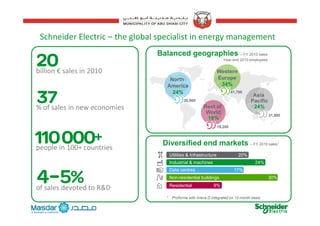
Schneider Electric the global specialist in energy managementSchneider Electric – the global specialist in energy management
Balanced geographies – FY 2010 sales
Year-end 2010 employees
billion € sales in 2010 
p y
North
America
Western
Europe
34%
% of sales in new economies
America
24%
Asia
Pacific
24%Rest of
World
26,000
41,700
World
18%
31,900
19,200
people in 100+ countries
Utilities & Infrastructure 20%
Industrial & machines 24%
Diversified end markets – FY 2010 sales1
of sales devoted to R&D Residential 9%
Data centres 17%
Non-residential buildings 30%
3
of sales devoted to R&D
1 Proforma with Areva D integrated on 12-month basis
Th t blThe most renewable
energy is the one thatenergy is the one that
you do not consumeyou do not consume
World Future Energy Summit, Abu Dhabi,
20112011
4
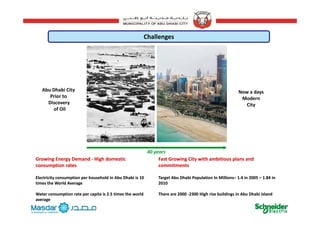
ChallengesChallenges
Abu Dhabi City 
Prior to 
Discovery
of Oil
Now a days 
Modern 
City
Growing Energy Demand Growing Energy Demand ‐‐ High domestic High domestic 
ti tti t
Fast Growing City with ambitious plans and Fast Growing City with ambitious plans and 
it tit t
40 years
consumption ratesconsumption rates
Electricity consumption per household in Abu Dhabi is Electricity consumption per household in Abu Dhabi is 10 10 
times the World Averagetimes the World Average
commitments  commitments  
Target Abu Dhabi Population In MillionsTarget Abu Dhabi Population In Millions–– 11..4 4 in in 2005 2005 –– 11..84 84 in in 
20102010
5
Water consumption rate per capita is Water consumption rate per capita is 22..5 5 times the world times the world 
averageaverage
There are There are 2000 2000 ‐‐2300 2300 High rise buildings in Abu Dhabi IslandHigh rise buildings in Abu Dhabi Island
Th i l t ti f h i t t i d t
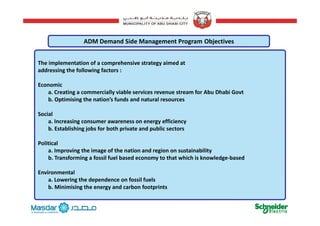
ADM Demand Side Management Program Objectives
The implementation of a comprehensive strategy aimed at 
addressing the following factors :
Economic
a. Creating a commercially viable services revenue stream for Abu Dhabi Govt
b. Optimising the nation’s funds and natural resources
S i lSocial
a. Increasing consumer awareness on energy efficiency
b. Establishing jobs for both private and public sectors
Political
a. Improving the image of the nation and region on sustainability
b. Transforming a fossil fuel based economy to that which is knowledge‐based
Environmental
a. Lowering the dependence on fossil fuels
b. Minimising the energy and carbon footprints
6
g gy p
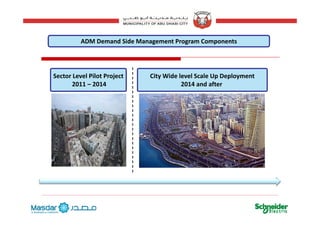
ADM Demand Side Management Program Components
City Wide level Scale Up Deployment
2014 and after 
Sector Level Pilot Project
2011 – 2014
7
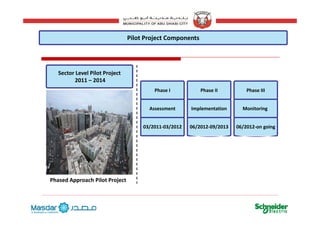
Pil P j CPilot Project Components
Sector Level Pilot Project
2011 – 2014
Phase I
Assessment
Phase II
Implementation
Phase III
Monitoring 
03/2011‐03/2012 06/2012‐09/2013 06/2012‐on going
Phased Approach Pilot Project
8
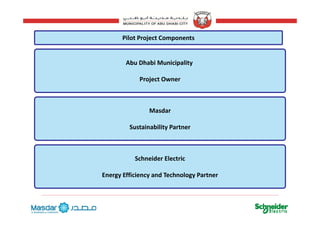
Pil P j C
Abu Dhabi Municipality
Pilot Project Components
Abu Dhabi Municipality 
Project Owner
Masdar
Sustainability Partner
Schneider Electric
Energy Efficiency and Technology Partner
9
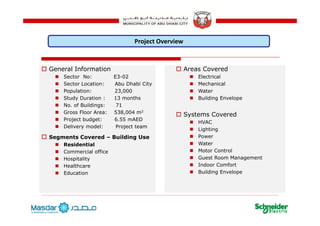
Project Overview
General Information
Sector No: E3-02
Sector Location: Abu Dhabi City
Areas Covered
Electrical
Mechanical
Population: 23,000
Study Duration : 13 months
No. of Buildings: 71
Gross Floor Area: 538 004 m2
Water
Building Envelope
S t C dGross Floor Area: 538,004 m
Project budget: 6.55 mAED
Delivery model: Project team
Segments Covered – Building Use
Systems Covered
HVAC
Lighting
PowerSegments Covered Building Use
Residential
Commercial office
Hospitality
H lth
Water
Motor Control
Guest Room Management
Indoor ComfortHealthcare
Education
Indoor Comfort
Building Envelope
10
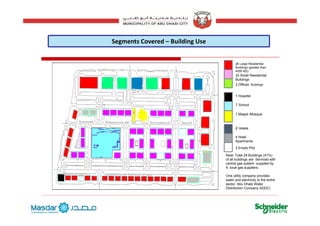
Segments Covered – Building Use
26 Large Residential
Buildings (greater than
4000 M2)
32 Small Residential
Buildings
3 Offices Buildings
1 M jid /M
1 School
1 Hospital
1 Masjid /Mosque
2 Hotels
4 Hotel
Apartments
3 Empty Plot
Note: Total 28 Buildings (41%)
of all buildings are Serviced with
central gas system supplied bycentral gas system supplied by
9 local gas suppliers.
One utility company provides
water and electricity to the entire
sector. Abu Dhabi Water
Distribution Company ADDC)
11
p y )
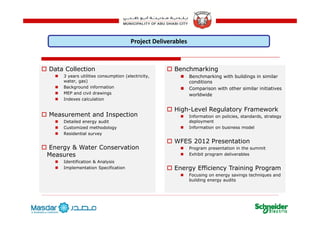
Project Deliverables
Data Collection
3 years utilities consumption (electricity,
water, gas)
Background information
Benchmarking
Benchmarking with buildings in similar
conditions
C i ith th i il i iti tiBackground information
MEP and civil drawings
Indexes calculation
M t d I ti
Comparison with other similar initiatives
worldwide
High-Level Regulatory Framework
Measurement and Inspection
Detailed energy audit
Customized methodology
Residential survey
Information on policies, standards, strategy
deployment
Information on business model
Energy & Water Conservation
Measures
Identification & Analysis
WFES 2012 Presentation
Program presentation in the summit
Exhibit program deliverables
Implementation Specification Energy Efficiency Training Program
Focusing on energy savings techniques and
building energy audits
12
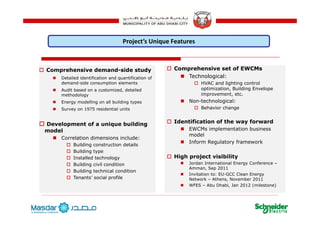
Project’s Unique Features
Comprehensive demand-side study
Detailed identification and quantification of
demand-side consumption elements
Comprehensive set of EWCMs
Technological:
HVAC and lighting control
ti i ti B ildi E lAudit based on a customized, detailed
methodology
Energy modelling on all building types
Survey on 1975 residential units
optimization, Building Envelope
improvement, etc.
Non-technological:
Behavior change
Development of a unique building
model
Correlation dimensions include:
Identification of the way forward
EWCMs implementation business
model
Correlation dimensions include:
Building construction details
Building type
Installed technology
Building civil condition
Inform Regulatory framework
High project visibility
Jordan International Energy Conference –Building civil condition
Building technical condition
Tenants’ social profile
Jordan International Energy Conference
Amman, Sep 2011
Invitation to: EU-GCC Clean Energy
Network – Athens, November 2011
WFES – Abu Dhabi, Jan 2012 (milestone)
13
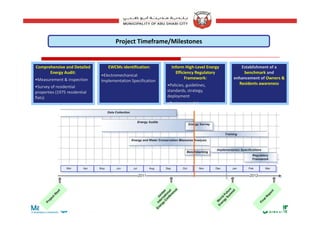
Project Timeframe/Milestones
Comprehensive and Detailed 
Energy Audit:
•Measurement & inspection 
•Survey of residential
EWCMs identification:
•Electromechanical 
Implementation Specification
Inform High‐Level Energy 
Efficiency Regulatory 
Framework:
•Policies, guidelines, 
Establishment of a 
benchmark and 
enhancement of Owners & 
Residents awareness
•Survey of residential 
properties (1975 residential 
flats)
standards, strategy, 
deployment
•Business model
14
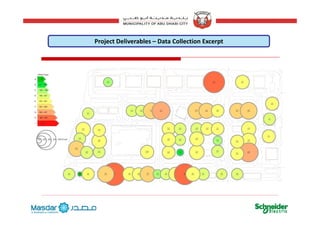
Project Deliverables – Data Collection Excerpt
15
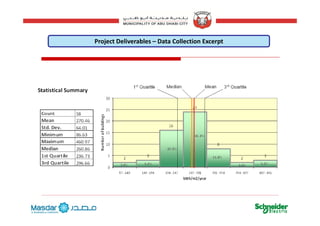
Project Deliverables – Data Collection Excerpt
16
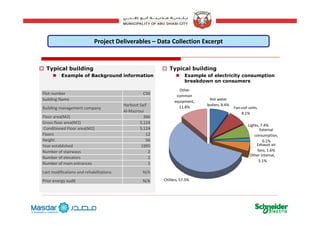
Project Deliverables – Data Collection Excerpt
Typical building
Example of Background information
Typical building
Example of electricity consumption
breakdown on consumers
Other 
common 
equipment, 
11.8%
Hot water 
boilers, 8.4%
Fan‐coil units, 
8 1%
Plot number C50
building Name ‐
Building management company
Harboot Saif 
Al‐Mazroui
External 
consumption, 
Lights, 7.4%
8.1%
Floor area(M2) 366
Gross floor area(M2) 5,124
 Conditioned Floor area(M2) 5,124
Floors 12
H i h 56
Other internal, 
5.1%
Exhaust air 
fans, 1.6%
0.1%Height 56
Year established 1995
Number of stairways 2
Number of elevators 2
Number of main entrances 1
Chillers, 57.5%
Number of main entrances 1
Last modifications and rehabilitations N/A
Prior energy audit N/A
17
Project Deliverables – Data Collection Excerpt
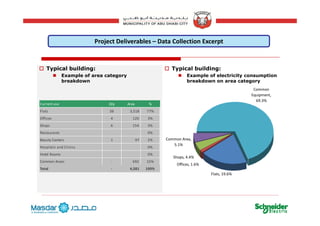
Typical building:
Example of area category
breakdown
Typical building:
Example of electricity consumption
breakdown on area category
Common 
Equipment, 
69.3%
Current use Qty Area %
Flats 38        3,518  77%
Common Area
,
Offices 4            120  3%
Shops 6            154  3%
Restaurants 0%
Offices 1 6%
Shops, 4.4%
Common Area, 
5.1%
Beauty Centers 1              97  2%
Hospitals and Clinics 0%
Hotel Rooms 0%
Common Areas ‐            692  15%
Flats, 19.6%
Offices, 1.6%
Total ‐         4,581  100%
18
Project Deliverables – Measurement and Inspection Excerpt
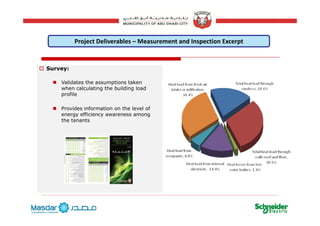
Survey:
Validates the assumptions taken
hen calc lating the b ilding loadwhen calculating the building load
profile
Provides information on the level of
ffi ienergy efficiency awareness among
the tenants
19
Project Deliverables – Measurement and Inspection Excerpt
60
70
80
on in kW
Chiller energy consumption logBus-bars thermal temperature reading
10
20
30
40
50
Power Consumptio
Chiller‐1
Chiller‐2
Chiller‐3
0
17:00
18:00
19:00
20:00
21:00
22:00
23:00
00:00
01:00
02:00
03:00
04:00
05:00
06:00
07:00
08:00
09:00
10:00
11:00
12:00
13:00
14:00
15:00
16:00
Time Interval
Chiller coefficient of performance log
Window thermal temperature reading
150
200
250
300
350
400
ower in kW
1.50
2.00
2.50
3.00
3.50
4.00
COP
Window thermal temperature reading
0
50
100
13:30 14:00 14:30 15:00 15:30
Time Interval
Po
0.00
0.50
1.00
Cooling Power [kW] Actual Power [kW] COP
20
g [ ] [ ]
Project Deliverables – WFES Pilot Excerpt
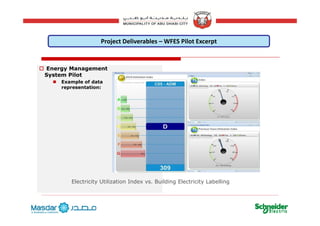
Energy Management
System Pilot
Example of data
representation:representation:
Electricity Utilization Index vs. Building Electricity Labelling
21
Project Deliverables – WFES Pilot Excerpt
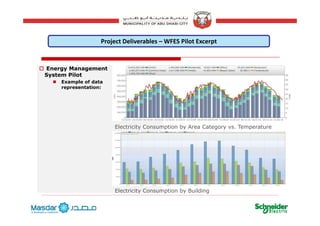
Energy Management
System Pilot
Example of data
representation:representation:
Electricity Consumption by Area Category vs. Temperature
Electricity Consumption by Building
22
Electricity Consumption by Building
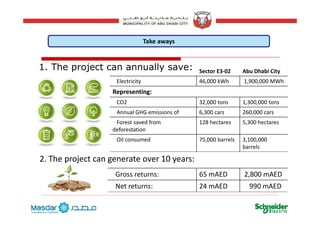
Take aways
1. The project can annually save: Sector E3‐02 Abu Dhabi City
Electricity 46,000 kWh 1,900,000 MWh
Representing:
CO2 32,000 tons 1,300,000 tons
Annual GHG emissions of 6 300 cars 260 000 carsAnnual GHG emissions of 6,300 cars 260,000 cars
Forest saved from 
deforestation
128 hectares 5,300 hectares
Oil d 75 000 b l 3 100 000Oil consumed 75,000 barrels 3,100,000 
barrels
2. The project can generate over 10 years:
Gross returns: 65 mAED 2,800 mAED
Net returns: 24 mAED 990 mAED
23
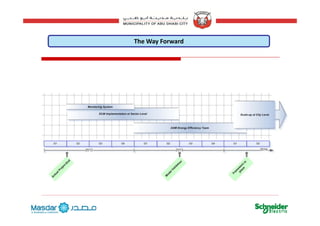
The Way Forward
24

Dr Tamer Qazi

  • 1.
  • 2.
    More than 170years of historyMore than 170 years of history Steel Industry Energy & Security Management Power & Control 1999 Groupe Schneider becomes Schneider Electric, focused on Power & Control 2008 2010 Acquisition of AREVA-D leader in Medium Voltage solutions focused on Power & Control 1996 Modicon, historic leader in Automation becomes a Schneider 2007 Acquisition of Pelco leaders in Security 2008 Acquisition of Xantrex, leader in renewable energy solutions 1991 Square D joins Groupe Automation, becomes a Schneider brand Acquisition of Pelco., leaders in Security Management 2007 Acquisition of APC corp., leaders in Data Centres 1988 Telemecanique joins Groupe S h id q j p Schneider 2003 2003-2008 Acquisitions in wiring devices and home automation (Clipsal, Merten etc.) C co p , eade s ata Ce t es 1975 Merlin Gerin joins Groupe Schneider Schneider 1836 Creation of Schneider at Le Creusot, France 2000 Acquisition of MGE UPS Systems 2003 Acquisition of T.A.C - Building Management and Security 2 Schneider 19th century 20th century 21st century Acquisition of MGE UPS Systems
  • 3.
    Schneider Electric theglobal specialist in energy managementSchneider Electric – the global specialist in energy management Balanced geographies – FY 2010 sales Year-end 2010 employees billion € sales in 2010  p y North America Western Europe 34% % of sales in new economies America 24% Asia Pacific 24%Rest of World 26,000 41,700 World 18% 31,900 19,200 people in 100+ countries Utilities & Infrastructure 20% Industrial & machines 24% Diversified end markets – FY 2010 sales1 of sales devoted to R&D Residential 9% Data centres 17% Non-residential buildings 30% 3 of sales devoted to R&D 1 Proforma with Areva D integrated on 12-month basis
  • 4.
    Th t blThemost renewable energy is the one thatenergy is the one that you do not consumeyou do not consume World Future Energy Summit, Abu Dhabi, 20112011 4
  • 5.
    ChallengesChallenges Abu Dhabi City  Prior to  Discovery of Oil Now a days  Modern  City Growing Energy Demand Growing Energy Demand ‐‐ High domestic High domestic  ti ttit Fast Growing City with ambitious plans and Fast Growing City with ambitious plans and  it tit t 40 years consumption ratesconsumption rates Electricity consumption per household in Abu Dhabi is Electricity consumption per household in Abu Dhabi is 10 10  times the World Averagetimes the World Average commitments  commitments   Target Abu Dhabi Population In MillionsTarget Abu Dhabi Population In Millions–– 11..4 4 in in 2005 2005 –– 11..84 84 in in  20102010 5 Water consumption rate per capita is Water consumption rate per capita is 22..5 5 times the world times the world  averageaverage There are There are 2000 2000 ‐‐2300 2300 High rise buildings in Abu Dhabi IslandHigh rise buildings in Abu Dhabi Island
  • 6.
    Th i lt ti f h i t t i d t ADM Demand Side Management Program Objectives The implementation of a comprehensive strategy aimed at  addressing the following factors : Economic a. Creating a commercially viable services revenue stream for Abu Dhabi Govt b. Optimising the nation’s funds and natural resources S i lSocial a. Increasing consumer awareness on energy efficiency b. Establishing jobs for both private and public sectors Political a. Improving the image of the nation and region on sustainability b. Transforming a fossil fuel based economy to that which is knowledge‐based Environmental a. Lowering the dependence on fossil fuels b. Minimising the energy and carbon footprints 6 g gy p
  • 7.
  • 8.
    Pil P jCPilot Project Components Sector Level Pilot Project 2011 – 2014 Phase I Assessment Phase II Implementation Phase III Monitoring  03/2011‐03/2012 06/2012‐09/2013 06/2012‐on going Phased Approach Pilot Project 8
  • 9.
    Pil P jC Abu Dhabi Municipality Pilot Project Components Abu Dhabi Municipality  Project Owner Masdar Sustainability Partner Schneider Electric Energy Efficiency and Technology Partner 9
  • 10.
    Project Overview General Information Sector No:E3-02 Sector Location: Abu Dhabi City Areas Covered Electrical Mechanical Population: 23,000 Study Duration : 13 months No. of Buildings: 71 Gross Floor Area: 538 004 m2 Water Building Envelope S t C dGross Floor Area: 538,004 m Project budget: 6.55 mAED Delivery model: Project team Segments Covered – Building Use Systems Covered HVAC Lighting PowerSegments Covered Building Use Residential Commercial office Hospitality H lth Water Motor Control Guest Room Management Indoor ComfortHealthcare Education Indoor Comfort Building Envelope 10
  • 11.
    Segments Covered – Building Use 26 LargeResidential Buildings (greater than 4000 M2) 32 Small Residential Buildings 3 Offices Buildings 1 M jid /M 1 School 1 Hospital 1 Masjid /Mosque 2 Hotels 4 Hotel Apartments 3 Empty Plot Note: Total 28 Buildings (41%) of all buildings are Serviced with central gas system supplied bycentral gas system supplied by 9 local gas suppliers. One utility company provides water and electricity to the entire sector. Abu Dhabi Water Distribution Company ADDC) 11 p y )
  • 12.
    Project Deliverables Data Collection 3 yearsutilities consumption (electricity, water, gas) Background information Benchmarking Benchmarking with buildings in similar conditions C i ith th i il i iti tiBackground information MEP and civil drawings Indexes calculation M t d I ti Comparison with other similar initiatives worldwide High-Level Regulatory Framework Measurement and Inspection Detailed energy audit Customized methodology Residential survey Information on policies, standards, strategy deployment Information on business model Energy & Water Conservation Measures Identification & Analysis WFES 2012 Presentation Program presentation in the summit Exhibit program deliverables Implementation Specification Energy Efficiency Training Program Focusing on energy savings techniques and building energy audits 12
  • 13.
    Project’s Unique Features Comprehensive demand-side study Detailedidentification and quantification of demand-side consumption elements Comprehensive set of EWCMs Technological: HVAC and lighting control ti i ti B ildi E lAudit based on a customized, detailed methodology Energy modelling on all building types Survey on 1975 residential units optimization, Building Envelope improvement, etc. Non-technological: Behavior change Development of a unique building model Correlation dimensions include: Identification of the way forward EWCMs implementation business model Correlation dimensions include: Building construction details Building type Installed technology Building civil condition Inform Regulatory framework High project visibility Jordan International Energy Conference –Building civil condition Building technical condition Tenants’ social profile Jordan International Energy Conference Amman, Sep 2011 Invitation to: EU-GCC Clean Energy Network – Athens, November 2011 WFES – Abu Dhabi, Jan 2012 (milestone) 13
  • 14.
  • 15.
  • 16.
  • 17.
    Project Deliverables – Data Collection Excerpt Typical building Exampleof Background information Typical building Example of electricity consumption breakdown on consumers Other  common  equipment,  11.8% Hot water  boilers, 8.4% Fan‐coil units,  8 1% Plot number C50 building Name ‐ Building management company Harboot Saif  Al‐Mazroui External  consumption,  Lights, 7.4% 8.1% Floor area(M2) 366 Gross floor area(M2) 5,124  Conditioned Floor area(M2) 5,124 Floors 12 H i h 56 Other internal,  5.1% Exhaust air  fans, 1.6% 0.1%Height 56 Year established 1995 Number of stairways 2 Number of elevators 2 Number of main entrances 1 Chillers, 57.5% Number of main entrances 1 Last modifications and rehabilitations N/A Prior energy audit N/A 17
  • 18.
    Project Deliverables – Data Collection Excerpt Typical building: Exampleof area category breakdown Typical building: Example of electricity consumption breakdown on area category Common  Equipment,  69.3% Current use Qty Area % Flats 38        3,518  77% Common Area , Offices 4            120  3% Shops 6            154  3% Restaurants 0% Offices 1 6% Shops, 4.4% Common Area,  5.1% Beauty Centers 1              97  2% Hospitals and Clinics 0% Hotel Rooms 0% Common Areas ‐            692  15% Flats, 19.6% Offices, 1.6% Total ‐         4,581  100% 18
  • 19.
    Project Deliverables – Measurement and Inspection Excerpt Survey: Validates theassumptions taken hen calc lating the b ilding loadwhen calculating the building load profile Provides information on the level of ffi ienergy efficiency awareness among the tenants 19
  • 20.
    Project Deliverables – Measurement and Inspection Excerpt 60 70 80 on in kW Chiller energyconsumption logBus-bars thermal temperature reading 10 20 30 40 50 Power Consumptio Chiller‐1 Chiller‐2 Chiller‐3 0 17:00 18:00 19:00 20:00 21:00 22:00 23:00 00:00 01:00 02:00 03:00 04:00 05:00 06:00 07:00 08:00 09:00 10:00 11:00 12:00 13:00 14:00 15:00 16:00 Time Interval Chiller coefficient of performance log Window thermal temperature reading 150 200 250 300 350 400 ower in kW 1.50 2.00 2.50 3.00 3.50 4.00 COP Window thermal temperature reading 0 50 100 13:30 14:00 14:30 15:00 15:30 Time Interval Po 0.00 0.50 1.00 Cooling Power [kW] Actual Power [kW] COP 20 g [ ] [ ]
  • 21.
    Project Deliverables – WFES Pilot Excerpt Energy Management SystemPilot Example of data representation:representation: Electricity Utilization Index vs. Building Electricity Labelling 21
  • 22.
    Project Deliverables – WFES Pilot Excerpt Energy Management SystemPilot Example of data representation:representation: Electricity Consumption by Area Category vs. Temperature Electricity Consumption by Building 22 Electricity Consumption by Building
  • 23.
    Take aways 1. The projectcan annually save: Sector E3‐02 Abu Dhabi City Electricity 46,000 kWh 1,900,000 MWh Representing: CO2 32,000 tons 1,300,000 tons Annual GHG emissions of 6 300 cars 260 000 carsAnnual GHG emissions of 6,300 cars 260,000 cars Forest saved from  deforestation 128 hectares 5,300 hectares Oil d 75 000 b l 3 100 000Oil consumed 75,000 barrels 3,100,000  barrels 2. The project can generate over 10 years: Gross returns: 65 mAED 2,800 mAED Net returns: 24 mAED 990 mAED 23
  • 24.