Topics to be covered.
1.   When the ARDS first dIscovered
2.   Patho physiology of ards and role of CS
3.   When was the first use of steroid
     started.
4.   Current prospective .
5.    doubble edege sword.
Introduction
   in 1821, in what was probably the first published scientific description,
    Laennec described the gross pathology of the heart and lungs and
    described idiopathic anasarca of the lungs; pulmonary edema without
    heart failure in ―A Treatise on Diseases of the Chest‖

   By the 1950s, pulmonary edema had become a medical subject
    heading by the National Library of Medicine; however, no distinction
    was made at that time between cardiac and noncardiac causes.

   But what clearly moved ARDS from a nearly universally fatal form of
    ―double pneumonia‖ was the development of methods of establishing
    secure airway access using tubes that could be attached to mechanical
    ventilators to deliver adequate pulmonary distending pressures

   These techniques extended the lives of these patients from a few hours
    to many days or even weeks—long enough to recover in some cases.

   Am. J. Respir. Crit. Care Med. October 1, 2005 vol. 172 no. 7 798-806
   For a period of time ARDS went by the name of inciting injuries (e.g., DaNang lung,
    shock lung, post-traumatic lung, etc.).

    It wasn't until 1967, in a landmark article published in Lancet, that Ashbaugh,
    Bigelow, Petty, and Levine first described the clinical entity that they called ―acute
    respiratory distress in adults‖ .

    This article recognized for the first time that ARDS was a constellation of
    pathophysiologic abnormalities common to a relatively large number of patients but
    that were initiated by a wide variety of unrelated insultS…

   However, in 1971 Petty and Ashbaugh used the term ―adult‖ respiratory distress
    syndrome in another publication, probably to address the perception of ARDS as an
    adult version of the previously described infant respiratory distress syndrome
    (IRDS).
 In 1992 the American European Consensus Conference
  (AECC) was charged with developing a standardized
  definition for ARDS to assist with clinical and epidemiologic
  research.
 In 1994, the American-European Consensus Conference
  (2) defined two pathogenetic pathways leading to ARDS as
  a direct ("primary" or "pulmonary") insult, that directly
  affects lung parenchyma, and an indirect ("secondary" or
  "extrapulmonary") insult, that results from an acute
  systemic inflammatory response

   Braz J Med Biol Res, February 2005, Volume 38(2) 147-159 (Review)
Berlin defination of ards                                         jama -
                                    2012

Timing          Within 1 week of known clinical insult or new or worsening
                of respiratory symptoms
Chest imaging b/l opacities not fully explained by effusion;lobar/lung collapse or
              nodule
Origin of       Respiratory failure not fully explained by cardiac failure or fluid
edema           overload.need objective assement to exclude the hydrostatic
                edema if no risk factor present.
oxygenation

mild            200mmhg <pao2/fio2,<300mmhg with peepor cpap .5cmh20

moderate        100mmhg <pao2/fio2,<200mmhg with peep > 5cmh20


severe          pao2/fio2,<100mmhg with peep>5cmh20
Pathophysiology of ARDS
   Although the cellular and molecular basis of acute lung injury and ARDS remains an area
    of active investigation,

        it appears that in ARDS, lung injury is caused by an imbalance of pro-inflammatory
    and anti-inflammatory mediators.[4]

   The most proximate signals leading to uncontrolled activation of the acute inflammatory
    response are not yet understood.

   However, nuclear factor κB (NF-κB), a transcription factor whose activation itself is
    tightly regulated under normal conditions, has emerged as a likely candidate shifting the
    balance in favor of a pro-inflammatory state.

   As early as 30 minutes after an acute insult, there is increased synthesis of interleukin-8

    (IL-8), a potent neutrophil chemotactic and activating agent, by pulmonary macrophages.
    Release of this and similar compounds, such as IL-1 and tumor necrosis factor (TNF),
    leads to endothelial activation, and pulmonary microvascular sequestration and
    activation of neutrophils.

   Neutrophils are thought to have an important role in the pathogenesis of ARDS.
PATHOGENESIS OF ARDS
Role of NFKB GENE…..
   NF-κB (nuclear factor kappa-light-chain-enhancer of activated B
    cells) is a protein complex that controls the transcription of DNA.

   NF-κB is found in almost all animal cell types and is involved in cellular
    responses to stimuli such as stress cytokines,,Free radicals, oxidized
    LDL and bacterial or viral antigens.

   NF-κB plays a key role in regulating the immune response to infection
    (kappa light chains are critical components of immunoglobulins).

   Incorrect regulation of NF-κB has been linked to cancer, inflammatory
    and autoimmune diseases, septic shock, viral infection, and improper
    immune development.

    Gilmore TD (2006). "Introduction to NF-κB: players, pathways,
    perspectives". Oncogene 25 . PMID
    Hayden MS, West AP, Ghosh S (October 2006). "NF-κB and the immune response". PMID.
Role of NFKB – conti….
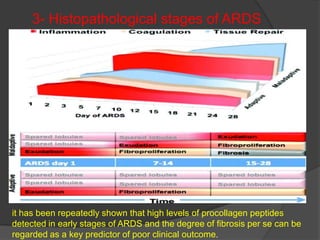
3- Histopathological stages of ARDS


it has been repeatedly shown that high levels of procollagen peptides
detected in early stages of ARDS and the degree of fibrosis per se can be
regarded as a key predictor of poor clinical outcome.
Activation and Regulation of Systemic
            Inflammation in ARDS:
 Experimental and clinical evidence has demonstrated the cellular
  mechanisms involved in activating and regulating inflammation
  are contrasted between patients with resolving and unresolving
  ARDS.
 In ARDS, down-regulation of systemic inflammation is essential to
  restoring homeostasis, decreasing morbidity, and improving
  survival.
 At the cellular level, patients with unresolving ARDS have
  deficient glucocorticoid (GC)-mediated down-regulation of
  inflammatory cytokine and chemokine transcription despite
  elevated levels of circulating cortisol, a condition defined as
  systemic inflammation-associated acquired GC RESISTANCE.
 Controll sydies shows; Prolonged low-to-moderate dose GC
  therapy promotes the down-regulation of inflammatory cytokine
  transcription at the cellular level. And consistently reported a
  significant reduction in markers of systemic inflammation,
  pulmonary and extrapulmonary organ dysfunction scores,
  duration of mechanical ventilation, and ICU length of stay
Progression of ARDS: Resolving vs
                 Unresolving
   The lung injury score (LIS) quantifies the impaired respiratory physiology in
    ARDS patients through the use of a 4-point score that is based on the level
    1) positive end-expiratory pressure (PEEP),

    2) the PaO2/FIO2 ratio,

    3) the quasistatic lung compliance, and

    4) the degree of infiltration seen on a chest radiograph

         (1 point per quadrant of chest radiograph involved).

   Based on simple physiologic criteria, the evolution of ARDS can be divided
    into resolving and unresolving based on achieving a 1-point reduction in LIS
    by day 7.

   Daily measurement of LIS, MODS score, and CRP levels allow early
    identification of non improvers.
Progression of ARDS conti….
            Variables                    Resolving             Unresolving
Onset of ARDS
Systemic inflammation*             Moderate             Exaggerated
HPA axis response                  Adequate             Inadequate
Over time
Systemic inflammation              Regulated            Dysregulated
Cellularactivation/regulation of
                                   GRα-driven           NF-κB-driven
inflammation
Inflammation, markers              Decreasing           Persistent elevation
ACM permeability,mark.             Decreasing           Persistent elevation
Fibrogenesis, markers              Decreasing           Increasing
Lung repair (histology)            Adaptive             Maladaptive
Reduction in LIS                   ≥ 1 point by day 7   < 1 point by day 7
  ICU mortality                    Low                  High
G. Umberto Meduri, MD, FCCP; Djillali Annane, MD, PhD; George P. Chrousos, MD;
Paul E. Marik, MD, FCCP; Scott E. Sinclair, MD, FCCP,chest-2009
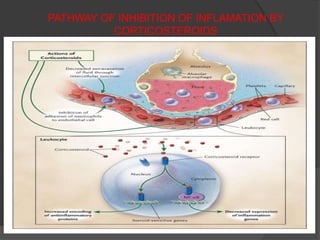
PATHWAY OF INHIBITION OF INFLAMATION BY
          CORTICOSTEROIDS
Interaction Between Activated NF-κB and GRα in
ARDS


Longitudinal relation on natural logarithmic scales between mean levels of
nuclear NF-κB and nuclear GRα: resolving vs unresolving ARDS (left) and after
randomization to methylprednisolone vs placebo (right).
   Activation and Regulation of Systemic Inflammation in ARDS: Rationale for Prolonged
Glucocorticoid TherapyFree .
G. Umberto Meduri, MD, FCCP; Djillali Annane, MD, PhD; George P. Chrousos, MD; Paul E. Marik, MD,
FCCP; Scott E. Sinclair, MD, FCCP,chest-2009
Corticosteroids for prevention of
                  ards
 ARDS develops after a variety of insults, including sepsis,
  multiple trauma, pneumonia, aspiration of gastric
  contents, and severe burns.
 Its pathogenesis includes immune-mediated injury
  leading to loss of the alveolar-capillary barrier, injury to
  the alveolar epithelium, an influx of neutrophils and
  macrophages, and fibrin. These changes develop over
  hours to a few days after the initiating event.
 Therefore, timely modulation of inflammation using
  corticosteroids in these high-risk patients would be a
  rational approach for prevention of ARDS and its
  consequences.
 There are only a few trials on the role of corticosteroids as
  immunomodulators to prevent development of ARDS in
  high-risk patients, such as patients with severe
  sepsis.However, results were not encouraging.
weigielt et al;1985;
   performed a randomized double-blind trial to determine the usefulness of early
    methylprednisolone therapy for patients with pulmonary failure.

   selected 81 acutely ill, mechanically ventilated patients at high risk for adult respiratory
    distress syndrome (ARDS).

   Thirty-nine patients received methylprednisolone, 30 mg/kg, every six hours for 48
    hours; 42 patients received mannitol placebo.

   All patients were given a positive end-expiratory pressure of 5 cm H2O, monitored with
    pulmonary artery catheters, and treated for their primary disease processes.

   Twenty-five steroid-treated patients (64%) and 14 placebo-treated patients (33%)
    developed ARDS.

   Early infectious complications occurred in 30 steroid-treated patients (77%) and 18
    placebo-treated patients (43%). There were no significant differences in factors
    predisposing to ARDS, ventilatory requirements, or days of intensive care.

   These results do not support the use of methylprednisolone for ARDS. Steroids failed
    to improve pulmonary function and were associated with an increased infection rate.
    Intensive pulmonary and general supportive care remain the preferred therapy for
    ARDS.
Bone et al;1987;
   In this study, 382 patients with sepsis were randomized
    to receive either MP (30 mg/kg every 6 hours for 4
    doses) or placebo.
   This study showed that there was a trend toward
    increased incidence of ARDS in MP group (32%) as
    compared with placebo (25%), though results were not
    statistically significant.
   However, mortality at day-14 was significantly higher
    (52% vs 22%; P = 0.005) in patients having received MP
    as compared with placebo.
   Other studies also showed that prophylactic short
    course high-dose corticosteroids were associated with
    increased chances of developing ARDS and/or mortality
Trials of corticosteroids for prevention of ARDS

Authour     Drug dosage                   No of pt             OR        P-
year                                      developing           (95%Ci)   value
                                          ards/total no pts%
                                          Corticos Placebo
                                          teroid   group
                                          group
                                                                 2.36
Weigelt et Methylprednisolone 30 mg/kg     25/39     14/42
                                                                (1.14-   0.008
al. 1985   6 hourly for 48 hours           (64.1)    (33.3)
                                                                 6.28)
            Methylprednisolone 30 mg/kg                          1.48     Not
Schein et                                   7/29      2/13
            or Dexamethasone 6 mg/kg                            (0.48-   menti
al. 1987                                   (24.1)    (15.3)
            single dose                                          4.44)   oned
                                                                 1.48
Bone et     Methylprednisolone 30 mg/kg   50/152     38/152
                                                                (0.93-   0.10
al. 1987    6 hourly for 24 hours         (32.9)      (25)
                                                                 2.34)
                                                                 1.55     Not
Luce et     Methylprednisolone 30 mg/kg    13/38     14/37
                                                                (0.44-   signifi
al. 1988    6 hourly for 24 hours          (34.2)    (37.8)
                                                                2.32)     cant
Prevention…
   It is important to note that in all these
    studies, MP was used for a maximum
    duration of 48 hours and its circulating half
    life in ARDS patients varies from 3.8 to 7.2
    hours; therefore, the effect of this drug will
    diminish after 24 to 36 hours at the most.

   Above study shows, it leads to higher rates
    of ARDS, increased infectious
    complications, and mortality.
Prevention conti….

Therefore, we strongly argue against
prophylactic use of corticosteroids in
seriously ill patients who are prone to
develop ARDS.

It is evident from these clinical trials that
corticosteroids have no role in prevention
of ARDS in high-risk patients
   Animal studies have shown that in acute
    lung injury, prolonged corticosteroids
    were shown to be effective in reducing
    edema and collagen deposition in lung,
    while premature withdrawal rapidly
    negated these positive effects.
   Hetsberg et al; In a rat model of butylated-hydroxytoluene-
    induced ARDS, the timing of corticosteroid administration had
    strikingly different effects.
       Early administration of steroids resulted in increased
    collagen deposition, increased lung damage, and inhibition of
    type II pneumocyte proliferation. Late administration, on the
    other hand, prevented excessive collagen deposition.

   Systemic methylprednisolone or dexamethasone at doses of 20
    or 4 mg kg-/day. respectively, improved pulmonary inflammation
    and mechanics in animals with acute lung injury.

   Volpe et al; On this basis, dexamethasone (a single dose of 2.5
    mg/kg) significantly reduced inflammatory cell protein content in
    bronchoalveolar lavage fluid (BALF), and improved lung
    compliance 24 h after injury induced by oleic acid .
    Kuwabara and co-workers (39),
    showed that prophylactic treatment with methylprednisolone (60 mg /kg 30
     min before oleic acid infusion, followed by continuous infusion until the end
     of the experiments) did not attenuate oleic acid-induced acute lung injury or
     the increased level of phospholipase A2 activity, leukotriene B4 and
     thromboxane B2 in the BALF, but greatly reduced IL-8


    Corticosteroid at a dose of 10 mg/kg, starting on day 5 after the infection
     with reovirus 1/L, and given daily until the end of the time course of the
     disease, also did not attenuate the infiltration of inflammatory leukocytes,
     did not suppress key cytokine/chemokine expression, and did not inhibit the
     development of fibrotic changes in the lungs

    Therefore, one may argue that in addition to short duration, high
     doses might have been responsible for the negative results.
   Hesterberg TW, Last JA. Ozone-induced acute pulmonary fibrosis in
    rats.Prevention of increased rates of collagen synthesis by
    methylprednisolone. Am Rev Respir Dis. 1981;123:47–52.
   Kuwabara K, Furue S, Tomita Y et al. (2001). Effect of methylprednisolone
    on phospholipase A2 activity and lung surfactant degradation in acute lung
    injury in rats. European Journal of Pharmacology, 433: 209-216.
   London L, Majeski E, Altman-Hamamdzic S, Enockson C, Paintlia MK,
    Harley RA & London SD (2002). Respiratory Reovirus 1/L induction of
    diffuse alveolar damage: pulmonary fibrosis is not modulated by
    corticosteroids in acute respiratory distress syndrome in rats. Clinical
    Immunology, 103: 284-295.
   Volpe BT, Lin W & Thrall RS (1994). Effect of intratracheal dexamethasone
    on oleic acid-induced lung injury in the rat. Chest, 106: 583-587
   This seems a plausible explanation for the
    negative results observed in earlier studies with
    short course of high-dose MP.
     Furthermore, it may be noticed that all these
    studies have used high doses of MP for prevention
    of ARDS.

    However, we have seen that the low-dose
    corticosteroids are useful in other critical illnesses
    such as septic shock.
CORTICOSTEROIDS FOR THE TREATMENT OF
                   ARDS

   Based on above results, researchers tried
    prolonged course of corticosteroids in patients with
    established ARDS at various stages, that is, early
    (<14 days of onset of ARDS) and late phases
    (after 14 days of onset of ARDS).

   1) Corticosteroids in early ards

   2) Corticosteroids in late ards.
Author,    Drug/dosage                      No. death/total no.      OR (95% P
Year                                        patients with            CI)     valu
                                            ARDS (%)                         e
                                            Corticogro   PLACEBOgr
                                                         oup
                                            up
Bernard                                                               0.75
           Methylprednisolone 30 mg/kg        30/50       31/49
et al.                                                                (0.4-      0.74
           IV 6 hourly for 24 hours.           (60)       (63.2)
1987                                                                  1.57)
Meduri
           Protocol-based IV                   2/16        5/8          0.41
et al.                                                                           0.03
           methylprednisolonea.               (12.5)      (62.5)     (0.06-99)
1998
           Hydrocortisone 50 mg IV 6
Annane                                                                 0.35
           hourly and 9-alpha                 33/62       50/67
et al.                                                                (0.15-     0.16
           fludrocortisone once a day for      (53)        (75)
2006                                                                   0.82)
           7 days.
Steinber                                                               0.84
           Protocol-based IV                  26/89       26/91
g et al.                                                              (0.40-     1.00
           methylprednisoloneb.               (29.2)      (28.5)
2006                                                                   1.60)
Meduri                                                                 0.53
           Protocol-based IV                  15/63       12/28
et al.                                                                (0.21-     0.03
           methylprednisolonec.               (23.8)      (42.8)
2007                                                                   1.21)
 aLoading  dose of 2 mg/kg; then 2 mg/kg/d from day 1 to
  day 14, 1 mg/kg/d from day 15 to day 21, 0.5 mg/kg/d
  from day 22 to day 28, 0.25 mg/kg/d on days 29 and 30,
  and 0.125 mg/kg/d on days 31 and 32. In patients who
  were extubated prior to day14, treatment was advanced
  to day 15 of drug therapy and tapered according to
  schedule
 bLoading dose of 2 mg/kg of predicted body weight
  followed by 0.5 mg/kg 6 hourly for 14 days; 0.5 mg/kg 12
  hourly for 7 days; and then tapering of the dose
 cLoading dose of 1 mg/kg followed by an infusion of 1
  mg/kg/d from day 1 to day 14, 0.5 mg/kg/d from day 15 to
  day 21, 0.25 mg/kg/d from day 22 to day 25, and 0.125
  mg/kg/d from day 26 to day 28. In patients who were
  extubated between days 1 and 14 were advanced to day
  15 of drug therapy and tapered according to schedule
  In all these studies, mortality (at various intervals during
   therapy) was taken as main outcome to document benefit of
   the therapy. Other clinically important parameters which have
   been studied were
       organ dysfunction score,
       lung injury score, oxygenation,
       duration of mechanical ventilation, and
       duration of ICU stay.
Bernard et al.
     tried short course of high-dose MP (30 mg/kg body weight
   every six hours for 24 hours) in 50 patients with ARDS.This
   study demonstrated insignificant beneficial effects of MP, such
   as reduced 45-day mortality (60% vs 63%) and increased
   chance of reversal of ARDS (39% vs 36%) as compared with
   placebo (P = 0.07)
   Meduri et al.,
     however, showed that prolonged corticosteroids
    use (a loading dose of 1 mg/kg, followed by an
    infusion of 1 mg/kg/day from day 1 to day 14, 0.5
    mg/kg/day from day 15 to day 21, 0.25 mg/kg/day
    from day 22 to day 25, and 0.125 mg/kg/day from
    day 26 to day 28) in early ARDS ,
     patients were enrolled within 72 hours of entry to
    the study, thereby insuring corticosteroids early in
    the course of disease,associated with significant
    decrease in I.C.U motrality(20.6% vs 42.9%).
 large trial by ARDS clinical trial network (ARDSnet),
    consisting of 180 patients with ARDS (both early [73%] and late
  [27%]), showed that
MP (2 mg/kg bolus in first 24 hours, followed by a dose of 0.5 mg/kg
  every 6 hours for 14 days, 0.5 mg/kg every 12 hours for 7 days, and
  then tapering over 4 days) has no survival benefits.

It showed that in patients with early ARDS (enrolled 7-13 days after
    onset of ARDS), there were no significant differences in 60-day
    mortality (36% vs 27%; P = 0.26) in the placebo and in MP group.

Similar results were seen at 180-day with mortality of 31.9 and 31.5%
   in the placebo and MP group, respectively.
Other workers have also shown that corticosteroids use have no
   statistically significant mortality benefits in patients with ARDS.
These conflicting conclusions may be a result of differences in
   characteristics of study cohort and treatment protocol of these
   studies.
 Meduri ET AL;
   1) This study may be criticized for poor matching between two
   groups as incidence of catecholamine-dependent shock in placebo
   group was nearly twice as compared with corticosteroids group
   (46.4% vs 23.8%).
   There is enough evidence that vasopressor use is an independent
   predictor of mortality and might have contributed to increased
   mortality in placebo group.
  2) Second limitation of this study is that a significant percentage of
   control patients crossed over to receive open-label MP; however,
   data were analyzed as intention to treat analysis.
  Intention to treat analysis is meant for larger trials but when same is
   applied to the smaller trials, the results may be biased by protocol
   violation and per protocol analysis is the best method.
In ARDSnet trial,
  1) There was poor matching for age, gender, pneumonia,
   trauma, serum creatinine, APACHE III, compliance, and
   lung injury score. All these factors can affect the final
   outcome.

  2) in ARDSnet trial, there was rapid tapering of
  corticosteroids, as compare with cohort studied by Meduri
  et al. which might have contributed to increased mortality in
  this trial.

  3)Another important difference between these two trials is
  the timing of administration of corticosteroids.
In ARDSnet trial corticosteroids were used during unresolving or
    persistent ARDS (less than 14 day).
   However, pathological ARDS has been classified as
   ―early‖ (from 1-7 days after onset),
   ―early persistent‖ (days 7-14), and
   ―late persistent‖ (>14 days).

Conceptually, corticosteroids administration should be more
  effective during exudative phase (early phase).

Unfortunately, clinically, it is difficult to identify different phases of ARDS
   without lung biopsy; however, its role in clinical practice is yet to be
   defined.
There are many clinical parameters which are important contributors to the
    morbidity associated with ARDS, such as
  organ dysfunction score, lung injury score, oxygenation, duration of
    mechanical ventilation, and ICU stay, as these have significant effect on the
    cost of treatment.
Therefore, the effect of corticosteroids on these parameters would be
    important consideration for its use in ARDS.
ARDSnet trial showed that
  MP increased the number of ventilator-free days (14.1 days vs 23.6 days, P =
    0.006)
Meduri et al. showed that corticosteroids use leads to significant reduction in
    number days of ICU stay (7 vs 14.5 days; P = 0.007).

Similar findings has been reported by various other studies.

Length of ICU stay is an important factor which uses lots of resources.

The corticosteroids have been shown to reduce disease severity scores,
    namely, the multiple organ dysfunction syndrome score and lung
    injury score. These agents also improve oxygenation (PaO2/FIO2
    ratios).
Corticosteroids in late ARDS
 Persistent ARDS at later stages is characterized by
  more of fibrosis than cellular inflammation; therefore,
  corticosteroid effect is expected to be different.
 It has been observed that there is significant
  association between late initiation corticosteroids and
  failure to improve, with 50% failure rate (P = 0.04).
 In ARDSnet trial in patients with late ARDS (LATE
  STEROID RESCUE STUDY –LASRS enrolled 13 days
  after onset of ARDS), corticosteroids use was
  associated with increased mortality (35% vs 8%; P =
  0.02) and neuromuscular weakness.
These results suggest that corticosteroid use in late stage
  of ARDS probably have negative effect on final
  outcome.
Adverse effect of
corticosteroids
 ARDSnet trial showed that rate of new
  infections was lower in patients receiving MP
  (22.4%) as compared with placebo (32.9%),
  though results were not statistically significant
  (P = 0.14).
 Meduri et al. reported similar infection rate in
  both the groups and no GI bleed.
 Annane et al. showed that rates of
  superinfection (13% vs 12%), GI bleed (2% vs
  6%), and psychiatric disorders were similar in
  both placebo and corticosteroids group
 Hyperglycemia was observed in ARDSnet trial with
  MP group having significantly higher glucose.
 Meduri et al. have shown that patients requiring
  insulin to treat hyperglycemia were similar (71.4%
  vs 64.3%) with MP and placebo.
 ARDSnet trial reported similar incidence of
  neuromuscular weakness in both placebo and
  treatment arm (24% vs 29%). However, serious
  neuromuscular weakness was observed in 9
  patients, all were in MP group (P = 0.001)
 Meduri et al. showed similar incidence of
  neuromuscular weakness (6.4% vs 3.6%) in
  patients treated with MP as compared with
  placebo.
   A recent meta-analysis has shown that there
    was no difference in the incidence of
    infection, neuromyopathy, GI bleeding, and
    life-threatening complications, such as major
    organ failure (heart, kidney, and liver),
    between corticosteroid and placebo group.
     Tang BM, Craig JC, Eslick GD, Seppelt I, McLean AS. Use of corticosteroids
    in acute lung injury and acute respiratory distress syndrome: A systematic
                                           .
    review and meta-analysis. Crit Care Med 2009;37:1594–603.[PubMed]
Corticosteroid use current view.
   Methylprednisolone-induced down-regulation of systemic
    inflammation was associated with significant improvement in
    pulmonary and extrapulmonary organ dysfunction and
    reduction in duration of mechanical ventilation and ICU
    length of stay.


    Methylprednisolone infusion in early severe ARDS: results of a
    randomized controlled trial.
    Meduri GU, Golden E Freire AX, Taylor E,, Zaman M, Carson SJ
    GibsonM, Umberger R,chest-2009
Admistration of glucocorticoids
                  I.C.U PROTOCOL,ISCCM.

 Wigh the risk and benefits of individual
  patients.
 It should be avoided in patients with
  active infection.
 It is used in 2weeks of onset.
 Dose should be 1mg/kg bolus followed
  by 1mg/kg/day infusion.
 Use only when paralytic agents are
  discontinued.
 Response is seen in 5 days ,if there is
  no response it may discontinued.
 If favorabel response continue for 14
  days or until extubation..there after half
  the dose for 7 days and then stop.
 The safety profile proven including no
  added risk of infection.
Exclusion criteria for steroids
treatment.
 Clinical evidence of active untreated infection.
 A known undrained abcess or a known
  intravascular nidus of infection. A bacterial
  infection being treated with std antibiotic regimen
  with exception of above.
 Disseminated fungal infection even if being
  treated.
 Age <13 year
 Pregnancy
 Burns requiring skin grafting
 Patien with AIDS or AIDS defining illness.
 malignancy or other chronic disease for which 6
  month mortality is estimated 50%
Summary
   Despite sound physiological basis, corticosteroids have not
    shown clear cut benefit in management of ARDS.
   It is clear from the available data that these agents have no role
    in prevention and late phase of ARDS and there is silver lining
    in the management of early ARDS using these agents.
   There is distinct advantage of corticosteroids in improving organ
    function score, lung injury score, and oxygenation which result
    in reduction in duration of mechanical ventilation requirement
    and ICU stay, although only few tudy showed mortality benefits.
   Heterogeneity of the conditions causing ARDS may be the
    reason for the lack of uniformity in the results.
   More studies are required to have convincing data regarding
    corticosteroid use in early ARDS before any definitive treatment
    recommendation.
   Future trials with corticosteroids may be designed in such way
    to make this cohort as homogenous as possible, so that we can
    identify the patients who will be benefited with such therapy.
   Activation and Regulation of Systemic Inflammation in ARDS:
    Rationale for Prolonged Glucocorticoid TherapyFree To ViewG.
    Umberto Meduri, MD, FCCP; Djillali Annane, MD, PhD; George P. Chrousos, MD;
    Paul E. Marik, MD, FCCP; Scott E. Sinclair, MD, FCCP


   Activation and Regulation of Systemic Inflammation in ARDS: Rationale for
    Prolonged Glucocorticoid TherapyFree To ViewG. Umberto Meduri, MD, FCCP;
    Djillali Annane, MD, PhD; George P. Chrousos, MD; Paul E. Marik, MD, FCCP; Scott E.
    Sinclair, MD, FCCP.lungindia april 2009

   .lung inflamation in ardsfriend and foe NEJMcorticosteroids in ards : a review of
    treatment and prevention evidence. G.c khillani ,vijay hadda may 2011..

   Corticosteroids in prevention and treatment of ards in adult meta analysis.BMJ.

   Steroid treatment in ARDS: a critical appraisal of the ARDS network trial and the recent
    literature.Meduri GU, Marik PEChrousos GP Pastores SM Arlt W, Beishuizen A Bokhari F Zaloga G
    AnnanD
Thank you.

Dr hardik patel

  • 2.
    Topics to becovered. 1. When the ARDS first dIscovered 2. Patho physiology of ards and role of CS 3. When was the first use of steroid started. 4. Current prospective . 5. doubble edege sword.
  • 3.
    Introduction  in 1821, in what was probably the first published scientific description, Laennec described the gross pathology of the heart and lungs and described idiopathic anasarca of the lungs; pulmonary edema without heart failure in ―A Treatise on Diseases of the Chest‖  By the 1950s, pulmonary edema had become a medical subject heading by the National Library of Medicine; however, no distinction was made at that time between cardiac and noncardiac causes.  But what clearly moved ARDS from a nearly universally fatal form of ―double pneumonia‖ was the development of methods of establishing secure airway access using tubes that could be attached to mechanical ventilators to deliver adequate pulmonary distending pressures  These techniques extended the lives of these patients from a few hours to many days or even weeks—long enough to recover in some cases.  Am. J. Respir. Crit. Care Med. October 1, 2005 vol. 172 no. 7 798-806
  • 4.
    For a period of time ARDS went by the name of inciting injuries (e.g., DaNang lung, shock lung, post-traumatic lung, etc.).  It wasn't until 1967, in a landmark article published in Lancet, that Ashbaugh, Bigelow, Petty, and Levine first described the clinical entity that they called ―acute respiratory distress in adults‖ .  This article recognized for the first time that ARDS was a constellation of pathophysiologic abnormalities common to a relatively large number of patients but that were initiated by a wide variety of unrelated insultS…  However, in 1971 Petty and Ashbaugh used the term ―adult‖ respiratory distress syndrome in another publication, probably to address the perception of ARDS as an adult version of the previously described infant respiratory distress syndrome (IRDS).
  • 5.
     In 1992the American European Consensus Conference (AECC) was charged with developing a standardized definition for ARDS to assist with clinical and epidemiologic research.  In 1994, the American-European Consensus Conference (2) defined two pathogenetic pathways leading to ARDS as a direct ("primary" or "pulmonary") insult, that directly affects lung parenchyma, and an indirect ("secondary" or "extrapulmonary") insult, that results from an acute systemic inflammatory response  Braz J Med Biol Res, February 2005, Volume 38(2) 147-159 (Review)
  • 6.
    Berlin defination ofards jama - 2012 Timing Within 1 week of known clinical insult or new or worsening of respiratory symptoms Chest imaging b/l opacities not fully explained by effusion;lobar/lung collapse or nodule Origin of Respiratory failure not fully explained by cardiac failure or fluid edema overload.need objective assement to exclude the hydrostatic edema if no risk factor present. oxygenation mild 200mmhg <pao2/fio2,<300mmhg with peepor cpap .5cmh20 moderate 100mmhg <pao2/fio2,<200mmhg with peep > 5cmh20 severe pao2/fio2,<100mmhg with peep>5cmh20
  • 7.
    Pathophysiology of ARDS  Although the cellular and molecular basis of acute lung injury and ARDS remains an area of active investigation,  it appears that in ARDS, lung injury is caused by an imbalance of pro-inflammatory and anti-inflammatory mediators.[4]  The most proximate signals leading to uncontrolled activation of the acute inflammatory response are not yet understood.  However, nuclear factor κB (NF-κB), a transcription factor whose activation itself is tightly regulated under normal conditions, has emerged as a likely candidate shifting the balance in favor of a pro-inflammatory state.  As early as 30 minutes after an acute insult, there is increased synthesis of interleukin-8 (IL-8), a potent neutrophil chemotactic and activating agent, by pulmonary macrophages. Release of this and similar compounds, such as IL-1 and tumor necrosis factor (TNF), leads to endothelial activation, and pulmonary microvascular sequestration and activation of neutrophils.  Neutrophils are thought to have an important role in the pathogenesis of ARDS.
  • 8.
  • 9.
    Role of NFKBGENE…..  NF-κB (nuclear factor kappa-light-chain-enhancer of activated B cells) is a protein complex that controls the transcription of DNA.  NF-κB is found in almost all animal cell types and is involved in cellular responses to stimuli such as stress cytokines,,Free radicals, oxidized LDL and bacterial or viral antigens.  NF-κB plays a key role in regulating the immune response to infection (kappa light chains are critical components of immunoglobulins).  Incorrect regulation of NF-κB has been linked to cancer, inflammatory and autoimmune diseases, septic shock, viral infection, and improper immune development. Gilmore TD (2006). "Introduction to NF-κB: players, pathways, perspectives". Oncogene 25 . PMID Hayden MS, West AP, Ghosh S (October 2006). "NF-κB and the immune response". PMID.
  • 10.
    Role of NFKB– conti….
  • 11.
    3- Histopathological stagesof ARDS it has been repeatedly shown that high levels of procollagen peptides detected in early stages of ARDS and the degree of fibrosis per se can be regarded as a key predictor of poor clinical outcome.
  • 12.
    Activation and Regulationof Systemic Inflammation in ARDS:  Experimental and clinical evidence has demonstrated the cellular mechanisms involved in activating and regulating inflammation are contrasted between patients with resolving and unresolving ARDS.  In ARDS, down-regulation of systemic inflammation is essential to restoring homeostasis, decreasing morbidity, and improving survival.  At the cellular level, patients with unresolving ARDS have deficient glucocorticoid (GC)-mediated down-regulation of inflammatory cytokine and chemokine transcription despite elevated levels of circulating cortisol, a condition defined as systemic inflammation-associated acquired GC RESISTANCE.  Controll sydies shows; Prolonged low-to-moderate dose GC therapy promotes the down-regulation of inflammatory cytokine transcription at the cellular level. And consistently reported a significant reduction in markers of systemic inflammation, pulmonary and extrapulmonary organ dysfunction scores, duration of mechanical ventilation, and ICU length of stay
  • 13.
    Progression of ARDS:Resolving vs Unresolving  The lung injury score (LIS) quantifies the impaired respiratory physiology in ARDS patients through the use of a 4-point score that is based on the level 1) positive end-expiratory pressure (PEEP), 2) the PaO2/FIO2 ratio, 3) the quasistatic lung compliance, and 4) the degree of infiltration seen on a chest radiograph (1 point per quadrant of chest radiograph involved).  Based on simple physiologic criteria, the evolution of ARDS can be divided into resolving and unresolving based on achieving a 1-point reduction in LIS by day 7.  Daily measurement of LIS, MODS score, and CRP levels allow early identification of non improvers.
  • 14.
    Progression of ARDSconti…. Variables Resolving Unresolving Onset of ARDS Systemic inflammation* Moderate Exaggerated HPA axis response Adequate Inadequate Over time Systemic inflammation Regulated Dysregulated Cellularactivation/regulation of GRα-driven NF-κB-driven inflammation Inflammation, markers Decreasing Persistent elevation ACM permeability,mark. Decreasing Persistent elevation Fibrogenesis, markers Decreasing Increasing Lung repair (histology) Adaptive Maladaptive Reduction in LIS ≥ 1 point by day 7 < 1 point by day 7 ICU mortality Low High G. Umberto Meduri, MD, FCCP; Djillali Annane, MD, PhD; George P. Chrousos, MD; Paul E. Marik, MD, FCCP; Scott E. Sinclair, MD, FCCP,chest-2009
  • 15.
    PATHWAY OF INHIBITIONOF INFLAMATION BY CORTICOSTEROIDS
  • 16.
    Interaction Between ActivatedNF-κB and GRα in ARDS Longitudinal relation on natural logarithmic scales between mean levels of nuclear NF-κB and nuclear GRα: resolving vs unresolving ARDS (left) and after randomization to methylprednisolone vs placebo (right). Activation and Regulation of Systemic Inflammation in ARDS: Rationale for Prolonged Glucocorticoid TherapyFree . G. Umberto Meduri, MD, FCCP; Djillali Annane, MD, PhD; George P. Chrousos, MD; Paul E. Marik, MD, FCCP; Scott E. Sinclair, MD, FCCP,chest-2009
  • 17.
    Corticosteroids for preventionof ards  ARDS develops after a variety of insults, including sepsis, multiple trauma, pneumonia, aspiration of gastric contents, and severe burns.  Its pathogenesis includes immune-mediated injury leading to loss of the alveolar-capillary barrier, injury to the alveolar epithelium, an influx of neutrophils and macrophages, and fibrin. These changes develop over hours to a few days after the initiating event.  Therefore, timely modulation of inflammation using corticosteroids in these high-risk patients would be a rational approach for prevention of ARDS and its consequences.  There are only a few trials on the role of corticosteroids as immunomodulators to prevent development of ARDS in high-risk patients, such as patients with severe sepsis.However, results were not encouraging.
  • 18.
    weigielt et al;1985;  performed a randomized double-blind trial to determine the usefulness of early methylprednisolone therapy for patients with pulmonary failure.  selected 81 acutely ill, mechanically ventilated patients at high risk for adult respiratory distress syndrome (ARDS).  Thirty-nine patients received methylprednisolone, 30 mg/kg, every six hours for 48 hours; 42 patients received mannitol placebo.  All patients were given a positive end-expiratory pressure of 5 cm H2O, monitored with pulmonary artery catheters, and treated for their primary disease processes.  Twenty-five steroid-treated patients (64%) and 14 placebo-treated patients (33%) developed ARDS.  Early infectious complications occurred in 30 steroid-treated patients (77%) and 18 placebo-treated patients (43%). There were no significant differences in factors predisposing to ARDS, ventilatory requirements, or days of intensive care.  These results do not support the use of methylprednisolone for ARDS. Steroids failed to improve pulmonary function and were associated with an increased infection rate. Intensive pulmonary and general supportive care remain the preferred therapy for ARDS.
  • 19.
    Bone et al;1987;  In this study, 382 patients with sepsis were randomized to receive either MP (30 mg/kg every 6 hours for 4 doses) or placebo.  This study showed that there was a trend toward increased incidence of ARDS in MP group (32%) as compared with placebo (25%), though results were not statistically significant.  However, mortality at day-14 was significantly higher (52% vs 22%; P = 0.005) in patients having received MP as compared with placebo.  Other studies also showed that prophylactic short course high-dose corticosteroids were associated with increased chances of developing ARDS and/or mortality
  • 20.
    Trials of corticosteroidsfor prevention of ARDS Authour Drug dosage No of pt OR P- year developing (95%Ci) value ards/total no pts% Corticos Placebo teroid group group 2.36 Weigelt et Methylprednisolone 30 mg/kg 25/39 14/42 (1.14- 0.008 al. 1985 6 hourly for 48 hours (64.1) (33.3) 6.28) Methylprednisolone 30 mg/kg 1.48 Not Schein et 7/29 2/13 or Dexamethasone 6 mg/kg (0.48- menti al. 1987 (24.1) (15.3) single dose 4.44) oned 1.48 Bone et Methylprednisolone 30 mg/kg 50/152 38/152 (0.93- 0.10 al. 1987 6 hourly for 24 hours (32.9) (25) 2.34) 1.55 Not Luce et Methylprednisolone 30 mg/kg 13/38 14/37 (0.44- signifi al. 1988 6 hourly for 24 hours (34.2) (37.8) 2.32) cant
  • 21.
    Prevention…  It is important to note that in all these studies, MP was used for a maximum duration of 48 hours and its circulating half life in ARDS patients varies from 3.8 to 7.2 hours; therefore, the effect of this drug will diminish after 24 to 36 hours at the most.  Above study shows, it leads to higher rates of ARDS, increased infectious complications, and mortality.
  • 22.
    Prevention conti…. Therefore, westrongly argue against prophylactic use of corticosteroids in seriously ill patients who are prone to develop ARDS. It is evident from these clinical trials that corticosteroids have no role in prevention of ARDS in high-risk patients
  • 23.
    Animal studies have shown that in acute lung injury, prolonged corticosteroids were shown to be effective in reducing edema and collagen deposition in lung, while premature withdrawal rapidly negated these positive effects.
  • 24.
    Hetsberg et al; In a rat model of butylated-hydroxytoluene- induced ARDS, the timing of corticosteroid administration had strikingly different effects. Early administration of steroids resulted in increased collagen deposition, increased lung damage, and inhibition of type II pneumocyte proliferation. Late administration, on the other hand, prevented excessive collagen deposition.  Systemic methylprednisolone or dexamethasone at doses of 20 or 4 mg kg-/day. respectively, improved pulmonary inflammation and mechanics in animals with acute lung injury.  Volpe et al; On this basis, dexamethasone (a single dose of 2.5 mg/kg) significantly reduced inflammatory cell protein content in bronchoalveolar lavage fluid (BALF), and improved lung compliance 24 h after injury induced by oleic acid .
  • 25.
    Kuwabara and co-workers (39), showed that prophylactic treatment with methylprednisolone (60 mg /kg 30 min before oleic acid infusion, followed by continuous infusion until the end of the experiments) did not attenuate oleic acid-induced acute lung injury or the increased level of phospholipase A2 activity, leukotriene B4 and thromboxane B2 in the BALF, but greatly reduced IL-8  Corticosteroid at a dose of 10 mg/kg, starting on day 5 after the infection with reovirus 1/L, and given daily until the end of the time course of the disease, also did not attenuate the infiltration of inflammatory leukocytes, did not suppress key cytokine/chemokine expression, and did not inhibit the development of fibrotic changes in the lungs  Therefore, one may argue that in addition to short duration, high doses might have been responsible for the negative results.
  • 26.
    Hesterberg TW, Last JA. Ozone-induced acute pulmonary fibrosis in rats.Prevention of increased rates of collagen synthesis by methylprednisolone. Am Rev Respir Dis. 1981;123:47–52.  Kuwabara K, Furue S, Tomita Y et al. (2001). Effect of methylprednisolone on phospholipase A2 activity and lung surfactant degradation in acute lung injury in rats. European Journal of Pharmacology, 433: 209-216.  London L, Majeski E, Altman-Hamamdzic S, Enockson C, Paintlia MK, Harley RA & London SD (2002). Respiratory Reovirus 1/L induction of diffuse alveolar damage: pulmonary fibrosis is not modulated by corticosteroids in acute respiratory distress syndrome in rats. Clinical Immunology, 103: 284-295.  Volpe BT, Lin W & Thrall RS (1994). Effect of intratracheal dexamethasone on oleic acid-induced lung injury in the rat. Chest, 106: 583-587
  • 27.
    This seems a plausible explanation for the negative results observed in earlier studies with short course of high-dose MP. Furthermore, it may be noticed that all these studies have used high doses of MP for prevention of ARDS.  However, we have seen that the low-dose corticosteroids are useful in other critical illnesses such as septic shock.
  • 28.
    CORTICOSTEROIDS FOR THETREATMENT OF ARDS  Based on above results, researchers tried prolonged course of corticosteroids in patients with established ARDS at various stages, that is, early (<14 days of onset of ARDS) and late phases (after 14 days of onset of ARDS).  1) Corticosteroids in early ards  2) Corticosteroids in late ards.
  • 29.
    Author, Drug/dosage No. death/total no. OR (95% P Year patients with CI) valu ARDS (%) e Corticogro PLACEBOgr oup up Bernard 0.75 Methylprednisolone 30 mg/kg 30/50 31/49 et al. (0.4- 0.74 IV 6 hourly for 24 hours. (60) (63.2) 1987 1.57) Meduri Protocol-based IV 2/16 5/8 0.41 et al. 0.03 methylprednisolonea. (12.5) (62.5) (0.06-99) 1998 Hydrocortisone 50 mg IV 6 Annane 0.35 hourly and 9-alpha 33/62 50/67 et al. (0.15- 0.16 fludrocortisone once a day for (53) (75) 2006 0.82) 7 days. Steinber 0.84 Protocol-based IV 26/89 26/91 g et al. (0.40- 1.00 methylprednisoloneb. (29.2) (28.5) 2006 1.60) Meduri 0.53 Protocol-based IV 15/63 12/28 et al. (0.21- 0.03 methylprednisolonec. (23.8) (42.8) 2007 1.21)
  • 30.
     aLoading dose of 2 mg/kg; then 2 mg/kg/d from day 1 to day 14, 1 mg/kg/d from day 15 to day 21, 0.5 mg/kg/d from day 22 to day 28, 0.25 mg/kg/d on days 29 and 30, and 0.125 mg/kg/d on days 31 and 32. In patients who were extubated prior to day14, treatment was advanced to day 15 of drug therapy and tapered according to schedule  bLoading dose of 2 mg/kg of predicted body weight followed by 0.5 mg/kg 6 hourly for 14 days; 0.5 mg/kg 12 hourly for 7 days; and then tapering of the dose  cLoading dose of 1 mg/kg followed by an infusion of 1 mg/kg/d from day 1 to day 14, 0.5 mg/kg/d from day 15 to day 21, 0.25 mg/kg/d from day 22 to day 25, and 0.125 mg/kg/d from day 26 to day 28. In patients who were extubated between days 1 and 14 were advanced to day 15 of drug therapy and tapered according to schedule
  • 31.
     Inall these studies, mortality (at various intervals during therapy) was taken as main outcome to document benefit of the therapy. Other clinically important parameters which have been studied were organ dysfunction score, lung injury score, oxygenation, duration of mechanical ventilation, and duration of ICU stay. Bernard et al. tried short course of high-dose MP (30 mg/kg body weight every six hours for 24 hours) in 50 patients with ARDS.This study demonstrated insignificant beneficial effects of MP, such as reduced 45-day mortality (60% vs 63%) and increased chance of reversal of ARDS (39% vs 36%) as compared with placebo (P = 0.07)
  • 32.
    Meduri et al., however, showed that prolonged corticosteroids use (a loading dose of 1 mg/kg, followed by an infusion of 1 mg/kg/day from day 1 to day 14, 0.5 mg/kg/day from day 15 to day 21, 0.25 mg/kg/day from day 22 to day 25, and 0.125 mg/kg/day from day 26 to day 28) in early ARDS , patients were enrolled within 72 hours of entry to the study, thereby insuring corticosteroids early in the course of disease,associated with significant decrease in I.C.U motrality(20.6% vs 42.9%).
  • 33.
     large trialby ARDS clinical trial network (ARDSnet), consisting of 180 patients with ARDS (both early [73%] and late [27%]), showed that MP (2 mg/kg bolus in first 24 hours, followed by a dose of 0.5 mg/kg every 6 hours for 14 days, 0.5 mg/kg every 12 hours for 7 days, and then tapering over 4 days) has no survival benefits. It showed that in patients with early ARDS (enrolled 7-13 days after onset of ARDS), there were no significant differences in 60-day mortality (36% vs 27%; P = 0.26) in the placebo and in MP group. Similar results were seen at 180-day with mortality of 31.9 and 31.5% in the placebo and MP group, respectively. Other workers have also shown that corticosteroids use have no statistically significant mortality benefits in patients with ARDS.
  • 34.
    These conflicting conclusionsmay be a result of differences in characteristics of study cohort and treatment protocol of these studies.  Meduri ET AL; 1) This study may be criticized for poor matching between two groups as incidence of catecholamine-dependent shock in placebo group was nearly twice as compared with corticosteroids group (46.4% vs 23.8%). There is enough evidence that vasopressor use is an independent predictor of mortality and might have contributed to increased mortality in placebo group. 2) Second limitation of this study is that a significant percentage of control patients crossed over to receive open-label MP; however, data were analyzed as intention to treat analysis. Intention to treat analysis is meant for larger trials but when same is applied to the smaller trials, the results may be biased by protocol violation and per protocol analysis is the best method.
  • 35.
    In ARDSnet trial, 1) There was poor matching for age, gender, pneumonia, trauma, serum creatinine, APACHE III, compliance, and lung injury score. All these factors can affect the final outcome. 2) in ARDSnet trial, there was rapid tapering of corticosteroids, as compare with cohort studied by Meduri et al. which might have contributed to increased mortality in this trial. 3)Another important difference between these two trials is the timing of administration of corticosteroids.
  • 36.
    In ARDSnet trialcorticosteroids were used during unresolving or persistent ARDS (less than 14 day). However, pathological ARDS has been classified as ―early‖ (from 1-7 days after onset), ―early persistent‖ (days 7-14), and ―late persistent‖ (>14 days). Conceptually, corticosteroids administration should be more effective during exudative phase (early phase). Unfortunately, clinically, it is difficult to identify different phases of ARDS without lung biopsy; however, its role in clinical practice is yet to be defined.
  • 37.
    There are manyclinical parameters which are important contributors to the morbidity associated with ARDS, such as organ dysfunction score, lung injury score, oxygenation, duration of mechanical ventilation, and ICU stay, as these have significant effect on the cost of treatment. Therefore, the effect of corticosteroids on these parameters would be important consideration for its use in ARDS. ARDSnet trial showed that MP increased the number of ventilator-free days (14.1 days vs 23.6 days, P = 0.006) Meduri et al. showed that corticosteroids use leads to significant reduction in number days of ICU stay (7 vs 14.5 days; P = 0.007). Similar findings has been reported by various other studies. Length of ICU stay is an important factor which uses lots of resources. The corticosteroids have been shown to reduce disease severity scores, namely, the multiple organ dysfunction syndrome score and lung injury score. These agents also improve oxygenation (PaO2/FIO2 ratios).
  • 38.
    Corticosteroids in lateARDS  Persistent ARDS at later stages is characterized by more of fibrosis than cellular inflammation; therefore, corticosteroid effect is expected to be different.  It has been observed that there is significant association between late initiation corticosteroids and failure to improve, with 50% failure rate (P = 0.04).  In ARDSnet trial in patients with late ARDS (LATE STEROID RESCUE STUDY –LASRS enrolled 13 days after onset of ARDS), corticosteroids use was associated with increased mortality (35% vs 8%; P = 0.02) and neuromuscular weakness. These results suggest that corticosteroid use in late stage of ARDS probably have negative effect on final outcome.
  • 39.
    Adverse effect of corticosteroids ARDSnet trial showed that rate of new infections was lower in patients receiving MP (22.4%) as compared with placebo (32.9%), though results were not statistically significant (P = 0.14).  Meduri et al. reported similar infection rate in both the groups and no GI bleed.  Annane et al. showed that rates of superinfection (13% vs 12%), GI bleed (2% vs 6%), and psychiatric disorders were similar in both placebo and corticosteroids group
  • 40.
     Hyperglycemia wasobserved in ARDSnet trial with MP group having significantly higher glucose.  Meduri et al. have shown that patients requiring insulin to treat hyperglycemia were similar (71.4% vs 64.3%) with MP and placebo.  ARDSnet trial reported similar incidence of neuromuscular weakness in both placebo and treatment arm (24% vs 29%). However, serious neuromuscular weakness was observed in 9 patients, all were in MP group (P = 0.001)  Meduri et al. showed similar incidence of neuromuscular weakness (6.4% vs 3.6%) in patients treated with MP as compared with placebo.
  • 41.
    A recent meta-analysis has shown that there was no difference in the incidence of infection, neuromyopathy, GI bleeding, and life-threatening complications, such as major organ failure (heart, kidney, and liver), between corticosteroid and placebo group. Tang BM, Craig JC, Eslick GD, Seppelt I, McLean AS. Use of corticosteroids in acute lung injury and acute respiratory distress syndrome: A systematic . review and meta-analysis. Crit Care Med 2009;37:1594–603.[PubMed]
  • 42.
    Corticosteroid use currentview.  Methylprednisolone-induced down-regulation of systemic inflammation was associated with significant improvement in pulmonary and extrapulmonary organ dysfunction and reduction in duration of mechanical ventilation and ICU length of stay. Methylprednisolone infusion in early severe ARDS: results of a randomized controlled trial. Meduri GU, Golden E Freire AX, Taylor E,, Zaman M, Carson SJ GibsonM, Umberger R,chest-2009
  • 43.
    Admistration of glucocorticoids I.C.U PROTOCOL,ISCCM.  Wigh the risk and benefits of individual patients.  It should be avoided in patients with active infection.  It is used in 2weeks of onset.  Dose should be 1mg/kg bolus followed by 1mg/kg/day infusion.  Use only when paralytic agents are discontinued.
  • 44.
     Response isseen in 5 days ,if there is no response it may discontinued.  If favorabel response continue for 14 days or until extubation..there after half the dose for 7 days and then stop.  The safety profile proven including no added risk of infection.
  • 45.
    Exclusion criteria forsteroids treatment.  Clinical evidence of active untreated infection.  A known undrained abcess or a known intravascular nidus of infection. A bacterial infection being treated with std antibiotic regimen with exception of above.  Disseminated fungal infection even if being treated.  Age <13 year  Pregnancy  Burns requiring skin grafting  Patien with AIDS or AIDS defining illness.  malignancy or other chronic disease for which 6 month mortality is estimated 50%
  • 46.
    Summary  Despite sound physiological basis, corticosteroids have not shown clear cut benefit in management of ARDS.  It is clear from the available data that these agents have no role in prevention and late phase of ARDS and there is silver lining in the management of early ARDS using these agents.  There is distinct advantage of corticosteroids in improving organ function score, lung injury score, and oxygenation which result in reduction in duration of mechanical ventilation requirement and ICU stay, although only few tudy showed mortality benefits.  Heterogeneity of the conditions causing ARDS may be the reason for the lack of uniformity in the results.  More studies are required to have convincing data regarding corticosteroid use in early ARDS before any definitive treatment recommendation.  Future trials with corticosteroids may be designed in such way to make this cohort as homogenous as possible, so that we can identify the patients who will be benefited with such therapy.
  • 47.
    Activation and Regulation of Systemic Inflammation in ARDS: Rationale for Prolonged Glucocorticoid TherapyFree To ViewG. Umberto Meduri, MD, FCCP; Djillali Annane, MD, PhD; George P. Chrousos, MD; Paul E. Marik, MD, FCCP; Scott E. Sinclair, MD, FCCP  Activation and Regulation of Systemic Inflammation in ARDS: Rationale for Prolonged Glucocorticoid TherapyFree To ViewG. Umberto Meduri, MD, FCCP; Djillali Annane, MD, PhD; George P. Chrousos, MD; Paul E. Marik, MD, FCCP; Scott E. Sinclair, MD, FCCP.lungindia april 2009  .lung inflamation in ardsfriend and foe NEJMcorticosteroids in ards : a review of treatment and prevention evidence. G.c khillani ,vijay hadda may 2011..  Corticosteroids in prevention and treatment of ards in adult meta analysis.BMJ.  Steroid treatment in ARDS: a critical appraisal of the ARDS network trial and the recent literature.Meduri GU, Marik PEChrousos GP Pastores SM Arlt W, Beishuizen A Bokhari F Zaloga G AnnanD
  • 48.