RESPIRATORY SYSTEM
Dr.V.Shanthi
Associate Professor, Department of Pathology
Sri Venkateswara Institute of Medical Sciences
Tirupathi
LUNGS
Main function of the lungs is exchange of gases
between inspired air and blood
Development
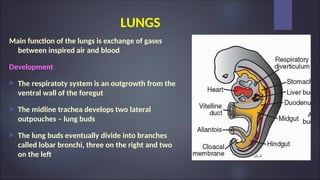
 The respiratoty system is an outgrowth from the
ventral wall of the foregut
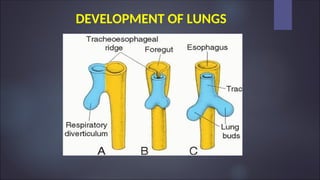
 The midline trachea develops two lateral
outpouches – lung buds
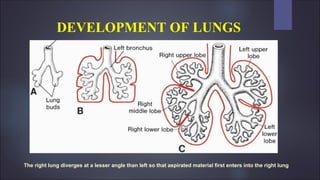
 The lung buds eventually divide into branches
called lobar bronchi, three on the right and two
on the left
DEVELOPMENT OF LUNGS
The right lung diverges at a lesser angle than left so that aspirated material first enters into the right lung
LUNG – NORMAL ANATOMY
 Bronchi have firm cartilagenous walls that provide support and
are lined by columnar ciliated epithelium and with abundant
subepithelial glands that produce mucus
 Bronchi branches dichotomously and gives rise to bronchioles
which lack cartilage and submucosal glands in their wall
 Bronchioles leads to terminal bronchioles which are less than
2mm in diametre
LUNG – NORMAL ANATOMY
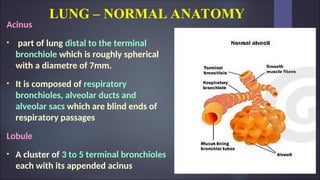
Acinus
• part of lung distal to the terminal
bronchiole which is roughly spherical
with a diametre of 7mm.
• It is composed of respiratory
bronchioles, alveolar ducts and
alveolar sacs which are blind ends of
respiratory passages
Lobule
• A cluster of 3 to 5 terminal bronchioles
each with its appended acinus
LUNG – NORMAL ANATOMY
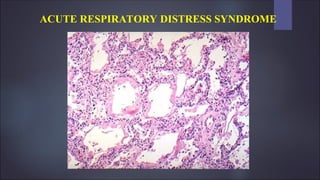
ACUTE RESPIRATORY DISTRESS SYNDROME
Synonyms:

Adult Respiratory Distress Syndrome
 Shock lung
 Diffuse alveolar damage
 Acute alveolar injury
 Acute lung injury
ACUTE RESPIRATORY DISTRESS SYNDROME

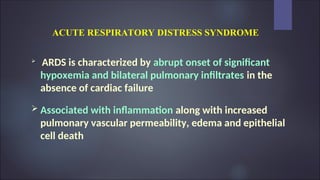
ARDS is characterized by abrupt onset of significant
hypoxemia and bilateral pulmonary infiltrates in the
absence of cardiac failure
 Associated with inflammation along with increased
pulmonary vascular permeability, edema and epithelial
cell death
ACUTE RESPIRATORY DISTRESS SYNDROME
Conditions associated with ARDS are-
- Infection
- Physical injury
- Inhaled irritants
- Chemical injury
- Hematological conditions
- Pancreatitis
- Uremia
- Hypersensitivity reactions
ACUTE RESPIRATORY DISTRESS SYNDROME
Conditions associated with ARDS are-
Infection
- Sepsis
- Diffuse pulmonary infections
- Viral infections
- Mycoplasma & Pneumocystis pneumonia;
- Miliary tuberculosis
- Gastric aspiration
ACUTE RESPIRATORY DISTRESS SYNDROME
Conditions associated with ARDS are-
Physical / Injury
- Mechanical trauma
- Pulmonary contusions
- Near-drowning
- Fractures with fat embolism
- Burns
- Ionizing radiation
ACUTE RESPIRATORY DISTRESS SYNDROME
Conditions associated with ARDS are-
Chemical Injury
- Heroin or methadone overdose
- Acetylsalicylic acid
- Barbiturate overdose
- Paraquat
ACUTE RESPIRATORY DISTRESS SYNDROME
Conditions associated with ARDS are-
Inhaled Irritants
 Oxygen toxicity
 Smoke
 Irritant gasses and chemicals
Hematologic Conditions
 Multiple transfusions
 Disseminated intravascular coagulation
ACUTE RESPIRATORY DISTRESS SYNDROME
Pathogenesis
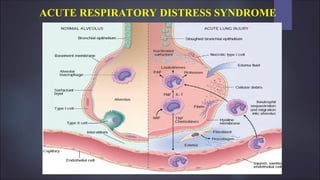
 In ARDS the integrity of alveolar capillary membrane formed by two
separate barriers ( microvascular endothelium and alveolar epithelium) is
compromised
 ARDS is initiated by injury to pneumocytes and pulmonary endothelium
setting in motion a vicious cycle of increasing inflammation and
pulmonary damage
ACUTE RESPIRATORY DISTRESS SYNDROME
Pathogenesis
 After acute insult there is increased synthesis of Interleukin -8 (IL-8)
which is potent neutrophil chemotactic and activating agent
 IL-8 and TNF is produced by activated alveolar macrophages
ACUTE RESPIRATORY DISTRESS SYNDROME
Pathogenesis
 Endothelial activation
 Adhesion and extravasation of neutrophils
 Accumulation of intraalveolar fluid and formation of
hyaline membrane
 Resolution of injury
ACUTE RESPIRATORY DISTRESS SYNDROME
Pathogenesis
Endothelial activation
 It is secondary to pneumocyte injury which activate macrophages
 Activated macrophages secrete TNF that act on neighbouring endothelium
 Alternatively circulating inflammatory mediators also activate pulmonary
endothelium
 Activated endothelial cells express increased levels of adhesion molecules,
procoagulant proteins and chemokines
ACUTE RESPIRATORY DISTRESS SYNDROME
Pathogenesis
Adhesion and extravasation of neutrophils
 Neutrophils adhere to the activated endothelium and migrate into
the interstitium and alveoli, where they degranulate and release
inflammatory mediators including proteases, reactive oxygen
species and cytokines
ACUTE RESPIRATORY DISTRESS SYNDROME
Pathogenesis
Accumulation of intra alveolar fluid and formation of hyaline membrane
 Endothelial activation and injury make pulmonary capillaries leaky,
allowing interstitial and intraalveolar edema fluid to form
 Damage and necrosis of type II alveolar pneumocytes leads to surfactant
abnormalities, further compromising alveolar gas exchange
 Ultimately inspissated protein-rich edema fluid and debris from dead
alveolar epithelial cells organize into hyaline membrane, a characteristic
feature of ARDS
ACUTE RESPIRATORY DISTRESS SYNDROME
Pathogenesis
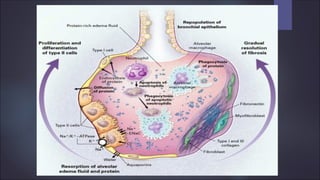
Resolution of injury
 When the inflammatory stimulus lessens, macrophages remove
intraalveolar debris and release fibrogenic cytokines such as
transforming growth factor β (TGF-β) and platelet derived growth factor
(PDGF)
 these factors stimulate fibroblast growth and collagen deposition,
leading to fibrosis of alveolar walls
 Bronchiolar stem cells proliferate to replace pneumocytes
ACUTE RESPIRATORY DISTRESS SYNDROME
ARDS - MORPHOLOGY
Acute stage:
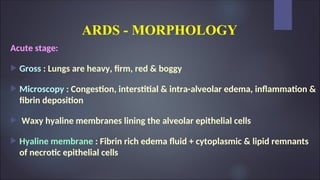
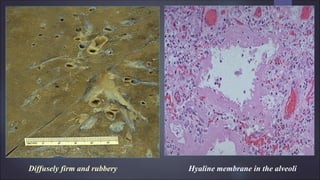
 Gross : Lungs are heavy, firm, red & boggy
 Microscopy : Congestion, interstitial & intra-alveolar edema, inflammation &
fibrin deposition
 Waxy hyaline membranes lining the alveolar epithelial cells
 Hyaline membrane : Fibrin rich edema fluid + cytoplasmic & lipid remnants
of necrotic epithelial cells
Diffusely firm and rubbery Hyaline membrane in the alveoli
fig
ACUTE RESPIRATORY DISTRESS SYNDROME
ARDS - MORPHOLOGY
Organizing stage:
 Proliferation of type II epithelial cells (to regenerate the alveolar

lining)
 Organization of fibrin exudate  Intra alveolar fibrosis
 Marked thickening of alveolar septa (collagen & proliferation of
interstitial cells)
ACUTE RESPIRATORY DISTRESS SYNDROME
Clinical features
 Dyspnea and tachypnea
 Cyanosis and hypoxemia
 Respiratory failure
 Hypoxemia may be refractory to oxygen therapy
LUNG ABSCESS
LUNG ABSCESS
 The term pulmonary abscess describes a local suppurative process that
produces necrosis of lung tissue
 Commonest organisms isolated from the abscess material are –
- Streptococci
- Staphylococci
- Gram negative organisms
LUNG ABSCESS
Pathogenesis:
 Aspiration of infected foreign material: Unconsciousness, Anesthesia,
general debility in which cough reflexes are depressed
 Preceding bacterial infection: Bronchopneumonia, Tuberculosis,
Bronchiectasis etc.,
 Bronchial obstruction: Bronchial tumor, Foreign body – produces
secondary infection in the obstructed bronchopulmonary segment
 Septic embolism: infected emboli from Thrombophlebitis or vegetations
of Infective Bacterial endocarditis
LUNG ABSCESS
Pathogenesis:
Miscellaneous
 Direct traumatic injury to lung
 Spread of infections from neighbouring organ such as suppuration
in the esophagus, spine, subphrenic space or pleural cavity
 Hematogenous seeding of the lung by pyogenic organisms
LUNG ABSCESS
 In some cases no discernible basis for the abscess
formation can be identified – Primary Cryptogenic
abscess
LUNG ABSCESS
Morphology
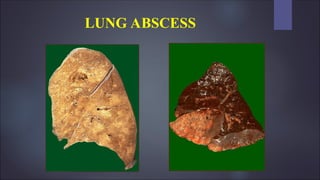
 Size – varies from few mm to large cavities of 5 to 6 cm
 Site – may affect any part of the lung and may be single or multiple
 Pulmonary abscess due to aspiration are common on the right side and are
single
 Abscess which develops in the course of pneumonia or bronchiectasis are
usually multiple, basal and diffusely scattered.
 Septic emboli and pyemic abscess – multiple and affect any region of lung
LUNG ABSCESS
Morphology
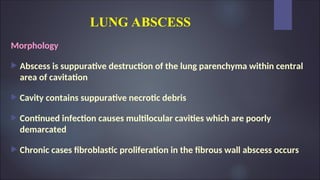
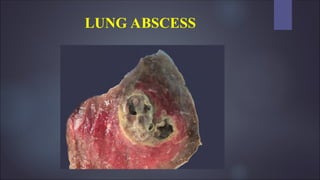
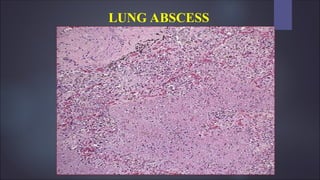
 Abscess is suppurative destruction of the lung parenchyma within central
area of cavitation
 Cavity contains suppurative necrotic debris
 Continued infection causes multilocular cavities which are poorly
demarcated
 Chronic cases fibroblastic proliferation in the fibrous wall abscess occurs
LUNG ABSCESS
LUNG ABSCESS
LUNG ABSCESS
THANK YOU

Respiaratory-sys-I-ARDS-lung-abscess.ppt

  • 1.
    RESPIRATORY SYSTEM Dr.V.Shanthi Associate Professor,Department of Pathology Sri Venkateswara Institute of Medical Sciences Tirupathi
  • 2.
    LUNGS Main function ofthe lungs is exchange of gases between inspired air and blood Development  The respiratoty system is an outgrowth from the ventral wall of the foregut  The midline trachea develops two lateral outpouches – lung buds  The lung buds eventually divide into branches called lobar bronchi, three on the right and two on the left
  • 3.
  • 4.
    DEVELOPMENT OF LUNGS Theright lung diverges at a lesser angle than left so that aspirated material first enters into the right lung
  • 5.
    LUNG – NORMALANATOMY  Bronchi have firm cartilagenous walls that provide support and are lined by columnar ciliated epithelium and with abundant subepithelial glands that produce mucus  Bronchi branches dichotomously and gives rise to bronchioles which lack cartilage and submucosal glands in their wall  Bronchioles leads to terminal bronchioles which are less than 2mm in diametre
  • 6.
    LUNG – NORMALANATOMY Acinus • part of lung distal to the terminal bronchiole which is roughly spherical with a diametre of 7mm. • It is composed of respiratory bronchioles, alveolar ducts and alveolar sacs which are blind ends of respiratory passages Lobule • A cluster of 3 to 5 terminal bronchioles each with its appended acinus
  • 7.
  • 8.
    ACUTE RESPIRATORY DISTRESSSYNDROME Synonyms:  Adult Respiratory Distress Syndrome  Shock lung  Diffuse alveolar damage  Acute alveolar injury  Acute lung injury
  • 9.
    ACUTE RESPIRATORY DISTRESSSYNDROME  ARDS is characterized by abrupt onset of significant hypoxemia and bilateral pulmonary infiltrates in the absence of cardiac failure  Associated with inflammation along with increased pulmonary vascular permeability, edema and epithelial cell death
  • 10.
    ACUTE RESPIRATORY DISTRESSSYNDROME Conditions associated with ARDS are- - Infection - Physical injury - Inhaled irritants - Chemical injury - Hematological conditions - Pancreatitis - Uremia - Hypersensitivity reactions
  • 11.
    ACUTE RESPIRATORY DISTRESSSYNDROME Conditions associated with ARDS are- Infection - Sepsis - Diffuse pulmonary infections - Viral infections - Mycoplasma & Pneumocystis pneumonia; - Miliary tuberculosis - Gastric aspiration
  • 12.
    ACUTE RESPIRATORY DISTRESSSYNDROME Conditions associated with ARDS are- Physical / Injury - Mechanical trauma - Pulmonary contusions - Near-drowning - Fractures with fat embolism - Burns - Ionizing radiation
  • 13.
    ACUTE RESPIRATORY DISTRESSSYNDROME Conditions associated with ARDS are- Chemical Injury - Heroin or methadone overdose - Acetylsalicylic acid - Barbiturate overdose - Paraquat
  • 14.
    ACUTE RESPIRATORY DISTRESSSYNDROME Conditions associated with ARDS are- Inhaled Irritants  Oxygen toxicity  Smoke  Irritant gasses and chemicals Hematologic Conditions  Multiple transfusions  Disseminated intravascular coagulation
  • 15.
    ACUTE RESPIRATORY DISTRESSSYNDROME Pathogenesis  In ARDS the integrity of alveolar capillary membrane formed by two separate barriers ( microvascular endothelium and alveolar epithelium) is compromised  ARDS is initiated by injury to pneumocytes and pulmonary endothelium setting in motion a vicious cycle of increasing inflammation and pulmonary damage
  • 16.
    ACUTE RESPIRATORY DISTRESSSYNDROME Pathogenesis  After acute insult there is increased synthesis of Interleukin -8 (IL-8) which is potent neutrophil chemotactic and activating agent  IL-8 and TNF is produced by activated alveolar macrophages
  • 17.
    ACUTE RESPIRATORY DISTRESSSYNDROME Pathogenesis  Endothelial activation  Adhesion and extravasation of neutrophils  Accumulation of intraalveolar fluid and formation of hyaline membrane  Resolution of injury
  • 18.
    ACUTE RESPIRATORY DISTRESSSYNDROME Pathogenesis Endothelial activation  It is secondary to pneumocyte injury which activate macrophages  Activated macrophages secrete TNF that act on neighbouring endothelium  Alternatively circulating inflammatory mediators also activate pulmonary endothelium  Activated endothelial cells express increased levels of adhesion molecules, procoagulant proteins and chemokines
  • 19.
    ACUTE RESPIRATORY DISTRESSSYNDROME Pathogenesis Adhesion and extravasation of neutrophils  Neutrophils adhere to the activated endothelium and migrate into the interstitium and alveoli, where they degranulate and release inflammatory mediators including proteases, reactive oxygen species and cytokines
  • 20.
    ACUTE RESPIRATORY DISTRESSSYNDROME Pathogenesis Accumulation of intra alveolar fluid and formation of hyaline membrane  Endothelial activation and injury make pulmonary capillaries leaky, allowing interstitial and intraalveolar edema fluid to form  Damage and necrosis of type II alveolar pneumocytes leads to surfactant abnormalities, further compromising alveolar gas exchange  Ultimately inspissated protein-rich edema fluid and debris from dead alveolar epithelial cells organize into hyaline membrane, a characteristic feature of ARDS
  • 21.
    ACUTE RESPIRATORY DISTRESSSYNDROME Pathogenesis Resolution of injury  When the inflammatory stimulus lessens, macrophages remove intraalveolar debris and release fibrogenic cytokines such as transforming growth factor β (TGF-β) and platelet derived growth factor (PDGF)  these factors stimulate fibroblast growth and collagen deposition, leading to fibrosis of alveolar walls  Bronchiolar stem cells proliferate to replace pneumocytes
  • 22.
  • 24.
    ARDS - MORPHOLOGY Acutestage:  Gross : Lungs are heavy, firm, red & boggy  Microscopy : Congestion, interstitial & intra-alveolar edema, inflammation & fibrin deposition  Waxy hyaline membranes lining the alveolar epithelial cells  Hyaline membrane : Fibrin rich edema fluid + cytoplasmic & lipid remnants of necrotic epithelial cells
  • 25.
    Diffusely firm andrubbery Hyaline membrane in the alveoli
  • 26.
  • 27.
    ARDS - MORPHOLOGY Organizingstage:  Proliferation of type II epithelial cells (to regenerate the alveolar lining)  Organization of fibrin exudate  Intra alveolar fibrosis  Marked thickening of alveolar septa (collagen & proliferation of interstitial cells)
  • 28.
    ACUTE RESPIRATORY DISTRESSSYNDROME Clinical features  Dyspnea and tachypnea  Cyanosis and hypoxemia  Respiratory failure  Hypoxemia may be refractory to oxygen therapy
  • 29.
  • 30.
    LUNG ABSCESS  Theterm pulmonary abscess describes a local suppurative process that produces necrosis of lung tissue  Commonest organisms isolated from the abscess material are – - Streptococci - Staphylococci - Gram negative organisms
  • 31.
    LUNG ABSCESS Pathogenesis:  Aspirationof infected foreign material: Unconsciousness, Anesthesia, general debility in which cough reflexes are depressed  Preceding bacterial infection: Bronchopneumonia, Tuberculosis, Bronchiectasis etc.,  Bronchial obstruction: Bronchial tumor, Foreign body – produces secondary infection in the obstructed bronchopulmonary segment  Septic embolism: infected emboli from Thrombophlebitis or vegetations of Infective Bacterial endocarditis
  • 32.
    LUNG ABSCESS Pathogenesis: Miscellaneous  Directtraumatic injury to lung  Spread of infections from neighbouring organ such as suppuration in the esophagus, spine, subphrenic space or pleural cavity  Hematogenous seeding of the lung by pyogenic organisms
  • 33.
    LUNG ABSCESS  Insome cases no discernible basis for the abscess formation can be identified – Primary Cryptogenic abscess
  • 34.
    LUNG ABSCESS Morphology  Size– varies from few mm to large cavities of 5 to 6 cm  Site – may affect any part of the lung and may be single or multiple  Pulmonary abscess due to aspiration are common on the right side and are single  Abscess which develops in the course of pneumonia or bronchiectasis are usually multiple, basal and diffusely scattered.  Septic emboli and pyemic abscess – multiple and affect any region of lung
  • 35.
    LUNG ABSCESS Morphology  Abscessis suppurative destruction of the lung parenchyma within central area of cavitation  Cavity contains suppurative necrotic debris  Continued infection causes multilocular cavities which are poorly demarcated  Chronic cases fibroblastic proliferation in the fibrous wall abscess occurs
  • 36.
  • 37.
  • 38.
  • 39.

Editor's Notes

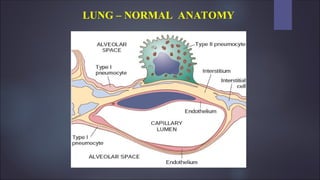
  • #7 Type I pneumocytes – flat plate like covering 95% of the alveolar surface Rounded type II pneumocytes – synthesize surfactant which forms a very thin layer over the alveolar cell membranes and are involved in the repair of alveolar damage through their ability to proliferate and give rise to type I cells