Did you know that the off-grid lighting market
has the potential to transform the lives
of 1.3 billion people around the world?
“Energy Poverty” remains one of the biggest challenges to achieving sustainable development.
The predominant means of lighting for one quarter of the global population is fuel-based and
has severe effects on the environment and health. Solar-based off-grid lighting is an economically
viable and sustainable alternative – for business and consumers alike.
90 million tonnes of CO₂
and 270,000 tonnes of
black carbon can be saved
annually
For many years, fuel-based lighting and candles
have been the only available sources of light.
This has led to indoor air pollution impacting
the health of users, and is also considered a
significant fire hazard.
Today, there is a viable alternative. Efficient off-
grid lighting products combine light-emitting
diodes (LEDs), advanced rechargeable battery
technology and renewable energy sources
(mostly solar power) to deliver affordable
high-performance and better quality lighting.
Solar LED products include stand-alone,
rechargeable lighting devices or kits that
can be installed easily by an end user.
Like the proliferation of mobile phones, off-grid
lighting products are now lower in price,
higher in quality
and more easily
accessible to the
people who need
them.
The move to solar LED technology is transfor-
ming lives and economies in developing coun-
tries around the world by delivering significant
impacts:
• Economic benefits: reduced household bud-
gets for kerosene or candles leading to
increased savings; stimulation of economic
activities by lengthening the day; and new
income opportunities for small businesses
• Social benefits: longer hours and better
illumination for studying; social cohesion
and community development; safety and
equitable development for women
Solar LED technologies
are of high quality,
affordable, and deliver
better illumination
Globally, 1.3 bil-
lion people do not
have access to
the electric grid
and countless
more have only limited or irregular electrical
supply. They are classified as “under-
electrified” i
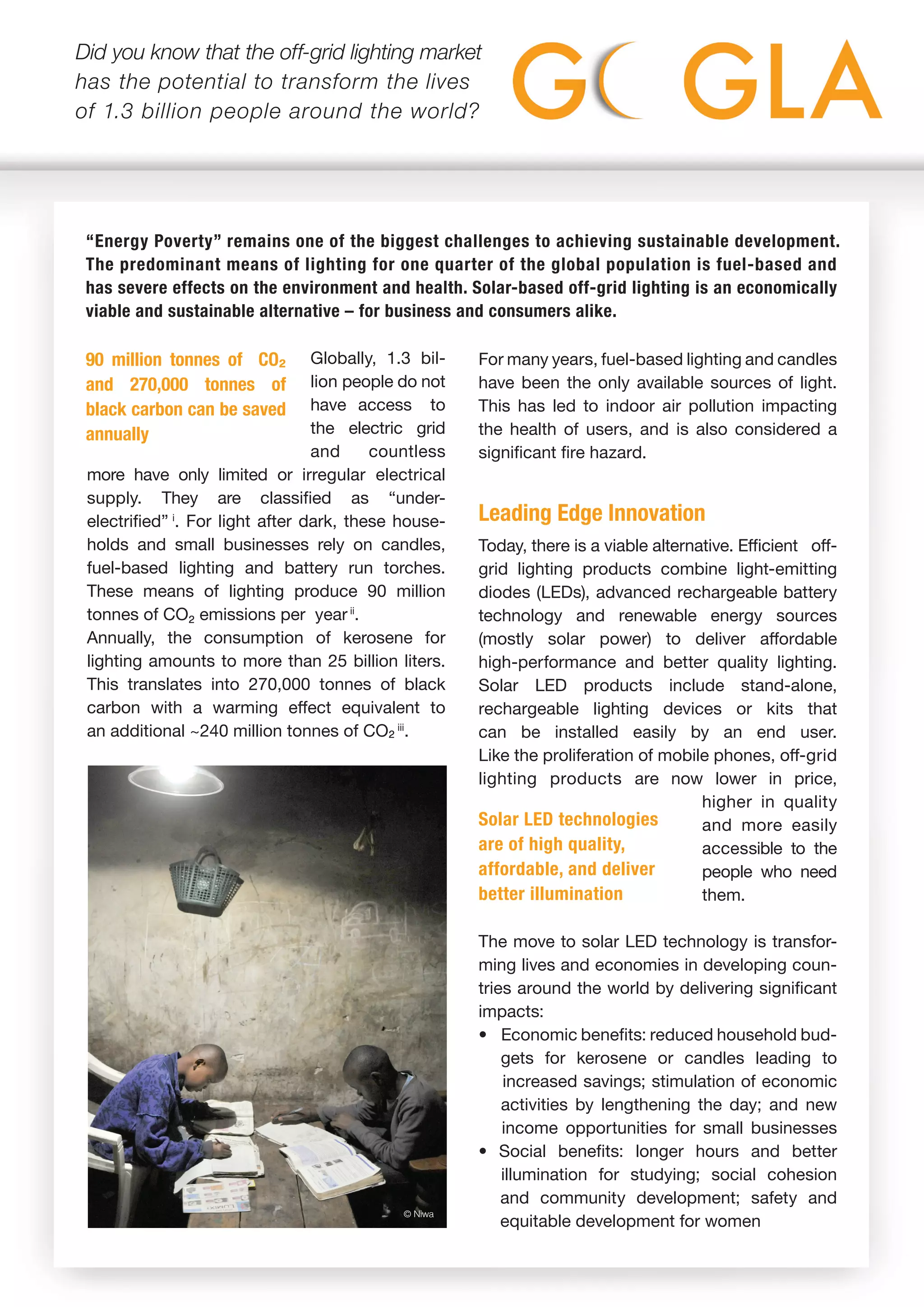
. For light after dark, these house-
holds and small businesses rely on candles,
fuel-based lighting and battery run torches.
These means of lighting produce 90 million
tonnes of CO₂ emissions per year ii
.
Annually, the consumption of kerosene for
lighting amounts to more than 25 billion liters.
This translates into 270,000 tonnes of black
carbon with a warming effect equivalent to
an additional ~240 million tonnes of CO₂ iii
.
Leading Edge Innovation
© Niwa
For more information on how to get involved, contact GOGLA at:
Sankt-Martin-Straße 53-55
81669 Munich, Germany
info@gogla.org
www.gogla.org
Although the penetration of off-grid lighting
products has increased, estimates indicate
that it still remains around 4% in Africa vi
. This
is due to several market barriers such as:
lack of access to financing, difficult distribution,
and low consumer awareness. The Global
Off-Grid-Lighting Association (GOGLA) has
been established to address these barriers
and to support the industry in the market
penetration of clean, quality and affordable
off-grid lighting technologies.
Support this thriving market in the transition to
sustainable and affordable off-grid lighting by
spreading the word. Give as many people as
possible the opportunity to choose leading edge
technology over harmful fuel-based lighting by:
• advocating the life-changing opportunity of
off-grid lighting
• creating awareness about the investment
opportunities for this rapidly growing market
• tackling the distribution challenge and over-
coming the “last mile”.
• Health benefits: improved safety by reducing
fire hazards associated with flammable fuels
and candles; reduced indoor air pollution;
reduced female mortality
• Environmental benefits: less greenhouse gas
emissions; protection of natural habitat
against deforestation.
Market forces continue
to drive off-grid lighting
technology, making it a
sustainable proposition
for end users and producers. The sector remains
one of the most attractive opportunities for
business with a steadily growing off-grid
population spending up to USD 30 billion
every year on fuel based lighting iv
.
Since 2009, the market increased by an
outstanding 300% and is expected to grow
even faster in the future v
.
Insteadofspending
limited incomes on
ineffective and
harmful forms of
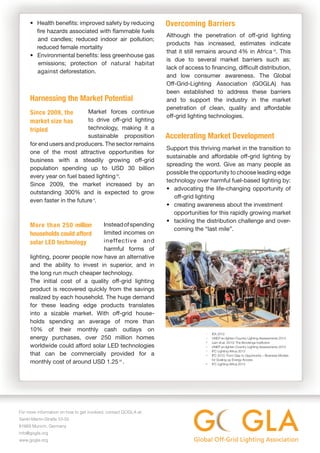
lighting, poorer people now have an alternative
and the ability to invest in superior, and in
the long run much cheaper technology.
The initial cost of a quality off-grid lighting
product is recovered quickly from the savings
realized by each household. The huge demand
for these leading edge products translates
into a sizable market. With off-grid house-
holds spending an average of more than
10% of their monthly cash outlays on
energy purchases, over 250 million homes
worldwide could afford solar LED technologies
that can be commercially provided for a
monthly cost of around USD 1.25 vi
.
IEA 2012
UNEP en.lighten Country Lighting Assessments 2013
Lam et.al. 2013/ The Brookings Institution
UNEP en.lighten Country Lighting Assessments 2013
IFC Lighting Africa 2013
IFC 2012: From Gap to Opportunity – Business Models
for Scaling up Energy Access
IFC Lighting Africa 2013
Since 2009, the
market size has
tripled
More than 250 million
households could afford
solar LED technology
Harnessing the Market Potential
Overcoming Barriers
Accelerating Market Development
© Lighting Africa / Andres Bifani
i
ii
iii
iv
v
vi
vii

GOGLA "Did You Know"

  • 1.
    Did you knowthat the off-grid lighting market has the potential to transform the lives of 1.3 billion people around the world? “Energy Poverty” remains one of the biggest challenges to achieving sustainable development. The predominant means of lighting for one quarter of the global population is fuel-based and has severe effects on the environment and health. Solar-based off-grid lighting is an economically viable and sustainable alternative – for business and consumers alike. 90 million tonnes of CO₂ and 270,000 tonnes of black carbon can be saved annually For many years, fuel-based lighting and candles have been the only available sources of light. This has led to indoor air pollution impacting the health of users, and is also considered a significant fire hazard. Today, there is a viable alternative. Efficient off- grid lighting products combine light-emitting diodes (LEDs), advanced rechargeable battery technology and renewable energy sources (mostly solar power) to deliver affordable high-performance and better quality lighting. Solar LED products include stand-alone, rechargeable lighting devices or kits that can be installed easily by an end user. Like the proliferation of mobile phones, off-grid lighting products are now lower in price, higher in quality and more easily accessible to the people who need them. The move to solar LED technology is transfor- ming lives and economies in developing coun- tries around the world by delivering significant impacts: • Economic benefits: reduced household bud- gets for kerosene or candles leading to increased savings; stimulation of economic activities by lengthening the day; and new income opportunities for small businesses • Social benefits: longer hours and better illumination for studying; social cohesion and community development; safety and equitable development for women Solar LED technologies are of high quality, affordable, and deliver better illumination Globally, 1.3 bil- lion people do not have access to the electric grid and countless more have only limited or irregular electrical supply. They are classified as “under- electrified” i . For light after dark, these house- holds and small businesses rely on candles, fuel-based lighting and battery run torches. These means of lighting produce 90 million tonnes of CO₂ emissions per year ii . Annually, the consumption of kerosene for lighting amounts to more than 25 billion liters. This translates into 270,000 tonnes of black carbon with a warming effect equivalent to an additional ~240 million tonnes of CO₂ iii . Leading Edge Innovation © Niwa
  • 2.
    For more informationon how to get involved, contact GOGLA at: Sankt-Martin-Straße 53-55 81669 Munich, Germany info@gogla.org www.gogla.org Although the penetration of off-grid lighting products has increased, estimates indicate that it still remains around 4% in Africa vi . This is due to several market barriers such as: lack of access to financing, difficult distribution, and low consumer awareness. The Global Off-Grid-Lighting Association (GOGLA) has been established to address these barriers and to support the industry in the market penetration of clean, quality and affordable off-grid lighting technologies. Support this thriving market in the transition to sustainable and affordable off-grid lighting by spreading the word. Give as many people as possible the opportunity to choose leading edge technology over harmful fuel-based lighting by: • advocating the life-changing opportunity of off-grid lighting • creating awareness about the investment opportunities for this rapidly growing market • tackling the distribution challenge and over- coming the “last mile”. • Health benefits: improved safety by reducing fire hazards associated with flammable fuels and candles; reduced indoor air pollution; reduced female mortality • Environmental benefits: less greenhouse gas emissions; protection of natural habitat against deforestation. Market forces continue to drive off-grid lighting technology, making it a sustainable proposition for end users and producers. The sector remains one of the most attractive opportunities for business with a steadily growing off-grid population spending up to USD 30 billion every year on fuel based lighting iv . Since 2009, the market increased by an outstanding 300% and is expected to grow even faster in the future v . Insteadofspending limited incomes on ineffective and harmful forms of lighting, poorer people now have an alternative and the ability to invest in superior, and in the long run much cheaper technology. The initial cost of a quality off-grid lighting product is recovered quickly from the savings realized by each household. The huge demand for these leading edge products translates into a sizable market. With off-grid house- holds spending an average of more than 10% of their monthly cash outlays on energy purchases, over 250 million homes worldwide could afford solar LED technologies that can be commercially provided for a monthly cost of around USD 1.25 vi . IEA 2012 UNEP en.lighten Country Lighting Assessments 2013 Lam et.al. 2013/ The Brookings Institution UNEP en.lighten Country Lighting Assessments 2013 IFC Lighting Africa 2013 IFC 2012: From Gap to Opportunity – Business Models for Scaling up Energy Access IFC Lighting Africa 2013 Since 2009, the market size has tripled More than 250 million households could afford solar LED technology Harnessing the Market Potential Overcoming Barriers Accelerating Market Development © Lighting Africa / Andres Bifani i ii iii iv v vi vii