rte_security: An update and introducing
PDCP
Akhil Goyal (NXP)
Hemant Agrawal (NXP)
DPDK Summit – Dublin- 2018
Agenda
 Rte_security – A brief recap
 PDCP - Introduction
 Rte_security – Updates for PDCP
 Protocol Error Handling
 Q&A
rte_security A Recap
rte_security – A brief recap
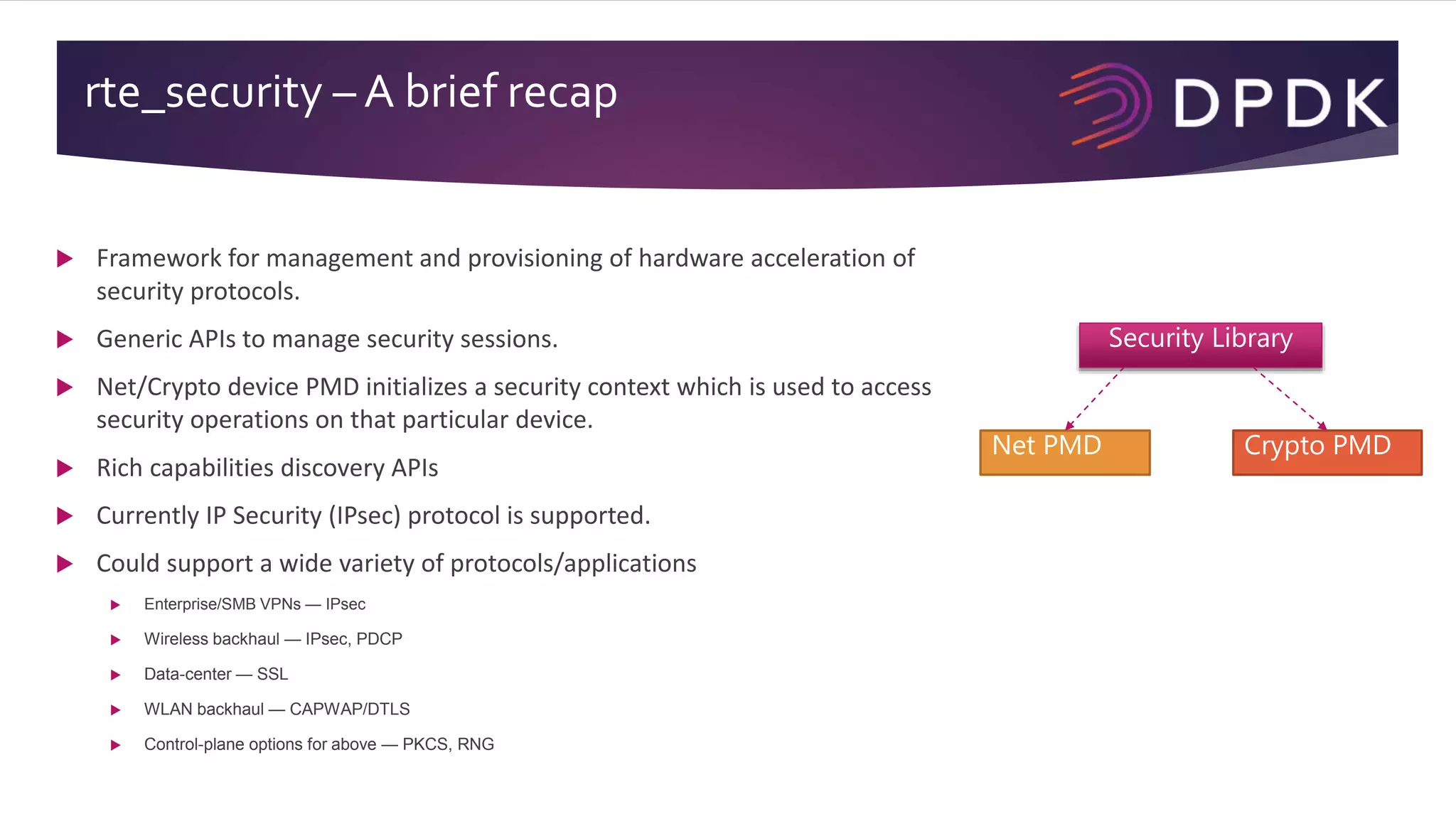
 Framework for management and provisioning of hardware acceleration of
security protocols.
 Generic APIs to manage security sessions.
 Net/Crypto device PMD initializes a security context which is used to access
security operations on that particular device.
 Rich capabilities discovery APIs
 Currently IP Security (IPsec) protocol is supported.
 Could support a wide variety of protocols/applications
 Enterprise/SMB VPNs — IPsec
 Wireless backhaul — IPsec, PDCP
 Data-center — SSL
 WLAN backhaul — CAPWAP/DTLS
 Control-plane options for above — PKCS, RNG
Net PMD
Security Library
Crypto PMD
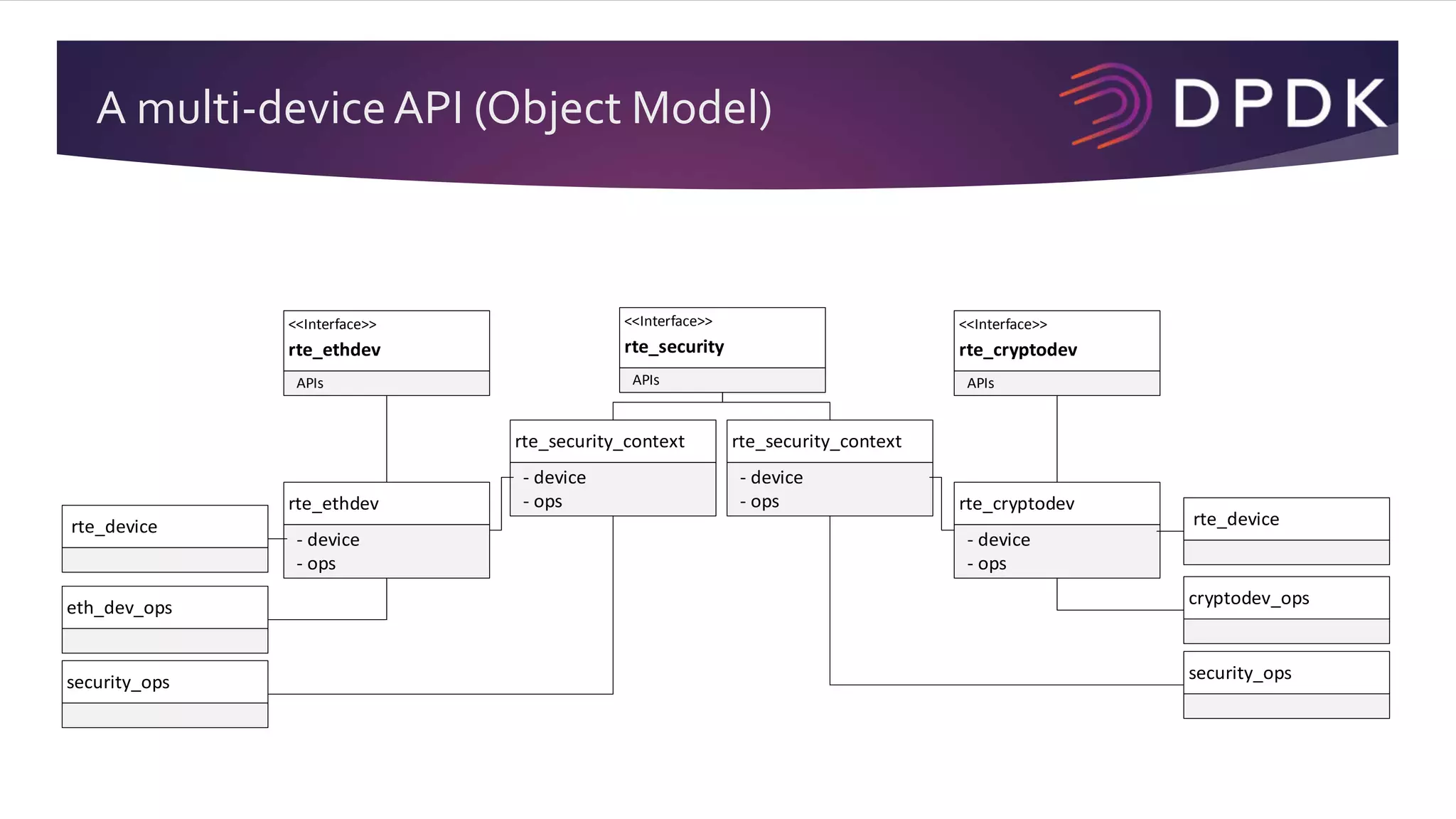
A multi-deviceAPI (Object Model)
<<Interface>>
rte_cryptodev
APIs
rte_device
cryptodev_ops
rte_cryptodev
- device
- ops
<<Interface>>
rte_security
APIs
<<Interface>>
rte_ethdev
APIs
rte_security_context
- device
- ops
security_ops
rte_device
eth_dev_ops
rte_ethdev
- device
- ops
security_ops
rte_security_context
- device
- ops
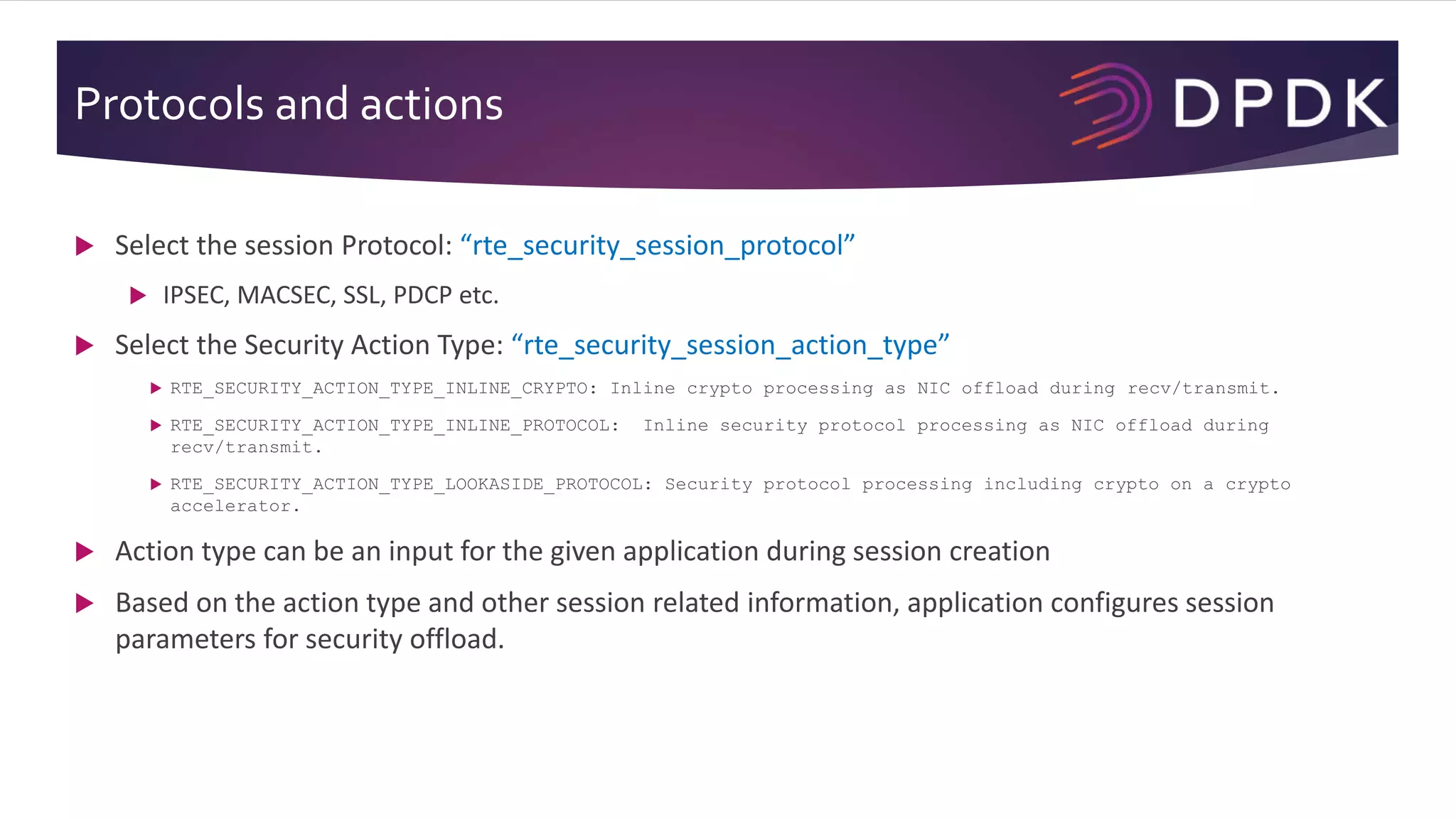
Protocols and actions
 Select the session Protocol: “rte_security_session_protocol”
 IPSEC, MACSEC, SSL, PDCP etc.
 Select the Security Action Type: “rte_security_session_action_type”
 RTE_SECURITY_ACTION_TYPE_INLINE_CRYPTO: Inline crypto processing as NIC offload during recv/transmit.
 RTE_SECURITY_ACTION_TYPE_INLINE_PROTOCOL: Inline security protocol processing as NIC offload during
recv/transmit.
 RTE_SECURITY_ACTION_TYPE_LOOKASIDE_PROTOCOL: Security protocol processing including crypto on a crypto
accelerator.
 Action type can be an input for the given application during session creation
 Based on the action type and other session related information, application configures session
parameters for security offload.
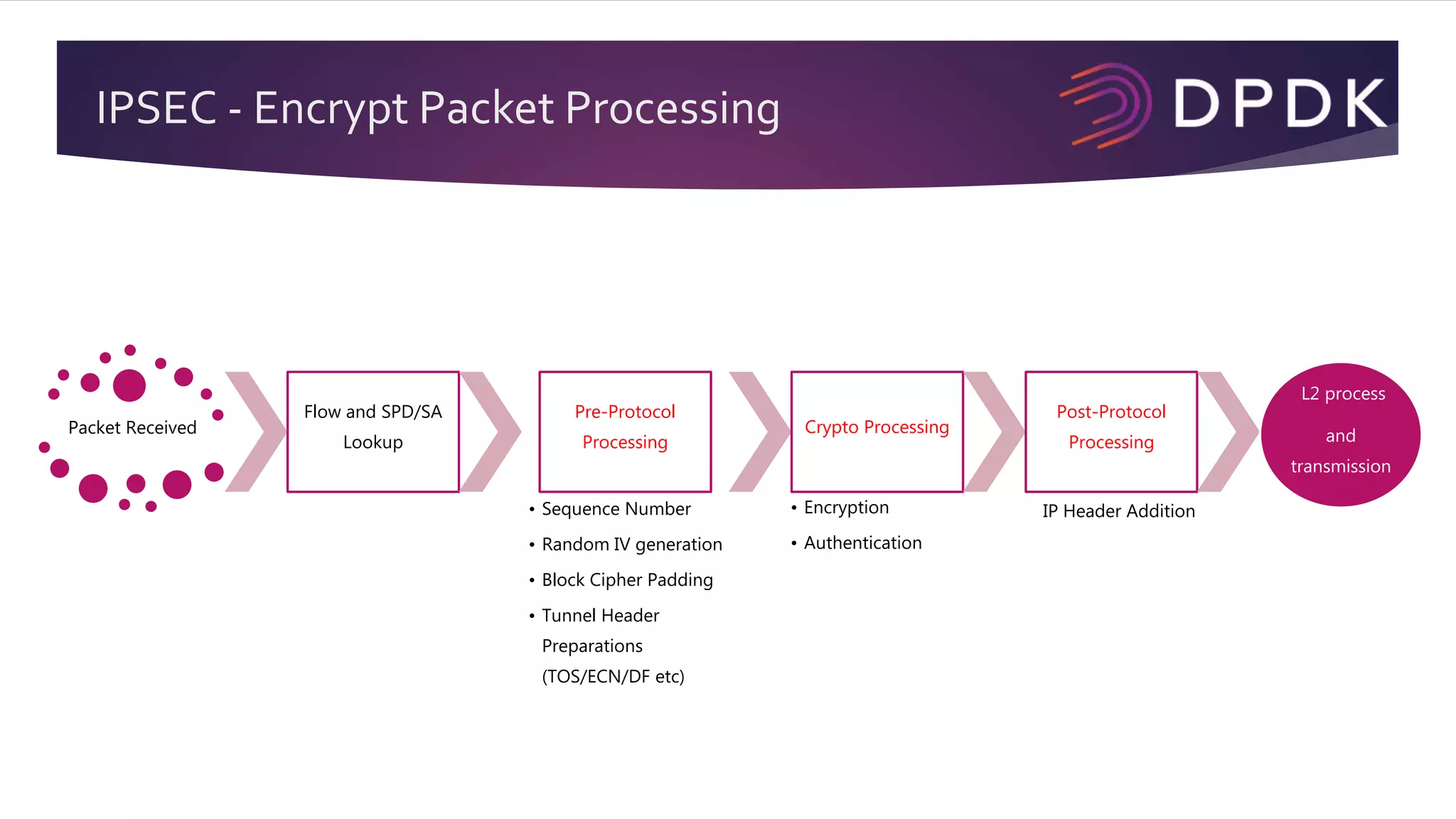
IPSEC - Encrypt Packet Processing
Packet Received
Flow and SPD/SA
Lookup
Pre-Protocol
Processing
• Sequence Number
• Random IV generation
• Block Cipher Padding
• Tunnel Header
Preparations
(TOS/ECN/DF etc)
Crypto Processing
• Encryption
• Authentication
Post-Protocol
Processing
IP Header Addition
L2 process
and
transmission
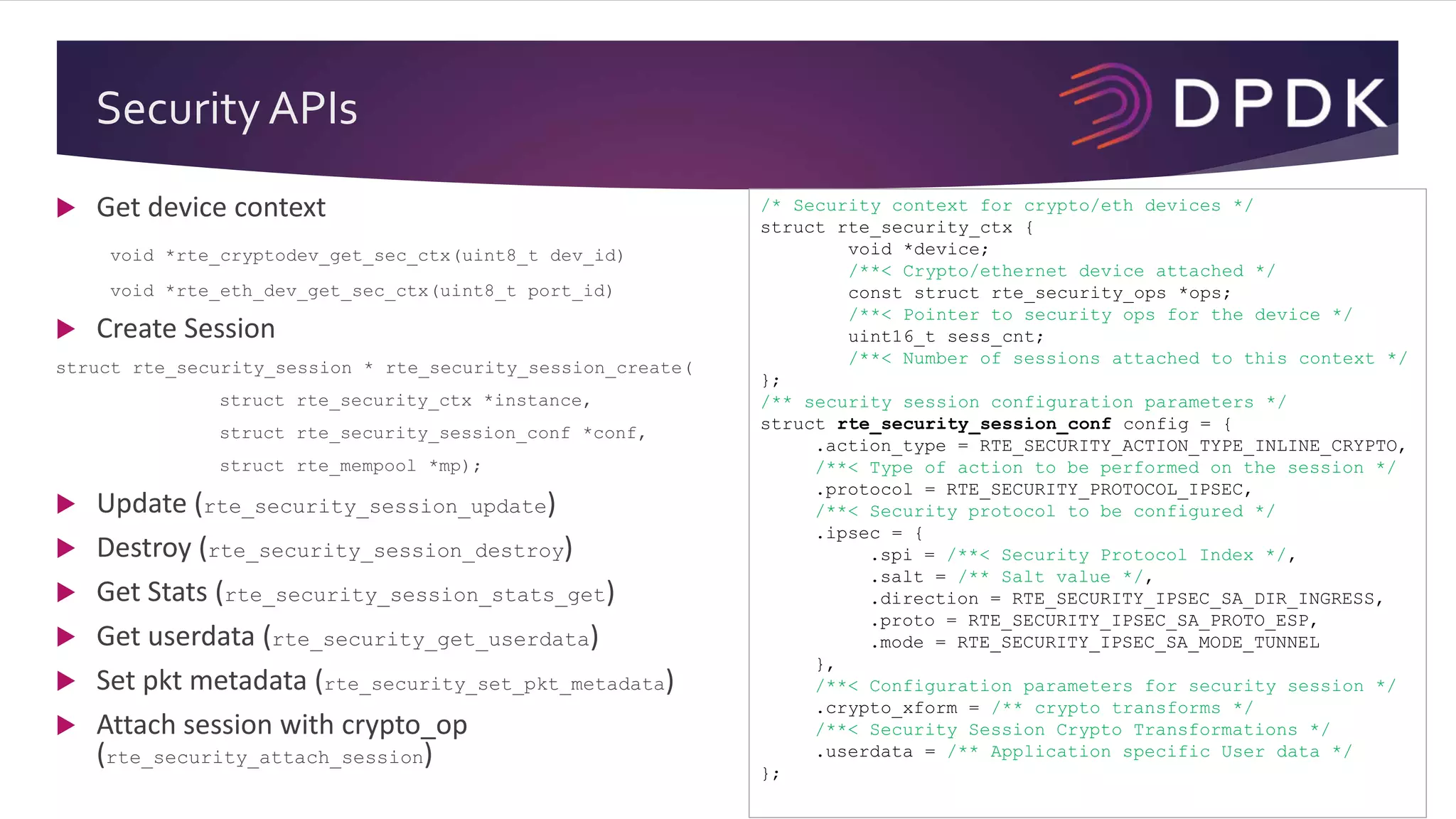
Security APIs
/* Security context for crypto/eth devices */
struct rte_security_ctx {
void *device;
/**< Crypto/ethernet device attached */
const struct rte_security_ops *ops;
/**< Pointer to security ops for the device */
uint16_t sess_cnt;
/**< Number of sessions attached to this context */
};
/** security session configuration parameters */
struct rte_security_session_conf config = {
.action_type = RTE_SECURITY_ACTION_TYPE_INLINE_CRYPTO,
/**< Type of action to be performed on the session */
.protocol = RTE_SECURITY_PROTOCOL_IPSEC,
/**< Security protocol to be configured */
.ipsec = {
.spi = /**< Security Protocol Index */,
.salt = /** Salt value */,
.direction = RTE_SECURITY_IPSEC_SA_DIR_INGRESS,
.proto = RTE_SECURITY_IPSEC_SA_PROTO_ESP,
.mode = RTE_SECURITY_IPSEC_SA_MODE_TUNNEL
},
/**< Configuration parameters for security session */
.crypto_xform = /** crypto transforms */
/**< Security Session Crypto Transformations */
.userdata = /** Application specific User data */
};
 Get device context
void *rte_cryptodev_get_sec_ctx(uint8_t dev_id)
void *rte_eth_dev_get_sec_ctx(uint8_t port_id)
 Create Session
struct rte_security_session * rte_security_session_create(
struct rte_security_ctx *instance,
struct rte_security_session_conf *conf,
struct rte_mempool *mp);
 Update (rte_security_session_update)
 Destroy (rte_security_session_destroy)
 Get Stats (rte_security_session_stats_get)
 Get userdata (rte_security_get_userdata)
 Set pkt metadata (rte_security_set_pkt_metadata)
 Attach session with crypto_op
(rte_security_attach_session)
PDCP Packet Data Convergence Protocol
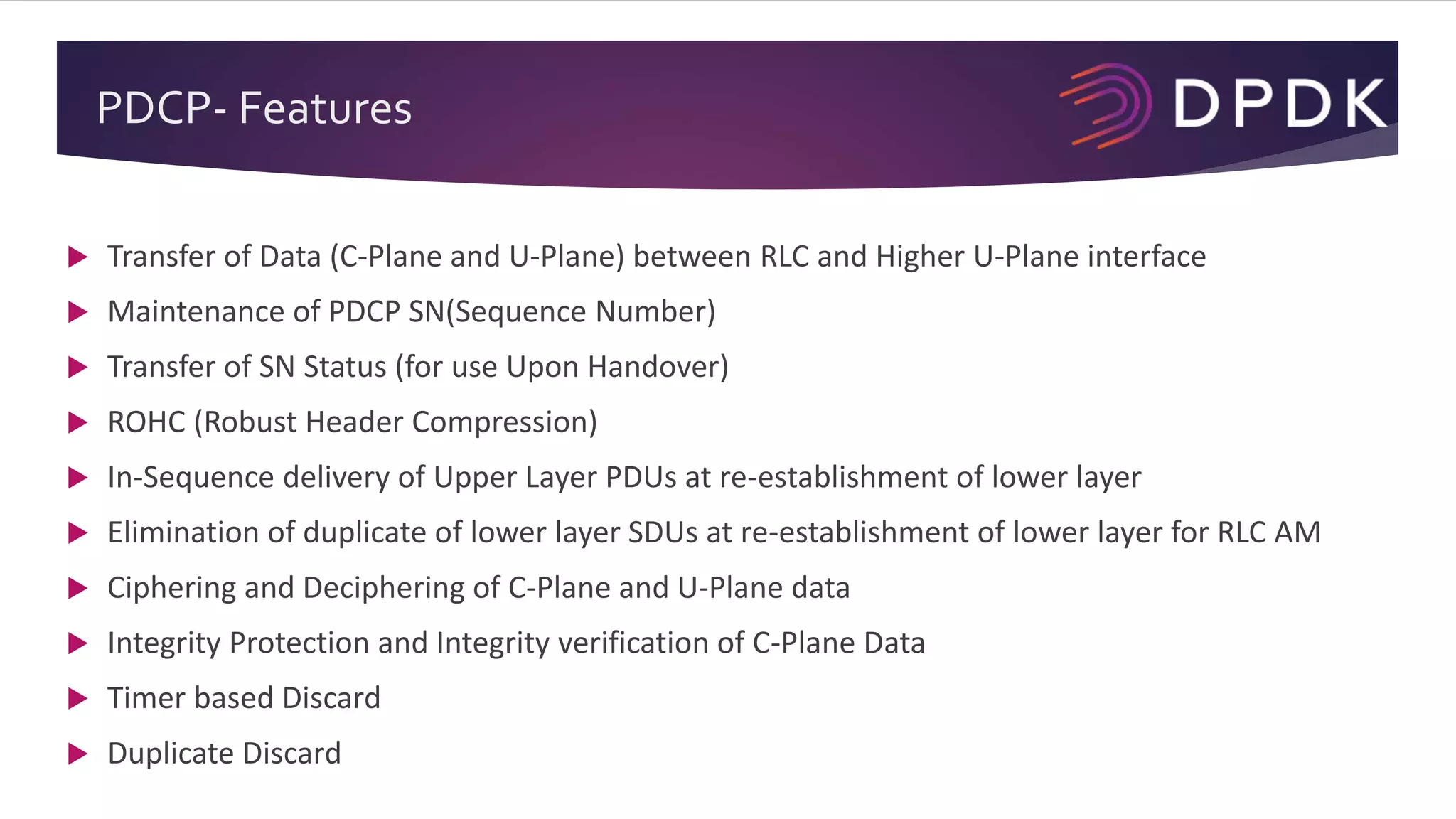
PDCP- Features
 Transfer of Data (C-Plane and U-Plane) between RLC and Higher U-Plane interface
 Maintenance of PDCP SN(Sequence Number)
 Transfer of SN Status (for use Upon Handover)
 ROHC (Robust Header Compression)
 In-Sequence delivery of Upper Layer PDUs at re-establishment of lower layer
 Elimination of duplicate of lower layer SDUs at re-establishment of lower layer for RLC AM
 Ciphering and Deciphering of C-Plane and U-Plane data
 Integrity Protection and Integrity verification of C-Plane Data
 Timer based Discard
 Duplicate Discard
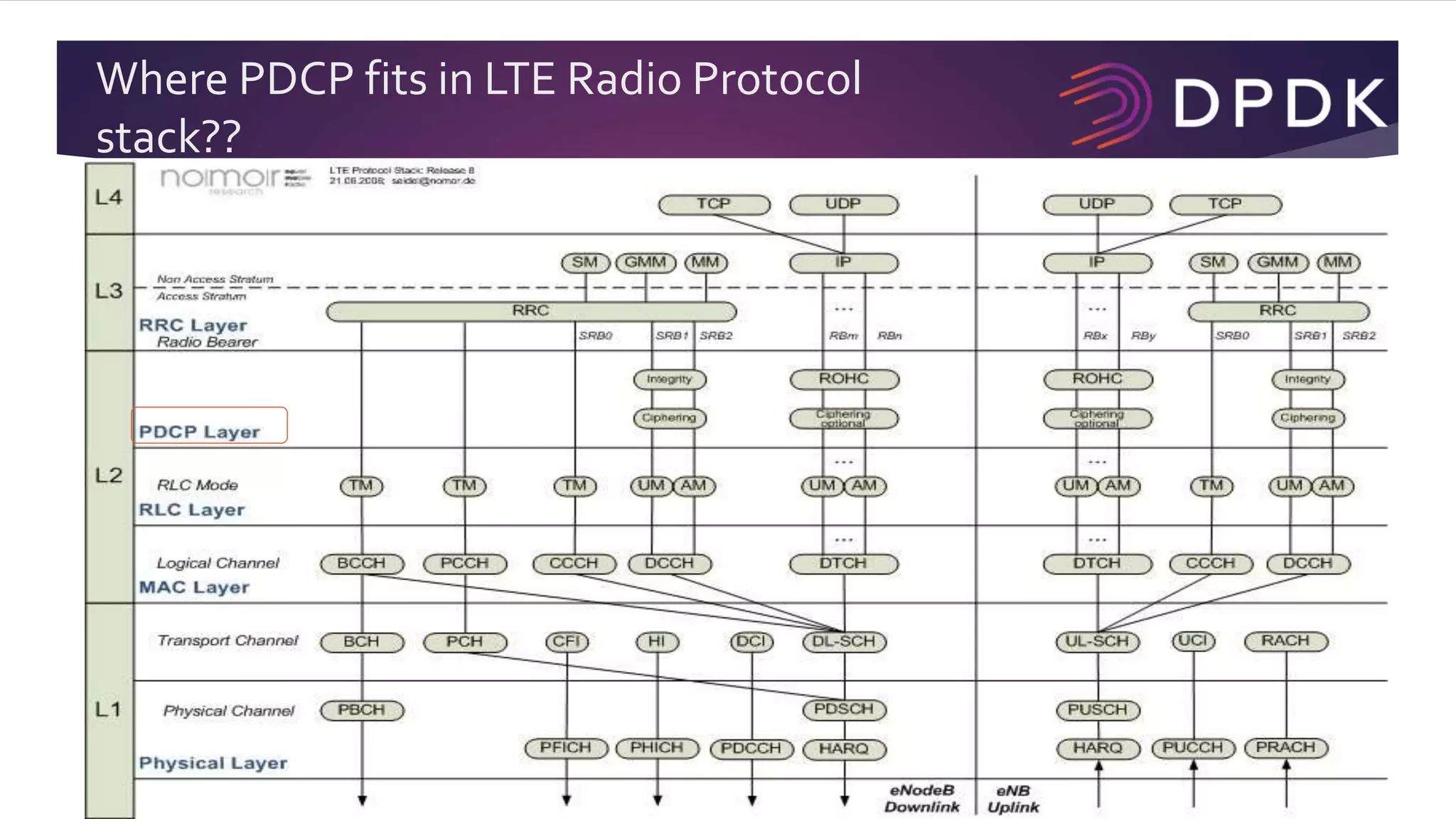
Where PDCP fits in LTE Radio Protocol
stack??
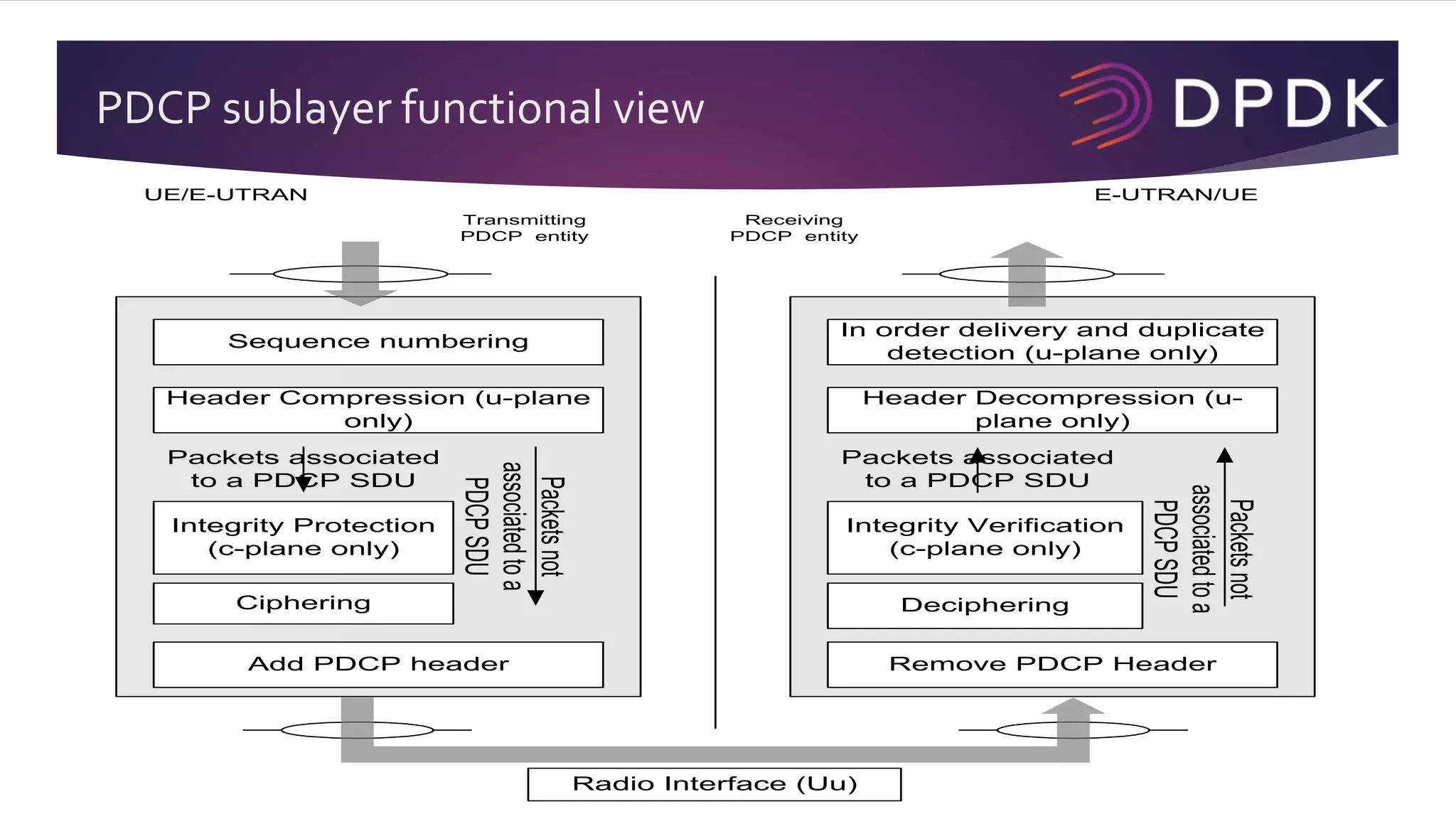
PDCP sublayer functional view
Radio Interface (Uu)
UE/E-UTRAN E-UTRAN/UE
Transmitting
PDCP entity
Ciphering
Header Compression (u-plane
only)
Receiving
PDCP entity
Sequence numbering
Integrity Protection
(c-plane only)
Add PDCP header
Header Decompression (u-
plane only)
Deciphering
Remove PDCP Header
In order delivery and duplicate
detection (u-plane only)
Integrity Verification
(c-plane only)
Packets associated
to a PDCP SDU
Packets associated
to a PDCP SDU
Packetsnot
associatedtoa
PDCPSDU
Packetsnot
associatedtoa
PDCPSDU
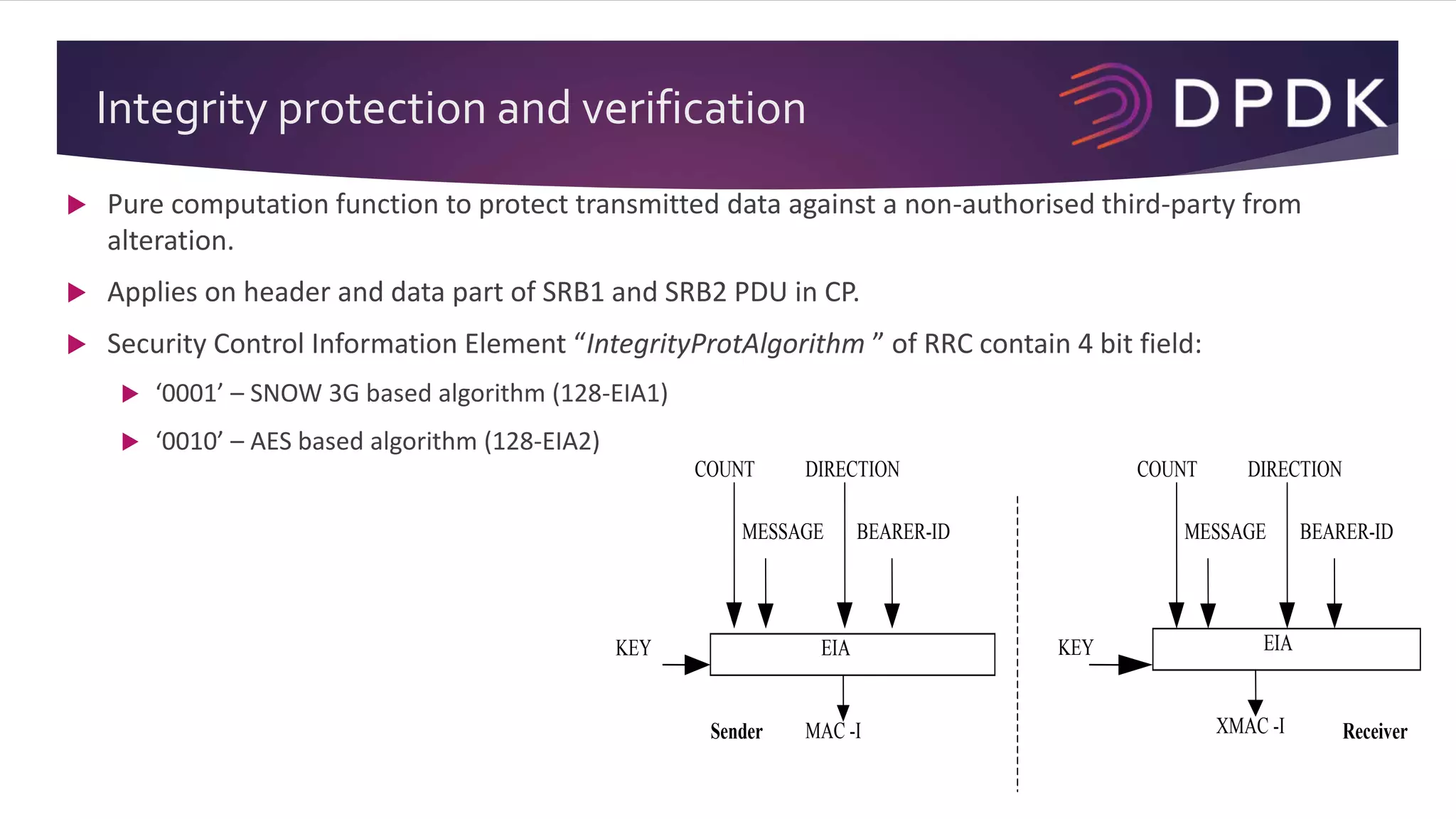
Integrity protection and verification
 Pure computation function to protect transmitted data against a non-authorised third-party from
alteration.
 Applies on header and data part of SRB1 and SRB2 PDU in CP.
 Security Control Information Element “IntegrityProtAlgorithm ” of RRC contain 4 bit field:
 ‘0001’ – SNOW 3G based algorithm (128-EIA1)
 ‘0010’ – AES based algorithm (128-EIA2)
EIAKEY
MAC -ISender
COUNT DIRECTION
MESSAGE BEARER-ID
EIA
XMAC -I
COUNT DIRECTION
MESSAGE BEARER-ID
KEY
Receiver
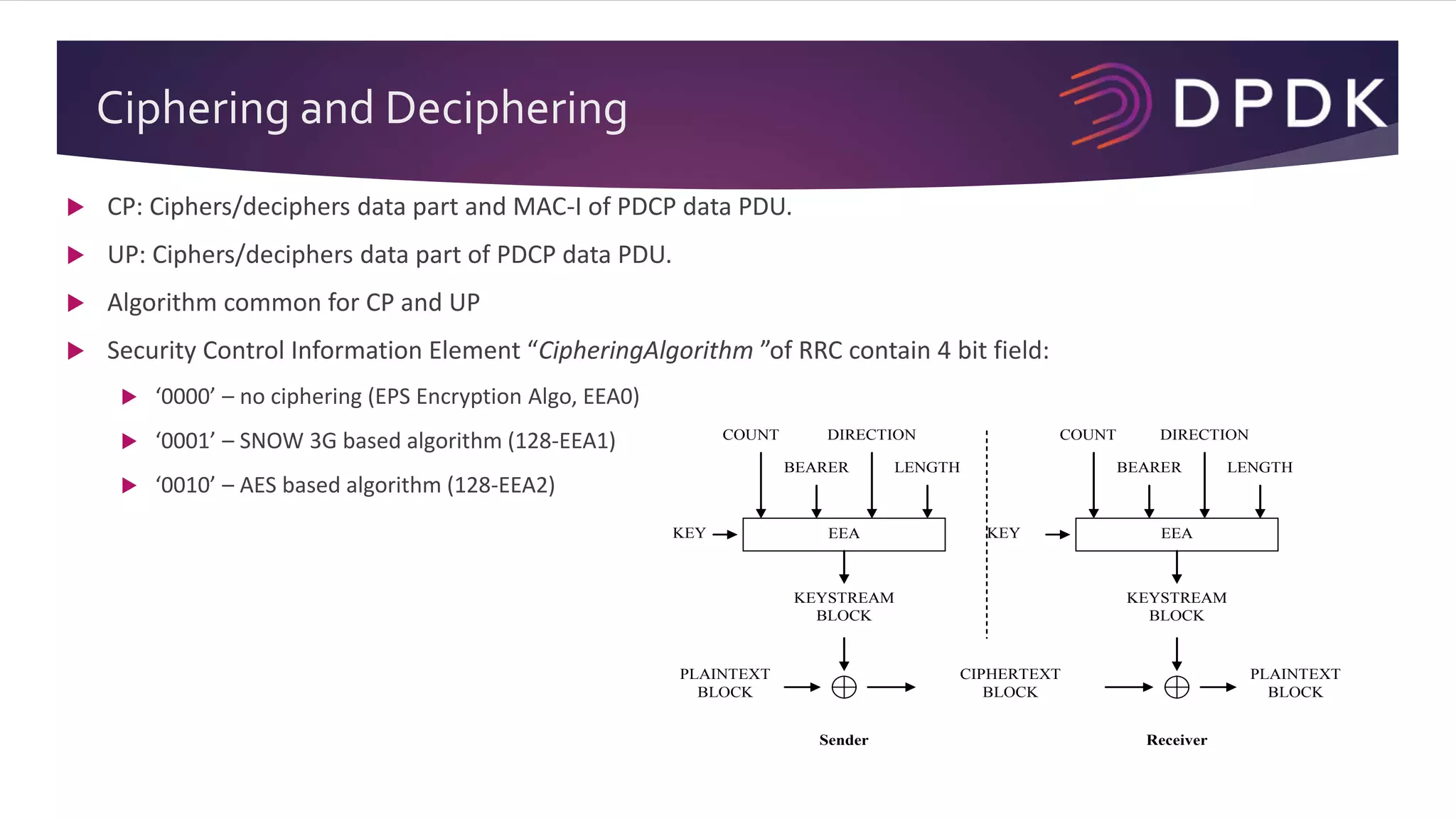
Ciphering and Deciphering
 CP: Ciphers/deciphers data part and MAC-I of PDCP data PDU.
 UP: Ciphers/deciphers data part of PDCP data PDU.
 Algorithm common for CP and UP
 Security Control Information Element “CipheringAlgorithm ”of RRC contain 4 bit field:
 ‘0000’ – no ciphering (EPS Encryption Algo, EEA0)
 ‘0001’ – SNOW 3G based algorithm (128-EEA1)
 ‘0010’ – AES based algorithm (128-EEA2)
PLAINTEXT
BLOCK
EEA
COUNT DIRECTION
BEARER LENGTH
KEY
KEYSTREAM
BLOCK
CIPHERTEXT
BLOCK
EEA
COUNT DIRECTION
BEARER LENGTH
KEY
KEYSTREAM
BLOCK
PLAINTEXT
BLOCK
Sender Receiver
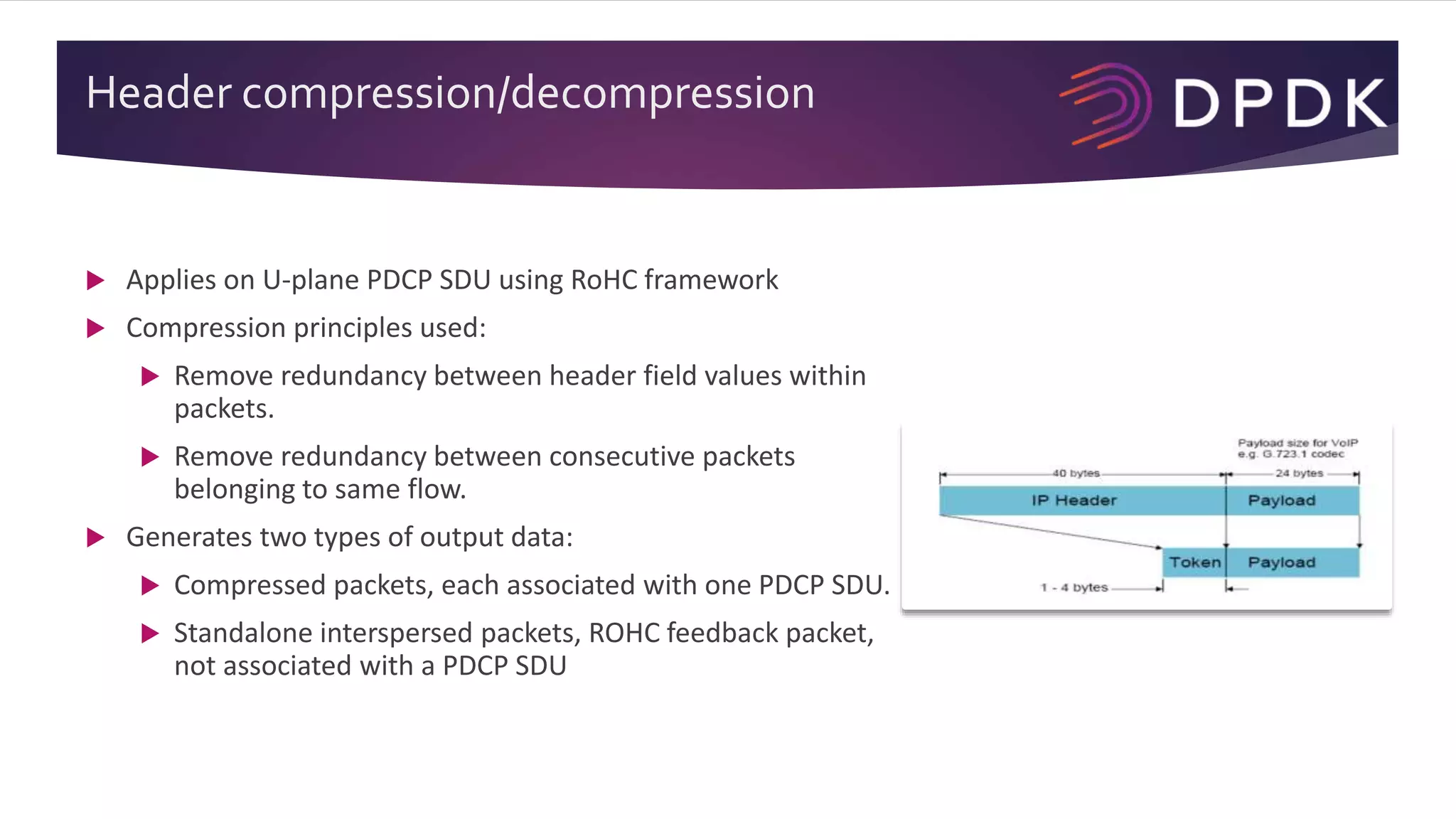
Header compression/decompression
 Applies on U-plane PDCP SDU using RoHC framework
 Compression principles used:
 Remove redundancy between header field values within
packets.
 Remove redundancy between consecutive packets
belonging to same flow.
 Generates two types of output data:
 Compressed packets, each associated with one PDCP SDU.
 Standalone interspersed packets, ROHC feedback packet,
not associated with a PDCP SDU
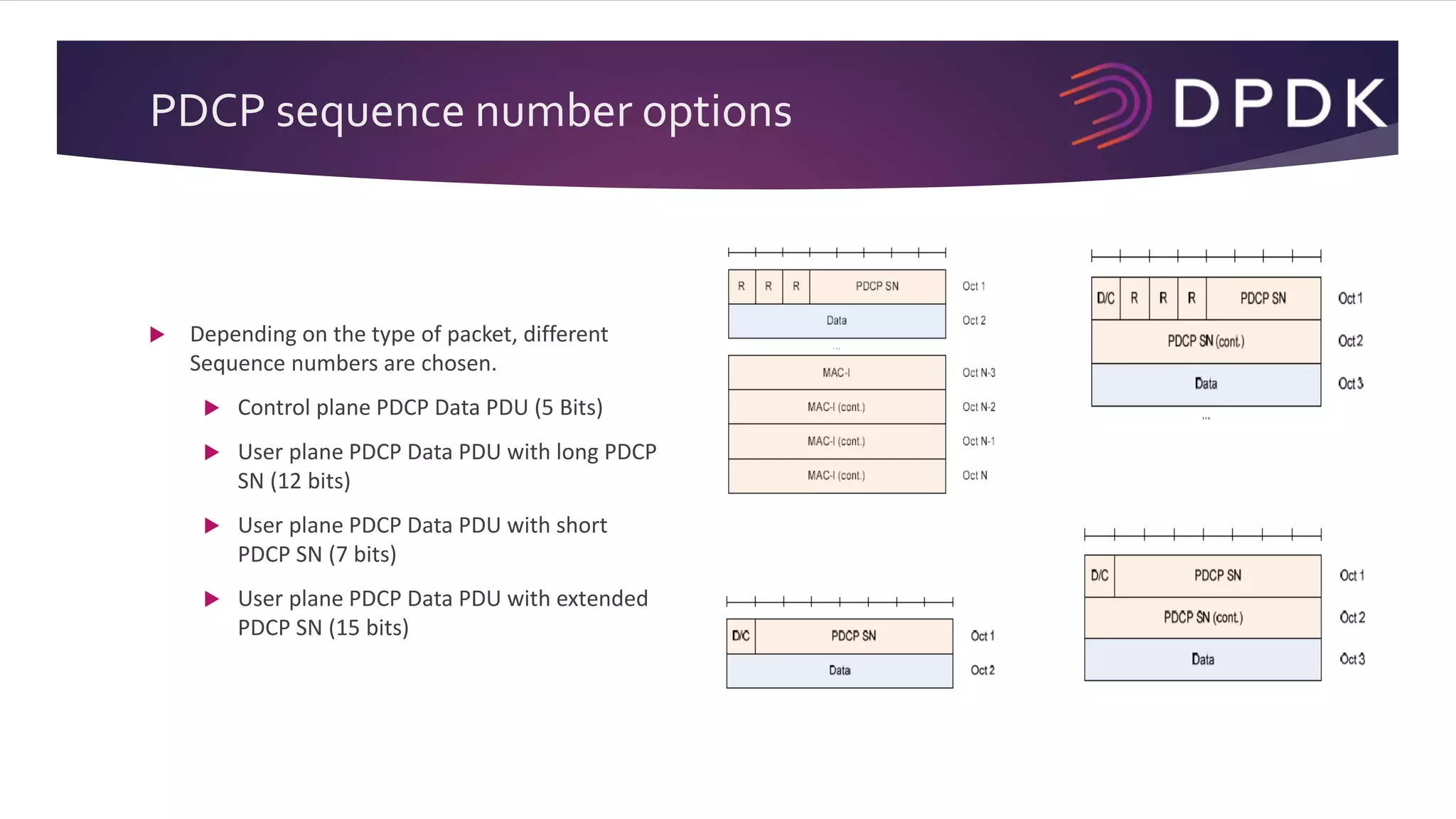
PDCP sequence number options
 Depending on the type of packet, different
Sequence numbers are chosen.
 Control plane PDCP Data PDU (5 Bits)
 User plane PDCP Data PDU with long PDCP
SN (12 bits)
 User plane PDCP Data PDU with short
PDCP SN (7 bits)
 User plane PDCP Data PDU with extended
PDCP SN (15 bits)
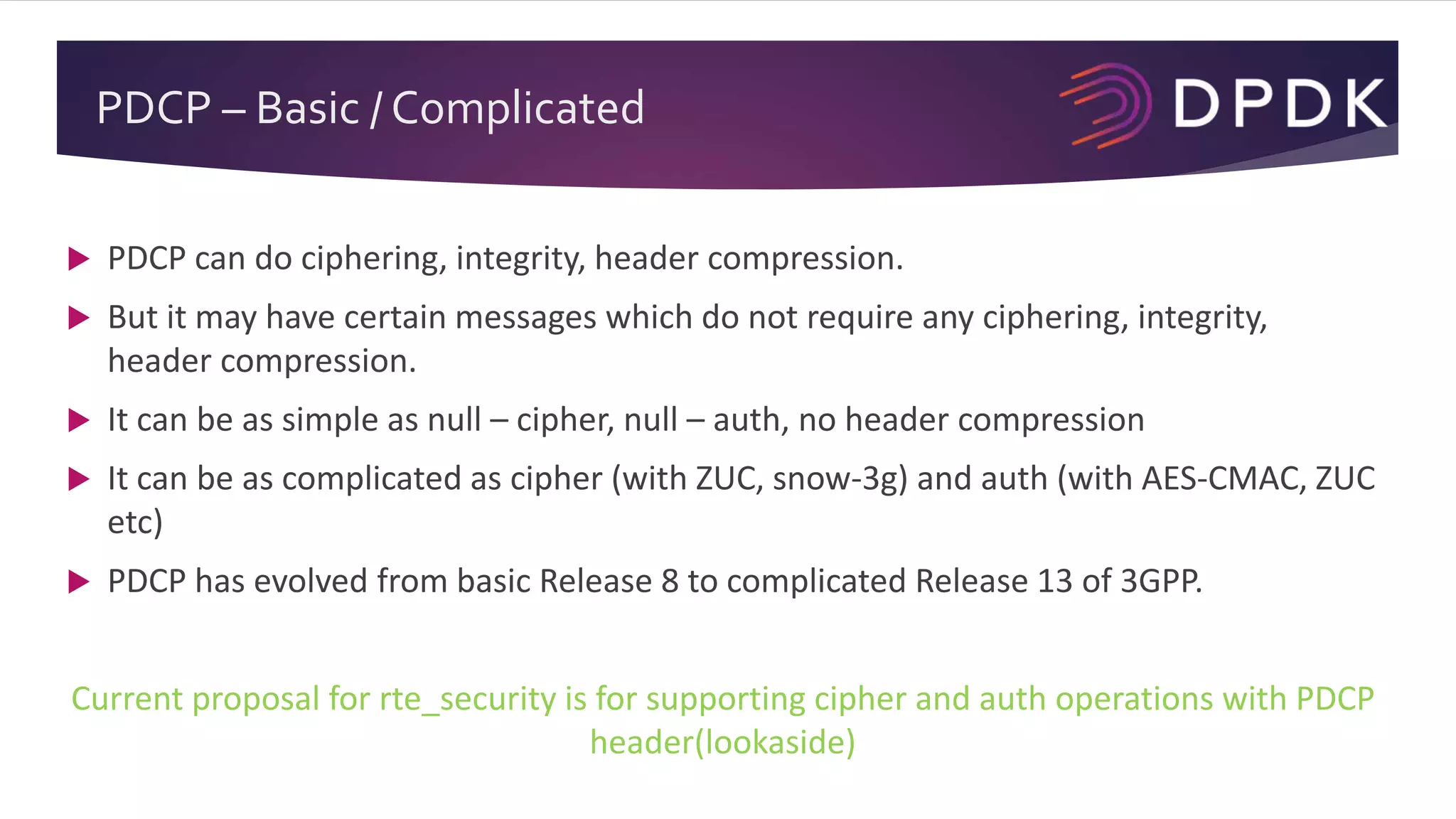
PDCP – Basic / Complicated
 PDCP can do ciphering, integrity, header compression.
 But it may have certain messages which do not require any ciphering, integrity,
header compression.
 It can be as simple as null – cipher, null – auth, no header compression
 It can be as complicated as cipher (with ZUC, snow-3g) and auth (with AES-CMAC, ZUC
etc)
 PDCP has evolved from basic Release 8 to complicated Release 13 of 3GPP.
Current proposal for rte_security is for supporting cipher and auth operations with PDCP
header(lookaside)
rte_security -revisit Updates for PDCP
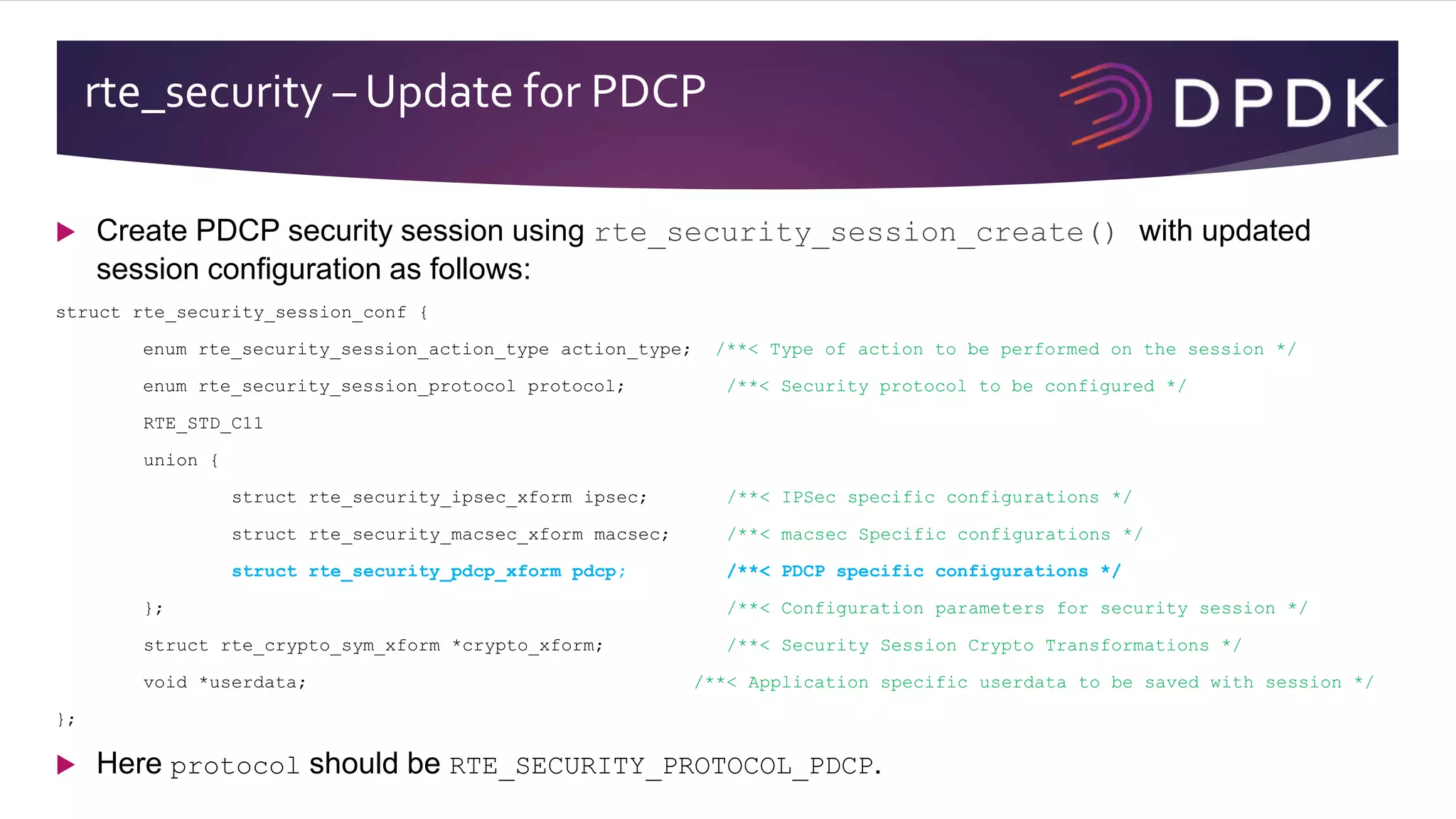
rte_security – Update for PDCP
 Create PDCP security session using rte_security_session_create() with updated
session configuration as follows:
struct rte_security_session_conf {
enum rte_security_session_action_type action_type; /**< Type of action to be performed on the session */
enum rte_security_session_protocol protocol; /**< Security protocol to be configured */
RTE_STD_C11
union {
struct rte_security_ipsec_xform ipsec; /**< IPSec specific configurations */
struct rte_security_macsec_xform macsec; /**< macsec Specific configurations */
struct rte_security_pdcp_xform pdcp; /**< PDCP specific configurations */
}; /**< Configuration parameters for security session */
struct rte_crypto_sym_xform *crypto_xform; /**< Security Session Crypto Transformations */
void *userdata; /**< Application specific userdata to be saved with session */
};
 Here protocol should be RTE_SECURITY_PROTOCOL_PDCP.
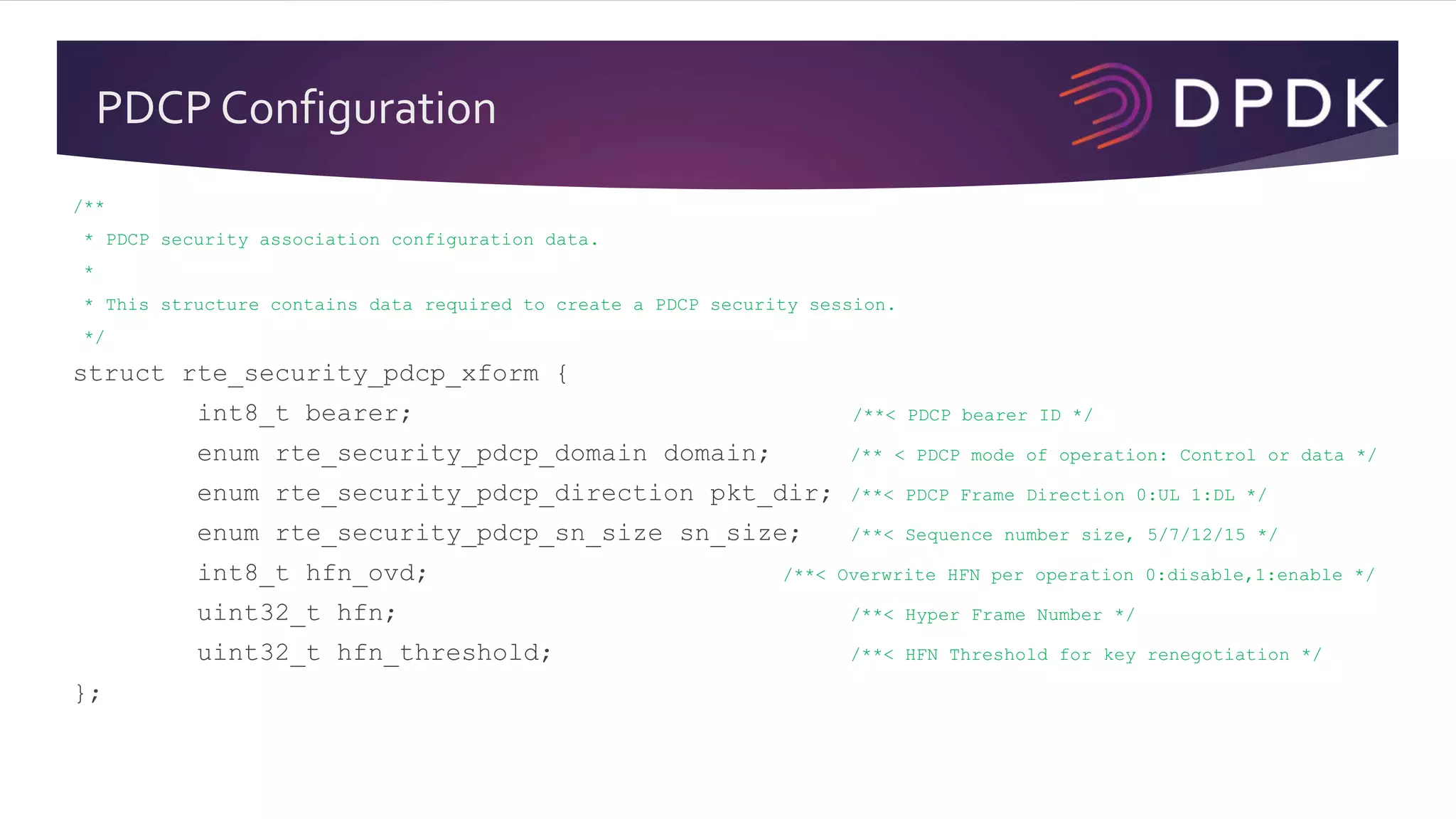
PDCP Configuration
/**
* PDCP security association configuration data.
*
* This structure contains data required to create a PDCP security session.
*/
struct rte_security_pdcp_xform {
int8_t bearer; /**< PDCP bearer ID */
enum rte_security_pdcp_domain domain; /** < PDCP mode of operation: Control or data */
enum rte_security_pdcp_direction pkt_dir; /**< PDCP Frame Direction 0:UL 1:DL */
enum rte_security_pdcp_sn_size sn_size; /**< Sequence number size, 5/7/12/15 */
int8_t hfn_ovd; /**< Overwrite HFN per operation 0:disable,1:enable */
uint32_t hfn; /**< Hyper Frame Number */
uint32_t hfn_threshold; /**< HFN Threshold for key renegotiation */
};
PDCP Capabilities Example
{ /* PDCP Lookaside Protocol offload Data Plane */
.action = RTE_SECURITY_ACTION_TYPE_LOOKASIDE_PROTOCOL,
.protocol = RTE_SECURITY_PROTOCOL_PDCP,
.pdcp = {
.domain = RTE_SECURITY_PDCP_MODE_DATA,
},
.crypto_capabilities = pdcp_capabilities
},
{ /* PDCP Lookaside Protocol offload Control Plane */
.action = RTE_SECURITY_ACTION_TYPE_LOOKASIDE_PROTOCOL,
.protocol = RTE_SECURITY_PROTOCOL_PDCP,
.pdcp = {
.domain = RTE_SECURITY_PDCP_MODE_CONTROL,
},
.crypto_capabilities = pdcp_capabilities
},
static const struct rte_cryptodev_capabilities pdcp_capabilities[] =
{
{ /* SNOW 3G (UIA2) */
.op = RTE_CRYPTO_OP_TYPE_SYMMETRIC,
{.sym = {
.xform_type = RTE_CRYPTO_SYM_XFORM_AUTH,
{.auth = {
.algo = RTE_CRYPTO_AUTH_SNOW3G_UIA2,
.block_size = 16,
.key_size = {
.min = 16,
.max = 16,
.increment = 0
},
.digest_size = {
.min = 4,
.max = 4,
.increment = 0
},
.iv_size = {
.min = 16,
.max = 16,
.increment = 0
}
}, }
}, }
},
}
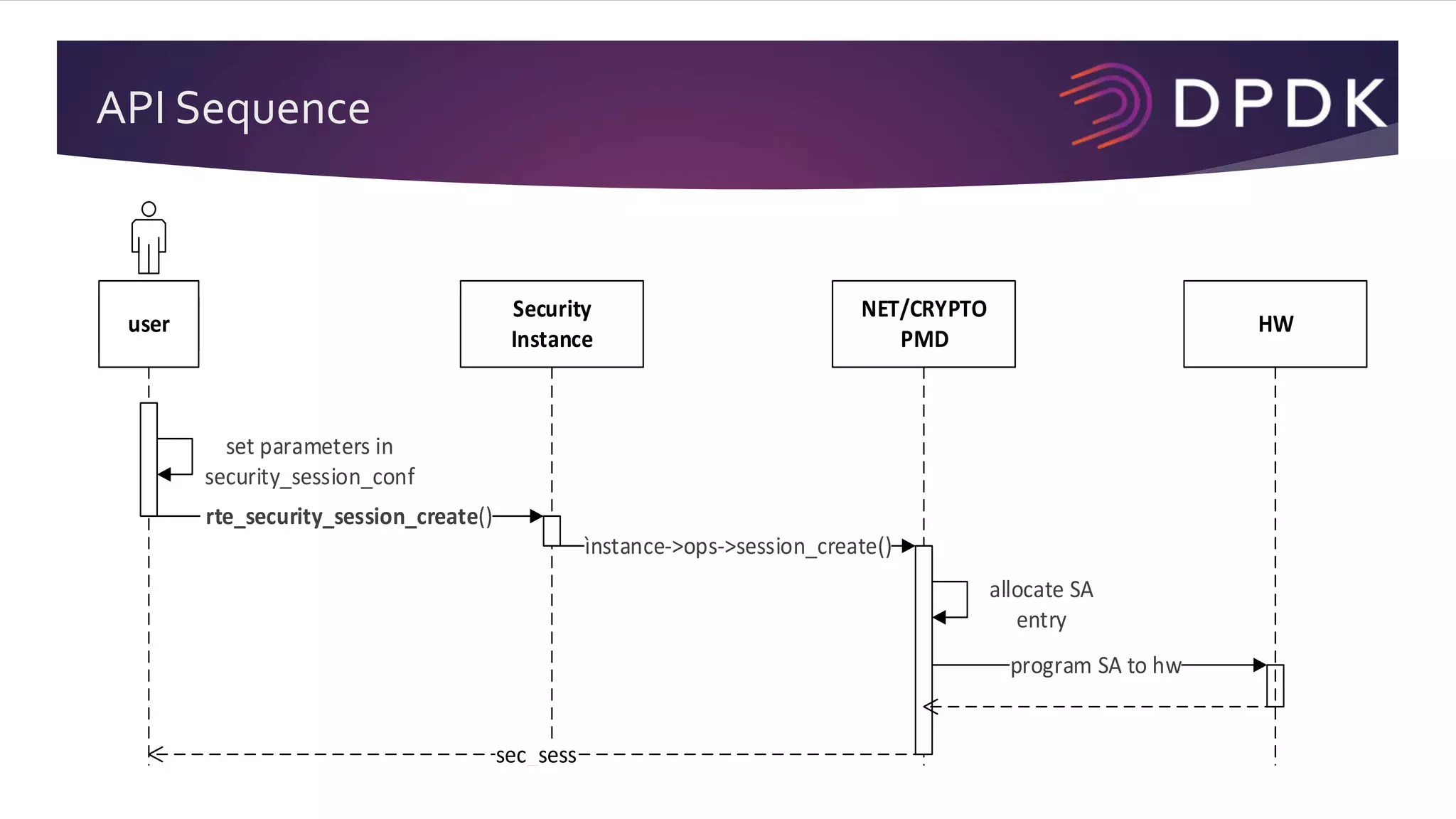
API Sequence
Security
Instance
NET/CRYPTO
PMD
user
ìnstance->ops->session_create()
allocate SA
entry
sec_sess
rte_security_session_create()
set parameters in
security_session_conf
program SA to hw
HW
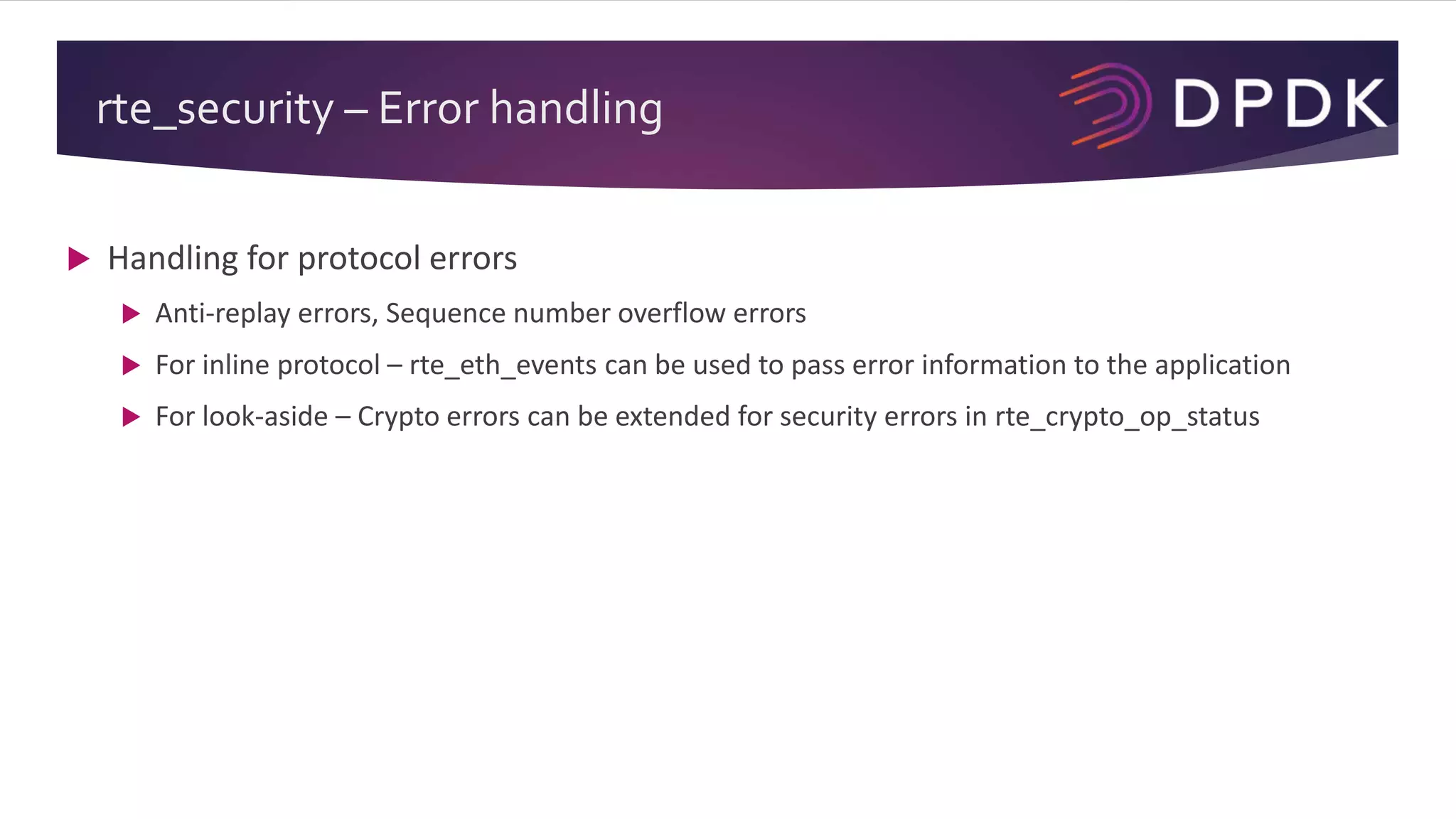
rte_security – Error handling
 Handling for protocol errors
 Anti-replay errors, Sequence number overflow errors
 For inline protocol – rte_eth_events can be used to pass error information to the application
 For look-aside – Crypto errors can be extended for security errors in rte_crypto_op_status
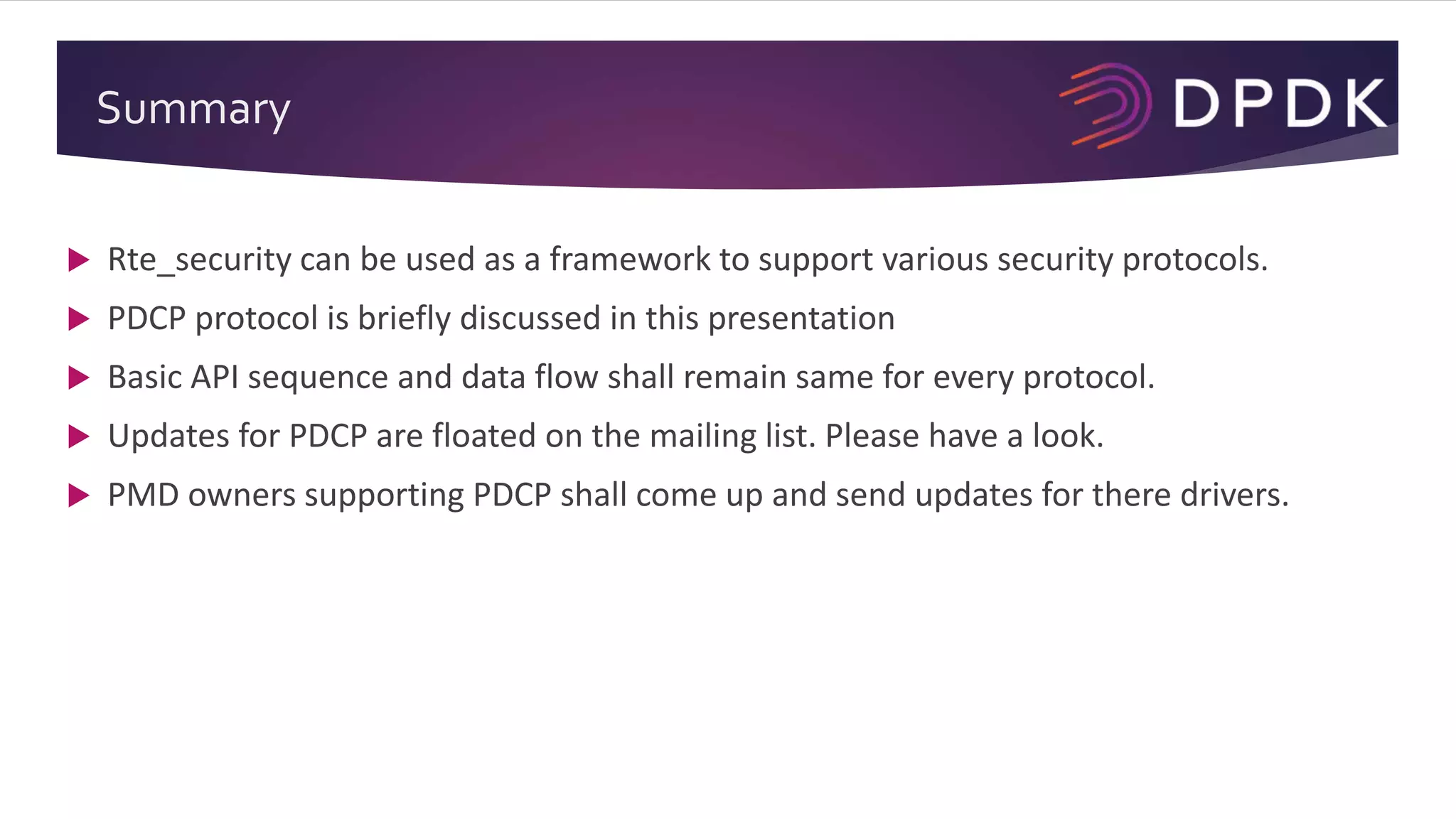
Summary
 Rte_security can be used as a framework to support various security protocols.
 PDCP protocol is briefly discussed in this presentation
 Basic API sequence and data flow shall remain same for every protocol.
 Updates for PDCP are floated on the mailing list. Please have a look.
 PMD owners supporting PDCP shall come up and send updates for there drivers.
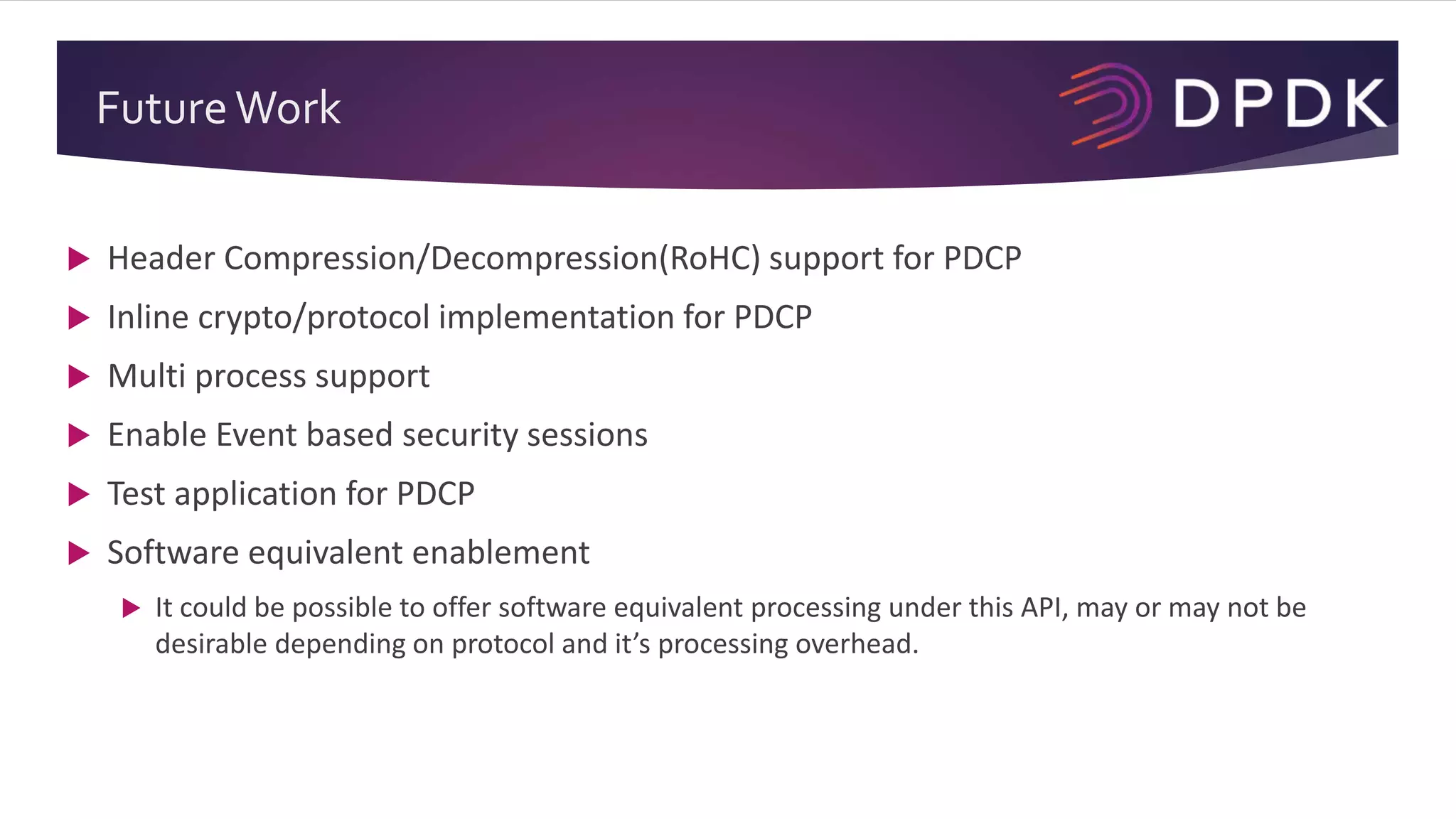
FutureWork
 Header Compression/Decompression(RoHC) support for PDCP
 Inline crypto/protocol implementation for PDCP
 Multi process support
 Enable Event based security sessions
 Test application for PDCP
 Software equivalent enablement
 It could be possible to offer software equivalent processing under this API, may or may not be
desirable depending on protocol and it’s processing overhead.
Questions?
<Akhil Goyal, Hemant Agrawal>
<akhil.goyal@nxp.com,
hemant.agrawal@nxp.com>

Dpdk: rte_security: An update and introducing PDCP

  • 1.
    rte_security: An updateand introducing PDCP Akhil Goyal (NXP) Hemant Agrawal (NXP) DPDK Summit – Dublin- 2018
  • 2.
    Agenda  Rte_security –A brief recap  PDCP - Introduction  Rte_security – Updates for PDCP  Protocol Error Handling  Q&A
  • 3.
  • 4.
    rte_security – Abrief recap  Framework for management and provisioning of hardware acceleration of security protocols.  Generic APIs to manage security sessions.  Net/Crypto device PMD initializes a security context which is used to access security operations on that particular device.  Rich capabilities discovery APIs  Currently IP Security (IPsec) protocol is supported.  Could support a wide variety of protocols/applications  Enterprise/SMB VPNs — IPsec  Wireless backhaul — IPsec, PDCP  Data-center — SSL  WLAN backhaul — CAPWAP/DTLS  Control-plane options for above — PKCS, RNG Net PMD Security Library Crypto PMD
  • 5.
    A multi-deviceAPI (ObjectModel) <<Interface>> rte_cryptodev APIs rte_device cryptodev_ops rte_cryptodev - device - ops <<Interface>> rte_security APIs <<Interface>> rte_ethdev APIs rte_security_context - device - ops security_ops rte_device eth_dev_ops rte_ethdev - device - ops security_ops rte_security_context - device - ops
  • 6.
    Protocols and actions Select the session Protocol: “rte_security_session_protocol”  IPSEC, MACSEC, SSL, PDCP etc.  Select the Security Action Type: “rte_security_session_action_type”  RTE_SECURITY_ACTION_TYPE_INLINE_CRYPTO: Inline crypto processing as NIC offload during recv/transmit.  RTE_SECURITY_ACTION_TYPE_INLINE_PROTOCOL: Inline security protocol processing as NIC offload during recv/transmit.  RTE_SECURITY_ACTION_TYPE_LOOKASIDE_PROTOCOL: Security protocol processing including crypto on a crypto accelerator.  Action type can be an input for the given application during session creation  Based on the action type and other session related information, application configures session parameters for security offload.
  • 7.
    IPSEC - EncryptPacket Processing Packet Received Flow and SPD/SA Lookup Pre-Protocol Processing • Sequence Number • Random IV generation • Block Cipher Padding • Tunnel Header Preparations (TOS/ECN/DF etc) Crypto Processing • Encryption • Authentication Post-Protocol Processing IP Header Addition L2 process and transmission
  • 8.
    Security APIs /* Securitycontext for crypto/eth devices */ struct rte_security_ctx { void *device; /**< Crypto/ethernet device attached */ const struct rte_security_ops *ops; /**< Pointer to security ops for the device */ uint16_t sess_cnt; /**< Number of sessions attached to this context */ }; /** security session configuration parameters */ struct rte_security_session_conf config = { .action_type = RTE_SECURITY_ACTION_TYPE_INLINE_CRYPTO, /**< Type of action to be performed on the session */ .protocol = RTE_SECURITY_PROTOCOL_IPSEC, /**< Security protocol to be configured */ .ipsec = { .spi = /**< Security Protocol Index */, .salt = /** Salt value */, .direction = RTE_SECURITY_IPSEC_SA_DIR_INGRESS, .proto = RTE_SECURITY_IPSEC_SA_PROTO_ESP, .mode = RTE_SECURITY_IPSEC_SA_MODE_TUNNEL }, /**< Configuration parameters for security session */ .crypto_xform = /** crypto transforms */ /**< Security Session Crypto Transformations */ .userdata = /** Application specific User data */ };  Get device context void *rte_cryptodev_get_sec_ctx(uint8_t dev_id) void *rte_eth_dev_get_sec_ctx(uint8_t port_id)  Create Session struct rte_security_session * rte_security_session_create( struct rte_security_ctx *instance, struct rte_security_session_conf *conf, struct rte_mempool *mp);  Update (rte_security_session_update)  Destroy (rte_security_session_destroy)  Get Stats (rte_security_session_stats_get)  Get userdata (rte_security_get_userdata)  Set pkt metadata (rte_security_set_pkt_metadata)  Attach session with crypto_op (rte_security_attach_session)
  • 9.
    PDCP Packet DataConvergence Protocol
  • 10.
    PDCP- Features  Transferof Data (C-Plane and U-Plane) between RLC and Higher U-Plane interface  Maintenance of PDCP SN(Sequence Number)  Transfer of SN Status (for use Upon Handover)  ROHC (Robust Header Compression)  In-Sequence delivery of Upper Layer PDUs at re-establishment of lower layer  Elimination of duplicate of lower layer SDUs at re-establishment of lower layer for RLC AM  Ciphering and Deciphering of C-Plane and U-Plane data  Integrity Protection and Integrity verification of C-Plane Data  Timer based Discard  Duplicate Discard
  • 11.
    Where PDCP fitsin LTE Radio Protocol stack??
  • 12.
    PDCP sublayer functionalview Radio Interface (Uu) UE/E-UTRAN E-UTRAN/UE Transmitting PDCP entity Ciphering Header Compression (u-plane only) Receiving PDCP entity Sequence numbering Integrity Protection (c-plane only) Add PDCP header Header Decompression (u- plane only) Deciphering Remove PDCP Header In order delivery and duplicate detection (u-plane only) Integrity Verification (c-plane only) Packets associated to a PDCP SDU Packets associated to a PDCP SDU Packetsnot associatedtoa PDCPSDU Packetsnot associatedtoa PDCPSDU
  • 13.
    Integrity protection andverification  Pure computation function to protect transmitted data against a non-authorised third-party from alteration.  Applies on header and data part of SRB1 and SRB2 PDU in CP.  Security Control Information Element “IntegrityProtAlgorithm ” of RRC contain 4 bit field:  ‘0001’ – SNOW 3G based algorithm (128-EIA1)  ‘0010’ – AES based algorithm (128-EIA2) EIAKEY MAC -ISender COUNT DIRECTION MESSAGE BEARER-ID EIA XMAC -I COUNT DIRECTION MESSAGE BEARER-ID KEY Receiver
  • 14.
    Ciphering and Deciphering CP: Ciphers/deciphers data part and MAC-I of PDCP data PDU.  UP: Ciphers/deciphers data part of PDCP data PDU.  Algorithm common for CP and UP  Security Control Information Element “CipheringAlgorithm ”of RRC contain 4 bit field:  ‘0000’ – no ciphering (EPS Encryption Algo, EEA0)  ‘0001’ – SNOW 3G based algorithm (128-EEA1)  ‘0010’ – AES based algorithm (128-EEA2) PLAINTEXT BLOCK EEA COUNT DIRECTION BEARER LENGTH KEY KEYSTREAM BLOCK CIPHERTEXT BLOCK EEA COUNT DIRECTION BEARER LENGTH KEY KEYSTREAM BLOCK PLAINTEXT BLOCK Sender Receiver
  • 15.
    Header compression/decompression  Applieson U-plane PDCP SDU using RoHC framework  Compression principles used:  Remove redundancy between header field values within packets.  Remove redundancy between consecutive packets belonging to same flow.  Generates two types of output data:  Compressed packets, each associated with one PDCP SDU.  Standalone interspersed packets, ROHC feedback packet, not associated with a PDCP SDU
  • 16.
    PDCP sequence numberoptions  Depending on the type of packet, different Sequence numbers are chosen.  Control plane PDCP Data PDU (5 Bits)  User plane PDCP Data PDU with long PDCP SN (12 bits)  User plane PDCP Data PDU with short PDCP SN (7 bits)  User plane PDCP Data PDU with extended PDCP SN (15 bits)
  • 17.
    PDCP – Basic/ Complicated  PDCP can do ciphering, integrity, header compression.  But it may have certain messages which do not require any ciphering, integrity, header compression.  It can be as simple as null – cipher, null – auth, no header compression  It can be as complicated as cipher (with ZUC, snow-3g) and auth (with AES-CMAC, ZUC etc)  PDCP has evolved from basic Release 8 to complicated Release 13 of 3GPP. Current proposal for rte_security is for supporting cipher and auth operations with PDCP header(lookaside)
  • 18.
  • 19.
    rte_security – Updatefor PDCP  Create PDCP security session using rte_security_session_create() with updated session configuration as follows: struct rte_security_session_conf { enum rte_security_session_action_type action_type; /**< Type of action to be performed on the session */ enum rte_security_session_protocol protocol; /**< Security protocol to be configured */ RTE_STD_C11 union { struct rte_security_ipsec_xform ipsec; /**< IPSec specific configurations */ struct rte_security_macsec_xform macsec; /**< macsec Specific configurations */ struct rte_security_pdcp_xform pdcp; /**< PDCP specific configurations */ }; /**< Configuration parameters for security session */ struct rte_crypto_sym_xform *crypto_xform; /**< Security Session Crypto Transformations */ void *userdata; /**< Application specific userdata to be saved with session */ };  Here protocol should be RTE_SECURITY_PROTOCOL_PDCP.
  • 20.
    PDCP Configuration /** * PDCPsecurity association configuration data. * * This structure contains data required to create a PDCP security session. */ struct rte_security_pdcp_xform { int8_t bearer; /**< PDCP bearer ID */ enum rte_security_pdcp_domain domain; /** < PDCP mode of operation: Control or data */ enum rte_security_pdcp_direction pkt_dir; /**< PDCP Frame Direction 0:UL 1:DL */ enum rte_security_pdcp_sn_size sn_size; /**< Sequence number size, 5/7/12/15 */ int8_t hfn_ovd; /**< Overwrite HFN per operation 0:disable,1:enable */ uint32_t hfn; /**< Hyper Frame Number */ uint32_t hfn_threshold; /**< HFN Threshold for key renegotiation */ };
  • 21.
    PDCP Capabilities Example {/* PDCP Lookaside Protocol offload Data Plane */ .action = RTE_SECURITY_ACTION_TYPE_LOOKASIDE_PROTOCOL, .protocol = RTE_SECURITY_PROTOCOL_PDCP, .pdcp = { .domain = RTE_SECURITY_PDCP_MODE_DATA, }, .crypto_capabilities = pdcp_capabilities }, { /* PDCP Lookaside Protocol offload Control Plane */ .action = RTE_SECURITY_ACTION_TYPE_LOOKASIDE_PROTOCOL, .protocol = RTE_SECURITY_PROTOCOL_PDCP, .pdcp = { .domain = RTE_SECURITY_PDCP_MODE_CONTROL, }, .crypto_capabilities = pdcp_capabilities }, static const struct rte_cryptodev_capabilities pdcp_capabilities[] = { { /* SNOW 3G (UIA2) */ .op = RTE_CRYPTO_OP_TYPE_SYMMETRIC, {.sym = { .xform_type = RTE_CRYPTO_SYM_XFORM_AUTH, {.auth = { .algo = RTE_CRYPTO_AUTH_SNOW3G_UIA2, .block_size = 16, .key_size = { .min = 16, .max = 16, .increment = 0 }, .digest_size = { .min = 4, .max = 4, .increment = 0 }, .iv_size = { .min = 16, .max = 16, .increment = 0 } }, } }, } }, }
  • 22.
  • 23.
    rte_security – Errorhandling  Handling for protocol errors  Anti-replay errors, Sequence number overflow errors  For inline protocol – rte_eth_events can be used to pass error information to the application  For look-aside – Crypto errors can be extended for security errors in rte_crypto_op_status
  • 24.
    Summary  Rte_security canbe used as a framework to support various security protocols.  PDCP protocol is briefly discussed in this presentation  Basic API sequence and data flow shall remain same for every protocol.  Updates for PDCP are floated on the mailing list. Please have a look.  PMD owners supporting PDCP shall come up and send updates for there drivers.
  • 25.
    FutureWork  Header Compression/Decompression(RoHC)support for PDCP  Inline crypto/protocol implementation for PDCP  Multi process support  Enable Event based security sessions  Test application for PDCP  Software equivalent enablement  It could be possible to offer software equivalent processing under this API, may or may not be desirable depending on protocol and it’s processing overhead.
  • 26.
    Questions? <Akhil Goyal, HemantAgrawal> <akhil.goyal@nxp.com, hemant.agrawal@nxp.com>

Editor's Notes