3
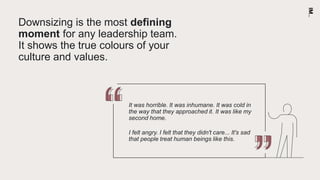
It was horrible. It was inhumane. It was cold in
the way that they approached it. It was like my
second home.
I felt angry. I felt that they didn't care... It's sad
that people treat human beings like this.
Downsizing is the most defining
moment for any leadership team.
It shows the true colours of your
culture and values.
7
To avoid conflicts,
we tend to make quick
short-term decisions
without considering
the long-term
consequences.
What seems logical
to you might not
be logical to your
organisation.
9
CULTURAL ACT
NEGLECTED EXERCISE
MINDSET GAP
10
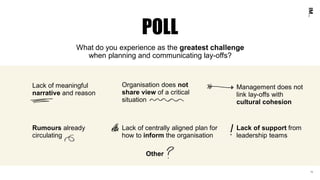
What do you experience as the greatest challenge
when planning and communicating lay-offs?
Lack of centrally aligned plan for
how to inform the organisation
Rumours already
circulating
Organisation does not
share view of a critical
situation
Lack of meaningful
narrative and reason
Management does not
link lay-offs with
cultural cohesion
Lack of support from
leadership teams
POLL
10
Other
11
Be a part of the conversation. Accept anxiety but plan thoroughly
to keep it to a minimum throughout the phases
TIME
BEFORE DURING AFTER
ANXIETY
What’s
next?
Who’s
next?
Who will
it be?
Are they
planning to lay
off people?
12
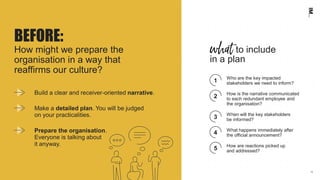
BEFORE:
How might we prepare the
organisation in a way that
reaffirms our culture?
1 Who are the key impacted
stakeholders we need to inform?
2 How is the narrative communicated
to each redundant employee and
the organisation?
3 When will the key stakeholders
be informed?
4 What happens immediately after
the official announcement?
5 How are reactions picked up
and addressed?
Make a detailed plan. You will be judged
on your practicalities.
Prepare the organisation.
Everyone is talking about
it anyway.
Build a clear and receiver-oriented narrative.
to include
in a plan
13
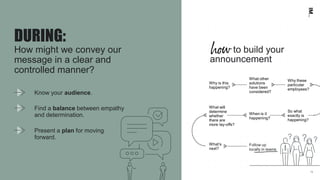
DURING:
How might we convey our
message in a clear and
controlled manner?
Find a balance between empathy
and determination.
Present a plan for moving
forward.
Know your audience.
to build your
announcement
When is it
happening?
What other
solutions
have been
considered?
What’s
next?
Why these
particular
employees?
So what
exactly is
happening?
Why is this
happening?
What will
determine
whether
there are
more lay-offs?
Follow up
locally in teams
14
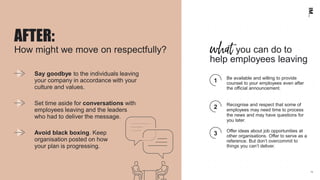
AFTER:
How might we move on respectfully? you can do to
help employees leaving
Set time aside for conversations with
employees leaving and the leaders
who had to deliver the message.
Avoid black boxing. Keep
organisation posted on how
your plan is progressing.
Say goodbye to the individuals leaving
your company in accordance with your
culture and values.
1 Be available and willing to provide
counsel to your employees even after
the official announcement.
2 Recognise and respect that some of
employees may need time to process
the news and may have questions for
you later.
3 Offer ideas about job opportunities at
other organisations. Offer to serve as a
reference. But don’t overcommit to
things you can’t deliver.
15
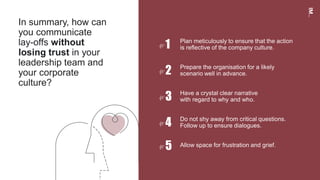
Plan meticulously to ensure that the action
is reflective of the company culture.
Prepare the organisation for a likely
scenario well in advance.
Have a crystal clear narrative
with regard to why and who.
Do not shy away from critical questions.
Follow up to ensure dialogues.
Allow space for frustration and grief.
1
2
3
4
5
In summary, how can
you communicate
lay-offs without
losing trust in your
leadership team and
your corporate
culture?
17
implementconsultinggroup.com/clearcommunication

Downsizing without losing trust

  • 1.
  • 2.
    It was horrible.It was inhumane. It was cold in the way that they approached it. It was like my second home. I felt angry. I felt that they didn't care... It's sad that people treat human beings like this. Downsizing is the most defining moment for any leadership team. It shows the true colours of your culture and values.
  • 3.
    7 To avoid conflicts, wetend to make quick short-term decisions without considering the long-term consequences.
  • 4.
    What seems logical toyou might not be logical to your organisation.
  • 5.
  • 6.
    10 What do youexperience as the greatest challenge when planning and communicating lay-offs? Lack of centrally aligned plan for how to inform the organisation Rumours already circulating Organisation does not share view of a critical situation Lack of meaningful narrative and reason Management does not link lay-offs with cultural cohesion Lack of support from leadership teams POLL 10 Other
  • 7.
    11 Be a partof the conversation. Accept anxiety but plan thoroughly to keep it to a minimum throughout the phases TIME BEFORE DURING AFTER ANXIETY What’s next? Who’s next? Who will it be? Are they planning to lay off people?
  • 8.
    12 BEFORE: How might weprepare the organisation in a way that reaffirms our culture? 1 Who are the key impacted stakeholders we need to inform? 2 How is the narrative communicated to each redundant employee and the organisation? 3 When will the key stakeholders be informed? 4 What happens immediately after the official announcement? 5 How are reactions picked up and addressed? Make a detailed plan. You will be judged on your practicalities. Prepare the organisation. Everyone is talking about it anyway. Build a clear and receiver-oriented narrative. to include in a plan
  • 9.
    13 DURING: How might weconvey our message in a clear and controlled manner? Find a balance between empathy and determination. Present a plan for moving forward. Know your audience. to build your announcement When is it happening? What other solutions have been considered? What’s next? Why these particular employees? So what exactly is happening? Why is this happening? What will determine whether there are more lay-offs? Follow up locally in teams
  • 10.
    14 AFTER: How might wemove on respectfully? you can do to help employees leaving Set time aside for conversations with employees leaving and the leaders who had to deliver the message. Avoid black boxing. Keep organisation posted on how your plan is progressing. Say goodbye to the individuals leaving your company in accordance with your culture and values. 1 Be available and willing to provide counsel to your employees even after the official announcement. 2 Recognise and respect that some of employees may need time to process the news and may have questions for you later. 3 Offer ideas about job opportunities at other organisations. Offer to serve as a reference. But don’t overcommit to things you can’t deliver.
  • 11.
    15 Plan meticulously toensure that the action is reflective of the company culture. Prepare the organisation for a likely scenario well in advance. Have a crystal clear narrative with regard to why and who. Do not shy away from critical questions. Follow up to ensure dialogues. Allow space for frustration and grief. 1 2 3 4 5 In summary, how can you communicate lay-offs without losing trust in your leadership team and your corporate culture?
  • 12.