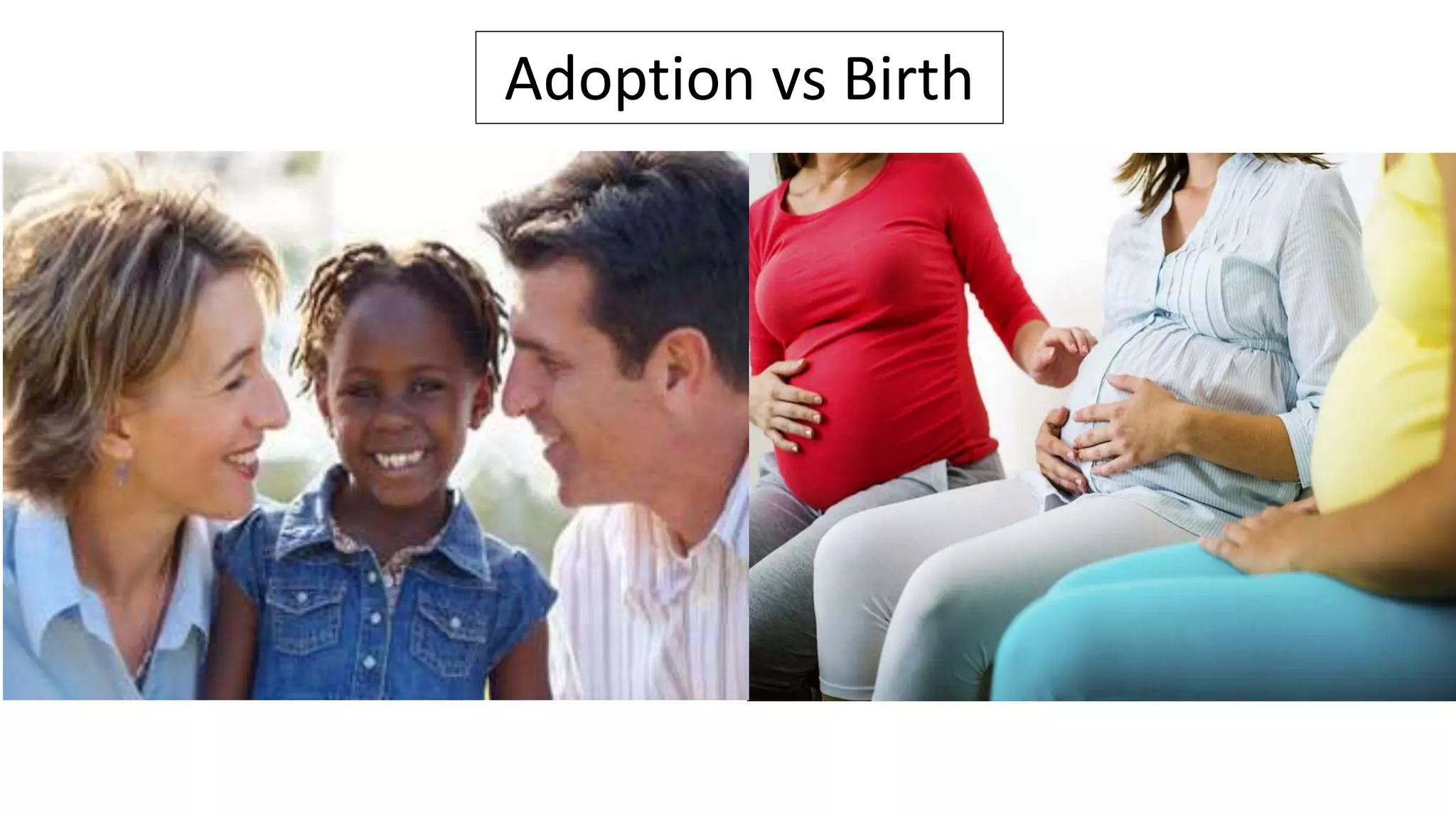
Adoption vs Birth
When planning a family, most people think of doing so
by procreation.
Conceiving a child biologically is a thrilling and life
changing experience, however, there are means of
creating a family that are not the typical method of
conception and birth.
Adoption is another wonderful option that can be
both very similar and very different from the
experience of having a child biologically.
"According to the most recent
federal data, there are currently
more than 400,000 children in
foster care in the United States."
(adoptuskids.org)
"Of the 400,000 children in foster
care, more than 100,000 of them
are waiting to be adopted."
(adoptuskids.org)
Deciding to start a family is one of
the biggest and most important
decisions a person can make.
It is important to know the
different options in order to
decide what is best for each
family.
The excitement in
meeting your child for
the first time.
The feeling of finally
bringing your child to
their new home.
Shopping and planning
for your child.
SIMILARITIES
Both adopting and
having a child
biologically are
expensive.
Both methods have
similar stressors.
Both adopting and
having a child
biologically are
extremely rewarding.
SIMILARITIES
"Intercountry adoption fees
differ widely from country
to country.
Costs tend to be higher than
for domestic adoptions
because they may include
foreign travel
and immigration processing
in addition to court costs,
mandatory adoption
education for prospective
adoptive parents, and
related documentation.
Average costs may run
between $20,000 and
$50,000."
(childwelfare.gov)
"On average, U.S. hospital deliveries
cost $3,500 per stay, according to the
Agency for Healthcare Research and
Quality Healthcare Cost and Utilization
Project.
Add in prenatal, delivery-related and
post-partum healthcare, and you're
looking at an $8,802 tab, according to a
Thomson Healthcare study for March of
Dimes."
(parents.com)
DIFFERENCES
• The experiences: When having a child
biologically, there is the experience of the
positive pregnancy test, seeing the baby through
ultrasound, experiencing or witnessing a change
in the mother's body as the baby grows, and
feeling tiny baby kicks. All of these things are not
necessarily an option with adoption.
• When adopting, the baby does not have your
genetics​ which may be bothersome for some
parents.
• If adopting through foster care, your child may
have behavioral, emotional, or mental issues
from a troubled past.
DIFFERENCES
• Being pregnant and giving birth to a
child requires frequent doctor visits. They
are even more frequent if the pregnancy
is complicated or considered high risk.
• There is less paperwork when having a
child biologically. Adoption is a long
process that can take several years. With
this comes a lot of paperwork and a lot of
waiting, often more than the 9 month
gestational period.
• With the adoption process, you have a
choice in the age of child you adopt. If
changing diapers or dealing with a cranky
toddler does not sound appealing to you,
you can choose to adopt an older child.
In conclusion,
whether to have a child biologically or to adopt is a matter of personal
choice and resources.
They both have their similarities, differences, and pros and cons.
It is important to weigh the options and consider them thoroughly
when deciding what option is best for your family.
WORKS CITED
"What to Expect: Hospital Birth Costs." Parents, 2011,
https://www.parents.com/pregnancy/considering-
baby/financing-family/what-to-expect-hospital-birth-
costs/. Accessed 10 May 2018.
"About the Children." Adopt US Kids,
https://www.adoptuskids.org/meet-the-
children/children-in-foster-care/about-the-children.
Accessed 10 May 2018.
"Planning for Adoption: Knowing the Costs and
Resources." Parents, 2011,
https://www.childwelfare.gov/pubpdfs/s_costs.pdf.
Accessed 10 May 2018.

Dowell PowerPoint Presentation

  • 1.
  • 2.
    When planning afamily, most people think of doing so by procreation. Conceiving a child biologically is a thrilling and life changing experience, however, there are means of creating a family that are not the typical method of conception and birth. Adoption is another wonderful option that can be both very similar and very different from the experience of having a child biologically.
  • 3.
    "According to themost recent federal data, there are currently more than 400,000 children in foster care in the United States." (adoptuskids.org) "Of the 400,000 children in foster care, more than 100,000 of them are waiting to be adopted." (adoptuskids.org)
  • 4.
    Deciding to starta family is one of the biggest and most important decisions a person can make. It is important to know the different options in order to decide what is best for each family.
  • 5.
    The excitement in meetingyour child for the first time. The feeling of finally bringing your child to their new home. Shopping and planning for your child. SIMILARITIES
  • 6.
    Both adopting and havinga child biologically are expensive. Both methods have similar stressors. Both adopting and having a child biologically are extremely rewarding. SIMILARITIES "Intercountry adoption fees differ widely from country to country. Costs tend to be higher than for domestic adoptions because they may include foreign travel and immigration processing in addition to court costs, mandatory adoption education for prospective adoptive parents, and related documentation. Average costs may run between $20,000 and $50,000." (childwelfare.gov) "On average, U.S. hospital deliveries cost $3,500 per stay, according to the Agency for Healthcare Research and Quality Healthcare Cost and Utilization Project. Add in prenatal, delivery-related and post-partum healthcare, and you're looking at an $8,802 tab, according to a Thomson Healthcare study for March of Dimes." (parents.com)
  • 7.
    DIFFERENCES • The experiences:When having a child biologically, there is the experience of the positive pregnancy test, seeing the baby through ultrasound, experiencing or witnessing a change in the mother's body as the baby grows, and feeling tiny baby kicks. All of these things are not necessarily an option with adoption. • When adopting, the baby does not have your genetics​ which may be bothersome for some parents. • If adopting through foster care, your child may have behavioral, emotional, or mental issues from a troubled past.
  • 8.
    DIFFERENCES • Being pregnantand giving birth to a child requires frequent doctor visits. They are even more frequent if the pregnancy is complicated or considered high risk. • There is less paperwork when having a child biologically. Adoption is a long process that can take several years. With this comes a lot of paperwork and a lot of waiting, often more than the 9 month gestational period. • With the adoption process, you have a choice in the age of child you adopt. If changing diapers or dealing with a cranky toddler does not sound appealing to you, you can choose to adopt an older child.
  • 9.
    In conclusion, whether tohave a child biologically or to adopt is a matter of personal choice and resources. They both have their similarities, differences, and pros and cons. It is important to weigh the options and consider them thoroughly when deciding what option is best for your family.
  • 10.
    WORKS CITED "What toExpect: Hospital Birth Costs." Parents, 2011, https://www.parents.com/pregnancy/considering- baby/financing-family/what-to-expect-hospital-birth- costs/. Accessed 10 May 2018. "About the Children." Adopt US Kids, https://www.adoptuskids.org/meet-the- children/children-in-foster-care/about-the-children. Accessed 10 May 2018. "Planning for Adoption: Knowing the Costs and Resources." Parents, 2011, https://www.childwelfare.gov/pubpdfs/s_costs.pdf. Accessed 10 May 2018.