Managing a Heterogeneous BI Landscape 
Douglas R. Briggs 
Director, Business Intelligence 
Washington University in St. Louis
Who am I? 
• Education: 
– BA, Williams College (go Ephs!) 
– MS, University of Illinois at Urbana-Champaign 
• Business: 
– Director of Business Intelligence at Washington University 
– 14+ years at Anheuser-Busch Inbev, managing BI and Data 
Warehouse support, development, and architecture 
– Managing Editor of Data Hub Australia ( 
http://datatalent.com.au/datahub-australia) 
– Advise companies throughout the Midwest on BI & DW matters
The place I love to work 
• Washington University is: 
– Not The University of Washington 
– Not George Washington University 
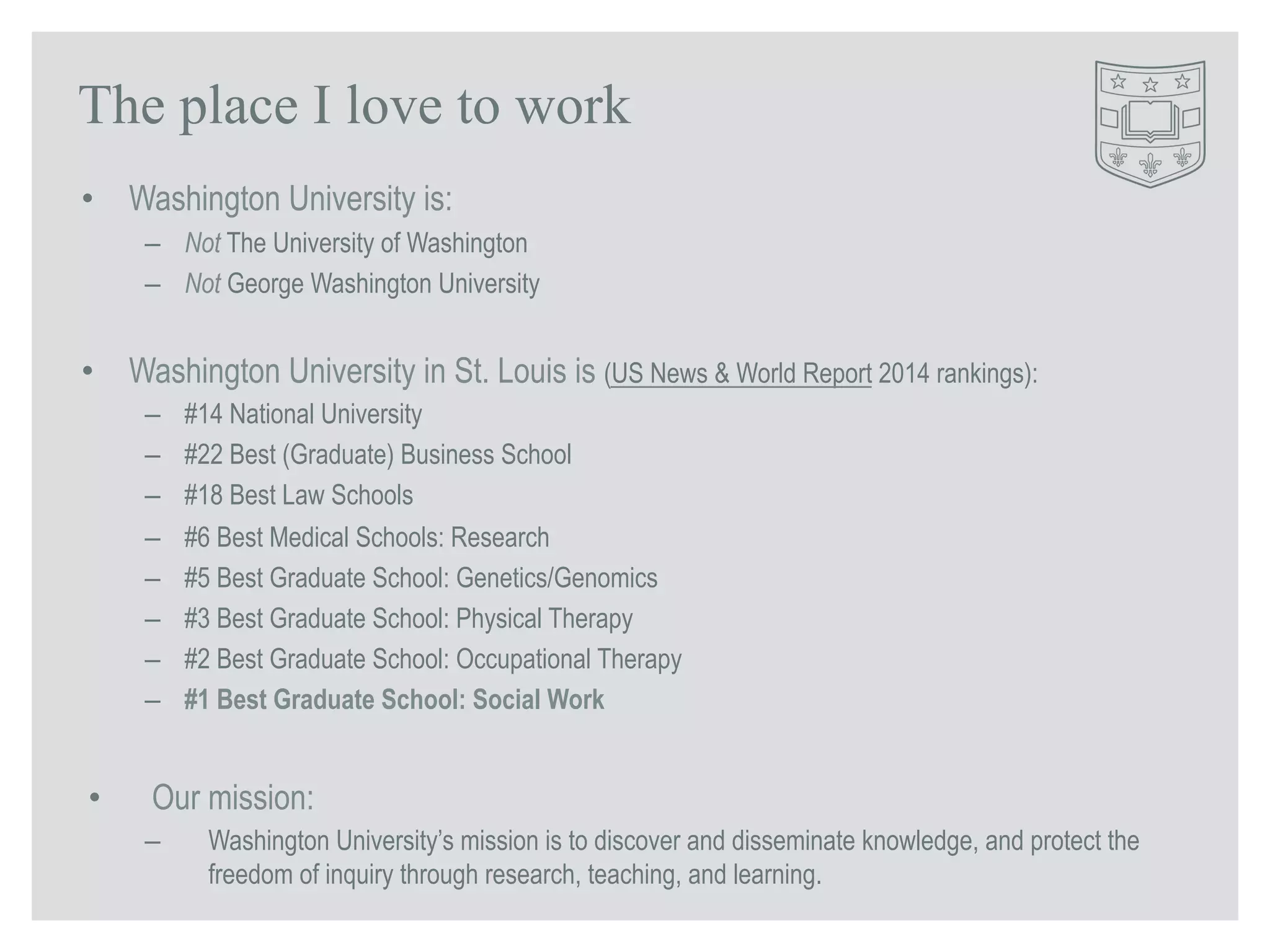
• Washington University in St. Louis is (US News & World Report 2014 rankings): 
– #14 National University 
– #22 Best (Graduate) Business School 
– #18 Best Law Schools 
– #6 Best Medical Schools: Research 
– #5 Best Graduate School: Genetics/Genomics 
– #3 Best Graduate School: Physical Therapy 
– #2 Best Graduate School: Occupational Therapy 
– #1 Best Graduate School: Social Work 
• Our mission: 
– Washington University’s mission is to discover and disseminate knowledge, and protect the 
freedom of inquiry through research, teaching, and learning.
… but enough about me, let’s talk about data …
Background and Ancient History 
• BI used to be done “inside the house” 
• As cloud became more viable, more vendors supporting it, 
more stuff went into the cloud, including BI! 
• Some companies rushed into the cloud, resulting in 
– Failure to deliver ROI 
– Failure to satisfy user expectations 
– Failure to “play nicely” with IT’s other systems 
• Cloud got a tarnished reputation, BI seen as risky for 
moving “out of the house” 
• Now, confusion!
Current State 
• Companies charting a course that accomplishes three 
goals: 
– Plan: create a roadmap to a destination that is reachable given 
the company’s culture, resources, and landscape 
– Deliver: provide safe and robust service where it’s needed 
– Earn: Maximize ROI 
• How do we do this? We need to know: where is BI now, 
and where is it going?
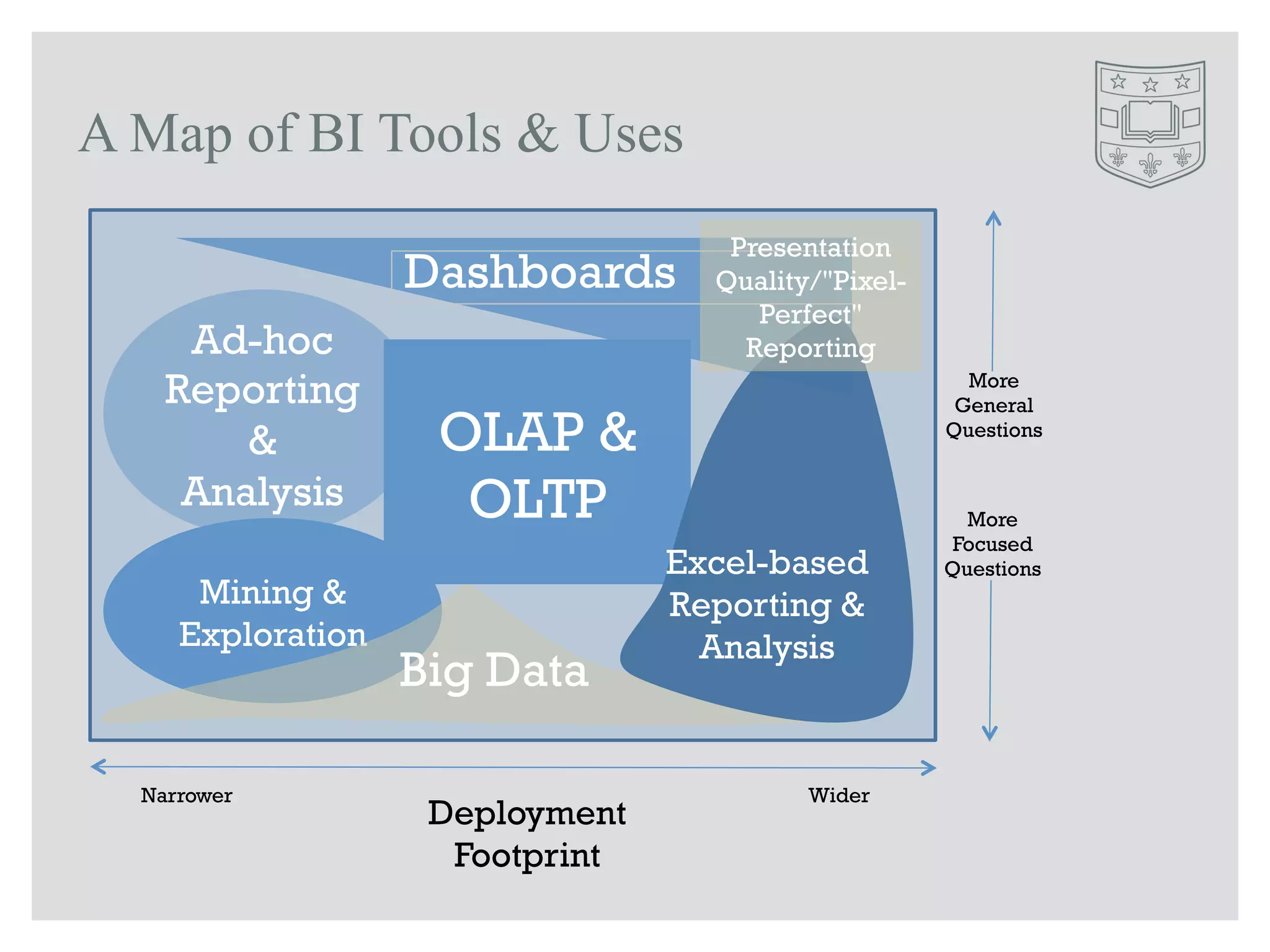
A Map of BI Tools & Uses 
Mining & 
Exploration 
Dashboards 
Big Data 
Ad-hoc 
Reporting 
& 
Analysis 
OLAP & 
OLTP 
Presentation 
Quality/"Pixel- 
Perfect" 
Reporting 
Excel-based 
Reporting & 
Analysis 
Narrower Wider 
More 
General 
Questions 
More 
Focused 
Questions 
Deployment 
Footprint
The Natural Partition 
• Enterprise-wide reporting solutions: 
– High-quality presentation 
– Standardized, repeatable processes 
• Department-wide reporting 
– Intermediate-scope business questions 
– Multiple delivery channels 
– Parameterization, customized look & feel 
• Specialized data tools 
– Data mining, powerful analytics, data discovery 
– Used by enclaves of power users who know the data intimately
Implications 
• Vastly different tools for different audiences! 
• Single tools can be unsuitable for use across the segments 
• You can refocus your landscape on best-in-class solutions 
for each segment 
• Some vendors have multiple products in their suite that 
can work in each segment, but don’t discount niche 
players focused on specialized needs
Your Challenge 
• Remember your goals: 
– Create the viable roadmap that gets you from here to there 
– Deliver the goods 
– Make it pay for itself 
• You need the appropriate segmentation between 
components that provide the best facility and agility 
– Facility = effective feature-set given your institutional needs 
– Agility = robust, extensible solution that meets present and future 
needs
Goals for delivery: safe, robust, accessible 
• Safety means all of these things (and more): 
– Regulatory compliance 
– Data & information protection (including models & algorithms) 
– Business process resumption & disaster recovery 
• Data governance can help facilitate this 
• Credibility is the first casualty if it’s inconsistent or 
unscalable 
• Delivery at the user-interaction endpoint is tailored
Managing the Transformation - Technology 
• Rip-out & Replace: 
– Focus change and time-box the impact 
– Costly, and highest risk for “institutional inertia” to cause delays & 
overruns 
• Phased: 
– Minimize risk and pivot quickly 
– Landscape is constantly in flux 
– Requires thoughtful landscape architecture & effective 
communication to foster credibility!
Managing the Transformation - Organizational 
• Roles: 
– Development & support teams 
– May require changes to staff, retraining, or reorganization of 
leadership 
• Processes: 
– Governance, architecture, & business alignment 
– Grow it over time, especially if you’re phasing in BI components 
– Vendors & integration partners are excellent resources for best-practices
Make it Earn its Keep 
• Find your partners and advocates 
• Select targeted opportunities: 
– Short ROI horizons 
– Cheap investments with outsized returns 
• Handcuff the organization to the results 
– Nothing motivates like skin in the game 
– Vendors too!
Strategies 
• Decouple segment-based solutions from each other 
• Leverage SaaS paradigms selectively 
• Allows departments to build effective point-solutions 
• Your landscape will (probably) become heterogeneous 
organically – that’s okay.
Change is coming … 
The vendor offering landscape is (once again) gravitating 
toward consolidated solutions 
• OLAP à OLTP 
• Increasingly sophisticated, presentation-style graphics to 
merge traditional dashboards and pixel-perfect reporting 
• Hardware acceleration and advanced storage & retrieval is 
allowing traditional data discovery and exploration tools to 
encroach into the Big Data space
Your next steps 
• Understand alignment between your current landscape 
and the segmentation map 
– Talk to your BI architects, they will show you the fit/gap 
– Close gaps with effective tool choices & process changes 
• Develop the strategic plan, but … 
• Make sure you seed the path (especially in the beginning) 
with the projects that meet your goals: 
– Part of a feasible plan 
– Deliver the goods 
– Pay for themselves
Take-aways 
• Natural user & use-case partition à landscape 
segmentation 
• Best-in-class is a more effective strategy than it’s been for 
the past several years 
• Expect some solutions to migrate to SaaS organically 
• Expect tool consolidation to muddy the waters
Questions? 
(I have some answers)
Please keep in touch! 
• My interests and specialties: 
– BI competency centers 
– Data governance 
– BI change management 
• Contact: 
– douglas.briggs@wustl.edu 
– www.linkedin.com/douglasrbriggs
Thank you and good luck!

Douglas Briggs

  • 1.
    Managing a HeterogeneousBI Landscape Douglas R. Briggs Director, Business Intelligence Washington University in St. Louis
  • 2.
    Who am I? • Education: – BA, Williams College (go Ephs!) – MS, University of Illinois at Urbana-Champaign • Business: – Director of Business Intelligence at Washington University – 14+ years at Anheuser-Busch Inbev, managing BI and Data Warehouse support, development, and architecture – Managing Editor of Data Hub Australia ( http://datatalent.com.au/datahub-australia) – Advise companies throughout the Midwest on BI & DW matters
  • 3.
    The place Ilove to work • Washington University is: – Not The University of Washington – Not George Washington University • Washington University in St. Louis is (US News & World Report 2014 rankings): – #14 National University – #22 Best (Graduate) Business School – #18 Best Law Schools – #6 Best Medical Schools: Research – #5 Best Graduate School: Genetics/Genomics – #3 Best Graduate School: Physical Therapy – #2 Best Graduate School: Occupational Therapy – #1 Best Graduate School: Social Work • Our mission: – Washington University’s mission is to discover and disseminate knowledge, and protect the freedom of inquiry through research, teaching, and learning.
  • 4.
    … but enoughabout me, let’s talk about data …
  • 5.
    Background and AncientHistory • BI used to be done “inside the house” • As cloud became more viable, more vendors supporting it, more stuff went into the cloud, including BI! • Some companies rushed into the cloud, resulting in – Failure to deliver ROI – Failure to satisfy user expectations – Failure to “play nicely” with IT’s other systems • Cloud got a tarnished reputation, BI seen as risky for moving “out of the house” • Now, confusion!
  • 6.
    Current State •Companies charting a course that accomplishes three goals: – Plan: create a roadmap to a destination that is reachable given the company’s culture, resources, and landscape – Deliver: provide safe and robust service where it’s needed – Earn: Maximize ROI • How do we do this? We need to know: where is BI now, and where is it going?
  • 7.
    A Map ofBI Tools & Uses Mining & Exploration Dashboards Big Data Ad-hoc Reporting & Analysis OLAP & OLTP Presentation Quality/"Pixel- Perfect" Reporting Excel-based Reporting & Analysis Narrower Wider More General Questions More Focused Questions Deployment Footprint
  • 8.
    The Natural Partition • Enterprise-wide reporting solutions: – High-quality presentation – Standardized, repeatable processes • Department-wide reporting – Intermediate-scope business questions – Multiple delivery channels – Parameterization, customized look & feel • Specialized data tools – Data mining, powerful analytics, data discovery – Used by enclaves of power users who know the data intimately
  • 9.
    Implications • Vastlydifferent tools for different audiences! • Single tools can be unsuitable for use across the segments • You can refocus your landscape on best-in-class solutions for each segment • Some vendors have multiple products in their suite that can work in each segment, but don’t discount niche players focused on specialized needs
  • 10.
    Your Challenge •Remember your goals: – Create the viable roadmap that gets you from here to there – Deliver the goods – Make it pay for itself • You need the appropriate segmentation between components that provide the best facility and agility – Facility = effective feature-set given your institutional needs – Agility = robust, extensible solution that meets present and future needs
  • 11.
    Goals for delivery:safe, robust, accessible • Safety means all of these things (and more): – Regulatory compliance – Data & information protection (including models & algorithms) – Business process resumption & disaster recovery • Data governance can help facilitate this • Credibility is the first casualty if it’s inconsistent or unscalable • Delivery at the user-interaction endpoint is tailored
  • 12.
    Managing the Transformation- Technology • Rip-out & Replace: – Focus change and time-box the impact – Costly, and highest risk for “institutional inertia” to cause delays & overruns • Phased: – Minimize risk and pivot quickly – Landscape is constantly in flux – Requires thoughtful landscape architecture & effective communication to foster credibility!
  • 13.
    Managing the Transformation- Organizational • Roles: – Development & support teams – May require changes to staff, retraining, or reorganization of leadership • Processes: – Governance, architecture, & business alignment – Grow it over time, especially if you’re phasing in BI components – Vendors & integration partners are excellent resources for best-practices
  • 14.
    Make it Earnits Keep • Find your partners and advocates • Select targeted opportunities: – Short ROI horizons – Cheap investments with outsized returns • Handcuff the organization to the results – Nothing motivates like skin in the game – Vendors too!
  • 15.
    Strategies • Decouplesegment-based solutions from each other • Leverage SaaS paradigms selectively • Allows departments to build effective point-solutions • Your landscape will (probably) become heterogeneous organically – that’s okay.
  • 16.
    Change is coming… The vendor offering landscape is (once again) gravitating toward consolidated solutions • OLAP à OLTP • Increasingly sophisticated, presentation-style graphics to merge traditional dashboards and pixel-perfect reporting • Hardware acceleration and advanced storage & retrieval is allowing traditional data discovery and exploration tools to encroach into the Big Data space
  • 17.
    Your next steps • Understand alignment between your current landscape and the segmentation map – Talk to your BI architects, they will show you the fit/gap – Close gaps with effective tool choices & process changes • Develop the strategic plan, but … • Make sure you seed the path (especially in the beginning) with the projects that meet your goals: – Part of a feasible plan – Deliver the goods – Pay for themselves
  • 18.
    Take-aways • Naturaluser & use-case partition à landscape segmentation • Best-in-class is a more effective strategy than it’s been for the past several years • Expect some solutions to migrate to SaaS organically • Expect tool consolidation to muddy the waters
  • 19.
    Questions? (I havesome answers)
  • 20.
    Please keep intouch! • My interests and specialties: – BI competency centers – Data governance – BI change management • Contact: – douglas.briggs@wustl.edu – www.linkedin.com/douglasrbriggs
  • 21.
    Thank you andgood luck!
  • 22.
    Thank you andgood luck!
  • 23.
    Thank you andgood luck!