Lecture 1:

The .NET Architecture
Objectives

    “Microsoft .NET is based on the .NET Framework, which consists of
       two major components: the Common Language Runtime (CLR)
       and an extensive set of Framework Class Libraries (FCL). The
       CLR defines a common programming model and a standard type
       system for cross-platform, multi-language development.”


    •   CLR-based execution
    •   Application designs


Microsoft                                                               2
Part 1

    •   CLR-based execution…


Microsoft                      3
Influences

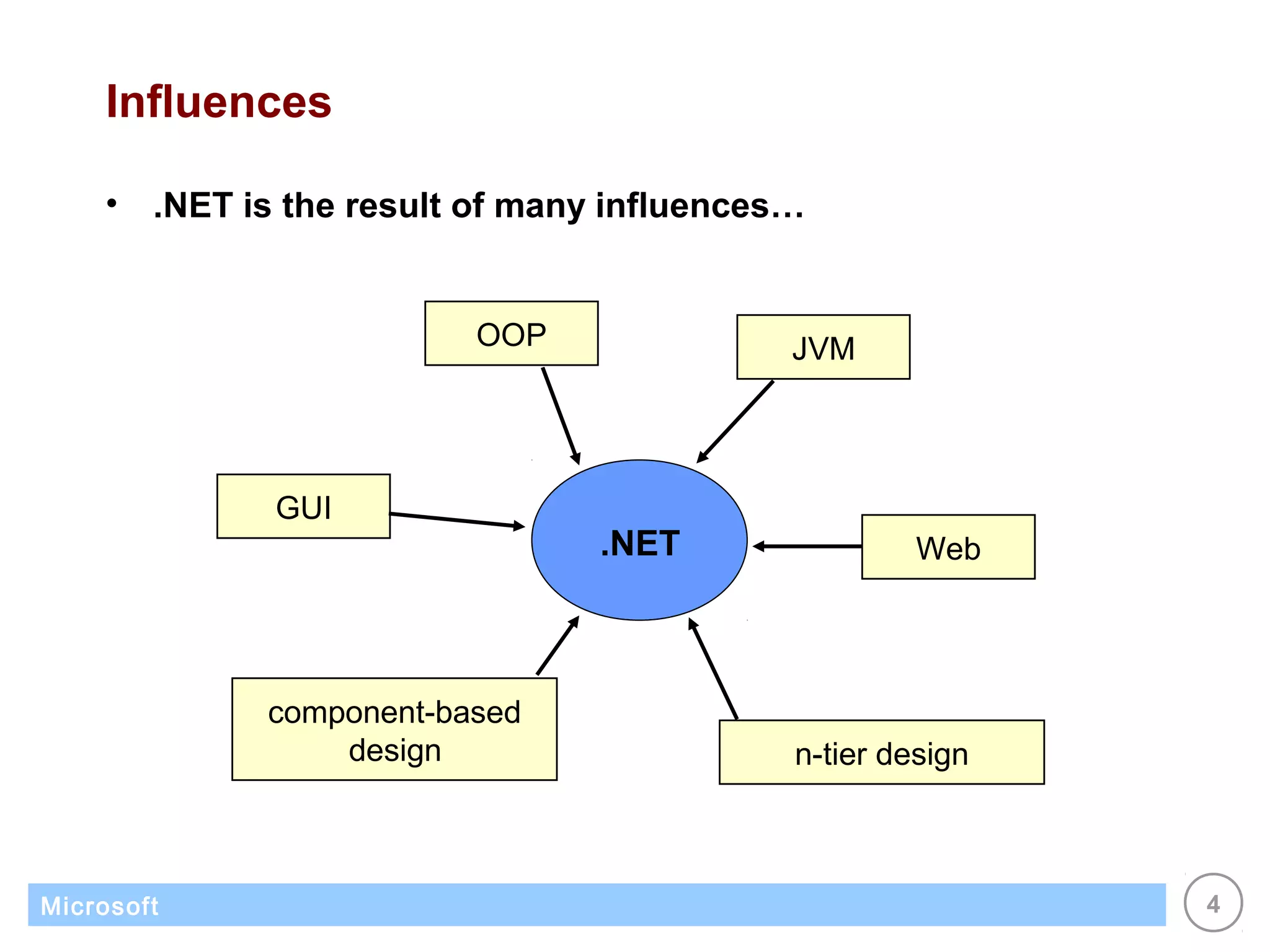
    •   .NET is the result of many influences…


                          OOP                JVM


               GUI
                                  .NET                Web


              component-based
                  design                     n-tier design


Microsoft                                                    4
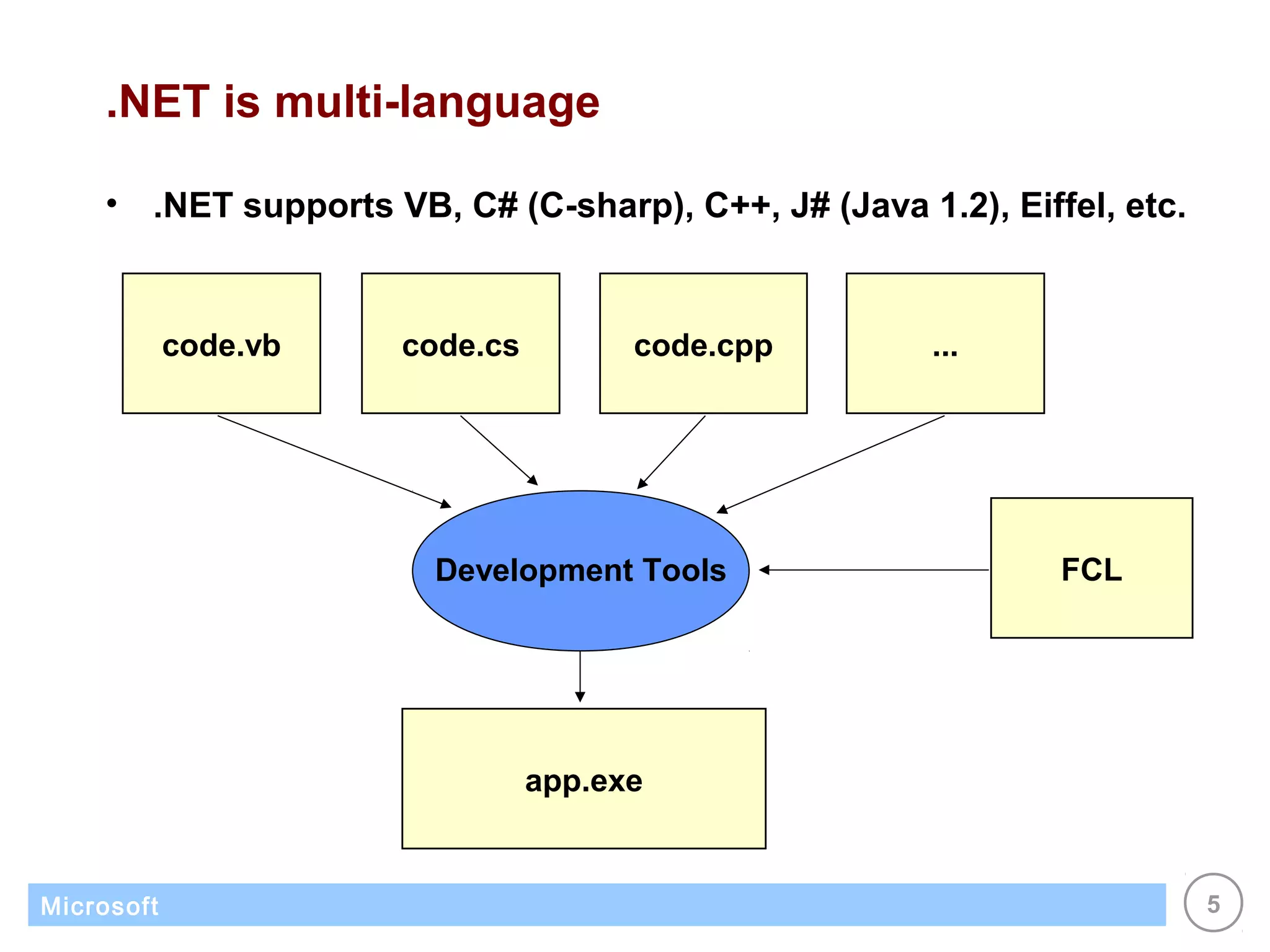
.NET is multi-language

    •   .NET supports VB, C# (C-sharp), C++, J# (Java 1.2), Eiffel, etc.


            code.vb    code.cs         code.cpp         ...


                         Development Tools                      FCL


                                 app.exe


Microsoft                                                                  5
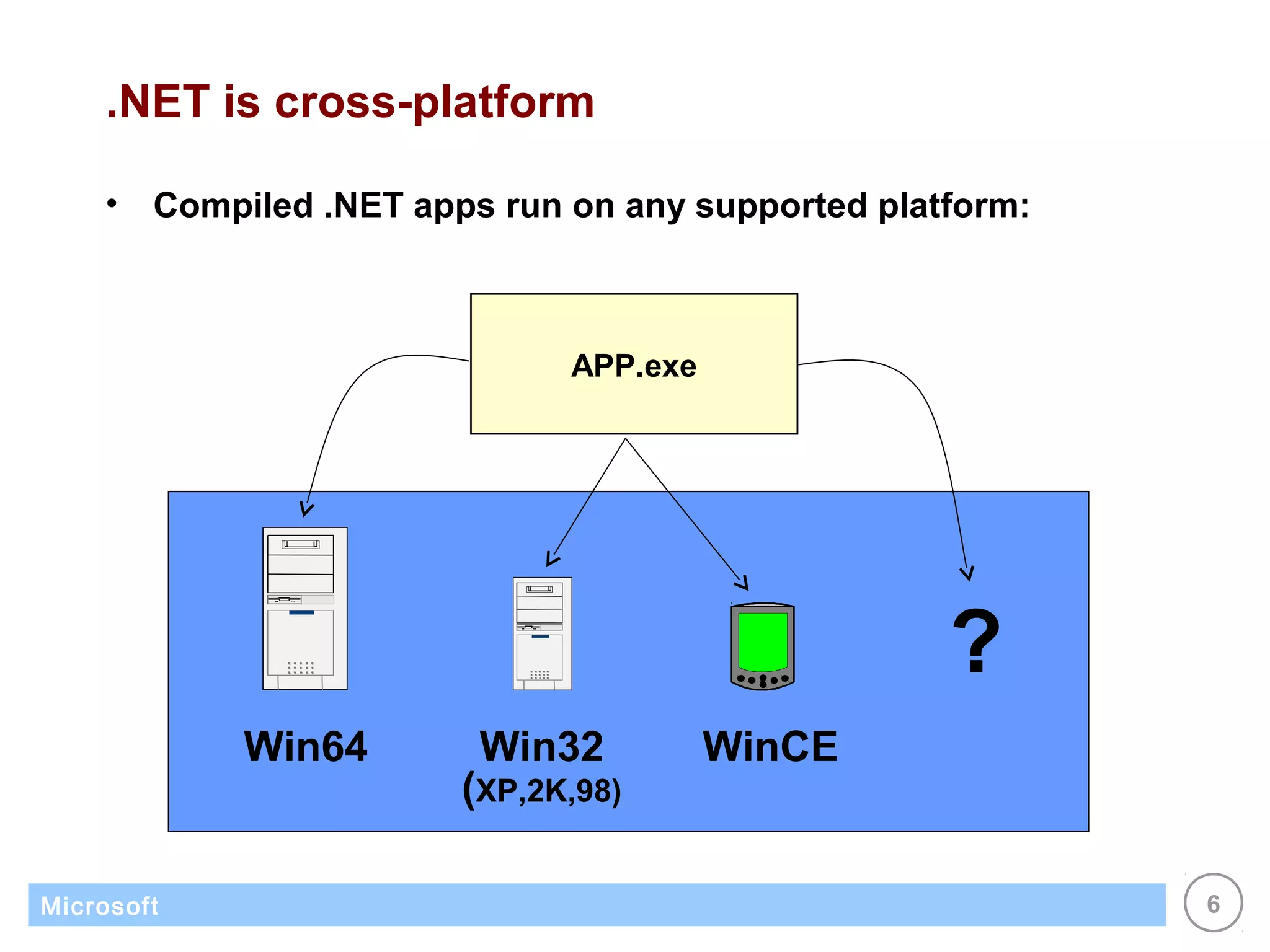
.NET is cross-platform

    •   Compiled .NET apps run on any supported platform:


                               APP.exe


                                                    ?
             Win64        Win32          WinCE
                         (XP,2K,98)

Microsoft                                                   6
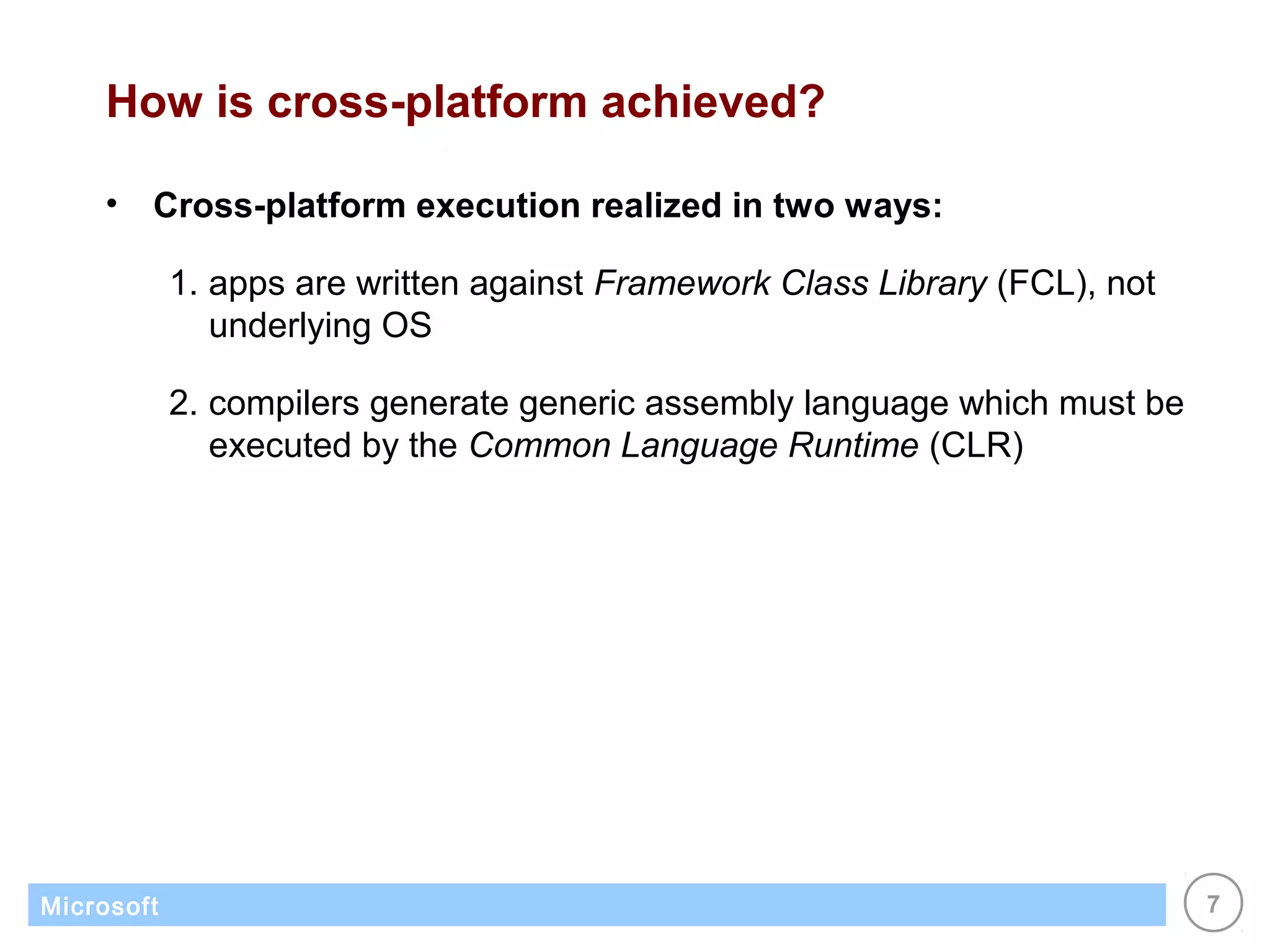
How is cross-platform achieved?

    •   Cross-platform execution realized in two ways:

            1. apps are written against Framework Class Library (FCL), not
               underlying OS

            2. compilers generate generic assembly language which must be
               executed by the Common Language Runtime (CLR)


Microsoft                                                                    7
(1) FCL

    •   Framework Class Library
         – 1000's of predefined classes
         – common subset across all platforms & languages
         – networking, database access, XML processing, GUI, Web, etc.


    •   Goal?
         – FCL is a portable operating system


Microsoft                                                                8
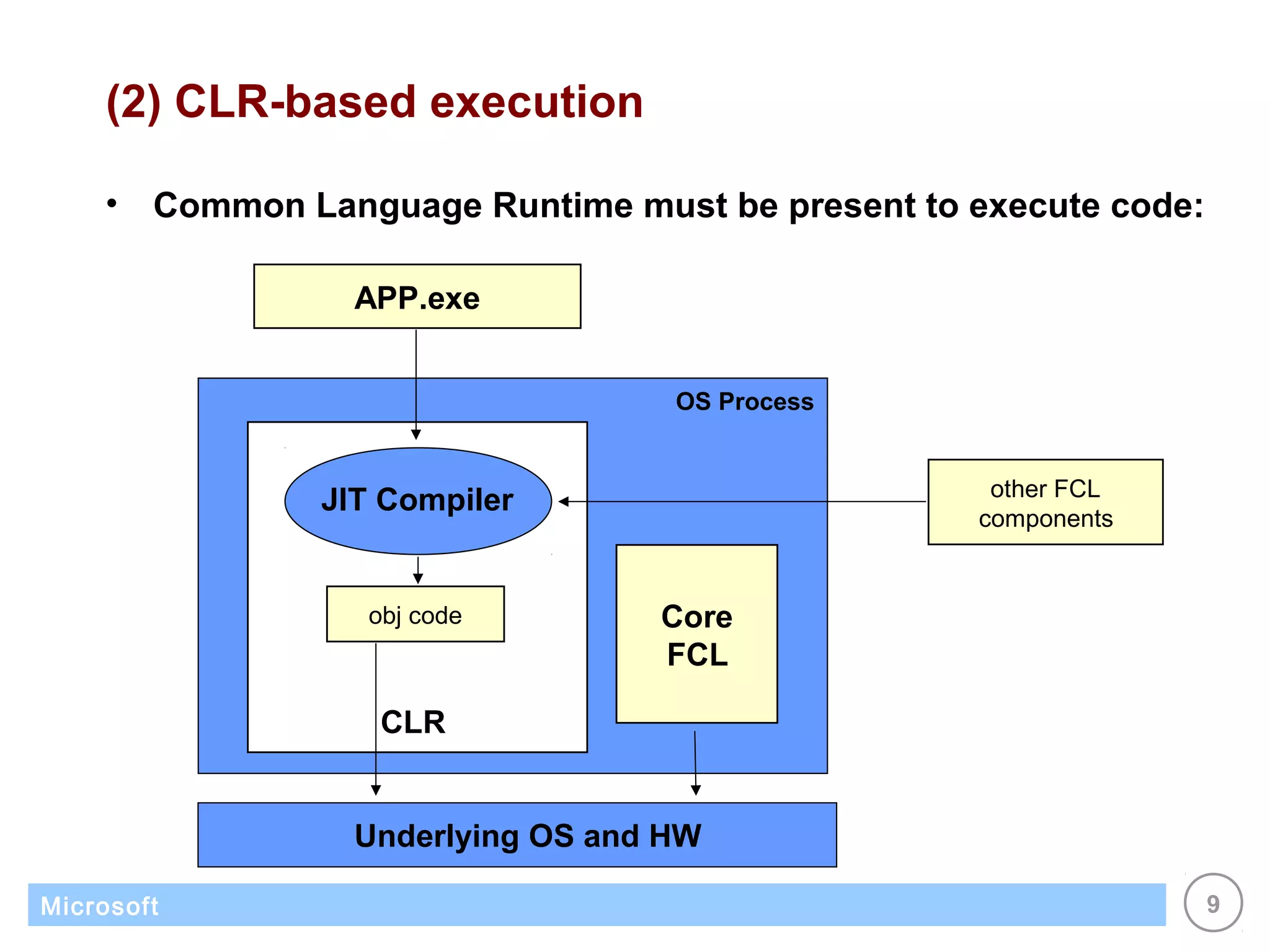
(2) CLR-based execution

    •   Common Language Runtime must be present to execute code:

                  APP.exe


                                    OS Process


                                                    other FCL
                JIT Compiler
                                                   components


                   obj code        Core
                                   FCL

                    CLR


                  Underlying OS and HW

Microsoft                                                          9
Implications of .NET's execution model

    1. Clients need CLR & FCL to run .NET apps
       – available via Redistributable .NET Framework
       – 20MB download
       – runs on 98 and above, NT (sp6a) and above


    2. Design trade-off…
       + managed execution (memory protection, verifiable code, etc.)
       + portability:
       – slower execution?


Microsoft                                                               10
Part 2

    •   Application design…


Microsoft                     11
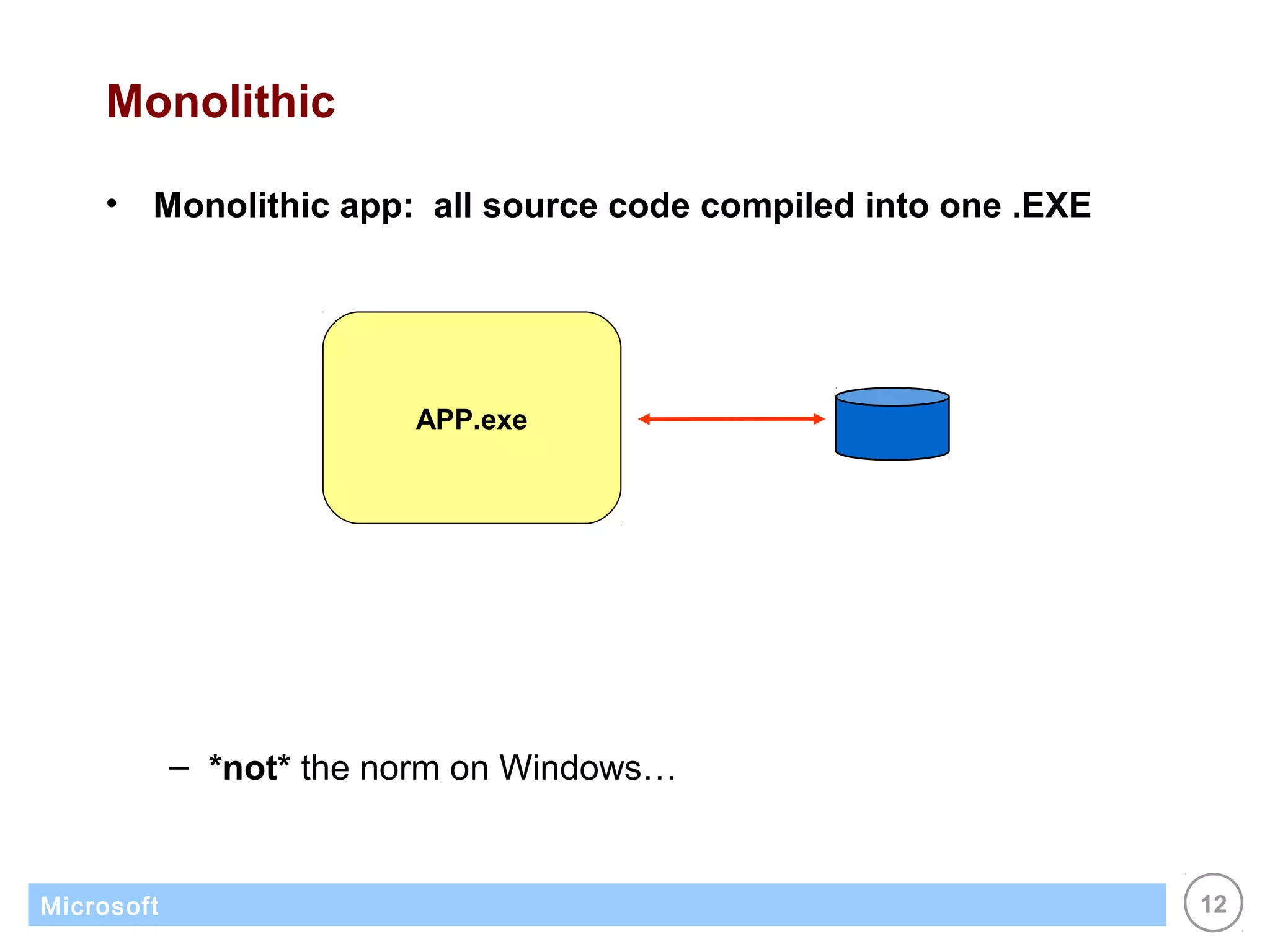
Monolithic

    •   Monolithic app: all source code compiled into one .EXE


                         APP.exe


            – *not* the norm on Windows…


Microsoft                                                        12
Component-based

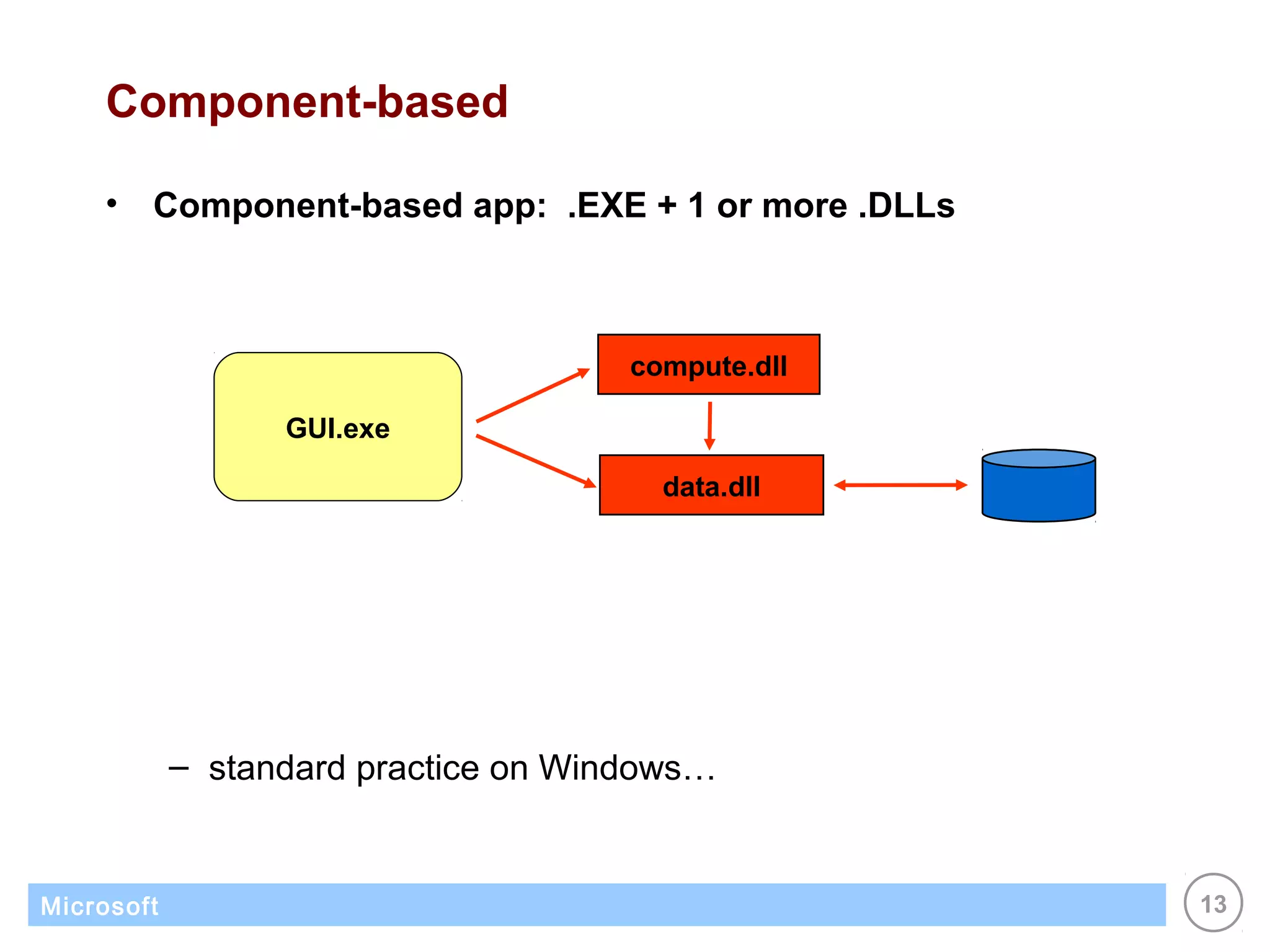
    •   Component-based app: .EXE + 1 or more .DLLs


                                      compute.dll

                  GUI.exe

                                        data.dll


            – standard practice on Windows…


Microsoft                                             13
Why component-based?

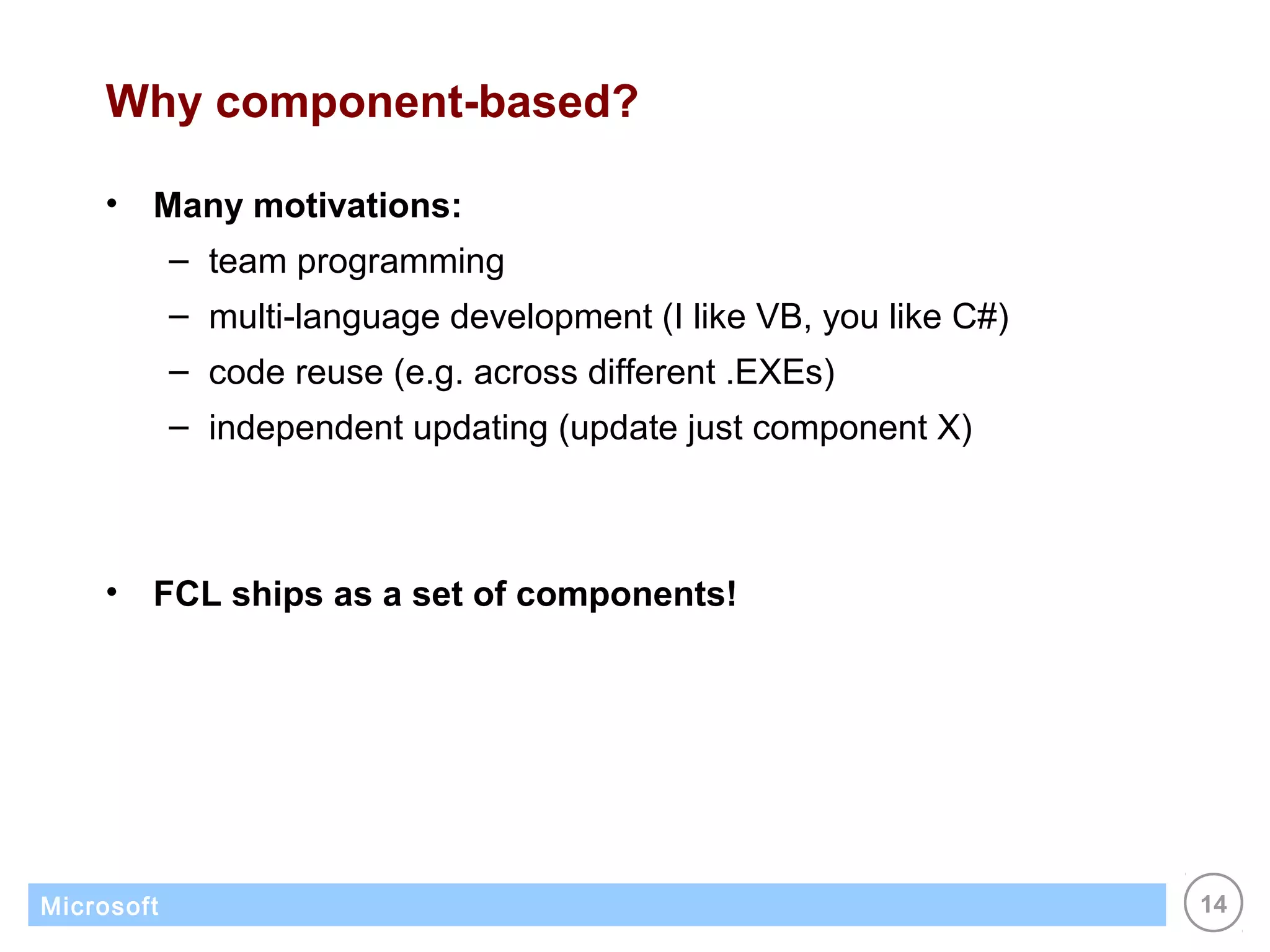
    •   Many motivations:
            – team programming
            – multi-language development (I like VB, you like C#)
            – code reuse (e.g. across different .EXEs)
            – independent updating (update just component X)


    •   FCL ships as a set of components!


Microsoft                                                           14
Assemblies

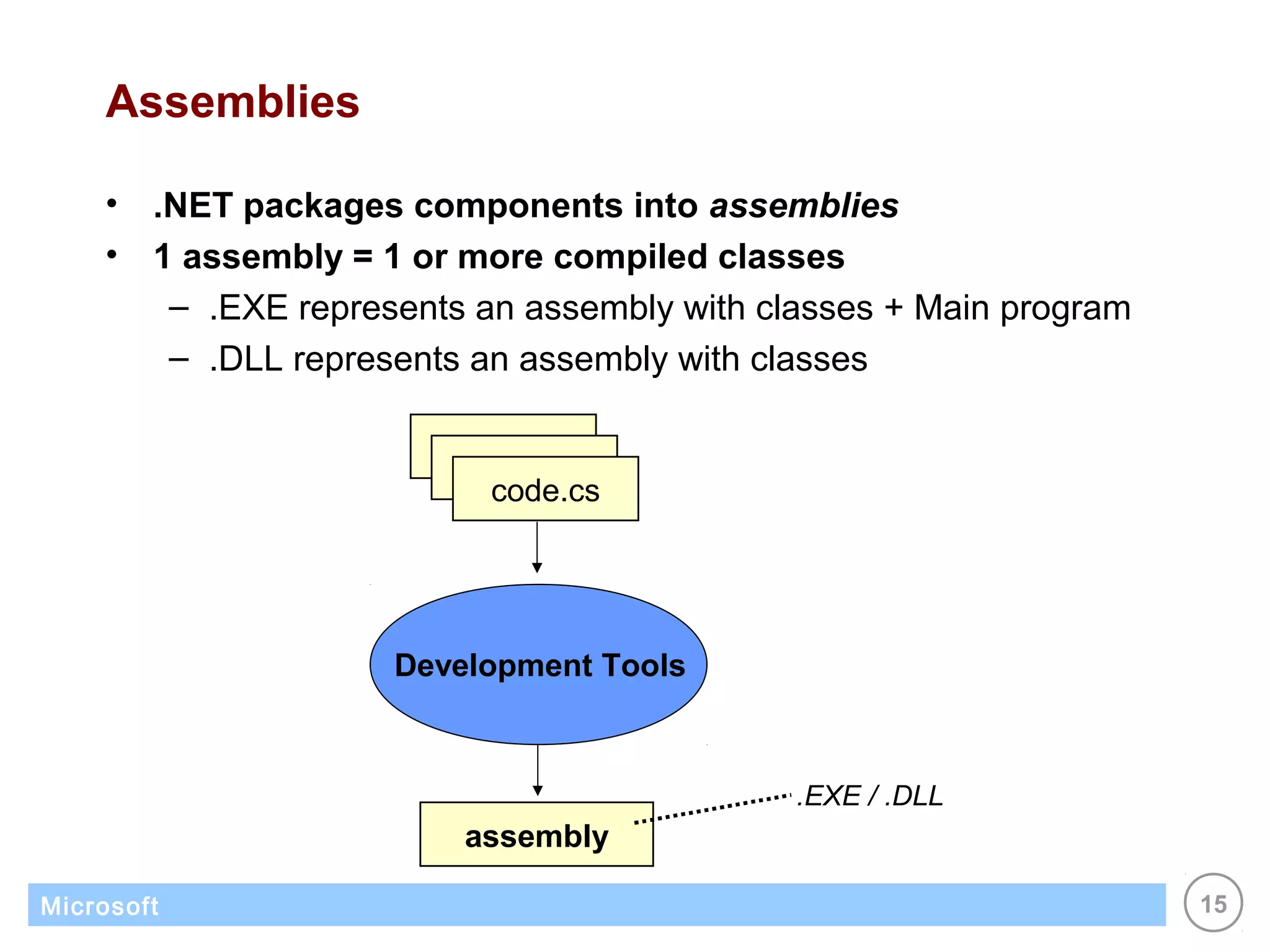
    •   .NET packages components into assemblies
    •   1 assembly = 1 or more compiled classes
         – .EXE represents an assembly with classes + Main program
         – .DLL represents an assembly with classes

                         code.vb
                          code.vb
                            code.cs


                      Development Tools


                                              .EXE / .DLL
                          assembly

Microsoft                                                            15
CLR-based execution revisted
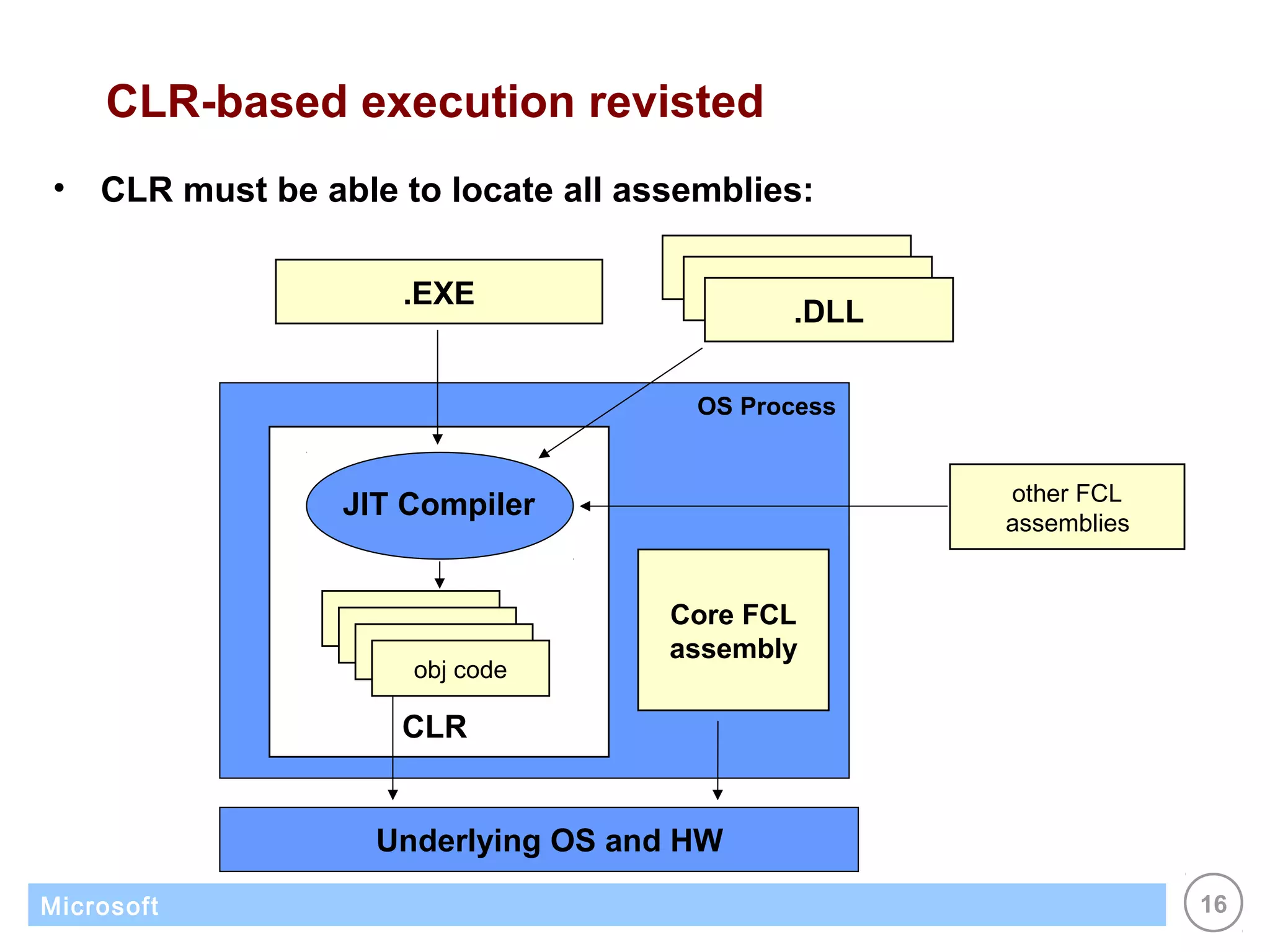
•   CLR must be able to locate all assemblies:

                                           .DLL
                      .EXE                   .DLL
                                               .DLL

                                       OS Process


                                                      other FCL
                  JIT Compiler
                                                      assemblies


                   obj code          Core FCL
                    obj code
                      obj code       assembly
                        obj code

                      CLR


                    Underlying OS and HW
Microsoft                                                          16
Assembly resolution

    •   How does CLR find assemblies?

    •   For now, simple answer is sufficient:
         – our DLLs must reside in same directory as our EXE
         – FCL assemblies reside in GAC
         – CLR looks in GAC first, then EXE's directory…


Microsoft                                                      17
GAC?

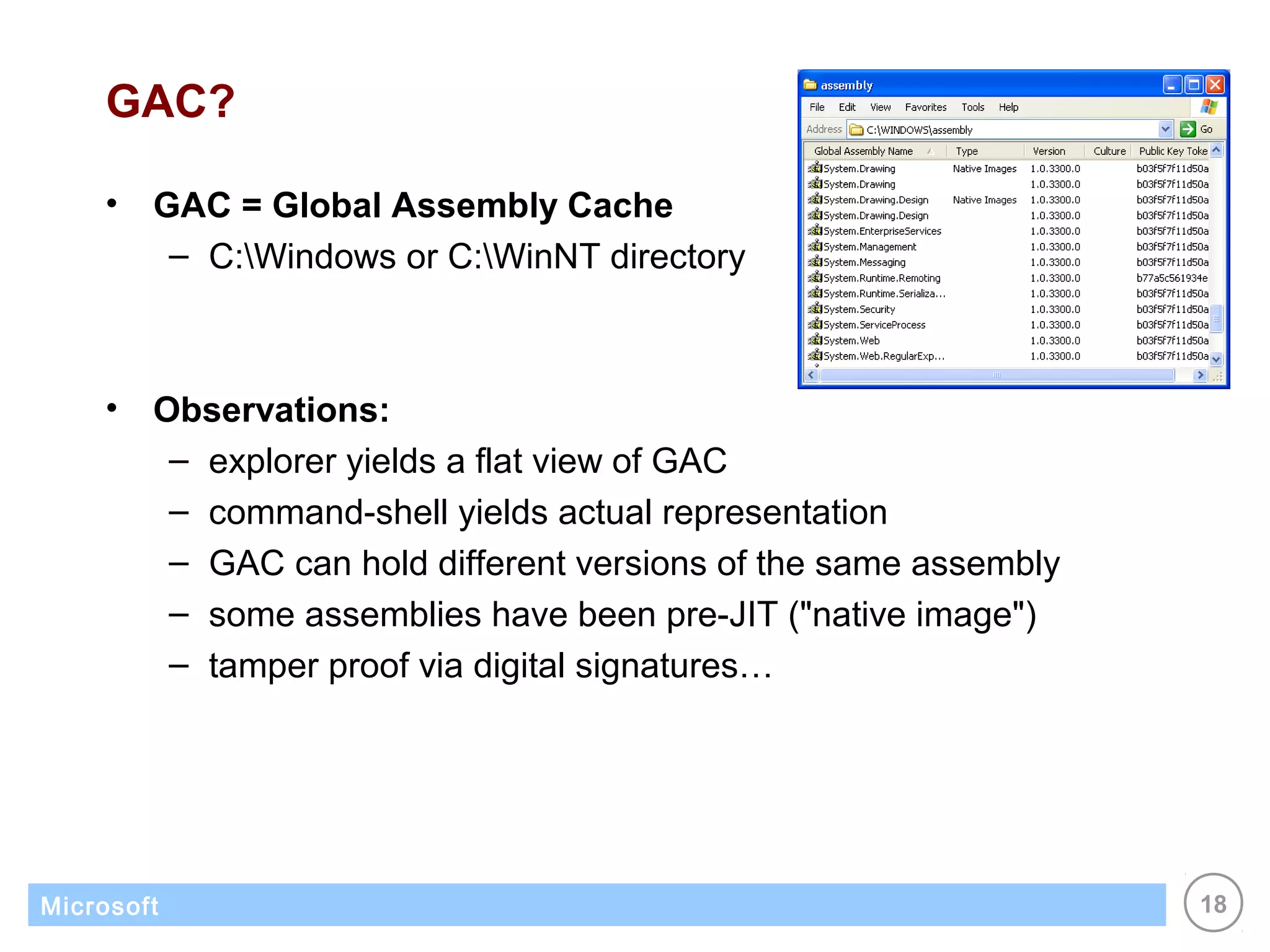
    •   GAC = Global Assembly Cache
         – C:Windows or C:WinNT directory


    •   Observations:
         – explorer yields a flat view of GAC
         – command-shell yields actual representation
         – GAC can hold different versions of the same assembly
         – some assemblies have been pre-JIT ("native image")
         – tamper proof via digital signatures…


Microsoft                                                         18
Summary

    •   .NET architecture is:
         – multi-language
         – cross-platform
         – based on the CLR, FCL, and JIT technology

    •   Application designs are typically multi-tier
    •   Application designs yield component-based development
         – .NET components are packaged as assemblies


Microsoft                                                       19
Resources

 •   Books:
      – J. Richter, "Applied Microsoft .NET Framework Programming" (C#)
      – J. Richter and F. Balena, "Applied Microsoft .NET Framework
        Programming in Microsoft Visual Basic .NET" (VB)
      – T. Thai and H. Lam, ".NET Framework Essentials"

 •   Web sites:
     – http://msdn.microsoft.com/net
     – http://www.gotdotnet.com/
     – Linux port (Mono): http://www.go-mono.com/
     – MS source (Rotor / SSCLI): http://msdn.microsoft.com/net/sscli


Microsoft                                                               20

Dot net

  • 1.
    Lecture 1: The .NETArchitecture
  • 2.
    Objectives “Microsoft .NET is based on the .NET Framework, which consists of two major components: the Common Language Runtime (CLR) and an extensive set of Framework Class Libraries (FCL). The CLR defines a common programming model and a standard type system for cross-platform, multi-language development.” • CLR-based execution • Application designs Microsoft 2
  • 3.
    Part 1 • CLR-based execution… Microsoft 3
  • 4.
    Influences • .NET is the result of many influences… OOP JVM GUI .NET Web component-based design n-tier design Microsoft 4
  • 5.
    .NET is multi-language • .NET supports VB, C# (C-sharp), C++, J# (Java 1.2), Eiffel, etc. code.vb code.cs code.cpp ... Development Tools FCL app.exe Microsoft 5
  • 6.
    .NET is cross-platform • Compiled .NET apps run on any supported platform: APP.exe ? Win64 Win32 WinCE (XP,2K,98) Microsoft 6
  • 7.
    How is cross-platformachieved? • Cross-platform execution realized in two ways: 1. apps are written against Framework Class Library (FCL), not underlying OS 2. compilers generate generic assembly language which must be executed by the Common Language Runtime (CLR) Microsoft 7
  • 8.
    (1) FCL • Framework Class Library – 1000's of predefined classes – common subset across all platforms & languages – networking, database access, XML processing, GUI, Web, etc. • Goal? – FCL is a portable operating system Microsoft 8
  • 9.
    (2) CLR-based execution • Common Language Runtime must be present to execute code: APP.exe OS Process other FCL JIT Compiler components obj code Core FCL CLR Underlying OS and HW Microsoft 9
  • 10.
    Implications of .NET'sexecution model 1. Clients need CLR & FCL to run .NET apps – available via Redistributable .NET Framework – 20MB download – runs on 98 and above, NT (sp6a) and above 2. Design trade-off… + managed execution (memory protection, verifiable code, etc.) + portability: – slower execution? Microsoft 10
  • 11.
    Part 2 • Application design… Microsoft 11
  • 12.
    Monolithic • Monolithic app: all source code compiled into one .EXE APP.exe – *not* the norm on Windows… Microsoft 12
  • 13.
    Component-based • Component-based app: .EXE + 1 or more .DLLs compute.dll GUI.exe data.dll – standard practice on Windows… Microsoft 13
  • 14.
    Why component-based? • Many motivations: – team programming – multi-language development (I like VB, you like C#) – code reuse (e.g. across different .EXEs) – independent updating (update just component X) • FCL ships as a set of components! Microsoft 14
  • 15.
    Assemblies • .NET packages components into assemblies • 1 assembly = 1 or more compiled classes – .EXE represents an assembly with classes + Main program – .DLL represents an assembly with classes code.vb code.vb code.cs Development Tools .EXE / .DLL assembly Microsoft 15
  • 16.
    CLR-based execution revisted • CLR must be able to locate all assemblies: .DLL .EXE .DLL .DLL OS Process other FCL JIT Compiler assemblies obj code Core FCL obj code obj code assembly obj code CLR Underlying OS and HW Microsoft 16
  • 17.
    Assembly resolution • How does CLR find assemblies? • For now, simple answer is sufficient: – our DLLs must reside in same directory as our EXE – FCL assemblies reside in GAC – CLR looks in GAC first, then EXE's directory… Microsoft 17
  • 18.
    GAC? • GAC = Global Assembly Cache – C:Windows or C:WinNT directory • Observations: – explorer yields a flat view of GAC – command-shell yields actual representation – GAC can hold different versions of the same assembly – some assemblies have been pre-JIT ("native image") – tamper proof via digital signatures… Microsoft 18
  • 19.
    Summary • .NET architecture is: – multi-language – cross-platform – based on the CLR, FCL, and JIT technology • Application designs are typically multi-tier • Application designs yield component-based development – .NET components are packaged as assemblies Microsoft 19
  • 20.
    Resources • Books: – J. Richter, "Applied Microsoft .NET Framework Programming" (C#) – J. Richter and F. Balena, "Applied Microsoft .NET Framework Programming in Microsoft Visual Basic .NET" (VB) – T. Thai and H. Lam, ".NET Framework Essentials" • Web sites: – http://msdn.microsoft.com/net – http://www.gotdotnet.com/ – Linux port (Mono): http://www.go-mono.com/ – MS source (Rotor / SSCLI): http://msdn.microsoft.com/net/sscli Microsoft 20

Editor's Notes

  • #7 Other platforms? As of May 2003: Mono : open-source Linux port of .Net, beta, no GUI support. Rotor : MS has released the source to the standardized components of .Net, compiles on Windows, FreeBSD, and Mac OS X. 1.0 Release, C# only, no GUI support. Mono can be downloaded from http://www.go-mono.com/ Rotor, officially known as SSCLI, can be downloaded from http://msdn.microsoft.com/net/sscli
  • #10 JIT = Just-in-time, which gets its name because you generate the actual x86 code at the last possible moment, i.e. run-time. Java uses same approach with its JVM
  • #17 CLR = Common Language Runtime FCL = .NET Framework Class Library