Dose adjustment in
Renal Disease
Dr. Anmaria Thomas
Several approaches are available for estimating the appropriate
dosage regimen for a patient with renal impairment.
Most of these methods assume that
“the required therapeutic plasma drug concentration in uremic
patients is similar to that required in patients with normal renal
function.”
Uremic patients are maintained on the same C ∞
av after multiple oral
doses or multiple IV bolus injections.
For IV infusions, the same Css is maintained. (Css is the same as C ∞
av
after the plasma drug concentration reaches steady state.)
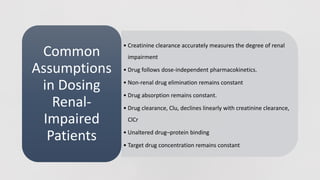
• Creatinine clearance accurately measures the degree of renal
impairment
• Drug follows dose-independent pharmacokinetics.
• Non-renal drug elimination remains constant
• Drug absorption remains constant.
• Drug clearance, Clu, declines linearly with creatinine clearance,
ClCr
• Unaltered drug–protein binding
• Target drug concentration remains constant
Common
Assumptions
in Dosing
Renal-
Impaired
Patients
• The design of dosage regimens for uremic patients is based on the pharmacokinetic
changes that have occurred because of the uremic condition.
• Generally, drugs in patients with uremia or kidney impairment have prolonged elimination
half-lives and a change in the apparent volume of distribution.
• In less severe uremic conditions, there may be neither edema nor a significant change in
the apparent volume of distribution.
• Consequently, the methods for dose adjustment in uremic patients are based on an
accurate estimation of the drug clearance in these patients.
• Two general pharmacokinetic approaches for dose adjustment include methods based on
drug clearance and methods based on the elimination rate constant.
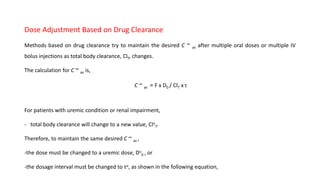
Dose Adjustment Based on Drug Clearance
Methods based on drug clearance try to maintain the desired C ∞
av after multiple oral doses or multiple IV
bolus injections as total body clearance, ClT, changes.
The calculation for C ∞
av is,
C ∞
av = F x D0 / ClT x τ
For patients with uremic condition or renal impairment,
- total body clearance will change to a new value, Clu
T.
Therefore, to maintain the same desired C ∞
av ,
-the dose must be changed to a uremic dose, Du
0 , or
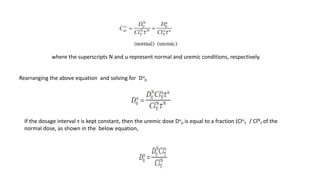
-the dosage interval must be changed to τu, as shown in the following equation,
where the superscripts N and u represent normal and uremic conditions, respectively.
Rearranging the above equation and solving for Du
0
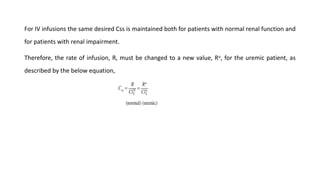
If the dosage interval τ is kept constant, then the uremic dose Du
0 is equal to a fraction (Clu
T / ClN
T of the
normal dose, as shown in the below equation,
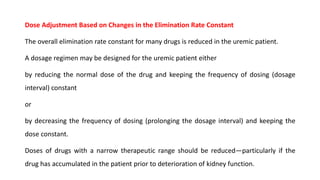
For IV infusions the same desired Css is maintained both for patients with normal renal function and
for patients with renal impairment.
Therefore, the rate of infusion, R, must be changed to a new value, Ru, for the uremic patient, as
described by the below equation,
Dose Adjustment Based on Changes in the Elimination Rate Constant
The overall elimination rate constant for many drugs is reduced in the uremic patient.
A dosage regimen may be designed for the uremic patient either
by reducing the normal dose of the drug and keeping the frequency of dosing (dosage
interval) constant
or
by decreasing the frequency of dosing (prolonging the dosage interval) and keeping the
dose constant.
Doses of drugs with a narrow therapeutic range should be reduced—particularly if the
drug has accumulated in the patient prior to deterioration of kidney function.
The usual approach to estimating a multiple dosage regimen in the normal patient is to maintain a
desired C ∞
av , as shown in the below equation,
C ∞
av = F x D0 / ClT xτ
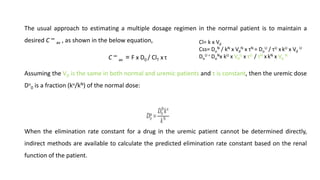
Assuming the VD is the same in both normal and uremic patients and τ is constant, then the uremic dose
Du
0 is a fraction (ku/kN) of the normal dose:
When the elimination rate constant for a drug in the uremic patient cannot be determined directly,
indirect methods are available to calculate the predicted elimination rate constant based on the renal
function of the patient.
Cl= k x Vd
Css= Do
N / kN x Vd
N x τN = Do
U / τU x kU x Vd
U
Do
U = Do
Nx kU x Vd
U x τU / τN x kN x Vd
N
The assumptions on how these dosage regimens are calculated include the
following:
1. The renal elimination rate constant (kR) decreases proportionately as renal
function decreases.
2. The non-renal routes of elimination (primarily, the rate constant for
metabolism) remain unchanged.
3. Changes in the renal clearance of the drug are reflected by changes in the
creatinine clearance
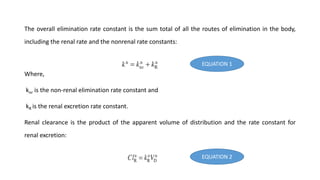
The overall elimination rate constant is the sum total of all the routes of elimination in the body,
including the renal rate and the nonrenal rate constants:
Where,
knr is the non-renal elimination rate constant and
kR is the renal excretion rate constant.
Renal clearance is the product of the apparent volume of distribution and the rate constant for
renal excretion:
EQUATION 1
EQUATION 2
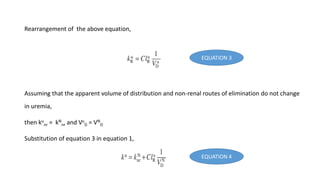
Rearrangement of the above equation,
Assuming that the apparent volume of distribution and non-renal routes of elimination do not change
in uremia,
then ku
nr = kN
nr and Vu
D = VN
D
Substitution of equation 3 in equation 1,
EQUATION 3
EQUATION 4
From Equation 4 , a change in the renal clearance Clu
R due to renal impairment will be
reflected in a change in the overall elimination rate constant ku.
Because changes in the renal drug clearance cannot be assessed directly in the uremic
patient, Clu
R is usually related to a measurement of kidney function by the GFR, which
in turn is estimated by changes in the patient’s creatinine clearance.

Dose adjustment in Renal Disease.pdf

  • 1.
    Dose adjustment in RenalDisease Dr. Anmaria Thomas
  • 2.
    Several approaches areavailable for estimating the appropriate dosage regimen for a patient with renal impairment. Most of these methods assume that “the required therapeutic plasma drug concentration in uremic patients is similar to that required in patients with normal renal function.” Uremic patients are maintained on the same C ∞ av after multiple oral doses or multiple IV bolus injections. For IV infusions, the same Css is maintained. (Css is the same as C ∞ av after the plasma drug concentration reaches steady state.)
  • 3.
    • Creatinine clearanceaccurately measures the degree of renal impairment • Drug follows dose-independent pharmacokinetics. • Non-renal drug elimination remains constant • Drug absorption remains constant. • Drug clearance, Clu, declines linearly with creatinine clearance, ClCr • Unaltered drug–protein binding • Target drug concentration remains constant Common Assumptions in Dosing Renal- Impaired Patients
  • 4.
    • The designof dosage regimens for uremic patients is based on the pharmacokinetic changes that have occurred because of the uremic condition. • Generally, drugs in patients with uremia or kidney impairment have prolonged elimination half-lives and a change in the apparent volume of distribution. • In less severe uremic conditions, there may be neither edema nor a significant change in the apparent volume of distribution. • Consequently, the methods for dose adjustment in uremic patients are based on an accurate estimation of the drug clearance in these patients. • Two general pharmacokinetic approaches for dose adjustment include methods based on drug clearance and methods based on the elimination rate constant.
  • 5.
    Dose Adjustment Basedon Drug Clearance Methods based on drug clearance try to maintain the desired C ∞ av after multiple oral doses or multiple IV bolus injections as total body clearance, ClT, changes. The calculation for C ∞ av is, C ∞ av = F x D0 / ClT x τ For patients with uremic condition or renal impairment, - total body clearance will change to a new value, Clu T. Therefore, to maintain the same desired C ∞ av , -the dose must be changed to a uremic dose, Du 0 , or -the dosage interval must be changed to τu, as shown in the following equation,
  • 6.
    where the superscriptsN and u represent normal and uremic conditions, respectively. Rearranging the above equation and solving for Du 0 If the dosage interval τ is kept constant, then the uremic dose Du 0 is equal to a fraction (Clu T / ClN T of the normal dose, as shown in the below equation,
  • 7.
    For IV infusionsthe same desired Css is maintained both for patients with normal renal function and for patients with renal impairment. Therefore, the rate of infusion, R, must be changed to a new value, Ru, for the uremic patient, as described by the below equation,
  • 8.
    Dose Adjustment Basedon Changes in the Elimination Rate Constant The overall elimination rate constant for many drugs is reduced in the uremic patient. A dosage regimen may be designed for the uremic patient either by reducing the normal dose of the drug and keeping the frequency of dosing (dosage interval) constant or by decreasing the frequency of dosing (prolonging the dosage interval) and keeping the dose constant. Doses of drugs with a narrow therapeutic range should be reduced—particularly if the drug has accumulated in the patient prior to deterioration of kidney function.
  • 9.
    The usual approachto estimating a multiple dosage regimen in the normal patient is to maintain a desired C ∞ av , as shown in the below equation, C ∞ av = F x D0 / ClT xτ Assuming the VD is the same in both normal and uremic patients and τ is constant, then the uremic dose Du 0 is a fraction (ku/kN) of the normal dose: When the elimination rate constant for a drug in the uremic patient cannot be determined directly, indirect methods are available to calculate the predicted elimination rate constant based on the renal function of the patient. Cl= k x Vd Css= Do N / kN x Vd N x τN = Do U / τU x kU x Vd U Do U = Do Nx kU x Vd U x τU / τN x kN x Vd N
  • 10.
    The assumptions onhow these dosage regimens are calculated include the following: 1. The renal elimination rate constant (kR) decreases proportionately as renal function decreases. 2. The non-renal routes of elimination (primarily, the rate constant for metabolism) remain unchanged. 3. Changes in the renal clearance of the drug are reflected by changes in the creatinine clearance
  • 11.
    The overall eliminationrate constant is the sum total of all the routes of elimination in the body, including the renal rate and the nonrenal rate constants: Where, knr is the non-renal elimination rate constant and kR is the renal excretion rate constant. Renal clearance is the product of the apparent volume of distribution and the rate constant for renal excretion: EQUATION 1 EQUATION 2
  • 12.
    Rearrangement of theabove equation, Assuming that the apparent volume of distribution and non-renal routes of elimination do not change in uremia, then ku nr = kN nr and Vu D = VN D Substitution of equation 3 in equation 1, EQUATION 3 EQUATION 4
  • 13.
    From Equation 4, a change in the renal clearance Clu R due to renal impairment will be reflected in a change in the overall elimination rate constant ku. Because changes in the renal drug clearance cannot be assessed directly in the uremic patient, Clu R is usually related to a measurement of kidney function by the GFR, which in turn is estimated by changes in the patient’s creatinine clearance.