Don’t Wait!
Develop responsive applications with Java EE7 instead!
Erin Schnabel
schnabel@us.ibm.com
@ebullientworks
Focus on the server side
• “Responsive” application
• Maximize resource utilization
• Technologies in EE7 can help
JAX-RS 2.0 async processing
Concurrency Utilities (JSR-236)
WebSocket API (JSR-356)
Non-blocking I/O added in Servlet 3.1
2
JAX-RS 2.0 Async Support
Concurrency Utilities
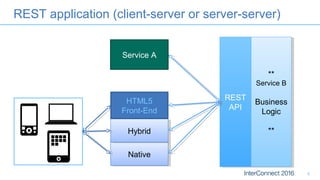
REST application (client-server or server-server)
4
NativeNative
HTML5
Front-End
REST
API
REST
API
**
Service B
Business
Logic
**
**
Service B
Business
Logic
**HybridHybrid
Service A
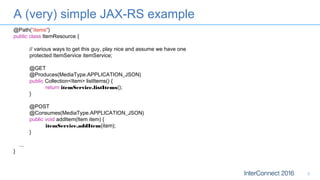
A (very) simple JAX-RS example
5
@Path(”items")
public class ItemResource {
// various ways to get this guy, play nice and assume we have one
protected ItemService itemService;
@GET
@Produces(MediaType.APPLICATION_JSON)
public Collection<Item> listItems() {
return itemService.listItems();
}
@POST
@Consumes(MediaType.APPLICATION_JSON)
public void addItem(Item item) {
itemService.addItem(item);
}
...
}
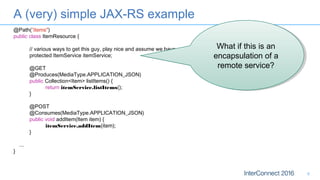
A (very) simple JAX-RS example
6
@Path(”items")
public class ItemResource {
// various ways to get this guy, play nice and assume we have one
protected ItemService itemService;
@GET
@Produces(MediaType.APPLICATION_JSON)
public Collection<Item> listItems() {
return itemService.listItems();
}
@POST
@Consumes(MediaType.APPLICATION_JSON)
public void addItem(Item item) {
itemService.addItem(item);
}
...
}
What if this is an
encapsulation of a
remote service?
What if this is an
encapsulation of a
remote service?
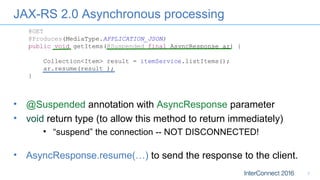
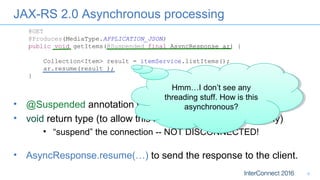
JAX-RS 2.0 Asynchronous processing
7
@GET
@Produces(MediaType.APPLICATION_JSON)
public void getItems(@Suspended final AsyncResponse ar) {
Collection<Item> result = itemService.listItems();
ar.resume(result );
}
• AsyncResponse.resume(…) to send the response to the client.
• @Suspended annotation with AsyncResponse parameter
• void return type (to allow this method to return immediately)
• “suspend” the connection -- NOT DISCONNECTED!
JAX-RS 2.0 Asynchronous processing
8
@GET
@Produces(MediaType.APPLICATION_JSON)
public void getItems(@Suspended final AsyncResponse ar) {
Collection<Item> result = itemService.listItems();
ar.resume(result );
}
• AsyncResponse.resume(…) to send the response to the client.
• @Suspended annotation with AsyncResponse parameter
• void return type (to allow this method to return immediately)
• “suspend” the connection -- NOT DISCONNECTED!
Hmm…I don’t see any
threading stuff. How is this
asynchronous?
Hmm…I don’t see any
threading stuff. How is this
asynchronous?
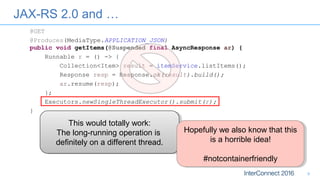
JAX-RS 2.0 and …
9
@GET
@Produces(MediaType.APPLICATION_JSON)
public void getItems(@Suspended final AsyncResponse ar) {
Runnable r = () -> {
Collection<Item> result = itemService.listItems();
Response resp = Response.ok(result).build();
ar.resume(resp);
};
Executors.newSingleThreadExecutor().submit(r);
}
This would totally work:
The long-running operation is
definitely on a different thread.
This would totally work:
The long-running operation is
definitely on a different thread.
Hopefully we also know that this
is a horrible idea!
#notcontainerfriendly
Hopefully we also know that this
is a horrible idea!
#notcontainerfriendly
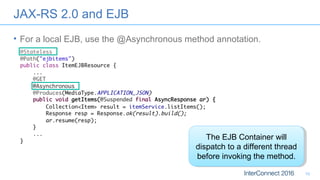
JAX-RS 2.0 and EJB
• For a local EJB, use the @Asynchronous method annotation.
10
The EJB Container will
dispatch to a different thread
before invoking the method.
The EJB Container will
dispatch to a different thread
before invoking the method.
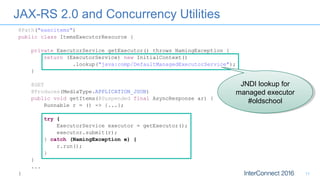
JAX-RS 2.0 and Concurrency Utilities
11
@Path("execitems")
public class ItemsExecutorResource {
private ExecutorService getExecutor() throws NamingException {
return (ExecutorService) new InitialContext()
.lookup("java:comp/DefaultManagedExecutorService");
}
@GET
@Produces(MediaType.APPLICATION_JSON)
public void getItems(@Suspended final AsyncResponse ar) {
Runnable r = () -> {...};
try {
ExecutorService executor = getExecutor();
executor.submit(r);
} catch (NamingException e) {
r.run();
}
}
...
}
JNDI lookup for
managed executor
#oldschool
JNDI lookup for
managed executor
#oldschool
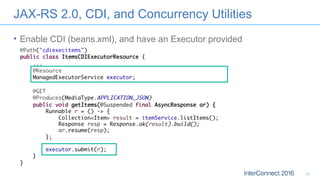
JAX-RS 2.0, CDI, and Concurrency Utilities
• Enable CDI (beans.xml), and have an Executor provided
12
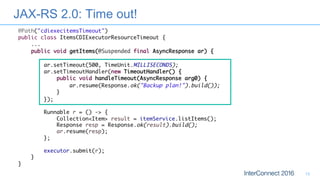
JAX-RS 2.0: Time out!
13
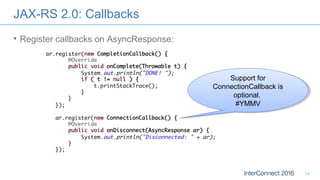
JAX-RS 2.0: Callbacks
• Register callbacks on AsyncResponse:
14
Support for
ConnectionCallback is
optional.
#YMMV
Support for
ConnectionCallback is
optional.
#YMMV
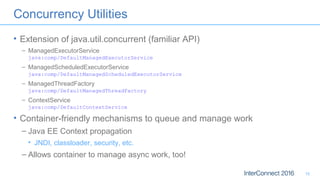
Concurrency Utilities
• Extension of java.util.concurrent (familiar API)
– ManagedExecutorService
java:comp/DefaultManagedExecutorService
– ManagedScheduledExecutorService
java:comp/DefaultManagedScheduledExecutorService
– ManagedThreadFactory
java:comp/DefaultManagedThreadFactory
– ContextService
java:comp/DefaultContextService
• Container-friendly mechanisms to queue and manage work
– Java EE Context propagation
• JNDI, classloader, security, etc.
– Allows container to manage async work, too!
15
WebSocket APIs
Server Endpoint: Annotated
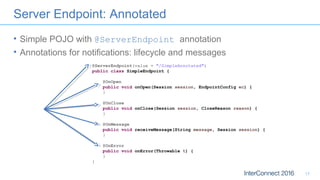
• Simple POJO with @ServerEndpoint annotation
• Annotations for notifications: lifecycle and messages
17
@ServerEndpoint(value = "/SimpleAnnotated")
public class SimpleEndpoint {
@OnOpen
public void onOpen(Session session, EndpointConfig ec) {
}
@OnClose
public void onClose(Session session, CloseReason reason) {
}
@OnMessage
public void receiveMessage(String message, Session session) {
}
@OnError
public void onError(Throwable t) {
}
}
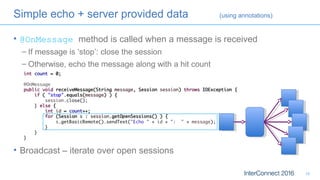
• @OnMessage method is called when a message is received
– If message is ‘stop’: close the session
– Otherwise, echo the message along with a hit count
• Broadcast – iterate over open sessions
18
Simple echo + server provided data (using annotations)
Non-blocking I/O
Servlet 3.1
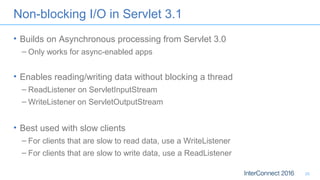
Non-blocking I/O in Servlet 3.1
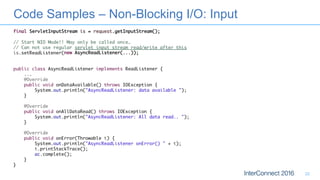
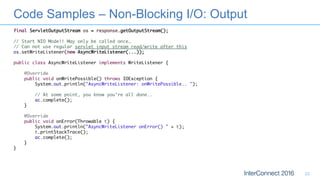
• Builds on Asynchronous processing from Servlet 3.0
– Only works for async-enabled apps
• Enables reading/writing data without blocking a thread
– ReadListener on ServletInputStream
– WriteListener on ServletOutputStream
• Best used with slow clients
– For clients that are slow to read data, use a WriteListener
– For clients that are slow to write data, use a ReadListener
20
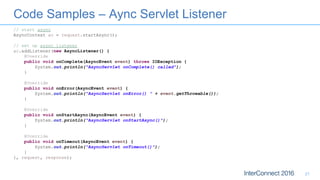
Code Samples – Aync Servlet Listener
21
// start async
AsyncContext ac = request.startAsync();
// set up async listener
ac.addListener(new AsyncListener() {
@Override
public void onComplete(AsyncEvent event) throws IOException {
System.out.println("AsyncServlet onComplete() called");
}
@Override
public void onError(AsyncEvent event) {
System.out.println("AsyncServlet onError() " + event.getThrowable());
}
@Override
public void onStartAsync(AsyncEvent event) {
System.out.println("AsyncServlet onStartAsync()");
}
@Override
public void onTimeout(AsyncEvent event) {
System.out.println("AsyncServlet onTimeout()");
}
}, request, response);
Code Samples – Non-Blocking I/O: Input
22
Code Samples – Non-Blocking I/O: Output
23
RxJava + EE7
Reactive Programming
• Reactive programming focuses on data flows and propagation of
change.
• Java 8 has introduced lambdas and a new java.util.stream package,
which help reactive programmers get started.
• For highly concurrent stream processing and more advanced
scenarios, ReactiveX is the library of choice.
• RxJava is the Java implementation of ReactiveX.
25
RxJava and JEE7
• RxJava and EE7 go hand-in-hand:
– Inject (CDI) and ExecutorServices from Concurrency Utilities into your app
– Encapsulate these concurrent artifacts with a RxJava Scheduler
– Use Websockets to provide real-time updates as observables are completed
26
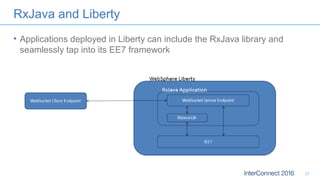
RxJava and Liberty
• Applications deployed in Liberty can include the RxJava library and
seamlessly tap into its EE7 framework
27
RxJava and Liberty
• GitHub sample:
https://github.com/WASdev/sample.rxjava
• App provides reviews and weather information about vacation
destinations
– concurrent-1.0
– websocket-1.1
– cdi-1.2
28
RxJava and Liberty
29
RxJava and Liberty
30
Notices and Disclaimers
31
Copyright © 2016 by International Business Machines Corporation (IBM). No part of this document may be reproduced or transmitted in any form without written permission
from IBM.
U.S. Government Users Restricted Rights - Use, duplication or disclosure restricted by GSA ADP Schedule Contract with IBM.
Information in these presentations (including information relating to products that have not yet been announced by IBM) has been reviewed for accuracy as of the date of
initial publication and could include unintentional technical or typographical errors. IBM shall have no responsibility to update this information. THIS DOCUMENT IS
DISTRIBUTED "AS IS" WITHOUT ANY WARRANTY, EITHER EXPRESS OR IMPLIED. IN NO EVENT SHALL IBM BE LIABLE FOR ANY DAMAGE ARISING FROM THE
USE OF THIS INFORMATION, INCLUDING BUT NOT LIMITED TO, LOSS OF DATA, BUSINESS INTERRUPTION, LOSS OF PROFIT OR LOSS OF OPPORTUNITY. IBM
products and services are warranted according to the terms and conditions of the agreements under which they are provided.
Any statements regarding IBM's future direction, intent or product plans are subject to change or withdrawal without notice.
Performance data contained herein was generally obtained in a controlled, isolated environments. Customer examples are presented as illustrations of how those
customers have used IBM products and the results they may have achieved. Actual performance, cost, savings or other results in other operating environments may vary.
References in this document to IBM products, programs, or services does not imply that IBM intends to make such products, programs or services available in all countries
in which IBM operates or does business.
Workshops, sessions and associated materials may have been prepared by independent session speakers, and do not necessarily reflect the views of IBM. All materials
and discussions are provided for informational purposes only, and are neither intended to, nor shall constitute legal or other guidance or advice to any individual participant
or their specific situation.
It is the customer’s responsibility to insure its own compliance with legal requirements and to obtain advice of competent legal counsel as to the identification and
interpretation of any relevant laws and regulatory requirements that may affect the customer’s business and any actions the customer may need to take to comply with such
laws. IBM does not provide legal advice or represent or warrant that its services or products will ensure that the customer is in compliance with any law
Notices and Disclaimers Con’t.
32
Information concerning non-IBM products was obtained from the suppliers of those products, their published announcements or other publicly available sources. IBM has not
tested those products in connection with this publication and cannot confirm the accuracy of performance, compatibility or any other claims related to non-IBM products.
Questions on the capabilities of non-IBM products should be addressed to the suppliers of those products. IBM does not warrant the quality of any third-party products, or the
ability of any such third-party products to interoperate with IBM’s products. IBM EXPRESSLY DISCLAIMS ALL WARRANTIES, EXPRESSED OR IMPLIED, INCLUDING BUT
NOT LIMITED TO, THE IMPLIED WARRANTIES OF MERCHANTABILITY AND FITNESS FOR A PARTICULAR PURPOSE.
The provision of the information contained h erein is not intended to, and does not, grant any right or license under any IBM patents, copyrights, trademarks or other
intellectual property right.
IBM, the IBM logo, ibm.com, Aspera®, Bluemix, Blueworks Live, CICS, Clearcase, Cognos®, DOORS®, Emptoris®, Enterprise Document Management System™, FASP®,
FileNet®, Global Business Services ®, Global Technology Services ®, IBM ExperienceOne™, IBM SmartCloud®, IBM Social Business®, Information on Demand, ILOG,
Maximo®, MQIntegrator®, MQSeries®, Netcool®, OMEGAMON, OpenPower, PureAnalytics™, PureApplication®, pureCluster™, PureCoverage®, PureData®,
PureExperience®, PureFlex®, pureQuery®, pureScale®, PureSystems®, QRadar®, Rational®, Rhapsody®, Smarter Commerce®, SoDA, SPSS, Sterling Commerce®,
StoredIQ, Tealeaf®, Tivoli®, Trusteer®, Unica®, urban{code}®, Watson, WebSphere®, Worklight®, X-Force® and System z® Z/OS, are trademarks of International Business
Machines Corporation, registered in many jurisdictions worldwide. Other product and service names might be trademarks of IBM or other companies. A current list of IBM
trademarks is available on the Web at "Copyright and trademark information" at: www.ibm.com/legal/copytrade.shtml.
Thank You
Your Feedback is Important!
Access the InterConnect 2016 Conference Attendee
Portal to complete your session surveys from your
smartphone,
laptop or conference kiosk.

Don't Wait! Develop responsive applications with Java EE7 instead

  • 1.
    Don’t Wait! Develop responsiveapplications with Java EE7 instead! Erin Schnabel schnabel@us.ibm.com @ebullientworks
  • 2.
    Focus on theserver side • “Responsive” application • Maximize resource utilization • Technologies in EE7 can help JAX-RS 2.0 async processing Concurrency Utilities (JSR-236) WebSocket API (JSR-356) Non-blocking I/O added in Servlet 3.1 2
  • 3.
    JAX-RS 2.0 AsyncSupport Concurrency Utilities
  • 4.
    REST application (client-serveror server-server) 4 NativeNative HTML5 Front-End REST API REST API ** Service B Business Logic ** ** Service B Business Logic **HybridHybrid Service A
  • 5.
    A (very) simpleJAX-RS example 5 @Path(”items") public class ItemResource { // various ways to get this guy, play nice and assume we have one protected ItemService itemService; @GET @Produces(MediaType.APPLICATION_JSON) public Collection<Item> listItems() { return itemService.listItems(); } @POST @Consumes(MediaType.APPLICATION_JSON) public void addItem(Item item) { itemService.addItem(item); } ... }
  • 6.
    A (very) simpleJAX-RS example 6 @Path(”items") public class ItemResource { // various ways to get this guy, play nice and assume we have one protected ItemService itemService; @GET @Produces(MediaType.APPLICATION_JSON) public Collection<Item> listItems() { return itemService.listItems(); } @POST @Consumes(MediaType.APPLICATION_JSON) public void addItem(Item item) { itemService.addItem(item); } ... } What if this is an encapsulation of a remote service? What if this is an encapsulation of a remote service?
  • 7.
    JAX-RS 2.0 Asynchronousprocessing 7 @GET @Produces(MediaType.APPLICATION_JSON) public void getItems(@Suspended final AsyncResponse ar) { Collection<Item> result = itemService.listItems(); ar.resume(result ); } • AsyncResponse.resume(…) to send the response to the client. • @Suspended annotation with AsyncResponse parameter • void return type (to allow this method to return immediately) • “suspend” the connection -- NOT DISCONNECTED!
  • 8.
    JAX-RS 2.0 Asynchronousprocessing 8 @GET @Produces(MediaType.APPLICATION_JSON) public void getItems(@Suspended final AsyncResponse ar) { Collection<Item> result = itemService.listItems(); ar.resume(result ); } • AsyncResponse.resume(…) to send the response to the client. • @Suspended annotation with AsyncResponse parameter • void return type (to allow this method to return immediately) • “suspend” the connection -- NOT DISCONNECTED! Hmm…I don’t see any threading stuff. How is this asynchronous? Hmm…I don’t see any threading stuff. How is this asynchronous?
  • 9.
    JAX-RS 2.0 and… 9 @GET @Produces(MediaType.APPLICATION_JSON) public void getItems(@Suspended final AsyncResponse ar) { Runnable r = () -> { Collection<Item> result = itemService.listItems(); Response resp = Response.ok(result).build(); ar.resume(resp); }; Executors.newSingleThreadExecutor().submit(r); } This would totally work: The long-running operation is definitely on a different thread. This would totally work: The long-running operation is definitely on a different thread. Hopefully we also know that this is a horrible idea! #notcontainerfriendly Hopefully we also know that this is a horrible idea! #notcontainerfriendly
  • 10.
    JAX-RS 2.0 andEJB • For a local EJB, use the @Asynchronous method annotation. 10 The EJB Container will dispatch to a different thread before invoking the method. The EJB Container will dispatch to a different thread before invoking the method.
  • 11.
    JAX-RS 2.0 andConcurrency Utilities 11 @Path("execitems") public class ItemsExecutorResource { private ExecutorService getExecutor() throws NamingException { return (ExecutorService) new InitialContext() .lookup("java:comp/DefaultManagedExecutorService"); } @GET @Produces(MediaType.APPLICATION_JSON) public void getItems(@Suspended final AsyncResponse ar) { Runnable r = () -> {...}; try { ExecutorService executor = getExecutor(); executor.submit(r); } catch (NamingException e) { r.run(); } } ... } JNDI lookup for managed executor #oldschool JNDI lookup for managed executor #oldschool
  • 12.
    JAX-RS 2.0, CDI,and Concurrency Utilities • Enable CDI (beans.xml), and have an Executor provided 12
  • 13.
  • 14.
    JAX-RS 2.0: Callbacks •Register callbacks on AsyncResponse: 14 Support for ConnectionCallback is optional. #YMMV Support for ConnectionCallback is optional. #YMMV
  • 15.
    Concurrency Utilities • Extensionof java.util.concurrent (familiar API) – ManagedExecutorService java:comp/DefaultManagedExecutorService – ManagedScheduledExecutorService java:comp/DefaultManagedScheduledExecutorService – ManagedThreadFactory java:comp/DefaultManagedThreadFactory – ContextService java:comp/DefaultContextService • Container-friendly mechanisms to queue and manage work – Java EE Context propagation • JNDI, classloader, security, etc. – Allows container to manage async work, too! 15
  • 16.
  • 17.
    Server Endpoint: Annotated •Simple POJO with @ServerEndpoint annotation • Annotations for notifications: lifecycle and messages 17 @ServerEndpoint(value = "/SimpleAnnotated") public class SimpleEndpoint { @OnOpen public void onOpen(Session session, EndpointConfig ec) { } @OnClose public void onClose(Session session, CloseReason reason) { } @OnMessage public void receiveMessage(String message, Session session) { } @OnError public void onError(Throwable t) { } }
  • 18.
    • @OnMessage methodis called when a message is received – If message is ‘stop’: close the session – Otherwise, echo the message along with a hit count • Broadcast – iterate over open sessions 18 Simple echo + server provided data (using annotations)
  • 19.
  • 20.
    Non-blocking I/O inServlet 3.1 • Builds on Asynchronous processing from Servlet 3.0 – Only works for async-enabled apps • Enables reading/writing data without blocking a thread – ReadListener on ServletInputStream – WriteListener on ServletOutputStream • Best used with slow clients – For clients that are slow to read data, use a WriteListener – For clients that are slow to write data, use a ReadListener 20
  • 21.
    Code Samples –Aync Servlet Listener 21 // start async AsyncContext ac = request.startAsync(); // set up async listener ac.addListener(new AsyncListener() { @Override public void onComplete(AsyncEvent event) throws IOException { System.out.println("AsyncServlet onComplete() called"); } @Override public void onError(AsyncEvent event) { System.out.println("AsyncServlet onError() " + event.getThrowable()); } @Override public void onStartAsync(AsyncEvent event) { System.out.println("AsyncServlet onStartAsync()"); } @Override public void onTimeout(AsyncEvent event) { System.out.println("AsyncServlet onTimeout()"); } }, request, response);
  • 22.
    Code Samples –Non-Blocking I/O: Input 22
  • 23.
    Code Samples –Non-Blocking I/O: Output 23
  • 24.
  • 25.
    Reactive Programming • Reactiveprogramming focuses on data flows and propagation of change. • Java 8 has introduced lambdas and a new java.util.stream package, which help reactive programmers get started. • For highly concurrent stream processing and more advanced scenarios, ReactiveX is the library of choice. • RxJava is the Java implementation of ReactiveX. 25
  • 26.
    RxJava and JEE7 •RxJava and EE7 go hand-in-hand: – Inject (CDI) and ExecutorServices from Concurrency Utilities into your app – Encapsulate these concurrent artifacts with a RxJava Scheduler – Use Websockets to provide real-time updates as observables are completed 26
  • 27.
    RxJava and Liberty •Applications deployed in Liberty can include the RxJava library and seamlessly tap into its EE7 framework 27
  • 28.
    RxJava and Liberty •GitHub sample: https://github.com/WASdev/sample.rxjava • App provides reviews and weather information about vacation destinations – concurrent-1.0 – websocket-1.1 – cdi-1.2 28
  • 29.
  • 30.
  • 31.
    Notices and Disclaimers 31 Copyright© 2016 by International Business Machines Corporation (IBM). No part of this document may be reproduced or transmitted in any form without written permission from IBM. U.S. Government Users Restricted Rights - Use, duplication or disclosure restricted by GSA ADP Schedule Contract with IBM. Information in these presentations (including information relating to products that have not yet been announced by IBM) has been reviewed for accuracy as of the date of initial publication and could include unintentional technical or typographical errors. IBM shall have no responsibility to update this information. THIS DOCUMENT IS DISTRIBUTED "AS IS" WITHOUT ANY WARRANTY, EITHER EXPRESS OR IMPLIED. IN NO EVENT SHALL IBM BE LIABLE FOR ANY DAMAGE ARISING FROM THE USE OF THIS INFORMATION, INCLUDING BUT NOT LIMITED TO, LOSS OF DATA, BUSINESS INTERRUPTION, LOSS OF PROFIT OR LOSS OF OPPORTUNITY. IBM products and services are warranted according to the terms and conditions of the agreements under which they are provided. Any statements regarding IBM's future direction, intent or product plans are subject to change or withdrawal without notice. Performance data contained herein was generally obtained in a controlled, isolated environments. Customer examples are presented as illustrations of how those customers have used IBM products and the results they may have achieved. Actual performance, cost, savings or other results in other operating environments may vary. References in this document to IBM products, programs, or services does not imply that IBM intends to make such products, programs or services available in all countries in which IBM operates or does business. Workshops, sessions and associated materials may have been prepared by independent session speakers, and do not necessarily reflect the views of IBM. All materials and discussions are provided for informational purposes only, and are neither intended to, nor shall constitute legal or other guidance or advice to any individual participant or their specific situation. It is the customer’s responsibility to insure its own compliance with legal requirements and to obtain advice of competent legal counsel as to the identification and interpretation of any relevant laws and regulatory requirements that may affect the customer’s business and any actions the customer may need to take to comply with such laws. IBM does not provide legal advice or represent or warrant that its services or products will ensure that the customer is in compliance with any law
  • 32.
    Notices and DisclaimersCon’t. 32 Information concerning non-IBM products was obtained from the suppliers of those products, their published announcements or other publicly available sources. IBM has not tested those products in connection with this publication and cannot confirm the accuracy of performance, compatibility or any other claims related to non-IBM products. Questions on the capabilities of non-IBM products should be addressed to the suppliers of those products. IBM does not warrant the quality of any third-party products, or the ability of any such third-party products to interoperate with IBM’s products. IBM EXPRESSLY DISCLAIMS ALL WARRANTIES, EXPRESSED OR IMPLIED, INCLUDING BUT NOT LIMITED TO, THE IMPLIED WARRANTIES OF MERCHANTABILITY AND FITNESS FOR A PARTICULAR PURPOSE. The provision of the information contained h erein is not intended to, and does not, grant any right or license under any IBM patents, copyrights, trademarks or other intellectual property right. IBM, the IBM logo, ibm.com, Aspera®, Bluemix, Blueworks Live, CICS, Clearcase, Cognos®, DOORS®, Emptoris®, Enterprise Document Management System™, FASP®, FileNet®, Global Business Services ®, Global Technology Services ®, IBM ExperienceOne™, IBM SmartCloud®, IBM Social Business®, Information on Demand, ILOG, Maximo®, MQIntegrator®, MQSeries®, Netcool®, OMEGAMON, OpenPower, PureAnalytics™, PureApplication®, pureCluster™, PureCoverage®, PureData®, PureExperience®, PureFlex®, pureQuery®, pureScale®, PureSystems®, QRadar®, Rational®, Rhapsody®, Smarter Commerce®, SoDA, SPSS, Sterling Commerce®, StoredIQ, Tealeaf®, Tivoli®, Trusteer®, Unica®, urban{code}®, Watson, WebSphere®, Worklight®, X-Force® and System z® Z/OS, are trademarks of International Business Machines Corporation, registered in many jurisdictions worldwide. Other product and service names might be trademarks of IBM or other companies. A current list of IBM trademarks is available on the Web at "Copyright and trademark information" at: www.ibm.com/legal/copytrade.shtml.
  • 33.
    Thank You Your Feedbackis Important! Access the InterConnect 2016 Conference Attendee Portal to complete your session surveys from your smartphone, laptop or conference kiosk.

Editor's Notes

  • #5 REST over HTTP is an incredibly popular transport RESTful interactions take place both between client devices, either in browsers or in web applications, or between individual services in the backend of a microservices application.
  • #6 JAX-RS annotations make creating a RESTful service easy and obvious.
  • #14 If you are submitting the async work via an executor, you can set a timeout, and optionally register a timeout handler. If a handler isn’t present, a ServiceUnavailableException will be thrown with status code 503. The TimeoutHandler is given the AsyncResponse as a parameter, which must still be resumed to send a response back to the client. The AsyncResponse can also be cancelled, with an accompanying indication of how long a client should wait before retrying. A cancelled AsyncResponse sends a 503 / Service Unvaliable response to the client.
  • #15 If you are submitting the async work via an executor, you can set a timeout, and optionally register a timeout handler. If a handler isn’t present, a ServiceUnavailableException will be thrown with status code 503. The TimeoutHandler is given the AsyncResponse as a parameter, which must still be resumed to send a response back to the client.
  • #16 Unmanaged threads and timers can cause problems for containers: they inhibit an app server’s ability to track and manage resources. Concurrency Utilities provided in EE7 extend the mechanisms java.util.concurrent to provide a familiar API to applications that allows easy creation of container-managed resources to support async activities. Java EE Concurrency utilities provide context propagation, so that new threads inherit the container thread context of the originating application component thread (which is important for referencing other EE).
  • #19 @OnMessage methods are single threaded for an endpoint… Note the broadcast! Easy as pie to send the same data around to different sessions. Also note that each connection will have it’s own Endpoint instance, but that instances can see each other through sessions: Endpoints are not thread safe, but Sessions are.
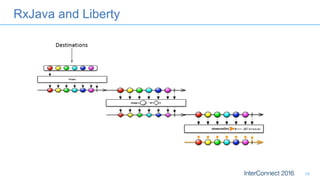
  • #30 Create a new stream from the input destination Map them into internal populated POJOs, using a custom scheduler / executor.
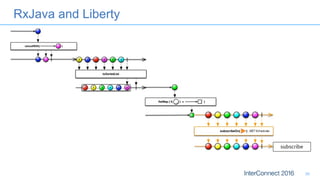
  • #31 Concat previous observable of destinations (from previous inputs) with current stream Sort the aggregated list of destinations Flatten the list of destination streams into a single stream Subscribe (ie: push results back to client via websocket) using a different scheduler / executor.