MANAGEMENT
CONTROL
TOPICS:
-AGENCY THEORY
-CONTROL MECHANISMS
-PARTICIPATIVE MANAGEMENT
-THE CRITERIA FOR SUPERIOR PERFORMANCE
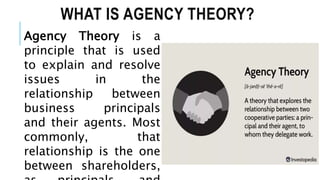
WHAT IS AGENCY THEORY?
Agency Theory is a
principle that is used
to explain and resolve
issues in the
relationship between
business principals
and their agents. Most
commonly, that
relationship is the one
between shareholders,
AGENCY THEORY
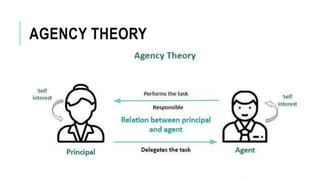
-Agency theory attempts to explain and resolve
disputes over the respective priorities between
principals and their agents.
-Principals rely on agents to execute certain
transactions, which results in a difference in
agreement on priorities and methods.
-The difference in priorities and interests
between agents and principals is known as the
principal-agent problem.
-Resolving the differences in expectations is
called "reducing agency loss."
-Performance-based compensation is one way
that is used to achieve a balance between
CONTROL MECHANISM
A means to control the behavior of
or within a process or system.
There are many types of control
mechanisms. Human decision
making is a control mechanism
made by an individual to start or
delay a process in an attempt to
keep or bring a process within a
desired state.
CONTROL MECHANISM
Control mechanisms can be
physical such as limiting the
number of trailers controls the
number of deliveries that can be
made at a given time. Software
provides control by signaling
whether a process should be
started or delayed in order to
achieve or maintain a desired
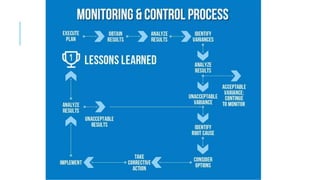
CONTROL MECHANISMS
1.Monitoring
2.Incentive Contracting
MONITORING
The principal can design control
systems that monitors agent’s
actions. For example, financial
reports and performance appraisal
are tools of monitoring. Agency
theory has attempted to explain why
different agency relationships involve
different levels of monitoring.
INCENTIVE CONTRACTING
A principal may attempt to limit divergent preferences
by establishing an appropriate incentive contracts. The
more an agent’s reward depends on a performance
measure; the more incentive there is for the agent to
improve the measure. Therefore, the principal should
define the performance measure to that it furthers the
employee’s interest. The ability to accomplish this is
referred to as goal congruence.
When the contract given to the agent motivates the
agent to work in the principal’s best interest, the
contract is considered goal congruent.
A Performance Measurement
System is a simply a mechanism
that improves the organization
and shows how the organization
will implement its strategy
successfully.
MORALE
Morale is generally considered as a
group phenomenon and in some
cases it is viewed as an individual
phenomenon. It may be described as
a feeling of the employee towards his
work, organization more often related
to his personality
MORALE AND CONTROL
Morale is viewed as an important component
for increase in productivity. In the same line of
thought, the level of morale also induces the
level of control.
CONTROL AND MORALE
Control and morale are interrelated.
On one hand, the high morale level
improves self control in the
organization, which helps in effective
implementation of management
control system. On the other hand, an
effective control system like control of
absenteeism and tardiness will
improve morale. It is a continuous
process and a miss in the link may
develop a serious trouble for the
CONTROL AND MORALE
INTERRELATIONSHIP
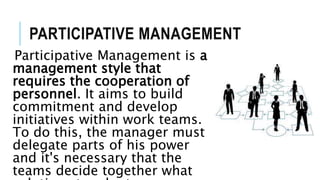
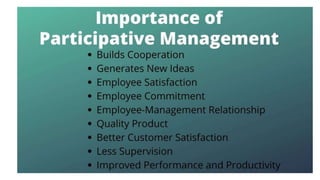
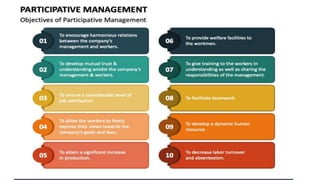
PARTICIPATIVE MANAGEMENT
Participative Management is a
management style that
requires the cooperation of
personnel. It aims to build
commitment and develop
initiatives within work teams.
To do this, the manager must
delegate parts of his power
and it's necessary that the
teams decide together what
PARTICIPATIVE MANAGEMENT
Participative management is a
method, which gives employees
responsibility, accountability, and
authority over their work. The
method provides simple tools for
employees to improve their work
performance and positively impact
the bottom line.
PARTICIPATIVE MANAGEMENT
participative management indirectly
induces the ‘self-control’ mechanism,
which is rather more powerful than
any other control mechanisms.
People solve their own issues and feel
empowered within the process of
doing so. Executives and employees
learn to redesign their workplace to
be participative and self-managing
PARTICIPATIVE MANAGEMENT
Participative management creates a
workforce that is committed to
obtaining positive results for the
organization such as increased
productivity and improved quality.
PARTICIPATIVE MANAGEMENT
Participative management works
best when the organization has a
clear and compelling mission and
vision. Employees then can align
their personal mission and vision
to the organization.
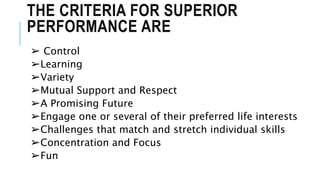
THE CRITERIA FOR SUPERIOR
PERFORMANCE ARE
➢ Control
➢Learning
➢Variety
➢Mutual Support and Respect
➢A Promising Future
➢Engage one or several of their preferred life interests
➢Challenges that match and stretch individual skills
➢Concentration and Focus
➢Fun
Participative management makes it
to people’s advantage to share
their knowledge because when
their team is successful they are
successful. The group excels
because the criteria for superior
performance are being applied and
top management sees the benefit
of all employees contributing to
the organization.
RESISTANCE TO THE
PARTICIPATIVE MANAGEMENT
PROCESS
Whenever there is
change we can expect
resistance to the
process. Many people
do not welcome change
even if it is in their best
interests.
People do not want to
lose power and control.
RESISTANCE TO THE
PARTICIPATIVE MANAGEMENT
PROCESS
An effective method for managing
this type of situation is to reassure
the person or group that the
change is for the best interest of
the organization.
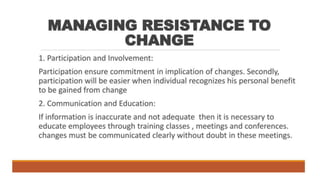
MANAGING RESISTANCE TO
CHANGE
1. Participation and Involvement
2. Communication and Education
3. Leadership
4. Negotiation and Agreement
5. Willingness
6. Timing of Change
PARTICIPATIVE MANAGEMENT MAY FAIL
BECAUSE OF THE FOLLOWING
REASONS:
Resistance to Change: Participative
Management calls for a change in the
entire organizational culture..
Workers tendency to deviate: Managers
must be aware of the tendency of the
workers to try spending more time
formulating strategies than focus on job
in hand. This needs to taken care of.
Again top level management may not
PARTICIPATIVE MANAGEMENT MAY FAIL
BECAUSE OF THE FOLLOWING
REASONS:
One stop Solution: Participative management can
not always be a one stop solution for every problem.
Often the manager needs to delegate or take a
decision on his own without consulting or seeking
others advice. For example, cases where disciplinary
action is needed do not qualify for participative
management.
Size of the Organization: This style of management
can be more difficult to implement in organizations
that are big in size. Big size means that there are
large numbers of management layers. This often
PARTICIPATIVE MANAGEMENT MAY FAIL
BECAUSE OF THE FOLLOWING
REASONS:
Abuse of Authority: Managers sometimes look upon
their own jobs as a license instead as a
responsibility. They are unwilling to give away some
authority to their subordinate which slows down and
chokes the process of decision making. Often such
managers complain of being overburdened with
responsibilities. This fails the idea of participative
management.
Misunderstanding Participation: This is yet another
reason for failure of participative management.
Managers sometimes fail to understand that
participative management is not the same as
delegating or distributing responsibility. They fail to
THE END

DOE 8 Management Control Sysytems.pptx

  • 1.
  • 2.
    TOPICS: -AGENCY THEORY -CONTROL MECHANISMS -PARTICIPATIVEMANAGEMENT -THE CRITERIA FOR SUPERIOR PERFORMANCE
  • 3.
    WHAT IS AGENCYTHEORY? Agency Theory is a principle that is used to explain and resolve issues in the relationship between business principals and their agents. Most commonly, that relationship is the one between shareholders,
  • 4.
  • 5.
    -Agency theory attemptsto explain and resolve disputes over the respective priorities between principals and their agents. -Principals rely on agents to execute certain transactions, which results in a difference in agreement on priorities and methods. -The difference in priorities and interests between agents and principals is known as the principal-agent problem. -Resolving the differences in expectations is called "reducing agency loss." -Performance-based compensation is one way that is used to achieve a balance between
  • 6.
    CONTROL MECHANISM A meansto control the behavior of or within a process or system. There are many types of control mechanisms. Human decision making is a control mechanism made by an individual to start or delay a process in an attempt to keep or bring a process within a desired state.
  • 7.
    CONTROL MECHANISM Control mechanismscan be physical such as limiting the number of trailers controls the number of deliveries that can be made at a given time. Software provides control by signaling whether a process should be started or delayed in order to achieve or maintain a desired
  • 8.
  • 9.
    MONITORING The principal candesign control systems that monitors agent’s actions. For example, financial reports and performance appraisal are tools of monitoring. Agency theory has attempted to explain why different agency relationships involve different levels of monitoring.
  • 11.
    INCENTIVE CONTRACTING A principalmay attempt to limit divergent preferences by establishing an appropriate incentive contracts. The more an agent’s reward depends on a performance measure; the more incentive there is for the agent to improve the measure. Therefore, the principal should define the performance measure to that it furthers the employee’s interest. The ability to accomplish this is referred to as goal congruence. When the contract given to the agent motivates the agent to work in the principal’s best interest, the contract is considered goal congruent.
  • 12.
    A Performance Measurement Systemis a simply a mechanism that improves the organization and shows how the organization will implement its strategy successfully.
  • 13.
    MORALE Morale is generallyconsidered as a group phenomenon and in some cases it is viewed as an individual phenomenon. It may be described as a feeling of the employee towards his work, organization more often related to his personality
  • 14.
    MORALE AND CONTROL Moraleis viewed as an important component for increase in productivity. In the same line of thought, the level of morale also induces the level of control.
  • 15.
    CONTROL AND MORALE Controland morale are interrelated. On one hand, the high morale level improves self control in the organization, which helps in effective implementation of management control system. On the other hand, an effective control system like control of absenteeism and tardiness will improve morale. It is a continuous process and a miss in the link may develop a serious trouble for the
  • 16.
  • 17.
    PARTICIPATIVE MANAGEMENT Participative Managementis a management style that requires the cooperation of personnel. It aims to build commitment and develop initiatives within work teams. To do this, the manager must delegate parts of his power and it's necessary that the teams decide together what
  • 21.
    PARTICIPATIVE MANAGEMENT Participative managementis a method, which gives employees responsibility, accountability, and authority over their work. The method provides simple tools for employees to improve their work performance and positively impact the bottom line.
  • 22.
    PARTICIPATIVE MANAGEMENT participative managementindirectly induces the ‘self-control’ mechanism, which is rather more powerful than any other control mechanisms. People solve their own issues and feel empowered within the process of doing so. Executives and employees learn to redesign their workplace to be participative and self-managing
  • 23.
    PARTICIPATIVE MANAGEMENT Participative managementcreates a workforce that is committed to obtaining positive results for the organization such as increased productivity and improved quality.
  • 24.
    PARTICIPATIVE MANAGEMENT Participative managementworks best when the organization has a clear and compelling mission and vision. Employees then can align their personal mission and vision to the organization.
  • 25.
    THE CRITERIA FORSUPERIOR PERFORMANCE ARE ➢ Control ➢Learning ➢Variety ➢Mutual Support and Respect ➢A Promising Future ➢Engage one or several of their preferred life interests ➢Challenges that match and stretch individual skills ➢Concentration and Focus ➢Fun
  • 26.
    Participative management makesit to people’s advantage to share their knowledge because when their team is successful they are successful. The group excels because the criteria for superior performance are being applied and top management sees the benefit of all employees contributing to the organization.
  • 27.
    RESISTANCE TO THE PARTICIPATIVEMANAGEMENT PROCESS Whenever there is change we can expect resistance to the process. Many people do not welcome change even if it is in their best interests. People do not want to lose power and control.
  • 28.
    RESISTANCE TO THE PARTICIPATIVEMANAGEMENT PROCESS An effective method for managing this type of situation is to reassure the person or group that the change is for the best interest of the organization.
  • 29.
    MANAGING RESISTANCE TO CHANGE 1.Participation and Involvement 2. Communication and Education 3. Leadership 4. Negotiation and Agreement 5. Willingness 6. Timing of Change
  • 33.
    PARTICIPATIVE MANAGEMENT MAYFAIL BECAUSE OF THE FOLLOWING REASONS: Resistance to Change: Participative Management calls for a change in the entire organizational culture.. Workers tendency to deviate: Managers must be aware of the tendency of the workers to try spending more time formulating strategies than focus on job in hand. This needs to taken care of. Again top level management may not
  • 34.
    PARTICIPATIVE MANAGEMENT MAYFAIL BECAUSE OF THE FOLLOWING REASONS: One stop Solution: Participative management can not always be a one stop solution for every problem. Often the manager needs to delegate or take a decision on his own without consulting or seeking others advice. For example, cases where disciplinary action is needed do not qualify for participative management. Size of the Organization: This style of management can be more difficult to implement in organizations that are big in size. Big size means that there are large numbers of management layers. This often
  • 35.
    PARTICIPATIVE MANAGEMENT MAYFAIL BECAUSE OF THE FOLLOWING REASONS: Abuse of Authority: Managers sometimes look upon their own jobs as a license instead as a responsibility. They are unwilling to give away some authority to their subordinate which slows down and chokes the process of decision making. Often such managers complain of being overburdened with responsibilities. This fails the idea of participative management. Misunderstanding Participation: This is yet another reason for failure of participative management. Managers sometimes fail to understand that participative management is not the same as delegating or distributing responsibility. They fail to
  • 36.

Editor's Notes

  • #4 Agency theory explores how contracts and incentives can be used as motivation tools to achieve goal congruence.
  • #5 An agency relationship exists whenever one party (the principal) hires another party (The agent) to perform some service and in so doing, delegates decision making authority to the agent. In an organization shareholders are the principal and the Top –level Manager, say a CEO is the agent. At the other level, the CEO is the principal and the unit managers are the agents. The challenge is how to motivate the agents’ so that they will be productive as they would be if they are the owners. Agency theory conceptualize that the principals and agents have divergent preferences or objectives. The theory assumes that all individuals act in their own self-interest. Agents are assumed to receive satisfaction not only from financial compensation but also from the perks involved in an agency relationship, such as leisure time, good environment, club memberships etc. Principals on the other hand are interested only in the financial returns from the investments.
  • #7 Mechanisms exist to ensure that the organization is on track
  • #8 Mechanisms exist to ensure that the organization is on track
  • #9 Monitoring and Incentive contracting are the two control mechanisms suggested by the agency theory.
  • #11 Monitoring IS THE WAY TO track, review, adjust and report on the project’s performance. It’s important to find out how a project’s performing and whether it’s on time, as well as implement approved changes. This ensures the project remains on track, on budget and on time.
  • #14 The attitude differs for each individual. The environment the employees work in greatly influences the behaviour and attitude. Managers at all levels are highly concerned about the Morale.
  • #15 In any organization the rules and regulations are imposed in a expectation that it is followed even when supervision is not available. At the end of the day, any manager can understand that self control is more important than any other form of control- say supervision, punishments, pay-cuts, demotions etc. Let us see how the control system is linked with Morale and attitudes thru the diagram Morale is contagious. The reason being, people learn from one another through various communication channels. Hence, to implement an effective management control system, the cultivation of favourable attitudes with morale building objectives is one of the important characteristics of management process. Further, the centre of the process of managing attitudes is for the superior to become the master of his own attitudes because a manager’s attitudes are in a large part likely to reappear as attitudes of those who are near him in the organization. The first line supervisor is a key factor in morale because his morale has huge effects on his subordinates.
  • #17 Even though we emphasises on the efficiency of the control system, there should be a human relations approach to the design of the system to make it acceptable among the employees. When every individual is treated with respect and due care, there would be a trust building which will lead to morale building and thus resulting in efficient control.
  • #18 The process provides an environment to make employee needs known and creates a vehicle for improved communication between all areas of the organization. What differentiates this work is that people’s recommendations are actually implemented and acted upon.
  • #19 Participative management includes ----
  • #22 The process provides an environment to make employee needs known and creates a vehicle for improved communication between all areas of the organization. What differentiates this work is that people’s recommendations are actually implemented and acted upon.
  • #23 The process provides an environment to make employee needs known and creates a vehicle for improved communication between all areas of the organization. What differentiates this work is that people’s recommendations are actually implemented and acted upon.
  • #24 People are engaged and motivated and are willing to put forth energy to improve work performance.
  • #25 People have clear roles and responsibilities and manage themselves as much as possible. Management tells people what the strategy is and what is expected in terms of results and then allows people to figure out the how to deliver on management expectations. Top management still decides strategy and front line employees still focus on their primary tasks. The difference is that the criteria for superior performance are utilized and leveraged for the success of the organization.
  • #26 The criteria for superior performance are drivers of behaviour, reasons why people get up in the morning and are enthusiastic about their work. When the criteria for superior performance are leveraged in an organization the performance will dramatically improve
  • #34 Older employees specially resist change and do not welcome it. They take it as a device to curtail their powers. Training is also not welcome