Introduction
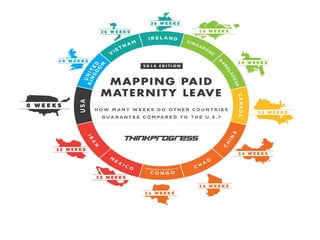
The objective of maternity leave and benefits to
protect the dignity of motherhood by providing
complete health maintenance of women and
her child when she is non-working. With the
advent of modern age, as the number of women
employees are growing the maternity leave and
the benefits are becoming interestingly more
common.
ACT 53 Of 1961
The bill was passed by both the Houses of
Parliament and Subsequently it received the
assent of president on 12th December, 1961. The
act comes under a title called “ MATERNITY
BENEFIT ACT”, providing maternity leave and
maternity benefits.
MINISTRY OF LAW AND JUSTICE (Legislative
Department) New Delhi, the 28th March,
2017/Chaitra 7, 1939 (Saka) The following Act of
Parliament received the assent of the President
on the 27th March, 2017, and is hereby
published for general information:- THE
MATERNITY BENEFIT (AMENDMENT) ACT, 2017
Employment of, or work by, women prohibited
during certain period. No employer shall
knowingly employ a woman in any
establishment during the six weeks immediately
following the day of her delivery , miscarriage or
medical termination of pregnancy.
• No woman shall work in any establishment
during the six weeks immediately following the
day of her delivery 1, miscarriage or medical
termination of pregnancy.
• Without prejudice to the provisions of section 6,
no pregnant woman shall, on a request being
made by her in this behalf, be required by her
employer to do during the period specified in
sub-sections.any work which is of an arduous
nature or which involves long hours of standing,
or which in any way is likely to interfere with her
pregnancy or the normal development of the
foetus, or is likely to cause her miscarriage or
otherwise to adversely affect her health
Right to payment of maternity benefit.—
Subject to the provisions of this Act, every
woman shall be entitled to, and her employer
shall be liable for, the payment of maternity
benefit at the rate of the average daily wage for
the period of her actual absence, that is to say,
the period immediately preceding the day of her
delivery, the actual day of her delivery and any
period immediately following that day.
Continuance of payment of maternity benefit
in certain cases.—Every woman entitled to the
payment of maternity benefit under this Act
shall, notwithstanding the application of the
Employees’ State Insurance Act, 1948 (34 of
1948), to the factory or other establishment in
which she is employed, continue to be so
entitled until she becomes qualified to claim
maternity benefit under section 50 of that act
• Payment of maternity benefit in certain
cases.—Every woman— (a) who is employed
in a factory or other establishment to which
the provisions of the Employees’ State
Insurance Act, 1948 (34 of 1948), apply; (b)
whose wages (excluding remuneration for
overtime work) for a month exceed the
amount specified in sub-clause (b) of clause
(9) of section 2 of that Act; and (c) who fulfils
the conditions specified in sub-section (2) of
section
• Notice of claim for maternity benefit and
payment thereof. Any woman employed in an
establishment and entitled to maternity
benefit under the provisions of this Act may
give notice in writing
• Payment of maternity benefit in case of
death of a woman.—If a woman entitled to
maternity benefit or any other amount under
this Act, dies before receiving such maternity
benefit or amount, or where the employer is
liable for maternity benefit under the second
proviso to sub-section (3) of section 5, the
employer shall pay such benefit or amount to
the person nominated by the woman in the
notice given under section 6 and in case there
is no such nominee, to her legal
representative.
Payment of medical bonus.Every woman
entitled to maternity benefit under this Act shall
also be entitled to receive from her employer a
medical bonus of one thousand rupees, if no
pre-natal confinement and post-natal care is
provided for by the employer free of charge. The
Central Government may before every three
years, by notification in the Official Gazette,
increase the amount of medical bonus subject
to the maximum of twenty thousand rupees.
• Leave for miscarriage, etc.—In case of
miscarriage or medical termination of pregnancy,
a woman shall, on production of such proof as
may be prescribed, be entitled to leave with
wages at the rate of maternity benefit, for a
period of six weeks immediately following the
day of her miscarriage or, as the case may be, her
medical termination of pregnancy.] 4 [9A. Leave
with wages for tubectomy operation.—In case of
tubectomy operation, a woman shall, shall, on
production of such proof as may be prescribed,
be entitled to leave with wages at the rate of
maternity benefit for a period of two weeks
immediately following the day of her tubectomy
operation.]
Leave for illness arising out of pregnancy, delivery,
premature birth of child [, miscarriage,
miscarriage, medical termination of pregnancy or
tubectomy operation].—A woman suffering from
illness arising out of pregnancy, delivery, premature
birth of child 4 [, miscarriage, medical termination
of pregnancy or tubectomy operation] shall, on
production of such proof as may be prescribed, be
entitled, in addition to the period of absence
allowed to her under section 6, or, as the case may
be, under section 9, to leave with wages at the rate
of maternity benefit for a maximum period of one
month.
• Nursing breaks.—Every woman delivered of a child who
returns to duty after such delivery shall, in addition to the
interval for rest allowed to her, be allowed in the course of
her daily work two breaks of the prescribed duration for
nursing the child until the child attains the age of fifteen
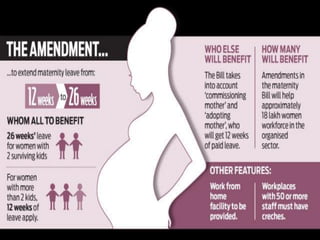
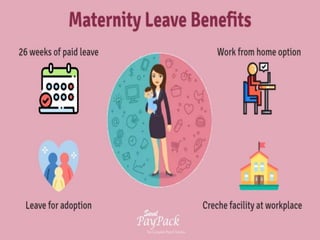
months. 1 [11A. Crèche facility.—(1) Every establishment
having fifty or more employees shall have the facility of
créche within such distance as may be prescribed, either
separately or along with common facilities: Provided that the
employer shall allow four visits a day to the creche by the
woman, which shall also include the interval for rest allowed
to her. (2) Every establishment shall intimate in writing and
electronically to every woman at the time of her initial
appointment regarding every benefit available under the Act.]
DOC-2023092.pdf
DOC-2023092.pdf

DOC-2023092.pdf

  • 5.
    Introduction The objective ofmaternity leave and benefits to protect the dignity of motherhood by providing complete health maintenance of women and her child when she is non-working. With the advent of modern age, as the number of women employees are growing the maternity leave and the benefits are becoming interestingly more common.
  • 7.
    ACT 53 Of1961 The bill was passed by both the Houses of Parliament and Subsequently it received the assent of president on 12th December, 1961. The act comes under a title called “ MATERNITY BENEFIT ACT”, providing maternity leave and maternity benefits.
  • 8.
    MINISTRY OF LAWAND JUSTICE (Legislative Department) New Delhi, the 28th March, 2017/Chaitra 7, 1939 (Saka) The following Act of Parliament received the assent of the President on the 27th March, 2017, and is hereby published for general information:- THE MATERNITY BENEFIT (AMENDMENT) ACT, 2017
  • 10.
    Employment of, orwork by, women prohibited during certain period. No employer shall knowingly employ a woman in any establishment during the six weeks immediately following the day of her delivery , miscarriage or medical termination of pregnancy.
  • 12.
    • No womanshall work in any establishment during the six weeks immediately following the day of her delivery 1, miscarriage or medical termination of pregnancy. • Without prejudice to the provisions of section 6, no pregnant woman shall, on a request being made by her in this behalf, be required by her employer to do during the period specified in sub-sections.any work which is of an arduous nature or which involves long hours of standing, or which in any way is likely to interfere with her pregnancy or the normal development of the foetus, or is likely to cause her miscarriage or otherwise to adversely affect her health
  • 14.
    Right to paymentof maternity benefit.— Subject to the provisions of this Act, every woman shall be entitled to, and her employer shall be liable for, the payment of maternity benefit at the rate of the average daily wage for the period of her actual absence, that is to say, the period immediately preceding the day of her delivery, the actual day of her delivery and any period immediately following that day.
  • 15.
    Continuance of paymentof maternity benefit in certain cases.—Every woman entitled to the payment of maternity benefit under this Act shall, notwithstanding the application of the Employees’ State Insurance Act, 1948 (34 of 1948), to the factory or other establishment in which she is employed, continue to be so entitled until she becomes qualified to claim maternity benefit under section 50 of that act
  • 17.
    • Payment ofmaternity benefit in certain cases.—Every woman— (a) who is employed in a factory or other establishment to which the provisions of the Employees’ State Insurance Act, 1948 (34 of 1948), apply; (b) whose wages (excluding remuneration for overtime work) for a month exceed the amount specified in sub-clause (b) of clause (9) of section 2 of that Act; and (c) who fulfils the conditions specified in sub-section (2) of section
  • 21.
    • Notice ofclaim for maternity benefit and payment thereof. Any woman employed in an establishment and entitled to maternity benefit under the provisions of this Act may give notice in writing
  • 23.
    • Payment ofmaternity benefit in case of death of a woman.—If a woman entitled to maternity benefit or any other amount under this Act, dies before receiving such maternity benefit or amount, or where the employer is liable for maternity benefit under the second proviso to sub-section (3) of section 5, the employer shall pay such benefit or amount to the person nominated by the woman in the notice given under section 6 and in case there is no such nominee, to her legal representative.
  • 24.
    Payment of medicalbonus.Every woman entitled to maternity benefit under this Act shall also be entitled to receive from her employer a medical bonus of one thousand rupees, if no pre-natal confinement and post-natal care is provided for by the employer free of charge. The Central Government may before every three years, by notification in the Official Gazette, increase the amount of medical bonus subject to the maximum of twenty thousand rupees.
  • 26.
    • Leave formiscarriage, etc.—In case of miscarriage or medical termination of pregnancy, a woman shall, on production of such proof as may be prescribed, be entitled to leave with wages at the rate of maternity benefit, for a period of six weeks immediately following the day of her miscarriage or, as the case may be, her medical termination of pregnancy.] 4 [9A. Leave with wages for tubectomy operation.—In case of tubectomy operation, a woman shall, shall, on production of such proof as may be prescribed, be entitled to leave with wages at the rate of maternity benefit for a period of two weeks immediately following the day of her tubectomy operation.]
  • 29.
    Leave for illnessarising out of pregnancy, delivery, premature birth of child [, miscarriage, miscarriage, medical termination of pregnancy or tubectomy operation].—A woman suffering from illness arising out of pregnancy, delivery, premature birth of child 4 [, miscarriage, medical termination of pregnancy or tubectomy operation] shall, on production of such proof as may be prescribed, be entitled, in addition to the period of absence allowed to her under section 6, or, as the case may be, under section 9, to leave with wages at the rate of maternity benefit for a maximum period of one month.
  • 31.
    • Nursing breaks.—Everywoman delivered of a child who returns to duty after such delivery shall, in addition to the interval for rest allowed to her, be allowed in the course of her daily work two breaks of the prescribed duration for nursing the child until the child attains the age of fifteen months. 1 [11A. Crèche facility.—(1) Every establishment having fifty or more employees shall have the facility of créche within such distance as may be prescribed, either separately or along with common facilities: Provided that the employer shall allow four visits a day to the creche by the woman, which shall also include the interval for rest allowed to her. (2) Every establishment shall intimate in writing and electronically to every woman at the time of her initial appointment regarding every benefit available under the Act.]