Documentary Codes and
Conventions
MAGDA RAK
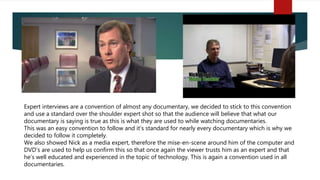
Expert interviews are a convention of almost any documentary, we decided to stick to this convention
and use a standard over the shoulder expert shot so that the audience will believe that what our
documentary is saying is true as this is what they are used to while watching documentaries.
This was an easy convention to follow and it’s standard for nearly every documentary which is why we
decided to follow it completely.
We also showed Nick as a media expert, therefore the mise-en-scene around him of the computer and
DVD’s are used to help us confirm this so that once again the viewer trusts him as an expert and that
he’s well educated and experienced in the topic of technology. This is again a convention used in all
documentaries.
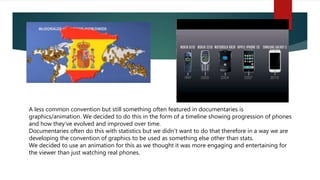
A less common convention but still something often featured in documentaries is
graphics/animation. We decided to do this in the form of a timeline showing progression of phones
and how they’ve evolved and improved over time.
Documentaries often do this with statistics but we didn’t want to do that therefore in a way we are
developing the convention of graphics to be used as something else other than stats.
We decided to use an animation for this as we thought it was more engaging and entertaining for
the viewer than just watching real phones.
Statistics are also a very important convention in having the audience believe what you are saying is true
and factual. We decided to use simple text with voiceover rather than charts as we felt that that is easier
to understand and follow along for the audience.
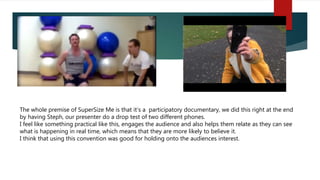
The whole premise of SuperSize Me is that it’s a participatory documentary, we did this right at the end
by having Steph, our presenter do a drop test of two different phones.
I feel like something practical like this, engages the audience and also helps them relate as they can see
what is happening in real time, which means that they are more likely to believe it.
I think that using this convention was good for holding onto the audiences interest.
Voxs pops are another convention that nearly ever documentary has. We used vox pops to find out if
people believe in a generational technology gap. This gave us a wide variety of opinions and helped
us establish our young versus old binary opposition.
I don’t feel like we developed or challenged this in any way and used it in the same way that most
other documentaries do.
Another convention that we used was an on screen presenter. We felt like this would make our
documentary easier to progress through the storyline if someone was there present to guide it and also
that the audience can relate to.
Conclusion
In conclusion I don’t believe that we challenged any conventions at it wasn’t necessary to
do that for our documentary to work and be engaging.
We developed the convention of using graphics for stats and instead used it for giving a
different type of information.
We mostly stuck to conventions as it was easy worked for the plan of our documentary and
what we wanted to achieve with it.

Doc codes and conventions

  • 1.
  • 2.
    Expert interviews area convention of almost any documentary, we decided to stick to this convention and use a standard over the shoulder expert shot so that the audience will believe that what our documentary is saying is true as this is what they are used to while watching documentaries. This was an easy convention to follow and it’s standard for nearly every documentary which is why we decided to follow it completely. We also showed Nick as a media expert, therefore the mise-en-scene around him of the computer and DVD’s are used to help us confirm this so that once again the viewer trusts him as an expert and that he’s well educated and experienced in the topic of technology. This is again a convention used in all documentaries.
  • 3.
    A less commonconvention but still something often featured in documentaries is graphics/animation. We decided to do this in the form of a timeline showing progression of phones and how they’ve evolved and improved over time. Documentaries often do this with statistics but we didn’t want to do that therefore in a way we are developing the convention of graphics to be used as something else other than stats. We decided to use an animation for this as we thought it was more engaging and entertaining for the viewer than just watching real phones.
  • 4.
    Statistics are alsoa very important convention in having the audience believe what you are saying is true and factual. We decided to use simple text with voiceover rather than charts as we felt that that is easier to understand and follow along for the audience.
  • 5.
    The whole premiseof SuperSize Me is that it’s a participatory documentary, we did this right at the end by having Steph, our presenter do a drop test of two different phones. I feel like something practical like this, engages the audience and also helps them relate as they can see what is happening in real time, which means that they are more likely to believe it. I think that using this convention was good for holding onto the audiences interest.
  • 6.
    Voxs pops areanother convention that nearly ever documentary has. We used vox pops to find out if people believe in a generational technology gap. This gave us a wide variety of opinions and helped us establish our young versus old binary opposition. I don’t feel like we developed or challenged this in any way and used it in the same way that most other documentaries do.
  • 7.
    Another convention thatwe used was an on screen presenter. We felt like this would make our documentary easier to progress through the storyline if someone was there present to guide it and also that the audience can relate to.
  • 8.
    Conclusion In conclusion Idon’t believe that we challenged any conventions at it wasn’t necessary to do that for our documentary to work and be engaging. We developed the convention of using graphics for stats and instead used it for giving a different type of information. We mostly stuck to conventions as it was easy worked for the plan of our documentary and what we wanted to achieve with it.