The great misconception about mathematics -- and it stifles and
thwarts more students than any other single thing -- is the notion
that mathematics is about formulas and cranking out computations.
It is the unconsciously held delusion that mathematics is a set of
rules and formulas that have been worked out by God knows who
for God knows why, and the student's duty is to memorize all this
stuff. Such students seem to feel that sometime in the future their
boss will walk into the office and demand "Quick, what's the
quadratic formula?" Or, "Hurry, I need to know the derivative of
3x^2 - 6x + 7." There are no such employers.
The topics which are mainly useful in daily life are :

 Commercial Mathematics
 Algebra
 Statistics
 Calculus
 Number Theory
 Graph Theory
 Geometry
 Mechanics
COMMERCIAL MATHEMATICS

This include the following topics :

Discount
Banking
Foreign Exchange
Stock and Share
Arithmetic ( Profit & Loss, Percentage, Ratio and
 Proposition , Time problems)
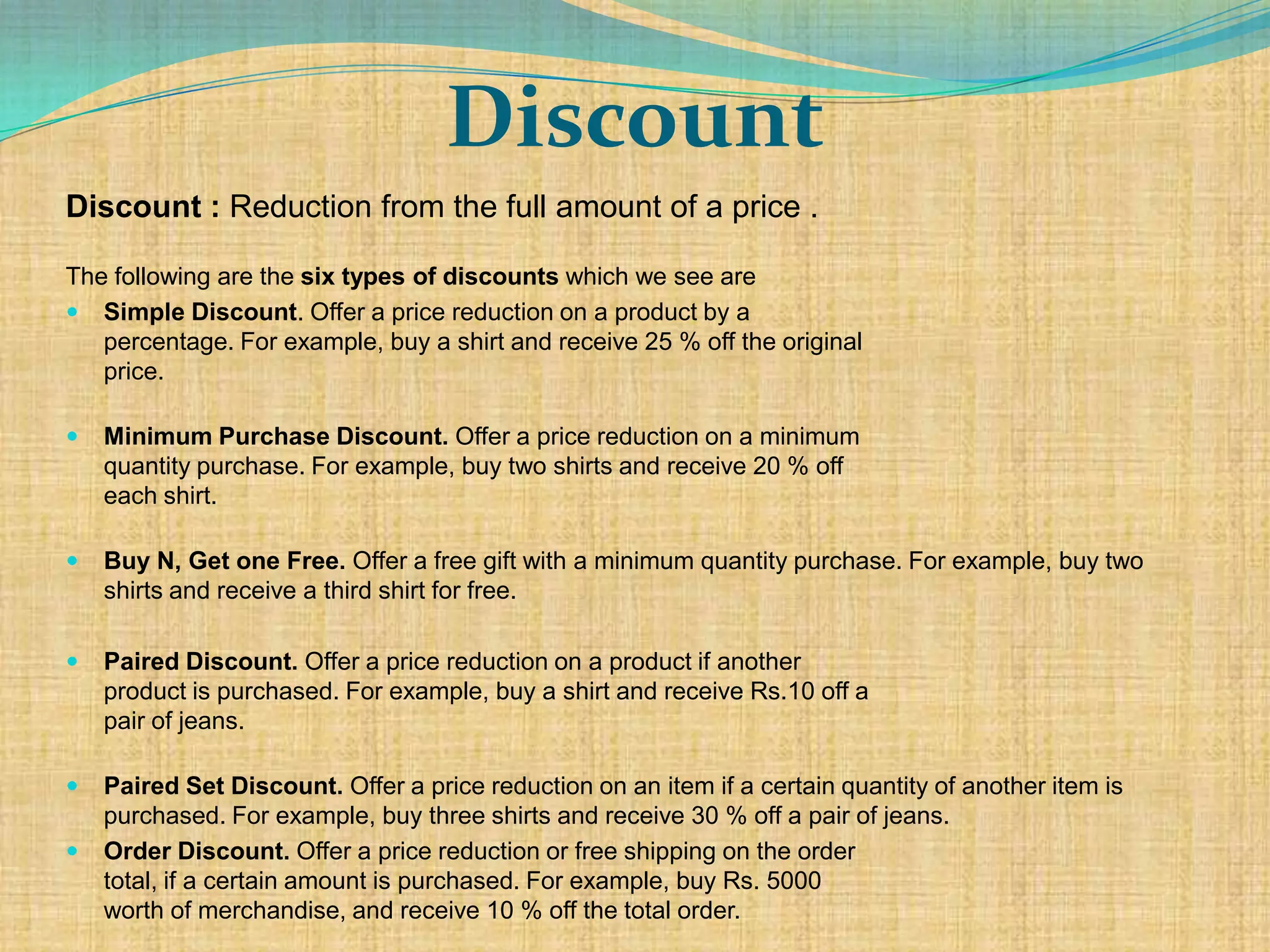
Discount
Discount : Reduction from the full amount of a price .

The following are the six types of discounts which we see are
 Simple Discount. Offer a price reduction on a product by a
   percentage. For example, buy a shirt and receive 25 % off the original
   price.

   Minimum Purchase Discount. Offer a price reduction on a minimum
    quantity purchase. For example, buy two shirts and receive 20 % off
    each shirt.

   Buy N, Get one Free. Offer a free gift with a minimum quantity purchase. For example, buy two
    shirts and receive a third shirt for free.

   Paired Discount. Offer a price reduction on a product if another
    product is purchased. For example, buy a shirt and receive Rs.10 off a
    pair of jeans.

   Paired Set Discount. Offer a price reduction on an item if a certain quantity of another item is
    purchased. For example, buy three shirts and receive 30 % off a pair of jeans.
   Order Discount. Offer a price reduction or free shipping on the order
    total, if a certain amount is purchased. For example, buy Rs. 5000
    worth of merchandise, and receive 10 % off the total order.
BANKING
     Banking : A system of trading in money which involved
    safeguarding deposits and making funds available for
    borrowers.

 What is the use of mathematics in Banking ?

 Bank is full of transactions. In turn the transaction is
  nothing but mathematics
 Banks are also involved in stocks and bonds. Bond
  calculations are mathematical. Stock options are
  also quite mathematical.
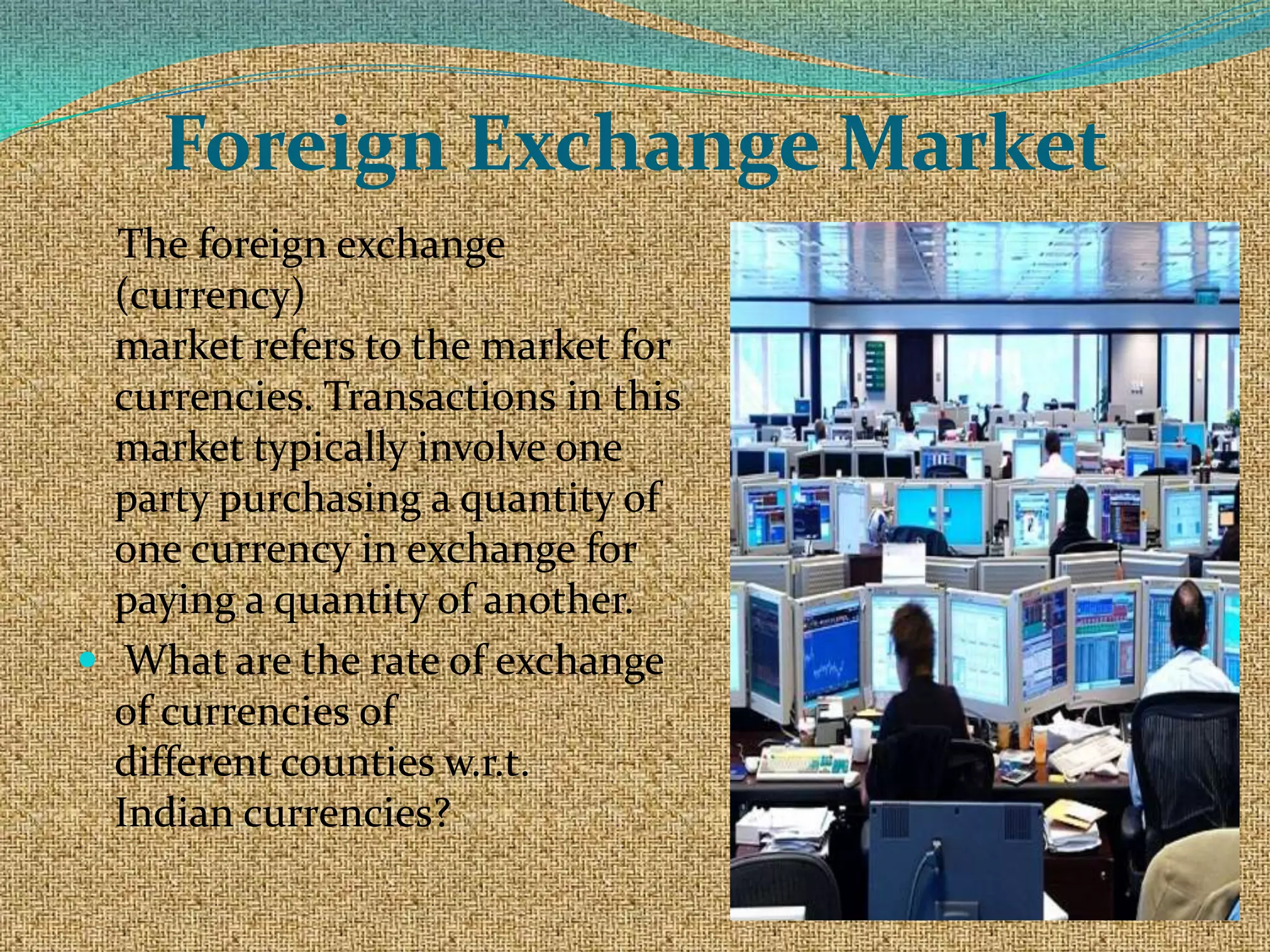
Foreign Exchange Market
  The foreign exchange
  (currency)
  market refers to the market for
  currencies. Transactions in this
  market typically involve one
  party purchasing a quantity of
  one currency in exchange for
  paying a quantity of another.
 What are the rate of exchange
  of currencies of
  different counties w.r.t.
  Indian currencies?
Stock and Share
  Stock and Share :In business and finance, a share (also
  referred to as equity share) of stock means a
  share of ownership in a corporation (company). In the
  plural, stocks is often used as a synonym for shares

 A stock is at a premium ( above par) , at par or at a discount
  (below par ) according as its market value is greater than ,
  equal to or less than the face value .
 Generally stocks are sold and purchased through brokers.
  The amount paid to them in selling and purchasing stocks
  are called Brokerage.
  so ,C.P.=M.V. + Brokerage
ARITHMETIC
  Arithmetic ( Profit & Loss, Percentage, Ratio and Proposition ,
  Time related problems): The word refers to a branch of
  mathematics which records elementary properties of certain
  operations on numbers.


  Arithmetic operations:
 The traditional arithmetic operations are addition,
  subtraction, multiplication and division, although more
  advanced      operations   (such     as    manipulations of
  percentages, square root, exponentiation, and logarithmic
  functions) are also sometimes included in this subject.
ALGEBRA
   Algebra : It is a branch of mathematics concerning the study of structure, relation,
   and quantity.

   Classification :Algebra may be divided into the following categories:
 Elementary algebra, in which the properties of operations on the real number
  system are recorded using symbols as "place holders" to denote constants and
  variables, and the rules governing mathematical expressions and equations involving
  these symbols are studied
 Abstract algebra, sometimes also called modern algebra, in which algebraic
  structures such as groups, rings and fields are axiomatically defined and investigated.
 Linear algebra, in which the specific properties of vector spaces are studied (including
  matrices);
 Universal algebra, in which properties common to all algebraic structures are studied.
 Algebraic number theory, in which the properties of numbers are studied through
  algebraic systems. Number theory inspired much of the original abstraction in algebra.
 Algebraic geometry in its algebraic aspect.
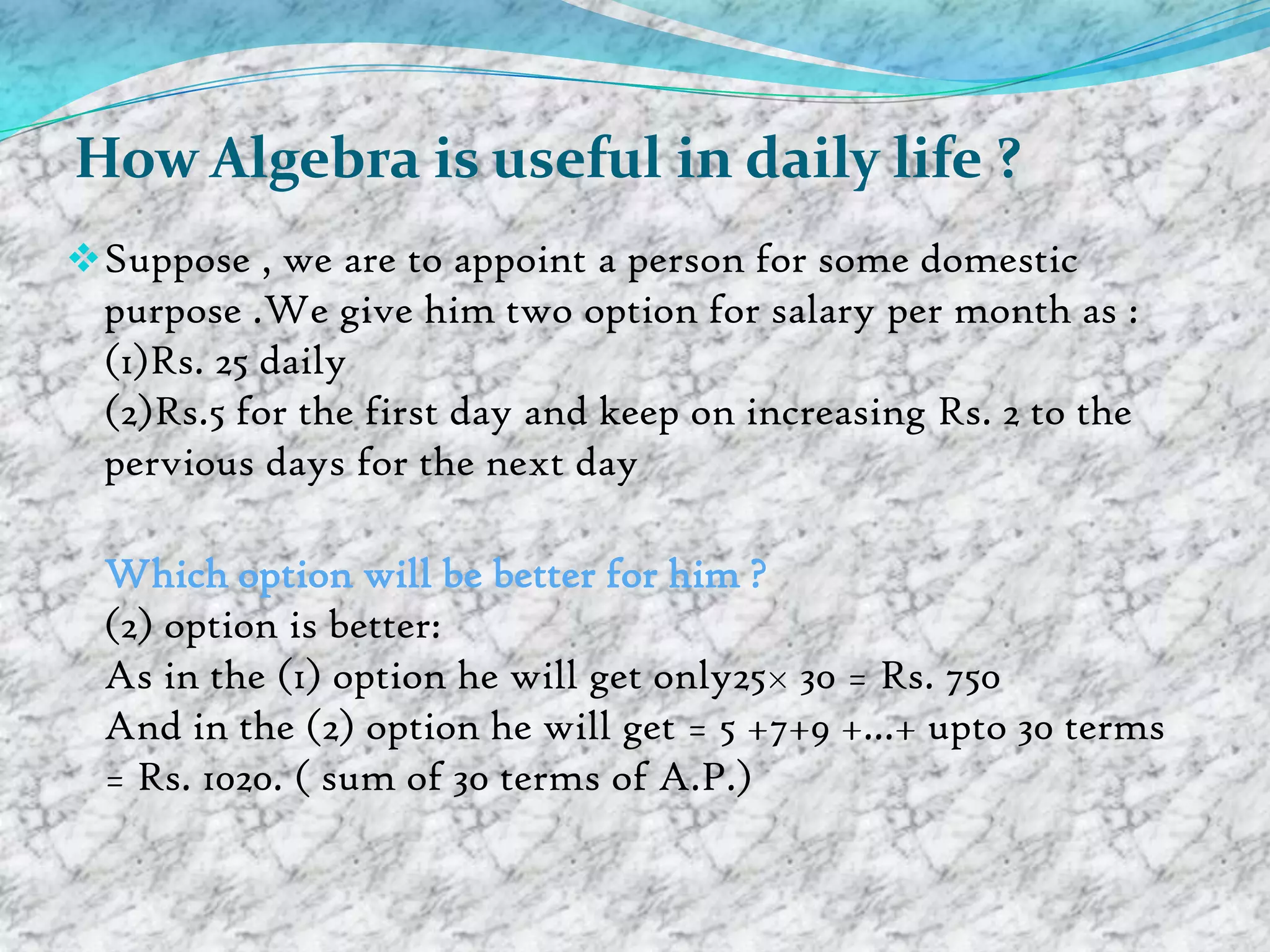
How Algebra is useful in daily life ?
 Suppose , we are to appoint a person for some domestic
  purpose .We give him two option for salary per month as :
  (1)Rs. 25 daily
  (2)Rs.5 for the first day and keep on increasing Rs. 2 to the
  pervious days for the next day

  Which option will be better for him ?
  (2) option is better:
  As in the (1) option he will get only25× 30 = Rs. 750
  And in the (2) option he will get = 5 +7+9 +...+ upto 30 terms
  = Rs. 1020. ( sum of 30 terms of A.P.)
STATISTICS

  Statistics: It is a mathematical science pertaining to the
  collection, analysis, interpretation or explanation, and
  presentation of data. Also with prediction and forecasting based
  on data.


 Statistics form a key basis tool in business and manufacturing as
  well. It is used to understand measurement systems
  variability, control processes for summarizing data, and to make
                              data-driven
  decisions. In these roles, it is a key tool, and perhaps the only
  reliable tool.
Some fields of inquiry use applied statistics so
extensively that they have specialized terminology. These
disciplines include:
   Actuarial science
   Applied information economics
   Biostatistics
   Business statistics
   Data mining
   Engineering statistics
   Environmental Statistics
   Epidemiology
   Geography and Geographic Information Systems
   Psychological statistics
   Quality
   Social statistics
   Statistical literacy
   Statistical modeling
   Statistical surveys
   Chemometrics (for analysis of data from chemistry)
   Structured data analysis (statistics)
   Statistics in various sports, particularly baseball and cricket
How the concept of mean, mode and median is used
  in daily life ?

 A shopkeeper, selling shirts, keeps more stock of that size of
  shirt which has more sale. Here the size of that shirt is the
  mode among other .

 If in a tour, the total money spent by10 students is Rs. 500.
  Then the average money spent by each student is Rs. 50.
  Here Rs. 50 is the mean.

 If you have 25 people lined up next to each other by age, the
  median age will be the age of the person in the very middle.
  Here the age of the middle person is the median.
CALCULUS

  Calculus: It is the study of change, in the same way that
  geometry is the study of space. It includes the study of
  limits, derivative , integrals, and infinite series.
 Calculus has widespread applications in science and
  engineering and is used to solve problems for which
  algebra alone is insufficient. Calculus builds on
  algebra, trigonometry, and analytic geometry and includes
  two major branches, differential calculus and integral
  calculus, that are related by the fundamental theorem of
                            calculus.
How is Integral and differential calculus useful in daily
life ?
 Integration is used to find areas of figures which are not geometric.
  Suppose you spill water on the floor and want to find out what area the
  water has covered, you can do so by integration. What it does is that it
  breaks up the non-geometric shape into a number of tiny geometric shapes.
  It then calculates the area of each of the tiny figures and adds them up.
  This of course gives only an approximation to the actual area.

 Let us consider the movement of a car on a highway. Here we can clearly
  visualize that if the highway is clear the driver would look forward to
  increase the speed to an optimum level after which he will drive with the
  same speed. With the help of calculus we can easily estimate the car's
  acceleration if we know the initial speed and the speed when he settled.
  Acceleration is therefore defined as the first order derivative of velocity,
  which in turn is the first order derivative of displacement.
GEOMETRY
  Geometry: It a part of mathematics concerned with questions of
  size, shape, and relative position of figures and with properties of
  space.


 How Is Geometry Used In Our Daily Life?

   Geometry is especially useful in home building or improvement
  projects. If you want to find the floor area of a house, you use
  geometry. This information is useful for laying carpet or tiles and for
  telling an estate agent how big your house is when you want to put
  it on the market. If you want to reupholster a piece of furniture, you
  have to estimate the amount of fabric you need by calculating the
  surface area of the furniture.
MECHANICS

  Mechanics : It is concerned with the behaviour of physical
  bodies when subjected to forces or displacements, and the
  subsequent effect of the bodies on their environment.

 Covering a long horizontal distance while making a long jump ,
  the angle of elevation should be 45°.

 Riding a bicycle round and round a globe, head downward
Maths is unavoidable. It's a deeply
    fundamental thing. Without math,
there would be no science, no music, no
art. Maths is part of all of those things. If
 it's got structure, then there's an aspect
          of it that's mathematical.
DivyANSH GOUR

DivyANSH GOUR

  • 3.
    The great misconceptionabout mathematics -- and it stifles and thwarts more students than any other single thing -- is the notion that mathematics is about formulas and cranking out computations. It is the unconsciously held delusion that mathematics is a set of rules and formulas that have been worked out by God knows who for God knows why, and the student's duty is to memorize all this stuff. Such students seem to feel that sometime in the future their boss will walk into the office and demand "Quick, what's the quadratic formula?" Or, "Hurry, I need to know the derivative of 3x^2 - 6x + 7." There are no such employers.
  • 4.
    The topics whichare mainly useful in daily life are :  Commercial Mathematics  Algebra  Statistics  Calculus  Number Theory  Graph Theory  Geometry  Mechanics
  • 5.
    COMMERCIAL MATHEMATICS This includethe following topics : Discount Banking Foreign Exchange Stock and Share Arithmetic ( Profit & Loss, Percentage, Ratio and Proposition , Time problems)
  • 6.
    Discount Discount : Reductionfrom the full amount of a price . The following are the six types of discounts which we see are  Simple Discount. Offer a price reduction on a product by a percentage. For example, buy a shirt and receive 25 % off the original price.  Minimum Purchase Discount. Offer a price reduction on a minimum quantity purchase. For example, buy two shirts and receive 20 % off each shirt.  Buy N, Get one Free. Offer a free gift with a minimum quantity purchase. For example, buy two shirts and receive a third shirt for free.  Paired Discount. Offer a price reduction on a product if another product is purchased. For example, buy a shirt and receive Rs.10 off a pair of jeans.  Paired Set Discount. Offer a price reduction on an item if a certain quantity of another item is purchased. For example, buy three shirts and receive 30 % off a pair of jeans.  Order Discount. Offer a price reduction or free shipping on the order total, if a certain amount is purchased. For example, buy Rs. 5000 worth of merchandise, and receive 10 % off the total order.
  • 7.
    BANKING  Banking : A system of trading in money which involved safeguarding deposits and making funds available for borrowers.  What is the use of mathematics in Banking ?  Bank is full of transactions. In turn the transaction is nothing but mathematics  Banks are also involved in stocks and bonds. Bond calculations are mathematical. Stock options are also quite mathematical.
  • 8.
    Foreign Exchange Market The foreign exchange (currency) market refers to the market for currencies. Transactions in this market typically involve one party purchasing a quantity of one currency in exchange for paying a quantity of another.  What are the rate of exchange of currencies of different counties w.r.t. Indian currencies?
  • 9.
    Stock and Share Stock and Share :In business and finance, a share (also referred to as equity share) of stock means a share of ownership in a corporation (company). In the plural, stocks is often used as a synonym for shares  A stock is at a premium ( above par) , at par or at a discount (below par ) according as its market value is greater than , equal to or less than the face value .  Generally stocks are sold and purchased through brokers. The amount paid to them in selling and purchasing stocks are called Brokerage. so ,C.P.=M.V. + Brokerage
  • 10.
    ARITHMETIC Arithmetic( Profit & Loss, Percentage, Ratio and Proposition , Time related problems): The word refers to a branch of mathematics which records elementary properties of certain operations on numbers. Arithmetic operations:  The traditional arithmetic operations are addition, subtraction, multiplication and division, although more advanced operations (such as manipulations of percentages, square root, exponentiation, and logarithmic functions) are also sometimes included in this subject.
  • 11.
    ALGEBRA Algebra : It is a branch of mathematics concerning the study of structure, relation, and quantity. Classification :Algebra may be divided into the following categories:  Elementary algebra, in which the properties of operations on the real number system are recorded using symbols as "place holders" to denote constants and variables, and the rules governing mathematical expressions and equations involving these symbols are studied  Abstract algebra, sometimes also called modern algebra, in which algebraic structures such as groups, rings and fields are axiomatically defined and investigated.  Linear algebra, in which the specific properties of vector spaces are studied (including matrices);  Universal algebra, in which properties common to all algebraic structures are studied.  Algebraic number theory, in which the properties of numbers are studied through algebraic systems. Number theory inspired much of the original abstraction in algebra.  Algebraic geometry in its algebraic aspect.
  • 12.
    How Algebra isuseful in daily life ?  Suppose , we are to appoint a person for some domestic purpose .We give him two option for salary per month as : (1)Rs. 25 daily (2)Rs.5 for the first day and keep on increasing Rs. 2 to the pervious days for the next day Which option will be better for him ? (2) option is better: As in the (1) option he will get only25× 30 = Rs. 750 And in the (2) option he will get = 5 +7+9 +...+ upto 30 terms = Rs. 1020. ( sum of 30 terms of A.P.)
  • 13.
    STATISTICS Statistics:It is a mathematical science pertaining to the collection, analysis, interpretation or explanation, and presentation of data. Also with prediction and forecasting based on data.  Statistics form a key basis tool in business and manufacturing as well. It is used to understand measurement systems variability, control processes for summarizing data, and to make data-driven decisions. In these roles, it is a key tool, and perhaps the only reliable tool.
  • 14.
    Some fields ofinquiry use applied statistics so extensively that they have specialized terminology. These disciplines include:  Actuarial science  Applied information economics  Biostatistics  Business statistics  Data mining  Engineering statistics  Environmental Statistics  Epidemiology  Geography and Geographic Information Systems  Psychological statistics  Quality  Social statistics  Statistical literacy  Statistical modeling  Statistical surveys  Chemometrics (for analysis of data from chemistry)  Structured data analysis (statistics)  Statistics in various sports, particularly baseball and cricket
  • 15.
    How the conceptof mean, mode and median is used in daily life ?  A shopkeeper, selling shirts, keeps more stock of that size of shirt which has more sale. Here the size of that shirt is the mode among other .  If in a tour, the total money spent by10 students is Rs. 500. Then the average money spent by each student is Rs. 50. Here Rs. 50 is the mean.  If you have 25 people lined up next to each other by age, the median age will be the age of the person in the very middle. Here the age of the middle person is the median.
  • 16.
    CALCULUS Calculus:It is the study of change, in the same way that geometry is the study of space. It includes the study of limits, derivative , integrals, and infinite series.  Calculus has widespread applications in science and engineering and is used to solve problems for which algebra alone is insufficient. Calculus builds on algebra, trigonometry, and analytic geometry and includes two major branches, differential calculus and integral calculus, that are related by the fundamental theorem of calculus.
  • 17.
    How is Integraland differential calculus useful in daily life ?  Integration is used to find areas of figures which are not geometric. Suppose you spill water on the floor and want to find out what area the water has covered, you can do so by integration. What it does is that it breaks up the non-geometric shape into a number of tiny geometric shapes. It then calculates the area of each of the tiny figures and adds them up. This of course gives only an approximation to the actual area.  Let us consider the movement of a car on a highway. Here we can clearly visualize that if the highway is clear the driver would look forward to increase the speed to an optimum level after which he will drive with the same speed. With the help of calculus we can easily estimate the car's acceleration if we know the initial speed and the speed when he settled. Acceleration is therefore defined as the first order derivative of velocity, which in turn is the first order derivative of displacement.
  • 18.
    GEOMETRY Geometry:It a part of mathematics concerned with questions of size, shape, and relative position of figures and with properties of space.  How Is Geometry Used In Our Daily Life? Geometry is especially useful in home building or improvement projects. If you want to find the floor area of a house, you use geometry. This information is useful for laying carpet or tiles and for telling an estate agent how big your house is when you want to put it on the market. If you want to reupholster a piece of furniture, you have to estimate the amount of fabric you need by calculating the surface area of the furniture.
  • 19.
    MECHANICS Mechanics: It is concerned with the behaviour of physical bodies when subjected to forces or displacements, and the subsequent effect of the bodies on their environment.  Covering a long horizontal distance while making a long jump , the angle of elevation should be 45°.  Riding a bicycle round and round a globe, head downward
  • 20.
    Maths is unavoidable.It's a deeply fundamental thing. Without math, there would be no science, no music, no art. Maths is part of all of those things. If it's got structure, then there's an aspect of it that's mathematical.