

Storm: Distributed Real-Time
Computation
(better than Hadoop)
Brian O’Neill, CTO
boneill@healthmarketscience.com
@boneill42
Talk Breakdown
29%
20%
31%
20%
Topics
(1) Motivation
(2) Polyglot Persistence
(3) Analytics
(4) Lambda Architecture
Health Market Science - Then
What we were.
Health Market Science - Now
Intersecting Big Data
w/ Healthcare
We’re fixing healthcare!
Data Pipelines
I/O
The InputFrom government,
state boards, etc.
From the internet,
social data,
networks / graphs
From third-parties,
medical claims
From customers,
expenses,
sales data,
beneficiary information,
quality scores
Data
Pipeline
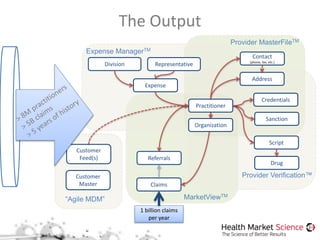
The Output
Script
Claims
Expense
Sanction
Address
Contact
(phone, fax, etc.)
Drug
RepresentativeDivision
Expense ManagerTM
Provider Verification™
MarketViewTM
Customer
Feed(s)
Customer
Master
Provider MasterFileTM
Credentials
“Agile MDM”
1 billion claims
per year
Organization
Practitioner
Referrals
Sounds easy
Except...
Incomplete Capture
No foreign keys
Differing schemas
Changing schemas
Conflicting information
Ad-hoc Analysis (is hard)
Point-In-Time Retrieval
Golde
n
Record
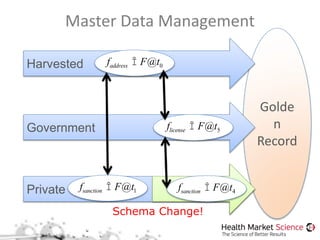
Master Data Management
Harvested
Government
Private
faddress Î F@t0
flicense Î F@t5
fsanction Î F@t1 fsanction Î F@t4
Schema Change!
Why?
?’s
Our MDM Pipeline
- Data Stewardship
- Data Scientists
- Business Analysts
Ingestion
- Semantic Tagging
- Standardization
- Data Mapping
Incorporation
- Consolidation
- Enumeration
- Association
Insight
- Search
- Reports
- Analytics
Feeds
(multiple formats,
changing over time)
API / FTP Web Interface
DimensionsLogicRules
Our first “Pipeline”
+
Sweet!
Dirt Simple
Lightning Fast
Highly Available
Scalable
Multi-Datacenter (DR)
Not Sweet.
How do we query the data?
NoSQL Indexes?
Do such things exist?
Rev. 1 – Wide Rows!
AOP
Triggers!Data model to
support your
queries.
9 7 32 74 99 12 42
$3.50 $7.00 $8.75 $1.00 $4.20 $3.17 $8.88
ONC : PA : 19460
D’Oh! What about ad hoc?
Transformation
Rev 2 – Elastic Search!
AOP
Triggers!
D’Oh!
What if ES fails?
What about schema / type information?
Rev 3 - Apache Storm!
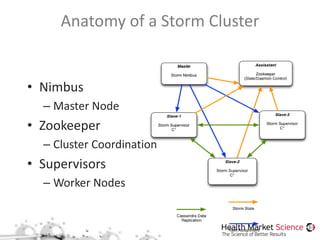
Anatomy of a Storm Cluster
• Nimbus
– Master Node
• Zookeeper
– Cluster Coordination
• Supervisors
– Worker Nodes
Storm Primitives
• Streams
– Unbounded sequence of tuples
• Spouts
– Stream Sources
• Bolts
– Unit of Computation
• Topologies
– Combination of n Spouts and m Bolts
– Defines the overall “Computation”
Storm Spouts
• Represents a source (stream) of data
– Queues (JMS, Kafka, Kestrel, etc.)
– Twitter Firehose
– Sensor Data
• Emits “Tuples” (Events) based on source
– Primary Storm data structure
– Set of Key-Value pairs
Storm Bolts
• Receive Tuples from Spouts or other Bolts
• Operate on, or React to Data
– Functions/Filters/Joins/Aggregations
– Database writes/lookups
• Optionally emit additional Tuples
Storm Topologies
• Data flow between spouts and bolts
• Routing of Tuples between spouts/bolts
– Stream “Groupings”
• Parallelism of Components
• Long-Lived
Storm Topologies
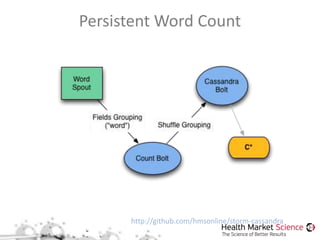
Persistent Word Count
http://github.com/hmsonline/storm-cassandra
CODE INTERLUDE
NEXT LEVEL : TRIDENT
Trident
• Part of Storm
• Provides a higher-level abstraction for stream
processing
– Constructs for state management and batching
• Adds additional primitives that abstract away
common topological patterns
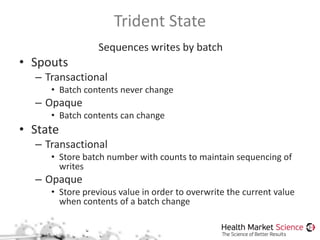
Trident State
Sequences writes by batch
• Spouts
– Transactional
• Batch contents never change
– Opaque
• Batch contents can change
• State
– Transactional
• Store batch number with counts to maintain sequencing of
writes
– Opaque
• Store previous value in order to overwrite the current value
when contents of a batch change
State Management
Last Batch Value
15 1000
(+59)
Last Batch Value
16 1059
Transactional
Last Batch Previous Current
15 980 1000
(+59)
Opaque
replay == incorporated already?
(because batch composition is the same)
Last Batch Previous Current
16 1000 1059
Last Batch Previous Current
15 980 1000
(+72)
Last Batch Previous Current
16 1000 1072
replay == re-incorporate
Batch composition changes! (not guaranteed)
BACK TO OUR REGULARLY
SCHEDULED TALK
Polyglot Persistence
“The Right Tool for the Job”
Oracle is a registered trademark
of Oracle Corporation and/or its
affiliates. Other names may be
trademarks of their respective
owners.
Back to the Pipeline
KafkaDW
Storm
C* ES Titan SQL
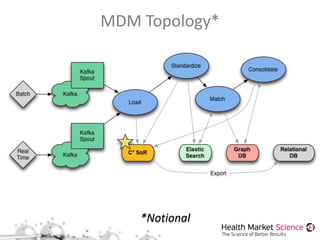
MDM Topology*
*Notional
Design Principles
• What we got:
– At-least-once processing
– Simple data flows
• What we needed to account for:
– Replays
Idempotent Operations!
Immutable Data!
Cassandra State (v0.4.0)
git@github.com:hmsonline/storm-cassandra.git
{tuple}  <mapper>  (ks, cf, row, k:v[])
Storm Cassandra
Trident Elastic Search (v0.3.1)
git@github.com:hmsonline/trident-elasticsearch.git
{tuple}  <mapper>  (idx, docid, k:v[])
Storm Elastic Search
Storm Graph (v0.1.2)
Coming soon to...
git@github.com:hmsonline/storm-graph.git
for (tuple : batch)
<processor> (graph, tuple)
Storm JDBI (v0.1.14)
INTERNAL ONLY (so far)
Worth releasing?
{tuple}  <mapper>  (JDBC Statement)
All good!
But...
What was the average amount for a
medical claim associated with procedure
X by zip code over the last five years?
Hadoop (<2)? Batch?
Yuck. ‘Nuff Said.
http://www.slideshare.net/prash1784/introduction-to-hadoop-and-pig-15036186
Let’s Pre-Compute It!
stream
.groupBy(new Field(“ICD9”))
.groupBy(new Field(“zip”))
.aggregate(new Field(“amount”),
new Average())
D’Oh!
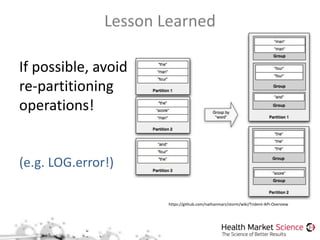
GroupBy’s.
They set data in motion!
Lesson Learned
https://github.com/nathanmarz/storm/wiki/Trident-API-Overview
If possible, avoid
re-partitioning
operations!
(e.g. LOG.error!)
Why so hard?
D’Oh!
19 != 9
What we don’t want:
LOCKS!
What’s the alternative?
CONSENSUS!
Cassandra 2.0!
http://www.slideshare.net/planetcassandra/nyc-jonathan-ellis-keynote-cassandra-12-20
http://www.cs.cornell.edu/courses/CS6452/2012sp/papers/paxos-complex.pdf
Conditional Updates
“The alert reader will notice here that
Paxos gives us the ability to agree on
exactly one proposal. After one has been
accepted, it will be returned to future
leaders in the promise, and the new leader
will have to re-propose it again.”
http://www.datastax.com/dev/blog/lightweight-transactions-in-cassandra-2-0
UPDATE value=9 WHERE word=“fox” IF value=6
Love CQL
Conditional Updates
+
Batch Statements
+
Collections
=
BADASS DATA MODELS
Announcing : Storm Cassandra CQL!
git@github.com:hmsonline/storm-cassandra-cql.git
{tuple}  <mapper>  (CQL Statement)
Trident Batching =? CQL Batching
CassandraCqlState
public void commit(Long txid) {
BatchStatement batch = new BatchStatement(Type.LOGGED);
batch.addAll(this.statements);
clientFactory.getSession().execute(batch);
}
public void addStatement(Statement statement) {
this.statements.add(statement);
}
public ResultSet execute(Statement statement){
return clientFactory.getSession().execute(statement);
}
CassandraCqlStateUpdater
public void updateState(CassandraCqlState state,
List<TridentTuple> tuples,
TridentCollector collector) {
for (TridentTuple tuple : tuples) {
Statement statement = this.mapper.map(tuple);
state.addStatement(statement);
}
}
ExampleMapper
public Statement map(List<String> keys, Number value) {
Insert statement =
QueryBuilder.insertInto(KEYSPACE_NAME, TABLE_NAME);
statement.value(KEY_NAME, keys.get(0));
statement.value(VALUE_NAME, value);
return statement;
}
public Statement retrieve(List<String> keys) {
Select statement = QueryBuilder.select()
.column(KEY_NAME).column(VALUE_NAME)
.from(KEYSPACE_NAME, TABLE_NAME)
.where(QueryBuilder.eq(KEY_NAME, keys.get(0)));
return statement;
}
Incremental State!
• Collapse aggregation into the state object.
– This allows the state object to aggregate with current state
in a loop until success.
• Uses Trident Batching to perform in-memory
aggregation for the batch.
for (tuple : batch)
state.aggregate(tuple);
while (failed?) {
persisted_state = read(state)
aggregate(in_memory_state, persisted_state)
failed? = conditionally_update(state)
}
Partition 1
In-Memory Aggregation by Key!
Key Value
fox 6
brown 3
Partition 2
Key Value
fox 3
lazy 72C*
No More GroupBy!
To protect against replays
Use partition + batch identifier(s) in
your conditional update!
“BatchId + partitionIndex consistently represents the
same data as long as:
1.Any repartitioning you do is deterministic (so
partitionBy is, but shuffle is not)
2.You're using a spout that replays the exact same
batch each time (which is true of transactional spouts
but not of opaque transactional spouts)”
- Nathan Marz
The Lambda Architecture
http://architects.dzone.com/articles/nathan-marzs-lamda
Let’s Challenge This a Bit
because “additional tools and techniques” cost
money and time.
• Questions:
– Can we solve the problem with a single tool and a
single approach?
– Can we re-use logic across layers?
– Or better yet, can we collapse layers?
A Traditional Interpretation
Speed Layer
(Storm)
Batch Layer
(Hadoop)
Data
Stream
Serving Layer
HBase
Impala
D’Oh! Two pipelines!
Integrating Web Services
• We need a web service that receives an event
and provides,
– an immediate acknowledgement
– a high likelihood that the data is integrated very soon
– a guarantee that the data will be integrated eventually
• We need an architecture that provides for,
– Code / Logic and approach re-use
– Fault-Tolerance
Grand Finale
The Idea : Embedding State!
Kafka
DropWizard
C*
IncrementalCqlState
aggregate(tuple)
“Batch” Layer
(Storm)
Client
The Sequence of Events
The Wins
• Reuse Aggregations and State Code!
• To re-compute (or backfill) a dimension,
simply re-queue!
• Storm is the “safety” net
– If a DW host fails during aggregation, Storm will fill
in the gaps for all ACK’d events.
• Is there an opportunity to reuse more?
– BatchingStrategy & PartitionStrategy?
In the end, all good. =)
Plug
The Book
Shout out:
Taylor Goetz
Thanks
Brian O’Neill, CTO
boneill@healthmarketscience.com
@boneill42

Phily JUG : Web Services APIs for Real-time Analytics w/ Storm and DropWizard

Editor's Notes

  • #20 Tuple: set of key-value pairs (values can be serialized objects)
  • #45 title Distributed Counting participant A participant B participant Storage note over Storage {"fox" : 6} end note note over A count("fox", batch)=3 end note A->Storage: read("fox") note over B count("fox", batch)=10 end note Storage->A: 6 B->Storage: read("fox") Storage->B: 8 note over A add(6, 3) = 9 end note note over B add(6, 10) = 16 end note B->Storage: write(16) A->Storage: write(9) note over Storage {"fox":16} end note
  • #62 title Distributed Counting participant Client participant DropWizard participant Kafka participant State(1) participant C* participant Storm participant State(2) Client->DropWizard: POST(event) DropWizard->State(1): aggregate(new Tuple(event)) DropWizard->Kafka: queue(event) DropWizard->Client: 200(ACK) note over State(1) duration (30 sec.) end note State(1)->C*: state, events = read(key) note over State(1) state = aggregate (state, in_memory_state) events = join (events, in_memory_events) end note State(1)->C*: write(state, events) Kafka->Storm: dequeue(event) Storm->State(2): persisted_state, events = read(key) note over State(2) if (!contains?(event)) ... end note State(2)->C*: if !contains(ids) write(state)