Distributed Client ServerOperation
( Mod- V )
GUIDED BY,
DR.(MRS.) SANTI BEHERA
(ASSISTANT PROFESSOR)
PRESENTED BY,
NAME : RAJALAXMI RANA
REDG NO. 2203041004
DEPARTMENT OF COMPUTER SCIENCE AND ENGINEERING
Veer Surendra Sai University of Technology,burla
2.
Distributed Client-Server
System
A distributedclient-server system is a network architecture that separates
client and server functionalities, allowing for efficient processing, data
management, and resource sharing across different systems, enhancing
scalability and performance.
3.
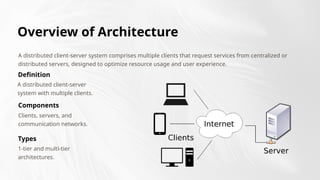
A distributed client-serversystem comprises multiple clients that request services from centralized or
distributed servers, designed to optimize resource usage and user experience.
Definition
Clients, servers, and
communication networks.
Overview of Architecture
1-tier and multi-tier
architectures.
Types
A distributed client-server
system with multiple clients.
Components
4.
3
1
2
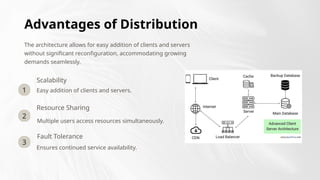
Easy addition ofclients and servers.
Advantages of Distribution
The architecture allows for easy addition of clients and servers
without significant reconfiguration, accommodating growing
demands seamlessly.
Resource Sharing
Fault Tolerance
Scalability
Multiple users access resources simultaneously.
Ensures continued service availability.
5.
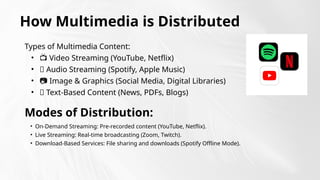
How Multimedia isDistributed
Types of Multimedia Content:
• 📺 Video Streaming (YouTube, Netflix)
• 🎵 Audio Streaming (Spotify, Apple Music)
• 📷 Image & Graphics (Social Media, Digital Libraries)
• 📄 Text-Based Content (News, PDFs, Blogs)
Modes of Distribution:
• On-Demand Streaming: Pre-recorded content (YouTube, Netflix).
• Live Streaming: Real-time broadcasting (Zoom, Twitch).
• Download-Based Services: File sharing and downloads (Spotify Offline Mode).
6.
Multimedia Streaming Protocols
•HTTP Streaming: Progressive download for web-based streaming.
• RTSP (Real-Time Streaming Protocol): Used for real-time audio/video
streaming.
• RTP (Real-Time Transport Protocol): Delivers real-time multimedia over
networks.
• MPEG-DASH: Adaptive bitrate streaming for smooth video playback.
7.
Challenges in Distributed
MultimediaSystems
❗ Common Challenges:
• Latency Issues: Delays in video/audio transmission.
• Bandwidth Constraints: High data transfer requirements.
• Synchronization: Maintaining sync between audio and video
streams.
• Security & Privacy: Preventing piracy and unauthorized access.
8.
Load Balancing &Scalability in
Client-Server Systems
Load Balancing Techniques:
🔄 Round-robin distribution: Distributes requests evenly among servers.
📥 Content caching (CDN usage): Reduces load on central servers.
📊 Dynamic resource allocation: Adjusts server load based on demand.
Why is Scalability Important?
• Ensures smooth performance during peak traffic.
• Enhances user experience in high-demand applications.
• Prevents server overload and failures.
9.
• Implementing AIcan lead to smarter decision-making and optimized data handling.
• Growth in decentralized cloud services allows for dynamic resource allocation.
• Processing shifts to the edge of networks, reducing latency and
enhancing applications.
Future Trends
🚀 Emerging Technologies:
• 5G & Edge Computing: Faster and lower-latency streaming.
• AI & Machine Learning: Personalized recommendations and content optimization.
• Cloud-Based Streaming Services: More scalable and cost-effective content delivery.
10.
Conclusion
• Distributed client-serversystems enhance multimedia delivery and efficiency.
• Scalability, load balancing, and security are crucial for seamless operation.
• Emerging technologies like AI, 5G, and cloud computing will shape the future.