Distance Vector Routing
Presented by Seema Thapa
Roll no: 27
Computer Networks
Department of Computer Science
Soch College of Information and Technology
Contents:
• Basic Introduction
• Distance Vector Routing Protocol
• Working Mechanism with example
• Pros and Cons
• Conclusion
Basic Introduction
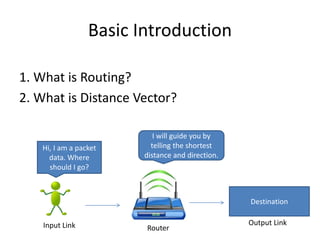
1. What is Routing?
2. What is Distance Vector?
Hi, I am a packet
data. Where
should I go?
I will guide you by
telling the shortest
distance and direction.
Input Link
Destination
Output Link
Router
Routing and Distance Vector
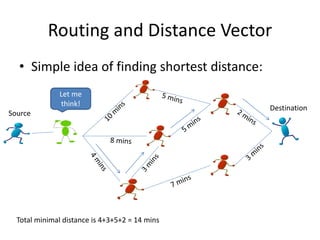
• Simple idea of finding shortest distance:
Source
Destination
Total minimal distance is 4+3+5+2 = 14 mins
Let me
think!
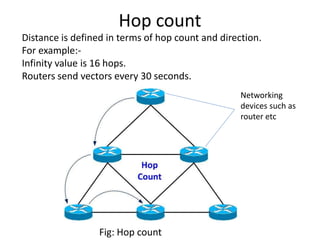
Hop count
Distance is defined in terms of hop count and direction.
For example:-
Infinity value is 16 hops.
Routers send vectors every 30 seconds.
Fig: Hop count
Networking
devices such as
router etc
Distance Vector Routing Protocol
A distance vector routing algorithm is an
intra-domain(within a network) routing protocol
which is:
i. Iterative
ii. Asynchronous
iii. Distributed
It is based on the Bellman-Ford Equation.
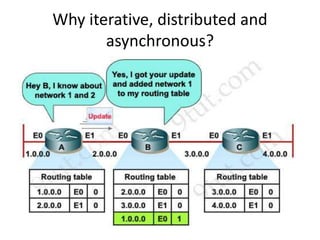
Why iterative, distributed and
asynchronous?
Bellman-Ford Equation
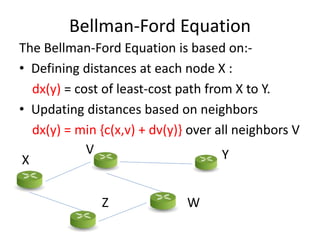
The Bellman-Ford Equation is based on:-
• Defining distances at each node X :
dx(y) = cost of least-cost path from X to Y.
• Updating distances based on neighbors
dx(y) = min {c(x,v) + dv(y)} over all neighbors V
X Y
Z
V
W
Bellman-Ford Equation
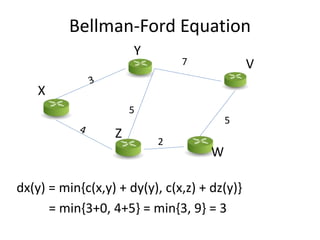
dx(y) = min{c(x,y) + dy(y), c(x,z) + dz(y)}
= min{3+0, 4+5} = min{3, 9} = 3
X
Y
Z
V
W
7
2
5
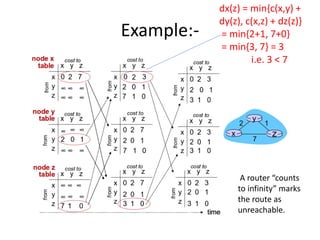
Example:-
dx(z) = min{c(x,y) +
dy(z), c(x,z) + dz(z)}
= min{2+1, 7+0}
= min{3, 7} = 3
i.e. 3 < 7
A router “counts
to infinity” marks
the route as
unreachable.
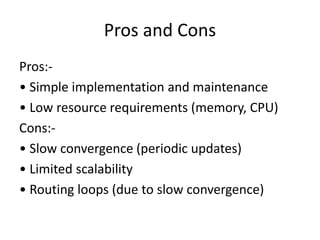
Pros and Cons
Pros:-
• Simple implementation and maintenance
• Low resource requirements (memory, CPU)
Cons:-
• Slow convergence (periodic updates)
• Limited scalability
• Routing loops (due to slow convergence)
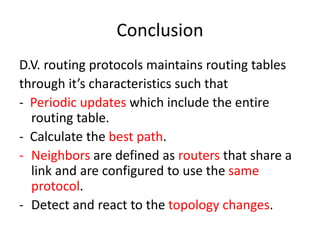
Conclusion
D.V. routing protocols maintains routing tables
through it’s characteristics such that
- Periodic updates which include the entire
routing table.
- Calculate the best path.
- Neighbors are defined as routers that share a
link and are configured to use the same
protocol.
- Detect and react to the topology changes.
THANK YOU

Distance_Vector_Routing.pptx

  • 1.
    Distance Vector Routing Presentedby Seema Thapa Roll no: 27 Computer Networks Department of Computer Science Soch College of Information and Technology
  • 2.
    Contents: • Basic Introduction •Distance Vector Routing Protocol • Working Mechanism with example • Pros and Cons • Conclusion
  • 3.
    Basic Introduction 1. Whatis Routing? 2. What is Distance Vector? Hi, I am a packet data. Where should I go? I will guide you by telling the shortest distance and direction. Input Link Destination Output Link Router
  • 4.
    Routing and DistanceVector • Simple idea of finding shortest distance: Source Destination Total minimal distance is 4+3+5+2 = 14 mins Let me think!
  • 5.
    Hop count Distance isdefined in terms of hop count and direction. For example:- Infinity value is 16 hops. Routers send vectors every 30 seconds. Fig: Hop count Networking devices such as router etc
  • 6.
    Distance Vector RoutingProtocol A distance vector routing algorithm is an intra-domain(within a network) routing protocol which is: i. Iterative ii. Asynchronous iii. Distributed It is based on the Bellman-Ford Equation.
  • 7.
    Why iterative, distributedand asynchronous?
  • 8.
    Bellman-Ford Equation The Bellman-FordEquation is based on:- • Defining distances at each node X : dx(y) = cost of least-cost path from X to Y. • Updating distances based on neighbors dx(y) = min {c(x,v) + dv(y)} over all neighbors V X Y Z V W
  • 9.
    Bellman-Ford Equation dx(y) =min{c(x,y) + dy(y), c(x,z) + dz(y)} = min{3+0, 4+5} = min{3, 9} = 3 X Y Z V W 7 2 5
  • 10.
    Example:- dx(z) = min{c(x,y)+ dy(z), c(x,z) + dz(z)} = min{2+1, 7+0} = min{3, 7} = 3 i.e. 3 < 7 A router “counts to infinity” marks the route as unreachable.
  • 11.
    Pros and Cons Pros:- •Simple implementation and maintenance • Low resource requirements (memory, CPU) Cons:- • Slow convergence (periodic updates) • Limited scalability • Routing loops (due to slow convergence)
  • 12.
    Conclusion D.V. routing protocolsmaintains routing tables through it’s characteristics such that - Periodic updates which include the entire routing table. - Calculate the best path. - Neighbors are defined as routers that share a link and are configured to use the same protocol. - Detect and react to the topology changes.
  • 13.