DISTANCE TEACHING
Prepared By:
Maynopas, Jessa Mae C.
3D3 Student
DISTANCE TEACHING
 This refers to all
instructional activities
that are carried out
where, and when the
learners are separated
from the learning
organization and the
teachers for much of
the learning process.
WHAT'S DIFFERENT ABOUT
DISTANCE TEACHING?
• Lack of visual cues.
• The teacher receives no
visual information from
the distant sites.
• Use of technological
devices.
• Lack of spontaneous class
discussion.
WHY TEACH AT A
DISTANCE?
To reach a wider student audience.
To meet the needs of students who are
unable to attend on-campus classes.
To involve outside speakers who would
otherwise be unavailable.
To link students from different social,
cultural, economic, and experiential
backgrounds.
To improve interaction and
feedback, consider the following:
 Integrate a variety of delivery systems.
 Contact each site (or student) every
week if possible.
 Make detailed comments on written
assignments.
 Arrange telephone office hours using a
toll-free number.
 Require students to contact you and
interact among themselves via electronic
mail.
To improve interaction and
feedback, consider the following:
 Use pre-class study questions and
advance organizers.
 Have students keep a journal of their
thoughts and ideas.
 Use pre-stamped and addressed
postcards and out-of-class phone
conferences for feedback.
 Call on individual students.
 Use an on-site facilitator to stimulate
interaction.
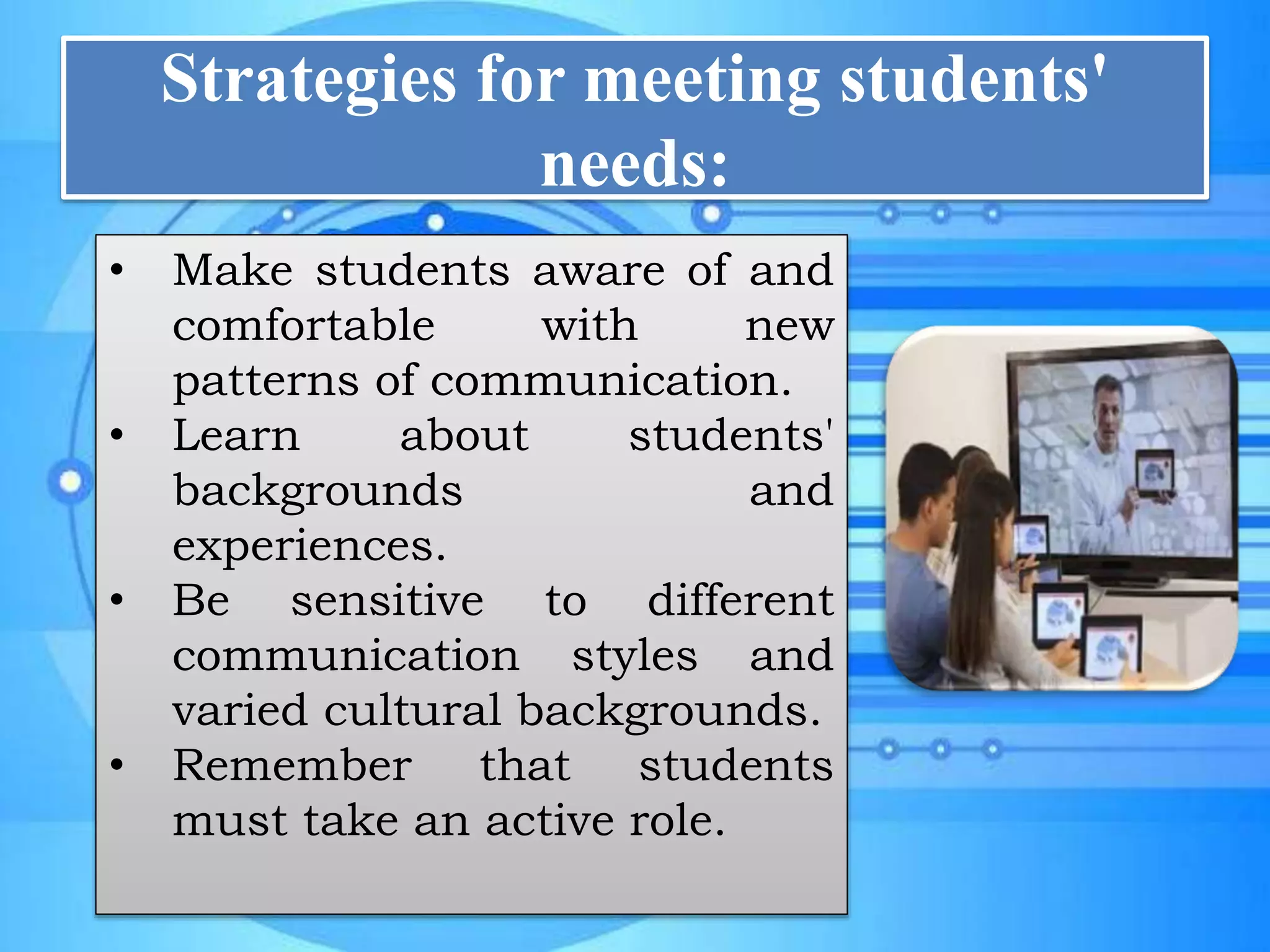
Strategies for meeting students'
needs:
• Make students aware of and
comfortable with new
patterns of communication.
• Learn about students'
backgrounds and
experiences.
• Be sensitive to different
communication styles and
varied cultural backgrounds.
• Remember that students
must take an active role.
Strategies for meeting students'
needs:
• Assist students in
becoming familiar and
comfortable with the
delivery technology.
• Be aware of students'
needs in meeting
standard university
deadlines.
REFERENCES
Blanchard, W. (1989). TELECOURSE
EFFECTIVENESS: A RESEARCH-
REVIEW UPDATE. Olympia, WA:
Washington State Board for Community
College Education. (ED 320 554).
https://eric.ed.gov/?id=ED351008
http://www.tandfonline.com/doi/abs/10.1
080/08923640009527061
https://eric.ed.gov/?id=ED396724
GOD BLESS 

Distance Teaching

  • 1.
  • 2.
    DISTANCE TEACHING  Thisrefers to all instructional activities that are carried out where, and when the learners are separated from the learning organization and the teachers for much of the learning process.
  • 3.
    WHAT'S DIFFERENT ABOUT DISTANCETEACHING? • Lack of visual cues. • The teacher receives no visual information from the distant sites. • Use of technological devices. • Lack of spontaneous class discussion.
  • 4.
    WHY TEACH ATA DISTANCE? To reach a wider student audience. To meet the needs of students who are unable to attend on-campus classes. To involve outside speakers who would otherwise be unavailable. To link students from different social, cultural, economic, and experiential backgrounds.
  • 5.
    To improve interactionand feedback, consider the following:  Integrate a variety of delivery systems.  Contact each site (or student) every week if possible.  Make detailed comments on written assignments.  Arrange telephone office hours using a toll-free number.  Require students to contact you and interact among themselves via electronic mail.
  • 6.
    To improve interactionand feedback, consider the following:  Use pre-class study questions and advance organizers.  Have students keep a journal of their thoughts and ideas.  Use pre-stamped and addressed postcards and out-of-class phone conferences for feedback.  Call on individual students.  Use an on-site facilitator to stimulate interaction.
  • 7.
    Strategies for meetingstudents' needs: • Make students aware of and comfortable with new patterns of communication. • Learn about students' backgrounds and experiences. • Be sensitive to different communication styles and varied cultural backgrounds. • Remember that students must take an active role.
  • 8.
    Strategies for meetingstudents' needs: • Assist students in becoming familiar and comfortable with the delivery technology. • Be aware of students' needs in meeting standard university deadlines.
  • 9.
    REFERENCES Blanchard, W. (1989).TELECOURSE EFFECTIVENESS: A RESEARCH- REVIEW UPDATE. Olympia, WA: Washington State Board for Community College Education. (ED 320 554). https://eric.ed.gov/?id=ED351008 http://www.tandfonline.com/doi/abs/10.1 080/08923640009527061 https://eric.ed.gov/?id=ED396724
  • 10.