Deployment Techniques in
Wireless Sensor Networks with
     Guaranteed Coverage and
                     Lifetime
                Student: Chun-Han Lin
           Advisor: Prof. Chung-Ta King
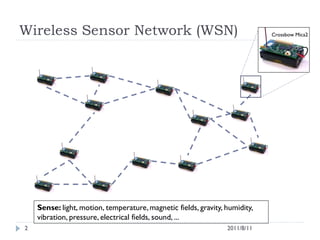
Wireless Sensor Network (WSN)                                                Crossbow Mica2


    Sense: light, motion, temperature, magnetic fields, gravity, humidity,
    vibration, pressure, electrical fields, sound, ...
2                                                                2011/8/11
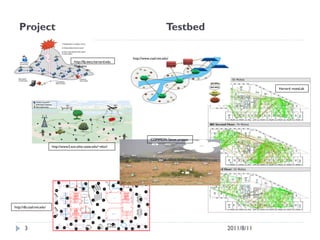
Project                                                                                      Testbed

                                                                         http://www.csail.mit.edu/
                                          http://fiji.eecs.harvard.edu
                                          /Volcano


                                                                                                                        Harvard moteLab


                                                                                     COMMON Sense project

                           http://www2.ece.ohio-state.edu/~ekici/


http://db.csail.mit.edu/


       3                                                                                                    2011/8/11
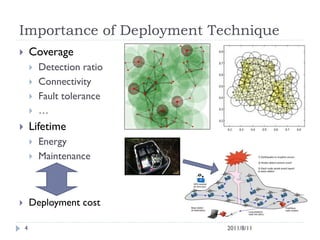
Importance of Deployment Technique
       Coverage
           Detection ratio
           Connectivity
           Fault tolerance
           …
       Lifetime
           Energy
           Maintenance


       Deployment cost

    4                         2011/8/11
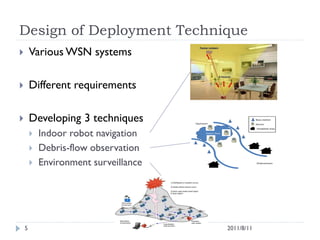
Design of Deployment Technique
       Various WSN systems

       Different requirements

       Developing 3 techniques
           Indoor robot navigation
           Debris-flow observation
           Environment surveillance


    5                                  2011/8/11
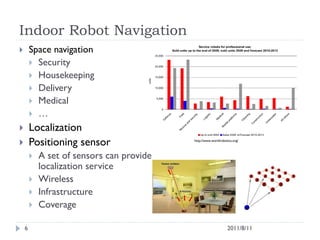
Indoor Robot Navigation
       Space navigation
         Security
         Housekeeping
         Delivery
         Medical
         …
       Localization
       Positioning sensor                 http://www.worldrobotics.org/


           A set of sensors can provide
            localization service
           Wireless
           Infrastructure
           Coverage

    6                                                           2011/8/11
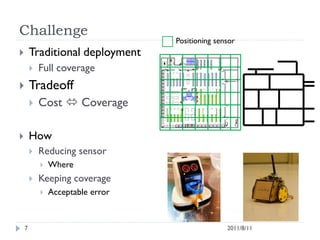
Challenge
                                   Positioning sensor
       Traditional deployment
           Full coverage
       Tradeoff
           Cost  Coverage

       How
           Reducing sensor
               Where
           Keeping coverage
               Acceptable error


    7                                             2011/8/11
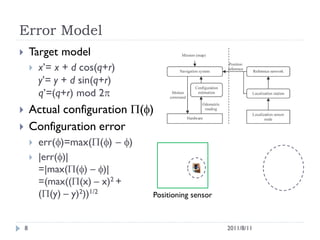
Error Model
       Target model
           x’= x + d cos(q+r)
            y’= y + d sin(q+r)
            q’=(q+r) mod 2p
       Actual configuration P(f)
       Configuration error
           err(f)=max(P(f) – f)
           |err(f)|
            =|max(P(f) – f)|
            =(max((P(x) – x)2 +
            (P(y) – y)2))1/2       Positioning sensor


    8                                                   2011/8/11
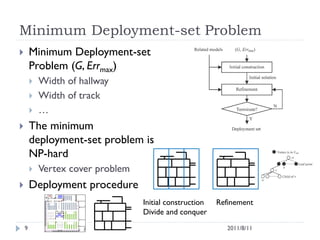
Minimum Deployment-set Problem
       Minimum Deployment-set
        Problem (G, Errmax)
           Width of hallway
           Width of track
           …
       The minimum
        deployment-set problem is
        NP-hard
           Vertex cover problem
       Deployment procedure
                                   Initial construction   Refinement
                                   Divide and conquer
    9                                                       2011/8/11
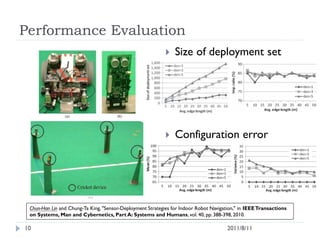
Performance Evaluation
                                                               Size of deployment set


                                                               Configuration error


 Chun-Han Lin and Chung-Ta King, "Sensor-Deployment Strategies for Indoor Robot Navigation," in IEEE Transactions
 on Systems, Man and Cybernetics, Part A: Systems and Humans, vol. 40, pp. 388-398, 2010.

10                                                                                     2011/8/11
農委會水土保持局


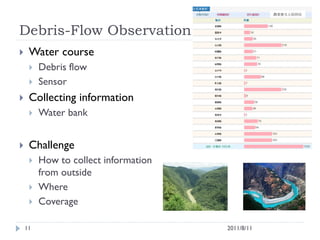
Debris-Flow Observation
    Water course
        Debris flow
        Sensor
    Collecting information
        Water bank


    Challenge
        How to collect information
         from outside
        Where
        Coverage

    11                                2011/8/11
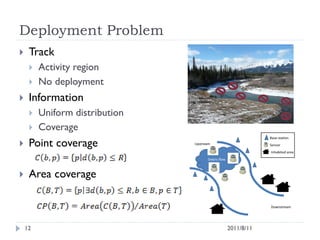
Deployment Problem
    Track
        Activity region
        No deployment
    Information
        Uniform distribution
        Coverage
    Point coverage

    Area coverage


    12                          2011/8/11
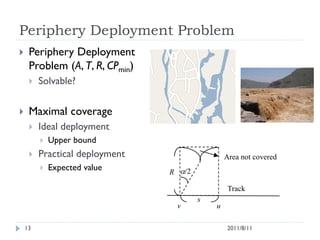
Periphery Deployment Problem
    Periphery Deployment
     Problem (A, T, R, CPmin)
        Solvable?


    Maximal coverage
        Ideal deployment
            Upper bound
        Practical deployment
            Expected value


    13                          2011/8/11
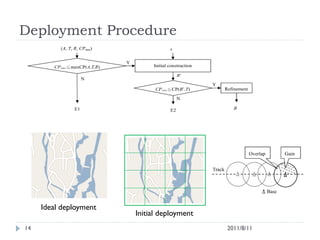
Deployment Procedure


     Ideal deployment
                        Initial deployment
14                                           2011/8/11
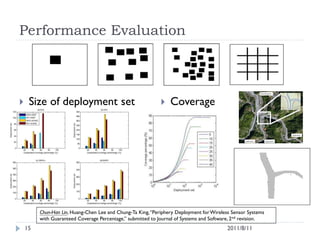
Performance Evaluation


    Size of deployment set                                      Coverage


         Chun-Han Lin, Huang-Chen Lee and Chung-Ta King, “Periphery Deployment for Wireless Sensor Systems
         with Guaranteed Coverage Percentage,” submitted to Journal of Systems and Software, 2 nd revision.
    15                                                                                    2011/8/11
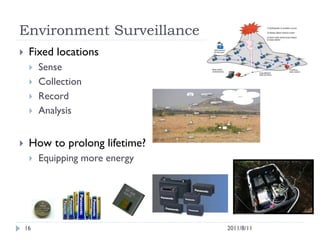
Environment Surveillance
    Fixed locations
        Sense
        Collection
        Record
        Analysis


    How to prolong lifetime?
        Equipping more energy


    16                           2011/8/11
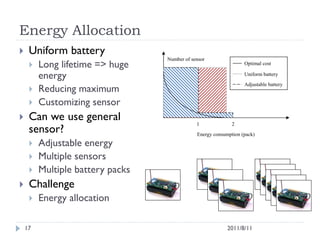
Energy Allocation
    Uniform battery
        Long lifetime => huge
         energy
        Reducing maximum
        Customizing sensor
    Can we use general
     sensor?
        Adjustable energy
        Multiple sensors
        Multiple battery packs
    Challenge
        Energy allocation

    17                            2011/8/11
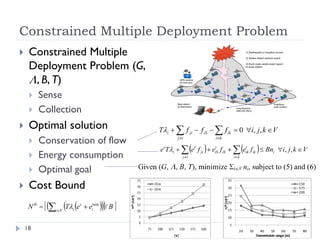
Constrained Multiple Deployment Problem
    Constrained Multiple
     Deployment Problem (G,
     , B, T)
        Sense
        Collection
    Optimal solution
        Conservation of flow
        Energy consumption
        Optimal goal
    Cost Bound


    18                          2011/8/11
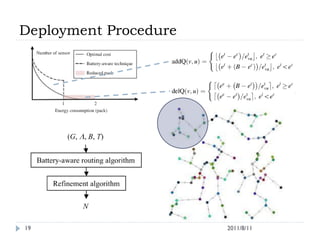
Deployment Procedure


19                     2011/8/11
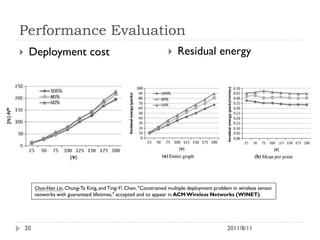
Performance Evaluation
    Deployment cost                                                   Residual energy


         Chun-Han Lin, Chung-Ta King, and Ting-Yi Chen, "Constrained multiple deployment problem in wireless sensor
         networks with guaranteed lifetimes," accepted and to appear in ACM Wireless Networks (WINET).


    20                                                                                        2011/8/11
Conclusion
    Analysis 3 applications
        Indoor robot navigation: guaranteed coverage
        Debris-flow observation: guaranteed coverage
        Environment surveillance: guaranteed lifetime
    Problem formulation
    Deployment procedure
    Performance evaluation

    Future Work
        Algorithm improvement
            Complexity of periphery and multiple deployments
            The results of multiple deployment compare with those of ILP
        Publication procedure

    21                                                         2011/8/11
Publications
    JOURNAL PAPERS
        Chun-Han Lin, Chung-Ta King, and Ting-Yi Chen, “Constrained multiple deployment problem in wireless sensor
         networks with guaranteed lifetimes,” accepted and to appear in ACM Wireless Networks (WINET).
        Chun-Han Lin and Chung-Ta King, “Sensor-Deployment Strategies for Indoor Robot Navigation,” in IEEE
         Transactions on Systems, Man and Cybernetics, Part A: Systems and Humans, vol. 40, pp. 388-398,
         2010.
        Nai.-Luen Lai, Chun-Han Lin, and Chung-Ta King, "Scheduling algorithms and routing structures for efficient
         convergecast in wireless sensor networks," in International Journal of Pervasive Computing and
         Communications, vol. 6, pp. 4-18, 2010.
    CONFERENCE PAPERS
        Nai-Luen Lai, Chung-Ta King, and Chun-Han Lin, “On Maximizing the Throughput of Convergecast in Wireless
         Sensor Networks,” in Proceedings of the 3rd international conference on Advances in grid and pervasive
         computing (GPC), pages 396-408, 2008.
        Chun-Han Lin, Chung-Ta King, and Hung-Chang Hsiao, “Region Abstraction for Event Tracking in Wireless Sensor
         Networks,” in Proceedings of the 8th International Symposium on Parallel Architectures, Algorithms and
         Networks (ISPAN), pages 274-281, 2005.
    PATENTS
        Fu-Kuang Yeh, Long-Der Chen, Chung-Ta King, and Chun-Han Lin, "METHOD FOR INFORMATION
         TRANSMISSION WITH BACKBONE NETWORK AND A POSITION MONITORING SYSTEM FOR
         MULTIPLE ROBOTIC DEVICES," submitted to USA and ROC Patent Offices, pending.
    SUBMITTED PAPERS
        Chun-Han Lin, Huang-Chen Lee and Chung-Ta King, “Periphery Deployment for Wireless Sensor Systems with
         Guaranteed Coverage Percentage,” submitted to Journal of Systems and Software, 2 nd revision.


    22                                                                                 2011/8/11

Dissertation defence

  • 1.
    Deployment Techniques in WirelessSensor Networks with Guaranteed Coverage and Lifetime Student: Chun-Han Lin Advisor: Prof. Chung-Ta King
  • 2.
    Wireless Sensor Network(WSN) Crossbow Mica2 Sense: light, motion, temperature, magnetic fields, gravity, humidity, vibration, pressure, electrical fields, sound, ... 2 2011/8/11
  • 3.
    Project Testbed http://www.csail.mit.edu/ http://fiji.eecs.harvard.edu /Volcano Harvard moteLab COMMON Sense project http://www2.ece.ohio-state.edu/~ekici/ http://db.csail.mit.edu/ 3 2011/8/11
  • 4.
    Importance of DeploymentTechnique  Coverage  Detection ratio  Connectivity  Fault tolerance  …  Lifetime  Energy  Maintenance  Deployment cost 4 2011/8/11
  • 5.
    Design of DeploymentTechnique  Various WSN systems  Different requirements  Developing 3 techniques  Indoor robot navigation  Debris-flow observation  Environment surveillance 5 2011/8/11
  • 6.
    Indoor Robot Navigation  Space navigation  Security  Housekeeping  Delivery  Medical  …  Localization  Positioning sensor http://www.worldrobotics.org/  A set of sensors can provide localization service  Wireless  Infrastructure  Coverage 6 2011/8/11
  • 7.
    Challenge Positioning sensor  Traditional deployment  Full coverage  Tradeoff  Cost  Coverage  How  Reducing sensor  Where  Keeping coverage  Acceptable error 7 2011/8/11
  • 8.
    Error Model  Target model  x’= x + d cos(q+r) y’= y + d sin(q+r) q’=(q+r) mod 2p  Actual configuration P(f)  Configuration error  err(f)=max(P(f) – f)  |err(f)| =|max(P(f) – f)| =(max((P(x) – x)2 + (P(y) – y)2))1/2 Positioning sensor 8 2011/8/11
  • 9.
    Minimum Deployment-set Problem  Minimum Deployment-set Problem (G, Errmax)  Width of hallway  Width of track  …  The minimum deployment-set problem is NP-hard  Vertex cover problem  Deployment procedure Initial construction Refinement Divide and conquer 9 2011/8/11
  • 10.
    Performance Evaluation  Size of deployment set  Configuration error Chun-Han Lin and Chung-Ta King, "Sensor-Deployment Strategies for Indoor Robot Navigation," in IEEE Transactions on Systems, Man and Cybernetics, Part A: Systems and Humans, vol. 40, pp. 388-398, 2010. 10 2011/8/11
  • 11.
    農委會水土保持局 Debris-Flow Observation  Water course  Debris flow  Sensor  Collecting information  Water bank  Challenge  How to collect information from outside  Where  Coverage 11 2011/8/11
  • 12.
    Deployment Problem  Track  Activity region  No deployment  Information  Uniform distribution  Coverage  Point coverage  Area coverage 12 2011/8/11
  • 13.
    Periphery Deployment Problem  Periphery Deployment Problem (A, T, R, CPmin)  Solvable?  Maximal coverage  Ideal deployment  Upper bound  Practical deployment  Expected value 13 2011/8/11
  • 14.
    Deployment Procedure Ideal deployment Initial deployment 14 2011/8/11
  • 15.
    Performance Evaluation  Size of deployment set  Coverage Chun-Han Lin, Huang-Chen Lee and Chung-Ta King, “Periphery Deployment for Wireless Sensor Systems with Guaranteed Coverage Percentage,” submitted to Journal of Systems and Software, 2 nd revision. 15 2011/8/11
  • 16.
    Environment Surveillance  Fixed locations  Sense  Collection  Record  Analysis  How to prolong lifetime?  Equipping more energy 16 2011/8/11
  • 17.
    Energy Allocation  Uniform battery  Long lifetime => huge energy  Reducing maximum  Customizing sensor  Can we use general sensor?  Adjustable energy  Multiple sensors  Multiple battery packs  Challenge  Energy allocation 17 2011/8/11
  • 18.
    Constrained Multiple DeploymentProblem  Constrained Multiple Deployment Problem (G, , B, T)  Sense  Collection  Optimal solution  Conservation of flow  Energy consumption  Optimal goal  Cost Bound 18 2011/8/11
  • 19.
  • 20.
    Performance Evaluation  Deployment cost  Residual energy Chun-Han Lin, Chung-Ta King, and Ting-Yi Chen, "Constrained multiple deployment problem in wireless sensor networks with guaranteed lifetimes," accepted and to appear in ACM Wireless Networks (WINET). 20 2011/8/11
  • 21.
    Conclusion  Analysis 3 applications  Indoor robot navigation: guaranteed coverage  Debris-flow observation: guaranteed coverage  Environment surveillance: guaranteed lifetime  Problem formulation  Deployment procedure  Performance evaluation  Future Work  Algorithm improvement  Complexity of periphery and multiple deployments  The results of multiple deployment compare with those of ILP  Publication procedure 21 2011/8/11
  • 22.
    Publications  JOURNAL PAPERS  Chun-Han Lin, Chung-Ta King, and Ting-Yi Chen, “Constrained multiple deployment problem in wireless sensor networks with guaranteed lifetimes,” accepted and to appear in ACM Wireless Networks (WINET).  Chun-Han Lin and Chung-Ta King, “Sensor-Deployment Strategies for Indoor Robot Navigation,” in IEEE Transactions on Systems, Man and Cybernetics, Part A: Systems and Humans, vol. 40, pp. 388-398, 2010.  Nai.-Luen Lai, Chun-Han Lin, and Chung-Ta King, "Scheduling algorithms and routing structures for efficient convergecast in wireless sensor networks," in International Journal of Pervasive Computing and Communications, vol. 6, pp. 4-18, 2010.  CONFERENCE PAPERS  Nai-Luen Lai, Chung-Ta King, and Chun-Han Lin, “On Maximizing the Throughput of Convergecast in Wireless Sensor Networks,” in Proceedings of the 3rd international conference on Advances in grid and pervasive computing (GPC), pages 396-408, 2008.  Chun-Han Lin, Chung-Ta King, and Hung-Chang Hsiao, “Region Abstraction for Event Tracking in Wireless Sensor Networks,” in Proceedings of the 8th International Symposium on Parallel Architectures, Algorithms and Networks (ISPAN), pages 274-281, 2005.  PATENTS  Fu-Kuang Yeh, Long-Der Chen, Chung-Ta King, and Chun-Han Lin, "METHOD FOR INFORMATION TRANSMISSION WITH BACKBONE NETWORK AND A POSITION MONITORING SYSTEM FOR MULTIPLE ROBOTIC DEVICES," submitted to USA and ROC Patent Offices, pending.  SUBMITTED PAPERS  Chun-Han Lin, Huang-Chen Lee and Chung-Ta King, “Periphery Deployment for Wireless Sensor Systems with Guaranteed Coverage Percentage,” submitted to Journal of Systems and Software, 2 nd revision. 22 2011/8/11