DISEASES OF THE PROSTATE
GLAND
PAULINE TEMBO-RN/BSC
THE PROSTATE GLAND
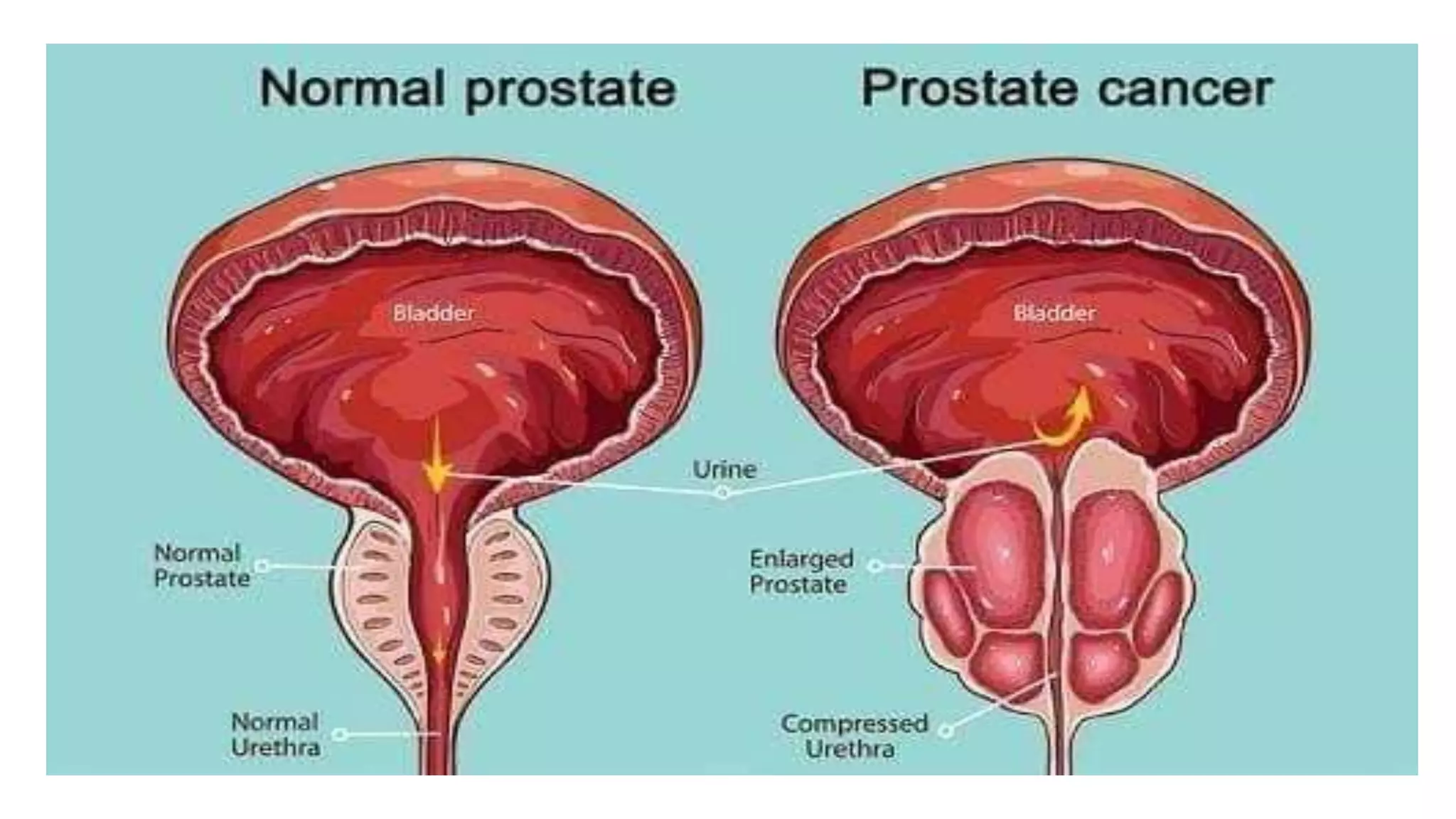
• The prostate gland (walnut shape)is located just below
the bladder in men and surrounds the top portion of
the tube that drains urine from the bladder (urethra).
• The urethra runs through the center of the prostate,
from the bladder to the penis, letting urine flow out of
the body.
• The prostate secretes fluid that nourishes and
protects sperm. During ejaculation, the prostate
squeezes this fluid into the urethra, and it’s expelled
with sperm as semen.
• The prostate's primary function is to produce the fluid
that nourishes and transports sperm (seminal fluid).
PROSTATITIS
• Def: Prostatitis is inflammation of the prostate
gland.
• Prostatitis is often caused by systemic Bacterial
infections and auto immune.
Risk factors
• Infection of the urinary or reproductive system
• HIV infection or AIDS
• Use of a urinary catheter inserted into the urethra
to drain the bladder /during cystoscopy
• Diagnostic sampling of prostate tissue (biopsy)
Symptoms
• Pain or burning sensation when urinating (dysuria)
• Difficulty urinating, such as dribbling or hesitant urination
• Frequent urination, particularly at night (nocturia)
• Urgent need to urinate
• Cloudy urine
• Blood in the urine
• Pain in the abdomen, groin or lower back
• Pain in the area between the scrotum and rectum (perineum)
• Painful ejaculation
• Fever, chills, muscle aches
Complications
• Bacterial infection of the blood (bacteremia)
• Pus-filled cavity in the prostate (prostatic
abscess)
• Sexual dysfunction, such as the inability to get
and maintain an erection (erectile dysfunction)
• Changes in sperm and semen that may cause
infertility
PROSTATE CANCER
Define prostate cancer
• Prostate cancer is the cancer that occurs in the
prostate – a small walnut – shaped gland in men that
produces seminal fluid that nourishes and transports
sperm.
TYPES OF PROSTATE CANCER
• 1. Acinar Adenocarcinoma – are cancers that develop in
the gland cells that line the prostate gland. They are the
most common type of cancer.
• 2. Ductal adenocarcinoma – starts in the cells that line the
ducts (tubes) of the prostate gland. It tends to grow and
spread more quickly than Acinar Adenocarcinoma.
• 3. Transitional cell (urothelial) cancer- starts in the cells
that line the tube carrying urine to the outside of the body
(urethra).
• 4. Squamous cell cancer – these cancers develop from the
flat cells that cover the prostate. They tend to grow and
spread more quickly than adenocarcinoma of the prostate.
CAUSES
• The cause of prostate cancer is unknown,
although some studies have shown a
relationship between high dietary fat
intake and increased testosterone levels.
SIGNS AND SYMPTOMS
Prostatic cancers may not cause symptoms until it is
advanced. Signs include;
• Blood in semen
• Discomfort in the pelvic area
• Dribbling
• Urine retention and Bone pain
• trouble urinating
• Erectile dysfunction
INVESTIGATION
• Digital rectal examination may reveal a small hard
mass or nodule
• Biopsy
• Magnetic resonance imaging
• Computerized tomography scan
• Urine for culture and sensitivity
• Blood urea examination
• Haemoglobin estimation, grouping and cross matching
• Pelvic xray
• Prostate-specific antigen (PSA):The prostate makes a
protein called PSA, which can be measured by a
blood test. If PSA is high, prostate cancer is more
likely
• Prostate ultrasound (transrectal ultrasound): An
ultrasound probe is inserted into the rectum, bringing
it close to the prostate.
Treatment
• Medical treatment
• The drugs Lupron or Zoladex are also being used to block
the production of testosterone.
• Estramistine (anti- cancer chemotherapy drug) is used to
treat prostate cancer that has progressed.
SURGERY
• Removal of prostate gland (radical
prostatectomy) is often recommended for
treatment of stage A and B prostate cancers.
• Radiation therapy is used in combination
with drug therapy.

DISEASES OF THE PROSTATE GLAND-paula.pptx

  • 1.
    DISEASES OF THEPROSTATE GLAND PAULINE TEMBO-RN/BSC
  • 2.
  • 3.
    • The prostategland (walnut shape)is located just below the bladder in men and surrounds the top portion of the tube that drains urine from the bladder (urethra). • The urethra runs through the center of the prostate, from the bladder to the penis, letting urine flow out of the body. • The prostate secretes fluid that nourishes and protects sperm. During ejaculation, the prostate squeezes this fluid into the urethra, and it’s expelled with sperm as semen. • The prostate's primary function is to produce the fluid that nourishes and transports sperm (seminal fluid).
  • 5.
  • 6.
    • Def: Prostatitisis inflammation of the prostate gland. • Prostatitis is often caused by systemic Bacterial infections and auto immune.
  • 7.
    Risk factors • Infectionof the urinary or reproductive system • HIV infection or AIDS • Use of a urinary catheter inserted into the urethra to drain the bladder /during cystoscopy • Diagnostic sampling of prostate tissue (biopsy)
  • 8.
    Symptoms • Pain orburning sensation when urinating (dysuria) • Difficulty urinating, such as dribbling or hesitant urination • Frequent urination, particularly at night (nocturia) • Urgent need to urinate • Cloudy urine • Blood in the urine • Pain in the abdomen, groin or lower back • Pain in the area between the scrotum and rectum (perineum) • Painful ejaculation • Fever, chills, muscle aches
  • 9.
    Complications • Bacterial infectionof the blood (bacteremia) • Pus-filled cavity in the prostate (prostatic abscess) • Sexual dysfunction, such as the inability to get and maintain an erection (erectile dysfunction) • Changes in sperm and semen that may cause infertility
  • 10.
  • 11.
    Define prostate cancer •Prostate cancer is the cancer that occurs in the prostate – a small walnut – shaped gland in men that produces seminal fluid that nourishes and transports sperm.
  • 13.
    TYPES OF PROSTATECANCER • 1. Acinar Adenocarcinoma – are cancers that develop in the gland cells that line the prostate gland. They are the most common type of cancer. • 2. Ductal adenocarcinoma – starts in the cells that line the ducts (tubes) of the prostate gland. It tends to grow and spread more quickly than Acinar Adenocarcinoma. • 3. Transitional cell (urothelial) cancer- starts in the cells that line the tube carrying urine to the outside of the body (urethra). • 4. Squamous cell cancer – these cancers develop from the flat cells that cover the prostate. They tend to grow and spread more quickly than adenocarcinoma of the prostate.
  • 14.
    CAUSES • The causeof prostate cancer is unknown, although some studies have shown a relationship between high dietary fat intake and increased testosterone levels.
  • 15.
    SIGNS AND SYMPTOMS Prostaticcancers may not cause symptoms until it is advanced. Signs include; • Blood in semen • Discomfort in the pelvic area • Dribbling • Urine retention and Bone pain • trouble urinating • Erectile dysfunction
  • 16.
    INVESTIGATION • Digital rectalexamination may reveal a small hard mass or nodule • Biopsy • Magnetic resonance imaging • Computerized tomography scan • Urine for culture and sensitivity • Blood urea examination • Haemoglobin estimation, grouping and cross matching • Pelvic xray
  • 17.
    • Prostate-specific antigen(PSA):The prostate makes a protein called PSA, which can be measured by a blood test. If PSA is high, prostate cancer is more likely • Prostate ultrasound (transrectal ultrasound): An ultrasound probe is inserted into the rectum, bringing it close to the prostate.
  • 18.
    Treatment • Medical treatment •The drugs Lupron or Zoladex are also being used to block the production of testosterone. • Estramistine (anti- cancer chemotherapy drug) is used to treat prostate cancer that has progressed.
  • 19.
    SURGERY • Removal ofprostate gland (radical prostatectomy) is often recommended for treatment of stage A and B prostate cancers.
  • 20.
    • Radiation therapyis used in combination with drug therapy.