Why do we do discussion boards?
Asynchronous discussion
● Enhances learning as you share your ideas,
perspectives, and experiences with the class
● Develops and refines your thoughts through the
writing process
● Broaden your classmates’ understanding of the
course content
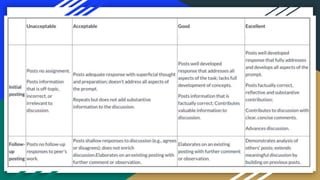
I will consider these characteristics when assessing the quality and level of
student participation.
● Posts and responses should be thorough and thoughtful. Just posting
an "I agree" or "Good ideas" will not be considered adequate. Support
statements with examples, experiences, or references. Be brief —
keep each post and response to one or two short paragraphs. Keep in
mind that fellow learners will be reading and responding to you, too.
● Posts should be within a range of 75-150 words.
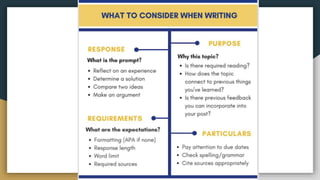
● Make certain that all posts and responses address the question,
problem, or situation as presented for discussion. This does not mean
you should not extend the topic, but do not stray from the topic.
● Discussions occur when there is dialogue; therefore, you need to build
upon the posts and responses of other learners to create discussion
threads. Make sure to revisit the discussion forum and respond (if
necessary) to what other learners have posted to your initial
responses.
● When relevant, add to the discussion by including prior knowledge,
work experiences, references, web sites, resources, etc. (giving credit
when appropriate).
● Contributions to the discussions (posts and responses) should be
complete and free of grammatical or structural errors.
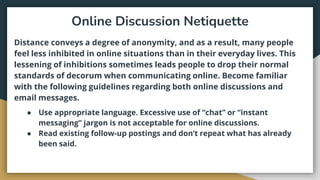
Online Discussion Netiquette
Distance conveys a degree of anonymity, and as a result, many people
feel less inhibited in online situations than in their everyday lives. This
lessening of inhibitions sometimes leads people to drop their normal
standards of decorum when communicating online. Become familiar
with the following guidelines regarding both online discussions and
email messages.
● Use appropriate language. Excessive use of “chat” or “instant
messaging” jargon is not acceptable for online discussions.
● Read existing follow-up postings and don’t repeat what has already
been said.
Online Discussion Netiquette
● Inappropriate and/or offensive language, especially comments that
might be construed as racist or sexist, are not appropriate and will be
dealt with on an individual basis.
● Be careful with humor and sarcasm. One person’s humorous comment
can be another person’s boorish or degrading remark.
● Do not use all caps in an online environment. Using all caps is
considered SHOUTING.
● Use proper spelling, capitalization, grammar, usage, and punctuation.
Utilize the Spell Check feature.
● Remember that there are other human beings reading your postings,
so treat everyone with respect. Don’t post anything you wouldn’t be
willing to communicate face to face.
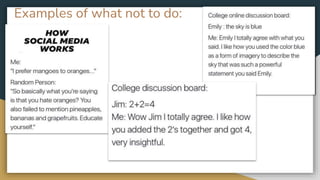
Examples of what not to do:

Discussion boards 101

  • 1.
    Why do wedo discussion boards? Asynchronous discussion ● Enhances learning as you share your ideas, perspectives, and experiences with the class ● Develops and refines your thoughts through the writing process ● Broaden your classmates’ understanding of the course content
  • 2.
    I will considerthese characteristics when assessing the quality and level of student participation. ● Posts and responses should be thorough and thoughtful. Just posting an "I agree" or "Good ideas" will not be considered adequate. Support statements with examples, experiences, or references. Be brief — keep each post and response to one or two short paragraphs. Keep in mind that fellow learners will be reading and responding to you, too. ● Posts should be within a range of 75-150 words. ● Make certain that all posts and responses address the question, problem, or situation as presented for discussion. This does not mean you should not extend the topic, but do not stray from the topic.
  • 3.
    ● Discussions occurwhen there is dialogue; therefore, you need to build upon the posts and responses of other learners to create discussion threads. Make sure to revisit the discussion forum and respond (if necessary) to what other learners have posted to your initial responses. ● When relevant, add to the discussion by including prior knowledge, work experiences, references, web sites, resources, etc. (giving credit when appropriate). ● Contributions to the discussions (posts and responses) should be complete and free of grammatical or structural errors.
  • 7.
    Online Discussion Netiquette Distanceconveys a degree of anonymity, and as a result, many people feel less inhibited in online situations than in their everyday lives. This lessening of inhibitions sometimes leads people to drop their normal standards of decorum when communicating online. Become familiar with the following guidelines regarding both online discussions and email messages. ● Use appropriate language. Excessive use of “chat” or “instant messaging” jargon is not acceptable for online discussions. ● Read existing follow-up postings and don’t repeat what has already been said.
  • 8.
    Online Discussion Netiquette ●Inappropriate and/or offensive language, especially comments that might be construed as racist or sexist, are not appropriate and will be dealt with on an individual basis. ● Be careful with humor and sarcasm. One person’s humorous comment can be another person’s boorish or degrading remark. ● Do not use all caps in an online environment. Using all caps is considered SHOUTING. ● Use proper spelling, capitalization, grammar, usage, and punctuation. Utilize the Spell Check feature. ● Remember that there are other human beings reading your postings, so treat everyone with respect. Don’t post anything you wouldn’t be willing to communicate face to face.
  • 9.
    Examples of whatnot to do:

Editor's Notes

  • #2 https://canvas.uw.edu/courses/1065666/pages/discussion-board-participation-and-expectations##Posting%20to%20the%20Discussion%20Board
  • #3 https://canvas.uw.edu/courses/1065666/pages/discussion-board-participation-and-expectations##Posting%20to%20the%20Discussion%20Board
  • #4 https://canvas.uw.edu/courses/1065666/pages/discussion-board-participation-and-expectations##Posting%20to%20the%20Discussion%20Board
  • #5 https://canvas.uw.edu/courses/1065666/pages/discussion-board-participation-and-expectations##Posting%20to%20the%20Discussion%20Board
  • #6 https://online.jwu.edu/blog/how-write-strong-discussion-post-infographic
  • #7 https://online.jwu.edu/blog/how-write-strong-discussion-post-infographic
  • #8 https://canvas.uw.edu/courses/1065666/pages/discussion-board-participation-and-expectations##Posting%20to%20the%20Discussion%20Board
  • #9 https://canvas.uw.edu/courses/1065666/pages/discussion-board-participation-and-expectations##Posting%20to%20the%20Discussion%20Board