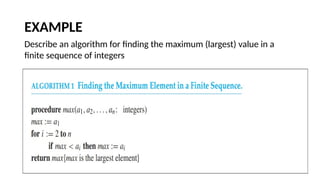
Algorithm
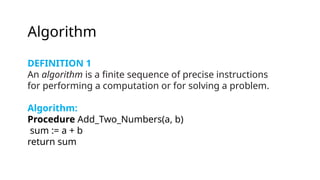
DEFINITION 1
An algorithmis a finite sequence of precise instructions
for performing a computation or for solving a problem.
Algorithm:
Procedure Add_Two_Numbers(a, b)
sum := a + b
return sum
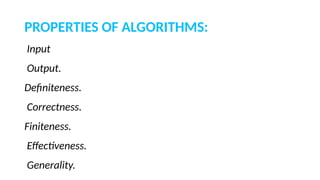
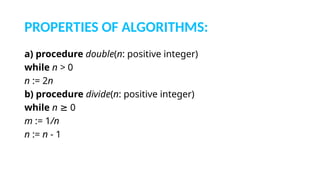
PROPERTIES OF ALGORITHMS:
a)procedure double(n: positive integer)
while n > 0
n := 2n
b) procedure divide(n: positive integer)
while n ≥ 0
m := 1/n
n := n - 1
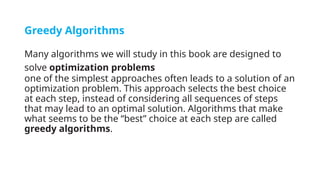
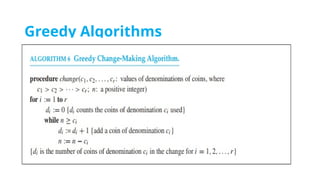
Greedy Algorithms
Many algorithmswe will study in this book are designed to
solve optimization problems
one of the simplest approaches often leads to a solution of an
optimization problem. This approach selects the best choice
at each step, instead of considering all sequences of steps
that may lead to an optimal solution. Algorithms that make
what seems to be the “best” choice at each step are called
greedy algorithms.
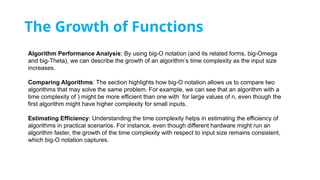
The Growth ofFunctions
Algorithm Performance Analysis: By using big-O notation (and its related forms, big-Omega
and big-Theta), we can describe the growth of an algorithm’s time complexity as the input size
increases.
Comparing Algorithms: The section highlights how big-O notation allows us to compare two
algorithms that may solve the same problem. For example, we can see that an algorithm with a
time complexity of ) might be more efficient than one with for large values of n, even though the
first algorithm might have higher complexity for small inputs.
Estimating Efficiency: Understanding the time complexity helps in estimating the efficiency of
algorithms in practical scenarios. For instance, even though different hardware might run an
algorithm faster, the growth of the time complexity with respect to input size remains consistent,
which big-O notation captures.
13.
Big-O Notation
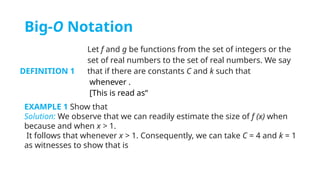
DEFINITION 1
Letf and g be functions from the set of integers or the
set of real numbers to the set of real numbers. We say
that if there are constants C and k such that
whenever .
[This is read as“
EXAMPLE 1 Show that
Solution: We observe that we can readily estimate the size of f (x) when
because and when x > 1.
It follows that whenever x > 1. Consequently, we can take C = 4 and k = 1
as witnesses to show that is
14.
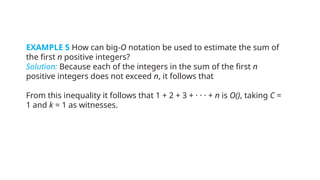
EXAMPLE 5 Howcan big-O notation be used to estimate the sum of
the first n positive integers?
Solution: Because each of the integers in the sum of the first n
positive integers does not exceed n, it follows that
From this inequality it follows that 1 + 2 + 3 + · · · + n is O(), taking C =
1 and k = 1 as witnesses.
15.
Big-O Notation
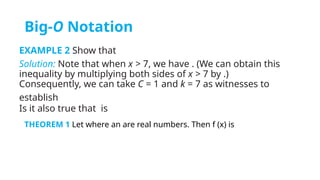
EXAMPLE 2Show that
Solution: Note that when x > 7, we have . (We can obtain this
inequality by multiplying both sides of x > 7 by .)
Consequently, we can take C = 1 and k = 7 as witnesses to
establish
Is it also true that is
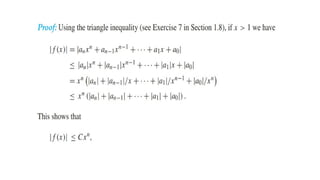
THEOREM 1 Let where an are real numbers. Then f (x) is
17.
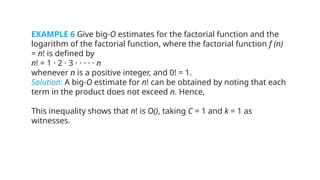
EXAMPLE 6 Givebig-O estimates for the factorial function and the
logarithm of the factorial function, where the factorial function f (n)
= n! is defined by
n! = 1 · 2 · 3 · · · · · n
whenever n is a positive integer, and 0! = 1.
Solution: A big-O estimate for n! can be obtained by noting that each
term in the product does not exceed n. Hence,
This inequality shows that n! is O(), taking C = 1 and k = 1 as
witnesses.
18.
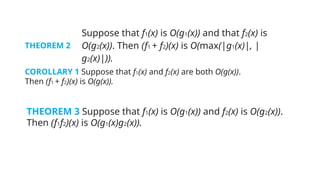
THEOREM 2
Suppose thatf1(x) is O(g1(x)) and that f2(x) is
O(g2(x)). Then (f1 + f2)(x) is O(max(|g1(x)|, |
g2(x)|)).
COROLLARY 1 Suppose that f1(x) and f2(x) are both O(g(x)).
Then (f1 + f2)(x) is O(g(x)).
THEOREM 3 Suppose that f1(x) is O(g1(x)) and f2(x) is O(g2(x)).
Then (f1f2)(x) is O(g1(x)g2(x)).
19.
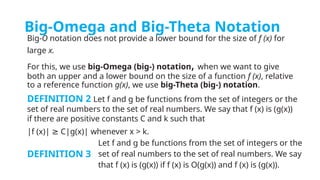
Big-Omega and Big-ThetaNotation
Big-O notation does not provide a lower bound for the size of f (x) for
large x.
For this, we use big-Omega (big-) notation, when we want to give
both an upper and a lower bound on the size of a function f (x), relative
to a reference function g(x), we use big-Theta (big-) notation.
DEFINITION 2 Let f and g be functions from the set of integers or the
set of real numbers to the set of real numbers. We say that f (x) is (g(x))
if there are positive constants C and k such that
|f (x)| C|g(x)| whenever x > k.
≥
DEFINITION 3
Let f and g be functions from the set of integers or the
set of real numbers to the set of real numbers. We say
that f (x) is (g(x)) if f (x) is O(g(x)) and f (x) is (g(x)).
20.
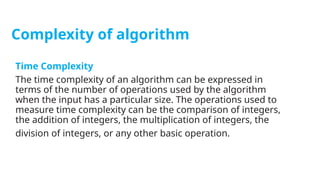
Complexity of algorithm
TimeComplexity
The time complexity of an algorithm can be expressed in
terms of the number of operations used by the algorithm
when the input has a particular size. The operations used to
measure time complexity can be the comparison of integers,
the addition of integers, the multiplication of integers, the
division of integers, or any other basic operation.
21.
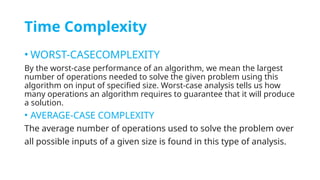
Time Complexity
• WORST-CASECOMPLEXITY
Bythe worst-case performance of an algorithm, we mean the largest
number of operations needed to solve the given problem using this
algorithm on input of specified size. Worst-case analysis tells us how
many operations an algorithm requires to guarantee that it will produce
a solution.
• AVERAGE-CASE COMPLEXITY
The average number of operations used to solve the problem over
all possible inputs of a given size is found in this type of analysis.
22.
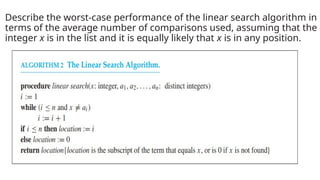
Describe the worst-caseperformance of the linear search algorithm in
terms of the average number of comparisons used, assuming that the
integer x is in the list and it is equally likely that x is in any position.
23.
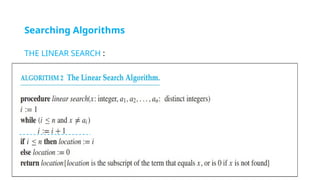
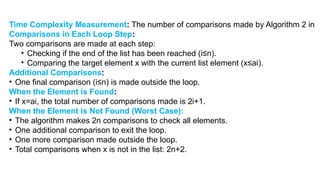
Time Complexity Measurement:The number of comparisons made by Algorithm 2 in
Comparisons in Each Loop Step:
Two comparisons are made at each step:
• Checking if the end of the list has been reached (i≤n).
• Comparing the target element x with the current list element (x≤ai
).
Additional Comparisons:
• One final comparison (i≤n) is made outside the loop.
When the Element is Found:
• If x=ai
, the total number of comparisons made is 2i+1.
When the Element is Not Found (Worst Case):
• The algorithm makes 2n comparisons to check all elements.
• One additional comparison to exit the loop.
• One more comparison made outside the loop.
• Total comparisons when x is not in the list: 2n+2.
24.
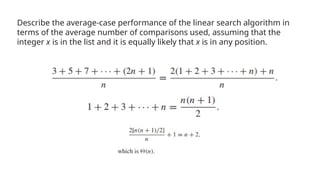
Describe the average-caseperformance of the linear search algorithm in
terms of the average number of comparisons used, assuming that the
integer x is in the list and it is equally likely that x is in any position.
26.
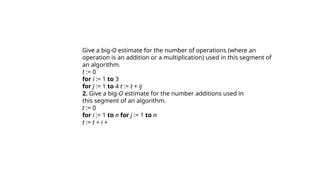
Give a big-Oestimate for the number of operations (where an
operation is an addition or a multiplication) used in this segment of
an algorithm.
t := 0
for i := 1 to 3
for j := 1 to 4 t := t + ij
2. Give a big-O estimate for the number additions used in
this segment of an algorithm.
t := 0
for i := 1 to n for j := 1 to n
t := t + i +