NEW
TRENDS IN
COMPUTER
SCIENCE CONT.
LECTURE 3
OBJECTIVES
• Understand the basic concepts of the latest trends in computer science:
• Virtual Reality - Augmented Reality – Mixed Reality
• Cybersecurity
• Internet of things
• Provide examples of real-case applications of the latest trends in computer science
VIRTUAL REALITY
AUGMENTED REALITY
MIXED REALITY
VIRTUAL REALITY
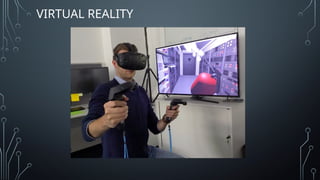
• Virtual reality (VR) implies a complete immersion experience that shuts out the
physical world.
• VR is typically achieved by wearing a headset like Facebook’s Oculus equipped
with the technology, and is used prominently in two different ways:
• To create and enhance an imaginary reality for gaming, entertainment, and play (Such as
video and computer games, or 3D movies, head-mounted displays).
• To enhance training for real-life environments by creating a simulation of reality where
people can practice beforehand (Such as flight simulators for pilots).
VIRTUAL REALITY
• Augmented reality (AR) is a technology that enriches the user’s
perception and provides a live view of the real world with digital
information, aiming to expand it by adding images, sound, video
and other virtual details.
• The purpose of AR is to augment the environment and let virtual
elements interact with real objects to create intended meanings.
In AR, informatively-designed virtual environments coexist with
real ones by providing additional data about the real world.
AUGMENTED REALITY
• Today, AR technology is commonly complemented by mobile phone
technologies such as GPS, 3G, 4G and remote sensing. The combined image is
usually projected onto mobile screens, augmented reality glasses and other
devices.
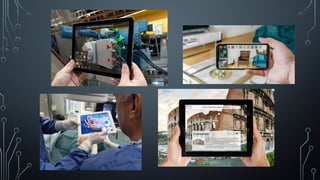
• Examples of AR systems are those that are used in photography and editing
like Snapchat filters, virtual dressing rooms, interior decoration applications
like IKEA mobile as well as virtual battlefields, and games such as Nintendo's
Pokémon Go. Moreover, AR is also widely used in marketing, and medical and
healthcare applications.
AUGMENTED REALITY
• MR brings together real-world and digital elements. In mixed reality, you interact with
and manipulate both physical and virtual items and environments, using next-
generation sensing and imaging technologies.
• Mixed Reality allows you to see and immerse yourself in the world around you even
as you interact with a virtual environment using your own hands—all without ever
removing your headset. It provides the ability to have one foot (or hand) in the real
world, and the other in an imaginary place, breaking down basic concepts between
real and imaginary, offering an experience that can change the way you game and
work today.
MIXED REALITY
AUGMENTED – VIRTUAL AND MIXED REALITY
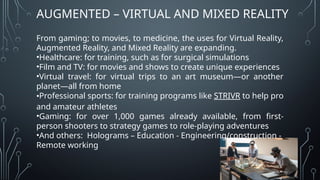
From gaming; to movies, to medicine, the uses for Virtual Reality,
Augmented Reality, and Mixed Reality are expanding.
•Healthcare: for training, such as for surgical simulations
•Film and TV: for movies and shows to create unique experiences
•Virtual travel: for virtual trips to an art museum—or another
planet—all from home
•Professional sports: for training programs like STRIVR to help pro
and amateur athletes
•Gaming: for over 1,000 games already available, from first-
person shooters to strategy games to role-playing adventures
•And others: Holograms – Education - Engineering/construction -
Remote working
VIRTUAL REALITY AND AUGMENTED REALITY
• Please visit this link: https://www.youtube.com/watch?
v=f9MwaH6oGEY to watch a video about what virtual reality and
augmented reality are.
• Please visit
https://www.credencys.com/blog/7-great-applications-of-augment
ed-reality-that-be-seen-in-the-real-world-today/
to learn about 7 different applications to AR in real world today
CYBERSECURITY
CYBERSECURITY
• Cybersecurity is the practice of protecting systems, networks, and
programs from digital attacks. These cyber attacks are usually
aimed at accessing, changing, or destroying sensitive information;
extorting money from users via ransomware; or interrupting
normal business processes.
• Implementing effective cybersecurity measures is particularly
challenging today because there are more devices than people,
and attackers are becoming more innovative.
• Cyber security is important because the government, military,
corporate, financial, and medical organizations collect, process,
and store unprecedented amounts of data on computers and
other devices. A significant portion of that data can be sensitive
information, whether that be intellectual property, financial data,
• A successful cybersecurity approach has multiple layers of protection spread across the computers, networks,
programs, or data that one intends to keep safe. In an organization, the people, processes, and technology
must all complement one another to create an effective defense from cyber attacks.
• People: Users must understand and comply with basic data security principles like choosing strong
passwords, being wary of attachments in email, and backing up data.
• Processes: Organizations must have a framework for how they deal with both attempted and successful
cyber-attacks. One well-respected framework can guide you. It explains how you can identify attacks, protect
systems, detect and respond to threats, and recover from successful attacks.
• Technology: Technology is essential to giving organizations and individuals the computer security tools
needed to protect themselves from cyber-attacks. Three main entities must be protected: endpoint devices
like computers, smart devices, and routers; networks; and the cloud. Common technology used to protect
these entities include next-generation firewalls, DNS filtering, malware protection, antivirus software, and
email security solutions.
CYBERSECURITY
Why is cybersecurity important?
• In today’s connected world, everyone benefits from advanced cyber defense programs. At an
individual level, a cybersecurity attack can result in everything from identity theft, to extortion
attempts, to the loss of important data like family photos. Everyone relies on critical
infrastructures like power plants, hospitals, and financial service companies. Securing these
and other organizations is essential to keeping our society functioning.
• Everyone also benefits from the work of cyber threat researchers, like teams of threat
researchers investigating new and emerging threats and cyber attack strategies. They reveal
new vulnerabilities, educate the public on the importance of cybersecurity, and strengthen
open-source tools. Their work makes the Internet safer for everyone.
CYBERSECURITY
Examples of cybersecurity threats
• Phishing
Phishing is the practice of sending fraudulent emails that resemble emails from reputable sources. The aim is to
steal sensitive data like credit card numbers and login information. It’s the most common type of cyber attack. You
can help protect yourself through education or a technology solution that filters malicious emails.
• Social engineering
Social engineering is a tactic that adversaries use to trick you into revealing sensitive information. They can solicit
a monetary payment or gain access to your confidential data. Social engineering can be combined with any of the
threats listed above to make you more likely to click on links, download malware, or trust a malicious source.
• Ransomware
Ransomware is a type of malicious software. It is designed to extort money by blocking access to files or the
computer system until the ransom is paid. Paying the ransom does not guarantee that the files will be recovered
or the system restored.
• Malware
Malware is a type of software designed to gain unauthorized access or to cause damage to a computer.
CYBERSECURITY
CYBER SECURITY
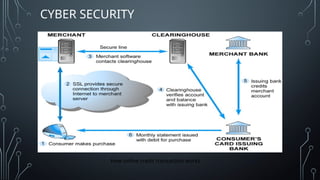
How online credit transaction works
CYBER SECURITY
• Please visit this link: https://www.youtube.com/watch?
v=JdfmV2KW11I to watch a video about how cyber security works.
INTERNET OF THINGS
INTERNET OF THINGS
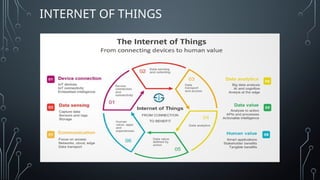
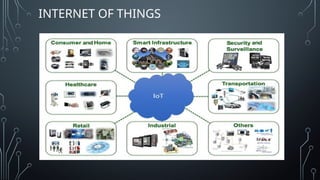
• The internet of things, or IoT, is a system of interrelated computing devices,
mechanical and digital machines, objects, animals or people that are provided with
unique identifiers (UIDs) and the ability to transfer data over a network without
requiring human-to-human or human-to-computer interaction.
INTERNET OF THINGS
INTERNET OF THINGS
INTERNET OF THINGS
• Please visit this link:
https://www.youtube.com/watch?v=NjYTzvAVozo to watch a video
about how life is more simple with connected devices
ASSIGNMENT
• Please choose ONE of the trends discussed in Weeks 2 and 3 and
write a report about the possible applications of this trend.
• Your report should be no longer than 1 and a half pages ( and no
less than 1 page).
• The due date is before your next lecture.
SUMMARY AND DISCUSSION

New 03A Short Version New Trends in Computer Science.pptx

  • 1.
  • 2.
    OBJECTIVES • Understand thebasic concepts of the latest trends in computer science: • Virtual Reality - Augmented Reality – Mixed Reality • Cybersecurity • Internet of things • Provide examples of real-case applications of the latest trends in computer science
  • 3.
  • 4.
    VIRTUAL REALITY • Virtualreality (VR) implies a complete immersion experience that shuts out the physical world. • VR is typically achieved by wearing a headset like Facebook’s Oculus equipped with the technology, and is used prominently in two different ways: • To create and enhance an imaginary reality for gaming, entertainment, and play (Such as video and computer games, or 3D movies, head-mounted displays). • To enhance training for real-life environments by creating a simulation of reality where people can practice beforehand (Such as flight simulators for pilots).
  • 5.
  • 6.
    • Augmented reality(AR) is a technology that enriches the user’s perception and provides a live view of the real world with digital information, aiming to expand it by adding images, sound, video and other virtual details. • The purpose of AR is to augment the environment and let virtual elements interact with real objects to create intended meanings. In AR, informatively-designed virtual environments coexist with real ones by providing additional data about the real world. AUGMENTED REALITY
  • 7.
    • Today, ARtechnology is commonly complemented by mobile phone technologies such as GPS, 3G, 4G and remote sensing. The combined image is usually projected onto mobile screens, augmented reality glasses and other devices. • Examples of AR systems are those that are used in photography and editing like Snapchat filters, virtual dressing rooms, interior decoration applications like IKEA mobile as well as virtual battlefields, and games such as Nintendo's Pokémon Go. Moreover, AR is also widely used in marketing, and medical and healthcare applications. AUGMENTED REALITY
  • 9.
    • MR bringstogether real-world and digital elements. In mixed reality, you interact with and manipulate both physical and virtual items and environments, using next- generation sensing and imaging technologies. • Mixed Reality allows you to see and immerse yourself in the world around you even as you interact with a virtual environment using your own hands—all without ever removing your headset. It provides the ability to have one foot (or hand) in the real world, and the other in an imaginary place, breaking down basic concepts between real and imaginary, offering an experience that can change the way you game and work today. MIXED REALITY
  • 10.
    AUGMENTED – VIRTUALAND MIXED REALITY From gaming; to movies, to medicine, the uses for Virtual Reality, Augmented Reality, and Mixed Reality are expanding. •Healthcare: for training, such as for surgical simulations •Film and TV: for movies and shows to create unique experiences •Virtual travel: for virtual trips to an art museum—or another planet—all from home •Professional sports: for training programs like STRIVR to help pro and amateur athletes •Gaming: for over 1,000 games already available, from first- person shooters to strategy games to role-playing adventures •And others: Holograms – Education - Engineering/construction - Remote working
  • 11.
    VIRTUAL REALITY ANDAUGMENTED REALITY • Please visit this link: https://www.youtube.com/watch? v=f9MwaH6oGEY to watch a video about what virtual reality and augmented reality are. • Please visit https://www.credencys.com/blog/7-great-applications-of-augment ed-reality-that-be-seen-in-the-real-world-today/ to learn about 7 different applications to AR in real world today
  • 12.
  • 13.
    CYBERSECURITY • Cybersecurity isthe practice of protecting systems, networks, and programs from digital attacks. These cyber attacks are usually aimed at accessing, changing, or destroying sensitive information; extorting money from users via ransomware; or interrupting normal business processes. • Implementing effective cybersecurity measures is particularly challenging today because there are more devices than people, and attackers are becoming more innovative. • Cyber security is important because the government, military, corporate, financial, and medical organizations collect, process, and store unprecedented amounts of data on computers and other devices. A significant portion of that data can be sensitive information, whether that be intellectual property, financial data,
  • 14.
    • A successfulcybersecurity approach has multiple layers of protection spread across the computers, networks, programs, or data that one intends to keep safe. In an organization, the people, processes, and technology must all complement one another to create an effective defense from cyber attacks. • People: Users must understand and comply with basic data security principles like choosing strong passwords, being wary of attachments in email, and backing up data. • Processes: Organizations must have a framework for how they deal with both attempted and successful cyber-attacks. One well-respected framework can guide you. It explains how you can identify attacks, protect systems, detect and respond to threats, and recover from successful attacks. • Technology: Technology is essential to giving organizations and individuals the computer security tools needed to protect themselves from cyber-attacks. Three main entities must be protected: endpoint devices like computers, smart devices, and routers; networks; and the cloud. Common technology used to protect these entities include next-generation firewalls, DNS filtering, malware protection, antivirus software, and email security solutions. CYBERSECURITY
  • 15.
    Why is cybersecurityimportant? • In today’s connected world, everyone benefits from advanced cyber defense programs. At an individual level, a cybersecurity attack can result in everything from identity theft, to extortion attempts, to the loss of important data like family photos. Everyone relies on critical infrastructures like power plants, hospitals, and financial service companies. Securing these and other organizations is essential to keeping our society functioning. • Everyone also benefits from the work of cyber threat researchers, like teams of threat researchers investigating new and emerging threats and cyber attack strategies. They reveal new vulnerabilities, educate the public on the importance of cybersecurity, and strengthen open-source tools. Their work makes the Internet safer for everyone. CYBERSECURITY
  • 16.
    Examples of cybersecuritythreats • Phishing Phishing is the practice of sending fraudulent emails that resemble emails from reputable sources. The aim is to steal sensitive data like credit card numbers and login information. It’s the most common type of cyber attack. You can help protect yourself through education or a technology solution that filters malicious emails. • Social engineering Social engineering is a tactic that adversaries use to trick you into revealing sensitive information. They can solicit a monetary payment or gain access to your confidential data. Social engineering can be combined with any of the threats listed above to make you more likely to click on links, download malware, or trust a malicious source. • Ransomware Ransomware is a type of malicious software. It is designed to extort money by blocking access to files or the computer system until the ransom is paid. Paying the ransom does not guarantee that the files will be recovered or the system restored. • Malware Malware is a type of software designed to gain unauthorized access or to cause damage to a computer. CYBERSECURITY
  • 17.
    CYBER SECURITY How onlinecredit transaction works
  • 18.
    CYBER SECURITY • Pleasevisit this link: https://www.youtube.com/watch? v=JdfmV2KW11I to watch a video about how cyber security works.
  • 19.
  • 20.
    INTERNET OF THINGS •The internet of things, or IoT, is a system of interrelated computing devices, mechanical and digital machines, objects, animals or people that are provided with unique identifiers (UIDs) and the ability to transfer data over a network without requiring human-to-human or human-to-computer interaction.
  • 21.
  • 22.
  • 23.
    INTERNET OF THINGS •Please visit this link: https://www.youtube.com/watch?v=NjYTzvAVozo to watch a video about how life is more simple with connected devices
  • 24.
    ASSIGNMENT • Please chooseONE of the trends discussed in Weeks 2 and 3 and write a report about the possible applications of this trend. • Your report should be no longer than 1 and a half pages ( and no less than 1 page). • The due date is before your next lecture.
  • 25.