Discrete Structures
Logic and Proofs
Lecture-3
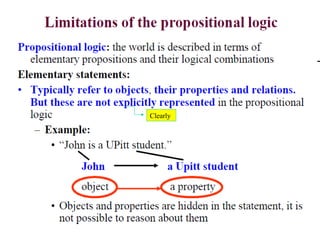
Clearly
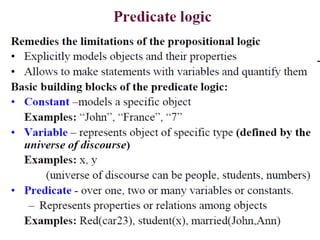
Predicate
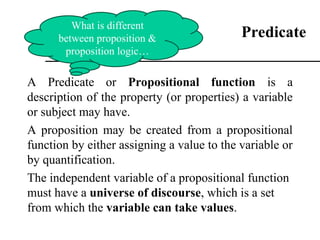
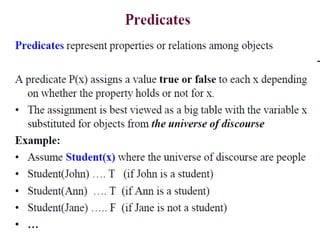
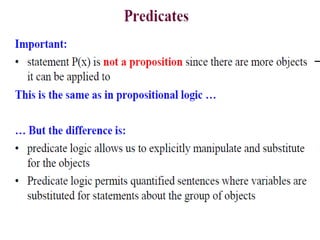
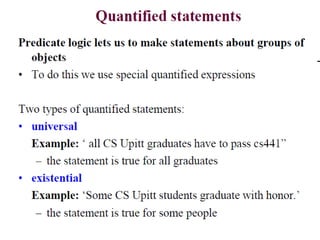
A Predicate or Propositional function is a
description of the property (or properties) a variable
or subject may have.
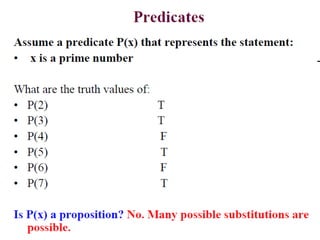
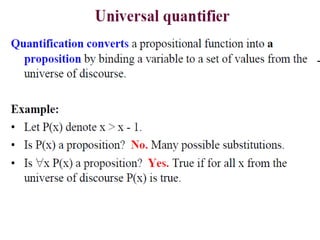
A proposition may be created from a propositional
function by either assigning a value to the variable or
by quantification.
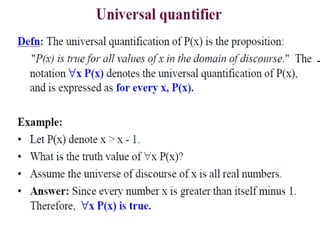
The independent variable of a propositional function
must have a universe of discourse, which is a set
from which the variable can take values.
What is different
between proposition &
proposition logic…
Predicate (Conti…)
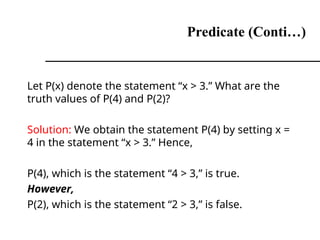
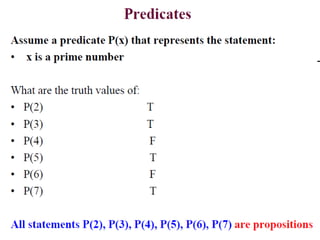
Let P(x) denote the statement “x > 3.” What are the
truth values of P(4) and P(2)?
Solution: We obtain the statement P(4) by setting x =
4 in the statement “x > 3.” Hence,
P(4), which is the statement “4 > 3,” is true.
However,
P(2), which is the statement “2 > 3,” is false.
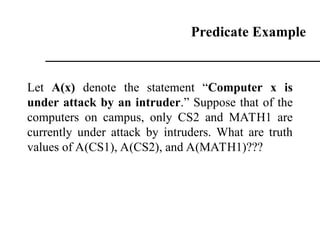
Predicate Example
Let A(x) denote the statement “Computer x is
under attack by an intruder.” Suppose that of the
computers on campus, only CS2 and MATH1 are
currently under attack by intruders. What are truth
values of A(CS1), A(CS2), and A(MATH1)???
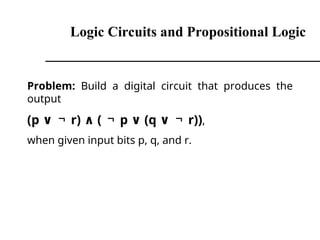
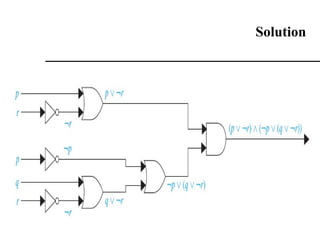
Logic Circuits and Propositional Logic
Problem: Build a digital circuit that produces the
output
(p ∨ ¬ r) ∧ ( ¬ p ∨ (q ∨ ¬ r)),
when given input bits p, q, and r.
Solution
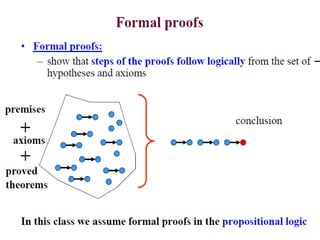
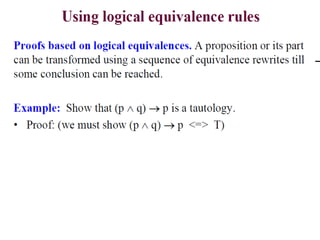
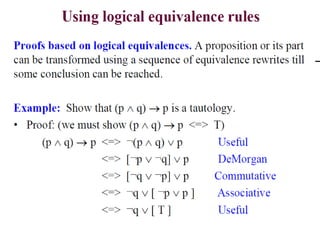
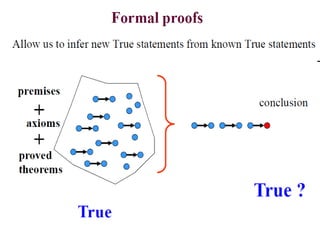
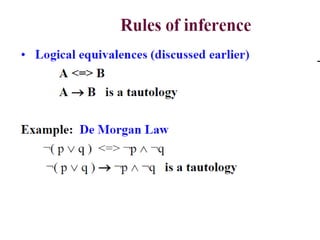
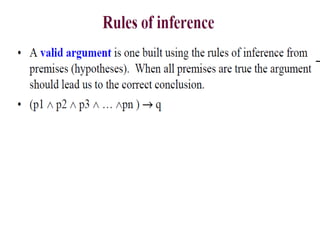
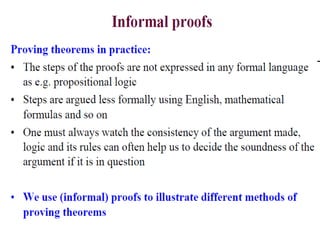
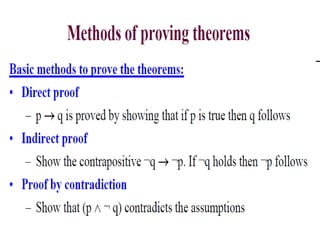
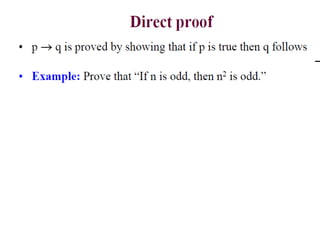
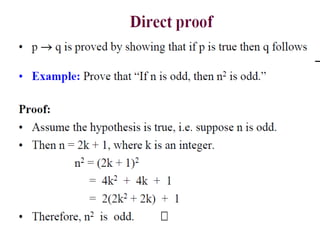
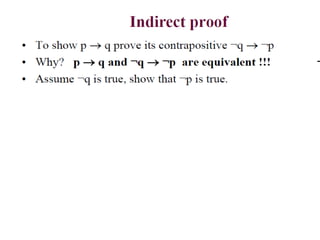
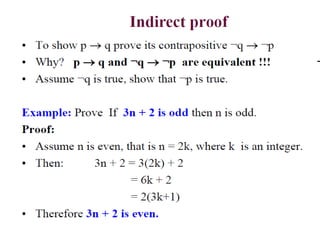
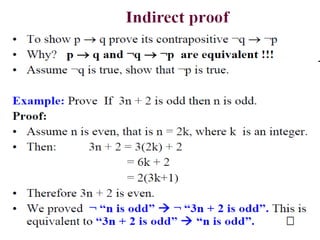
Formal and informal proofs
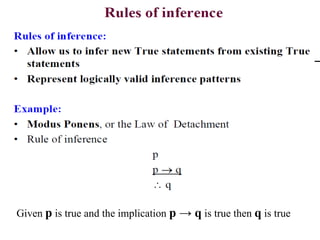
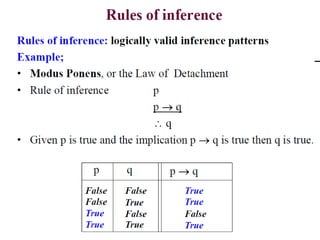
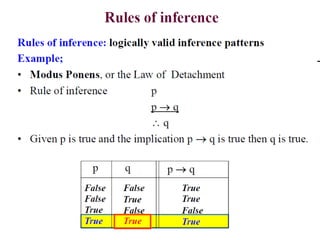
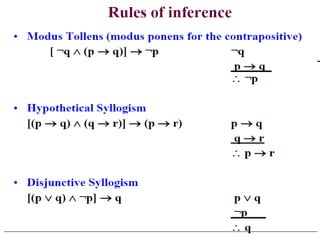
Given p is true and the implication p → q is true then q is true
Reading Assignment
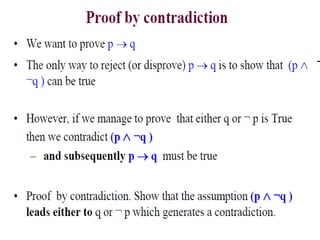
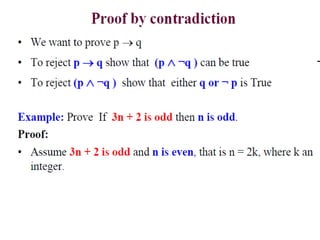
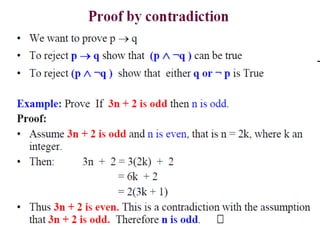
Proof by Contradiction
Discrete Structures |Topic: Logic and Proofs

Discrete Structures |Topic: Logic and Proofs

  • 1.
  • 2.
  • 6.
    Predicate A Predicate orPropositional function is a description of the property (or properties) a variable or subject may have. A proposition may be created from a propositional function by either assigning a value to the variable or by quantification. The independent variable of a propositional function must have a universe of discourse, which is a set from which the variable can take values. What is different between proposition & proposition logic…
  • 7.
    Predicate (Conti…) Let P(x)denote the statement “x > 3.” What are the truth values of P(4) and P(2)? Solution: We obtain the statement P(4) by setting x = 4 in the statement “x > 3.” Hence, P(4), which is the statement “4 > 3,” is true. However, P(2), which is the statement “2 > 3,” is false.
  • 26.
    Predicate Example Let A(x)denote the statement “Computer x is under attack by an intruder.” Suppose that of the computers on campus, only CS2 and MATH1 are currently under attack by intruders. What are truth values of A(CS1), A(CS2), and A(MATH1)???
  • 36.
    Logic Circuits andPropositional Logic Problem: Build a digital circuit that produces the output (p ∨ ¬ r) ∧ ( ¬ p ∨ (q ∨ ¬ r)), when given input bits p, q, and r.
  • 37.
  • 38.
  • 47.
    Given p istrue and the implication p → q is true then q is true
  • 61.

Editor's Notes

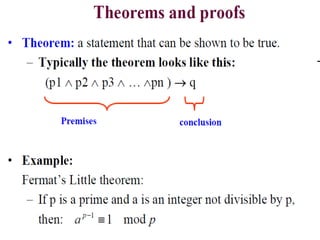
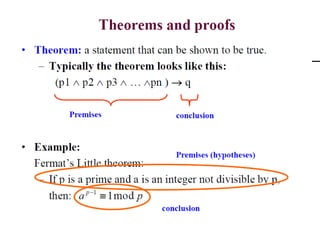
  • #40 For example, if a = 2 and p = 7, then 26 = 64, and 64 − 1 = 63 = 7 × 9 is thus a multiple of 7.