Discounted Cash Flow Analysis - Part 3 of the Valuation Series
Prepared by Prashant S Nair
13th April 2021
strategyrev.com
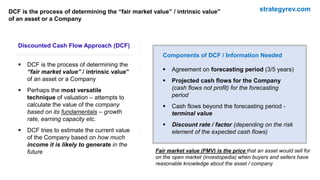
DCF is the process of determining the “fair market value” / intrinsic value”
of an asset or a Company
strategyrev.com
Discounted Cash Flow Approach (DCF)
 DCF is the process of determining the
“fair market value” / intrinsic value”
of an asset or a Company
 Perhaps the most versatile
technique of valuation – attempts to
calculate the value of the company
based on its fundamentals – growth
rate, earning capacity etc.
 DCF tries to estimate the current value
of the Company based on how much
income it is likely to generate in the
future
Components of DCF / Information Needed
 Agreement on forecasting period (3/5 years)
 Projected cash flows for the Company
(cash flows not profit) for the forecasting
period
 Cash flows beyond the forecasting period -
terminal value
 Discount rate / factor (depending on the risk
element of the expected cash flows)
Fair market value (FMV) is the price that an asset would sell for
on the open market (investopedia) when buyers and sellers have
reasonable knowledge about the asset / company
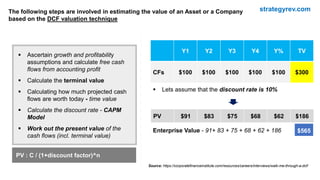
$565
PV : C / (1+discount factor)^n
The following steps are involved in estimating the value of an Asset or a Company
based on the DCF valuation technique
strategyrev.com
 Ascertain growth and profitability
assumptions and calculate free cash
flows from accounting profit
 Calculate the terminal value
 Calculating how much projected cash
flows are worth today - time value
 Calculate the discount rate - CAPM
Model
 Work out the present value of the
cash flows (incl. terminal value)
Y1 Y2 Y3 Y4 Y% TV
CFs $100 $100 $100 $100 $100 $300
 Lets assume that the discount rate is 10%
PV $91 $83 $75 $68 $62 $186
Enterprise Value - 91+ 83 + 75 + 68 + 62 + 186
Source: https://corporatefinanceinstitute.com/resources/careers/interviews/walk-me-through-a-dcf/

Discounted Cash Flow Analysis

  • 1.
    Discounted Cash FlowAnalysis - Part 3 of the Valuation Series Prepared by Prashant S Nair 13th April 2021 strategyrev.com
  • 2.
    DCF is theprocess of determining the “fair market value” / intrinsic value” of an asset or a Company strategyrev.com Discounted Cash Flow Approach (DCF)  DCF is the process of determining the “fair market value” / intrinsic value” of an asset or a Company  Perhaps the most versatile technique of valuation – attempts to calculate the value of the company based on its fundamentals – growth rate, earning capacity etc.  DCF tries to estimate the current value of the Company based on how much income it is likely to generate in the future Components of DCF / Information Needed  Agreement on forecasting period (3/5 years)  Projected cash flows for the Company (cash flows not profit) for the forecasting period  Cash flows beyond the forecasting period - terminal value  Discount rate / factor (depending on the risk element of the expected cash flows) Fair market value (FMV) is the price that an asset would sell for on the open market (investopedia) when buyers and sellers have reasonable knowledge about the asset / company
  • 3.
    $565 PV : C/ (1+discount factor)^n The following steps are involved in estimating the value of an Asset or a Company based on the DCF valuation technique strategyrev.com  Ascertain growth and profitability assumptions and calculate free cash flows from accounting profit  Calculate the terminal value  Calculating how much projected cash flows are worth today - time value  Calculate the discount rate - CAPM Model  Work out the present value of the cash flows (incl. terminal value) Y1 Y2 Y3 Y4 Y% TV CFs $100 $100 $100 $100 $100 $300  Lets assume that the discount rate is 10% PV $91 $83 $75 $68 $62 $186 Enterprise Value - 91+ 83 + 75 + 68 + 62 + 186 Source: https://corporatefinanceinstitute.com/resources/careers/interviews/walk-me-through-a-dcf/