DISCOUNTED CASH FLOW
METHOD
Valuation
Purpose of Valuation
Various Approaches
DCF method
 Estimation Process - worth of an object/instrument
Examples:
 Bike sale - Hero Honda Vs Bajaj
 Real Estate - ECR beach side Vs Non beach
 Valuation of Asset - fire sale Vs normal sale
 Sale of shares by a person to another.
 Merger of two or more companies
 Absorption - capital restructuring
 Tax Purposes
 Acquisition/ transfer of shares in an Indian
company by a non-resident
 Ascertainment of the premium at which shares
are to be issued
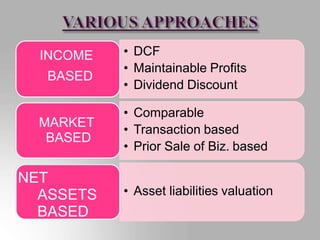
INCOME
BASED
• DCF
• Maintainable Profits
• Dividend Discount
• Comparable
• Transaction based
• Prior Sale of Biz. based
MARKET
BASED
• Asset liabilities valuation
NET
ASSETS
BASED
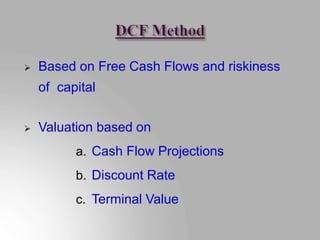
 Based on Free Cash Flows and riskiness
of capital
 Valuation based on
a. Cash Flow Projections
b. Discount Rate
c. Terminal Value
 Growth prospects & Earnings Capacity
 Discontinuation of biz
 Expansion of capacity
 Turnaround Cases
 Entire Biz Cycle
 Consideration – Policy change
 Operating Leverage – Utilization Capacity
 Product Mix
 Financing Policy
 Capex
 Expansion Capex
 Maintenance Capex
 Income Tax
 CAPM Method
 Leveraged Entity
 Weighted Average Cost of Capital (WACC)
 Deleveraged Entity
 Cost of Equity
 Equivalent to liquidation/sale value
 Value of CF after forecast period
 Methods - Perpetual Growth & Multiple
Approach
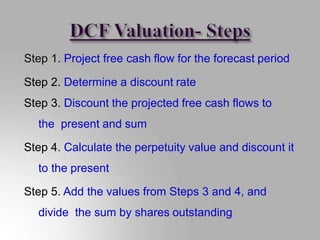
Step 1. Project free cash flow for the forecast period
Step 2. Determine a discount rate
Step 3. Discount the projected free cash flows to
the present and sum
Step 4. Calculate the perpetuity value and discount it
to the present
Step 5. Add the values from Steps 3 and 4, and
divide the sum by shares outstanding
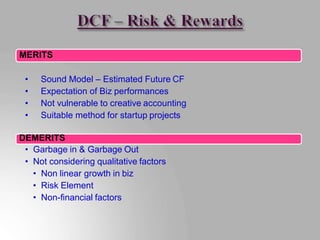
MERITS
• Sound Model – Estimated Future CF
• Expectation of Biz performances
• Not vulnerable to creative accounting
• Suitable method for startup projects
DEMERITS
• Garbage in & Garbage Out
• Not considering qualitative factors
• Non linear growth in biz
• Risk Element
• Non-financial factors

DCF theory.pptx

  • 1.
  • 2.
  • 3.
     Estimation Process- worth of an object/instrument Examples:  Bike sale - Hero Honda Vs Bajaj  Real Estate - ECR beach side Vs Non beach  Valuation of Asset - fire sale Vs normal sale
  • 4.
     Sale ofshares by a person to another.  Merger of two or more companies  Absorption - capital restructuring  Tax Purposes  Acquisition/ transfer of shares in an Indian company by a non-resident  Ascertainment of the premium at which shares are to be issued
  • 5.
    INCOME BASED • DCF • MaintainableProfits • Dividend Discount • Comparable • Transaction based • Prior Sale of Biz. based MARKET BASED • Asset liabilities valuation NET ASSETS BASED
  • 6.
     Based onFree Cash Flows and riskiness of capital  Valuation based on a. Cash Flow Projections b. Discount Rate c. Terminal Value
  • 7.
     Growth prospects& Earnings Capacity  Discontinuation of biz  Expansion of capacity  Turnaround Cases  Entire Biz Cycle  Consideration – Policy change  Operating Leverage – Utilization Capacity  Product Mix  Financing Policy  Capex  Expansion Capex  Maintenance Capex  Income Tax
  • 8.
     CAPM Method Leveraged Entity  Weighted Average Cost of Capital (WACC)  Deleveraged Entity  Cost of Equity
  • 9.
     Equivalent toliquidation/sale value  Value of CF after forecast period  Methods - Perpetual Growth & Multiple Approach
  • 10.
    Step 1. Projectfree cash flow for the forecast period Step 2. Determine a discount rate Step 3. Discount the projected free cash flows to the present and sum Step 4. Calculate the perpetuity value and discount it to the present Step 5. Add the values from Steps 3 and 4, and divide the sum by shares outstanding
  • 11.
    MERITS • Sound Model– Estimated Future CF • Expectation of Biz performances • Not vulnerable to creative accounting • Suitable method for startup projects DEMERITS • Garbage in & Garbage Out • Not considering qualitative factors • Non linear growth in biz • Risk Element • Non-financial factors