Discontinuous Control Systems 1st Edition Igor Boiko (Auth.)
Discontinuous Control Systems 1st Edition Igor Boiko (Auth.)
Discontinuous Control Systems 1st Edition Igor Boiko (Auth.)
Discontinuous Control Systems 1st Edition Igor Boiko (Auth.)
Discontinuous Control Systems 1st Edition Igor Boiko (Auth.)
1.
Visit ebookfinal.com todownload the full version and
explore more ebooks or textbooks
Discontinuous Control Systems 1st Edition Igor
Boiko (Auth.)
_____ Click the link below to download _____
https://ebookfinal.com/download/discontinuous-control-
systems-1st-edition-igor-boiko-auth/
Explore and download more ebooks or textbook at ebookfinal.com
2.
Here are somerecommended products that we believe you will be
interested in. You can click the link to download.
Discontinuous Control Systems 1st Edition Igor Boiko
(Auth.)
https://ebookfinal.com/download/discontinuous-control-systems-1st-
edition-igor-boiko-auth/
Control Systems 1st Edition U.A.Bakshi
https://ebookfinal.com/download/control-systems-1st-edition-u-a-
bakshi/
Vagabond Vol 29 29 Inoue
https://ebookfinal.com/download/vagabond-vol-29-29-inoue/
Automatic Control Systems 9th Edition Farid Golnaraghi
https://ebookfinal.com/download/automatic-control-systems-9th-edition-
farid-golnaraghi/
3.
Food industry qualitycontrol systems Mark Clute
https://ebookfinal.com/download/food-industry-quality-control-systems-
mark-clute/
Stability and Control of Aircraft Systems Introduction to
Classical Feedback Control 1st Edition Roy Langton
https://ebookfinal.com/download/stability-and-control-of-aircraft-
systems-introduction-to-classical-feedback-control-1st-edition-roy-
langton/
Introduction to Linear Control Systems 1st Edition Yazdan
Bavafa-Toosi
https://ebookfinal.com/download/introduction-to-linear-control-
systems-1st-edition-yazdan-bavafa-toosi/
Feedback Control of Computing Systems 1st Edition Joseph
L. Hellerstein
https://ebookfinal.com/download/feedback-control-of-computing-
systems-1st-edition-joseph-l-hellerstein/
Vibration Control of Vehicle Suspension Systems 1st
Edition Haiping Du
https://ebookfinal.com/download/vibration-control-of-vehicle-
suspension-systems-1st-edition-haiping-du/
5.
Discontinuous Control Systems1st Edition Igor Boiko
(Auth.) Digital Instant Download
Author(s): Igor Boiko (auth.)
ISBN(s): 9780817647520, 081764752X
Edition: 1
File Details: PDF, 3.68 MB
Year: 2009
Language: english
Preface
Discontinuous control systemsare the oldest type of control system and the
most widespread type of nonlinear control system. The theory of discontinuous
control, and the theory of relay feedback systems in particular, is usually con-
sidered a mature subject. However, many problems in discontinuous control
theory still remain open. One problem involves the input-output properties
of these systems, knowledge of which is extremely important to every appli-
cation.
Two types of discontinuous control systems are studied in this book. The
first is the so-called relay feedback system, which normally encompasses re-
lay servomechanisms, various on-off controllers, sigma-delta modulators, relay
feedback tests used for process dynamics identification, and controller tuning.
Relay systems are often considered the main type of nonlinear system, which is
evident by the enormous amount of house temperature control systems (that
are usually implemented as on-off controllers) that exist. The theory of relay
systems is an old subject. The problem of analysis of relay feedback systems
was first considered by L. MacColl in 1945 [71]; the study was motivated by
the development of relay servomechanisms of missile thrusters on the one hand
and vibrational voltage regulators on the other. MacColl’s analysis was based
on an approximate approach close to the describing function method. Later,
exact methods of analysis of relay feedback systems were developed, the most
well-known of which is the Tsypkin locus [94]. The exact approach developed
by Tsypkin, however, did not consider the servo aspect of relay feedback con-
trol. Its purpose was limited to finding periodic motions that may occur in a
relay system in an autonomous mode or under external excitation. The servo
problem in relay feedback control has not received due attention since. In
recent years, a relatively small number of publications on relay feedback sys-
tems theory have appeared, in which only autonomous modes, and not servo
modes, were considered.
The second type of discontinuous control system considered in this volume
is the so-called sliding mode control system, which includes the conventional
first-order sliding mode control system and the second-order sliding mode
12.
VIII Preface
system. Slidingmode systems are a specific type of discontinuous control
system. There are a number of references on sliding mode control (systems)
devoted to this type of discontinuous control, the most well-known of which
is by V.I. Utkin [97]. This subject has been an active research area during the
past three decades. However, the present volume offers a different treatment
of sliding modes than the traditional approach. The approach presented in
this work allows accounting for the presence of so-called parasitic dynamics in
control loops and uncovers mechanisms of chattering and non-ideal closed-loop
performance in sliding mode control systems.
The purpose of this book is to present a new frequency-domain theory of
discontinuous control systems in which the control systems are viewed and
studied as servo systems. This theory involves a unified frequency-domain ap-
proach to both analysis of possible self-excited periodic motions and analysis
of input-output properties of discontinuous control systems. The servo aspect
of control is very important and was underestimated in the past. Knowledge of
input-output properties is as important as knowledge of autonomous behav-
ior in discontinuous control systems (self-excited oscillations). In fact, these
two aspects complement each other. For example, in on-off house temperature
control system design, it is equally important to know both the frequency of
relay switching and how the average indoor temperature might change in re-
sponse to the outdoor temperature. The latter problem can be solved only if
the servo aspect of the system is considered.
The core approach in this present book is the frequency-domain method
called the locus of a perturbed relay system (LPRS). This method offers an
exact analysis of both oscillatory properties and servo properties of relay
feedback systems. The method is analytical and very convenient for design
applications, which is illustrated by the numerous examples provided. This
approach is exact, which allows for overcoming the drawback of the well-
known describing function method. Further, overcoming the constraint of the
filtering hypothesis of the describing function method allows for extending
the proposed theory to analysis of motion in sliding mode control systems,
where the sliding mode itself is now considered as oscillations of either finite
or infinite frequency. The analysis provided, however, is not merely another
confirmation of available results in sliding mode control theory. The proposed
approach offers a more precise treatment of sliding mode control systems than
does classic sliding mode control theory. Thus, the proposed approach intro-
duces the theory of real sliding mode control versus ideal classic sliding mode
control.
This book is primarily a research monograph, as it is devoted only to
frequency-domain theory of discontinuous control systems, and the theory pre-
sented in the book is novel. However, it also has many features of a textbook,
as the theory presented covers a relatively large classic nonlinear control area.
This theory is illustrated by a number of application examples from different
areas of control engineering and is accessible to students with a background
in linear control. The included MATLAB code can also make understanding
13.
Preface IX
of thepresented theory easy. The book, therefore, can be used by researchers,
practitioners, and undergraduate and graduate students.
The material is organized into two parts and appendices. Part I is de-
voted to the theory of the locus of a perturbed relay system (LPRS) method,
and Part II presents applications of the LPRS method. Part I comprises five
chapters. Chapter 1 poses the problem and outlines the scope and method of
analysis, which is presented in detail in the following chapter. In Chapter 3,
the results obtained in Chapter 2 for slow inputs are extended to the analy-
sis of the system response to relatively fast input signals. Chapter 4 presents
frequency-domain theory of sliding mode control systems. The sliding mode
analysis follows the methodology developed in the preceding chapters. Chap-
ter 5 is devoted to an emerging area of sliding mode control — second-order
sliding mode control systems analysis.
Part II gives a number of applications of LPRS theory. These applications
include the electro-pneumatic servomechanism (Chapter 6), the relay feed-
back test and its application to process dynamics identification and controller
tuning (Chapter 7), the sliding mode differentiator and dynamic compen-
sator (Chapter 8), and the sliding mode observer (Chapter 9). Some of these
applications have been in engineering practice for many years, and other ap-
plications are relatively new. In general, the material of each chapter in the
second part of the book is independent and only makes general references to
topics presented in the first part. The Appendix contains the derivations of
the LPRS, the proofs of the theorems, and the MATLAB code used in the
text for the LPRS computations.
I wish to acknowledge the many colleagues who have contributed to the
development of this book. I am especially grateful to Prof. L. Fridman for
the many discussions resulting in the refinement of the theory presented,
to Dr. A. Pisano for his review of the manuscript, to Prof. V.I. Utkin and
Prof. K. Furuta for their encouragement and support of my work on this
project, to the late Prof. V. Kainov who years ago introduced me to the
world of discontinuous control systems, to Prof. N.V. Faldin who influenced
my research in many ways, to Prof. D. Atherton and Prof. Y. Shtessel for
their valuable comments and discussions of the theory currently presented in
the book, and to Mr. E. Tamayo for providing the opportunity and help in
implementation of the presented theory in a loop tuner. I thank Alex and
Michael Boiko for their help with the LaTeX typesetting and artwork. I also
express gratitude to my family for their patience and support; without them
this undertaking would not have been possible.
Calgary, Canada Igor Boiko
October 2008
XIV Contents
10 Appendix. . . . . . . . . . . . . . . . . . . . . . . . . . . . . . . . . . . . . . . . . . . . . . . . . . 177
10.1 The LPRS derivation for a non-integrating linear part . . . . . . . . 177
10.2 Orbital stability of a system with a non-integrating linear part 181
10.3 The LPRS derivation for an integrating linear part . . . . . . . . . . 183
10.4 Orbital stability of a system with an integrating linear part . . . 191
10.5 The LPRS derivation for a linear part with time delay . . . . . . . 194
10.6 MATLAB code for LPRS computing . . . . . . . . . . . . . . . . . . . . . . . 198
References . . . . . . . . . . . . . . . . . . . . . . . . . . . . . . . . . . . . . . . . . . . . . . . . . . . . . 205
Index . . . . . . . . . . . . . . . . . . . . . . . . . . . . . . . . . . . . . . . . . . . . . . . . . . . . . . . . . . 211
18.
1
The servo problemin discontinuous control
systems
1.1 Introduction
Discontinuous control systems, and relay feedback systems in particular, are
one of the most important types of nonlinear systems. The term “relay” comes
from electrical applications where on-off control has long been used. To de-
scribe the nonlinear phenomenon typical of electrical relays, the nonlinear
function also received the name “relay” comprising a number of discontinu-
ous nonlinearities. Thus, when applied to any type of control system, the term
“relay” is now associated not with applications but with the kind of nonlin-
earities that are found in the system models. However, what we traditionally
call the “relay system” cannot always be described by the relay system model.
For example, the vibrational voltage regulator is not a relay system in the full
sense, as the charge and discharge time constants are different and the regu-
lator is better described as a variable structure system (which is, however, a
discontinuous control system).
Applications of the discontinuous feedback principle have evolved from vi-
brational voltage regulators and missile thruster servomechanisms of the 1940s
to numerous on-off process parameter closed-loop control systems, sigma-
delta modulators, process identification and automatic tuning of proportional-
integral-derivative (PID) controller techniques, and DC motor, hydraulic and
pneumatic servo systems, to name a few. The enormous number of residential
temperature control systems available throughout the world illustrates how
popular discontinuous control systems are. A number of industrial examples
of relay systems were given in the classic book on relay systems [94]. Further-
more, many existing sliding mode algorithms can be considered and analyzed
via the relay control principle. Perhaps, some aspects of hybrid systems can
also be analyzed via application of discontinuous control system theory. In
fact, discontinuous control systems are probably the most conventional type
of control system in history.
Discontinuous control systems provide many advantages over linear sys-
tems: simplicity of design, cheaper components that were known as early as
19.
4 1 Theservo problem in discontinuous control systems
the 1930s [55], and the ability to adapt the open-loop gain in the relay feed-
back system in response to changing parameters [8, 50, 71]. As a rule, they
also provide a higher open-loop gain and a higher performance [56] than lin-
ear systems. In some applications, smoothing of the Coulomb friction and of
other plant nonlinearities can also be achieved.
Discontinuous control systems theory has been the subject of attention
since the 1940s from the worldwide research community. Traditionally, the
scope of research was composed of the following problems: existence and pa-
rameters of periodic motions, stability of limit cycles, and input-output prob-
lems (set point tracking or external signal propagation through the system),
which includes the disturbance attenuation problem. The theoretical devel-
opment was motivated by the design of missile thruster servomechanisms in
Germany [17] and in the United States [71, 72, 104] as well as vibrational
voltage regulators [51]. Later, a number of publications, some of which be-
came classic works in the area, appeared. Most of these were concerned with
the solution of the periodic problem. A semigrahpical solution [43], a matrix
method [28], a z-transform–based solution [57], frequency-domain methods
[54, 941
] and [9] (which can be considered a generalization of method [94]), a
state-space–based technique [34], and a finite-difference operator method [81]
for the solution of problem of existence and local stability of periodic mo-
tions were proposed in the late 1950s to the mid-1960s. In [79] a systematic
overview of applications of Poincaré maps to the analysis of periodic motions
in relay systems was given. A rigorous solution of the problem of existence
and local stability of limit cycles was presented in [2] and [100] for symmet-
ric and asymmetric limit cycles, respectively. The problem of global stability
of limit cycles was considered in [53]. In [81, 94] and [84], the input-output
problem was analyzed. Relay feedback systems were also studied with the use
of more general approximate methods such as the describing function (DF)
method [71] (where the input-output problem in relay systems was probably
considered for the first time; the authors used the results obtained in [58]),
and [8, 50, 56, 87]. In the recent monographs [103] and [107], extensive cover-
age of the theory of relay feedback test–based identification is given.
Another study of oscillations in the relay and variable structure systems
was motivated by the chattering problem in sliding mode control [97, 105].
This problem is closely related to the original problem, and the results are
applicable to both variable structure systems and relay systems ([4, 16, 26, 46,
47, 98, 99]). A number of techniques of process parameter identification and
PID controller tuning based on the relay feedback test are given in [3, 59–61,
70, 73–75, 83]. Periodic motions in sigma-delta modulators were studied in [41]
and [78].
The method presented in this book is based on the frequency-domain char-
acteristic of the discontinuous control system that is similar in some ways
to the frequency response of a linear system (Nyquist plot) and the Tsypkin
1
The first edition of this book was published in 1955.
20.
1.2 Fundamentals offrequency-domain analysis of periodic motions 5
locus [94]. Therefore, the presented approach has some resemblance to the DF
method and Tsypkin’s method. Moreover, from the methodological point of
view, the presented theory in some ways replicates the DF method. However,
the presented method offers a few advantages over both methods mentioned
above: better accuracy than that of the DF method (eliminating the necessity
of the filtering hypothesis) and a better solution of the input-output problem
compared with that of the Tsypkin locus, which can only furnish a solution
of the periodic problem.2
All discontinuous control systems have a nonlinear element in the control
loop. Usually the nonlinearity is associated with the controller. In most cases
the discontinuous nonlinearity is an ideal (sign function) or hysteretic relay.
However, it can be a more complex nonlinearity, examples of which are consid-
ered in the chapters devoted to sliding mode control and second-order sliding
mode control.
A mode that may occur in a discontinuous control system is a self-excited
(non-vanishing) oscillation, which is also referred to as a periodic motion. If
the system does not have asymmetric nonlinearities, this periodic motion is
symmetric in the autonomous mode (no external input applied). However, if
an external input (disturbance) is applied to the system that has a periodic
motion, the self-excited oscillations become biased or asymmetric. The key ap-
proach to the analysis of discontinuous control systems is a method of analysis
of self-excited oscillations (symmetric and asymmetric). The following section
gives a general methodology of such an analysis based on frequency-domain
concepts.
1.2 Fundamentals of frequency-domain analysis
of periodic motions in nonlinear systems
The problem of finding possible periodic motions in nonlinear dynamical sys-
tems is a fundamental problem in both mathematics and control theory. It
can be traced back to the works of Poincaré who introduced a widely used
now geometric interpretation of this problem as that of finding a closed orbit
in the state space.
Poincaré’s approach involves finding a certain map in the state space,
which is now called the Poincaré map. Yet Poincaré maps for most nonlinear
systems can hardly be obtained in an analytical form. Analytical expressions
have been obtained only for low-order systems or higher-order systems con-
taining simple types of nonlinear functions. An example of the latter is the
relay feedback system for which the Poincaré map is obtained in an explicit
form. A few formulations of Poincaré maps for relay feedback systems are pre-
sented in [2, 20, 54, 94, 100]. For more complex types of nonlinearities, only an
2
Tsypkin [94] also considers the input-output problem in his book; he proposes
that the solution of the input-output problem should be done via analysis of
asymmetric oscillations.
21.
6 1 Theservo problem in discontinuous control systems
approximate solution can be found as a rule. A number of different approaches
to the problem of finding a periodic solution have been proposed. The most
general approach was given in [64] in which the solution of the periodic prob-
lem was found in the form of a Fourier series. Despite the clear underlying
idea of this method, its application is computationally cumbersome, as the
original problem is transformed into the problem of solving the system of a
high number of nonlinear algebraic equations, which is often impractical. A
modification of this classic approach was given in [96]. However, the compu-
tational efficiency of the proposed approach rapidly decreases with required
accuracy. Among other methods are Volterra series used to solve both the pe-
riodic problem in autonomous systems [32] and forced oscillations [102]. Yet
the Volterra series approach can only handle weak (mild) nonlinearities. A
combination of the perturbation method and the harmonic balance method
was proposed in [29]. But this method also can handle only mild nonlinear-
ities. A singular perturbation method was used for analysis of the periodic
problem in relay systems in [47].
Commonly in engineering practice, only the first-harmonic approximation
is used, which is known as the describing function (DF) method. The main
concepts of this method were developed in the 1940s and 1950s [36, 51, 52,
63, 71, 95]. Comprehensive coverage of this method is given in [8, 50]. The
DF method provides a simple and efficient, but not exact, solution of the pe-
riodic problem. Its applications are limited to systems that can be separated
into nonlinear and linear parts interconnected into a closed loop (Fig. 1.1)
with the nonlinear part being a static nonlinearity (with possible hysteresis)
and the linear part given by linear time-invariant differential equations. More-
over, the linear part must be a low-pass filter to filter out higher harmonics,
so that the input to the nonlinearity could approximately be considered a
sinusoid.
Let us consider the frequency-domain approach to analysis of self-excited
oscillations. Consider the following nonlinear system,
ẋ = Ax + Bu
y = Cx
(1.1)
Fig. 1.1. Block diagram of the system for DF analysis
22.
1.2 Fundamentals offrequency-domain analysis of periodic motions 7
Fig. 1.2. Poincaré mapping
u = f(σ), (1.2)
σ = −y, (1.3)
where A ∈ Rn×n
, B ∈ Rn×1
, and C ∈ R1×n
are matrices, x ∈ Rn
, y ∈
R1
, σ ∈ R1
, f ∈ R1
, f(σ) is a single-valued symmetric monotone nonlinear
function: f(−σ) = −f(σ) (it will be later extended to a hysteretic function).
Formula (1.1) provides a description of the linear part, formula (1.2) denotes
the nonlinear part of the system, and formula (1.3) gives the condition of
closing the system loop. We shall also use the linear part description in the
form of the transfer function W(s), which can be obtained from formulas (1.1)
as follows: W(s) = C(Is − A)−1
B. Let us also assume that the linear part is
strictly proper, i.e., the relative degree of W(s) is one or higher.
The problem of finding a periodic solution of system (1.1), (1.2), and (1.3)
is usually formulated as the problem of finding a fixed point x∗
of Poincaré
map, which will be a solution to the equation: x = P(x), where P(x) is the
mapping. Figure 1.2 provides two examples of Poincaré mapping. P1 maps
point x1 into point x2, and P2 maps point x3 into itself. Therefore, x3 = x∗
.
In the time domain, the closed orbit that starts from the point x∗
(denote it
x∗
(t) for brevity) will be a periodic vector signal, and y∗
(t) = Cx∗
(t) will be
a periodic scalar signal.
Now consider the open-loop system (1.1), (1.2), which can be obtained by
ignoring equality (1.3). Let σ(t) be a periodic symmetric signal of period T
with zero mean, continuously differentiable with respect to t, so that σ(t +
T/2) = −σ(t), σ ∈ R, t ∈ D ⊂ R, D := t ∈ [0; T]. Consider the following
lemma, which will be instrumental below.
Lemma 1.1. If σ(t) satisfies the conditions of symmetric periodicity and uni-
modality and f(σ) is a symmetric monotone nonlinear function, then x(t) will
be a periodic vector signal, and y(t) will be a periodic scalar signal.
Proof. u(t) is a periodic signal because it is a function of f(σ): u(t + T) =
f(σ(t+T)) = f(σ(t)) = u(t). y(t) as well as x(t) are periodic because they are
responses to the periodic input u(t), which follows from linear system theory.
23.
8 1 Theservo problem in discontinuous control systems
Definition 1.2. Let us call the mapping of space R×D into itself, where σ(t)
satisfies the conditions of symmetric periodicity and unimodality, the periodic
signal mapping (PSM)
y(t) = g(f(σ(t)), (1.4)
which is a chain-rule application of two mappings: g for the linear part and f
for the nonlinear part.
Definition 1.3. Let us call the periodic function σ∗
(t), which provides the
solution to the equation −σ(t) = g(f(σ(t)), t ∈ D, the fixed point of the
periodic signal mapping (the minus sign is attributed to the negative feedback
in the closed-loop system).
The following theorem relates periodic solutions in the state-space and
time domains.
Theorem 1.4. If σ∗
(t) is a fixed point of the periodic signal mapping y(t) =
g(f(σ(t)) in the open-loop nonlinear system (1.1), (1.2) where f(σ) is a single-
valued symmetric monotone nonlinear function, then x∗
(t) = h(f(σ∗
(t)) will
be a fixed point of the Poincaré mapping in the closed-loop system (1.1), (1.2),
(1.3), where h is mapping u(t) → x(t).
Proof. Because σ∗
(t) is a fixed point of the periodic signal mapping (1.4),
σ∗
(t) provides a solution to system (1.1), (1.2), (1.3). This is a periodic so-
lution, as the property of periodicity is “embedded” in the type of function
σ(t). According to Lemma 1.1, x∗
(t) will be a periodic vector function, which
means that in the state space, the trajectory that starts from x∗
is a closed
orbit, i.e., satisfying the condition of being a fixed point of the Poincaré map.
Let us analyze how the PSM can be implemented in practice. Transfer the
analyzed problem including the defined mappings into the spectral domain,
which can be provided via taking the Fourier series of the signals in the system.
Represent the periodic signal σ(t) in the form of the Fourier series as follows,
σ(t) = 2
∞
k=1
|qσk| cos ((2k − 1) ωt + arg qσk) (1.5)
where ω = 2π/T, and all even harmonics are zeros due to σ(t) being symmetric
qσk =
1
T
T/2
−T/2
σ(t) [cos(2k − 1)ωt − j sin(2k − 1)ωt] dt. (1.6)
Therefore, any σ(t) can be characterized by the matrix Qσ as follows:
Qσ = [qσ1 qσ3 qσ5 . . .] subject to the frequency ω being given. We shall call
the matrix Qσ the spectrum of the signal σ(t). The number of elements of Qσ
can be set arbitrarily large, but it makes sense to limit the number of elements
24.
1.2 Fundamentals offrequency-domain analysis of periodic motions 9
to some reasonable value, so that any further increase of this number will not
provide any noticeable increase in the accuracy of the σ(t) representation. Let
us represent other periodic signals u and y in the system by their spectra: Qu,
Qy. Then the mapping Qσ → Qu can be given by the transformation into the
time domain as per (1.5), nonlinear mapping in the time domain as per (1.3),
and transformation into the spectral domain through the following formulas:
quk =
1
T
T/2
−T/2
u(t) [cos(2k − 1)ωt − j sin(2k − 1)ωt] dt (1.7)
Qu = [qu1 qu3 qu5 . . .] . (1.8)
The mapping Qu → Qy can be given by the following element-by-element
multiplication of the two matrices, which directly follows from linear systems
theory:
Qy = Qu • S (1.9)
where
Qy = [qy1 qy3 qy5 . . .] (1.10)
S = [W(jω) W(j3ω) W(j5ω) . . .] . (1.11)
According to Theorem 1.4, the periodic solution of (1.1), (1.2), (1.3) can be
found as a fixed point of the PSM. We have defined the PSM as the chain
application of two mappings: the first of which is provided by (1.5), (1.2),
and (1.7), and the second is given by (1.9). To find the fixed point, we have
to design a contraction mapping, so that iterates from the initial point will
converge to the solution.
Assume now that the linear part is an ideal low-pass filter. This assumption
enables one to rewrite (1.9) as
Qy = qu1W(jω) (1.12)
and (1.5), (1.2), (1.7) as just
qu1 =
1
T
T/2
−T/2
u(t) [cos ωt − j sin ωt] dt (1.13)
with σ(t) = aσ cos ωt. The ratio qu1/qσ1 = 0.5aσ gives the describing func-
tion (DF) of the nonlinearity. As a result, considering (1.3) we can write the
harmonic balance equation for the DF approximated system as follows:
N(aσ)W(jΩ) = −1 (1.14)
where N(aσ) is the describing function of the nonlinearity, aσ is the amplitude
of σ(t), and Ω is the frequency of the periodic motion:
25.
10 1 Theservo problem in discontinuous control systems
N(aσ) =
qu1
qσ1
=
2
Taσ
T/2
−T/2
u(t) [cos ωt − j sin ωt] dt.
Equation (1.14) is a well-known formula [8, 50] that is widely used for
analysis of periodic motions. Therefore, the DF analysis can be viewed as a
fixed point of the PSM considered above, subject to the assumption about
the low-pass filtering property of the linear part.
Equation (1.14) provides a basis for analysis of possible periodic motions
in a nonlinear system via application of the DF method. Usually this equation
is presented in the following form:
W(jΩ) = −
1
N(aσ)
(1.15)
which is convenient for graphical interpretation, as the unknown variables are
separated into the left-hand and the right-hand parts of the equation.
1.3 Relay servo systems
Usually, control systems are categorized into two groups depending on the
control problem they are supposed to solve. These two categories are stabi-
lization systems and servo systems. Stabilization systems carry out the task of
stabilization of certain process variables. The main challenge for such systems
is producing a compensating action for the disturbances that inevitably oc-
cur. The servo systems implement the task of tracking certain input signals,
so that the system output follows the input signal as precisely as possible.
Normally, the input to the system is unknown, but some a priori informa-
tion about the input signal such as frequency and amplitude range may be
available. The typical examples of stabilization systems are temperature, pres-
sure, level, flow control systems; and examples of servo systems are actuators,
airplane autopilots, and temperature control systems, which are supposed to
ensure the temperature change in time according to a given profile.
We can see from the above examples that the autonomous mode, when no
external signals are applied to the system, does not normally occur. What is
common for both these types of control systems is the existence of external
signals that affect the functioning of the system. In the first case, this is a
disturbance to which the system is supposed to respond in such a way as
to provide its compensation. In the second case, the system is supposed to
respond to the input to bring the output in alignment with this external
input. In both cases, the problem analyzing the effect of external signals on
the system characteristics is the most important part of system performance
analysis.
themselves the revengingjustice of God, from verse 10. to the end
of the Chapter. In the description of the false teachers he makes,
1. A comparison of the like betwixt the false teachers and those that
were false prophets among the people of Israel, partly that he might
joyne together this discourse with the former, where he spake of true
Prophets; and partly that he might meet with the scandall which
might arise by such seducers; and partly that he might stirre up the
faithfull so much the more, to beware of their seducing. In the first
respect, the last words of the former Chapter, and the first of this
Chapter, make such a discreet axiom as this; although there were
many Prophets among the People of Israel, that were holy men of
God, and were moved by the Spirit of God in those things that they
spake; yet among the same people also there were many false
Prophets. This discretion is shewed in these words: But there were.
In the second respect these words make a copulate axiom thus: Like
as there were false Prophets among the People of Israel, so also
shall there be false teachers among you. In the third respect there is
intimated and implicitely contained such a connex axiom as this: If
there shall be false teachers among you, like as there were false
Prophets among the people of Israel, then must you be alike careful
to beware of these, as the Israelites were warned heretofore to
beware of them. After that description which is made by way of
comparison, followes an absolute description; wherein the false
teachers are described by their effects. Which effects have either an
immediate reference unto the false teachers themselves, or unto
others by them. Those that have reference unto the false teachers
themselves, are 1. The bringing in of heresies, which are set forth by
their adjunct, that they are damnable, whereof he gives a reason
also, taken from the nature of heresies, which is said to be such, that
it brings in a denying of the Lord. 2. The second effect is, that they
bring upon themselves swift destruction. In respect of others the first
effect is, that they shall have many followers, who are pointed out by
another effect accompanying this seducing, namely, a speaking evill
of the truth, or of the Gospell, which shall come to passe by their
meanes. The other effect is the abuse of those whom they do
seduce for gain; which abuse is set forth by the helping cause,
namely by fained words.
28.
The Doctrines arisingherehence.
Doctrine 1. There are alwayes false prophets and false
teachers in the Church.
This is gathered from these words: there were, there shall bee.
Reason. This comes to passe in a threefold respect, 1. in respect
of God. 2. In respect of the Devill. 3. In respect of men. First, in
respect of God, and that 1. that they which are approved in the
Church may be made manifest, 1 Corinthians 11.19. Deuteronomy
13.3. 2. That the obstinate wicked may perish in their ungodlinesse
and cruelty, 2 Thessalonians 2.10,11,12. 1 Kings 22.20,21,22.
Secondly, in respect of the Devill, because he is alwayes the father
of lyes, and a murtherer, and that envious one, which soweth tares
among the good seed. Thirdly, In respect of men, because the
wisdome of the flesh is enmity against God and his truth.
The use hereof according to the Apostles intention is twofold:
Vse 1. To admonish us, not to be offended, nor to be too much
troubled in minde, when we see heresies to arise in the Church, but
to say as the Apostle did, There were, there shall be.
2. To instruct us, not to believe every spirit, but to try whether
they are of God, 1 Iohn 4.1.
Doctrine 2. Every heresie hath damnation joyned with it.
This is gathered from these words: damnable heresies. Some are
more damnable then others, yet all do in their nature tend to
damnation. For all are contrary unto the way of truth, whereof
mention is made, verse 2. which way alone leads unto life. But there
are some heresies which can by no meanes consist with salvation or
eternall life. Hereupon such opinions are by a kind of appropriation
called heresies in the Church, that is, opinions altogether damnable.
For there is a difference to be observed betwixt things rashly spoken,
bare errors in faith, and heresies properly so called. In the heresies
29.
themselves also wemust distinguish betwixt the materiality, and the
formality of it. For to make a formall heresie, for which a man is
properly called an heretick, there is required besides an errour in
those things that pertaine unto the fundamentals of religion, a
reluctation against the cleare light, and obstinacy in that reluctation.
Vse. This may serve to condemne those that under the name of
peace and charity, make so little reckoning of the bringing in of
heresies into the Church. They would have all things received in and
tollerated, which is all one, as if they would for peace and charity
admit of damnation it selfe. For heresies have damnation joyned with
it.
2. To admonish us, 1. to take diligent heed that we do not by any
means further such heresies. 2. Not rashly or for a light cause to
pronounce any man an heretick. 3. As carefully to beware of
heresies, as we should of damnation.
Question. In the reason which is here given of this property of
heresies, that they are damnable, a question is moved, What is
meant by denying the Lord? denying the Lord that bought them. For
many gather from this place, that all and every particular man were
redeemed by Christ, because it is here said that he bought even
those wicked hereticks: but it may be answered divers wayes.
Answer 1. That these false teachers were members of the visible
Church, and therefore, 1. they accounted themselves such as were
redeemed by Christ, and made shew of that profession. 2. Men were
to account them such, as long as they continued in the Church; and
in this respect they may be said to be such as were redeemed by
Christ; like as the Apostles are wont to call whole Churches justified,
sanctified, and elect. There is not the same reason therefore of all
and every particular man, as there was of these.
Answer 2. He doth not here speak of Christ properly, as he is
Redeemer, nor of the redemption of his blood, but of that right,
whereby masters chalenge their servants, as having bought them;
which may be thus shewed: 1. Here is no mention of Christ as being
30.
Lord properly, butMaster. For in the Greek it is δεσπώτης, which is
properly, a Master in respect of a servant, not κώριος, Lord. And
these two names are clearly distinguished, Iude verse 4. where the
same thing is spoken of the same false teachers: there they are said
to deny their Dominum herum, Lord and master; although he may
be called their Herus, Master, he is not properly called their
Dominus, Lord. Then againe, the Lord is not said to have redeemed
all men, but only to have bought them: now although the word
ἀγορώζω, to buy, be sometimes used in the same sense that the
other is, yet it is not alwayes so.
Answer 3. The comparison here is plainly made betwixt the false
teachers and the false Prophets, ♦betwixt the visible Church and the
people of Israel; for the Lord is said to have bought those men in the
same sense, that he is said to have redeemed and delivered all the
people of Israel; that is, as he delivered them out of Egypt, and
challenged them to himselfe in a peculiar manner, that by a solemne
covenant they should be his servants; so also all those that give their
names unto the Church, he may in this respect be said to have
bought, as a Master, that they should serve him for ever. To deny the
Lord is, not to acknowledge God or Christ for the Lord, Matthew
10.32,33. to confesse and to deny are made contrary one to another,
Luke 12.8,9. The reason is, because it hath once professed the
name of the Lord, and afterwards departs from that profession, it is
all one as if he did plainly say, that he would no longer be a servant
of that Lord. For this denying is twofold, either verball or reall. A
verball denying was in Peter, a reall denying is in all those that after
they have made profession of the faith, return unto a profane life,
1 Timothy 5.8. 2 Timothy 3.5. The denying in this place is properly
meant of a reall denying. For the description of these men doth
rather expresse their profane courses, then their open renouncing of
Christ.
♦ “bewixt” replaced with “betwixt”
31.
Doctrine 3. Itis a damnable impiety to deny Christ either in
word or deed.
Reason 1. ♦Because by this means Christ is greatly dishonoured;
for men, our lusts, and Sathan himselfe are preferred before him,
Mark 8.38. where the indignity of this sinne is shewed, that an
adulterous and sinfull generation is preferred before Christ. Christ
also by this means is accused of iniquity: for no servant usually
goeth away from his master, if he confesseth him to be a just master;
therefore this going away is as it were a professing that he doth
accuse that master from whom he goes of some iniquity. Hereupon
was that contesting of the Lord against his rebellious people, that he
was a just and right master, neither did he give them any cause to
depart from him, Ieremiah 2.5. Micah 6.3. Deuteronomy 32.4.
♦ “Becawse” replaced with “Because”
2. Because Christ threatned a most heavie judgement against
this sin, when he saith that he will deny those men; that he wil be
ashamed of them before God and his Angels, Mark 8.38.
Vse 1. This may serve to condemne, not only the manifest
Apostates, but also all those, that with the profession of godlinesse
joyne a profane life, or turn aside from that profession. The sinne of
these men is more grievous, then of Turks and Infidels, that never
gave their names unto Christ; for the neerer any man commeth unto
God, the more doth he dishonour his name, if he doth fall back
againe. He that hath in some sort forsaken Sathan, and given
himselfe up unto God, and afterward forsakes God again, and gives
himselfe up unto Sathan, seems to have known both masters, and
advisedly to pronounce that he is the better, whose servant he would
rather be, that is, Sathan.
2. To admonish us, 1. Carefully to beware, not only of the
damnable sin it selfe, but also of all appearance, and every degree
of it, and every occasion that might leade us thereunto. 2. If in any
32.
respect we haveturned towards such like abomination, to recall our
selves betimes, and seriously to bewaile our offence, like as Peter
did after his denying of Christ, Matthew 26.75.
Doctrine 4. It is the nature of such sinnes to bring destruction
upon men.
This is gathered from these words; bring upon themselves
destruction.
Reason. Because sinne in respect of the guilt that is joyned with
it, hath a kind of power whereby it drawes all evill; like as faith and
prayers obtain every good gift from God. Hence is it, that our sins
are said to cry for vengeance; and also to draw punishment unto it
as it were with strong cords, Isaiah 5.18. For while men draw sin with
such-like cords, they do also draw the punishment of sinne, which is
joyned unto it.
Vse 1. This may serve to admonish us, in this respect to beware
of sin.
2. To exhort us, by faith, repentance, and prayers, to turn away
that destruction from us, which our sins would bring upon us.
Doctrine 5. The destruction which hangs over the heads of
grievous offenders will come swiftly.
This is gathered from these words; swift destruction.
Doctrine 6. Men are wonderfully prone to imbrace errors.
This is gathered from these words; And many shall follow.
Reason 1. By reason of that darknesse, which hath taken hold of
mens mindes; thereupon they may be easily drawne under any shew
or glimps of light.
2. By reason of that disposition which they have, alien from the
truth; thereupon they easily imbrace those things that are contrary to
33.
this truth.
3. Byreason of that disposition which they have, agreeing with
the nature of errors. For sinners have in themselves the seeds, of all
sins, errors and heresies; so that the nature of corrupt man doth as
easily receive errors, as the tinder fire.
4. By reason of the just judgement of God, whereby for the
punishment of other sins they are given over to the power of errors,
2 Thessalonians 2.10.
Vse 1. This may serve to instruct us, to shew the corruption and
wretchednesse of our nature, how hardly are we brought to imbrace
the heavenly and saving truth, when we are carried headlong unto
damnable errors.
2. To admonish us, that it should not be an offence unto us, if we
see many given unto errors; because this was foretold us by the
Apostle, and it hath a manifest reason; so that it is not to be wondred
at, that many are given unto errors, but that rather, that any one doth
believe the truth.
3. To exhort us, 1. Unto humiliation, in respect of this pronenesse
unto error, 2. To care and circumspection that we be not overswayed
by it. And an Argument whereby we may and should be stirred up
unto this care, we have in the text, whiles they which follow heresies
and hereticks, are said to follow their destruction. For not only the
authors of heresies run unto destruction, but also their followers, as
in the place of the Thessalonians before cited. In those which perish,
so that it is a signe of destruction, to be seduced by hereticks.
Doctrine 7. The fruit of errors and heresies is speaking evill of
the way of truth.
This is gathered from these words, By reason of whom the way of
truth shall be evill spoken of. By the way of truth is meant the
Gospell, or the will of God revealed in the Scripture, which shewes
the true way of salvation. It is said to be evill spoken of, when the
34.
dignity thereof isviolated, most properly by reproachfull words. It is
said to be evill spoken of by them, namely, by the authors of the
heresies and their followers, in a two-fold respect, 1. When they
themselves speak reproachfully of it, as the Scribes and Pharisees
did of Christ. 2. While they give others occasion to speak
reproachfully of it, as the Jewes did unto the Gentiles, Romans 2.24.
both respects seeme to be meant here by these, for the Greek word
διὰ signifies per propter, by, and by reason of.
Vse 1. This may serve to instruct us, to judge aright of the nature
of sinne, that never staies till it hath brought men to blasphemy
against God, and to speak evill of the way of God.
2. To admonish us, 1. For this cause to withstand the beginnings
of sin, lest at length we be brought also to blasphemy against the
holy Ghost, which Christ saith is a sin that shall never be forgiven.
2. To beware also of those men, that durst openly speak evill of the
truth; amongst the number of whom they are to be put, that dare
mock and scoffe at the name of predestination and the predestinate.
Doctrine 8. They which propagate errors under faire pretence,
do often times seek their own gaine.
This is gathered from these words; through covetousnesse with
fained words: Covetousnesse is commonly the companion of
heresies, oftentimes the mother, very often the Nurse of them, as we
may see in the Papists.
Vse. This may serve to admonish us, 1. Not to believe mens
fained words. 2. To beware of covetousnesse, which is the root, as of
all evils, so also of heresies.
Doctrine 9. Miserable is the condition of those men that are
seduced by hereticks; for they are sold like beasts and cattell.
This is gathered from these words, they shall make merchandize
of you.
35.
H
Verse 3, atthe end. Whose judgement now of a long time lingreth
not, and their damnation slumbreth not.
The Analysis.
itherto we have seen the description of false teachers, and their
sins; now followes their reproofe, or the punishment for their
sins, that shall certainly befall them. This punishment is set forth,
1. Metonymically, by the cause, in that it is called judgement. 2. By
the effect, in that it is called damnation. 3. By the adjunct of
swiftnesse and speed, which is shewed by the negation of those
things that are opposed unto swiftnesse. Now in generall, lingring or
slownesse is opposed thereunto; in speciall, slumbring, which is put
as a species of idlensse or slacknesse. This swiftnesse of the
punishment that shall befall them, is set forth by the adjunct of time,
that it did not now first of all begin to make hast, but now of a long
time.
The Doctrines arising herehence.
Doctrine 1. The punishment of sinne followes after sinne.
This is gathered from the connexion of these words with the
words foregoing: there was the description of sin; and here presently
followes the threatning of punishment.
Vse. This may serve to admonish us, never to think of sin, but to
adjoyne also the consideration of the punishment, which is joyned
unto sin.
Doctrine 2. This punishment proceeds from the just
judgement of God; for that it is here called judgement.
For God as judge of all the earth, pronounceth sentence upon
men for their sins, and the execution of that sentence is called
punishment. Now he pronounceth sentence according to right and a
most holy law, and therefore the punishment which God inflicteth is
in a proper sense called judgement.
36.
Vse 1. Thismay serve to refute, 1. prophane men, which think
that those evils that men suffer, both publick and private, come by
chance. 2. Those that are wont to complaine of the evils which they
suffer, as if God did deale unjustly with them, Genesis 18.25.
Deuteronomy 32.4.
2. To admonish us, continually to walke in the feare of the Lord,
because we live in his sight, that exerciseth judgement.
Doctrine 3. This judgement of God brings damnation upon
sinners, that is, a privation of all good, which pertaines unto the
happinesse or well-being of man, and the sense of all misery; which
makes that very being bitter and unpleasant.
Vse. This may serve to admonish us, with feare to flye away from
sin, and to seek the face of God.
Doctrine 4. This damnation comes swiftly upon sinners.
Reason 1. Because it comes long before their expectation of it.
2. Because it is not deferred beyond the time which is most fit,
and appointed by God, and in that respect it is said not to linger.
3. Because no impediment can hinder it, but it is deferred through
Gods mercy and long-suffering; in that respect it is said not to
slumber, because slumbring and sleepe bindes the mind, and
hinders the actions.
4. Because now of a long time before, way is made and prepared
for this damnation.
5. Because the damnation it selfe, although the wicked
oftentimes are not sensible of it, yet it takes hold of them, and
spiritually worketh in their minds and consciences.
Vse 1. This may serve to condemne those, that give themselves
wholly unto sin, either because they think that punishment commeth
37.
N
slowly, or elsebecause they hope to escape unpunished,
Ecclesiastes 8.10,11,12.
2. To admonish us, to make haste to repent of our sinnes, not to
linger nor slumber.
Doctrine 5. In all those things which pertaine unto judgement
against sinners, like as in all other things, God doth nothing rashly,
but foreseeth, premeditateth, and prepareth all things.
This is gathered from the adjunct of time, Now of a long time. So
Iude verse 4.
Verse 4. For if God spared not the Angels that sinned, but cast them
downe to hell, and delivered them into chaines of darknesse to
be reserved unto judgement.
The Analysis.
ow the Apostle proves that which he had before laid downe
concerning the punishment that should befall false teachers.
The conclusion of this arguing is, 1. In generall propounded of all the
wicked, verse 9. For there is the consequent part of that connex
axiom, the antecedent whereof begins verse 4. and is shewed by the
connexion If, as, If God spared not the Angels, c. Then afterwards
in speciall, of these false teachers themselves and their followers,
verse 10. In the generall conclusion, verse 9. he doth not barely set
downe the condemnation of the wicked, but also by a copulate axiom
joynes together with it, the deliverance of the godly from that
temptation, which ariseth unto them by means of the wicked. And the
reason is, because the Apostles purpose was, so to reprove the
wicked, that he might in the mean time comfort the godly, and
strengthen them against all the temptations, whereunto they were
obnoxious by means of the wicked. In the antecedent part of this
arguing he sets downe three arguments, which are as so many
examples judgements of God against the wicked; they may
make three syllogismes to prove one and the same conclusion. The
38.
first example isof the Angels that fell, verse 4. The second is of the
old world, verse 5. The third is of Sodome and Gomorrha. The
syllogismes are knit together, after this manner: If God spared not
the Angels, nor the old world, nor Sodome and Gomorrha; then he
will not spare these false teachers, nor the like wicked men; But the
former is true, by the testimony of Scripture, Therefore, c. These
examples in respect of the generall conclusion, which is set downe,
verse 9. are as species unto their genus. But in respect of the
speciall conclusion wᶜʰ is set down, verse 10. they are as comparata,
partly alike, partly greater. That wherein they are alike, consists
therein, as God condemned those sinners, so also will he condemn
these. Their inequality therein; if God spared not his most excellent
creatures, the Angels, nor the old world, nor those cities; then much
lesse will he spare these false teachers.
The Doctrines arising herehence.
Doctrine 1. The judgements of God which he hath executed
from the beginning of the world were ordained to be examples for us.
This is evidently gathered from all this arguing of the Apostle, and
it is plainly taught us, verse 6. So 1 Corinthians 10.6. they are called
types, that is, ensamples; which appears also by verse 11. which
sense of the words Beza and others have missed.
Reason. The reason of this truth is Gods unchangeable nature
and constant justice, whereby he is alwayes like himself, not only
inwardly and in himselfe, but also outwardly towards us in the
dispensation of his punishments and rewards, if we look to the
substance of God. Hence is it, that by this argument the godly are
both confirmed in their hope, Isaiah 59.1. 9.9,10. and assured of
the destruction of all their enemies, and of all those that give
themselves over unto impiety.
Vse 1. This may serve to instruct us, so to read the sacred
History, not as we read profane histories and fables, either for
delight, or to be informed only in the knowledge of the times, or in
39.
things that havebin done; but alwayes to observe Gods warnings
and apply them unto our own use.
2. To admonish us, not to deceive our selves, as if we had a
priviledge to sin above other men, or as if God ♦would not deale so
severely with us, if we should continue in our sins, as he did
heretofore with those whom he destroyed: *Other mens harmes
should teach us to beware of the like sins. In the first example we
have, first, The object of Gods judgement, The Angels that sinned.
Secondly, the manner how he dealt with them, If he spared them not.
Thirdly, the degree of this judgement, present, and to come: present,
that they were adjudged unto damnation; and to come, that they
were to be reserved unto judgement. The sin of the Angels is not
particularly set downe in the Scriptures, because it doth not so much
pertaine to our edification and salvation, to know their sin, as it doth
to know our own sins. But in generall we are taught, that they kept
not their first estate. Iude verse 6. that is, they left that estate
wherein God had placed them, and afterwards exercised envie,
lying, murther towards men. We are taught also that the number of
those that fell was great; thence it is that the Apostle here speaks in
the plurall number. They are said to have been cast down to hell,
1. By reason of the change of their estate, because from that
wonderfull high condition, which they had received by creation, they
were cast downe to the lowest of all. 2. By reason of the change of
their place, because from the place of blisse, where they were round
about the throne of God with the other Angels, they were thrust
downe into a lower place fit for sin and misery: But that this place is
in the lowest parts of the earth, as the Papists would have it, it
cannot be shewed out of the Scriptures, but rather the contrary: for
they are said to be in the aire, and to rule there, and to go about the
earth seeking to devoure men. This at least is plaine out of the
Scripture, and it should suffice such as are not over-curious: 1. That
they suffer a great change of estate. 2. That they are excluded from
their first habitation. 3. That they are in that place, where they
receive pœnam damni sensus, the punishment of losse, and the
punishment also of sense. They are said to be delivered into
darknesse, partly in respect of sin, partly in respect of misery: for
40.
both are signifiedby darknesse in the Scriptures. They are said to be
delivered into chains, by a metaphor taken from malefactors that are
condemned, who are kept in prison bound with chains. Now these
chains are, 1. A hardning in their sins. 2. A despaire of all
deliverance. 3. A fearfull looking for that misery whereof mention is
made, Hebrews 10.27. 4. The providence of God which alwayes
watcheth over them, to keep and punish them. They are said to be
reserved unto judgement, because they are bound so fast with these
evils, that they can never escape; and yet these are but the
beginnings of the evils, which they must farther undergo.
♦ “wold” replaced with “would”
Doctrine 2. There is no dignity that can exempt a sinner from
the judgement of God.
This is gathered from the nature of the Angels.
Reason. Because dignity doth not lessen the sin, but aggravate
it. For he that hath received much, owes much, and of him much is
required.
Use. This may serve for admonition, that men should not trust to
such staffes of reed.
Doctrine 3. That severity is due unto sin, that sinners should
not be spared.
This is gathered from these words, He spared not.
Reason 1. Because sinners alwayes abuse the goodnesse of
God.
2. They spare not the glory of God, but themselves.
Vse 1. This may serve to instruct us, to ascribe it unto the grace
and mercy of God, that he hath hitherto spared us.
41.
2. To exhortus, not to contemne this long-suffering of God, but
thereby to be led unto repentance, Romans 2.4.
Doctrine 4. By sinne a sinner is cast downe from the place
and condition which he had before.
This is gathered from these words; cast down to hell.
Reason. Because sin is an aversion from God. Now as the
communion which we have with God, makes us to ascend into a
high condition, even into Heaven it selfe, so that our conversation is
in heaven, as it is Philippians 3.20. So also aversion from him makes
us to descend, even untill we come unto hell it selfe.
Vse. This may serve to admonish us, not to trust the devill, nor
our own imaginations, as if we could ever attain any good by sinning.
For so our first parents were deceived, when they thought to make
themselves like unto God by sin, they were made like unto the devill.
Doctrine 5. The darknesse of misery followes the darknesse
of sinne.
This gathered from these words; delivered them into chaines of
darknesse.
Reason. Because the light is the same, whereby we are directed,
and whereby we are perfected; therefore the privation of perfection
and happinesse followes the privation of direction.
Use. This may serve to admonish us, alwayes to walk in the light,
as children of the light, if we desire to avoid utter darknesse.
Doctrine 6. Sinners are held in sinne and in their misery, as it
were with bonds.
This is gathered from that: Chaines.
Reason. Because the sins themselves are the snares of the
devill, 2 Timothy 2.last. Lamentations 1.14. There are other reasons
42.
T
given of thisthing in the Analysis.
Vse. This may serve to admonish us, betimes to pray for
deliverance from our sins, which then we shall obtaine, when we do
flye unto Christ, who gives deliverance unto the Captives; Luke 4.18.
Doctrine 7. The extreamest punishment of sinners is deferred
unto the last judgement of God.
Use. This may serve for instruction, that no man should please
himselfe therein, that he suffers afflictions in this world, as if
therefore he should escape free in the world to come, which is the
miserable comfort of some men.
Verse 5. And spared not the old world, but saved Noah, the eighth
person, a Preacher of righteousnesse, bringing in the flood upon
the world of the ungodly.
The Analysis.
he second and third example of Gods justice towards sinners are
not barely propounded, as the first was, but are illustrated by
different examples, or by examples of Gods mercy, which he shewed
towards the godly, while he destroyed the wicked. The reason is, that
both parts of the conclusion, which is set down, verse 9. might be
fitly inferred; where the deliverance of the godly is joyned together
with the destruction of the wicked. In the former of these examples is
set downe, 1. The object of Gods justice, materially, the old world,
which is more formally explained by the adjunct of impiety, whence it
is called the world of the ungodly. 2. This justice is also illustrated by
the instrument thereof, namely, the bringing in of the flood upon the
world of the ungodly. The object of Gods mercy is made to be Noah
with his family: who are described, 1. By their small number, wherein
his family was contained, which is said to be eight. This Peter
shewes, 1 Epistle chapter 3. verse 20. 2. By the effect, that he was a
Preacher of righteousnesse. For the office or duty is not here
commended, but the act or exercise of this duty. For the duty was
43.
common to himwith many more, but the exercise of it was proper
unto himselfe.
The Doctrines arising here-hence.
Doctrine 1. The multitude of those that sinne doth not hinder
Gods justice from executing his judgements upon them for their
sinnes.
This is gathered from this; He spared not the whole world. For as
it was with dignity in the Angels, so it is also with the multitude now
in the world.
Reason 1. Because the multitude doth not lessen, but rather
increase the guilt of sinne, and more fill up the measure thereof, as it
is in the Proverbe, Qui peccat exemplo, bis peccat, he that sins with
example, sins twice: So he that sins with many examples, sins often
times, if the thing be rightly considered. As if a man should see
another fall in a slippery way, and not take the more heed unto
himselfe therein, but fall into the same place and after the same
manner, he is much more taxed by men, then if he had fallen alone,
or first of all: so is it also in these.
2. Because the multitude which seemeth unto us a great thing, as
if it could withstand Gods anger, is before God like unto water, that
fals from a bucket.
Vse. This may serve to admonish us, not to follow a multitude to
do evill. And so much the more necessary is this admonition,
because we are all too prone to go in the way of the multitude; which
fault also we seeme to commit with some reason.
1. Because that we presume that many eyes see more then one,
whence it is that the voice of the people is often taken for the voice
of God.
2. Because the labour of examination seemes too difficult, and
almost impossible.
44.
3. Because thatwhich all men do, usually goes unpunished
among men, and we conceive the like thing of God.
4. Because he that doth not follow the multitude, shall gaine a
multitude of enemies, and such as hate him.
But the contrary reason, which is of greater value then all those,
is that of Christ, Matthew 7.13. Broad is the way that leadeth to
destruction, and many there be which go in thereat. To the first
reason or objection we answer; that one eye of a man that seeth,
perceives more, then a thousand blind eyes. The world or the
multitude of the world is blinded; therefore one Christian which hath
the eye of his mind inlightned by the Spirit, and followes the light of
Gods word, can see more then a great multitude of others. To the
second we answer, that the duty of examination lies upon all and
every one. And they had need to do it, not only as they are
Christians, and as Christ commands them, to prove all things, and
hold fast that which is good, but also as they are men: for it is not a
humane, but a brutish thing to follow the multitude of those that go
before, without judgement. To the third we answer, that the wayes of
God are not as the wayes of men: Men winck at many, either out of
ignorance, or impotency, or for feare, and the like imperfections
which are not incident to God. To the fourth we answer, If God be
with us, who can be against us?
Doctrine 2. The creatures which are most necessary and
profitable unto us, by sin are made our enemies and hurtfull unto us.
This is gathered from the flood of waters, that destroyed the old
world. Now nothing is more necessary and profitable unto us then
water.
Reason. Because the creatures are the servants and hoast of
God, and therefore they depend upon his will, and pleasure, and
command both for war and peace, Hosea 2.18.
Vse 1. This may serve to admonish us, so much the more to
beware of sin.
45.
2. To instructus, if we would have any true comfort from the
creatures, to lay the foundation thereof in our reconciliation with God.
Doctrine 3. God in the midst of judgement towards the
ungodly, is mercifull towards the godly.
This is gathered therehence, that when he destroyed the world,
he saved Noah.
Reason. Because God doth not execute judgement according to
the fiercenesse of his anger or fury, as men oftentimes use to do, but
according to the counsell of his most perfect wisdome.
Use 1. This may serve to instruct us, not to ascribe those things
unto fortune or chance, which happen unto us or others in this kind.
2. To comfort us, because in a world of all dangers and
judgements, we may flye unto the mercy of God.
Doctrine 4. There are wont to be but a few godly men in the
world.
This is gathered therehence, that Noah is called the eighth of the
godly, or rather he may be called the seventh, because Cham was
cursed.
Reason 1. In respect of God, because he gives this grace but
unto a few, that his goodnesse and mercy towards them may
appeare the more abundant.
2. In respect of the second causes, and of the nature of the thing
it selfe, because that which is most difficult, and of the greatest care
and perfection, is not wont to be found but in few. The gifts of nature
are common unto all; of art and industry to fewer, but the gifts of
grace to fewest of all. There are more good Taylors, then good
Physitians, and more good Physitians then good Kings. So that that
hath the greatest perfection, which is given but to a few.
46.
Vse 1. Thismay serve to admonish us, to be so much the more
diligent to make our election and calling sure.
2. To exhort us, to give God thanks, that he hath made us
partakers of that happinesse, which he grants but to a few.
Doctrine 5. All the godly, that will be made partakers of Gods
mercy, must be preachers of righteousnesse, as Noah was.
Now righteousnesse is preached not only in words, but also in
deeds. For so it is wont to be said, The thing it selfe speaketh, not
the tongue only, Philippians 2.15,16.
Reason. Because no man can escape the revenging justice of
God, unlesse he labour to follow and advance the righteousnesse
that is prescribed by him.
Vse 1. This may serve to condemne and reprove those, that are
rather Preachers of unrighteousnesse, then of righteousnesse.
2. To exhort us, more and more to stir up our selves to have a
care of this duty.
Verse 6. And turning the Cities of Sodome and Gomorrha into ashes,
condemned them with an overthrow, making them an ensample
unto those that after should live ungodly.
Verse 7. And delivered just Lot, vexed with the filthy conversation of
the wicked:
Verse 8. (For that righteous man dwelling among them, in seeing
and hearing, vexed his righteous soule from day to day, with
their unlawfull deeds.)
The Analysis.
47.
Welcome to ourwebsite – the ideal destination for book lovers and
knowledge seekers. With a mission to inspire endlessly, we offer a
vast collection of books, ranging from classic literary works to
specialized publications, self-development books, and children's
literature. Each book is a new journey of discovery, expanding
knowledge and enriching the soul of the reade
Our website is not just a platform for buying books, but a bridge
connecting readers to the timeless values of culture and wisdom. With
an elegant, user-friendly interface and an intelligent search system,
we are committed to providing a quick and convenient shopping
experience. Additionally, our special promotions and home delivery
services ensure that you save time and fully enjoy the joy of reading.
Let us accompany you on the journey of exploring knowledge and
personal growth!
ebookfinal.com








![Preface
Discontinuous control systems are the oldest type of control system and the
most widespread type of nonlinear control system. The theory of discontinuous
control, and the theory of relay feedback systems in particular, is usually con-
sidered a mature subject. However, many problems in discontinuous control
theory still remain open. One problem involves the input-output properties
of these systems, knowledge of which is extremely important to every appli-
cation.
Two types of discontinuous control systems are studied in this book. The
first is the so-called relay feedback system, which normally encompasses re-
lay servomechanisms, various on-off controllers, sigma-delta modulators, relay
feedback tests used for process dynamics identification, and controller tuning.
Relay systems are often considered the main type of nonlinear system, which is
evident by the enormous amount of house temperature control systems (that
are usually implemented as on-off controllers) that exist. The theory of relay
systems is an old subject. The problem of analysis of relay feedback systems
was first considered by L. MacColl in 1945 [71]; the study was motivated by
the development of relay servomechanisms of missile thrusters on the one hand
and vibrational voltage regulators on the other. MacColl’s analysis was based
on an approximate approach close to the describing function method. Later,
exact methods of analysis of relay feedback systems were developed, the most
well-known of which is the Tsypkin locus [94]. The exact approach developed
by Tsypkin, however, did not consider the servo aspect of relay feedback con-
trol. Its purpose was limited to finding periodic motions that may occur in a
relay system in an autonomous mode or under external excitation. The servo
problem in relay feedback control has not received due attention since. In
recent years, a relatively small number of publications on relay feedback sys-
tems theory have appeared, in which only autonomous modes, and not servo
modes, were considered.
The second type of discontinuous control system considered in this volume
is the so-called sliding mode control system, which includes the conventional
first-order sliding mode control system and the second-order sliding mode](https://image.slidesharecdn.com/77293-250317124040-6f4f00b0/85/Discontinuous-Control-Systems-1st-Edition-Igor-Boiko-Auth-11-320.jpg)
![VIII Preface
system. Sliding mode systems are a specific type of discontinuous control
system. There are a number of references on sliding mode control (systems)
devoted to this type of discontinuous control, the most well-known of which
is by V.I. Utkin [97]. This subject has been an active research area during the
past three decades. However, the present volume offers a different treatment
of sliding modes than the traditional approach. The approach presented in
this work allows accounting for the presence of so-called parasitic dynamics in
control loops and uncovers mechanisms of chattering and non-ideal closed-loop
performance in sliding mode control systems.
The purpose of this book is to present a new frequency-domain theory of
discontinuous control systems in which the control systems are viewed and
studied as servo systems. This theory involves a unified frequency-domain ap-
proach to both analysis of possible self-excited periodic motions and analysis
of input-output properties of discontinuous control systems. The servo aspect
of control is very important and was underestimated in the past. Knowledge of
input-output properties is as important as knowledge of autonomous behav-
ior in discontinuous control systems (self-excited oscillations). In fact, these
two aspects complement each other. For example, in on-off house temperature
control system design, it is equally important to know both the frequency of
relay switching and how the average indoor temperature might change in re-
sponse to the outdoor temperature. The latter problem can be solved only if
the servo aspect of the system is considered.
The core approach in this present book is the frequency-domain method
called the locus of a perturbed relay system (LPRS). This method offers an
exact analysis of both oscillatory properties and servo properties of relay
feedback systems. The method is analytical and very convenient for design
applications, which is illustrated by the numerous examples provided. This
approach is exact, which allows for overcoming the drawback of the well-
known describing function method. Further, overcoming the constraint of the
filtering hypothesis of the describing function method allows for extending
the proposed theory to analysis of motion in sliding mode control systems,
where the sliding mode itself is now considered as oscillations of either finite
or infinite frequency. The analysis provided, however, is not merely another
confirmation of available results in sliding mode control theory. The proposed
approach offers a more precise treatment of sliding mode control systems than
does classic sliding mode control theory. Thus, the proposed approach intro-
duces the theory of real sliding mode control versus ideal classic sliding mode
control.
This book is primarily a research monograph, as it is devoted only to
frequency-domain theory of discontinuous control systems, and the theory pre-
sented in the book is novel. However, it also has many features of a textbook,
as the theory presented covers a relatively large classic nonlinear control area.
This theory is illustrated by a number of application examples from different
areas of control engineering and is accessible to students with a background
in linear control. The included MATLAB code can also make understanding](https://image.slidesharecdn.com/77293-250317124040-6f4f00b0/85/Discontinuous-Control-Systems-1st-Edition-Igor-Boiko-Auth-12-320.jpg)
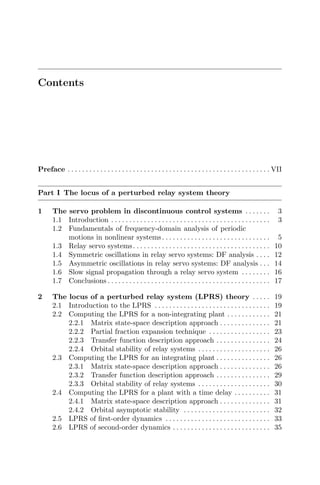
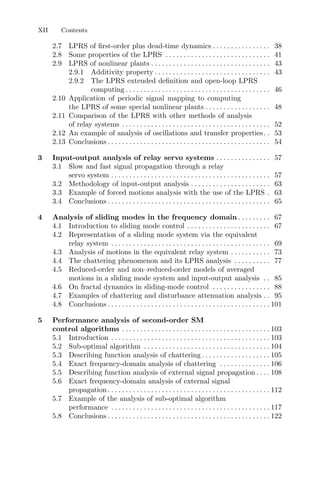
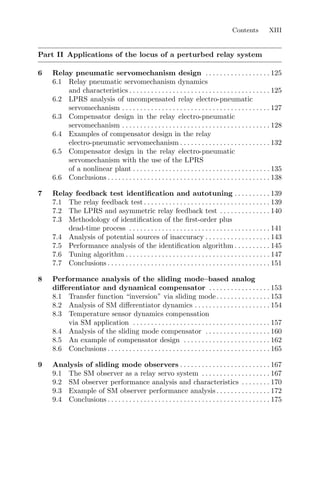
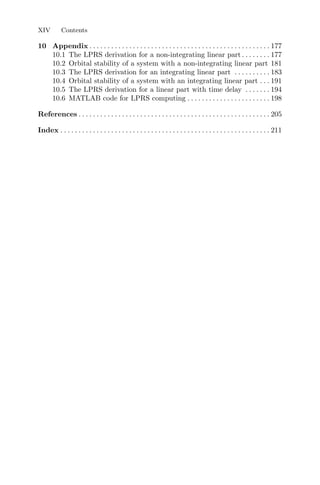
![1
The servo problem in discontinuous control
systems
1.1 Introduction
Discontinuous control systems, and relay feedback systems in particular, are
one of the most important types of nonlinear systems. The term “relay” comes
from electrical applications where on-off control has long been used. To de-
scribe the nonlinear phenomenon typical of electrical relays, the nonlinear
function also received the name “relay” comprising a number of discontinu-
ous nonlinearities. Thus, when applied to any type of control system, the term
“relay” is now associated not with applications but with the kind of nonlin-
earities that are found in the system models. However, what we traditionally
call the “relay system” cannot always be described by the relay system model.
For example, the vibrational voltage regulator is not a relay system in the full
sense, as the charge and discharge time constants are different and the regu-
lator is better described as a variable structure system (which is, however, a
discontinuous control system).
Applications of the discontinuous feedback principle have evolved from vi-
brational voltage regulators and missile thruster servomechanisms of the 1940s
to numerous on-off process parameter closed-loop control systems, sigma-
delta modulators, process identification and automatic tuning of proportional-
integral-derivative (PID) controller techniques, and DC motor, hydraulic and
pneumatic servo systems, to name a few. The enormous number of residential
temperature control systems available throughout the world illustrates how
popular discontinuous control systems are. A number of industrial examples
of relay systems were given in the classic book on relay systems [94]. Further-
more, many existing sliding mode algorithms can be considered and analyzed
via the relay control principle. Perhaps, some aspects of hybrid systems can
also be analyzed via application of discontinuous control system theory. In
fact, discontinuous control systems are probably the most conventional type
of control system in history.
Discontinuous control systems provide many advantages over linear sys-
tems: simplicity of design, cheaper components that were known as early as](https://image.slidesharecdn.com/77293-250317124040-6f4f00b0/85/Discontinuous-Control-Systems-1st-Edition-Igor-Boiko-Auth-18-320.jpg)
![4 1 The servo problem in discontinuous control systems
the 1930s [55], and the ability to adapt the open-loop gain in the relay feed-
back system in response to changing parameters [8, 50, 71]. As a rule, they
also provide a higher open-loop gain and a higher performance [56] than lin-
ear systems. In some applications, smoothing of the Coulomb friction and of
other plant nonlinearities can also be achieved.
Discontinuous control systems theory has been the subject of attention
since the 1940s from the worldwide research community. Traditionally, the
scope of research was composed of the following problems: existence and pa-
rameters of periodic motions, stability of limit cycles, and input-output prob-
lems (set point tracking or external signal propagation through the system),
which includes the disturbance attenuation problem. The theoretical devel-
opment was motivated by the design of missile thruster servomechanisms in
Germany [17] and in the United States [71, 72, 104] as well as vibrational
voltage regulators [51]. Later, a number of publications, some of which be-
came classic works in the area, appeared. Most of these were concerned with
the solution of the periodic problem. A semigrahpical solution [43], a matrix
method [28], a z-transform–based solution [57], frequency-domain methods
[54, 941
] and [9] (which can be considered a generalization of method [94]), a
state-space–based technique [34], and a finite-difference operator method [81]
for the solution of problem of existence and local stability of periodic mo-
tions were proposed in the late 1950s to the mid-1960s. In [79] a systematic
overview of applications of Poincaré maps to the analysis of periodic motions
in relay systems was given. A rigorous solution of the problem of existence
and local stability of limit cycles was presented in [2] and [100] for symmet-
ric and asymmetric limit cycles, respectively. The problem of global stability
of limit cycles was considered in [53]. In [81, 94] and [84], the input-output
problem was analyzed. Relay feedback systems were also studied with the use
of more general approximate methods such as the describing function (DF)
method [71] (where the input-output problem in relay systems was probably
considered for the first time; the authors used the results obtained in [58]),
and [8, 50, 56, 87]. In the recent monographs [103] and [107], extensive cover-
age of the theory of relay feedback test–based identification is given.
Another study of oscillations in the relay and variable structure systems
was motivated by the chattering problem in sliding mode control [97, 105].
This problem is closely related to the original problem, and the results are
applicable to both variable structure systems and relay systems ([4, 16, 26, 46,
47, 98, 99]). A number of techniques of process parameter identification and
PID controller tuning based on the relay feedback test are given in [3, 59–61,
70, 73–75, 83]. Periodic motions in sigma-delta modulators were studied in [41]
and [78].
The method presented in this book is based on the frequency-domain char-
acteristic of the discontinuous control system that is similar in some ways
to the frequency response of a linear system (Nyquist plot) and the Tsypkin
1
The first edition of this book was published in 1955.](https://image.slidesharecdn.com/77293-250317124040-6f4f00b0/85/Discontinuous-Control-Systems-1st-Edition-Igor-Boiko-Auth-19-320.jpg)
![1.2 Fundamentals of frequency-domain analysis of periodic motions 5
locus [94]. Therefore, the presented approach has some resemblance to the DF
method and Tsypkin’s method. Moreover, from the methodological point of
view, the presented theory in some ways replicates the DF method. However,
the presented method offers a few advantages over both methods mentioned
above: better accuracy than that of the DF method (eliminating the necessity
of the filtering hypothesis) and a better solution of the input-output problem
compared with that of the Tsypkin locus, which can only furnish a solution
of the periodic problem.2
All discontinuous control systems have a nonlinear element in the control
loop. Usually the nonlinearity is associated with the controller. In most cases
the discontinuous nonlinearity is an ideal (sign function) or hysteretic relay.
However, it can be a more complex nonlinearity, examples of which are consid-
ered in the chapters devoted to sliding mode control and second-order sliding
mode control.
A mode that may occur in a discontinuous control system is a self-excited
(non-vanishing) oscillation, which is also referred to as a periodic motion. If
the system does not have asymmetric nonlinearities, this periodic motion is
symmetric in the autonomous mode (no external input applied). However, if
an external input (disturbance) is applied to the system that has a periodic
motion, the self-excited oscillations become biased or asymmetric. The key ap-
proach to the analysis of discontinuous control systems is a method of analysis
of self-excited oscillations (symmetric and asymmetric). The following section
gives a general methodology of such an analysis based on frequency-domain
concepts.
1.2 Fundamentals of frequency-domain analysis
of periodic motions in nonlinear systems
The problem of finding possible periodic motions in nonlinear dynamical sys-
tems is a fundamental problem in both mathematics and control theory. It
can be traced back to the works of Poincaré who introduced a widely used
now geometric interpretation of this problem as that of finding a closed orbit
in the state space.
Poincaré’s approach involves finding a certain map in the state space,
which is now called the Poincaré map. Yet Poincaré maps for most nonlinear
systems can hardly be obtained in an analytical form. Analytical expressions
have been obtained only for low-order systems or higher-order systems con-
taining simple types of nonlinear functions. An example of the latter is the
relay feedback system for which the Poincaré map is obtained in an explicit
form. A few formulations of Poincaré maps for relay feedback systems are pre-
sented in [2, 20, 54, 94, 100]. For more complex types of nonlinearities, only an
2
Tsypkin [94] also considers the input-output problem in his book; he proposes
that the solution of the input-output problem should be done via analysis of
asymmetric oscillations.](https://image.slidesharecdn.com/77293-250317124040-6f4f00b0/85/Discontinuous-Control-Systems-1st-Edition-Igor-Boiko-Auth-20-320.jpg)
![6 1 The servo problem in discontinuous control systems
approximate solution can be found as a rule. A number of different approaches
to the problem of finding a periodic solution have been proposed. The most
general approach was given in [64] in which the solution of the periodic prob-
lem was found in the form of a Fourier series. Despite the clear underlying
idea of this method, its application is computationally cumbersome, as the
original problem is transformed into the problem of solving the system of a
high number of nonlinear algebraic equations, which is often impractical. A
modification of this classic approach was given in [96]. However, the compu-
tational efficiency of the proposed approach rapidly decreases with required
accuracy. Among other methods are Volterra series used to solve both the pe-
riodic problem in autonomous systems [32] and forced oscillations [102]. Yet
the Volterra series approach can only handle weak (mild) nonlinearities. A
combination of the perturbation method and the harmonic balance method
was proposed in [29]. But this method also can handle only mild nonlinear-
ities. A singular perturbation method was used for analysis of the periodic
problem in relay systems in [47].
Commonly in engineering practice, only the first-harmonic approximation
is used, which is known as the describing function (DF) method. The main
concepts of this method were developed in the 1940s and 1950s [36, 51, 52,
63, 71, 95]. Comprehensive coverage of this method is given in [8, 50]. The
DF method provides a simple and efficient, but not exact, solution of the pe-
riodic problem. Its applications are limited to systems that can be separated
into nonlinear and linear parts interconnected into a closed loop (Fig. 1.1)
with the nonlinear part being a static nonlinearity (with possible hysteresis)
and the linear part given by linear time-invariant differential equations. More-
over, the linear part must be a low-pass filter to filter out higher harmonics,
so that the input to the nonlinearity could approximately be considered a
sinusoid.
Let us consider the frequency-domain approach to analysis of self-excited
oscillations. Consider the following nonlinear system,
ẋ = Ax + Bu
y = Cx
(1.1)
Fig. 1.1. Block diagram of the system for DF analysis](https://image.slidesharecdn.com/77293-250317124040-6f4f00b0/85/Discontinuous-Control-Systems-1st-Edition-Igor-Boiko-Auth-21-320.jpg)
![1.2 Fundamentals of frequency-domain analysis of periodic motions 7
Fig. 1.2. Poincaré mapping
u = f(σ), (1.2)
σ = −y, (1.3)
where A ∈ Rn×n
, B ∈ Rn×1
, and C ∈ R1×n
are matrices, x ∈ Rn
, y ∈
R1
, σ ∈ R1
, f ∈ R1
, f(σ) is a single-valued symmetric monotone nonlinear
function: f(−σ) = −f(σ) (it will be later extended to a hysteretic function).
Formula (1.1) provides a description of the linear part, formula (1.2) denotes
the nonlinear part of the system, and formula (1.3) gives the condition of
closing the system loop. We shall also use the linear part description in the
form of the transfer function W(s), which can be obtained from formulas (1.1)
as follows: W(s) = C(Is − A)−1
B. Let us also assume that the linear part is
strictly proper, i.e., the relative degree of W(s) is one or higher.
The problem of finding a periodic solution of system (1.1), (1.2), and (1.3)
is usually formulated as the problem of finding a fixed point x∗
of Poincaré
map, which will be a solution to the equation: x = P(x), where P(x) is the
mapping. Figure 1.2 provides two examples of Poincaré mapping. P1 maps
point x1 into point x2, and P2 maps point x3 into itself. Therefore, x3 = x∗
.
In the time domain, the closed orbit that starts from the point x∗
(denote it
x∗
(t) for brevity) will be a periodic vector signal, and y∗
(t) = Cx∗
(t) will be
a periodic scalar signal.
Now consider the open-loop system (1.1), (1.2), which can be obtained by
ignoring equality (1.3). Let σ(t) be a periodic symmetric signal of period T
with zero mean, continuously differentiable with respect to t, so that σ(t +
T/2) = −σ(t), σ ∈ R, t ∈ D ⊂ R, D := t ∈ [0; T]. Consider the following
lemma, which will be instrumental below.
Lemma 1.1. If σ(t) satisfies the conditions of symmetric periodicity and uni-
modality and f(σ) is a symmetric monotone nonlinear function, then x(t) will
be a periodic vector signal, and y(t) will be a periodic scalar signal.
Proof. u(t) is a periodic signal because it is a function of f(σ): u(t + T) =
f(σ(t+T)) = f(σ(t)) = u(t). y(t) as well as x(t) are periodic because they are
responses to the periodic input u(t), which follows from linear system theory.](https://image.slidesharecdn.com/77293-250317124040-6f4f00b0/85/Discontinuous-Control-Systems-1st-Edition-Igor-Boiko-Auth-22-320.jpg)
![8 1 The servo problem in discontinuous control systems
Definition 1.2. Let us call the mapping of space R×D into itself, where σ(t)
satisfies the conditions of symmetric periodicity and unimodality, the periodic
signal mapping (PSM)
y(t) = g(f(σ(t)), (1.4)
which is a chain-rule application of two mappings: g for the linear part and f
for the nonlinear part.
Definition 1.3. Let us call the periodic function σ∗
(t), which provides the
solution to the equation −σ(t) = g(f(σ(t)), t ∈ D, the fixed point of the
periodic signal mapping (the minus sign is attributed to the negative feedback
in the closed-loop system).
The following theorem relates periodic solutions in the state-space and
time domains.
Theorem 1.4. If σ∗
(t) is a fixed point of the periodic signal mapping y(t) =
g(f(σ(t)) in the open-loop nonlinear system (1.1), (1.2) where f(σ) is a single-
valued symmetric monotone nonlinear function, then x∗
(t) = h(f(σ∗
(t)) will
be a fixed point of the Poincaré mapping in the closed-loop system (1.1), (1.2),
(1.3), where h is mapping u(t) → x(t).
Proof. Because σ∗
(t) is a fixed point of the periodic signal mapping (1.4),
σ∗
(t) provides a solution to system (1.1), (1.2), (1.3). This is a periodic so-
lution, as the property of periodicity is “embedded” in the type of function
σ(t). According to Lemma 1.1, x∗
(t) will be a periodic vector function, which
means that in the state space, the trajectory that starts from x∗
is a closed
orbit, i.e., satisfying the condition of being a fixed point of the Poincaré map.
Let us analyze how the PSM can be implemented in practice. Transfer the
analyzed problem including the defined mappings into the spectral domain,
which can be provided via taking the Fourier series of the signals in the system.
Represent the periodic signal σ(t) in the form of the Fourier series as follows,
σ(t) = 2
∞
k=1
|qσk| cos ((2k − 1) ωt + arg qσk) (1.5)
where ω = 2π/T, and all even harmonics are zeros due to σ(t) being symmetric
qσk =
1
T
T/2
−T/2
σ(t) [cos(2k − 1)ωt − j sin(2k − 1)ωt] dt. (1.6)
Therefore, any σ(t) can be characterized by the matrix Qσ as follows:
Qσ = [qσ1 qσ3 qσ5 . . .] subject to the frequency ω being given. We shall call
the matrix Qσ the spectrum of the signal σ(t). The number of elements of Qσ
can be set arbitrarily large, but it makes sense to limit the number of elements](https://image.slidesharecdn.com/77293-250317124040-6f4f00b0/85/Discontinuous-Control-Systems-1st-Edition-Igor-Boiko-Auth-23-320.jpg)
![1.2 Fundamentals of frequency-domain analysis of periodic motions 9
to some reasonable value, so that any further increase of this number will not
provide any noticeable increase in the accuracy of the σ(t) representation. Let
us represent other periodic signals u and y in the system by their spectra: Qu,
Qy. Then the mapping Qσ → Qu can be given by the transformation into the
time domain as per (1.5), nonlinear mapping in the time domain as per (1.3),
and transformation into the spectral domain through the following formulas:
quk =
1
T
T/2
−T/2
u(t) [cos(2k − 1)ωt − j sin(2k − 1)ωt] dt (1.7)
Qu = [qu1 qu3 qu5 . . .] . (1.8)
The mapping Qu → Qy can be given by the following element-by-element
multiplication of the two matrices, which directly follows from linear systems
theory:
Qy = Qu • S (1.9)
where
Qy = [qy1 qy3 qy5 . . .] (1.10)
S = [W(jω) W(j3ω) W(j5ω) . . .] . (1.11)
According to Theorem 1.4, the periodic solution of (1.1), (1.2), (1.3) can be
found as a fixed point of the PSM. We have defined the PSM as the chain
application of two mappings: the first of which is provided by (1.5), (1.2),
and (1.7), and the second is given by (1.9). To find the fixed point, we have
to design a contraction mapping, so that iterates from the initial point will
converge to the solution.
Assume now that the linear part is an ideal low-pass filter. This assumption
enables one to rewrite (1.9) as
Qy = qu1W(jω) (1.12)
and (1.5), (1.2), (1.7) as just
qu1 =
1
T
T/2
−T/2
u(t) [cos ωt − j sin ωt] dt (1.13)
with σ(t) = aσ cos ωt. The ratio qu1/qσ1 = 0.5aσ gives the describing func-
tion (DF) of the nonlinearity. As a result, considering (1.3) we can write the
harmonic balance equation for the DF approximated system as follows:
N(aσ)W(jΩ) = −1 (1.14)
where N(aσ) is the describing function of the nonlinearity, aσ is the amplitude
of σ(t), and Ω is the frequency of the periodic motion:](https://image.slidesharecdn.com/77293-250317124040-6f4f00b0/85/Discontinuous-Control-Systems-1st-Edition-Igor-Boiko-Auth-24-320.jpg)
![10 1 The servo problem in discontinuous control systems
N(aσ) =
qu1
qσ1
=
2
Taσ
T/2
−T/2
u(t) [cos ωt − j sin ωt] dt.
Equation (1.14) is a well-known formula [8, 50] that is widely used for
analysis of periodic motions. Therefore, the DF analysis can be viewed as a
fixed point of the PSM considered above, subject to the assumption about
the low-pass filtering property of the linear part.
Equation (1.14) provides a basis for analysis of possible periodic motions
in a nonlinear system via application of the DF method. Usually this equation
is presented in the following form:
W(jΩ) = −
1
N(aσ)
(1.15)
which is convenient for graphical interpretation, as the unknown variables are
separated into the left-hand and the right-hand parts of the equation.
1.3 Relay servo systems
Usually, control systems are categorized into two groups depending on the
control problem they are supposed to solve. These two categories are stabi-
lization systems and servo systems. Stabilization systems carry out the task of
stabilization of certain process variables. The main challenge for such systems
is producing a compensating action for the disturbances that inevitably oc-
cur. The servo systems implement the task of tracking certain input signals,
so that the system output follows the input signal as precisely as possible.
Normally, the input to the system is unknown, but some a priori informa-
tion about the input signal such as frequency and amplitude range may be
available. The typical examples of stabilization systems are temperature, pres-
sure, level, flow control systems; and examples of servo systems are actuators,
airplane autopilots, and temperature control systems, which are supposed to
ensure the temperature change in time according to a given profile.
We can see from the above examples that the autonomous mode, when no
external signals are applied to the system, does not normally occur. What is
common for both these types of control systems is the existence of external
signals that affect the functioning of the system. In the first case, this is a
disturbance to which the system is supposed to respond in such a way as
to provide its compensation. In the second case, the system is supposed to
respond to the input to bring the output in alignment with this external
input. In both cases, the problem analyzing the effect of external signals on
the system characteristics is the most important part of system performance
analysis.](https://image.slidesharecdn.com/77293-250317124040-6f4f00b0/85/Discontinuous-Control-Systems-1st-Edition-Igor-Boiko-Auth-25-320.jpg)