Representations of People
with Disabilities
Social construction of disability:
 Largest minority group in the United States.
 Activists have argued for “person first” terminology.
 They have also argued that society and the media need to
stop using descriptions such as “wheelchair-bound” or
“crippled” to avoid marginalization.
 How society perceives the psychological, social, economic,
and political impacts of perpetuating stereotypes is critical in
terms of law making.
Social construction of disability:
 Disability began as a medical construct.
 Disability as functional impairment.
 Perspective that medicine and technology could “fix” the problem or
“cure” the issue.
 It later moved to become an economic construct.
 This construct centered on the question of how society alleviates the cost
burdens that people with disabilities face as they seek medical treatment.
 It then changed to a sociopolitical construct.
 This construct centers on ensuring that persons with equal productivity are
provided with equal opportunities for wages and employment.
 Critical moment:Americans with Disabilities Act (1990).
Understanding this social group
 Having regulations that accommodate for persons with disabilities
intrinsically acknowledges that there is a disability there to begin with.
 This runs somewhat contrary to the perspective of those who argue that
physical, sensory, and mental impairments are not impairments at all, just
differences between people.
 They argue that people are not “disabled,” just “differently abled.”
 Others suggest the Americans with DisabilitiesAct goes too far.
Disabilities do make a person different; this is not necessarily an
argument against integration but an acknowledgment that differences
exist.
 More than half ofAmericans admit they feel embarrassed or fearful
around people with disabilities.
 Fostering stereotypes does not just impact interpersonal relationships and
individual views, but also has ramifications for issues of equal rights legislation
and societal attitudes.
People with Disabilities in Film
There are six major stereotypes in
film and television portrayals:
 The disabled person as victim.
 The disabled person as hero
(the supercrip).
 The disabled person as a threat
(evil and warped).
 The disabled person as unable
to adjust.
 The disabled person as one to
be cared for and/or a burden.
 The disabled person as one
who should not have survived
(better off dead).
 When a person with a disability
is shown in movies or on
television, his/her life tends to
be:
 Empty .
 Narrowly defined.
 Completely centered on the
disability in question.
People with Disabilities in Entertainment
Television
 Research shows that people with disabilities are predominantly portrayed as:
 Belonging to lower socioeconomic groups.
 Unemployed.
 Single.
 Victims of abuse.
 Far fewer disabled characters are portrayed in prime-time programming than exist in the
US population.
 Disabled persons are often the butt of many jokes.
i.They can be treated as outsiders, pitiable, angry, or powerless.
 Changes in recent decades: Images of disability are more realistic than ever, though still in
short supply.
 Actors have taken activist roles when portraying characters with disabilities; along with
disability groups, they have pushed for more accurate depictions and the use of disabled
actors.
People with Disabilities in the News
 Research shows the mainstream media continue to do a poor
job of covering individuals with disabilities, and, at worst,
perpetuate stereotypes through poor word choice and
stagnant, overused feature- writing formulas.
 Most disability coverage is of physical disabilities, a low-
prevalence disability category.
 Mental illness is stereotyped and often stigmatized, when it
is covered at all; coverage is rare, despite the fact mental
illness is quite common in the US population.
People with Disabilities in Advertising
 In 1984, the first television ad said to feature a disabled
person aired across the United States.
 In this Levi’s commercial, a wheelchair user popped a wheelie.
 It was proof that people with disabilities were finally becoming
more visible.
 For years, people with disabilities were invisible in
advertising, just as they were invisible in other forms of
media.
 There was a fear that non-disabled consumers would be
“offended” by seeing persons with disabilities in campaigns.
People with Disabilities in Advertising
 Interestingly, advertising has been a catalyst for more
positive images of disability across media.
 The 1990s saw a number of ads featuring people with
disabilities. •Example:Target ad featuring a girl with Down
syndrome.
 In 2001, a Super Bowl ad by Cingular called “King Gimp”
garnered a great deal of positive attention.
 Not everyone is enthusiastic. Some criticize the use of
persons with disabilities, saying it is exploitation or tokenism.
Interview responds:
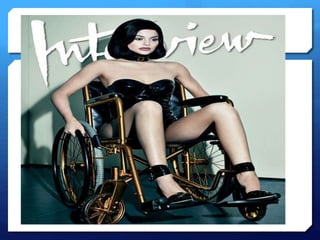
 Interview issued a statement following the scandal, but the magazine's
convoluted excuses may make things worse, not better:
“At Interview, we are proud of our tradition of working with great artists and
empowering them to realize their distinct and often bold visions,” the
magazine said in a statement. “The Kylie Jenner cover by Steven Klein, which
references the British artist Allen Jones, is a part of this tradition, placing Kylie
in a variety of positions of power and control and exploring her image as an
object of vast media scrutiny."
The statement continues, "Throughout the Art issue, we celebrate a variety of
women who are both the creators and subjects of their artistic work, and the
Kylie feature aims to unpack Kylie’s status as both engineer of her image and
object of attention. Our intention was to create a powerful set of pictures that
get people thinking about image and creative expression, including the set with
the wheelchair. But our intention was certainly not to offend anyone."
The notion of Inspiration Porn
 https://themighty.com/2017/10/please-stop-spreading-
inspiration-porn-about-disability/
 Amy PurdyToyota Campaign
 Oscars and Disability
 BornThis Way
 Dolls with Disabilities
 NCAA/ Kent State
 Don’t Shoot, I’m disabled
 PoliceViolence/ Disability

Disability Representations in the Media

  • 1.
  • 2.
    Social construction ofdisability:  Largest minority group in the United States.  Activists have argued for “person first” terminology.  They have also argued that society and the media need to stop using descriptions such as “wheelchair-bound” or “crippled” to avoid marginalization.  How society perceives the psychological, social, economic, and political impacts of perpetuating stereotypes is critical in terms of law making.
  • 3.
    Social construction ofdisability:  Disability began as a medical construct.  Disability as functional impairment.  Perspective that medicine and technology could “fix” the problem or “cure” the issue.  It later moved to become an economic construct.  This construct centered on the question of how society alleviates the cost burdens that people with disabilities face as they seek medical treatment.  It then changed to a sociopolitical construct.  This construct centers on ensuring that persons with equal productivity are provided with equal opportunities for wages and employment.  Critical moment:Americans with Disabilities Act (1990).
  • 4.
    Understanding this socialgroup  Having regulations that accommodate for persons with disabilities intrinsically acknowledges that there is a disability there to begin with.  This runs somewhat contrary to the perspective of those who argue that physical, sensory, and mental impairments are not impairments at all, just differences between people.  They argue that people are not “disabled,” just “differently abled.”  Others suggest the Americans with DisabilitiesAct goes too far. Disabilities do make a person different; this is not necessarily an argument against integration but an acknowledgment that differences exist.  More than half ofAmericans admit they feel embarrassed or fearful around people with disabilities.  Fostering stereotypes does not just impact interpersonal relationships and individual views, but also has ramifications for issues of equal rights legislation and societal attitudes.
  • 5.
    People with Disabilitiesin Film There are six major stereotypes in film and television portrayals:  The disabled person as victim.  The disabled person as hero (the supercrip).  The disabled person as a threat (evil and warped).  The disabled person as unable to adjust.  The disabled person as one to be cared for and/or a burden.  The disabled person as one who should not have survived (better off dead).  When a person with a disability is shown in movies or on television, his/her life tends to be:  Empty .  Narrowly defined.  Completely centered on the disability in question.
  • 6.
    People with Disabilitiesin Entertainment Television  Research shows that people with disabilities are predominantly portrayed as:  Belonging to lower socioeconomic groups.  Unemployed.  Single.  Victims of abuse.  Far fewer disabled characters are portrayed in prime-time programming than exist in the US population.  Disabled persons are often the butt of many jokes. i.They can be treated as outsiders, pitiable, angry, or powerless.  Changes in recent decades: Images of disability are more realistic than ever, though still in short supply.  Actors have taken activist roles when portraying characters with disabilities; along with disability groups, they have pushed for more accurate depictions and the use of disabled actors.
  • 7.
    People with Disabilitiesin the News  Research shows the mainstream media continue to do a poor job of covering individuals with disabilities, and, at worst, perpetuate stereotypes through poor word choice and stagnant, overused feature- writing formulas.  Most disability coverage is of physical disabilities, a low- prevalence disability category.  Mental illness is stereotyped and often stigmatized, when it is covered at all; coverage is rare, despite the fact mental illness is quite common in the US population.
  • 8.
    People with Disabilitiesin Advertising  In 1984, the first television ad said to feature a disabled person aired across the United States.  In this Levi’s commercial, a wheelchair user popped a wheelie.  It was proof that people with disabilities were finally becoming more visible.  For years, people with disabilities were invisible in advertising, just as they were invisible in other forms of media.  There was a fear that non-disabled consumers would be “offended” by seeing persons with disabilities in campaigns.
  • 9.
    People with Disabilitiesin Advertising  Interestingly, advertising has been a catalyst for more positive images of disability across media.  The 1990s saw a number of ads featuring people with disabilities. •Example:Target ad featuring a girl with Down syndrome.  In 2001, a Super Bowl ad by Cingular called “King Gimp” garnered a great deal of positive attention.  Not everyone is enthusiastic. Some criticize the use of persons with disabilities, saying it is exploitation or tokenism.
  • 11.
    Interview responds:  Interviewissued a statement following the scandal, but the magazine's convoluted excuses may make things worse, not better: “At Interview, we are proud of our tradition of working with great artists and empowering them to realize their distinct and often bold visions,” the magazine said in a statement. “The Kylie Jenner cover by Steven Klein, which references the British artist Allen Jones, is a part of this tradition, placing Kylie in a variety of positions of power and control and exploring her image as an object of vast media scrutiny." The statement continues, "Throughout the Art issue, we celebrate a variety of women who are both the creators and subjects of their artistic work, and the Kylie feature aims to unpack Kylie’s status as both engineer of her image and object of attention. Our intention was to create a powerful set of pictures that get people thinking about image and creative expression, including the set with the wheelchair. But our intention was certainly not to offend anyone."
  • 12.
    The notion ofInspiration Porn  https://themighty.com/2017/10/please-stop-spreading- inspiration-porn-about-disability/  Amy PurdyToyota Campaign
  • 13.
     Oscars andDisability  BornThis Way  Dolls with Disabilities  NCAA/ Kent State  Don’t Shoot, I’m disabled  PoliceViolence/ Disability