DIRECT TAX CODE
BACKGROUND
2
 Income Tax Act 1961 has undergone several
intractable amendments
 Dividend Distribution Tax inserted in 1997
 Fringe Benefit Tax inserted in 2006
 Wealth Tax administered by Wealth Tax Act, 1957
 Intractable conflicting rulings by different courts
 Incomprehensible to the average tax payers
 Complex tax law increases the cost of compliance
of marginal tax payers and administration as well
BACKGROUND
3
 Marginal tax rates lowered, range of exemptions
broadened
 Tax base increased, further push required for
horizontal equity
STRATEGY
4
 Efficient, Equitable and Effective
 Avoidance by competents- subsidizing rich– inequitable
 Minimize exemptions
 Remove ambiguity in law to minimize tax avoidance
 Keep pace with aggressive tax planning & court ruling on
interpretation of ambiguous provisions
 Technology & process reengineering to reduce cost
 Tax policy to encourage self assessment and penalize
evasion
 Hence new DTC is aligned with above strategies
SALIENT FEATUREs
5
 All direct taxes under one code
 Language simple in active voice and short
 Provisio and explanations removed, while essence
nested
 Extensive use of formulae and tables
 Executive is delegated to end protracted litigations
 Essential principles kept in statute, matters requiring
frequent changes kept in rules/ schedules- will
reduce frequent amendments
 Law is logically reproduced in FORMs
SALIENT FEATUREs
6
 Consolidation and reorganization of different
provisions/ sections such as incentives, tax rates etc
 Elimination of regulatory functions
 Rate of Tax in Schedule, no more an annual
legislation through Finance Bill
BASE for TAXATION
7
 Income= Consumption + Change in net worth
 Exemption up to a limit under income tax towards indirect
tax imposed on consumption
 Balance covered under income tax
 Income should ideally include
 Gifts
 Earnings from labour, investment and business
 Net accrued capital gains
 Value of services & non-business assets net of expenses &
depreciation
 Imputed value of services by family
 Windfall gains
 Casual receipts- lottery
EQUITY in TAXATION
8
 Income tax on individual income leads to
corporatization and avoidance of distribution of profits
to shareholders- to take profit out in course of capital
gains
 To prevent this corporate tax on profit of corporation is
required. However, this leads to double taxation, when
dividends are taxed again under income tax
 This creates bias for debt financing
 Owner occupied house left out of taxation
 Exemptions on positive externalities like cost of
administration, human development, equity
 Deferrals to allow liquidity
 Agricultural Income comes under State List of
Constitution.
RESIDENCE or SOURCE BASED TAX
9
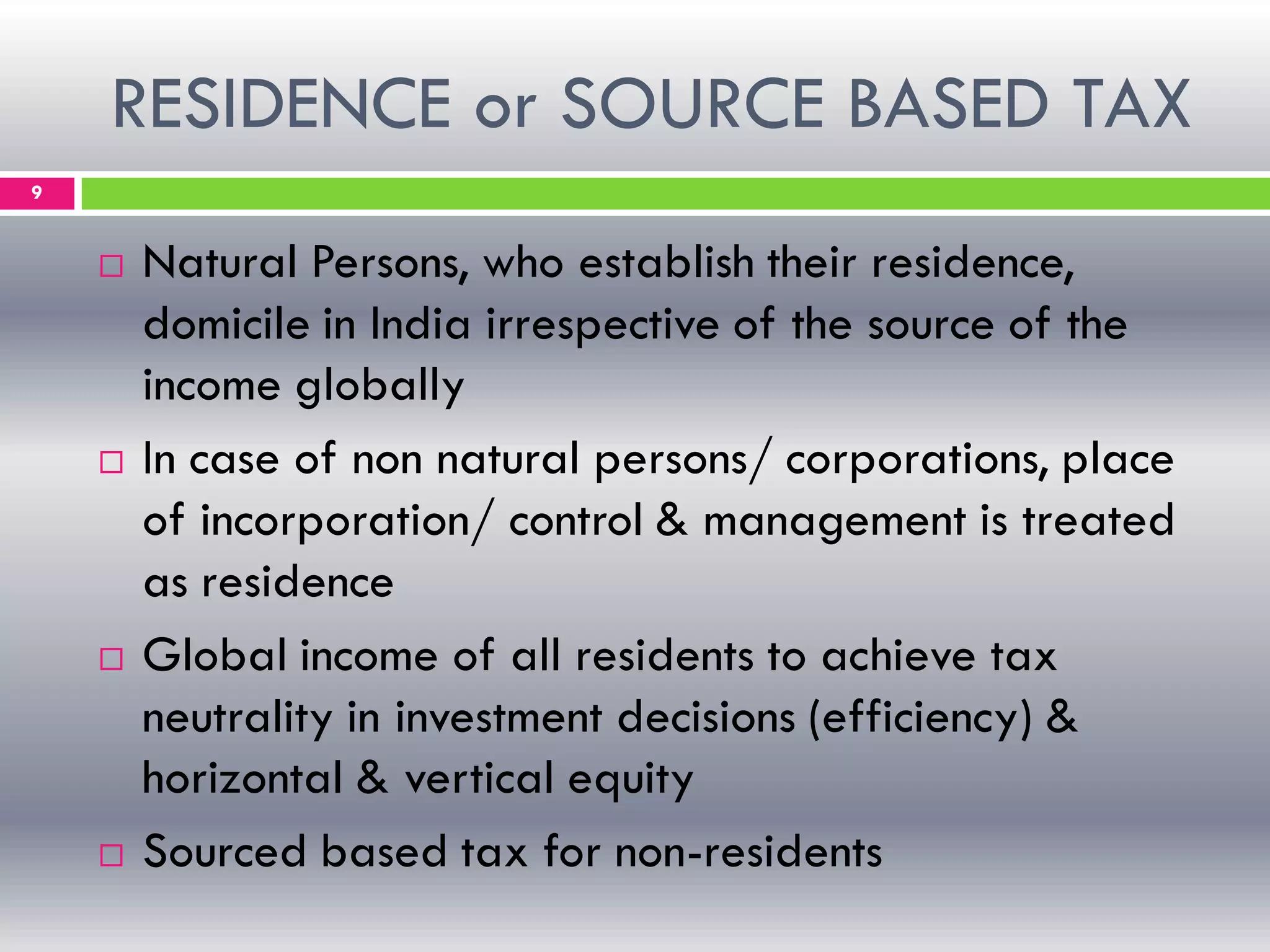
 Natural Persons, who establish their residence,
domicile in India irrespective of the source of the
income globally
 In case of non natural persons/ corporations, place
of incorporation/ control & management is treated
as residence
 Global income of all residents to achieve tax
neutrality in investment decisions (efficiency) &
horizontal & vertical equity
 Sourced based tax for non-residents
RESIDENCE or SOURCE BASED TAX
10
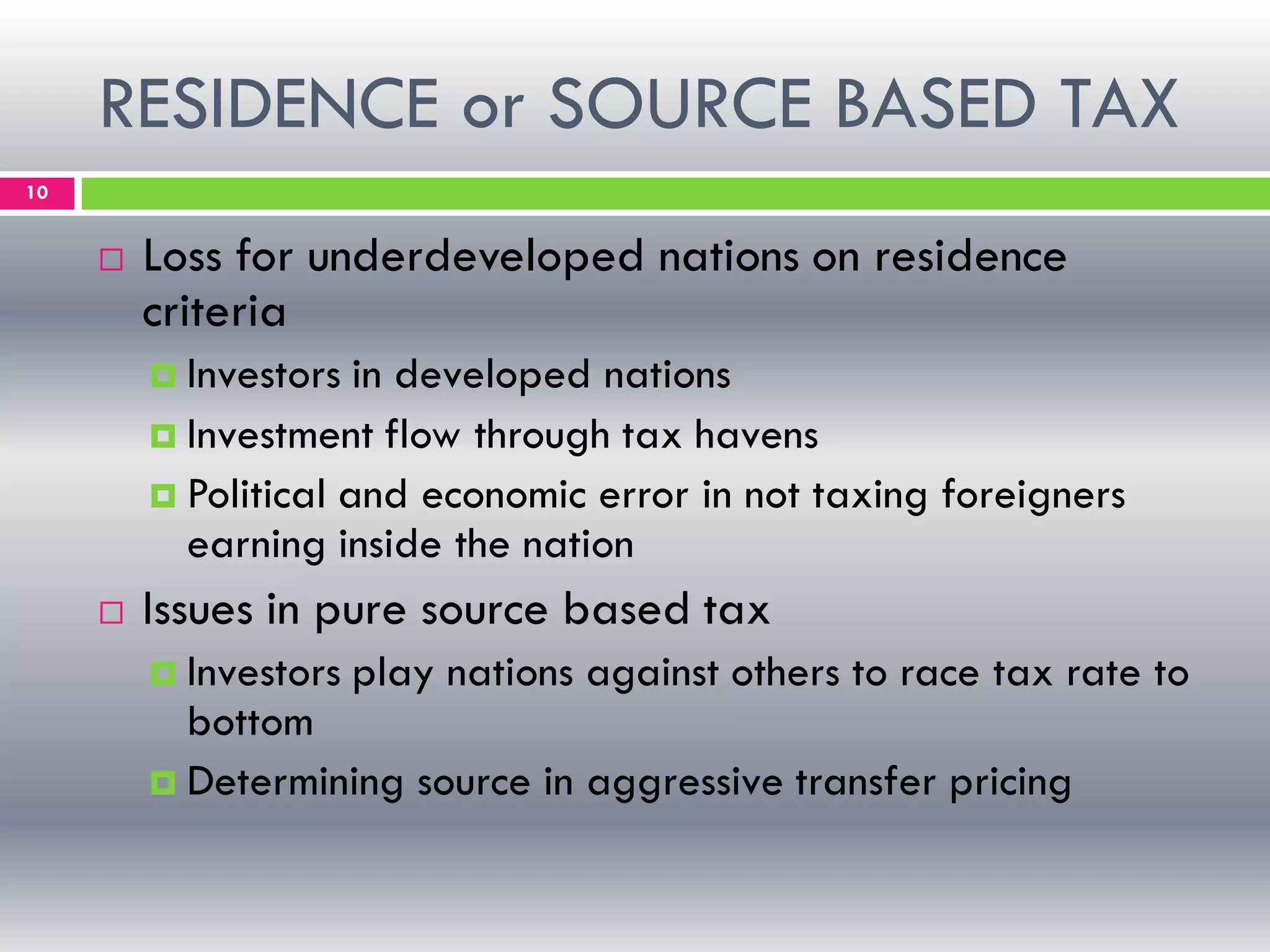
 Loss for underdeveloped nations on residence
criteria
 Investors in developed nations
 Investment flow through tax havens
 Political and economic error in not taxing foreigners
earning inside the nation
 Issues in pure source based tax
 Investors play nations against others to race tax rate to
bottom
 Determining source in aggressive transfer pricing
RESIDENCE or SOURCE BASED TAX
11
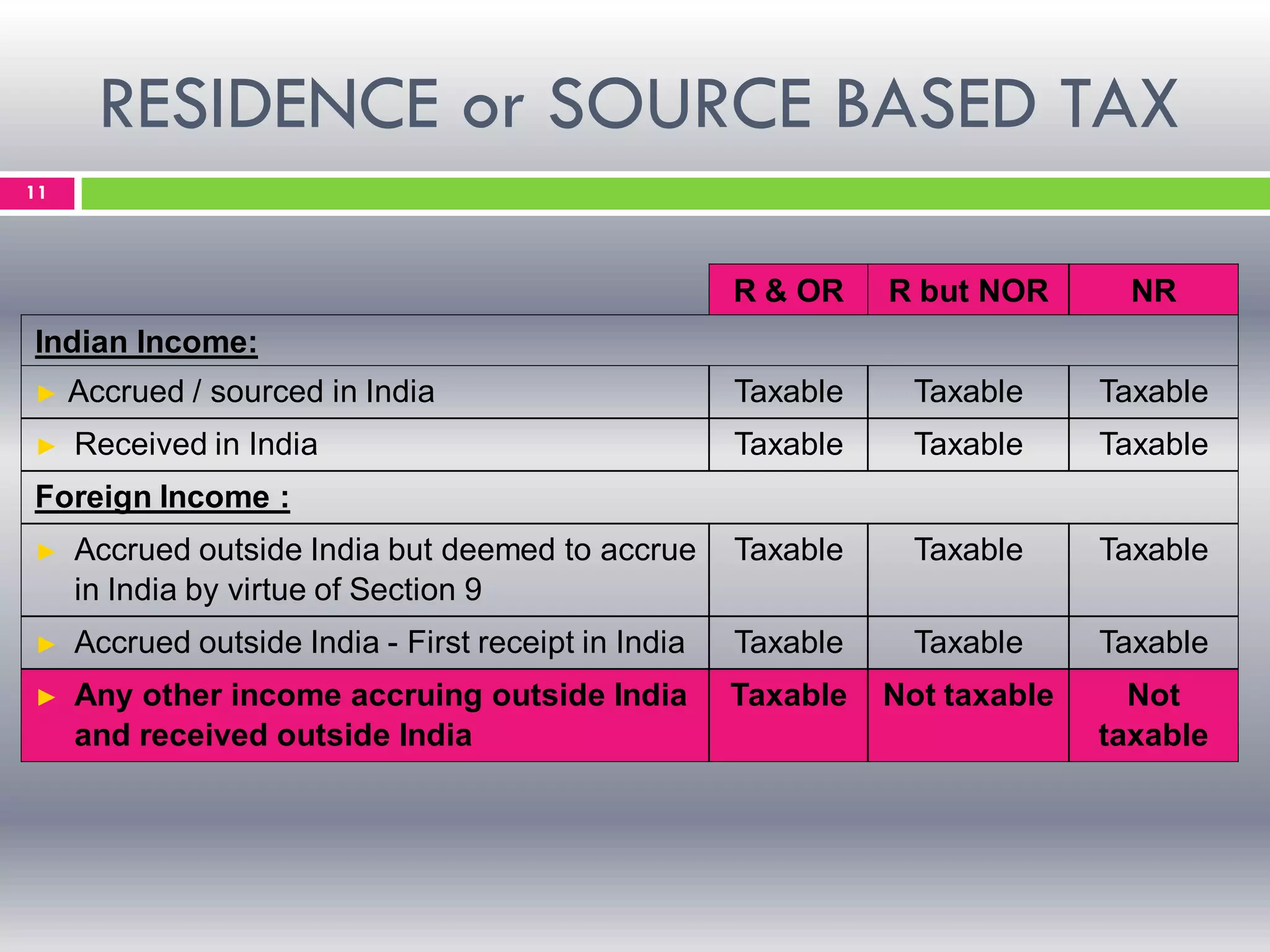
R & OR R but NOR NR
Indian Income:
► Accrued / sourced in India Taxable Taxable Taxable
► Received in India Taxable Taxable Taxable
Foreign Income :
► Accrued outside India but deemed to accrue
in India by virtue of Section 9
Taxable Taxable Taxable
► Accrued outside India - First receipt in India Taxable Taxable Taxable
► Any other income accruing outside India
and received outside India
Taxable Not taxable Not
taxable
Assessee & Residence
12
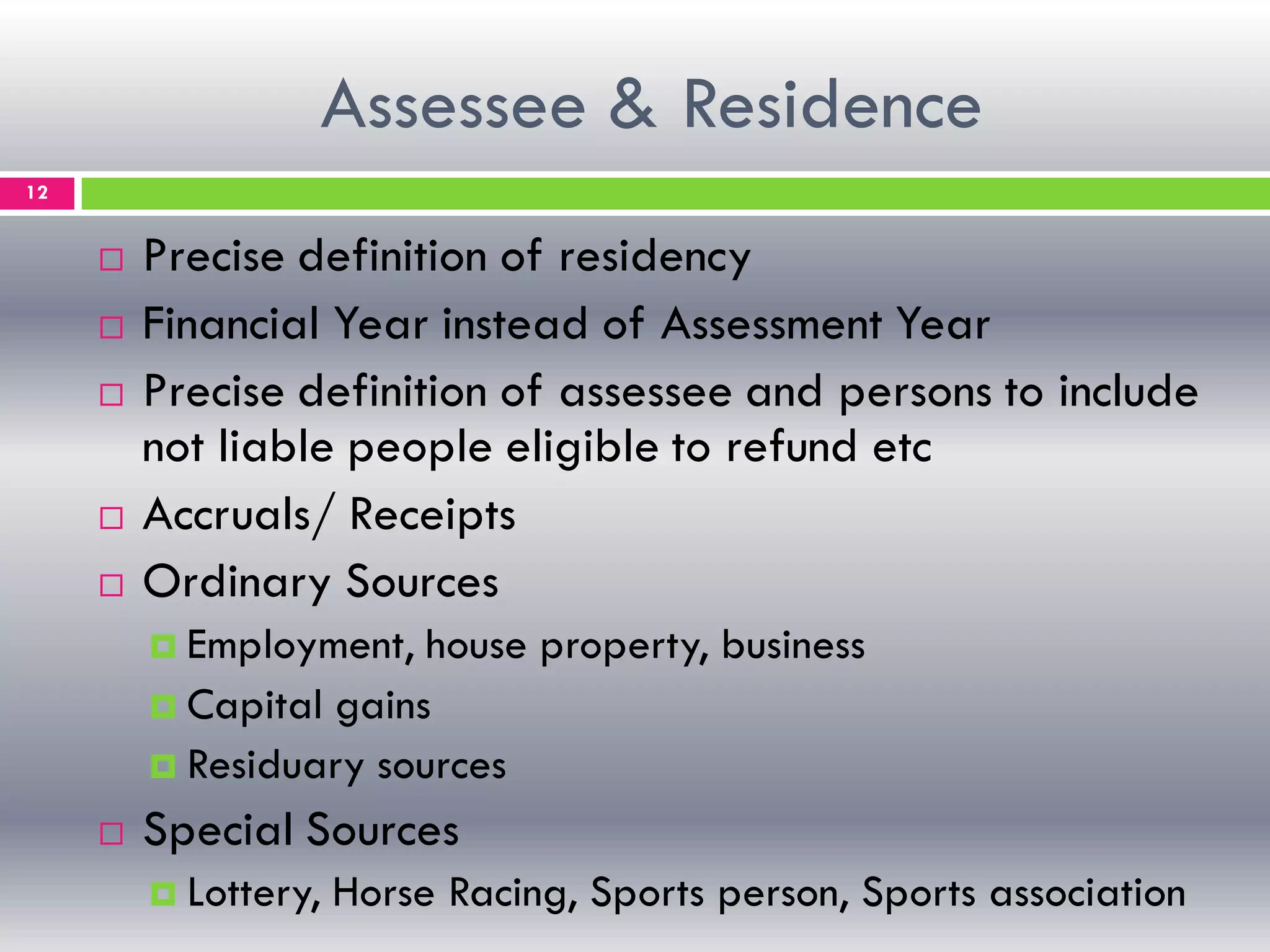
 Precise definition of residency
 Financial Year instead of Assessment Year
 Precise definition of assessee and persons to include
not liable people eligible to refund etc
 Accruals/ Receipts
 Ordinary Sources
 Employment, house property, business
 Capital gains
 Residuary sources
 Special Sources
 Lottery, Horse Racing, Sports person, Sports association
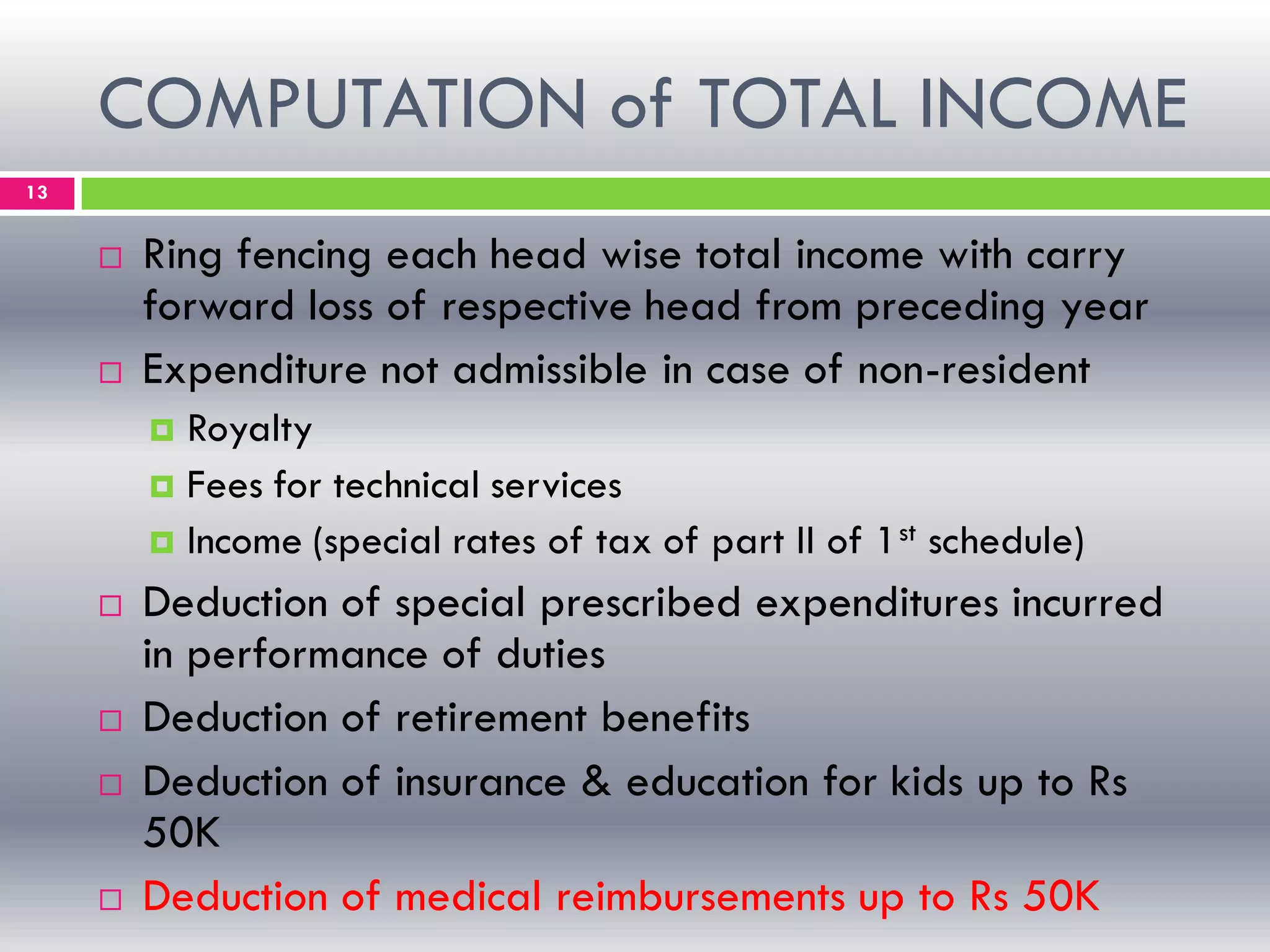
COMPUTATION of TOTAL INCOME
13
 Ring fencing each head wise total income with carry
forward loss of respective head from preceding year
 Expenditure not admissible in case of non-resident
 Royalty
 Fees for technical services
 Income (special rates of tax of part II of 1st schedule)
 Deduction of special prescribed expenditures incurred
in performance of duties
 Deduction of retirement benefits
 Deduction of insurance & education for kids up to Rs
50K
 Deduction of medical reimbursements up to Rs 50K
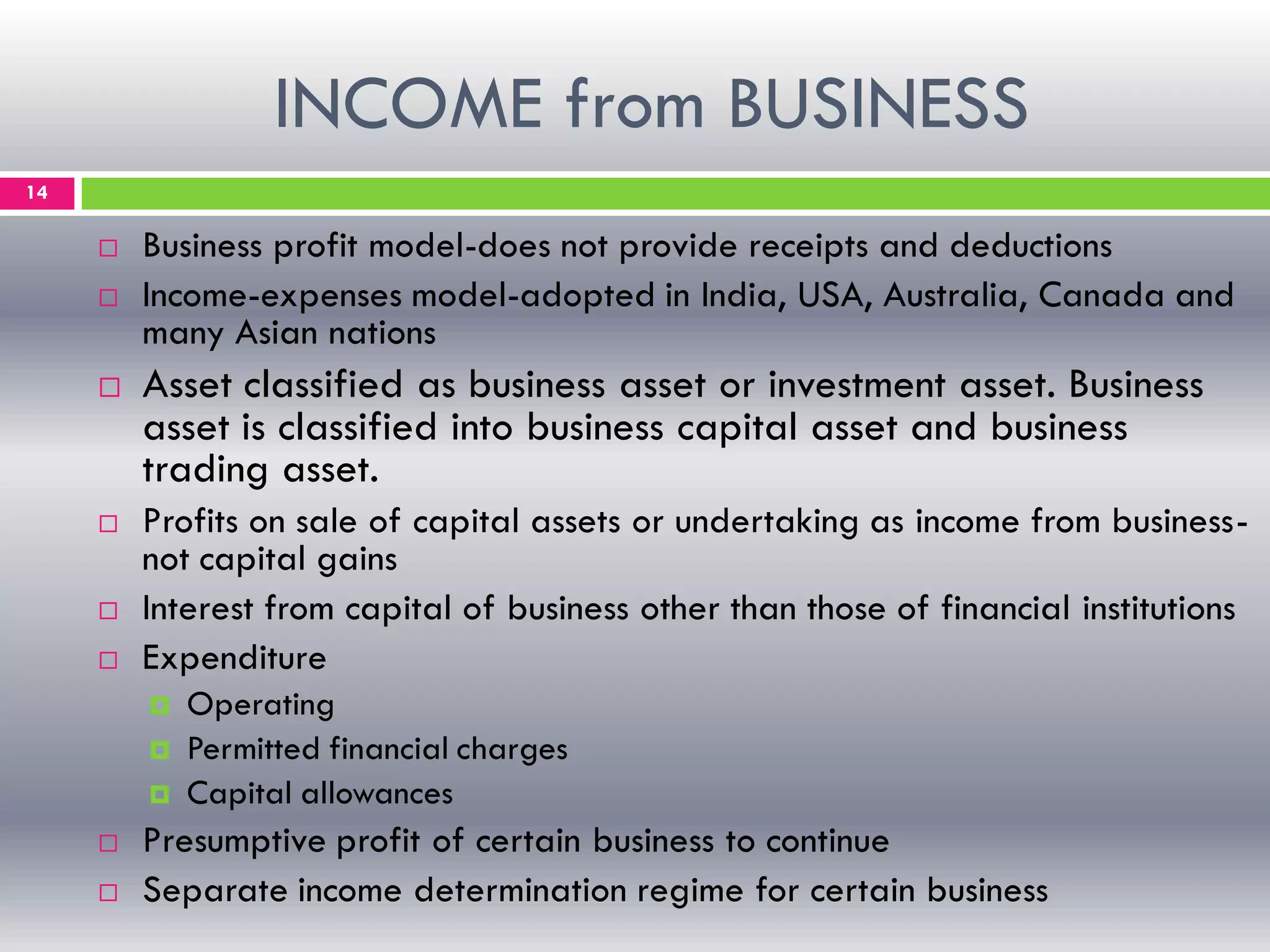
INCOME from BUSINESS
14
 Business profit model-does not provide receipts and deductions
 Income-expenses model-adopted in India, USA, Australia, Canada and
many Asian nations
 Asset classified as business asset or investment asset. Business
asset is classified into business capital asset and business
trading asset.
 Profits on sale of capital assets or undertaking as income from business-
not capital gains
 Interest from capital of business other than those of financial institutions
 Expenditure
 Operating
 Permitted financial charges
 Capital allowances
 Presumptive profit of certain business to continue
 Separate income determination regime for certain business
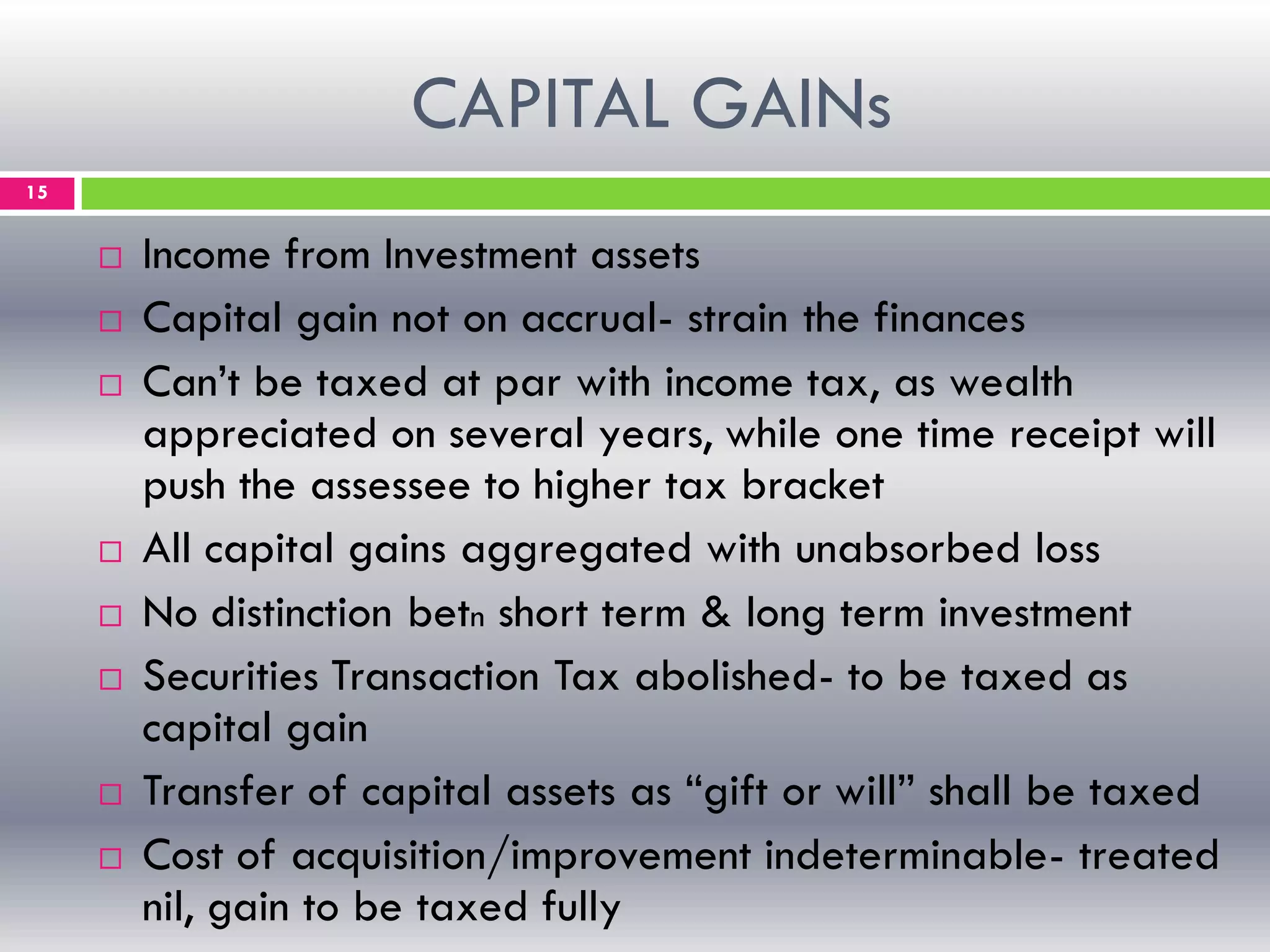
CAPITAL GAINs
15
 Income from Investment assets
 Capital gain not on accrual- strain the finances
 Can’t be taxed at par with income tax, as wealth
appreciated on several years, while one time receipt will
push the assessee to higher tax bracket
 All capital gains aggregated with unabsorbed loss
 No distinction betn short term & long term investment
 Securities Transaction Tax abolished- to be taxed as
capital gain
 Transfer of capital assets as “gift or will” shall be taxed
 Cost of acquisition/improvement indeterminable- treated
nil, gain to be taxed fully
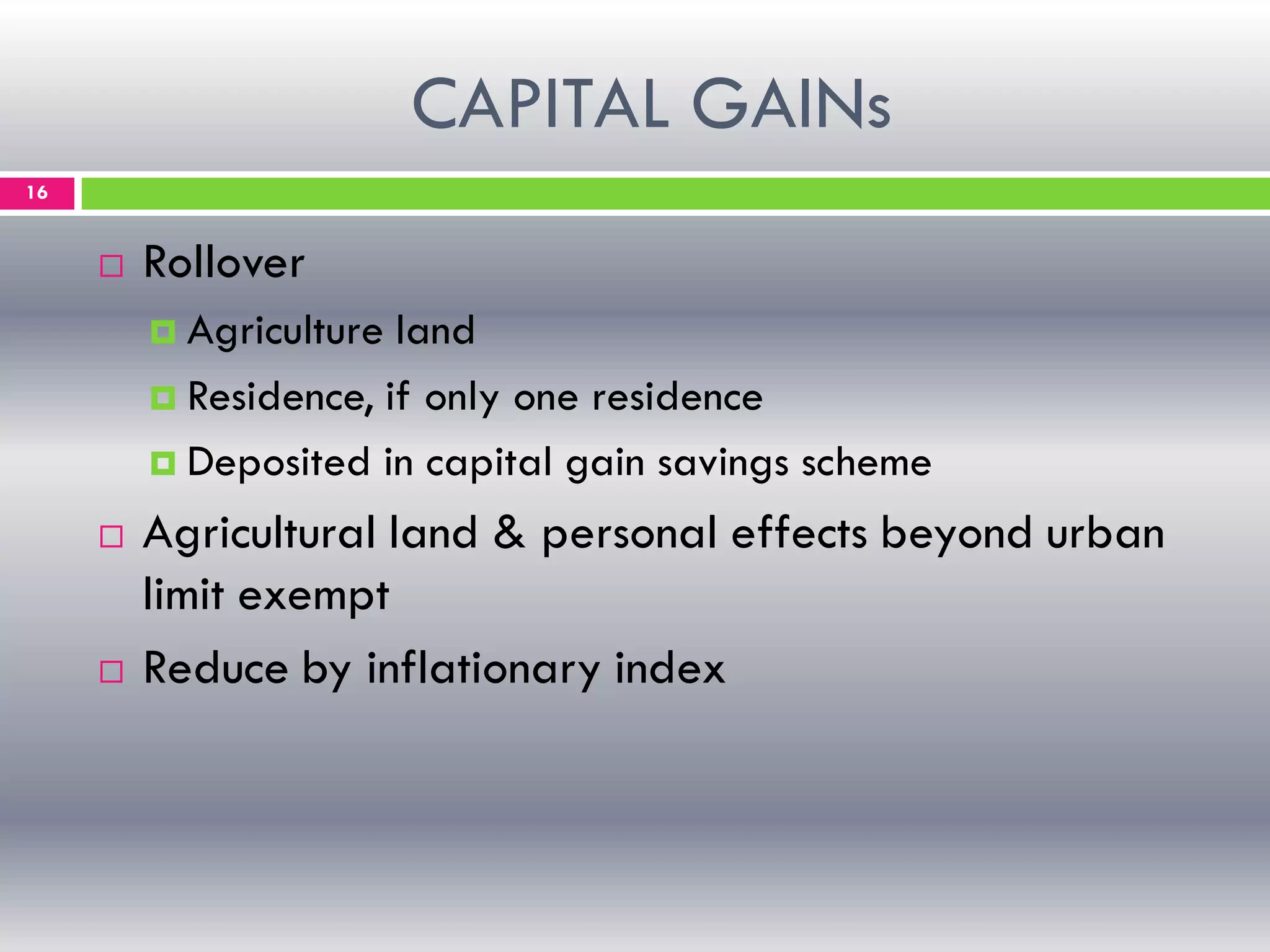
CAPITAL GAINs
16
 Rollover
 Agriculture land
 Residence, if only one residence
 Deposited in capital gain savings scheme
 Agricultural land & personal effects beyond urban
limit exempt
 Reduce by inflationary index
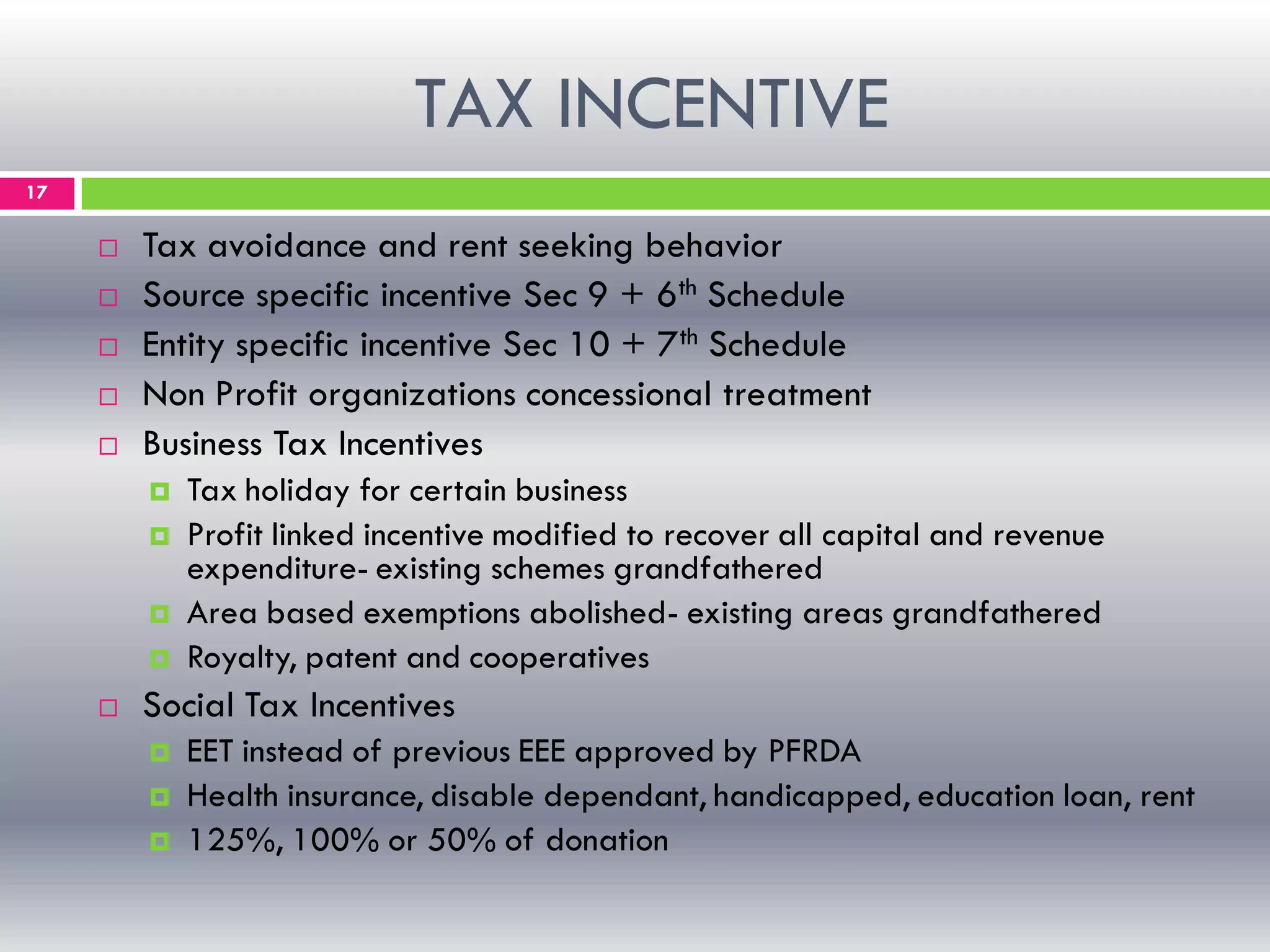
TAX INCENTIVE
17
 Tax avoidance and rent seeking behavior
 Source specific incentive Sec 9 + 6th Schedule
 Entity specific incentive Sec 10 + 7th Schedule
 Non Profit organizations concessional treatment
 Business Tax Incentives
 Tax holiday for certain business
 Profit linked incentive modified to recover all capital and revenue
expenditure- existing schemes grandfathered
 Area based exemptions abolished- existing areas grandfathered
 Royalty, patent and cooperatives
 Social Tax Incentives
 EET instead of previous EEE approved by PFRDA
 Health insurance, disable dependant, handicapped, education loan, rent
 125%, 100% or 50% of donation
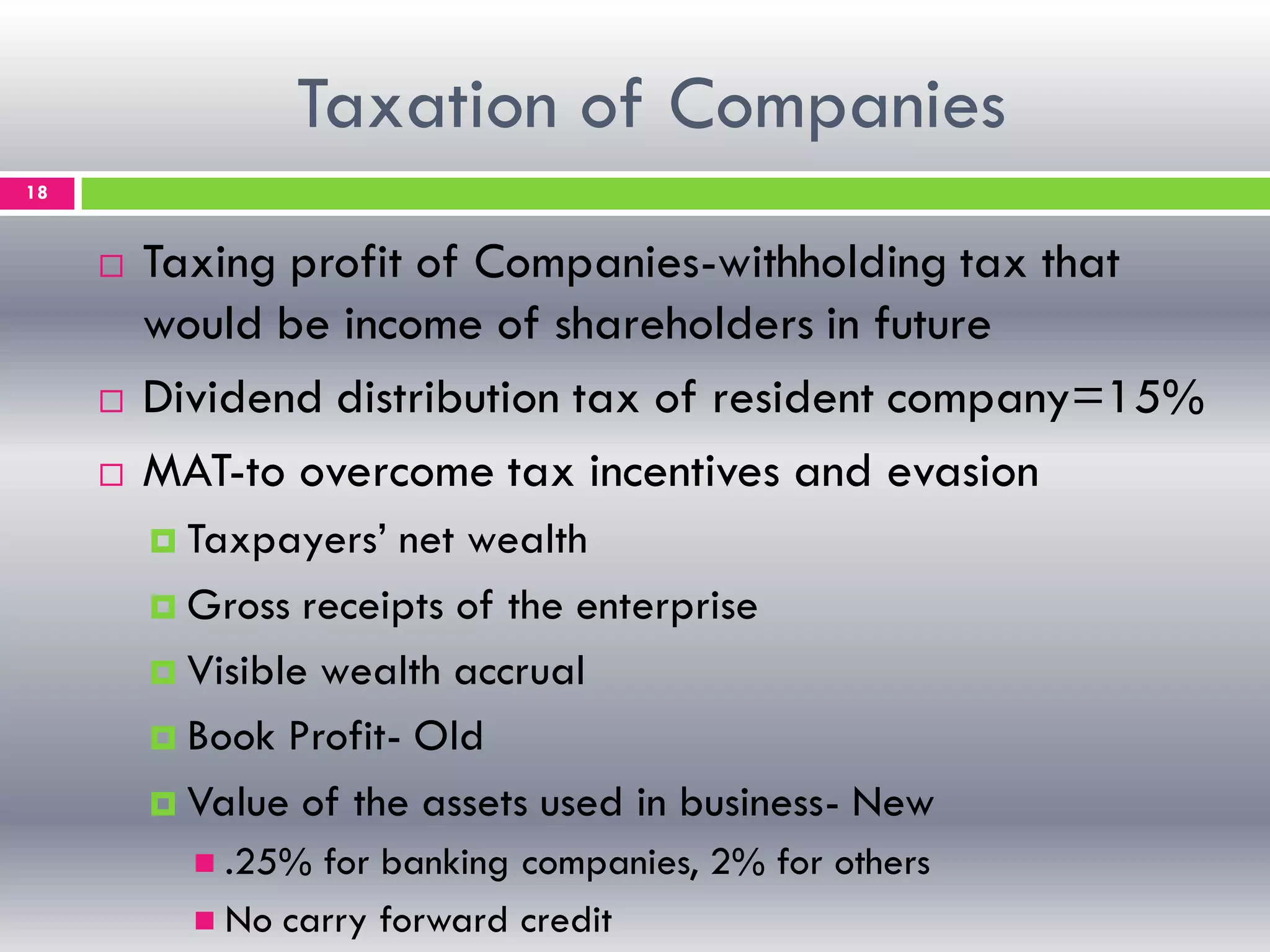
Taxation of Companies
18
 Taxing profit of Companies-withholding tax that
would be income of shareholders in future
 Dividend distribution tax of resident company=15%
 MAT-to overcome tax incentives and evasion
 Taxpayers’ net wealth
 Gross receipts of the enterprise
 Visible wealth accrual
 Book Profit- Old
 Value of the assets used in business- New
 .25% for banking companies, 2% for others
 No carry forward credit
Taxation of Companies
19
 Tax on Corporation
 25% both domestic and foreign
 15% on branch profit (income- corporate tax)
Unincorporated Bodies
20
 Partnership firms, association of persons
 Carry forward loss
 Deduction as per corporations
 Financial intermediary-passthru companies
 Not liable to pay tax for liability of investors
Non Profit Organs and Trusts
21
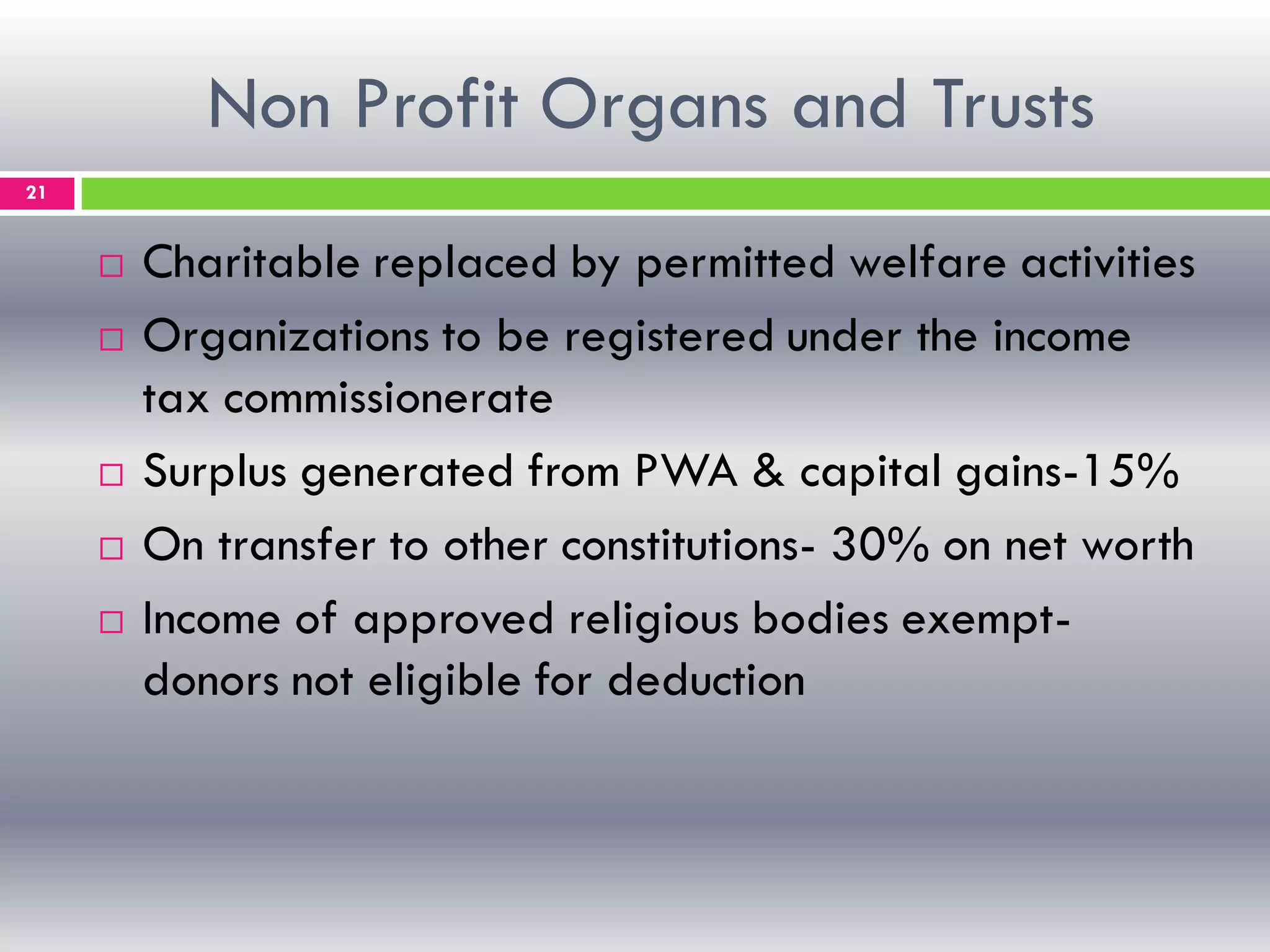
 Charitable replaced by permitted welfare activities
 Organizations to be registered under the income
tax commissionerate
 Surplus generated from PWA & capital gains-15%
 On transfer to other constitutions- 30% on net worth
 Income of approved religious bodies exempt-
donors not eligible for deduction
Tax on Net Wealth
22
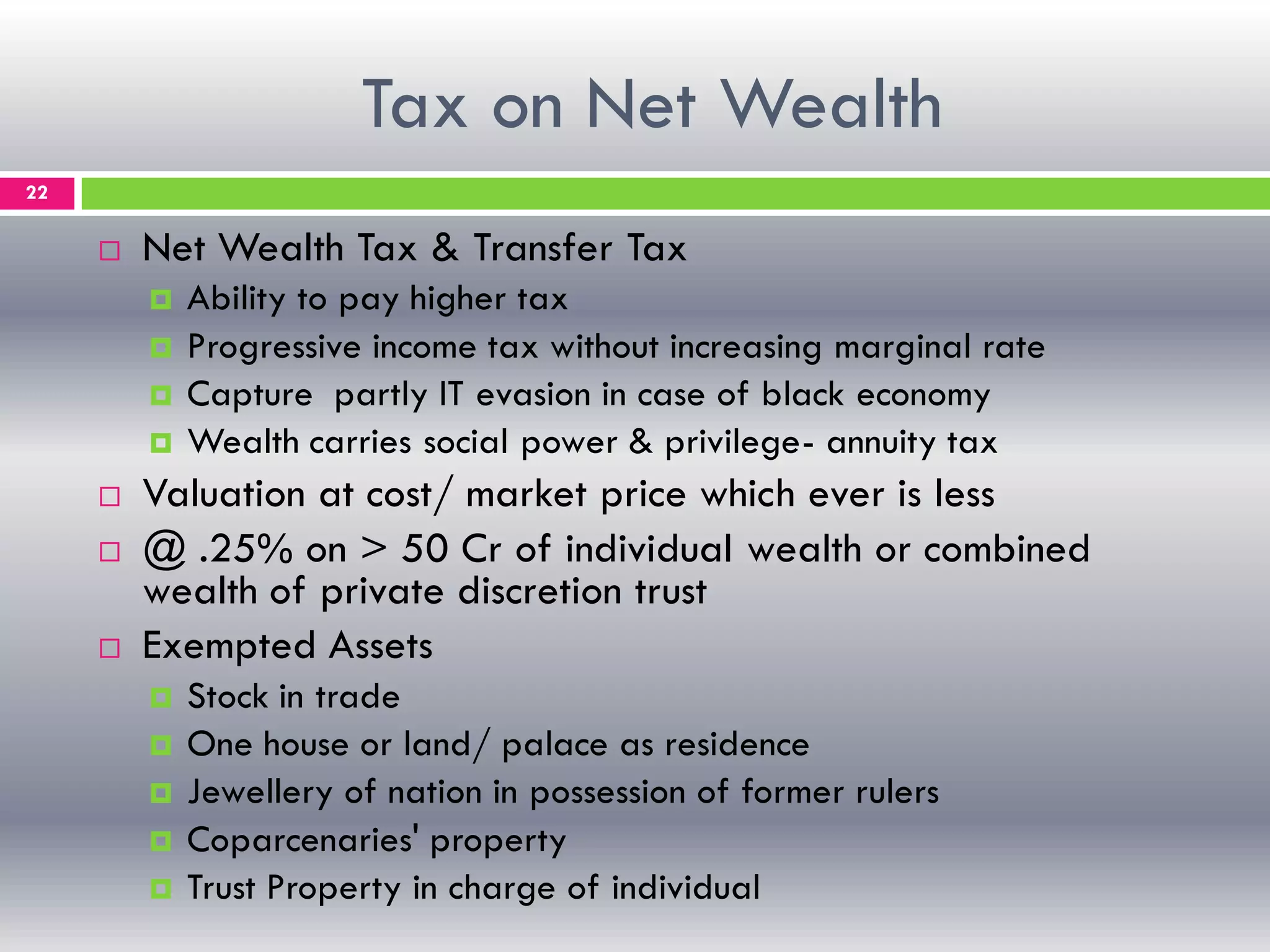
 Net Wealth Tax & Transfer Tax
 Ability to pay higher tax
 Progressive income tax without increasing marginal rate
 Capture partly IT evasion in case of black economy
 Wealth carries social power & privilege- annuity tax
 Valuation at cost/ market price which ever is less
 @ .25% on > 50 Cr of individual wealth or combined
wealth of private discretion trust
 Exempted Assets
 Stock in trade
 One house or land/ palace as residence
 Jewellery of nation in possession of former rulers
 Coparcenaries' property
 Trust Property in charge of individual
Tax Administration
23
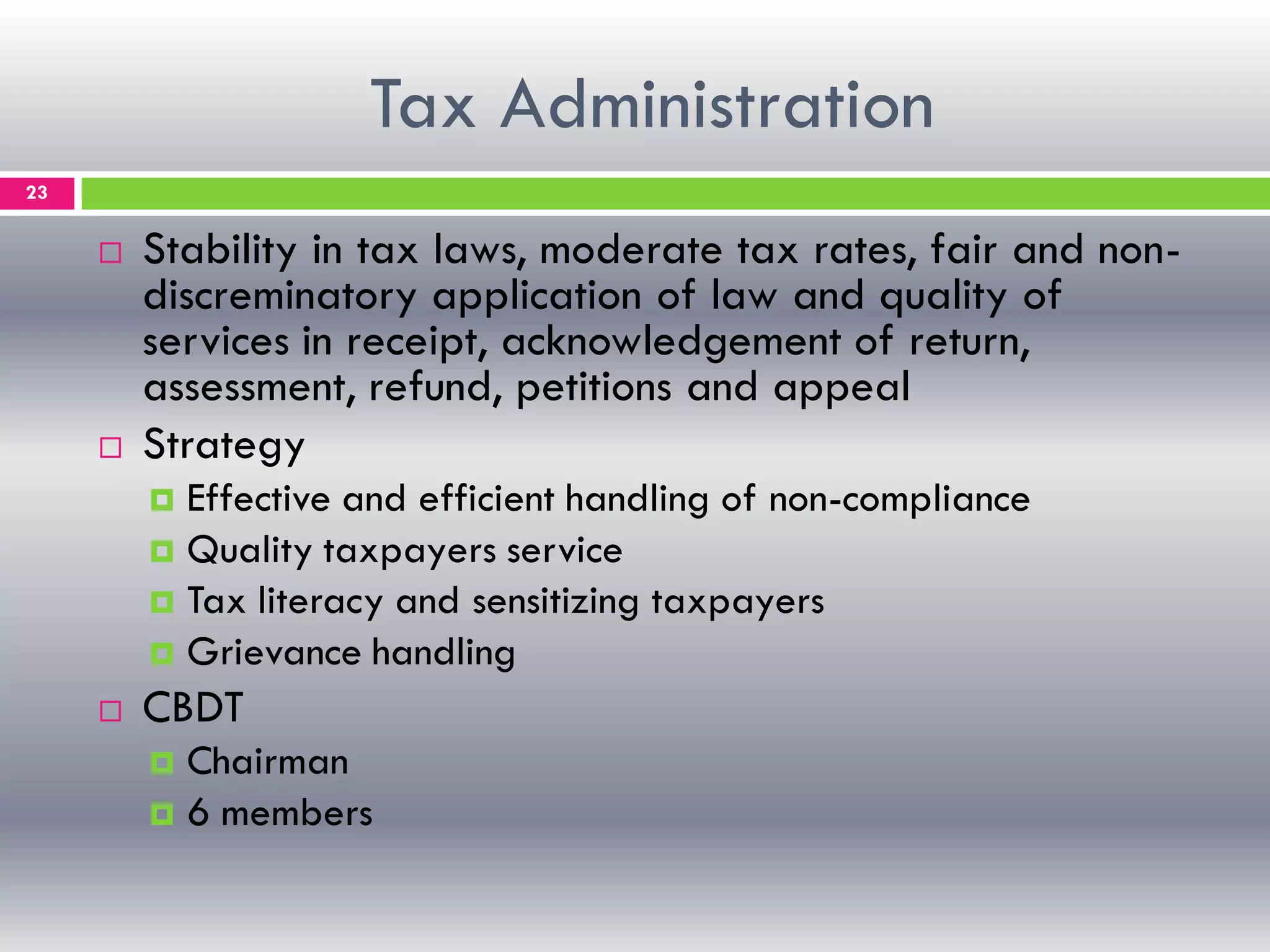
 Stability in tax laws, moderate tax rates, fair and non-
discreminatory application of law and quality of
services in receipt, acknowledgement of return,
assessment, refund, petitions and appeal
 Strategy
 Effective and efficient handling of non-compliance
 Quality taxpayers service
 Tax literacy and sensitizing taxpayers
 Grievance handling
 CBDT
 Chairman
 6 members
Tax Administration
24
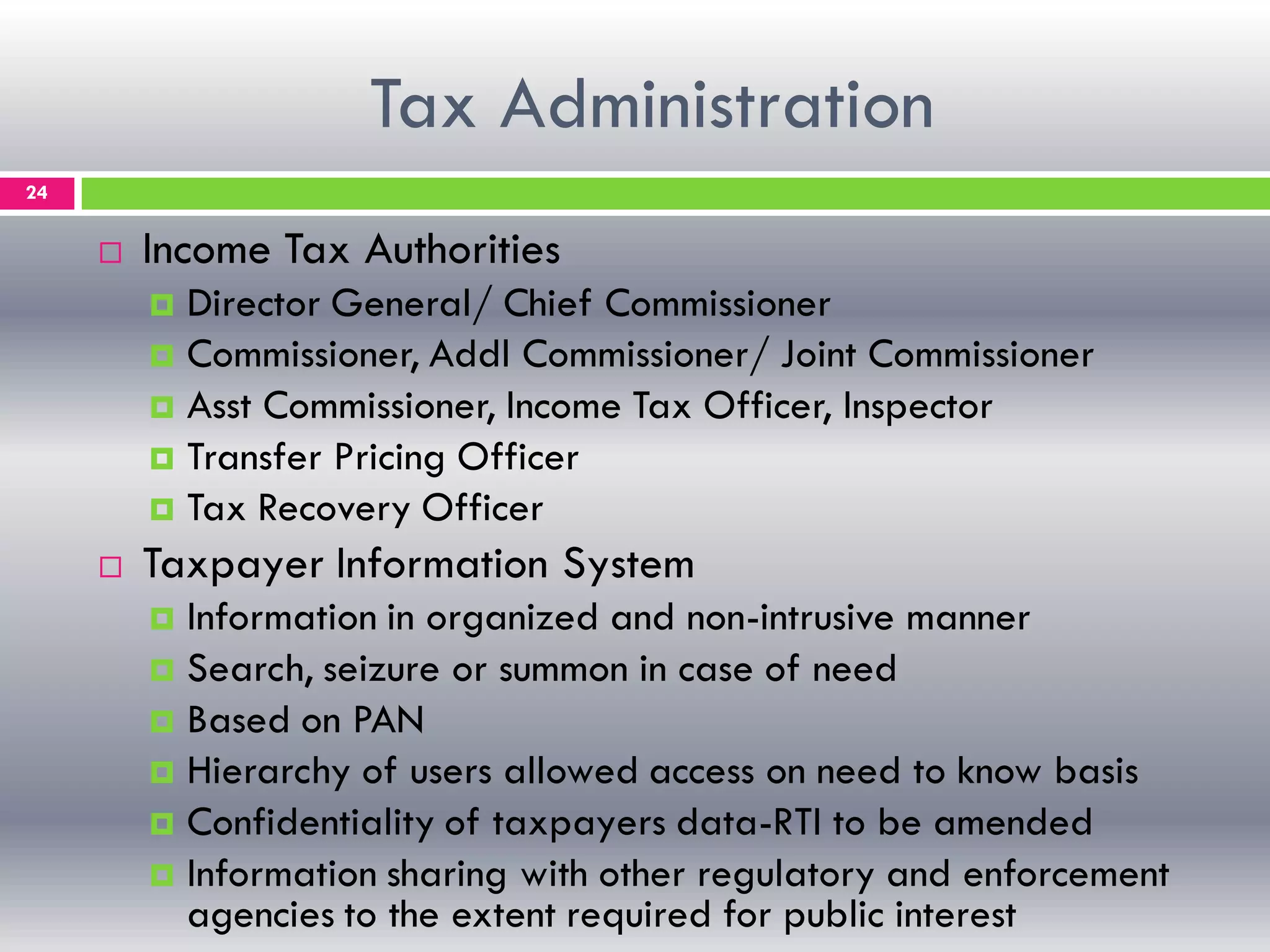
 Income Tax Authorities
 Director General/ Chief Commissioner
 Commissioner, Addl Commissioner/ Joint Commissioner
 Asst Commissioner, Income Tax Officer, Inspector
 Transfer Pricing Officer
 Tax Recovery Officer
 Taxpayer Information System
 Information in organized and non-intrusive manner
 Search, seizure or summon in case of need
 Based on PAN
 Hierarchy of users allowed access on need to know basis
 Confidentiality of taxpayers data-RTI to be amended
 Information sharing with other regulatory and enforcement
agencies to the extent required for public interest
Procedural Laws & Enforcement Strategy
25
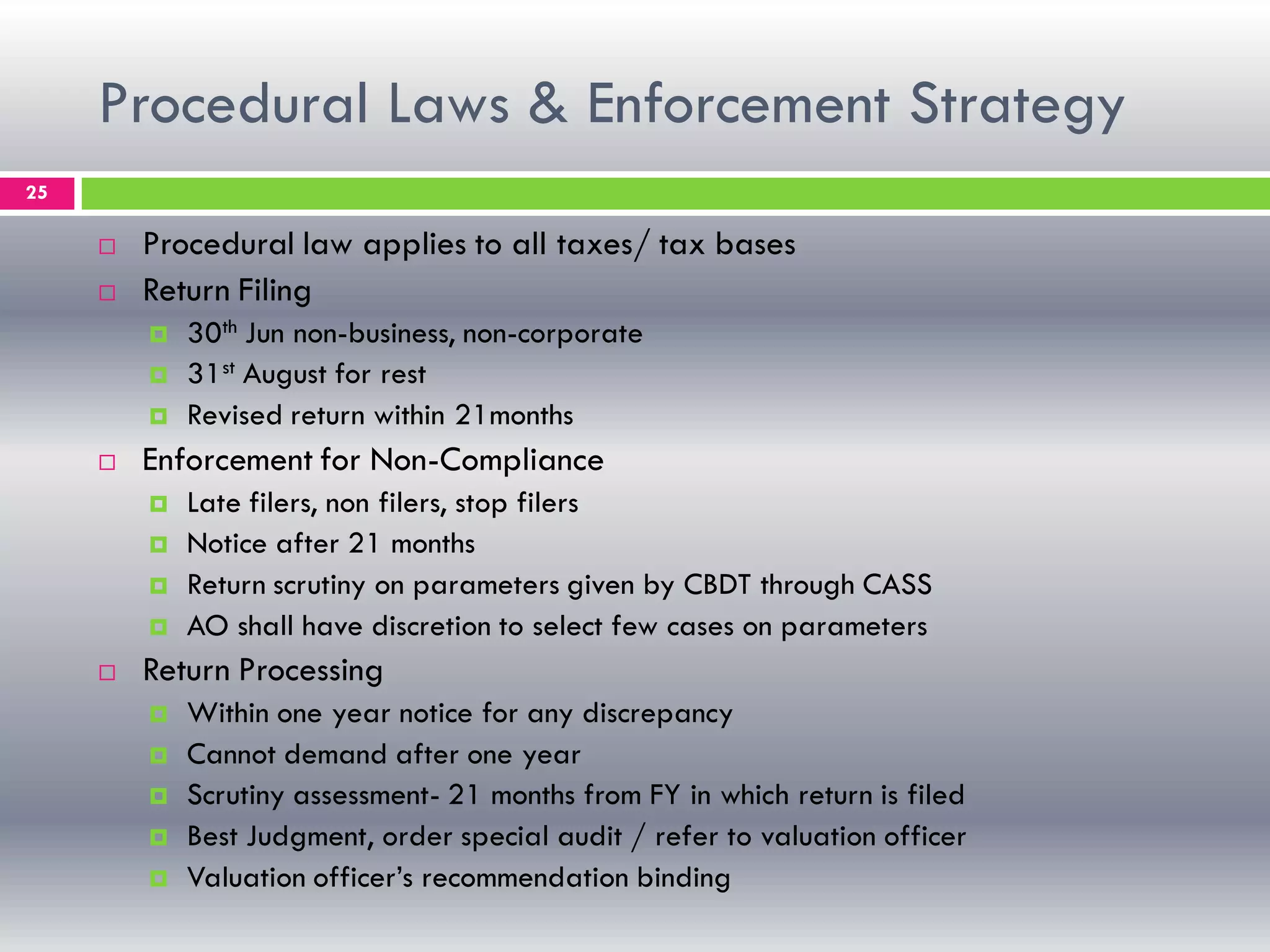
 Procedural law applies to all taxes/ tax bases
 Return Filing
 30th Jun non-business, non-corporate
 31st August for rest
 Revised return within 21months
 Enforcement for Non-Compliance
 Late filers, non filers, stop filers
 Notice after 21 months
 Return scrutiny on parameters given by CBDT through CASS
 AO shall have discretion to select few cases on parameters
 Return Processing
 Within one year notice for any discrepancy
 Cannot demand after one year
 Scrutiny assessment- 21 months from FY in which return is filed
 Best Judgment, order special audit / refer to valuation officer
 Valuation officer’s recommendation binding
Procedural Laws & Enforcement Strategy
26
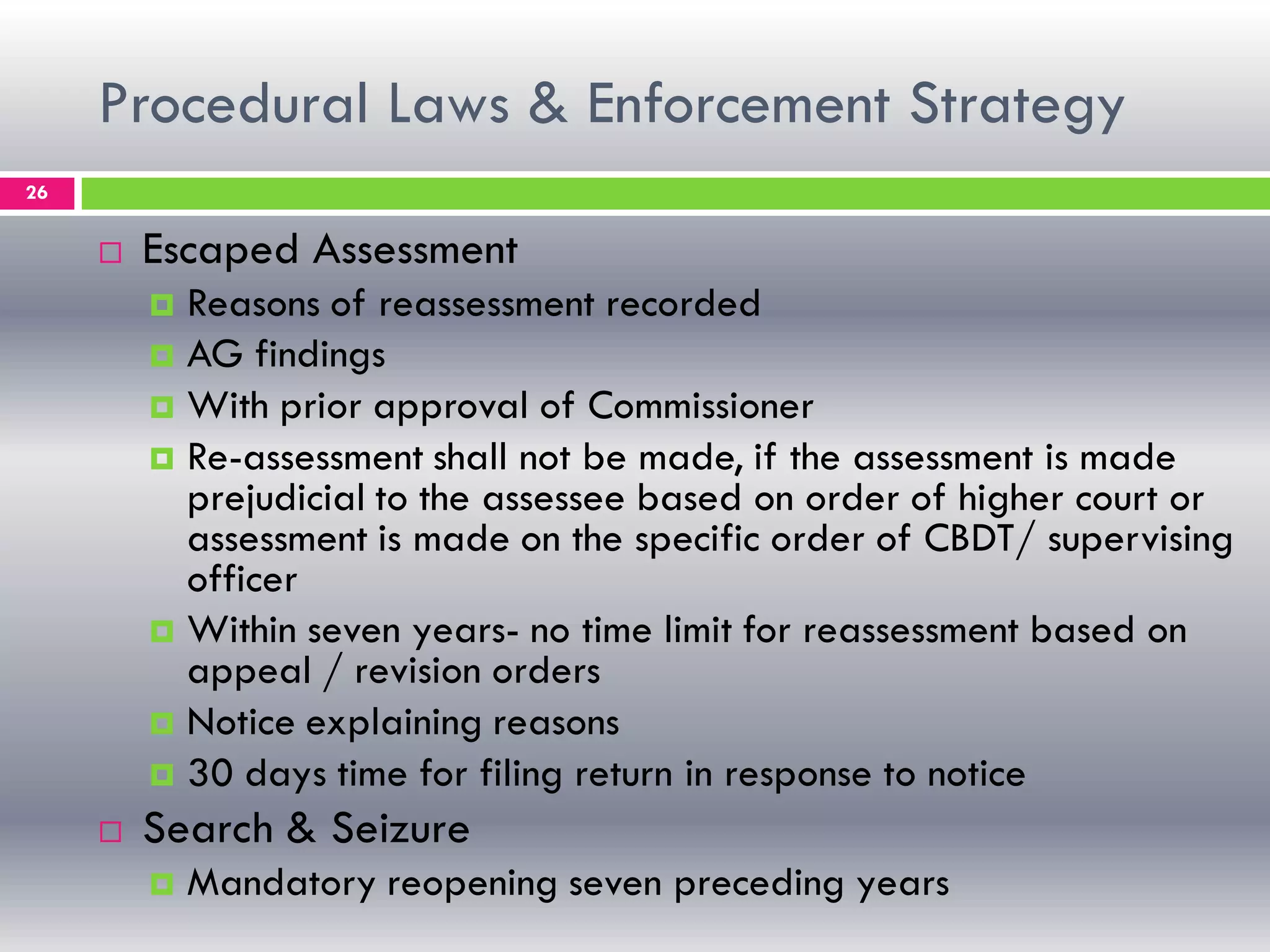
 Escaped Assessment
 Reasons of reassessment recorded
 AG findings
 With prior approval of Commissioner
 Re-assessment shall not be made, if the assessment is made
prejudicial to the assessee based on order of higher court or
assessment is made on the specific order of CBDT/ supervising
officer
 Within seven years- no time limit for reassessment based on
appeal / revision orders
 Notice explaining reasons
 30 days time for filing return in response to notice
 Search & Seizure
 Mandatory reopening seven preceding years
Background on Transfer Pricing
27
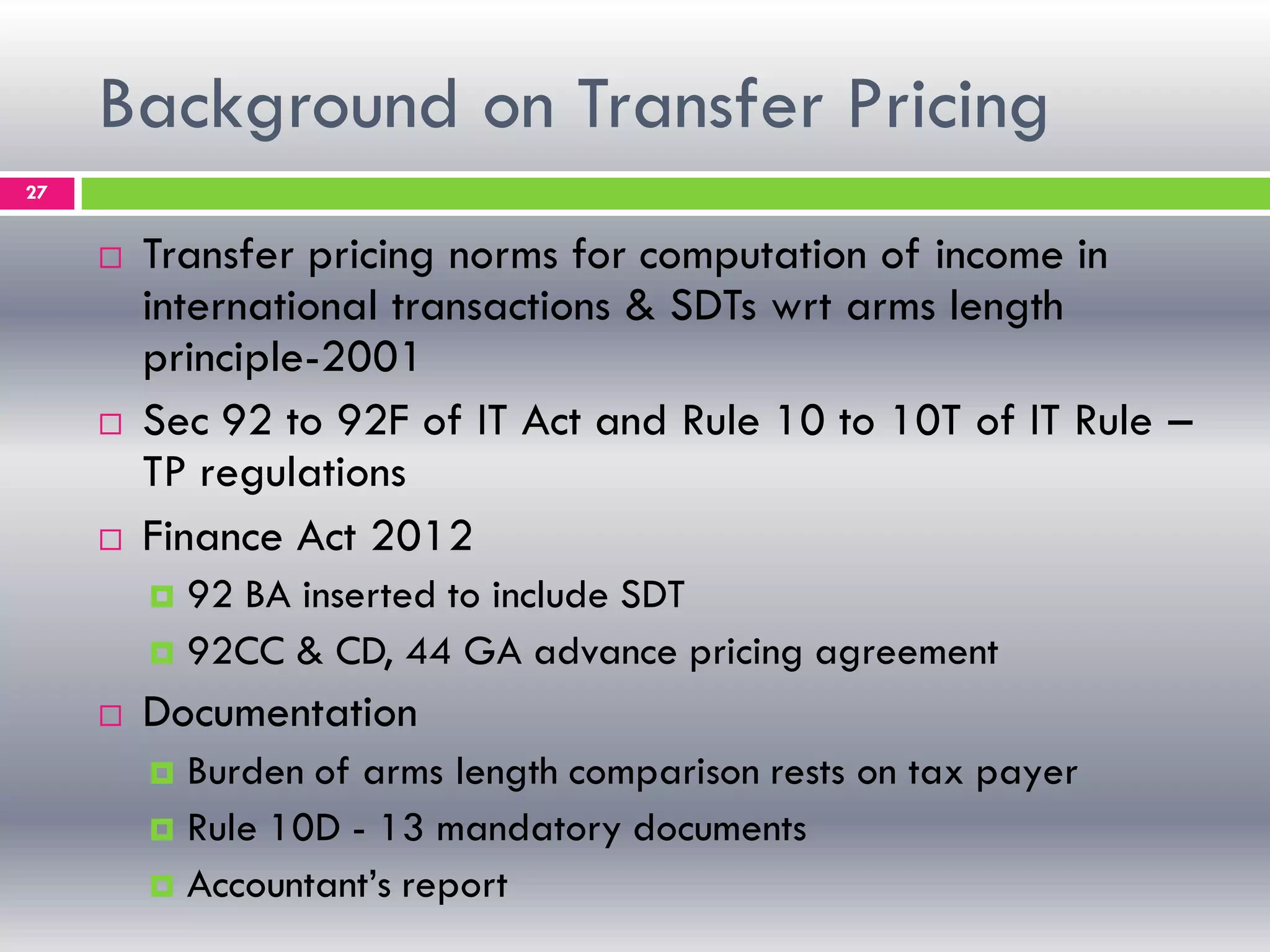
 Transfer pricing norms for computation of income in
international transactions & SDTs wrt arms length
principle-2001
 Sec 92 to 92F of IT Act and Rule 10 to 10T of IT Rule –
TP regulations
 Finance Act 2012
 92 BA inserted to include SDT
 92CC & CD, 44 GA advance pricing agreement
 Documentation
 Burden of arms length comparison rests on tax payer
 Rule 10D - 13 mandatory documents
 Accountant’s report
SPECIFIED DOMESTIC TRANSACTION (SDT)
28
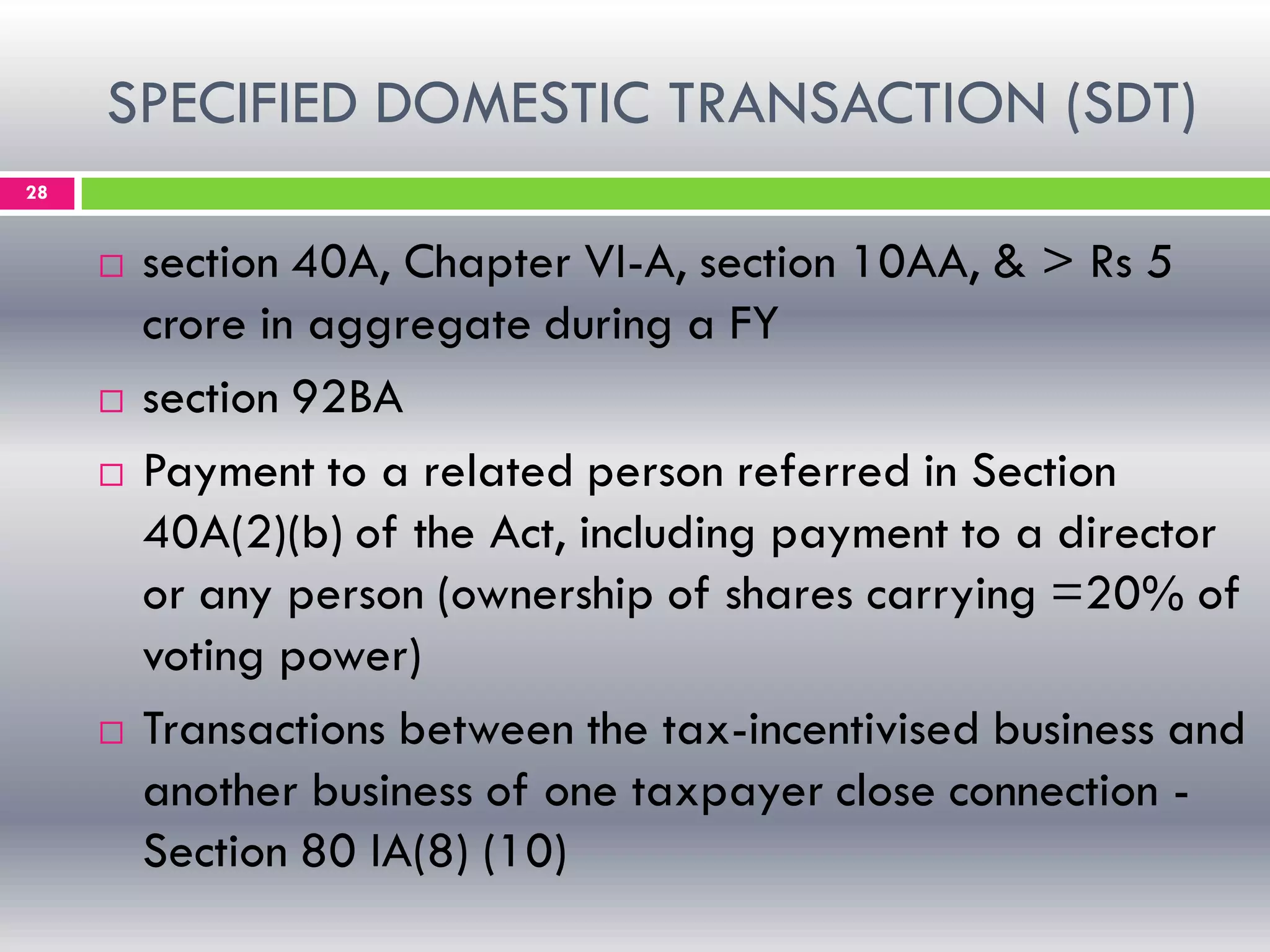
 section 40A, Chapter VI-A, section 10AA, & > Rs 5
crore in aggregate during a FY
 section 92BA
 Payment to a related person referred in Section
40A(2)(b) of the Act, including payment to a director
or any person (ownership of shares carrying =20% of
voting power)
 Transactions between the tax-incentivised business and
another business of one taxpayer close connection -
Section 80 IA(8) (10)
Transfer Pricing
29
 Audit by Indian Revenue Authorities- aggregate
income adjustments to the tune of Rs 44,000 crore
last year>audits of previous 4 years
 Companies are opting for the mutual agreement
procedure (MAP)- characterization of income,
permanent establishment profit attribution and
transfer pricing issues- actions by either of the tax
authorities are contrary to the treaty provisions
 MAP: Rules 44G and 44H Income tax Rules, 1962
 MoU with US and UK to follow certain procedures
Audit of Transfer Pricing
30
 Institution of TPO - Specialist
 Specified transactions to be reported to TPO by return
date
 Selection by TPO on risk parameters set by Board
within 2 months of end of FY in which assessee reported
 Communication to assessee & AO simultaneously
 Report of TPO to assessee & AO within 42 months of FY
of transaction
 AO to issue assessment order within 3 months
 Assessee may agitate the computation before AO &
TPO and dept or appeal
Double Taxation Avoidance Agreement(DTAA)
31
 Comprehensive DTAAs
 Limited DTAAs for shipping and air transport
 Conflict of DTC and DTAA- latest document shall prevail
 Residence and Source Based taxation four models
 Full or part tax in country of residence and country of
source waiving tax to that extent
 Full right to tax by one country based on source or
residence and the other country exempt fully
 Full right to tax by both countries, but tax rate of source
country is limited, and country of residence gives credit
 Full right to tax by both, residence country gives credit
Advance Pricing Agreement
32
 Bilateral and Multilateral APA
 Anonymous pre-filing consultation- confidentiality of
transaction/ party not revealed
 Inclusion of experts from industry, economics and
statistics in APA team
 Site visit to taxpayer’s premises
 Withdrawal of application - no refund of fee
 TPO carry out compliance audit every year
 APA not binding if critical assumptions alter
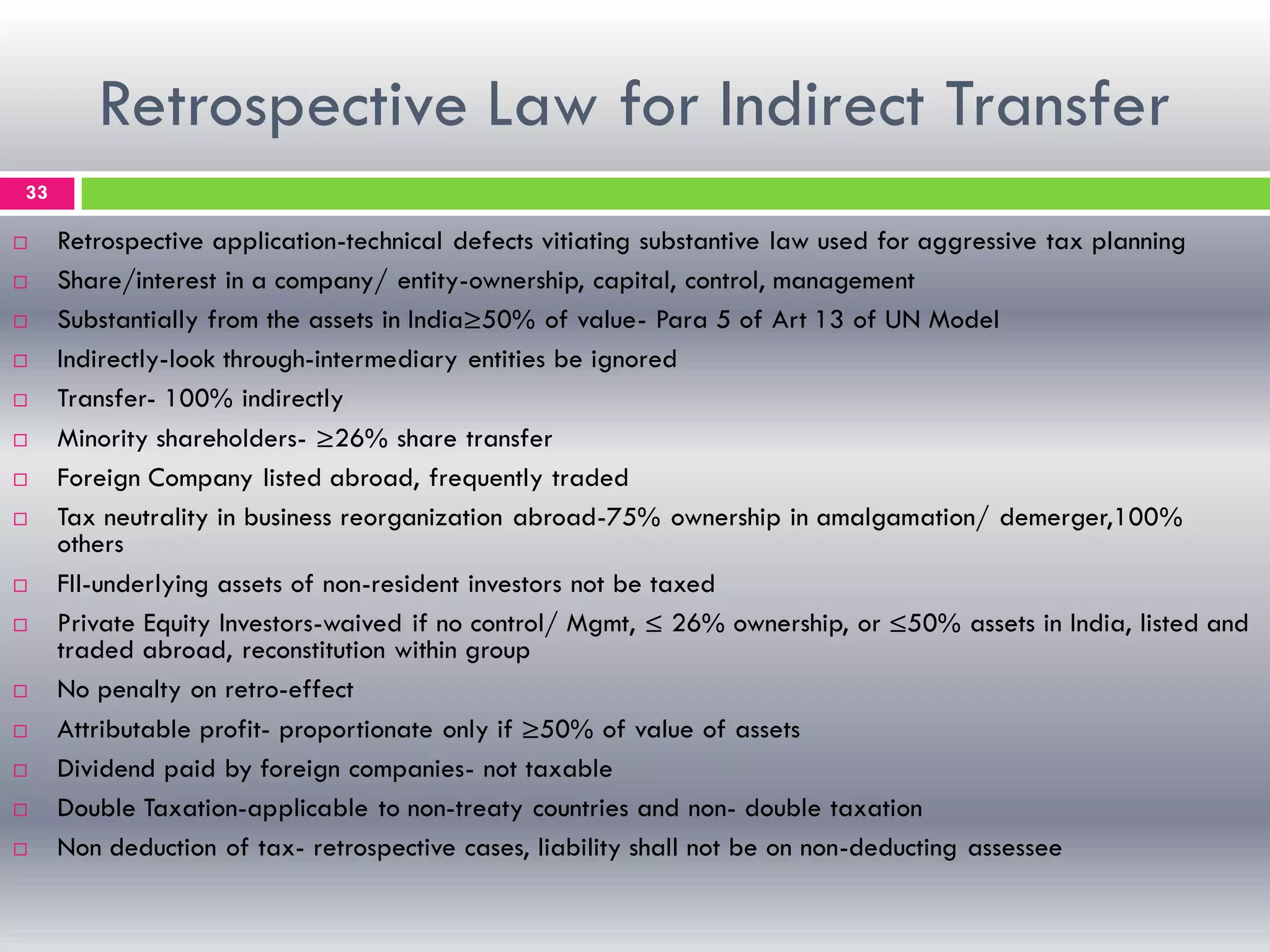
Retrospective Law for Indirect Transfer
33
 Retrospective application-technical defects vitiating substantive law used for aggressive tax planning
 Share/interest in a company/ entity-ownership, capital, control, management
 Substantially from the assets in India≥50% of value- Para 5 of Art 13 of UN Model
 Indirectly-look through-intermediary entities be ignored
 Transfer- 100% indirectly
 Minority shareholders- ≥26% share transfer
 Foreign Company listed abroad, frequently traded
 Tax neutrality in business reorganization abroad-75% ownership in amalgamation/ demerger,100%
others
 FII-underlying assets of non-resident investors not be taxed
 Private Equity Investors-waived if no control/ Mgmt, ≤ 26% ownership, or ≤50% assets in India, listed and
traded abroad, reconstitution within group
 No penalty on retro-effect
 Attributable profit- proportionate only if ≥50% of value of assets
 Dividend paid by foreign companies- not taxable
 Double Taxation-applicable to non-treaty countries and non- double taxation
 Non deduction of tax- retrospective cases, liability shall not be on non-deducting assessee
Chidananda Jena
Email: chidananda.jena@gmail.com
Skype/ YM: chidanandajena

Direct Tax Code India _ Jena

  • 1.
  • 2.
    BACKGROUND 2  Income TaxAct 1961 has undergone several intractable amendments  Dividend Distribution Tax inserted in 1997  Fringe Benefit Tax inserted in 2006  Wealth Tax administered by Wealth Tax Act, 1957  Intractable conflicting rulings by different courts  Incomprehensible to the average tax payers  Complex tax law increases the cost of compliance of marginal tax payers and administration as well
  • 3.
    BACKGROUND 3  Marginal taxrates lowered, range of exemptions broadened  Tax base increased, further push required for horizontal equity
  • 4.
    STRATEGY 4  Efficient, Equitableand Effective  Avoidance by competents- subsidizing rich– inequitable  Minimize exemptions  Remove ambiguity in law to minimize tax avoidance  Keep pace with aggressive tax planning & court ruling on interpretation of ambiguous provisions  Technology & process reengineering to reduce cost  Tax policy to encourage self assessment and penalize evasion  Hence new DTC is aligned with above strategies
  • 5.
    SALIENT FEATUREs 5  Alldirect taxes under one code  Language simple in active voice and short  Provisio and explanations removed, while essence nested  Extensive use of formulae and tables  Executive is delegated to end protracted litigations  Essential principles kept in statute, matters requiring frequent changes kept in rules/ schedules- will reduce frequent amendments  Law is logically reproduced in FORMs
  • 6.
    SALIENT FEATUREs 6  Consolidationand reorganization of different provisions/ sections such as incentives, tax rates etc  Elimination of regulatory functions  Rate of Tax in Schedule, no more an annual legislation through Finance Bill
  • 7.
    BASE for TAXATION 7 Income= Consumption + Change in net worth  Exemption up to a limit under income tax towards indirect tax imposed on consumption  Balance covered under income tax  Income should ideally include  Gifts  Earnings from labour, investment and business  Net accrued capital gains  Value of services & non-business assets net of expenses & depreciation  Imputed value of services by family  Windfall gains  Casual receipts- lottery
  • 8.
    EQUITY in TAXATION 8 Income tax on individual income leads to corporatization and avoidance of distribution of profits to shareholders- to take profit out in course of capital gains  To prevent this corporate tax on profit of corporation is required. However, this leads to double taxation, when dividends are taxed again under income tax  This creates bias for debt financing  Owner occupied house left out of taxation  Exemptions on positive externalities like cost of administration, human development, equity  Deferrals to allow liquidity  Agricultural Income comes under State List of Constitution.
  • 9.
    RESIDENCE or SOURCEBASED TAX 9  Natural Persons, who establish their residence, domicile in India irrespective of the source of the income globally  In case of non natural persons/ corporations, place of incorporation/ control & management is treated as residence  Global income of all residents to achieve tax neutrality in investment decisions (efficiency) & horizontal & vertical equity  Sourced based tax for non-residents
  • 10.
    RESIDENCE or SOURCEBASED TAX 10  Loss for underdeveloped nations on residence criteria  Investors in developed nations  Investment flow through tax havens  Political and economic error in not taxing foreigners earning inside the nation  Issues in pure source based tax  Investors play nations against others to race tax rate to bottom  Determining source in aggressive transfer pricing
  • 11.
    RESIDENCE or SOURCEBASED TAX 11 R & OR R but NOR NR Indian Income: ► Accrued / sourced in India Taxable Taxable Taxable ► Received in India Taxable Taxable Taxable Foreign Income : ► Accrued outside India but deemed to accrue in India by virtue of Section 9 Taxable Taxable Taxable ► Accrued outside India - First receipt in India Taxable Taxable Taxable ► Any other income accruing outside India and received outside India Taxable Not taxable Not taxable
  • 12.
    Assessee & Residence 12 Precise definition of residency  Financial Year instead of Assessment Year  Precise definition of assessee and persons to include not liable people eligible to refund etc  Accruals/ Receipts  Ordinary Sources  Employment, house property, business  Capital gains  Residuary sources  Special Sources  Lottery, Horse Racing, Sports person, Sports association
  • 13.
    COMPUTATION of TOTALINCOME 13  Ring fencing each head wise total income with carry forward loss of respective head from preceding year  Expenditure not admissible in case of non-resident  Royalty  Fees for technical services  Income (special rates of tax of part II of 1st schedule)  Deduction of special prescribed expenditures incurred in performance of duties  Deduction of retirement benefits  Deduction of insurance & education for kids up to Rs 50K  Deduction of medical reimbursements up to Rs 50K
  • 14.
    INCOME from BUSINESS 14 Business profit model-does not provide receipts and deductions  Income-expenses model-adopted in India, USA, Australia, Canada and many Asian nations  Asset classified as business asset or investment asset. Business asset is classified into business capital asset and business trading asset.  Profits on sale of capital assets or undertaking as income from business- not capital gains  Interest from capital of business other than those of financial institutions  Expenditure  Operating  Permitted financial charges  Capital allowances  Presumptive profit of certain business to continue  Separate income determination regime for certain business
  • 15.
    CAPITAL GAINs 15  Incomefrom Investment assets  Capital gain not on accrual- strain the finances  Can’t be taxed at par with income tax, as wealth appreciated on several years, while one time receipt will push the assessee to higher tax bracket  All capital gains aggregated with unabsorbed loss  No distinction betn short term & long term investment  Securities Transaction Tax abolished- to be taxed as capital gain  Transfer of capital assets as “gift or will” shall be taxed  Cost of acquisition/improvement indeterminable- treated nil, gain to be taxed fully
  • 16.
    CAPITAL GAINs 16  Rollover Agriculture land  Residence, if only one residence  Deposited in capital gain savings scheme  Agricultural land & personal effects beyond urban limit exempt  Reduce by inflationary index
  • 17.
    TAX INCENTIVE 17  Taxavoidance and rent seeking behavior  Source specific incentive Sec 9 + 6th Schedule  Entity specific incentive Sec 10 + 7th Schedule  Non Profit organizations concessional treatment  Business Tax Incentives  Tax holiday for certain business  Profit linked incentive modified to recover all capital and revenue expenditure- existing schemes grandfathered  Area based exemptions abolished- existing areas grandfathered  Royalty, patent and cooperatives  Social Tax Incentives  EET instead of previous EEE approved by PFRDA  Health insurance, disable dependant, handicapped, education loan, rent  125%, 100% or 50% of donation
  • 18.
    Taxation of Companies 18 Taxing profit of Companies-withholding tax that would be income of shareholders in future  Dividend distribution tax of resident company=15%  MAT-to overcome tax incentives and evasion  Taxpayers’ net wealth  Gross receipts of the enterprise  Visible wealth accrual  Book Profit- Old  Value of the assets used in business- New  .25% for banking companies, 2% for others  No carry forward credit
  • 19.
    Taxation of Companies 19 Tax on Corporation  25% both domestic and foreign  15% on branch profit (income- corporate tax)
  • 20.
    Unincorporated Bodies 20  Partnershipfirms, association of persons  Carry forward loss  Deduction as per corporations  Financial intermediary-passthru companies  Not liable to pay tax for liability of investors
  • 21.
    Non Profit Organsand Trusts 21  Charitable replaced by permitted welfare activities  Organizations to be registered under the income tax commissionerate  Surplus generated from PWA & capital gains-15%  On transfer to other constitutions- 30% on net worth  Income of approved religious bodies exempt- donors not eligible for deduction
  • 22.
    Tax on NetWealth 22  Net Wealth Tax & Transfer Tax  Ability to pay higher tax  Progressive income tax without increasing marginal rate  Capture partly IT evasion in case of black economy  Wealth carries social power & privilege- annuity tax  Valuation at cost/ market price which ever is less  @ .25% on > 50 Cr of individual wealth or combined wealth of private discretion trust  Exempted Assets  Stock in trade  One house or land/ palace as residence  Jewellery of nation in possession of former rulers  Coparcenaries' property  Trust Property in charge of individual
  • 23.
    Tax Administration 23  Stabilityin tax laws, moderate tax rates, fair and non- discreminatory application of law and quality of services in receipt, acknowledgement of return, assessment, refund, petitions and appeal  Strategy  Effective and efficient handling of non-compliance  Quality taxpayers service  Tax literacy and sensitizing taxpayers  Grievance handling  CBDT  Chairman  6 members
  • 24.
    Tax Administration 24  IncomeTax Authorities  Director General/ Chief Commissioner  Commissioner, Addl Commissioner/ Joint Commissioner  Asst Commissioner, Income Tax Officer, Inspector  Transfer Pricing Officer  Tax Recovery Officer  Taxpayer Information System  Information in organized and non-intrusive manner  Search, seizure or summon in case of need  Based on PAN  Hierarchy of users allowed access on need to know basis  Confidentiality of taxpayers data-RTI to be amended  Information sharing with other regulatory and enforcement agencies to the extent required for public interest
  • 25.
    Procedural Laws &Enforcement Strategy 25  Procedural law applies to all taxes/ tax bases  Return Filing  30th Jun non-business, non-corporate  31st August for rest  Revised return within 21months  Enforcement for Non-Compliance  Late filers, non filers, stop filers  Notice after 21 months  Return scrutiny on parameters given by CBDT through CASS  AO shall have discretion to select few cases on parameters  Return Processing  Within one year notice for any discrepancy  Cannot demand after one year  Scrutiny assessment- 21 months from FY in which return is filed  Best Judgment, order special audit / refer to valuation officer  Valuation officer’s recommendation binding
  • 26.
    Procedural Laws &Enforcement Strategy 26  Escaped Assessment  Reasons of reassessment recorded  AG findings  With prior approval of Commissioner  Re-assessment shall not be made, if the assessment is made prejudicial to the assessee based on order of higher court or assessment is made on the specific order of CBDT/ supervising officer  Within seven years- no time limit for reassessment based on appeal / revision orders  Notice explaining reasons  30 days time for filing return in response to notice  Search & Seizure  Mandatory reopening seven preceding years
  • 27.
    Background on TransferPricing 27  Transfer pricing norms for computation of income in international transactions & SDTs wrt arms length principle-2001  Sec 92 to 92F of IT Act and Rule 10 to 10T of IT Rule – TP regulations  Finance Act 2012  92 BA inserted to include SDT  92CC & CD, 44 GA advance pricing agreement  Documentation  Burden of arms length comparison rests on tax payer  Rule 10D - 13 mandatory documents  Accountant’s report
  • 28.
    SPECIFIED DOMESTIC TRANSACTION(SDT) 28  section 40A, Chapter VI-A, section 10AA, & > Rs 5 crore in aggregate during a FY  section 92BA  Payment to a related person referred in Section 40A(2)(b) of the Act, including payment to a director or any person (ownership of shares carrying =20% of voting power)  Transactions between the tax-incentivised business and another business of one taxpayer close connection - Section 80 IA(8) (10)
  • 29.
    Transfer Pricing 29  Auditby Indian Revenue Authorities- aggregate income adjustments to the tune of Rs 44,000 crore last year>audits of previous 4 years  Companies are opting for the mutual agreement procedure (MAP)- characterization of income, permanent establishment profit attribution and transfer pricing issues- actions by either of the tax authorities are contrary to the treaty provisions  MAP: Rules 44G and 44H Income tax Rules, 1962  MoU with US and UK to follow certain procedures
  • 30.
    Audit of TransferPricing 30  Institution of TPO - Specialist  Specified transactions to be reported to TPO by return date  Selection by TPO on risk parameters set by Board within 2 months of end of FY in which assessee reported  Communication to assessee & AO simultaneously  Report of TPO to assessee & AO within 42 months of FY of transaction  AO to issue assessment order within 3 months  Assessee may agitate the computation before AO & TPO and dept or appeal
  • 31.
    Double Taxation AvoidanceAgreement(DTAA) 31  Comprehensive DTAAs  Limited DTAAs for shipping and air transport  Conflict of DTC and DTAA- latest document shall prevail  Residence and Source Based taxation four models  Full or part tax in country of residence and country of source waiving tax to that extent  Full right to tax by one country based on source or residence and the other country exempt fully  Full right to tax by both countries, but tax rate of source country is limited, and country of residence gives credit  Full right to tax by both, residence country gives credit
  • 32.
    Advance Pricing Agreement 32 Bilateral and Multilateral APA  Anonymous pre-filing consultation- confidentiality of transaction/ party not revealed  Inclusion of experts from industry, economics and statistics in APA team  Site visit to taxpayer’s premises  Withdrawal of application - no refund of fee  TPO carry out compliance audit every year  APA not binding if critical assumptions alter
  • 33.
    Retrospective Law forIndirect Transfer 33  Retrospective application-technical defects vitiating substantive law used for aggressive tax planning  Share/interest in a company/ entity-ownership, capital, control, management  Substantially from the assets in India≥50% of value- Para 5 of Art 13 of UN Model  Indirectly-look through-intermediary entities be ignored  Transfer- 100% indirectly  Minority shareholders- ≥26% share transfer  Foreign Company listed abroad, frequently traded  Tax neutrality in business reorganization abroad-75% ownership in amalgamation/ demerger,100% others  FII-underlying assets of non-resident investors not be taxed  Private Equity Investors-waived if no control/ Mgmt, ≤ 26% ownership, or ≤50% assets in India, listed and traded abroad, reconstitution within group  No penalty on retro-effect  Attributable profit- proportionate only if ≥50% of value of assets  Dividend paid by foreign companies- not taxable  Double Taxation-applicable to non-treaty countries and non- double taxation  Non deduction of tax- retrospective cases, liability shall not be on non-deducting assessee
  • 34.