International
Finance
Sir Haris
Simplifying Direct and
Simplifying Direct and Indirect
Quotations in International
Finance
Presented By
Muhammad Waleed
BBHM-F21-232
Introduction
 Today, we'll simplify Direct and Indirect
Quotations in International Finance.
Direct vs. Indirect Quotations
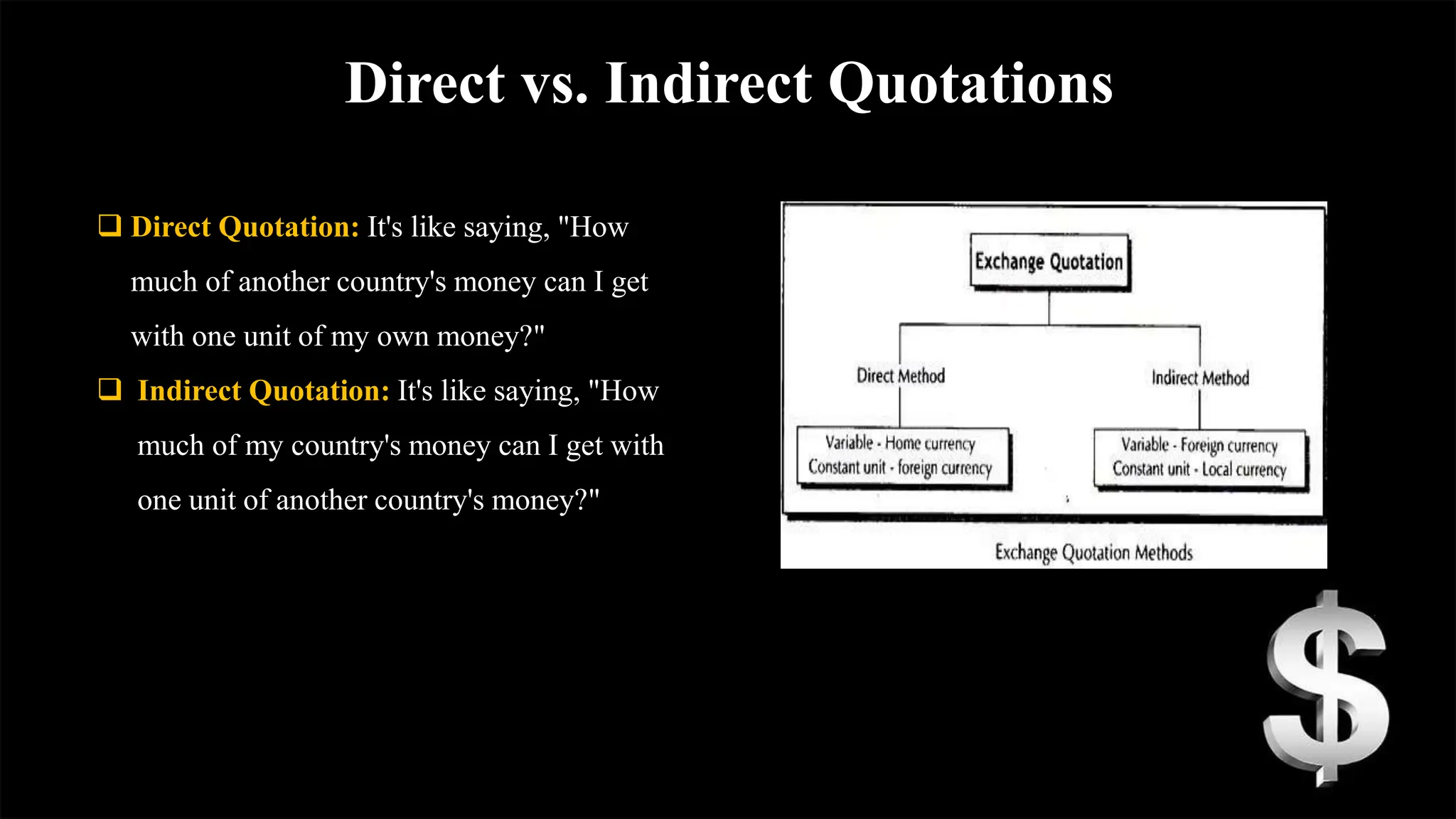
 Direct Quotation: It's like saying, "How
much of another country's money can I get
with one unit of my own money?"
 Indirect Quotation: It's like saying, "How
much of my country's money can I get with
one unit of another country's money?"
Differences Between Direct & Indirect
Quotations
 Direct Quotation: Shows how much foreign currency
you get with one unit of your currency.
 Indirect Quotation: Shows how much of your
currency you get with one unit of foreign currency.
Countries Using Direct Quotations
 United States
 Japan
 Canada
 Australia
 Switzerland
These countries show their currency's value
compared to others directly.
Reasons for Using Direct Quotations
 It's simple: You see how much of another currency you get for
yours.
 Helps in international trade: Makes it clear how much something
costs in different currencies.
Countries Using Indirect Quotations
 European Union (Eurozone countries)
 United Kingdom
 China
 India
 South Korea
These countries show how much of their currency you get with others.
Reasons for Using Indirect Quotations
 Makes Regional Trade Easier: Eurozone countries use
it for transactions within the Eurozone.
 Simplifies Comparisons: Helps in comparing prices
and values within the region.
Conclusion
Understanding Direct and Indirect Quotations
is important in international money matters.
They make trading, buying, and selling across
borders easier.
THANK YOU
Any Questions?

Direct and indirect Quotations Financence

  • 1.
  • 2.
    Simplifying Direct and SimplifyingDirect and Indirect Quotations in International Finance
  • 3.
  • 4.
    Introduction  Today, we'llsimplify Direct and Indirect Quotations in International Finance.
  • 5.
    Direct vs. IndirectQuotations  Direct Quotation: It's like saying, "How much of another country's money can I get with one unit of my own money?"  Indirect Quotation: It's like saying, "How much of my country's money can I get with one unit of another country's money?"
  • 6.
    Differences Between Direct& Indirect Quotations  Direct Quotation: Shows how much foreign currency you get with one unit of your currency.  Indirect Quotation: Shows how much of your currency you get with one unit of foreign currency.
  • 7.
    Countries Using DirectQuotations  United States  Japan  Canada  Australia  Switzerland These countries show their currency's value compared to others directly.
  • 8.
    Reasons for UsingDirect Quotations  It's simple: You see how much of another currency you get for yours.  Helps in international trade: Makes it clear how much something costs in different currencies.
  • 9.
    Countries Using IndirectQuotations  European Union (Eurozone countries)  United Kingdom  China  India  South Korea These countries show how much of their currency you get with others.
  • 10.
    Reasons for UsingIndirect Quotations  Makes Regional Trade Easier: Eurozone countries use it for transactions within the Eurozone.  Simplifies Comparisons: Helps in comparing prices and values within the region.
  • 11.
    Conclusion Understanding Direct andIndirect Quotations is important in international money matters. They make trading, buying, and selling across borders easier.
  • 12.