Case Overview
• •A bank detected unauthorized transactions
totaling $500,000.
• • Cybersecurity team identified suspicious
access patterns.
• • A digital forensic investigation was initiated.
3.
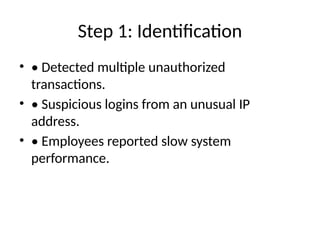
Step 1: Identification
•• Detected multiple unauthorized
transactions.
• • Suspicious logins from an unusual IP
address.
• • Employees reported slow system
performance.
4.
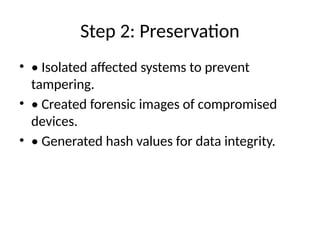
Step 2: Preservation
•• Isolated affected systems to prevent
tampering.
• • Created forensic images of compromised
devices.
• • Generated hash values for data integrity.
5.
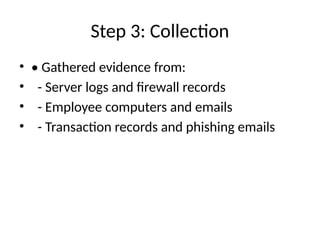
Step 3: Collection
•• Gathered evidence from:
• - Server logs and firewall records
• - Employee computers and emails
• - Transaction records and phishing emails
6.
Step 4: Examination
•• Network analysis traced suspicious IP
addresses.
• • Found a keylogger on an employee’s
machine.
• • Identified phishing email as attack entry
point.
7.
Step 5: Analysis
•• Attacker used stolen credentials via phishing.
• • Unauthorized transactions executed via VPN
tunneling.
• • Keylogger captured sensitive login details.
8.
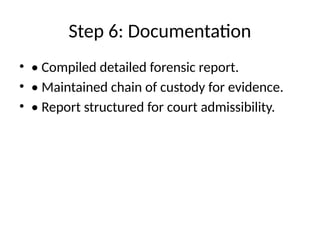
Step 6: Documentation
•• Compiled detailed forensic report.
• • Maintained chain of custody for evidence.
• • Report structured for court admissibility.
9.
Step 7: Presentation
•• Findings presented to bank executives.
• • Provided expert testimony in court.
• • Recommended stronger cybersecurity
measures.
10.
Outcome & Conclusion
•• Identified attacker as a former employee.
• • Law enforcement arrested the suspect.
• • Bank implemented stronger security
policies.
• • Digital forensics played a key role in solving
the case.