THREATS
DIGITAL
Trends & Predictions
2017
0
TOPICS
OF DISCUSSION
Security Predictions for
2017
Major Malware
Trends
1
1
2 4New breeds of
malware
Worst Cyberattacks of
20173
MAJOR MALWARE
2
TRENDS
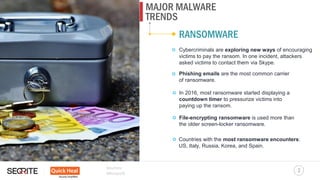
Cybercriminals are exploring new ways of encouraging
victims to pay the ransom. In one incident, attackers
asked victims to contact them via Skype.
RANSOMWARE
Phishing emails are the most common carrier
of ransomware.
In 2016, most ransomware started displaying a
countdown timer to pressurize victims into
paying up the ransom.
File-encrypting ransomware is used more than
the older screen-locker ransomware.
Countries with the most ransomware encounters:
US, Italy, Russia, Korea, and Spain.
Sources:
Microsoft
MAJOR MALWARE
3
TRENDS
Phishing attacks targeting social media users and SaaS
companies have tripled year-over-year.
PHISHING
Fake invoice messages are the top bait used
by cybercriminals in their phishing attacks.
Apple IDs are top target for phishing emails
designed for stealing credentials.
Phishing attacks on government tax authorities have
grown more than 300% since 2014.
91% of cyberattacks start with a phishing email.
Sources:
PHISHLABS | barkly.com | darkreading.com
MAJOR MALWARE
4
TRENDS
Fake apps developed by novice cybercriminals are being
used by seasoned attackers to spread malware.
ANDROID MALWARE
Criminals are launching Android malware in waves to test
new malware and ways to spread the infection.
In June 2016, 643,476 new malware programs
were found to be targeting Android users.
Android devices are attacked more frequently
because they make more money for criminals.
97% of malicious Android apps in 2016 were infected
with Trojans.
Sources:
AV-TEST
NEW BREEDS OF
5
MALWARE
Sources:
cloak-and-dagger.org | finextra.com
New types of Android malware are created to record whatever a
user does on their phone. Unlike older malware, these require a
few basic permissions which are anyway granted without a user’s
explicit permission.
Case in point: Cloak & Dagger attack where a malicious app can take
over the infected device using just two basic permissions – which
don’t need the user’s consent. Once installed, the malicious app can
record user keystrokes, unlock the phone when its screen is off, and
perform other malicious activities.
An unconventional banking malware was created that was
stealing huge sums of money from ATMs while hiding the
fraudulent transactions by automatically rolling back the
withdrawals so that the account balance remained unchanged.
This malware caused an unnamed bank in Russia to lose millions
of rubles in a single night.
WORST CYBERATTACKS OF
6
2017 (so far)
WANNACRY
Sources:
VERGE | WIRED |hindustantimes.com
Biggest Ransomware attack in history
Infected over 230,000 computers in more than 150 countries
Estimated loss: $4 billion
PETYA (NOTPETYA)
65 countries were affected
Used the same exploit that was used by WannaCry
Estimated loss:10 times more than WannaCry
FIREBALL
A browser-hijacker that infected 250 million computers worldwide
Was used to generate fraudulent clicks on ads to make money for the attacker
Can spy on the victim and steal their private information
HBO HACK
Hackers broke into HBO servers in late July and stole 1.5 terabytes of data
Leaked data included Game of Thrones stars’ phone numbers and addresses
Reportedly, hackers behind the hack released an email from HBO that shows the
company is wiling to pay $250,000
SECURITY PREDICTIONS
7
FOR 2017
Sources:
GARTNER
Ransomware creators will be going after backup before
encryption - doubling the chances of victims paying up the
ransom.
As digital payments gain popularity, banking Trojans (used to
obtain sensitive information about customers who use online
Banking and payment systems) will increase.
Deploying ransomware will become easier even for novice
criminals thanks to Ransomware-as-a-Service (a service where
malware authors sell ransomware for free or for a small fee).
There is an increased likelihood of massive attacks like
WannaCry & NotPetya Ransomware due to individual users
and businesses failing to keep their systems up-to-date.
THANK YOU
7Sources:
GARTNER

Digital Threat Landscape

  • 1.
  • 2.
    0 TOPICS OF DISCUSSION Security Predictionsfor 2017 Major Malware Trends 1 1 2 4New breeds of malware Worst Cyberattacks of 20173
  • 3.
    MAJOR MALWARE 2 TRENDS Cybercriminals areexploring new ways of encouraging victims to pay the ransom. In one incident, attackers asked victims to contact them via Skype. RANSOMWARE Phishing emails are the most common carrier of ransomware. In 2016, most ransomware started displaying a countdown timer to pressurize victims into paying up the ransom. File-encrypting ransomware is used more than the older screen-locker ransomware. Countries with the most ransomware encounters: US, Italy, Russia, Korea, and Spain. Sources: Microsoft
  • 4.
    MAJOR MALWARE 3 TRENDS Phishing attackstargeting social media users and SaaS companies have tripled year-over-year. PHISHING Fake invoice messages are the top bait used by cybercriminals in their phishing attacks. Apple IDs are top target for phishing emails designed for stealing credentials. Phishing attacks on government tax authorities have grown more than 300% since 2014. 91% of cyberattacks start with a phishing email. Sources: PHISHLABS | barkly.com | darkreading.com
  • 5.
    MAJOR MALWARE 4 TRENDS Fake appsdeveloped by novice cybercriminals are being used by seasoned attackers to spread malware. ANDROID MALWARE Criminals are launching Android malware in waves to test new malware and ways to spread the infection. In June 2016, 643,476 new malware programs were found to be targeting Android users. Android devices are attacked more frequently because they make more money for criminals. 97% of malicious Android apps in 2016 were infected with Trojans. Sources: AV-TEST
  • 6.
    NEW BREEDS OF 5 MALWARE Sources: cloak-and-dagger.org| finextra.com New types of Android malware are created to record whatever a user does on their phone. Unlike older malware, these require a few basic permissions which are anyway granted without a user’s explicit permission. Case in point: Cloak & Dagger attack where a malicious app can take over the infected device using just two basic permissions – which don’t need the user’s consent. Once installed, the malicious app can record user keystrokes, unlock the phone when its screen is off, and perform other malicious activities. An unconventional banking malware was created that was stealing huge sums of money from ATMs while hiding the fraudulent transactions by automatically rolling back the withdrawals so that the account balance remained unchanged. This malware caused an unnamed bank in Russia to lose millions of rubles in a single night.
  • 7.
    WORST CYBERATTACKS OF 6 2017(so far) WANNACRY Sources: VERGE | WIRED |hindustantimes.com Biggest Ransomware attack in history Infected over 230,000 computers in more than 150 countries Estimated loss: $4 billion PETYA (NOTPETYA) 65 countries were affected Used the same exploit that was used by WannaCry Estimated loss:10 times more than WannaCry FIREBALL A browser-hijacker that infected 250 million computers worldwide Was used to generate fraudulent clicks on ads to make money for the attacker Can spy on the victim and steal their private information HBO HACK Hackers broke into HBO servers in late July and stole 1.5 terabytes of data Leaked data included Game of Thrones stars’ phone numbers and addresses Reportedly, hackers behind the hack released an email from HBO that shows the company is wiling to pay $250,000
  • 8.
    SECURITY PREDICTIONS 7 FOR 2017 Sources: GARTNER Ransomwarecreators will be going after backup before encryption - doubling the chances of victims paying up the ransom. As digital payments gain popularity, banking Trojans (used to obtain sensitive information about customers who use online Banking and payment systems) will increase. Deploying ransomware will become easier even for novice criminals thanks to Ransomware-as-a-Service (a service where malware authors sell ransomware for free or for a small fee). There is an increased likelihood of massive attacks like WannaCry & NotPetya Ransomware due to individual users and businesses failing to keep their systems up-to-date.
  • 9.