DIGITAL MARKETING
UNIT 5
Digital Revenue Generation:
 A revenue model is a plan for earning revenue from a business or project. It explains
different mechanisms of revenue generation and its sources. Since selling software products is an
online business, a plan for making money from it is also called an eCommerce revenue model.
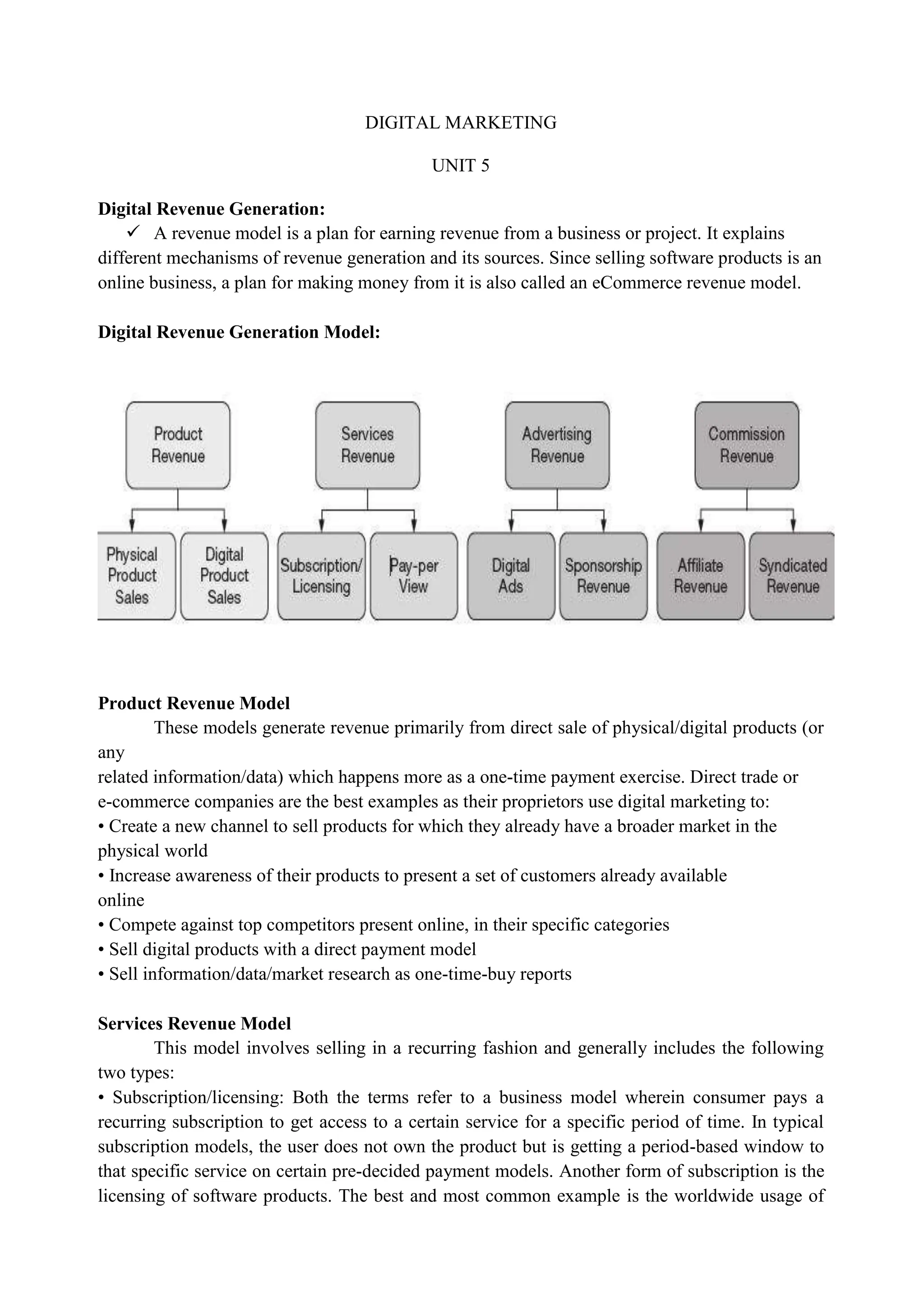
Digital Revenue Generation Model:
Product Revenue Model
These models generate revenue primarily from direct sale of physical/digital products (or
any
related information/data) which happens more as a one-time payment exercise. Direct trade or
e-commerce companies are the best examples as their proprietors use digital marketing to:
• Create a new channel to sell products for which they already have a broader market in the
physical world
• Increase awareness of their products to present a set of customers already available
online
• Compete against top competitors present online, in their specific categories
• Sell digital products with a direct payment model
• Sell information/data/market research as one-time-buy reports
Services Revenue Model
This model involves selling in a recurring fashion and generally includes the following
two types:
• Subscription/licensing: Both the terms refer to a business model wherein consumer pays a
recurring subscription to get access to a certain service for a specific period of time. In typical
subscription models, the user does not own the product but is getting a period-based window to
that specific service on certain pre-decided payment models. Another form of subscription is the
licensing of software products. The best and most common example is the worldwide usage of
Microsoft Office, whereby users have to pay for a periodbased license to access online
applications like Word, Excel, PowerPoint, etc.
• Pay-Per view: In this upcoming model on digital content revenue generation, certain
pages/chapters of a digitized book can be accessed for an à la carte price.
Advertising Revenue Model
One of the most commonly talked about and discussed online revenue models is that of
advertising (which includes most of the multiple digital advertising types we have already
covered in the preceding chapter) and the sponsorship revenue model (which has helped sustain a
large number of small and medium digital enterprises over the past twenty years). Although not
as big in terms of the revenue it generates for an enterprise moving online, it is still one of the
most dependable models for any firm to start earning initial revenue.
Commission-Based Revenue Mode
This type of model is typically adopted by companies which are affiliate networks and helps
provide leads to bigger online companies in lieu of specified pre-decided commissions. Another
revenue model, which is also close to this type, includes examples of companies which generate
revenue by syndicating content across multiple channels and gaining a cut of the revenues
(earned by other companies) from utilizing that content in various forms.
Customer Loyalty Management in the Digital Era
Managing customers and converting them into loyalists has been one of the most critical
objectives for any business to earn recurring revenues. “Loyalty Marketing is an approach in
which a company focuses on growing and retaining existing customers through incentives.
The three stages of loyalty evolution as below:
(a) Loyalty 1.0: It included programs that were purely transactional, completely focused on
customers, and were failures at generating the kind of loyalties that businesses really wanted.
The critical flaw with these programs was the long wait for any kind of loyalty program to turn
into fruition.
(b) Loyalty 2.0: In the 1990s the concept converted into a one-to-one marketing approach,
which focused on making the loyalty experience more targeted through segmentation and
personalization, emphasizing largely on direct mail and e-mail campaigns. The effectiveness of
this approach, however, diminished as open rates plummeted and consumers were overwhelmed
by the sheer amount of noise.
(c) Loyalty 3.0: According to the book, there are three key enabling components which have
helped the development of Loyalty 3.0:
• Motivation: It refers to understanding what compels and motivates human behavior to
create stronger engagement and true loyalty.
• Big data: It denotes gathering and consuming large amounts of data generated through
technology to understand, engage, and motivate consumers.
• Gamification: It involves utilizing gaming techniques for data-driven motivation, which
can be a powerful tool to drive engagement, participation, and high-value activity for
firm’s customers, employees, and partners.
Pillars of customer loyalty management in the digital era:
(a) Combining traditional loyalty with new programs
(b) Blending wider event streams
(c) Marketing-driven relationship management
(d) Test and learn (empowering creativity):
Relationship marketing Meaning:
Retaining customers using defensive strategies, for example, minimizing customer
turnover, maximizing customer retention.
Ladder of Customer Loyalty:
• Prospect: A prospect is one who pays attention to a firm’s promotion and might be
persuaded to buy its products.
• Purchaser: A purchaser is a person who has recently bought from the firm or executed any
business transaction.
• Client: A client is one who has done business more than once with the firm but his
disposition or engagement status with the firm is not necessarily positive.
• Supporter: A supporter is a client who has positive disposition towards the firm but might
not be actively engaged with the firm’s activities.
• Advocate: An advocate is a person who is deeply involved with an organization and also
influences others through positive word-of-mouth communication.
• Partner: A partner is a client who is working together with the firm for mutual benefit and
has a stake in its growth.
Emerging Digital Payment Solution:
Electronic Payment Systems
An electronic payment system, by definition, is a mode of payment that facilitates
acceptance of electronic payment primarily for commercial transactions over the internet. Any
electronic payment system must involve three key types of stakeholders—the payer (consumer),
the payee (business or merchant), a financial network (with which both payer and payee have
accounts).
(a) Credit card payment: Credit card transactions take place over large electronic
networks, typically linking cardholders, merchants, card-issuing banks, merchant banks, and
credit card companies.
(b) E-cash: Credit card transaction fees, typically, make small purchases unprofitable.
Electronic cash, which is cash converted into electronic form, improves upon paper cash since
the security and privacy features offer more efficient means of cash payments. E-cash, typically,
have not been that popular for reasons of lack of standards and interoperable software.
(c) E-checks: An e-check is an electronic version of the paper check and is a payment
instrument which was developed by a collaboration of several banks, government entities,
technology companies, and e-commerce organizations to provide highly secure, speedy, and
convenient online transactions.
(d) Smart cards: These are plastic cards containing an embedded microchip that contain
important financial and personal information which can be periodically recharged and helped
with very small transactions.
(e) ECS (Electronic Clearing Service) Credit: Known as ‘Credit-push’ facility or one-
to-many facility, this method is used for large-value payments where the receiver’s account is
credited with payment from the institution making the payment.
(f) ECS (Electronic Clearing Service) Debit: Known as many-to-one or ‘debit-pull’
facility, this method is used mainly for small value payments from consumers/individuals to big
organizations or companies.
(g) RTGS (Real Time Gross Settlement): It is a funds transfer mechanism where
transfer of money takes place from one bank to another on a ‘real time’ and on ‘gross’ basis.
(h) NEFT (National Electronic Fund Transfer): A nation-wide system that facilitates
individuals and firms to electronically transfer funds from a bank branch to any individual or
corporate having an account with any other bank branch in the country.
(i) IMPS (Immediate Payment System): It is a service through which money can be
transferred immediately from one account to another, within the same bank or accounts across
other banks.
Emerging Digital Payments Solutions
Mobile Payments Solutions
(a) SMS payments: These are text-based payments which have gained currency as one of the
most popular methods of making payments through mobile phones.
(b) NFC payments: Near Field Communication (NFC) payments are executed through mobile
phones that communicate with each other and with other NFC-enabled points of sale, utilizing
radio frequency identification.
(c) WAP payments: It involves use of Wireless Application Protocol (WAP) facility to make
payments through web pages displayed or additional applications downloaded and installed on
the mobile phone. WAP payments can be executed through online payment methods such as
PayPal, Google Wallet, or Yahoo Wallet, or through credit card details into the payment box of a
company’s WAP-enabled website.
Digital P2P Payments
(a) Personal to personal: It involves technologies which utilize an intermediate for customers to
transfer funds from their back accounts/credit cards to another individual’s account through
internet or a mobile transaction.
(b) Peer to peer: This refers to transactions where users can transact directly without needing an
intermediary. One of the most popular use of peer-to-peer technologies has been the introduction
of the Bitcoin payment system which was invented by Santoshi Nakamoto in 2008.
Social Media Payments
• Digital kiosks: Companies are setting up service kiosks which are fixed stations with phone
connections, where the customer can make payments using a digital screen and keyboard to
make transactions.
• TV set-top boxes: The future of media involves payments not only though mobile but also
across the IOT (Internet of things) ecosystem where smart internet-enabled TVs are the best
example.
• Biometric payments: These are fingerprint-based payments which have just started getting
traction and could become a very secure form of payment transactions in future.
E-commerce Implementation Challenges:
(i) External elements include:
(a) Product and market strategy: It includes impact of emerging customer segments and their
product portfolios, their go-to-market strategy, market intelligence, and customer engagement
platforms
(b) Customer/digital experience: It includes aspects related to customer experience on multiple
channels and the impact of their brand interaction and experiences.
(c) Payments and transactions: It involves elements like security and privacy breach and
fraudulent transactions.
(d) Fulfillment: It includes logistics and supply chain management costs.
(ii) Internal elements consist of:
(a) Organization scaling: This refers to the evolution and integration of multiple functions of
the firm for ensuing operations.
(b) Tax and regulatory structuring: It includes issues of tax planning, payment of sales tax,
business license tax, franchisee fees, etc., along with management of regulatory uncertainties.
(c) Risk, fraud, and cyber security: It denotes management issues like internet fraud,
protection of buyer’s interests, ethical concerns like privacy and web tracking, etc.
(d) Compliance framework: This refers to ensuring legal issues like cyber laws, domain names,
copyrights, etc.
(iii) Consumer Specific - Security, Privacy, Ethical, and Social Challenges:
It includes challenges related to and impacting the final consumer and his/her interaction
with the firm while undertaking transactions. Typical challenges included in this category are:
• Security, cybercrime, digital signature issues
• Privacy, data usage, and web tracking (client-server, data, document)
• Trust-related issues
• Ethical issues
• Societal and digital divide issues
Digital Marketing—Emerging Trends and Concepts
(a) Content marketing
(b) Mobile marketing
(c) Social media marketing
(d) Programmatic buying and real-time bidding (RTB)
(e) Responsive design and visual storytelling
(f) Marketing automation
(g) Personalization and micro targeting
(h) Localization and translation
(i) Multi-channel marketing
(j) Big Data and Internet of Things (IOT)
B2B and SMB—Segments-Based Digital Marketing
(a) Content marketing and marketing automation (66 percent) are the top areas where B2B
organizations will increase spending, followed closely by mobile applications and location-
based tracking (65 percent) and social media advertising/marketing (64 percent).
(b) While CRM (57 percent) is the most important tool for a seamless customer journey, the
report shared that marketing analytics (54 percent) and mobile applications (53 percent) are also
playing important roles in providing a robust buying experience.
(c) 70 percent respondents stated that marketing automation was either an effective or very
effective tool for digital marketing strategies. However, only 26 percent respondents had a
marketing automation tool implemented in their business, 31 percent are either piloting a
solution or planning to implement a marketing automation solution.
SoLoMo—the Next level of Hyperlocal Marketing
Hyperlocal marketing, by definition, involves targeting a highly specified local region based
upon its cultural nuances and the key concerns of its population. With advancements in
technology, it has become easier for marketers to keep defining narrower customer segments
based on micro-regions and develop strategies and tactics to target them.
Three concepts of SoLoMo Marketing:
• Social: With consumers trusting their social circles and through their networks gathering
advice about a range of issues, beginning from the cat food they should buy to the next apartment
they should invest in, social technology has become crucial for most purchase decisions across
the world.
• Local: With localization being the key differentiator for SoLoMo concept, the rise of location-
based services offers convenience to an individual to get the best offers for a particular product
or brand with in a nearby location; this is the ultimate experience a consumer looks for.
• Mobile: With 82 percent smartphone owners commenting that they always have their phones
with them when they are in-store (according to Vibes Mobile Consumer Report), one can
conclude that consumers use a mix of online–offline data to decide on most purchases, even
while being within a store.

Digital Marketing Revenue Generation Model

  • 1.
    DIGITAL MARKETING UNIT 5 DigitalRevenue Generation:  A revenue model is a plan for earning revenue from a business or project. It explains different mechanisms of revenue generation and its sources. Since selling software products is an online business, a plan for making money from it is also called an eCommerce revenue model. Digital Revenue Generation Model: Product Revenue Model These models generate revenue primarily from direct sale of physical/digital products (or any related information/data) which happens more as a one-time payment exercise. Direct trade or e-commerce companies are the best examples as their proprietors use digital marketing to: • Create a new channel to sell products for which they already have a broader market in the physical world • Increase awareness of their products to present a set of customers already available online • Compete against top competitors present online, in their specific categories • Sell digital products with a direct payment model • Sell information/data/market research as one-time-buy reports Services Revenue Model This model involves selling in a recurring fashion and generally includes the following two types: • Subscription/licensing: Both the terms refer to a business model wherein consumer pays a recurring subscription to get access to a certain service for a specific period of time. In typical subscription models, the user does not own the product but is getting a period-based window to that specific service on certain pre-decided payment models. Another form of subscription is the licensing of software products. The best and most common example is the worldwide usage of
  • 2.
    Microsoft Office, wherebyusers have to pay for a periodbased license to access online applications like Word, Excel, PowerPoint, etc. • Pay-Per view: In this upcoming model on digital content revenue generation, certain pages/chapters of a digitized book can be accessed for an à la carte price. Advertising Revenue Model One of the most commonly talked about and discussed online revenue models is that of advertising (which includes most of the multiple digital advertising types we have already covered in the preceding chapter) and the sponsorship revenue model (which has helped sustain a large number of small and medium digital enterprises over the past twenty years). Although not as big in terms of the revenue it generates for an enterprise moving online, it is still one of the most dependable models for any firm to start earning initial revenue. Commission-Based Revenue Mode This type of model is typically adopted by companies which are affiliate networks and helps provide leads to bigger online companies in lieu of specified pre-decided commissions. Another revenue model, which is also close to this type, includes examples of companies which generate revenue by syndicating content across multiple channels and gaining a cut of the revenues (earned by other companies) from utilizing that content in various forms. Customer Loyalty Management in the Digital Era Managing customers and converting them into loyalists has been one of the most critical objectives for any business to earn recurring revenues. “Loyalty Marketing is an approach in which a company focuses on growing and retaining existing customers through incentives. The three stages of loyalty evolution as below: (a) Loyalty 1.0: It included programs that were purely transactional, completely focused on customers, and were failures at generating the kind of loyalties that businesses really wanted. The critical flaw with these programs was the long wait for any kind of loyalty program to turn into fruition. (b) Loyalty 2.0: In the 1990s the concept converted into a one-to-one marketing approach, which focused on making the loyalty experience more targeted through segmentation and personalization, emphasizing largely on direct mail and e-mail campaigns. The effectiveness of this approach, however, diminished as open rates plummeted and consumers were overwhelmed by the sheer amount of noise. (c) Loyalty 3.0: According to the book, there are three key enabling components which have helped the development of Loyalty 3.0: • Motivation: It refers to understanding what compels and motivates human behavior to create stronger engagement and true loyalty. • Big data: It denotes gathering and consuming large amounts of data generated through technology to understand, engage, and motivate consumers. • Gamification: It involves utilizing gaming techniques for data-driven motivation, which can be a powerful tool to drive engagement, participation, and high-value activity for
  • 3.
    firm’s customers, employees,and partners. Pillars of customer loyalty management in the digital era: (a) Combining traditional loyalty with new programs (b) Blending wider event streams (c) Marketing-driven relationship management (d) Test and learn (empowering creativity): Relationship marketing Meaning: Retaining customers using defensive strategies, for example, minimizing customer turnover, maximizing customer retention. Ladder of Customer Loyalty: • Prospect: A prospect is one who pays attention to a firm’s promotion and might be persuaded to buy its products. • Purchaser: A purchaser is a person who has recently bought from the firm or executed any business transaction. • Client: A client is one who has done business more than once with the firm but his disposition or engagement status with the firm is not necessarily positive. • Supporter: A supporter is a client who has positive disposition towards the firm but might not be actively engaged with the firm’s activities. • Advocate: An advocate is a person who is deeply involved with an organization and also influences others through positive word-of-mouth communication. • Partner: A partner is a client who is working together with the firm for mutual benefit and has a stake in its growth.
  • 4.
    Emerging Digital PaymentSolution: Electronic Payment Systems An electronic payment system, by definition, is a mode of payment that facilitates acceptance of electronic payment primarily for commercial transactions over the internet. Any electronic payment system must involve three key types of stakeholders—the payer (consumer), the payee (business or merchant), a financial network (with which both payer and payee have accounts). (a) Credit card payment: Credit card transactions take place over large electronic networks, typically linking cardholders, merchants, card-issuing banks, merchant banks, and credit card companies. (b) E-cash: Credit card transaction fees, typically, make small purchases unprofitable. Electronic cash, which is cash converted into electronic form, improves upon paper cash since the security and privacy features offer more efficient means of cash payments. E-cash, typically, have not been that popular for reasons of lack of standards and interoperable software. (c) E-checks: An e-check is an electronic version of the paper check and is a payment instrument which was developed by a collaboration of several banks, government entities, technology companies, and e-commerce organizations to provide highly secure, speedy, and convenient online transactions. (d) Smart cards: These are plastic cards containing an embedded microchip that contain important financial and personal information which can be periodically recharged and helped with very small transactions. (e) ECS (Electronic Clearing Service) Credit: Known as ‘Credit-push’ facility or one- to-many facility, this method is used for large-value payments where the receiver’s account is credited with payment from the institution making the payment. (f) ECS (Electronic Clearing Service) Debit: Known as many-to-one or ‘debit-pull’ facility, this method is used mainly for small value payments from consumers/individuals to big organizations or companies. (g) RTGS (Real Time Gross Settlement): It is a funds transfer mechanism where transfer of money takes place from one bank to another on a ‘real time’ and on ‘gross’ basis. (h) NEFT (National Electronic Fund Transfer): A nation-wide system that facilitates individuals and firms to electronically transfer funds from a bank branch to any individual or corporate having an account with any other bank branch in the country. (i) IMPS (Immediate Payment System): It is a service through which money can be transferred immediately from one account to another, within the same bank or accounts across other banks.
  • 5.
    Emerging Digital PaymentsSolutions Mobile Payments Solutions (a) SMS payments: These are text-based payments which have gained currency as one of the most popular methods of making payments through mobile phones. (b) NFC payments: Near Field Communication (NFC) payments are executed through mobile phones that communicate with each other and with other NFC-enabled points of sale, utilizing radio frequency identification. (c) WAP payments: It involves use of Wireless Application Protocol (WAP) facility to make payments through web pages displayed or additional applications downloaded and installed on the mobile phone. WAP payments can be executed through online payment methods such as PayPal, Google Wallet, or Yahoo Wallet, or through credit card details into the payment box of a company’s WAP-enabled website. Digital P2P Payments (a) Personal to personal: It involves technologies which utilize an intermediate for customers to transfer funds from their back accounts/credit cards to another individual’s account through internet or a mobile transaction. (b) Peer to peer: This refers to transactions where users can transact directly without needing an intermediary. One of the most popular use of peer-to-peer technologies has been the introduction of the Bitcoin payment system which was invented by Santoshi Nakamoto in 2008. Social Media Payments • Digital kiosks: Companies are setting up service kiosks which are fixed stations with phone connections, where the customer can make payments using a digital screen and keyboard to make transactions. • TV set-top boxes: The future of media involves payments not only though mobile but also across the IOT (Internet of things) ecosystem where smart internet-enabled TVs are the best example. • Biometric payments: These are fingerprint-based payments which have just started getting traction and could become a very secure form of payment transactions in future. E-commerce Implementation Challenges: (i) External elements include: (a) Product and market strategy: It includes impact of emerging customer segments and their product portfolios, their go-to-market strategy, market intelligence, and customer engagement platforms (b) Customer/digital experience: It includes aspects related to customer experience on multiple channels and the impact of their brand interaction and experiences. (c) Payments and transactions: It involves elements like security and privacy breach and fraudulent transactions.
  • 6.
    (d) Fulfillment: Itincludes logistics and supply chain management costs. (ii) Internal elements consist of: (a) Organization scaling: This refers to the evolution and integration of multiple functions of the firm for ensuing operations. (b) Tax and regulatory structuring: It includes issues of tax planning, payment of sales tax, business license tax, franchisee fees, etc., along with management of regulatory uncertainties. (c) Risk, fraud, and cyber security: It denotes management issues like internet fraud, protection of buyer’s interests, ethical concerns like privacy and web tracking, etc. (d) Compliance framework: This refers to ensuring legal issues like cyber laws, domain names, copyrights, etc. (iii) Consumer Specific - Security, Privacy, Ethical, and Social Challenges: It includes challenges related to and impacting the final consumer and his/her interaction with the firm while undertaking transactions. Typical challenges included in this category are: • Security, cybercrime, digital signature issues • Privacy, data usage, and web tracking (client-server, data, document) • Trust-related issues • Ethical issues • Societal and digital divide issues Digital Marketing—Emerging Trends and Concepts (a) Content marketing (b) Mobile marketing (c) Social media marketing (d) Programmatic buying and real-time bidding (RTB) (e) Responsive design and visual storytelling (f) Marketing automation (g) Personalization and micro targeting (h) Localization and translation (i) Multi-channel marketing (j) Big Data and Internet of Things (IOT) B2B and SMB—Segments-Based Digital Marketing (a) Content marketing and marketing automation (66 percent) are the top areas where B2B organizations will increase spending, followed closely by mobile applications and location- based tracking (65 percent) and social media advertising/marketing (64 percent). (b) While CRM (57 percent) is the most important tool for a seamless customer journey, the report shared that marketing analytics (54 percent) and mobile applications (53 percent) are also playing important roles in providing a robust buying experience. (c) 70 percent respondents stated that marketing automation was either an effective or very effective tool for digital marketing strategies. However, only 26 percent respondents had a
  • 7.
    marketing automation toolimplemented in their business, 31 percent are either piloting a solution or planning to implement a marketing automation solution. SoLoMo—the Next level of Hyperlocal Marketing Hyperlocal marketing, by definition, involves targeting a highly specified local region based upon its cultural nuances and the key concerns of its population. With advancements in technology, it has become easier for marketers to keep defining narrower customer segments based on micro-regions and develop strategies and tactics to target them. Three concepts of SoLoMo Marketing: • Social: With consumers trusting their social circles and through their networks gathering advice about a range of issues, beginning from the cat food they should buy to the next apartment they should invest in, social technology has become crucial for most purchase decisions across the world. • Local: With localization being the key differentiator for SoLoMo concept, the rise of location- based services offers convenience to an individual to get the best offers for a particular product or brand with in a nearby location; this is the ultimate experience a consumer looks for. • Mobile: With 82 percent smartphone owners commenting that they always have their phones with them when they are in-store (according to Vibes Mobile Consumer Report), one can conclude that consumers use a mix of online–offline data to decide on most purchases, even while being within a store.