Διαπανεπιςτθμιακό πρόγραμμα μεταπτυχιακϊν ςπουδϊν
                   Μουςειολογία

          Εργαςτθριακό ςεμινάριο:

  ‘Ερμθνευτικι μεκοδολογία για
   παραδοςιακζσ, ψθφιακζσ και
      κινθτζσ πλατφόρμεσ’

              7 & 8 Λανουαρίου
          4 & 5 Φεβρουαρίου 2012
Μουςεία και δθμιουργία νοιματοσ
«The work of interpretation…is to give cognitive
hooks to the hookless, and assure that these hooks
are sufficiently varied so that they can successfully
land in the mental fabric of a broad array of visitors.
Once visitors have a framework, all kinds of sensory
impressions, emotions and reflections can weave
themselves into the fabric of perception. In fact, the
more you know about a subject, the more you can
learn about it (presuming the mental model you are
working with accommodates the new
information).» Peter Samis, SFMOMA
Ενότθτα 1:
       Μουςεία και δθμιουργία νοιματοσ
• Μουςεία και δθμιουργία νοιματοσ.
• Μουςεία ωσ φορείσ άτυπθσ μάκθςθσ.
• Mάκθςθ και ερμθνεία.
• Σχεδιαςμόσ ερμθνευτικισ ςτρατθγικισ και οργάνωςθ
  περιεχομζνου ςε ερμθνευτικζσ ενότθτεσ.
Πρακτικές ασκήσεις:
• Σχεδιαςμόσ μιασ ερμθνευτικισ ςτρατθγικισ για μια
  ζκκεςθ ι ςυλλογι.
• Ερμθνεία εκκεμάτων μζςα ςτθν ζκκεςθ. Συγγραφι
  λεηάντασ για ζνα ζκκεμα.
Ενότθτα 2:
    Ερμθνευτικζσ προςεγγίςεισ για διαφορετικζσ
               μακθςιακζσ ανάγκεσ
• Χρθςιμοποιϊντασ τθ ‘ςυναιςκθςία’ ωσ δθμιουργικό
  άξονα για μια εναλλακτικι ερμθνευτικι μεκοδολογία
  (μουςικι, ποίθςθ, κζατρο, χορόσ κλπ).
• Ερμθνεφοντασ μουςειακά εκκζματα για διαφορετικζσ
  θλικίεσ, μακθςιακζσ κατθγορίεσ και ανάγκεσ
• Ερμθνεφοντασ για άτομα με ειδικά χαρακτθριςτικά
  (ΑΜΕΧ).
Πρακτικές ασκήσεις:
• Σχεδιαςμόσ μιασ εναλλακτικισ ερμθνευτικισ
  προςζγγιςθσ.
• Ερμθνεία για άτομα με περιοριςμζνθ ι κακόλου
  όραςθ. Εργαςτιρι τεχνικισ ‘Ρεριγραφι ζργων’.
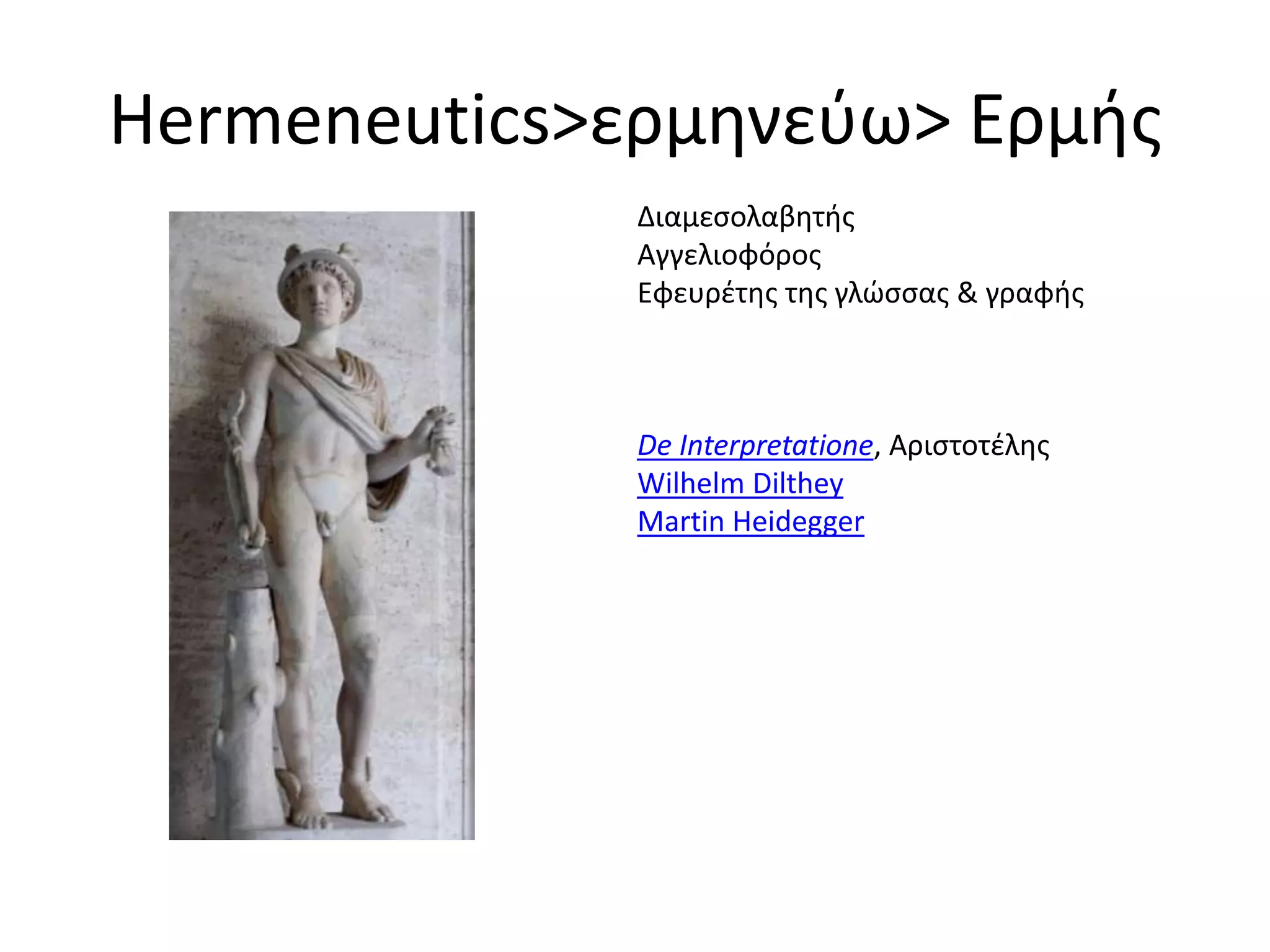
Hermeneutics>ερμθνεφω> Ερμισ
              Διαμεςολαβθτισ
              Αγγελιοφόροσ
              Εφευρζτθσ τθσ γλϊςςασ & γραφισ


              De Interpretatione, Αριςτοτζλθσ
              Wilhelm Dilthey
              Martin Heidegger
Ερωτιματα
• Τα μουςεία ςτεγάηουν αντικείμενα ι ιδζεσ?
• Τα μουςειακά αντικείμενα ζχουν νόθμα sui
  generis?
• Τί είναι αυκεντικό και τί όχι?
• Ρόςο ‘άτυπθϋ είναι θ μουςειακι μάκθςθ?
Σχεδιάηοντασ ζνα ερμθνευτικό
              πρόγραμμα

• Ροιό είναι το κοινό ςου? Τί περιμζνουν/ζχουν
  ςυνθκίςει?
• Τι ζχεισ ςτθ διάκεςι ςου από υποδομζσ,
  δυναμικό, τεχνολογία, εγκαταςτάςεισ,
  προυπολογιςμό, περιεχόμενο, επιμελθτζσ?
• Ρϊσ ςυνδζονται μεταξφ τουσ οι διάφορεσ
  ερμθνευτικζσ ςου λφςεισ? (Ρ΢ΛΝ-ΚΑΤΑ-ΜΕΤΑ-
  ΧΩ΢ΛΣ ΕΡΛΣΚΕΨΘ)
Τι κεωρείται ‘ερμθνευτικό’ εργαλείο?
•   Το κτιριο?
•   Οι διαδρομζσ ςτο χϊρο του μουςείου?
•   Θ εκκεςιακι διιγθςθ?
•   Οι γραπτζσ πλθροφορίεσ ςτο χϊρο?
•   Ξεναγιςεισ, διαλζξεισ, ομιλίεσ?
•   Εμπειρίεσ με κινθτά ερμθνευτικά ςυςτιματα?
•   Ο ιςτότοποσ?
•   Οι φφλακεσ/προςωπικό του μουςείου?
•   Το εκκεςιακό πρόγραμμα?
•   Το εκπαιδευτικό πρόγραμμα?
Eρμθνευτικά εργαλεία

• Χωροταξικά (διαδρομι, προκικεσ, φωτιςμόσ)
• Κεματικά (εκκεςιακι διιγθςθ, εκκεςιακό
  πρόγραμμα, επιμζλεια)
• Πλθροφοριακά (λεηάντεσ, πάνελσ, κινθτά
  ερμθνευτικά ςυςτιματα, φυλλάδια,
  κατάλογοσ, ψθφιακά κείμενα)
• Εμπειρίεσ (εναλλακτικζσ ερμθνευτικζσ
  προςεγγίςεισ, πολυμεςικά εργαλεία, multi-
  sensory, ξεναγιςεισ)
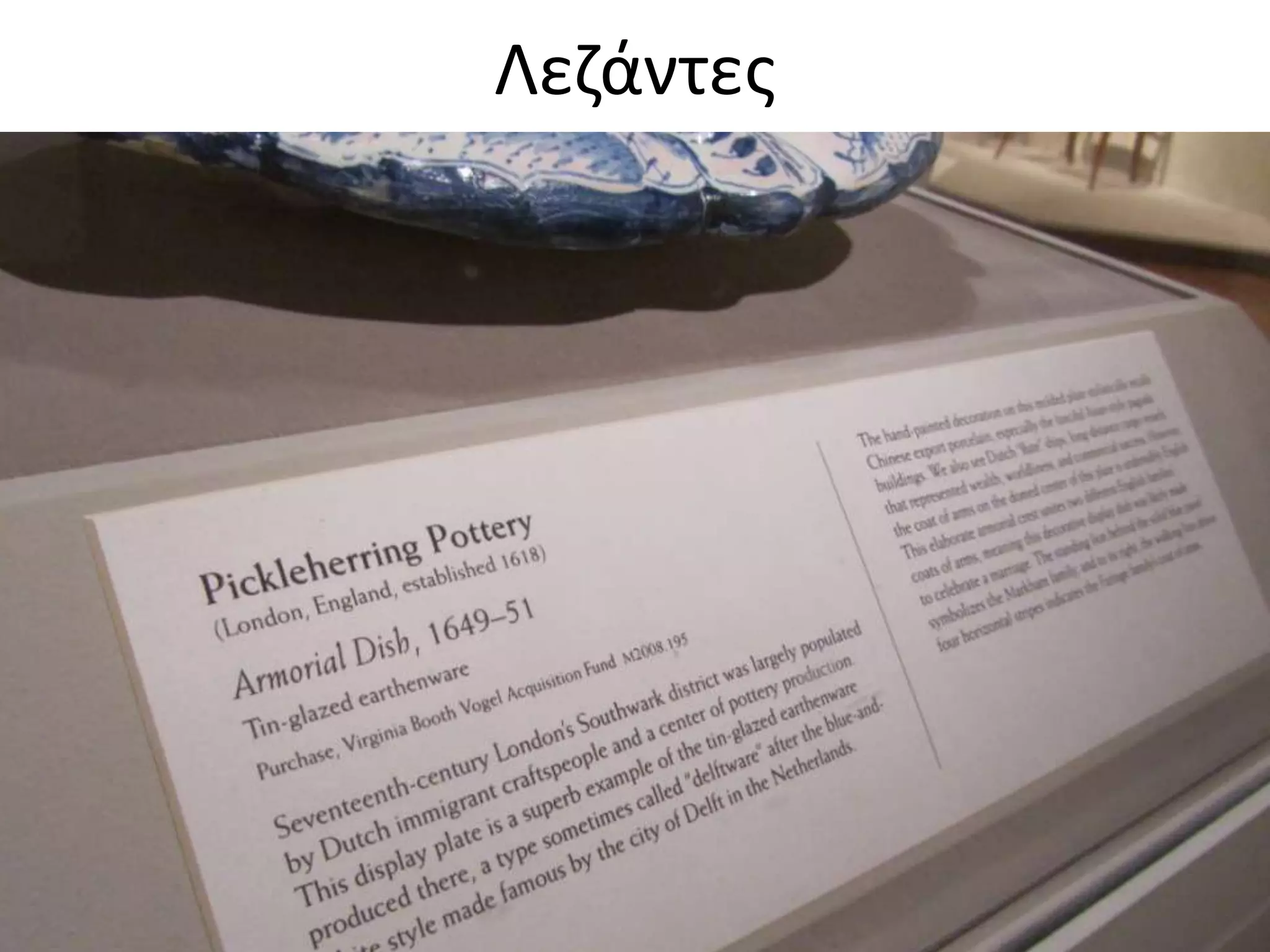
Λεηάντεσ
Γράφοντασ καλζσ
             ερμθνευτικζσ λεηάντεσ
•   Γράφε απλά
•   Χρωμάτιςε το λόγο με αναλογίεσ & παραδείγματα
•   Πχι τεχνικοφσ, δυςνόθτουσ όρουσ
•   Μια ιδζα ανά πρόταςθ
•   Χρθςιμοποίθςε ερωτιςεισ
•   Γράφε για το κοινό ςου
•   Ηωντανζσ λζξεισ
•   Κάνε τον κεατι να κοιτάξει καλφτερα το ζργο
•   Κάνε πολλοφσ ελζγχουσ
•   Πχι παραπάνω από 75 λζξεισ
•   Font size > 16
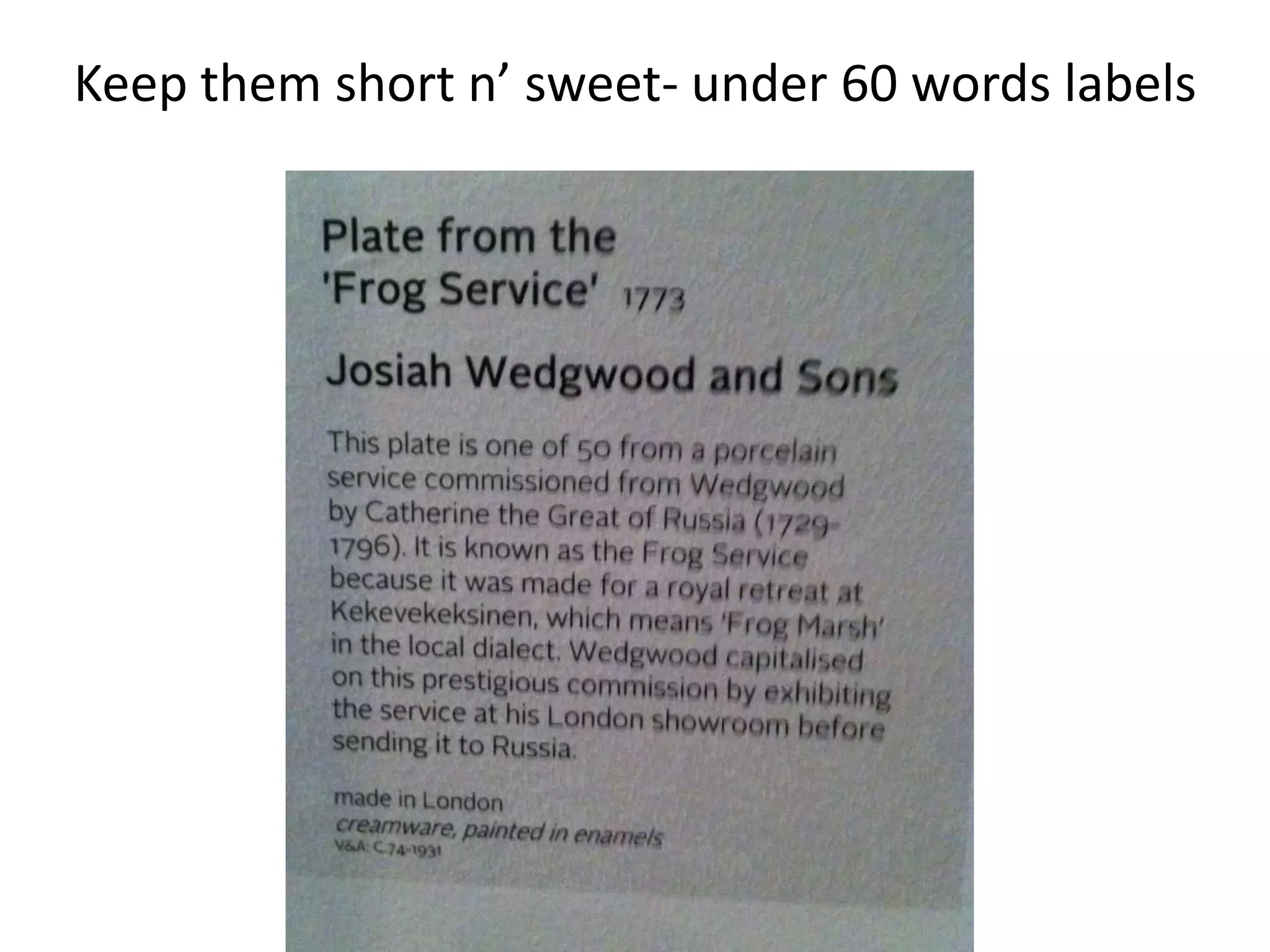
Keep them short n’ sweet- under 60 words labels
Τεχνικζσ για καλφτερεσ λεηάντεσ
• Πχι μόνο ‘πλθροφορίεσ ταφόπλακασ’
• Θ τζχνθ τθσ μυκοπλαςίασ (storytelling,
  narratives)
• Κλιςθ ςε δράςθ (Call to action)
• Συμμετοχικι εμπειρία
• Δυνατότθτα επιςθμείωςθσ/μεταφοράσ
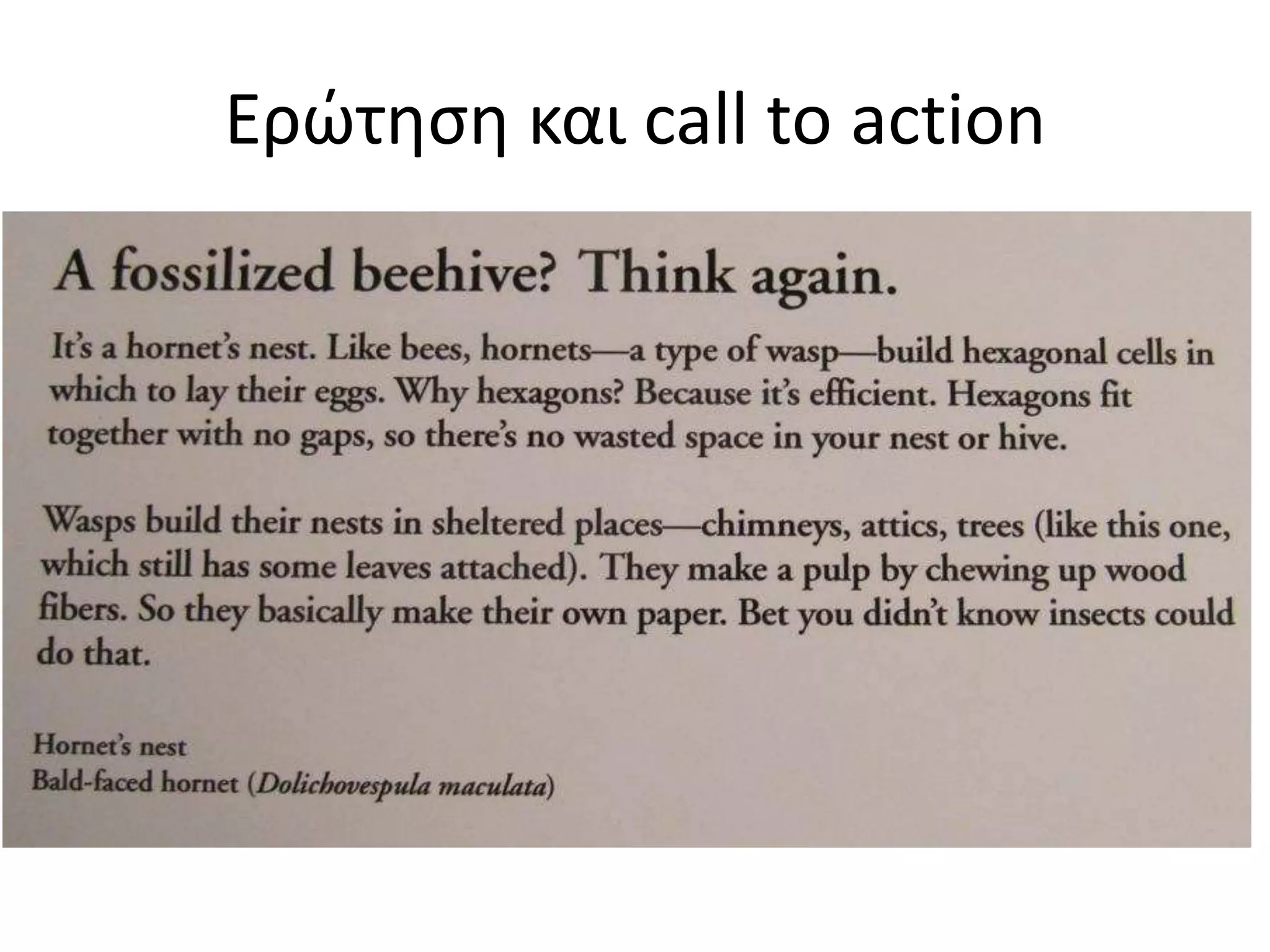
Ερϊτθςθ και call to action
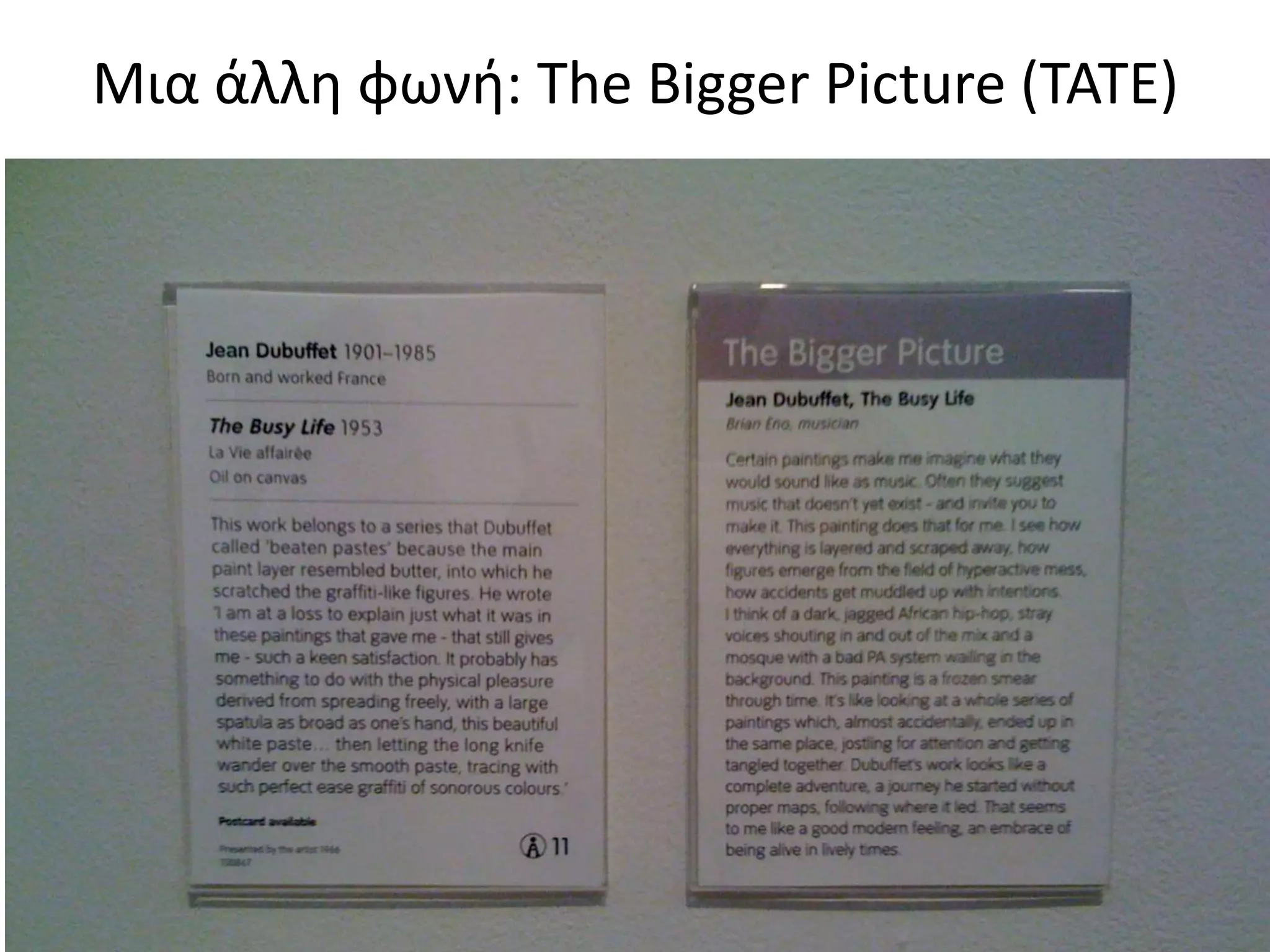
Μια άλλθ φωνι: The Bigger Picture (TATE)
Ραράδειγμα λεηάντασ από το ΜΟΜΑ
The Starry Night, Vincent van Gogh (Dutch, 1853-1890)
"This morning I saw the country from my
window a long time before sunrise," the artist
wrote to his brother Theo, "with nothing but the
morning star, which looked very big." Rooted in
imagination and memory, The Starry Night
embodies an inner, subjective expression of van
Gogh's response to nature. In thick sweeping
brushstrokes, a flamelike cypress unites the
churning sky and the quiet village below. The
village was partly invented, and the church spire
evokes van Gogh's native land, the Netherlands.
Άςκθςθ
Ξαναγράψε (αν χρειάηεται κατά τθ γνϊμθ ςου)
τθ λεηάντα
Eναλλακτικζσ ερμθνευτικζσ μζκοδοι
•   Ιχοσ
•   Μουςικι
•   Κζατρο
•   Performance
•   Ραντομίμα
•   Μόδα
•   Ραιχνίδι
•   Εικόνα
•   Βίντεο
Ερμθνεία με soundscapes
http://www.nationalgallery.org.uk/visiting/soun
ds-of-the-gallery/*/viewPage/4
Χρθςιμοποιϊντασ εναλλακτικζσ
    ερμθνευτικζσ μεκόδουσ για μια
   ολιςτικι ερμθνευτικι προςζγγιςθ
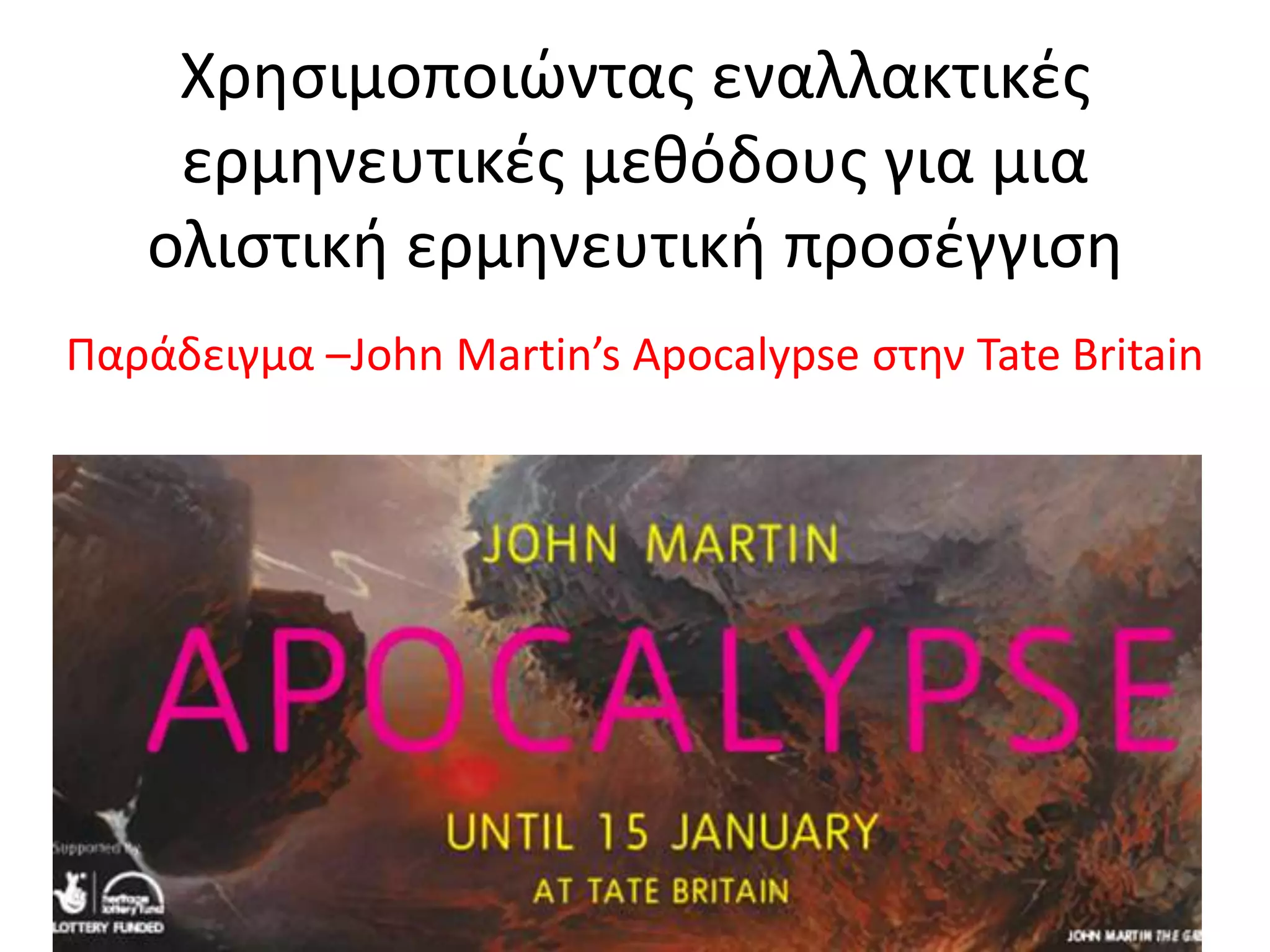
Ραράδειγμα –John Martin’s Apocalypse ςτθν Tate Britain
John Martin’s Apocalypse Interpretative plan
• Κατάλογοσ
• Φυλλάδιο
• Λεηάντεσ
• Επιτοίχια κείμενα
• Δραματουργθμζνθ ψθφιακι παρουςίαςθ μζςα ςτθν ζκκεςθ
• Ρολυμεςικόσ οδθγόσ + κείμενά του ςτο microsite
• Συνοδευτικό εκπαιδευτικό πρόγραμμα και Late@Tate
  πρόγραμμα
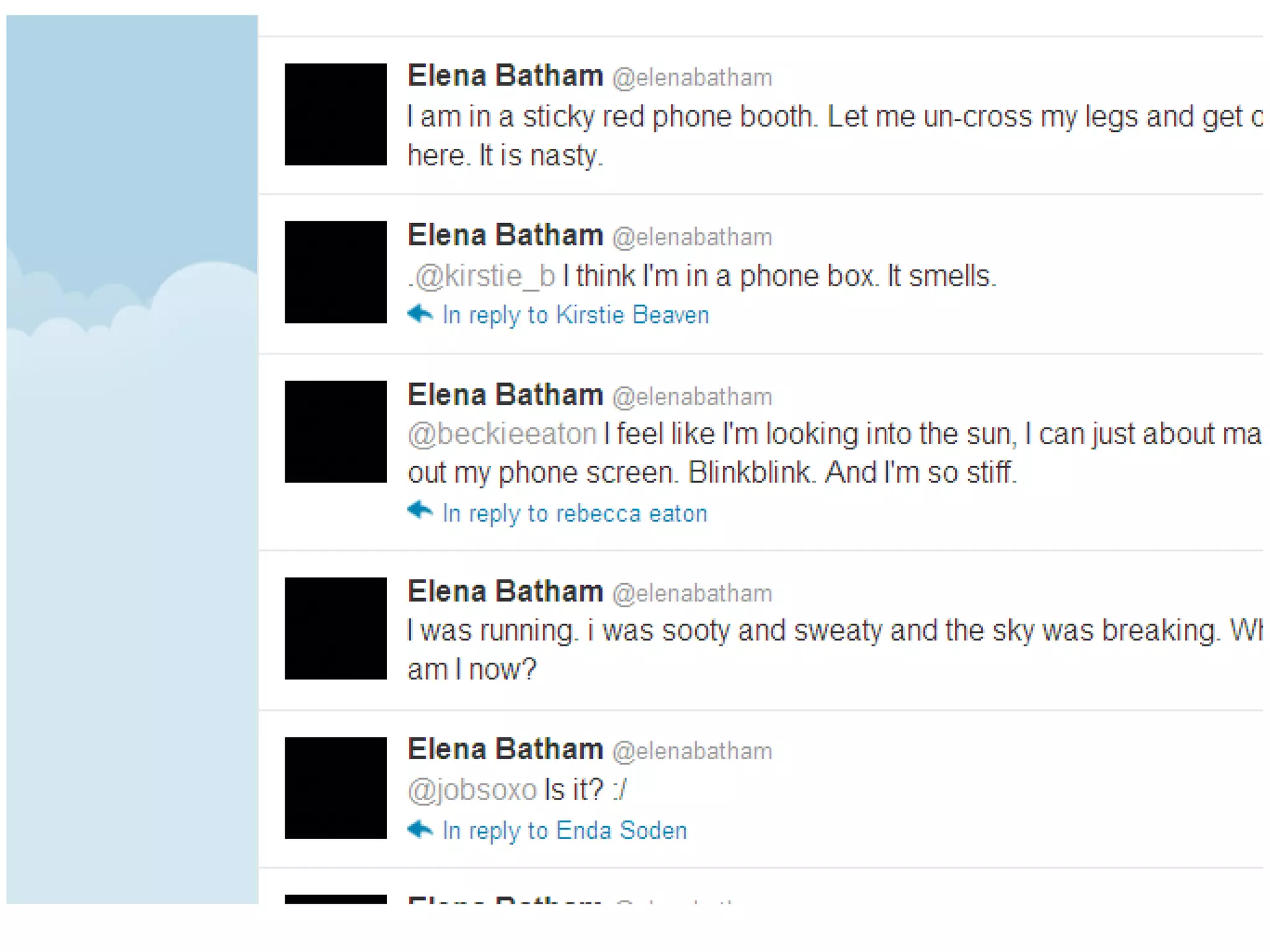
• Twitter- διαδραςτικό μυκοπλαςτικό κοινωνικό παιχνίδι
• Curator’s Blog- αρκράκια για τθν ζκκεςθ
• The Great British Art Debate Blog- αναφορζσ με link από το
  microsite τθσ ζκκεςθσ
Ερμθνεφοντασ για παιδιά
http://www.nga.gov/fcgi-
bin/tinfo_f?object=41581
Further webliography
http://www.museumsassociation.org/museum-
practice/exhibition-labels/17102011-riverside-
storytelling

http://mgnsw.blogspot.com/2011/11/engaging-
audiences-through-perths-chogm.html

http://australianmuseum.net.au/Writing-Text-
and-Labels
Ερμθνεφοντασ για άτομα με
         περιοριςμζνθ όραςθ
• http://www2.tate.org.uk/imap/imap2/pages/
  animated/leger.html
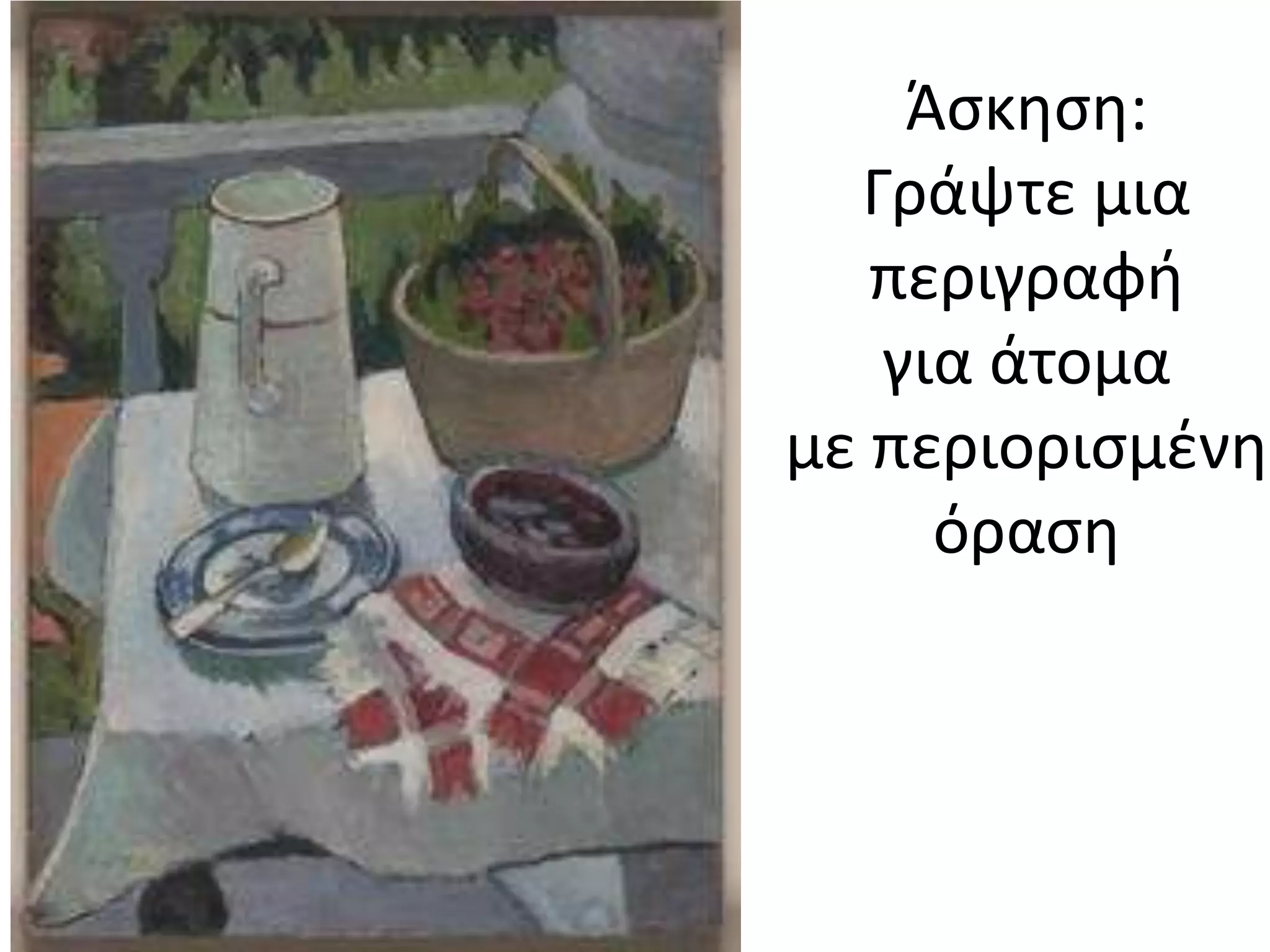
Άςκθςθ:
  Γράψτε μια
   περιγραφι
   για άτομα
με περιοριςμζνθ
     όραςθ
Ποπόβα Λιουμπόβ, "Νεκρι φφςθ"
(ηωγραφικό ζργο, 53 x 70,5 εκατοςτά)
Στο ζργο απεικονίηεται νεκρι φφςθ με κανάτα
(γαλατιζρα), πιάτο και κουτάλι, καλάκι με
φροφτα, μπολ με μαρμελάδα και πετςζτα
τοποκετθμζνα ςε τραπζηι, τμιμα του οποίου
καταλαμβάνει τον κφριο όγκο τθσ ηωγραφικισ
επιφάνειασ. Στο τραπζηι είναι ςτρωμζνο λευκό
τραπεηομάντιλο. Στο φόντο, πίςω από κτιςτό
κιγκλίδωμα τμιμα του οποίου είναι ορατό,
διακρίνεται τμιμα δαςϊδουσ ζκταςθσ.
Ενότθτα 3:
       Ερμθνευτικι μεκοδολογία για ψθφιακά
             περιβάλλοντα- διαδίκτυο
• Από τθν αρχιτεκτονικι τθσ πλθροφορίασ ςτο περιεχόμενο-
  ςχεδιαςμόσ καλφτερθσ homepage για διευκόλυνςθ
  ερμθνείασ του αντικειμζνου του μουςείου.
• Σχεδιαςμόσ ψθφιακϊν εμπειριϊν.
• Data Visualisation: Ραρουςίαςθ πλθροφορίασ με
  γραφιςτικό και οπτικό τρόπο.
• Σχεδιαςμόσ πολυμεςικοφ υλικοφ: δθμιουργία ςεναρίων για
  ερμθνευτικά βίντεο.
Πρακτικές ασκήσεις:
• Συγγραφι/ επεξεργαςία κειμζνου για το διαδίκτυο.
• Σχεδιαςμόσ μιασ εικονικισ ζκκεςθσ με κεματικό ι
  αφθγθματικό χαρακτιρα.
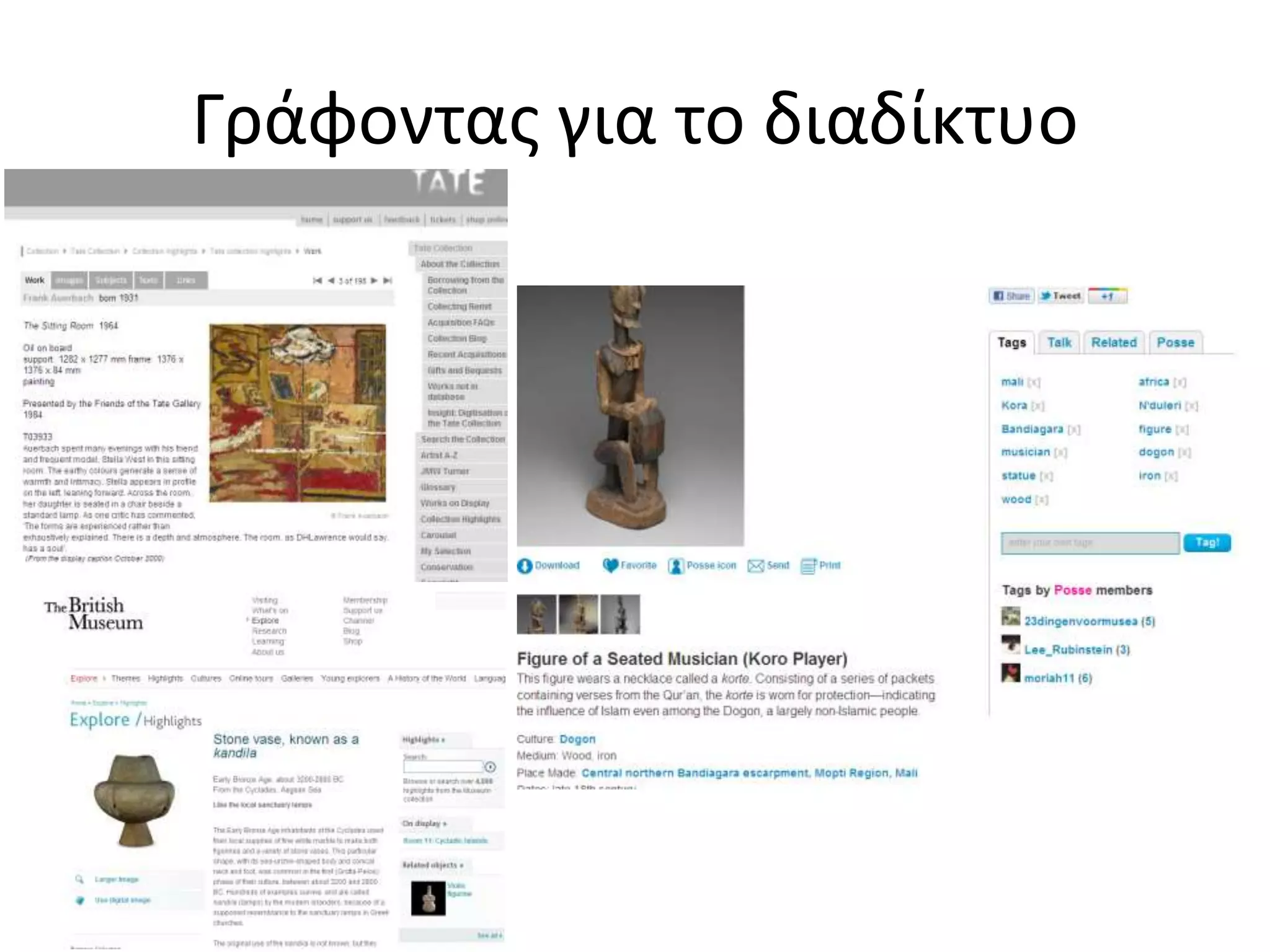
Γράφοντασ για το διαδίκτυο
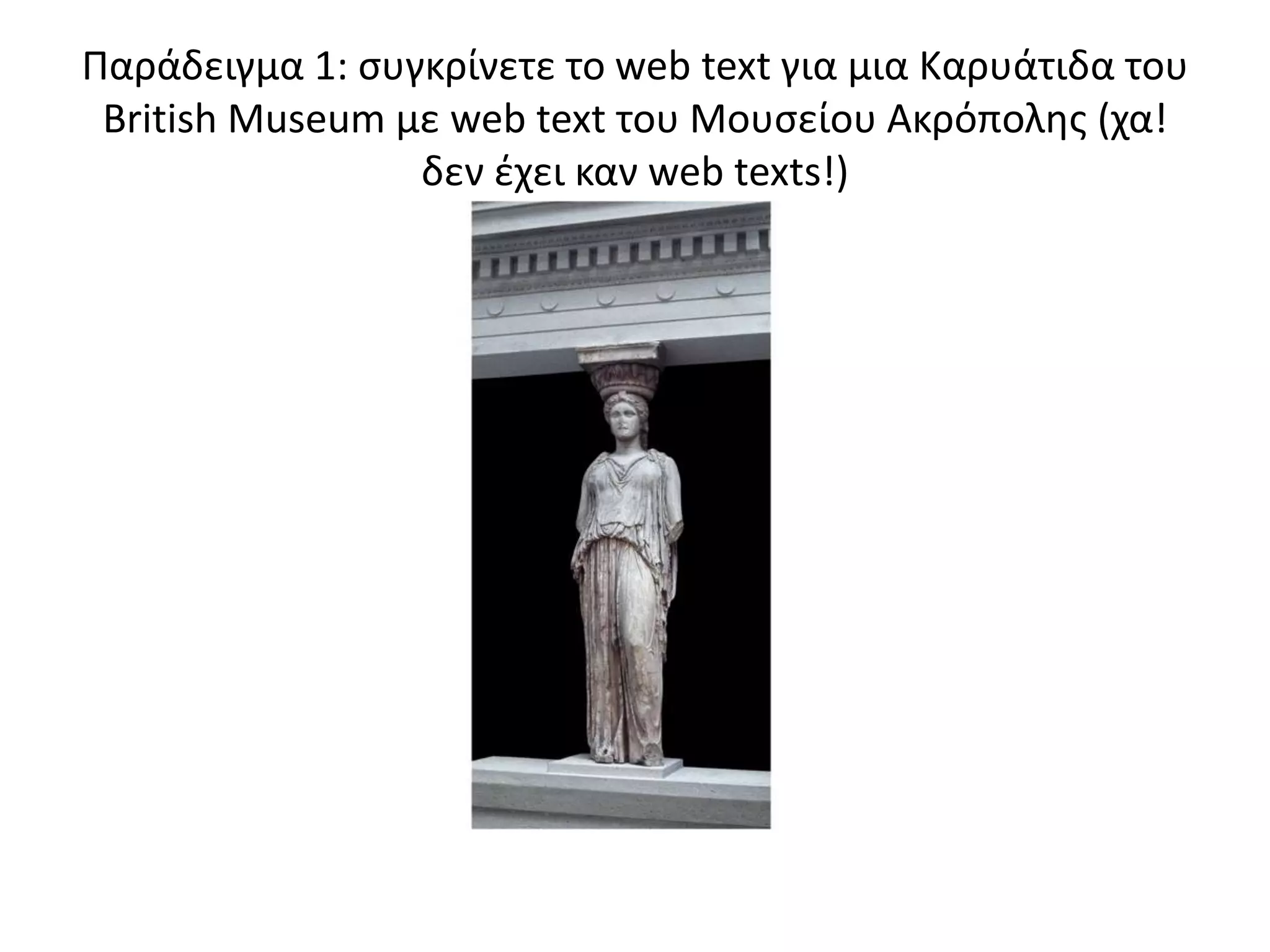
Ραράδειγμα 1: ςυγκρίνετε το web text για μια Καρυάτιδα του
 Βritish Museum με web text του Μουςείου Ακρόπολθσ (χα!
                 δεν ζχει καν web texts!)
Βritish Museum-
                    Caryatid from the Erechtheion
The Acropolis, Athens, Greece, around 420 BC
One of six who served in place of columns in a porch of the temple
• Caryatids are female figures serving as supports. The most likely derivation of their
   name is from the young women of Sparta who danced every year in honour of
   Artemis Karyatis ('Artemis of the Walnut Tree'). This is one of six caryatids that
   held up the roof of the temple on the Acropolis known as the Erechtheion.
• She wears a peplos, a simple tunic pinned on each shoulder. Her hair is braided
   and falls in a thick rope down her back. She probably held a sacrificial vessel in one
   of the missing hands.
• The figure strongly resembles the women of the east frieze of the Parthenon,
   which had just been completed when work on the Erechtheion began. She carries
   an architectural capital like a basket on her head. From the side, her burden seems
   to bear down upon her; the weight is taken on the right leg, encased in
   perpendicular folds arranged like the fluting of a column shaft. The other leg is
   flexed with the drapery moulded to it.
• Between 1800 and 1803 G.B. Lusieri, acting on behalf of Lord Elgin, removed this
   caryatid, which stood second from the left on the front of the south porch. During
   the Greek War of Independence (1821-33) the Erectheion was reduced to ruins,
   although the caryatids survived. It has since been reconstructed. The British
   Museum's caryatid is better preserved than her sisters, which have now severely
   weathered. They have recently been removed to the Acropolis Museum and
   replaced by casts.
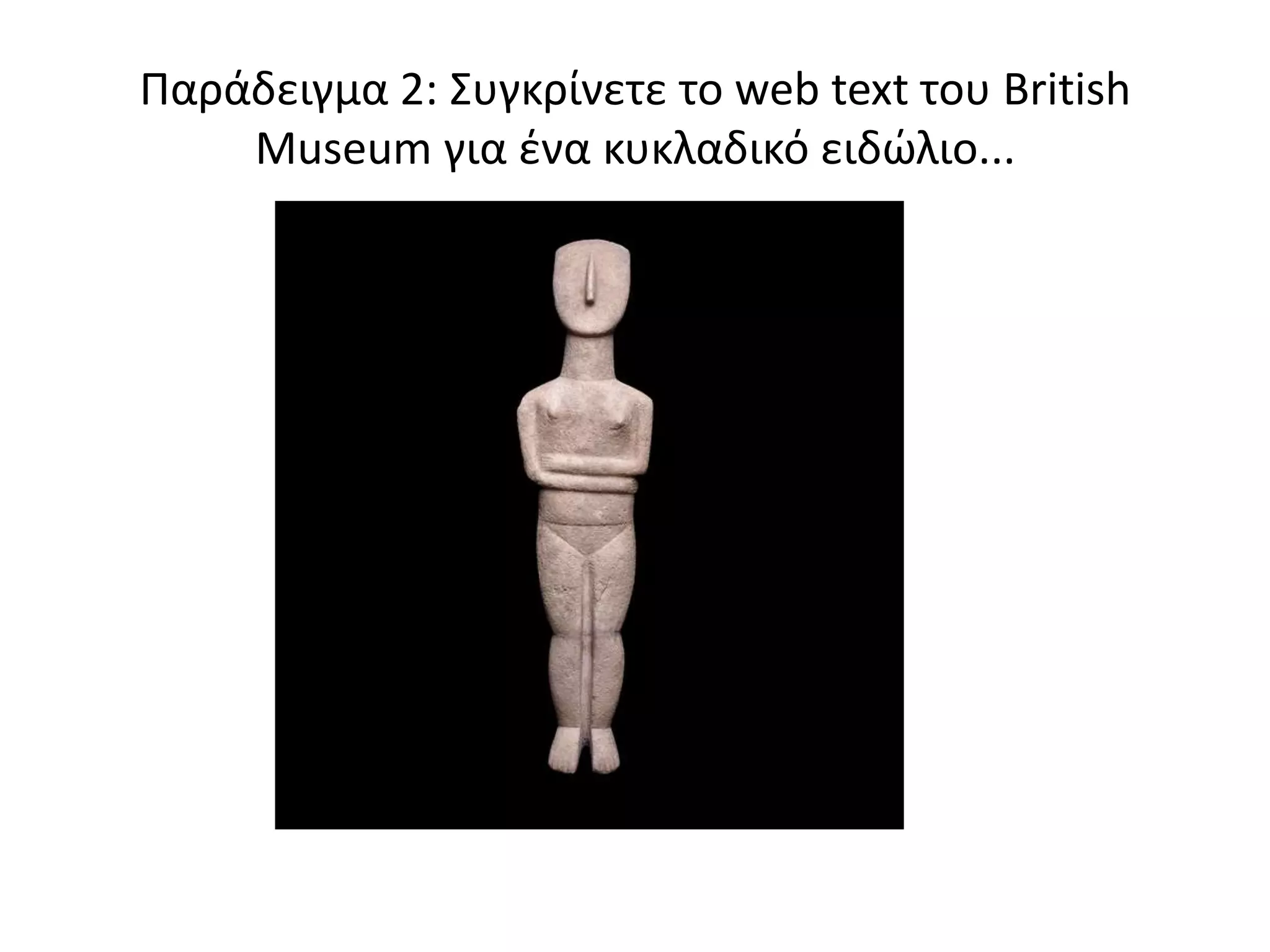
Ραράδειγμα 2: Συγκρίνετε το web text του British
    Museum για ζνα κυκλαδικό ειδϊλιο...
Marble figurine of a woman
Early Bronze Age, about 2600-2400 BC
From the Cyclades, Aegean Sea

The Early Bronze Age inhabitants of the Cyclades made marble figurines of
this type between about 2700 and 2400 BC. Though a few male figures are
known, as well as rare musician figures, they are usually female and naked
with folded arms. Their heads have no features apart from a sculpted nose,
though facial features were often originally added in paint. The elongated
crown of the head was also frequently painted, perhaps to indicate a hairstyle
or headdress. The arms are folded, the right always underneath the left, and
the feet point downwards, so that they are designed either to lie down, or to
be propped up or perhaps carried.
The care and time taken to produce these figures, in marble rather than some
softer material, and in a well-defined form that was maintained over
centuries, suggests that they were important to the people who made and
used them. They probably had religious significance and are unlikely to have
been dolls or toys. Most come from graves, though they have also been found
in settlements. They perhaps had some use in the rituals of the living before
accompanying their owners to the grave.
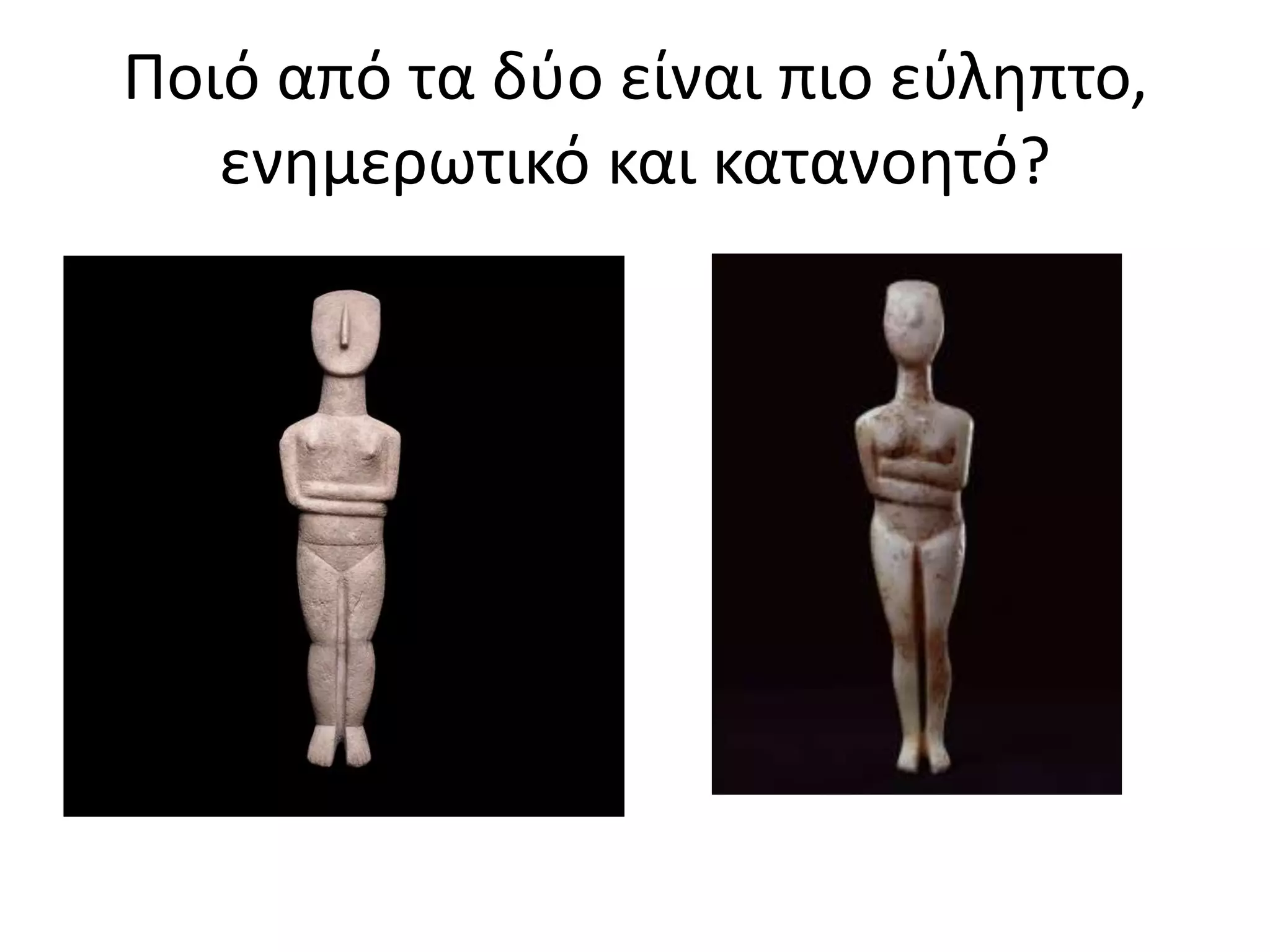
..με το web text του Μουςείου Κυκλαδικισ Τζχνθσ για
                ζνα κυκλαδικό ειδϊλιο
Female figurine of the canonical type (Kapsala variety)
marble
Cycladic
Early Cycladic II period - Syros phase
2800-2300 BC
H.: 25.2 cm / W.(max): 6 cm
Unknown provenance

Description
Cycladic art attained maturity during the Early Cycladic II period, with the creation of the
distinctive figurine type that was to hold sway for the next five hundred years. This type has been
called "canonical" because it displays constant morphological canons and artistic conventions,
such as the folded arms above the abdomen (with left over right), slightly flexed knees, backward
tilt of the head and slanting feet.
Researchers have distinguished five different varieties of the canonical type. The "Kapsala
variety", named after the Early Cycladic cemetery on Amorgos where it was first identified, is the
earliest and is dated to the early phase of the Early Cycladic II period. Figurines of this variety are
small (h. 13-37 cm.) and distinguished by plasticity in the treatment of the body, ovoid head,
curvaceous profiles and almost complete absence of incised details. Nonetheless, the presence of
certain traits reminiscent of figures of the later "Spedos variety" (lyre-shaped head, acutely
slanting feet) places this particular example in a transitional phase between the two varieties.
The majority of canonical figurines are of nude female figures, which several researchers
interpret as representations of fertility or chthonic deities. However, the issue of interpretation is
a complex one and is linked directly with the use of the figurines: some researchers attach
considerable importance to their frequent occurrence in graves and interpret them as apotropaic
images, substitutes for sacrifices, companions of the dead or symbols of social status, while
others maintain that they were for cultic use and consider them votive offerings depicting
devotees.
Ροιό από τα δφο είναι πιο εφλθπτο,
   ενθμερωτικό και κατανοθτό?
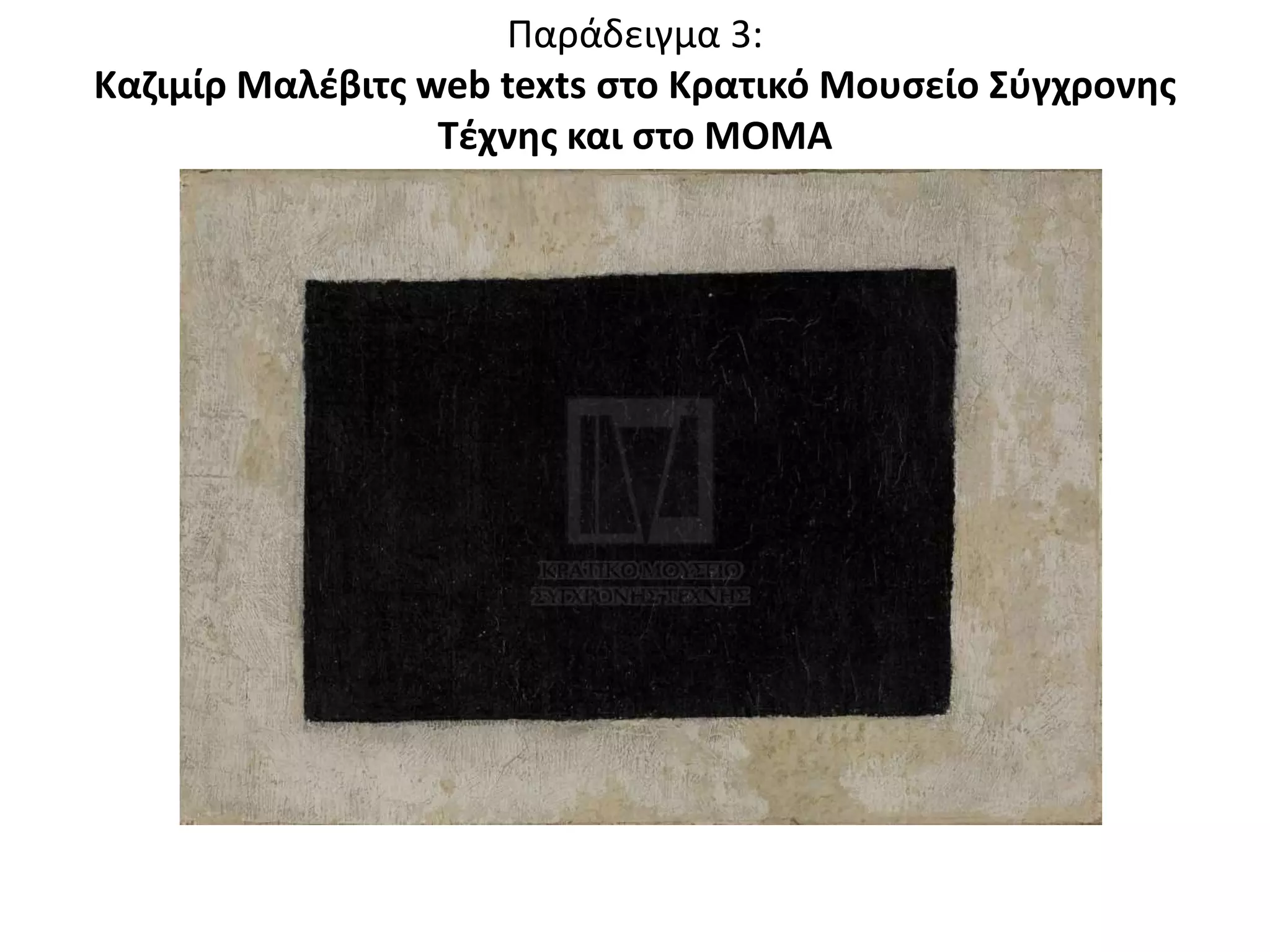
Ραράδειγμα 3:
Καηιμίρ Μαλζβιτσ web texts ςτο Κρατικό Μουςείο Σφγχρονθσ
                  Τζχνθσ και ςτο ΜOMA
Κρατικό Μουςείο Σφγχρονθσ Τζχνθσ
              Μαλζβιτσ Καηιμίρ, "Μαφρο Ορκογώνιο" (αχρονολόγθτο)
                   (Δεν υπάρχει μεταφραςμζνο ςτα αγγλικά)
Ο Καηιμίρ Μαλζβιτσ είναι ζνασ από τουσ πλζον πολυδιάςτατουσ και ριηοςπαςτικοφσ καλλιτζχνεσ
τθσ πρωτοπορίασ που ςτθ δθμιουργικι του πορεία πζραςε από τον ιμπρεςιονιςμό και τον
ςυμβολιςμό των αρχϊν του 20ου αιϊνα για να ςυνδεκεί ςτθ ςυνζχεια με τον κυβοφουτουριςμό
και να επθρεαςτεί από τθν «υπζρλογθ γλϊςςα» των ΢ϊςων φουτουριςτϊν, τθν γλϊςςα που
ζχει αποκτιςει δικό τθσ πρωτογενζσ νόθμα με βάςθ όχι τθ γνϊςθ αλλά τθν αίςκθςθ και τθν
εμπειρία, για να αναπτφξει τθ δικι του κεωρία περί μθ-αντικειμενικισ ηωγραφικισ που τθσ
ζδωςε το όνομα «ςουπρεματιςμόσ». Ο «ςουπρεματιςμόσ» πρωτοπαρουςιάςτθκε ςτθν ζκκεςθ
«Τελευταία φουτουριςτικι ζκκεςθ 0,10» ςτθν Ρετροφπολθ το 1915. Τα ςουπρεματιςτικά ζργα
του Μαλζβιτσ ιταν απαλλαγμζνα από κάκε είδουσ αντικείμενο και παρουςίαηαν ςυνκζςεισ
γεωμετρικϊν ςχθμάτων και χρωμάτων που ςτόχο είχαν να δθλϊςουν τον πρωτεφοντα ρόλο τθσ
φόρμασ ζναντι του περιεχομζνου και να δθλϊςουν ότι θ φόρμα είναι αυτι που προςδίδει το
περιεχόμενο και όχι το αντίκετο, όπωσ ςυνζβαινε ζωσ τότε. Θ λζξθ «ςουπρεματιςμόσ»
προζρχεται από τθ λατινικι ρίηα «suprem» (υπεροχι, κυριαρχία) και δθλϊνει, ςφμφωνα με τον
Μαλζβιτσ, τθν υπεροχι του χρϊματοσ πάνω ςε όλα τα άλλα τεχνικά μζρθ του πίνακα. Ο
Μαλζβιτσ κεωροφςε τον εαυτό του ιδιότυπο ρεαλιςτι, μόνο που ζβλεπε τον ρεαλιςμό ςε μια
φανταςτικι πραγματικότθτα «ςτθν οποία για να φτάςεισ πρζπει να απομακρυνκείσ από τθν
ορατι πλευρά τθσ ηωισ». Ο Μαλζβιτσ ίδρυςε τθν ομάδα «Supremus» ςτθν οποία προςχϊρθςαν
πολλοί καλλιτζχνεσ του κυβοφουτουριςμοφ όπωσ ο Λβάν Κλιοφν, θ Λιουμπόβ Ροπόβα, θ
Ναντιζηντα Ουνταλτςόβα, θ Πλγα ΢όηανοβα κ.α. ενϊ ςτθν πόλθ Βιτζμπςκ διθφκυνε τθν ςχολι
καλϊν τεχνϊν «Οφνοβισ» (Επιβεβαιωτζσ τθσ Νζασ Τζχνθσ) που ςτόχο είχε να αλλάξει μζςα από
τθν τζχνθ τθν αιςκθτικι αντίλθψθ των ανκρϊπων. Ζμβλθμα του ςουπρεματιςμοφ ζγινε το
«Μαφρο Τετράγωνο» (1915) το οποίο εξζφραηε το τζλοσ τθσ παλιάσ τζχνθσ και ταυτόχρονα τθν
αρχι τθσ καινοφργιασ.
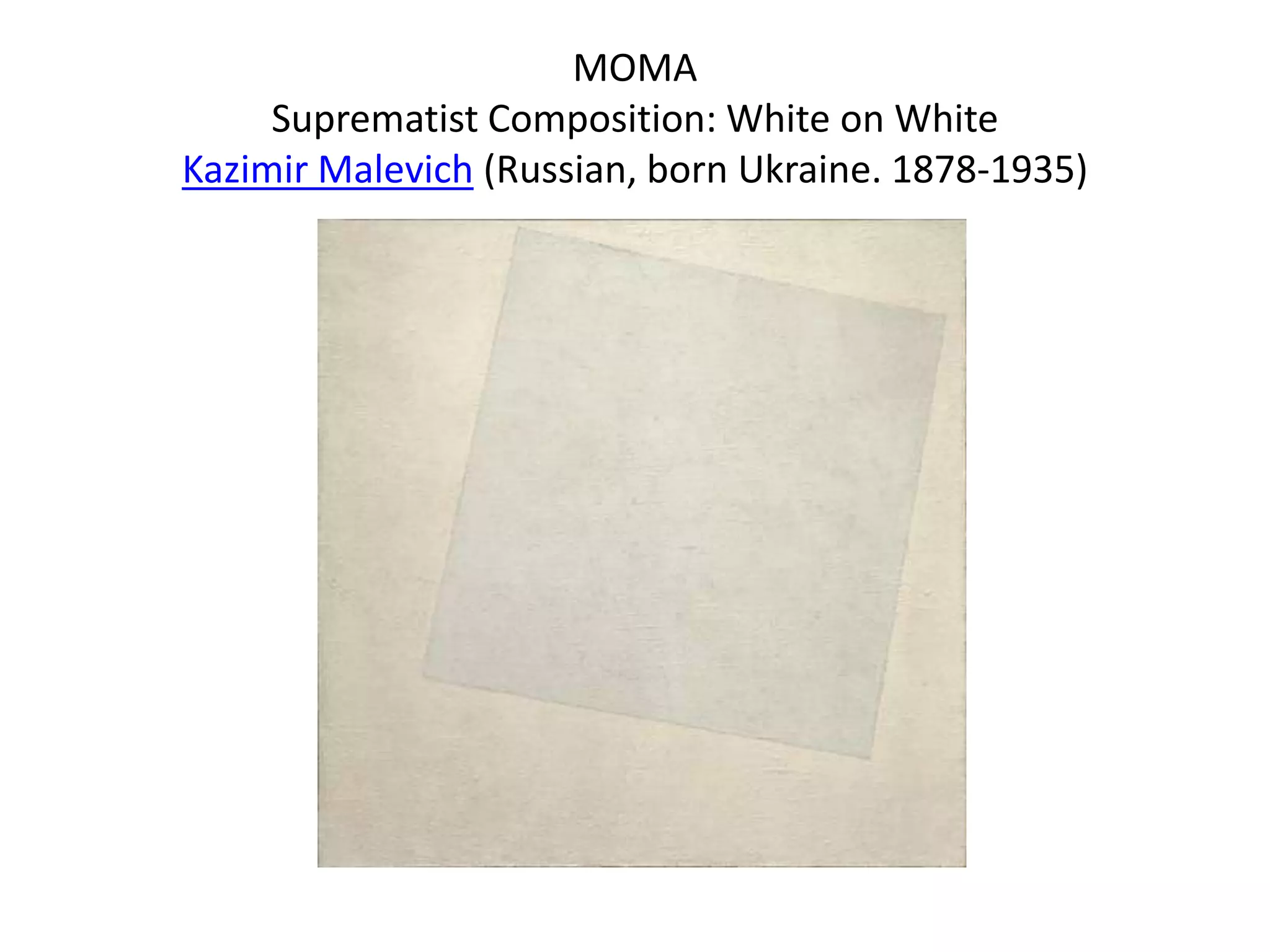
ΜΟΜΑ
     Suprematist Composition: White on White
Kazimir Malevich (Russian, born Ukraine. 1878-1935)
Suprematist Composition: White on White
       Kazimir Malevich (Russian, born Ukraine. 1878-1935)
Gallery label text

Malevich described his aesthetic theory, known as Suprematism,
as "the supremacy of pure feeling or perception in the pictorial
arts." He viewed the Russian Revolution as having paved the way
for a new society in which materialism would eventually lead to
spiritual freedom. This austere painting counts among the most
radical paintings of its day, yet it is not impersonal; the trace of
the artist's hand is visible in the texture of the paint and the
subtle variations of white. The imprecise outlines of the
asymmetrical square generate a feeling of infinite space rather
than definite borders.
Suprematist Composition: White on White
                 Kazimir Malevich (Russian, born Ukraine. 1878-1935)
The Museum of Modern Art, MoMA Highlights, New York: The Museum of Modern Art, revised
2004, originally published 1999, p. 85
A white square floating weightlessly in a white field, Suprematist Composition: White
on White was one of the most radical paintings of its day: a geometric abstraction
without reference to external reality. Yet the picture is not impersonal: we see the
artist's hand in the texture of the paint, and in the subtle variations of the whites. The
square is not exactly symmetrical, and its lines, imprecisely ruled, have a breathing
quality, generating a feeling not of borders defining a shape but of a space without
limits.
After the Revolution, Russian intellectuals hoped that human reason and modern
technology would engineer a perfect society. Malevich was fascinated with
technology, and particularly with the airplane, instrument of the human yearning to
break the bounds of earth. He studied aerial photography, and wanted White on
White to create a sense of floating and transcendence. White was for Malevich the
color of infinity, and signified a realm of higher feeling.
For Malevich, that realm, a utopian world of pure form, was attainable only through
nonobjective art. Indeed, he named his theory of art Suprematism to signify "the
supremacy of pure feeling or perception in the pictorial arts"; and pure perception
demanded that a picture's forms "have nothing in common with nature." Malevich
imagined Suprematism as a universal language that would free viewers from the
material world.
Suprematist Composition: White on White
Kazimir Malevich (Russian, born Ukraine. 1878-1935)
Σφγκριςθ:
ΚΜΣΤ=                      ΜΟΜΑ=
ζνα, μεγάλο κείμενο μόνο   • 1 ςυνοπτικό label text
ςτα ελλθνικά               • 1 πιο μεγάλο guide
                             book text
                           • 1 θχθτικό αρχείο-
                             soundbite και το
                             transcription του (για
                             άτομα με ειδικζσ
                             ανάγκεσ)
Ενότθτθτα 4:
  Ερμθνευτικι μεκοδολογία για κινθτζσ πλατφόρμεσ

• Σχεδιαςμόσ εμπειρίασ μιασ εφαρμογισ για
  κινθτζσ πλατφόρμεσ.
• Podcasting: ςχεδιάηοντασ ζνα podcast ωσ
  ερμθνευτικό και επικοινωνιακό εργαλείο.
• Gaming: χρθςιμοποίθςθ διαδραςτικϊν
  παιχνιδιϊν ωσ ερμθνευτικό εργαλείο.
Πρακτικές ασκήσεις:
• Συγγραφι ενόσ ςεναρίου για θχθτικό οδθγό.
• Σχεδιαςμόσ ενόσ podcast.
Αction points:
• Γράψτε ζνα blog entry ςτο wiki μασ
• Αν δεν ζχετε χρθςιμοποιιςει Twitter, αρχίςτε
• Βοθκείςτε ςτο ςχεδιαςμό εμπειρίασ για Διεκνι Μζρα
  Μουςείων 2012
• Ρροςκζςτε ζνα λιμμα ςτθ wikipedia ι βικιπζδια
• Δοκιμάςτε μια ψθφιακι εμπειρία για παιδιά
• Βάλτε tags ςε μια ςυλλογι που ζχει αυτι τθ
  δυνατότθτα (πχ ΛΜΑ, Powerhouse etc)
• Αναπτφξτε το βακμό ςυμμετοχισ ςασ ςε παραγωγι
  περιεχομζνου (user generated content)

Digital Interpretation workshop

  • 1.
    Διαπανεπιςτθμιακό πρόγραμμα μεταπτυχιακϊνςπουδϊν Μουςειολογία Εργαςτθριακό ςεμινάριο: ‘Ερμθνευτικι μεκοδολογία για παραδοςιακζσ, ψθφιακζσ και κινθτζσ πλατφόρμεσ’ 7 & 8 Λανουαρίου 4 & 5 Φεβρουαρίου 2012
  • 2.
    Μουςεία και δθμιουργίανοιματοσ «The work of interpretation…is to give cognitive hooks to the hookless, and assure that these hooks are sufficiently varied so that they can successfully land in the mental fabric of a broad array of visitors. Once visitors have a framework, all kinds of sensory impressions, emotions and reflections can weave themselves into the fabric of perception. In fact, the more you know about a subject, the more you can learn about it (presuming the mental model you are working with accommodates the new information).» Peter Samis, SFMOMA
  • 3.
    Ενότθτα 1: Μουςεία και δθμιουργία νοιματοσ • Μουςεία και δθμιουργία νοιματοσ. • Μουςεία ωσ φορείσ άτυπθσ μάκθςθσ. • Mάκθςθ και ερμθνεία. • Σχεδιαςμόσ ερμθνευτικισ ςτρατθγικισ και οργάνωςθ περιεχομζνου ςε ερμθνευτικζσ ενότθτεσ. Πρακτικές ασκήσεις: • Σχεδιαςμόσ μιασ ερμθνευτικισ ςτρατθγικισ για μια ζκκεςθ ι ςυλλογι. • Ερμθνεία εκκεμάτων μζςα ςτθν ζκκεςθ. Συγγραφι λεηάντασ για ζνα ζκκεμα.
  • 4.
    Ενότθτα 2: Ερμθνευτικζσ προςεγγίςεισ για διαφορετικζσ μακθςιακζσ ανάγκεσ • Χρθςιμοποιϊντασ τθ ‘ςυναιςκθςία’ ωσ δθμιουργικό άξονα για μια εναλλακτικι ερμθνευτικι μεκοδολογία (μουςικι, ποίθςθ, κζατρο, χορόσ κλπ). • Ερμθνεφοντασ μουςειακά εκκζματα για διαφορετικζσ θλικίεσ, μακθςιακζσ κατθγορίεσ και ανάγκεσ • Ερμθνεφοντασ για άτομα με ειδικά χαρακτθριςτικά (ΑΜΕΧ). Πρακτικές ασκήσεις: • Σχεδιαςμόσ μιασ εναλλακτικισ ερμθνευτικισ προςζγγιςθσ. • Ερμθνεία για άτομα με περιοριςμζνθ ι κακόλου όραςθ. Εργαςτιρι τεχνικισ ‘Ρεριγραφι ζργων’.
  • 5.
    Hermeneutics>ερμθνεφω> Ερμισ Διαμεςολαβθτισ Αγγελιοφόροσ Εφευρζτθσ τθσ γλϊςςασ & γραφισ De Interpretatione, Αριςτοτζλθσ Wilhelm Dilthey Martin Heidegger
  • 6.
    Ερωτιματα • Τα μουςείαςτεγάηουν αντικείμενα ι ιδζεσ? • Τα μουςειακά αντικείμενα ζχουν νόθμα sui generis? • Τί είναι αυκεντικό και τί όχι? • Ρόςο ‘άτυπθϋ είναι θ μουςειακι μάκθςθ?
  • 7.
    Σχεδιάηοντασ ζνα ερμθνευτικό πρόγραμμα • Ροιό είναι το κοινό ςου? Τί περιμζνουν/ζχουν ςυνθκίςει? • Τι ζχεισ ςτθ διάκεςι ςου από υποδομζσ, δυναμικό, τεχνολογία, εγκαταςτάςεισ, προυπολογιςμό, περιεχόμενο, επιμελθτζσ? • Ρϊσ ςυνδζονται μεταξφ τουσ οι διάφορεσ ερμθνευτικζσ ςου λφςεισ? (Ρ΢ΛΝ-ΚΑΤΑ-ΜΕΤΑ- ΧΩ΢ΛΣ ΕΡΛΣΚΕΨΘ)
  • 8.
    Τι κεωρείται ‘ερμθνευτικό’εργαλείο? • Το κτιριο? • Οι διαδρομζσ ςτο χϊρο του μουςείου? • Θ εκκεςιακι διιγθςθ? • Οι γραπτζσ πλθροφορίεσ ςτο χϊρο? • Ξεναγιςεισ, διαλζξεισ, ομιλίεσ? • Εμπειρίεσ με κινθτά ερμθνευτικά ςυςτιματα? • Ο ιςτότοποσ? • Οι φφλακεσ/προςωπικό του μουςείου? • Το εκκεςιακό πρόγραμμα? • Το εκπαιδευτικό πρόγραμμα?
  • 9.
    Eρμθνευτικά εργαλεία • Χωροταξικά(διαδρομι, προκικεσ, φωτιςμόσ) • Κεματικά (εκκεςιακι διιγθςθ, εκκεςιακό πρόγραμμα, επιμζλεια) • Πλθροφοριακά (λεηάντεσ, πάνελσ, κινθτά ερμθνευτικά ςυςτιματα, φυλλάδια, κατάλογοσ, ψθφιακά κείμενα) • Εμπειρίεσ (εναλλακτικζσ ερμθνευτικζσ προςεγγίςεισ, πολυμεςικά εργαλεία, multi- sensory, ξεναγιςεισ)
  • 10.
  • 11.
    Γράφοντασ καλζσ ερμθνευτικζσ λεηάντεσ • Γράφε απλά • Χρωμάτιςε το λόγο με αναλογίεσ & παραδείγματα • Πχι τεχνικοφσ, δυςνόθτουσ όρουσ • Μια ιδζα ανά πρόταςθ • Χρθςιμοποίθςε ερωτιςεισ • Γράφε για το κοινό ςου • Ηωντανζσ λζξεισ • Κάνε τον κεατι να κοιτάξει καλφτερα το ζργο • Κάνε πολλοφσ ελζγχουσ • Πχι παραπάνω από 75 λζξεισ • Font size > 16
  • 12.
    Keep them shortn’ sweet- under 60 words labels
  • 13.
    Τεχνικζσ για καλφτερεσλεηάντεσ • Πχι μόνο ‘πλθροφορίεσ ταφόπλακασ’ • Θ τζχνθ τθσ μυκοπλαςίασ (storytelling, narratives) • Κλιςθ ςε δράςθ (Call to action) • Συμμετοχικι εμπειρία • Δυνατότθτα επιςθμείωςθσ/μεταφοράσ
  • 14.
  • 15.
    Μια άλλθ φωνι:The Bigger Picture (TATE)
  • 16.
    Ραράδειγμα λεηάντασ απότο ΜΟΜΑ The Starry Night, Vincent van Gogh (Dutch, 1853-1890) "This morning I saw the country from my window a long time before sunrise," the artist wrote to his brother Theo, "with nothing but the morning star, which looked very big." Rooted in imagination and memory, The Starry Night embodies an inner, subjective expression of van Gogh's response to nature. In thick sweeping brushstrokes, a flamelike cypress unites the churning sky and the quiet village below. The village was partly invented, and the church spire evokes van Gogh's native land, the Netherlands.
  • 17.
    Άςκθςθ Ξαναγράψε (αν χρειάηεταικατά τθ γνϊμθ ςου) τθ λεηάντα
  • 18.
    Eναλλακτικζσ ερμθνευτικζσ μζκοδοι • Ιχοσ • Μουςικι • Κζατρο • Performance • Ραντομίμα • Μόδα • Ραιχνίδι • Εικόνα • Βίντεο
  • 19.
  • 20.
    Χρθςιμοποιϊντασ εναλλακτικζσ ερμθνευτικζσ μεκόδουσ για μια ολιςτικι ερμθνευτικι προςζγγιςθ Ραράδειγμα –John Martin’s Apocalypse ςτθν Tate Britain
  • 21.
    John Martin’s ApocalypseInterpretative plan • Κατάλογοσ • Φυλλάδιο • Λεηάντεσ • Επιτοίχια κείμενα • Δραματουργθμζνθ ψθφιακι παρουςίαςθ μζςα ςτθν ζκκεςθ • Ρολυμεςικόσ οδθγόσ + κείμενά του ςτο microsite • Συνοδευτικό εκπαιδευτικό πρόγραμμα και Late@Tate πρόγραμμα • Twitter- διαδραςτικό μυκοπλαςτικό κοινωνικό παιχνίδι • Curator’s Blog- αρκράκια για τθν ζκκεςθ • The Great British Art Debate Blog- αναφορζσ με link από το microsite τθσ ζκκεςθσ
  • 24.
  • 26.
  • 27.
    Ερμθνεφοντασ για άτομαμε περιοριςμζνθ όραςθ • http://www2.tate.org.uk/imap/imap2/pages/ animated/leger.html
  • 28.
    Άςκθςθ: Γράψτεμια περιγραφι για άτομα με περιοριςμζνθ όραςθ
  • 29.
    Ποπόβα Λιουμπόβ, "Νεκριφφςθ" (ηωγραφικό ζργο, 53 x 70,5 εκατοςτά) Στο ζργο απεικονίηεται νεκρι φφςθ με κανάτα (γαλατιζρα), πιάτο και κουτάλι, καλάκι με φροφτα, μπολ με μαρμελάδα και πετςζτα τοποκετθμζνα ςε τραπζηι, τμιμα του οποίου καταλαμβάνει τον κφριο όγκο τθσ ηωγραφικισ επιφάνειασ. Στο τραπζηι είναι ςτρωμζνο λευκό τραπεηομάντιλο. Στο φόντο, πίςω από κτιςτό κιγκλίδωμα τμιμα του οποίου είναι ορατό, διακρίνεται τμιμα δαςϊδουσ ζκταςθσ.
  • 30.
    Ενότθτα 3: Ερμθνευτικι μεκοδολογία για ψθφιακά περιβάλλοντα- διαδίκτυο • Από τθν αρχιτεκτονικι τθσ πλθροφορίασ ςτο περιεχόμενο- ςχεδιαςμόσ καλφτερθσ homepage για διευκόλυνςθ ερμθνείασ του αντικειμζνου του μουςείου. • Σχεδιαςμόσ ψθφιακϊν εμπειριϊν. • Data Visualisation: Ραρουςίαςθ πλθροφορίασ με γραφιςτικό και οπτικό τρόπο. • Σχεδιαςμόσ πολυμεςικοφ υλικοφ: δθμιουργία ςεναρίων για ερμθνευτικά βίντεο. Πρακτικές ασκήσεις: • Συγγραφι/ επεξεργαςία κειμζνου για το διαδίκτυο. • Σχεδιαςμόσ μιασ εικονικισ ζκκεςθσ με κεματικό ι αφθγθματικό χαρακτιρα.
  • 31.
  • 32.
    Ραράδειγμα 1: ςυγκρίνετετο web text για μια Καρυάτιδα του Βritish Museum με web text του Μουςείου Ακρόπολθσ (χα! δεν ζχει καν web texts!)
  • 33.
    Βritish Museum- Caryatid from the Erechtheion The Acropolis, Athens, Greece, around 420 BC One of six who served in place of columns in a porch of the temple • Caryatids are female figures serving as supports. The most likely derivation of their name is from the young women of Sparta who danced every year in honour of Artemis Karyatis ('Artemis of the Walnut Tree'). This is one of six caryatids that held up the roof of the temple on the Acropolis known as the Erechtheion. • She wears a peplos, a simple tunic pinned on each shoulder. Her hair is braided and falls in a thick rope down her back. She probably held a sacrificial vessel in one of the missing hands. • The figure strongly resembles the women of the east frieze of the Parthenon, which had just been completed when work on the Erechtheion began. She carries an architectural capital like a basket on her head. From the side, her burden seems to bear down upon her; the weight is taken on the right leg, encased in perpendicular folds arranged like the fluting of a column shaft. The other leg is flexed with the drapery moulded to it. • Between 1800 and 1803 G.B. Lusieri, acting on behalf of Lord Elgin, removed this caryatid, which stood second from the left on the front of the south porch. During the Greek War of Independence (1821-33) the Erectheion was reduced to ruins, although the caryatids survived. It has since been reconstructed. The British Museum's caryatid is better preserved than her sisters, which have now severely weathered. They have recently been removed to the Acropolis Museum and replaced by casts.
  • 34.
    Ραράδειγμα 2: Συγκρίνετετο web text του British Museum για ζνα κυκλαδικό ειδϊλιο...
  • 35.
    Marble figurine ofa woman Early Bronze Age, about 2600-2400 BC From the Cyclades, Aegean Sea The Early Bronze Age inhabitants of the Cyclades made marble figurines of this type between about 2700 and 2400 BC. Though a few male figures are known, as well as rare musician figures, they are usually female and naked with folded arms. Their heads have no features apart from a sculpted nose, though facial features were often originally added in paint. The elongated crown of the head was also frequently painted, perhaps to indicate a hairstyle or headdress. The arms are folded, the right always underneath the left, and the feet point downwards, so that they are designed either to lie down, or to be propped up or perhaps carried. The care and time taken to produce these figures, in marble rather than some softer material, and in a well-defined form that was maintained over centuries, suggests that they were important to the people who made and used them. They probably had religious significance and are unlikely to have been dolls or toys. Most come from graves, though they have also been found in settlements. They perhaps had some use in the rituals of the living before accompanying their owners to the grave.
  • 36.
    ..με το webtext του Μουςείου Κυκλαδικισ Τζχνθσ για ζνα κυκλαδικό ειδϊλιο
  • 37.
    Female figurine ofthe canonical type (Kapsala variety) marble Cycladic Early Cycladic II period - Syros phase 2800-2300 BC H.: 25.2 cm / W.(max): 6 cm Unknown provenance Description Cycladic art attained maturity during the Early Cycladic II period, with the creation of the distinctive figurine type that was to hold sway for the next five hundred years. This type has been called "canonical" because it displays constant morphological canons and artistic conventions, such as the folded arms above the abdomen (with left over right), slightly flexed knees, backward tilt of the head and slanting feet. Researchers have distinguished five different varieties of the canonical type. The "Kapsala variety", named after the Early Cycladic cemetery on Amorgos where it was first identified, is the earliest and is dated to the early phase of the Early Cycladic II period. Figurines of this variety are small (h. 13-37 cm.) and distinguished by plasticity in the treatment of the body, ovoid head, curvaceous profiles and almost complete absence of incised details. Nonetheless, the presence of certain traits reminiscent of figures of the later "Spedos variety" (lyre-shaped head, acutely slanting feet) places this particular example in a transitional phase between the two varieties. The majority of canonical figurines are of nude female figures, which several researchers interpret as representations of fertility or chthonic deities. However, the issue of interpretation is a complex one and is linked directly with the use of the figurines: some researchers attach considerable importance to their frequent occurrence in graves and interpret them as apotropaic images, substitutes for sacrifices, companions of the dead or symbols of social status, while others maintain that they were for cultic use and consider them votive offerings depicting devotees.
  • 38.
    Ροιό από ταδφο είναι πιο εφλθπτο, ενθμερωτικό και κατανοθτό?
  • 39.
    Ραράδειγμα 3: Καηιμίρ Μαλζβιτσweb texts ςτο Κρατικό Μουςείο Σφγχρονθσ Τζχνθσ και ςτο ΜOMA
  • 40.
    Κρατικό Μουςείο ΣφγχρονθσΤζχνθσ Μαλζβιτσ Καηιμίρ, "Μαφρο Ορκογώνιο" (αχρονολόγθτο) (Δεν υπάρχει μεταφραςμζνο ςτα αγγλικά) Ο Καηιμίρ Μαλζβιτσ είναι ζνασ από τουσ πλζον πολυδιάςτατουσ και ριηοςπαςτικοφσ καλλιτζχνεσ τθσ πρωτοπορίασ που ςτθ δθμιουργικι του πορεία πζραςε από τον ιμπρεςιονιςμό και τον ςυμβολιςμό των αρχϊν του 20ου αιϊνα για να ςυνδεκεί ςτθ ςυνζχεια με τον κυβοφουτουριςμό και να επθρεαςτεί από τθν «υπζρλογθ γλϊςςα» των ΢ϊςων φουτουριςτϊν, τθν γλϊςςα που ζχει αποκτιςει δικό τθσ πρωτογενζσ νόθμα με βάςθ όχι τθ γνϊςθ αλλά τθν αίςκθςθ και τθν εμπειρία, για να αναπτφξει τθ δικι του κεωρία περί μθ-αντικειμενικισ ηωγραφικισ που τθσ ζδωςε το όνομα «ςουπρεματιςμόσ». Ο «ςουπρεματιςμόσ» πρωτοπαρουςιάςτθκε ςτθν ζκκεςθ «Τελευταία φουτουριςτικι ζκκεςθ 0,10» ςτθν Ρετροφπολθ το 1915. Τα ςουπρεματιςτικά ζργα του Μαλζβιτσ ιταν απαλλαγμζνα από κάκε είδουσ αντικείμενο και παρουςίαηαν ςυνκζςεισ γεωμετρικϊν ςχθμάτων και χρωμάτων που ςτόχο είχαν να δθλϊςουν τον πρωτεφοντα ρόλο τθσ φόρμασ ζναντι του περιεχομζνου και να δθλϊςουν ότι θ φόρμα είναι αυτι που προςδίδει το περιεχόμενο και όχι το αντίκετο, όπωσ ςυνζβαινε ζωσ τότε. Θ λζξθ «ςουπρεματιςμόσ» προζρχεται από τθ λατινικι ρίηα «suprem» (υπεροχι, κυριαρχία) και δθλϊνει, ςφμφωνα με τον Μαλζβιτσ, τθν υπεροχι του χρϊματοσ πάνω ςε όλα τα άλλα τεχνικά μζρθ του πίνακα. Ο Μαλζβιτσ κεωροφςε τον εαυτό του ιδιότυπο ρεαλιςτι, μόνο που ζβλεπε τον ρεαλιςμό ςε μια φανταςτικι πραγματικότθτα «ςτθν οποία για να φτάςεισ πρζπει να απομακρυνκείσ από τθν ορατι πλευρά τθσ ηωισ». Ο Μαλζβιτσ ίδρυςε τθν ομάδα «Supremus» ςτθν οποία προςχϊρθςαν πολλοί καλλιτζχνεσ του κυβοφουτουριςμοφ όπωσ ο Λβάν Κλιοφν, θ Λιουμπόβ Ροπόβα, θ Ναντιζηντα Ουνταλτςόβα, θ Πλγα ΢όηανοβα κ.α. ενϊ ςτθν πόλθ Βιτζμπςκ διθφκυνε τθν ςχολι καλϊν τεχνϊν «Οφνοβισ» (Επιβεβαιωτζσ τθσ Νζασ Τζχνθσ) που ςτόχο είχε να αλλάξει μζςα από τθν τζχνθ τθν αιςκθτικι αντίλθψθ των ανκρϊπων. Ζμβλθμα του ςουπρεματιςμοφ ζγινε το «Μαφρο Τετράγωνο» (1915) το οποίο εξζφραηε το τζλοσ τθσ παλιάσ τζχνθσ και ταυτόχρονα τθν αρχι τθσ καινοφργιασ.
  • 41.
    ΜΟΜΑ Suprematist Composition: White on White Kazimir Malevich (Russian, born Ukraine. 1878-1935)
  • 42.
    Suprematist Composition: Whiteon White Kazimir Malevich (Russian, born Ukraine. 1878-1935) Gallery label text Malevich described his aesthetic theory, known as Suprematism, as "the supremacy of pure feeling or perception in the pictorial arts." He viewed the Russian Revolution as having paved the way for a new society in which materialism would eventually lead to spiritual freedom. This austere painting counts among the most radical paintings of its day, yet it is not impersonal; the trace of the artist's hand is visible in the texture of the paint and the subtle variations of white. The imprecise outlines of the asymmetrical square generate a feeling of infinite space rather than definite borders.
  • 43.
    Suprematist Composition: Whiteon White Kazimir Malevich (Russian, born Ukraine. 1878-1935) The Museum of Modern Art, MoMA Highlights, New York: The Museum of Modern Art, revised 2004, originally published 1999, p. 85 A white square floating weightlessly in a white field, Suprematist Composition: White on White was one of the most radical paintings of its day: a geometric abstraction without reference to external reality. Yet the picture is not impersonal: we see the artist's hand in the texture of the paint, and in the subtle variations of the whites. The square is not exactly symmetrical, and its lines, imprecisely ruled, have a breathing quality, generating a feeling not of borders defining a shape but of a space without limits. After the Revolution, Russian intellectuals hoped that human reason and modern technology would engineer a perfect society. Malevich was fascinated with technology, and particularly with the airplane, instrument of the human yearning to break the bounds of earth. He studied aerial photography, and wanted White on White to create a sense of floating and transcendence. White was for Malevich the color of infinity, and signified a realm of higher feeling. For Malevich, that realm, a utopian world of pure form, was attainable only through nonobjective art. Indeed, he named his theory of art Suprematism to signify "the supremacy of pure feeling or perception in the pictorial arts"; and pure perception demanded that a picture's forms "have nothing in common with nature." Malevich imagined Suprematism as a universal language that would free viewers from the material world.
  • 44.
    Suprematist Composition: Whiteon White Kazimir Malevich (Russian, born Ukraine. 1878-1935)
  • 45.
    Σφγκριςθ: ΚΜΣΤ= ΜΟΜΑ= ζνα, μεγάλο κείμενο μόνο • 1 ςυνοπτικό label text ςτα ελλθνικά • 1 πιο μεγάλο guide book text • 1 θχθτικό αρχείο- soundbite και το transcription του (για άτομα με ειδικζσ ανάγκεσ)
  • 46.
    Ενότθτθτα 4: Ερμθνευτικι μεκοδολογία για κινθτζσ πλατφόρμεσ • Σχεδιαςμόσ εμπειρίασ μιασ εφαρμογισ για κινθτζσ πλατφόρμεσ. • Podcasting: ςχεδιάηοντασ ζνα podcast ωσ ερμθνευτικό και επικοινωνιακό εργαλείο. • Gaming: χρθςιμοποίθςθ διαδραςτικϊν παιχνιδιϊν ωσ ερμθνευτικό εργαλείο. Πρακτικές ασκήσεις: • Συγγραφι ενόσ ςεναρίου για θχθτικό οδθγό. • Σχεδιαςμόσ ενόσ podcast.
  • 47.
    Αction points: • Γράψτεζνα blog entry ςτο wiki μασ • Αν δεν ζχετε χρθςιμοποιιςει Twitter, αρχίςτε • Βοθκείςτε ςτο ςχεδιαςμό εμπειρίασ για Διεκνι Μζρα Μουςείων 2012 • Ρροςκζςτε ζνα λιμμα ςτθ wikipedia ι βικιπζδια • Δοκιμάςτε μια ψθφιακι εμπειρία για παιδιά • Βάλτε tags ςε μια ςυλλογι που ζχει αυτι τθ δυνατότθτα (πχ ΛΜΑ, Powerhouse etc) • Αναπτφξτε το βακμό ςυμμετοχισ ςασ ςε παραγωγι περιεχομζνου (user generated content)