ABSTRACT
Digitalization which is the need of today's world is the result of innovations
and technological advances. Every country is aiming to achieve
digitalization to empower society in a better way. Digital India is a flagship
program launched by the Government of India to transform India in a
digitally empowered and knowledge economy. This drive came as a dream
project of the Indian government to remodel India digitally. This aim would
be very difficult to achieve unless there is awareness amongst the people.
Almost a year since the project is launched. This research paper strives to
analyze the awareness among the youth about the Digital India initiative.
INTRODUCTION
In an order to create participative, transparent and responsive government,
Prime Minister Narendra Modi launched the much ambitious 'Digital India'
programme. An influential umbrella project of the government and
blessings for the citizens to bring India to a global platform with
participation from people and businesses. This initiative will ensure that all
government services and information are available anywhere, anytime, on
any device that are user friendly and secured. This transformation will
make into reality when every citizen of India will participate in this
transformative impact. Digital India initiative could help in achieving the
objectives of:
• Education for all.
• Information for all.
• Broadband for all.
• Leadership structure.
This will provide all services electronically and promote digital literacy.
Digital Technologies which includes the concept of cloud computing and
mobile applications have emerged as the catalysts for express economic
growth and citizen empowerment. Companies all over the world desire to
invest in Digital India- the 21st century India, as a growth opportunity. The
objective of this paper is study and understand the awareness among the
youth about the Digital India Initiative and to suggestmeasures to empower
youth about this initiative.
CONCEPTUAL BACKGROUND
With the launch of Digital India Programme, the government is taking a
big step forward to transform the country into a digitally empowered
knowledge economy. Includes various schemes worth over Rs 1 lakh crore
like Digital Locker, e-eduction, e-health, e-sign and national scholarship
portal. BharatNet in 11 states and Next Generation Network (NGN), are
also a part of Digital India initiative. The programme includes projects that
aim to ensure that government services are available to citizens
electronically and people get benefit of the latest information and
communication technology. The Ministry of Communications and IT is the
nodal agency to implement the programme.
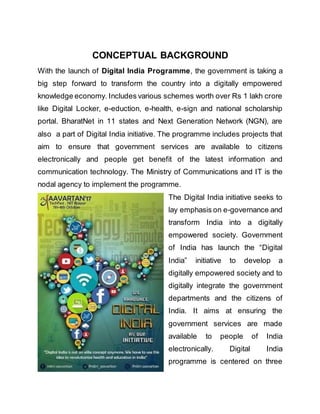
The Digital India initiative seeks to
lay emphasis on e-governance and
transform India into a digitally
empowered society. Government
of India has launch the “Digital
India” initiative to develop a
digitally empowered society and to
digitally integrate the government
departments and the citizens of
India. It aims at ensuring the
government services are made
available to people of India
electronically. Digital India
programme is centered on three
key vision areas:
1. Digital Infrastructure as a Utility to Every Citizen: Availability of
high speed internet as a core utility for delivery of services to citizens
.Cradle to grave digital identity that is unique, lifelong, online and
authenticable to every citizen. Mobile phone & bank account enabling
citizen participation in digital & financial space. Easy access to a Common
Service Centre Shareable private space on a public cloud .Safe and secure
cyber-space.
2. Governance& Services on Demand: Seamlesslyintegrated services
across departments or jurisdictions. Availability of services in real time from
online & mobile platforms. All citizen entitlements to be portable and
available on the cloud. Digitally transformed services for improving ease of
doing business .Making financial transactions electronic & cashless.
Leveraging Geospatial Information Systems (GIS) for decision support
systems & development.
3. Digital Empowerment of Citizens: Universal digital literacy.
Universally accessible digital resources. Availability of digital resources /
services in Indian languages. Collaborative digital platforms for participative
governance .Citizens are not required to physically submit Govt.
documents certificates.
4. In line with these objectives, the government has launched
some initiatives. Government also launched a digital locker under the
name "Digi Locker". Digital Locker System aims to minimize the usage of
physical documents and enable sharing of e-documents across agencies.
MyGov.in has been implemented as a innovative platform to build a
partnership
between citizen and goverment. Swachh Bharat Mission (SBM) Mobile app
would be used by people and Government organizations for achieving the
goals of Swachh Bharat Mission. eSign framework would allow citizens to
digitally sign a document online using Aadhaar authentication. National
Scholarships Portal is said to be a one stop solution for end to end
scholarship process right from submission of student application,
verification, sanction and disbursal to end beneficiary for all the
scholarships provided by the Government of India. The Government of
India has undertaken an initiative namely Bharat Net, a high speed digital
highway project using optical fibre to connect lakhs of Gram
Panchayats of country. The Digital India initiative is a promising initiative
of the Indian Government. There are some challenges also for this project
like capital, awareness etc. If Digital India will get implemented successfully
then it will boost the development of India.
DIGITAL INDIA INITIATIVE
The Government of India entity Bharat Broadband Network Limited (BBNL)
which executes the BharatNet project is the custodian of Digital India (DI)
project.
Implementation
New digital services
Some of the facilities which will be provided through this initiative are
Bharat net, digital locker, e-education, e-health, e-sign, e-shopping and
national scholarship portal. As part of Digital India, Indian Government
planned to launch Botnet cleaning centers.
 National e-Governance Plan aimed at bringing all the front-end
government services online.
o MyGov.in is a platform to share inputs and ideas on matters of policy
and governance.[12]
It is a platform for citizen engagement in governance,
through a "Discuss", "Do" and "Disseminate" approach.[7]
o UMANG (Unified Mobile Application for New-age Governance) is
a Government of India all-in-one single unified secure multi-channel multi-
platform multi-lingual multi-service freeware mobile app for accessing over
1,200 central and state government services in multiple Indian
languages over Android, iOS, Windows and USSD (feature phone)
devices, including services such as AADHAR, DigiLocker, Bharat Bill
Payment System, PAN, EPFO services, PMKVY services, AICTE, CBSE,
tax and fee or utilities bills payments, education, job search, tax, business,
health, agriculture, travel, Indian railway tickets bookings, birth certificates,
e-District, e-Panchayat, police clearance, passport, other utility services
from private companies and much more.[13]
o eSign framework allows citizens to digitally sign a document online
using Aadhaar authentication.[7]
o Swachh Bharat Mission (SBM) Mobile app is being used by people
and Government organisations for achieving the goals of Swachh Bharat
Mission.
o eHospital application provides important services such as online
registration, payment of fees and appointment, online diagnostic reports,
enquiring availability of blood online etc.
o Digital attendance: attendance.gov.in was launched by PM Narendra
Modi on 1 July 2015[5]
to keep a record of the attendance of government
employees on a real-time basis. This initiative started with implementation
of a common Biometric Attendance System (BAS) in the central
government offices located in Delhi.
Back-end digitisation
o Black money eradication: The 2016 Union budget of India
announced 11 technology initiatives including the use of data analytics to
nab tax evaders, creating a substantial opportunity for IT companies to
build out the systems that will be required. Digital Literacy mission will
cover six crore rural households. It is planned to connect 550 farmer
markets in the country through the use of technology.
Facilities to digitally empower citizens
o Digital Locker facility will help citizens to digitally store their important
documents like PAN card, passport, mark sheets and degree certificates.
Digital Locker will provide secure access to Government issued
documents.It uses authenticity services provided by Aadhaar. It is aimed at
eliminating the use of physical documents and enables the sharing of
verified electronic documents across government agencies. Three key
stakeholders of DigiLocker are Citizen, Issuer and requester.
o BPO and job growth: The government is planning to create 28,000
seats of BPOs in various states and set up at least one Common Service
Centre in each of the gram panchayats in the state.
o e-Sampark Vernacular email service: Out of 10% English speaking
Indians, only 2% reside in rural areas. Rest everyone depends on their
vernacular language for all living their lives. However, as of now, email
addresses can only be created in the English language. To connect rural
India with Digital India, the Government of India impelled email services
provider giants including Gmail, office, and Rediff to provide the email
address in regional languages. The email provider companies have shown
positive sign and is working in the same process.[21]
An Indian-based
company, Data Xgen Technologies Pvt Ltd, has launched world's first free
linguistic email address under the name ‘DATAMAIL’[22]
which allows
creating email ids in 8 Indian languages, English; and three foreign
languages – Arabic, Russian and Chinese. Over the period of time, the
email service in 22 languages will be offered by Data XGen Technologies.
NINE PILLARS FOR DIGITAL INDIA
Digital technologies influence almost all aspects of the economy
and society. Hence the programme covers wider areas to make
India a digitally empowered country. The Government has identified
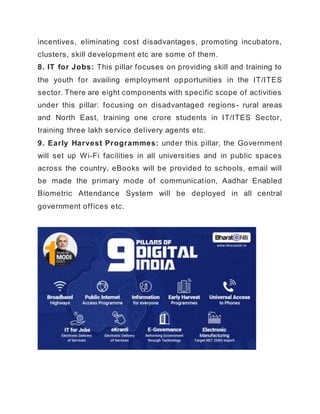
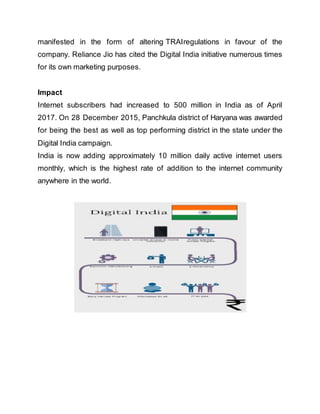
nine pillars for Digital India.
1. Broadband Highways: Government aims to lay national optical
fibre network in all 2.5 lakh gram panchayats. Department of
Telecommunications (DoT) is the nodal Department for this project.
A new deadline of 2018 has been set for providing broadband
internet to all panchayats.
National Information Infrastructure (NII) would integrate the network
and cloud infrastructure in the country to provide high speed
connectivity and cloud platform to various government departments
up to the panchayat level. The infrastructure components for
broadband networks includes: State Wide Area Network (SWAN),
National Knowledge Network (NKN), National Optical Fibre Network
(NOFN), Government User Network (GUN) and the MeghRaj Cloud.
DeitY will be the nodal Department for this project.
2. Universal Access to Phones: Mobile phone coverage will be
provided to all the remaining 55,619 villages in the country. The
Department of Telecommunications will be the nodal department
and project cost will be around Rs 16,000 Cr during 2014 -18.
3. Public Internet Access Programme: Common Services Centres
(CSCs) will be strengthened and their number will be increased so
that each Panchayt gets a CSC (total 250000 CSCs). CSCs would
be made viable and multi-functional end-points for delivery of
government and business services. DeitY would be the nodal
department to implement the scheme.
4. e-Governance – Reforming Govt. through technology: Digital
technology will be used for the better delivery of government
services. The government aims to improve processes and delivery
of services through e-Governance with UIDAI, payment gateway,
EDI and mobile platforms. School certificates, voter ID cards will be
provided online (digi-locker). All databases and information should
be in electronic form and not manual.
5. e-Kranti -Electronic Delivery of Services: e-Kranti is an
advanced e-governance programme to deliver governance services
through electronic mode. It has 44 mission projects. The
programme integrates the previous National E-Governance Plan.
Public services related to health, education, farmers, justice,
security and financial inclusion etc will be administered
electronically under e-Kranti.
6. Information to all: information related with governance and
public services to citizens will be easily provided to citizens through
digital platforms including social media.
7. Electronics, Manufacturing with a target Net Zero
Imports: This pillar of Digital India aims to promote the
manufacture of digital technology devices especially electronics
with the country. Manufacturing of electronics within India will be
promoted with a target of net zero import by 2020. For this, several
steps under the National Electronic Policy will be used. Taxation
incentives, eliminating cost disadvantages, promoting incubators,
clusters, skill development etc are some of them.
8. IT for Jobs: This pillar focuses on providing skill and training to
the youth for availing employment opportunities in the IT/ITES
sector. There are eight components with specific scope of activities
under this pillar: focusing on disadvantaged regions - rural areas
and North East, training one crore students in IT/ITES Sector,
training three lakh service delivery agents etc.
9. Early Harvest Programmes: under this pillar, the Government
will set up Wi-Fi facilities in all universities and in public spaces
across the country, eBooks will be provided to schools, email will
be made the primary mode of communication, Aadhar Enabled
Biometric Attendance System will be deployed in all central
government offices etc.
TRAINING
Pradhan MantriGramin DigitalSakshartaAbhiyan is being executed by
PMGDisha with an outlay of Rs 2,351.38 crore with the objective of making
6 crore rural households digitally literate by March 2019.[24][25][26]
Pradhan
Mantri Gramin Digital Saksharta Abhiyan (abbreviated as PMGDisha[27]
) is
an initiative under Digital India program, approved by The Union Cabinet
chaired by the PM Narendra Modi.[28][29]
The main objective of the Pradhan
Mantri Gramin Digital Saksharta Abhiyan is to make 6 crore people in rural
areas across India digitally literate, reaching around 40% of rural
households by covering one memberfrom every eligible household.[30][31][32]
CRITICISMS
Several academic scholars have critiqued ICTs in development.Some take
issue with technological determinism, the notion that ICTs are a sure-fire
antidote to the world's problems. Instead, governments must adjust
solutions to the specificpolitical and social context of their nation.[59]
Others
note that technologyamplifies underlying institutional forces, so technology
must be accompanied by significant changes in policy and institutions in
order to have meaningful impact.
It is being thought that there needs to be more research on the actual worth
of these multimillion-dollar government and ICT for development projects.
For the most part, the technological revolution in India has benefited the
already privileged sectors of Indians. It is also difficult to scale up initiatives
to affect all Indians, and fundamental attitudinal and institutional change is
still an issue. While much ICT research has been conducted in Kerala,
Andhra Pradesh, and Gujarat, poorer states such as Bihar and Orissa are
rarely mentioned.
Digital India as a programme has been considered by some as a
continuation of the long history of bias towards RIL, which has previously
manifested in the form of altering TRAIregulations in favour of the
company. Reliance Jio has cited the Digital India initiative numerous times
for its own marketing purposes.
Impact
Internet subscribers had increased to 500 million in India as of April
2017. On 28 December 2015, Panchkula district of Haryana was awarded
for being the best as well as top performing district in the state under the
Digital India campaign.
India is now adding approximately 10 million daily active internet users
monthly, which is the highest rate of addition to the internet community
anywhere in the world.
OUTCOME
The programme has been favoured by multiple countries including the US,
Japan, South Korea, the UK, Canada, Australia, Malaysia, Singapore,
Uzbekistan and Vietnam.
At the launch ceremony of Digital India Week by Prime Minister Narendra
Modi in Delhi on 1 July 2015, top CEOs from India and abroad committed
to invest 224.5 lakh crore(US$3.2 trillion) towards this initiative. The CEOs
said the investments would be utilized towards making smartphones and
internet devices at an affordable price in India which would help generate
jobs in India as well as reduce the cost of importing them from abroad.
Leaders from Silicon Valley, San Jose, California expressed their support
for Digital India during PM Narendra Modi's visit in September
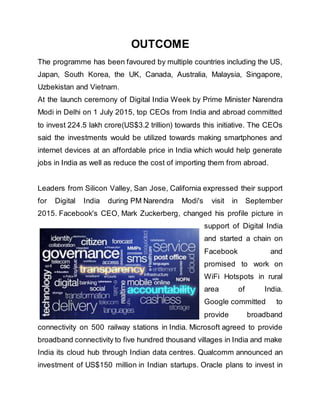
2015. Facebook's CEO, Mark Zuckerberg, changed his profile picture in
support of Digital India
and started a chain on
Facebook and
promised to work on
WiFi Hotspots in rural
area of India.
Google committed to
provide broadband
connectivity on 500 railway stations in India. Microsoft agreed to provide
broadband connectivity to five hundred thousand villages in India and make
India its cloud hub through Indian data centres. Qualcomm announced an
investment of US$150 million in Indian startups. Oracle plans to invest in
20 states and will work on payments and Smart city initiatives. However,
back in India, cyber experts expressed their concern over internet.org and
viewed the Prime Minister's bonhomie with Zuckerberg as the
government's indirect approval of the controversial initiative. The
Statesman reported, "Prime Minister Narendra Modi's chemistry with
Facebook CEO Mark Zuckerberg at the social media giant's headquarters
in California may have been greeted enthusiastically in Silicon Valley but
back home several social media enthusiasts and cyber activists are
disappointed."[57]
Later the Prime Minister office clarified that net neutrality
will be maintained at all costs and vetoed the Basic Internet plans. Digital
India has also been influential in promoting the interests of the Indian
Railways.

Digital india

  • 1.
    ABSTRACT Digitalization which isthe need of today's world is the result of innovations and technological advances. Every country is aiming to achieve digitalization to empower society in a better way. Digital India is a flagship program launched by the Government of India to transform India in a digitally empowered and knowledge economy. This drive came as a dream project of the Indian government to remodel India digitally. This aim would be very difficult to achieve unless there is awareness amongst the people. Almost a year since the project is launched. This research paper strives to analyze the awareness among the youth about the Digital India initiative.
  • 2.
    INTRODUCTION In an orderto create participative, transparent and responsive government, Prime Minister Narendra Modi launched the much ambitious 'Digital India' programme. An influential umbrella project of the government and blessings for the citizens to bring India to a global platform with participation from people and businesses. This initiative will ensure that all government services and information are available anywhere, anytime, on any device that are user friendly and secured. This transformation will make into reality when every citizen of India will participate in this transformative impact. Digital India initiative could help in achieving the objectives of: • Education for all. • Information for all. • Broadband for all. • Leadership structure. This will provide all services electronically and promote digital literacy. Digital Technologies which includes the concept of cloud computing and mobile applications have emerged as the catalysts for express economic growth and citizen empowerment. Companies all over the world desire to invest in Digital India- the 21st century India, as a growth opportunity. The objective of this paper is study and understand the awareness among the youth about the Digital India Initiative and to suggestmeasures to empower youth about this initiative.
  • 3.
    CONCEPTUAL BACKGROUND With thelaunch of Digital India Programme, the government is taking a big step forward to transform the country into a digitally empowered knowledge economy. Includes various schemes worth over Rs 1 lakh crore like Digital Locker, e-eduction, e-health, e-sign and national scholarship portal. BharatNet in 11 states and Next Generation Network (NGN), are also a part of Digital India initiative. The programme includes projects that aim to ensure that government services are available to citizens electronically and people get benefit of the latest information and communication technology. The Ministry of Communications and IT is the nodal agency to implement the programme. The Digital India initiative seeks to lay emphasis on e-governance and transform India into a digitally empowered society. Government of India has launch the “Digital India” initiative to develop a digitally empowered society and to digitally integrate the government departments and the citizens of India. It aims at ensuring the government services are made available to people of India electronically. Digital India programme is centered on three
  • 4.
    key vision areas: 1.Digital Infrastructure as a Utility to Every Citizen: Availability of high speed internet as a core utility for delivery of services to citizens .Cradle to grave digital identity that is unique, lifelong, online and authenticable to every citizen. Mobile phone & bank account enabling citizen participation in digital & financial space. Easy access to a Common Service Centre Shareable private space on a public cloud .Safe and secure cyber-space. 2. Governance& Services on Demand: Seamlesslyintegrated services across departments or jurisdictions. Availability of services in real time from online & mobile platforms. All citizen entitlements to be portable and available on the cloud. Digitally transformed services for improving ease of doing business .Making financial transactions electronic & cashless. Leveraging Geospatial Information Systems (GIS) for decision support systems & development. 3. Digital Empowerment of Citizens: Universal digital literacy. Universally accessible digital resources. Availability of digital resources / services in Indian languages. Collaborative digital platforms for participative governance .Citizens are not required to physically submit Govt. documents certificates. 4. In line with these objectives, the government has launched some initiatives. Government also launched a digital locker under the name "Digi Locker". Digital Locker System aims to minimize the usage of physical documents and enable sharing of e-documents across agencies. MyGov.in has been implemented as a innovative platform to build a partnership
  • 5.
    between citizen andgoverment. Swachh Bharat Mission (SBM) Mobile app would be used by people and Government organizations for achieving the goals of Swachh Bharat Mission. eSign framework would allow citizens to digitally sign a document online using Aadhaar authentication. National Scholarships Portal is said to be a one stop solution for end to end scholarship process right from submission of student application, verification, sanction and disbursal to end beneficiary for all the scholarships provided by the Government of India. The Government of India has undertaken an initiative namely Bharat Net, a high speed digital highway project using optical fibre to connect lakhs of Gram Panchayats of country. The Digital India initiative is a promising initiative of the Indian Government. There are some challenges also for this project like capital, awareness etc. If Digital India will get implemented successfully then it will boost the development of India.
  • 6.
    DIGITAL INDIA INITIATIVE TheGovernment of India entity Bharat Broadband Network Limited (BBNL) which executes the BharatNet project is the custodian of Digital India (DI) project. Implementation New digital services Some of the facilities which will be provided through this initiative are Bharat net, digital locker, e-education, e-health, e-sign, e-shopping and national scholarship portal. As part of Digital India, Indian Government planned to launch Botnet cleaning centers.  National e-Governance Plan aimed at bringing all the front-end government services online. o MyGov.in is a platform to share inputs and ideas on matters of policy and governance.[12] It is a platform for citizen engagement in governance, through a "Discuss", "Do" and "Disseminate" approach.[7] o UMANG (Unified Mobile Application for New-age Governance) is a Government of India all-in-one single unified secure multi-channel multi- platform multi-lingual multi-service freeware mobile app for accessing over 1,200 central and state government services in multiple Indian languages over Android, iOS, Windows and USSD (feature phone)
  • 7.
    devices, including servicessuch as AADHAR, DigiLocker, Bharat Bill Payment System, PAN, EPFO services, PMKVY services, AICTE, CBSE, tax and fee or utilities bills payments, education, job search, tax, business, health, agriculture, travel, Indian railway tickets bookings, birth certificates, e-District, e-Panchayat, police clearance, passport, other utility services from private companies and much more.[13] o eSign framework allows citizens to digitally sign a document online using Aadhaar authentication.[7] o Swachh Bharat Mission (SBM) Mobile app is being used by people and Government organisations for achieving the goals of Swachh Bharat Mission. o eHospital application provides important services such as online registration, payment of fees and appointment, online diagnostic reports, enquiring availability of blood online etc. o Digital attendance: attendance.gov.in was launched by PM Narendra Modi on 1 July 2015[5] to keep a record of the attendance of government employees on a real-time basis. This initiative started with implementation of a common Biometric Attendance System (BAS) in the central government offices located in Delhi. Back-end digitisation o Black money eradication: The 2016 Union budget of India announced 11 technology initiatives including the use of data analytics to nab tax evaders, creating a substantial opportunity for IT companies to build out the systems that will be required. Digital Literacy mission will cover six crore rural households. It is planned to connect 550 farmer markets in the country through the use of technology.
  • 8.
    Facilities to digitallyempower citizens o Digital Locker facility will help citizens to digitally store their important documents like PAN card, passport, mark sheets and degree certificates. Digital Locker will provide secure access to Government issued documents.It uses authenticity services provided by Aadhaar. It is aimed at eliminating the use of physical documents and enables the sharing of verified electronic documents across government agencies. Three key stakeholders of DigiLocker are Citizen, Issuer and requester. o BPO and job growth: The government is planning to create 28,000 seats of BPOs in various states and set up at least one Common Service Centre in each of the gram panchayats in the state. o e-Sampark Vernacular email service: Out of 10% English speaking Indians, only 2% reside in rural areas. Rest everyone depends on their vernacular language for all living their lives. However, as of now, email addresses can only be created in the English language. To connect rural India with Digital India, the Government of India impelled email services provider giants including Gmail, office, and Rediff to provide the email address in regional languages. The email provider companies have shown positive sign and is working in the same process.[21] An Indian-based company, Data Xgen Technologies Pvt Ltd, has launched world's first free linguistic email address under the name ‘DATAMAIL’[22] which allows creating email ids in 8 Indian languages, English; and three foreign languages – Arabic, Russian and Chinese. Over the period of time, the email service in 22 languages will be offered by Data XGen Technologies.
  • 9.
    NINE PILLARS FORDIGITAL INDIA Digital technologies influence almost all aspects of the economy and society. Hence the programme covers wider areas to make India a digitally empowered country. The Government has identified nine pillars for Digital India. 1. Broadband Highways: Government aims to lay national optical fibre network in all 2.5 lakh gram panchayats. Department of Telecommunications (DoT) is the nodal Department for this project. A new deadline of 2018 has been set for providing broadband internet to all panchayats. National Information Infrastructure (NII) would integrate the network and cloud infrastructure in the country to provide high speed connectivity and cloud platform to various government departments up to the panchayat level. The infrastructure components for broadband networks includes: State Wide Area Network (SWAN), National Knowledge Network (NKN), National Optical Fibre Network (NOFN), Government User Network (GUN) and the MeghRaj Cloud. DeitY will be the nodal Department for this project. 2. Universal Access to Phones: Mobile phone coverage will be provided to all the remaining 55,619 villages in the country. The Department of Telecommunications will be the nodal department and project cost will be around Rs 16,000 Cr during 2014 -18. 3. Public Internet Access Programme: Common Services Centres (CSCs) will be strengthened and their number will be increased so that each Panchayt gets a CSC (total 250000 CSCs). CSCs would
  • 10.
    be made viableand multi-functional end-points for delivery of government and business services. DeitY would be the nodal department to implement the scheme. 4. e-Governance – Reforming Govt. through technology: Digital technology will be used for the better delivery of government services. The government aims to improve processes and delivery of services through e-Governance with UIDAI, payment gateway, EDI and mobile platforms. School certificates, voter ID cards will be provided online (digi-locker). All databases and information should be in electronic form and not manual. 5. e-Kranti -Electronic Delivery of Services: e-Kranti is an advanced e-governance programme to deliver governance services through electronic mode. It has 44 mission projects. The programme integrates the previous National E-Governance Plan. Public services related to health, education, farmers, justice, security and financial inclusion etc will be administered electronically under e-Kranti. 6. Information to all: information related with governance and public services to citizens will be easily provided to citizens through digital platforms including social media. 7. Electronics, Manufacturing with a target Net Zero Imports: This pillar of Digital India aims to promote the manufacture of digital technology devices especially electronics with the country. Manufacturing of electronics within India will be promoted with a target of net zero import by 2020. For this, several steps under the National Electronic Policy will be used. Taxation
  • 11.
    incentives, eliminating costdisadvantages, promoting incubators, clusters, skill development etc are some of them. 8. IT for Jobs: This pillar focuses on providing skill and training to the youth for availing employment opportunities in the IT/ITES sector. There are eight components with specific scope of activities under this pillar: focusing on disadvantaged regions - rural areas and North East, training one crore students in IT/ITES Sector, training three lakh service delivery agents etc. 9. Early Harvest Programmes: under this pillar, the Government will set up Wi-Fi facilities in all universities and in public spaces across the country, eBooks will be provided to schools, email will be made the primary mode of communication, Aadhar Enabled Biometric Attendance System will be deployed in all central government offices etc.
  • 12.
    TRAINING Pradhan MantriGramin DigitalSakshartaAbhiyanis being executed by PMGDisha with an outlay of Rs 2,351.38 crore with the objective of making 6 crore rural households digitally literate by March 2019.[24][25][26] Pradhan Mantri Gramin Digital Saksharta Abhiyan (abbreviated as PMGDisha[27] ) is an initiative under Digital India program, approved by The Union Cabinet chaired by the PM Narendra Modi.[28][29] The main objective of the Pradhan Mantri Gramin Digital Saksharta Abhiyan is to make 6 crore people in rural areas across India digitally literate, reaching around 40% of rural households by covering one memberfrom every eligible household.[30][31][32]
  • 13.
    CRITICISMS Several academic scholarshave critiqued ICTs in development.Some take issue with technological determinism, the notion that ICTs are a sure-fire antidote to the world's problems. Instead, governments must adjust solutions to the specificpolitical and social context of their nation.[59] Others note that technologyamplifies underlying institutional forces, so technology must be accompanied by significant changes in policy and institutions in order to have meaningful impact. It is being thought that there needs to be more research on the actual worth of these multimillion-dollar government and ICT for development projects. For the most part, the technological revolution in India has benefited the already privileged sectors of Indians. It is also difficult to scale up initiatives to affect all Indians, and fundamental attitudinal and institutional change is still an issue. While much ICT research has been conducted in Kerala, Andhra Pradesh, and Gujarat, poorer states such as Bihar and Orissa are rarely mentioned. Digital India as a programme has been considered by some as a continuation of the long history of bias towards RIL, which has previously
  • 14.
    manifested in theform of altering TRAIregulations in favour of the company. Reliance Jio has cited the Digital India initiative numerous times for its own marketing purposes. Impact Internet subscribers had increased to 500 million in India as of April 2017. On 28 December 2015, Panchkula district of Haryana was awarded for being the best as well as top performing district in the state under the Digital India campaign. India is now adding approximately 10 million daily active internet users monthly, which is the highest rate of addition to the internet community anywhere in the world.
  • 15.
    OUTCOME The programme hasbeen favoured by multiple countries including the US, Japan, South Korea, the UK, Canada, Australia, Malaysia, Singapore, Uzbekistan and Vietnam. At the launch ceremony of Digital India Week by Prime Minister Narendra Modi in Delhi on 1 July 2015, top CEOs from India and abroad committed to invest 224.5 lakh crore(US$3.2 trillion) towards this initiative. The CEOs said the investments would be utilized towards making smartphones and internet devices at an affordable price in India which would help generate jobs in India as well as reduce the cost of importing them from abroad. Leaders from Silicon Valley, San Jose, California expressed their support for Digital India during PM Narendra Modi's visit in September 2015. Facebook's CEO, Mark Zuckerberg, changed his profile picture in support of Digital India and started a chain on Facebook and promised to work on WiFi Hotspots in rural area of India. Google committed to provide broadband connectivity on 500 railway stations in India. Microsoft agreed to provide broadband connectivity to five hundred thousand villages in India and make India its cloud hub through Indian data centres. Qualcomm announced an investment of US$150 million in Indian startups. Oracle plans to invest in
  • 16.
    20 states andwill work on payments and Smart city initiatives. However, back in India, cyber experts expressed their concern over internet.org and viewed the Prime Minister's bonhomie with Zuckerberg as the government's indirect approval of the controversial initiative. The Statesman reported, "Prime Minister Narendra Modi's chemistry with Facebook CEO Mark Zuckerberg at the social media giant's headquarters in California may have been greeted enthusiastically in Silicon Valley but back home several social media enthusiasts and cyber activists are disappointed."[57] Later the Prime Minister office clarified that net neutrality will be maintained at all costs and vetoed the Basic Internet plans. Digital India has also been influential in promoting the interests of the Indian Railways.