Digital IndiaA tool to empower India Digitally
Presented by
Rajmeet Kaur
Introduction
 To prepare India for a knowledge future.
 Umbrella project
Coordinated by DeitY, implemented by the entire government.
 Existing schemes will be restructured and re-focused implemented in a
synchronized manner.
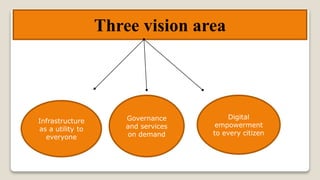
Three vision area
Infrastructure
as a utility to
everyone
Governance
and services
on demand
Digital
empowerment
to every citizen
D I G I T A L I N D I A
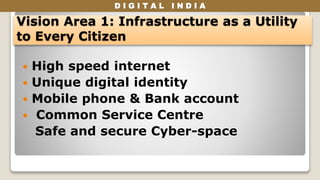
Vision Area 1: Infrastructure as a Utility
to Every Citizen
 High speed internet
 Unique digital identity
 Mobile phone & Bank account
 Common Service Centre
Safe and secure Cyber-space
D I G I T A L I N D I A
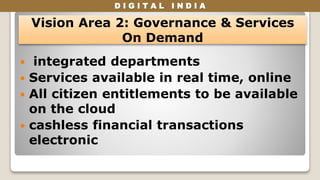
 integrated departments
 Services available in real time, online
 All citizen entitlements to be available
on the cloud
 cashless financial transactions
electronic
Vision Area 2: Governance & Services
On Demand
D I G I T A L I N D I A
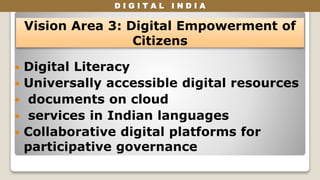
 Digital Literacy
 Universally accessible digital resources
 documents on cloud
 services in Indian languages
 Collaborative digital platforms for
participative governance
Vision Area 3: Digital Empowerment of
Citizens
D I G I T A L I N D I A
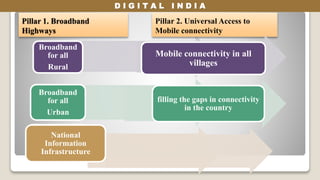
Pillar 1. Broadband
Highways
Broadband
for all
Rural
Broadband
for all
Urban
National
Information
Infrastructure
Pillar 2. Universal Access to
Mobile connectivity
Mobile connectivity in all
villages
filling the gaps in connectivity
in the country
National
Information
Infrastructure
D I G I T A L I N D I A
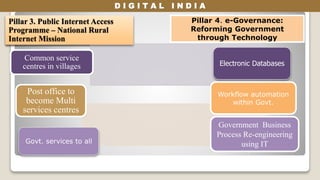
Pillar 3. Public Internet Access
Programme – National Rural
Internet Mission
Common service
centres in villages
Post office to
become Multi
services centres
Govt. services to all
Electronic Databases
Pillar 3. Public Internet Access
Programme – National Rural
Internet Mission
Pillar 4. e-Governance:
Reforming Government
through Technology
Workflow automation
within Govt.
Government Business
Process Re-engineering
using IT
D I G I T A L I N D I A
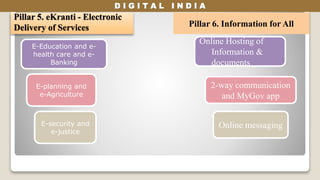
Pillar 5. eKranti - Electronic
Delivery of Services
E-Education and e-
health care and e-
Banking
E-security and
e-justice
E-planning and
e-Agriculture
Pillar 6. Information for All
Online Hosting of
Information &
documents
2-way communication
and MyGov app
Online messaging
D I G I T A L I N D I A
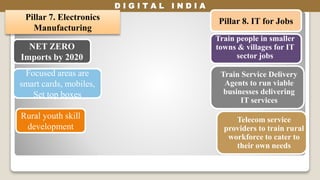
Pillar 7. Electronics
Manufacturing
NET ZERO
Imports by 2020
Rural youth skill
development
Focused areas are
smart cards, mobiles,
Set top boxes
Train people in smaller
towns & villages for IT
sector jobs
Train Service Delivery
Agents to run viable
businesses delivering
IT services
Telecom service
providers to train rural
workforce to cater to
their own needs
Pillar 8. IT for Jobs
D I G I T A L I N D I A
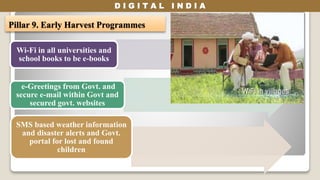
Pillar 9. Early Harvest Programmes
Wi-Fi in all universities and
school books to be e-books
e-Greetings from Govt. and
secure e-mail within Govt and
secured govt. websites
SMS based weather information
and disaster alerts and Govt.
portal for lost and found
children
D I G I T A L I N D I A
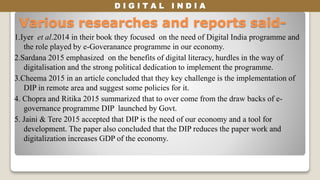
Various researches and reports said-
1.Iyer et al.2014 in their book they focused on the need of Digital India programme and
the role played by e-Goveranance programme in our economy.
2.Sardana 2015 emphasized on the benefits of digital literacy, hurdles in the way of
digitalisation and the strong political dedication to implement the programme.
3.Cheema 2015 in an article concluded that they key challenge is the implementation of
DIP in remote area and suggest some policies for it.
4. Chopra and Ritika 2015 summarized that to over come from the draw backs of e-
governance programme DIP launched by Govt.
5. Jaini & Tere 2015 accepted that DIP is the need of our economy and a tool for
development. The paper also concluded that the DIP reduces the paper work and
digitalization increases GDP of the economy.
D I G I T A L I N D I A
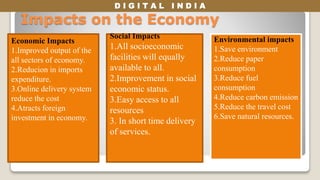
Impacts on the Economy
Economic Impacts
1.Improved output of the
all sectors of economy.
2.Reducion in imports
expenditure.
3.Online delivery system
reduce the cost
4.Atracts foreign
investment in economy.
Social Impacts
1.All socioeconomic
facilities will equally
available to all.
2.Improvement in social
economic status.
3.Easy access to all
resources
3. In short time delivery
of services.
Environmental impacts
1.Save environment
2.Reduce paper
consumption
3.Reduce fuel
consumption
4.Reduce carbon emission
5.Reduce the travel cost
6.Save natural resources.
11
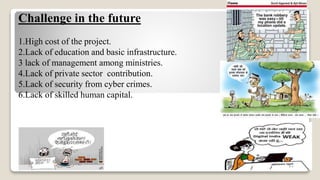
Challenge in the future
1.High cost of the project.
2.Lack of education and basic infrastructure.
3 lack of management among ministries.
4.Lack of private sector contribution.
5.Lack of security from cyber crimes.
6.Lack of skilled human capital.
D I G I T A L I N D I A

digital India and its Impact

  • 1.
    Digital IndiaA toolto empower India Digitally Presented by Rajmeet Kaur
  • 2.
    Introduction  To prepareIndia for a knowledge future.  Umbrella project Coordinated by DeitY, implemented by the entire government.  Existing schemes will be restructured and re-focused implemented in a synchronized manner.
  • 3.
    Three vision area Infrastructure asa utility to everyone Governance and services on demand Digital empowerment to every citizen
  • 4.
    D I GI T A L I N D I A Vision Area 1: Infrastructure as a Utility to Every Citizen  High speed internet  Unique digital identity  Mobile phone & Bank account  Common Service Centre Safe and secure Cyber-space
  • 5.
    D I GI T A L I N D I A  integrated departments  Services available in real time, online  All citizen entitlements to be available on the cloud  cashless financial transactions electronic Vision Area 2: Governance & Services On Demand
  • 6.
    D I GI T A L I N D I A  Digital Literacy  Universally accessible digital resources  documents on cloud  services in Indian languages  Collaborative digital platforms for participative governance Vision Area 3: Digital Empowerment of Citizens
  • 7.
    D I GI T A L I N D I A Pillar 1. Broadband Highways Broadband for all Rural Broadband for all Urban National Information Infrastructure Pillar 2. Universal Access to Mobile connectivity Mobile connectivity in all villages filling the gaps in connectivity in the country National Information Infrastructure
  • 8.
    D I GI T A L I N D I A Pillar 3. Public Internet Access Programme – National Rural Internet Mission Common service centres in villages Post office to become Multi services centres Govt. services to all Electronic Databases Pillar 3. Public Internet Access Programme – National Rural Internet Mission Pillar 4. e-Governance: Reforming Government through Technology Workflow automation within Govt. Government Business Process Re-engineering using IT
  • 9.
    D I GI T A L I N D I A Pillar 5. eKranti - Electronic Delivery of Services E-Education and e- health care and e- Banking E-security and e-justice E-planning and e-Agriculture Pillar 6. Information for All Online Hosting of Information & documents 2-way communication and MyGov app Online messaging
  • 10.
    D I GI T A L I N D I A Pillar 7. Electronics Manufacturing NET ZERO Imports by 2020 Rural youth skill development Focused areas are smart cards, mobiles, Set top boxes Train people in smaller towns & villages for IT sector jobs Train Service Delivery Agents to run viable businesses delivering IT services Telecom service providers to train rural workforce to cater to their own needs Pillar 8. IT for Jobs
  • 11.
    D I GI T A L I N D I A Pillar 9. Early Harvest Programmes Wi-Fi in all universities and school books to be e-books e-Greetings from Govt. and secure e-mail within Govt and secured govt. websites SMS based weather information and disaster alerts and Govt. portal for lost and found children
  • 12.
    D I GI T A L I N D I A Various researches and reports said- 1.Iyer et al.2014 in their book they focused on the need of Digital India programme and the role played by e-Goveranance programme in our economy. 2.Sardana 2015 emphasized on the benefits of digital literacy, hurdles in the way of digitalisation and the strong political dedication to implement the programme. 3.Cheema 2015 in an article concluded that they key challenge is the implementation of DIP in remote area and suggest some policies for it. 4. Chopra and Ritika 2015 summarized that to over come from the draw backs of e- governance programme DIP launched by Govt. 5. Jaini & Tere 2015 accepted that DIP is the need of our economy and a tool for development. The paper also concluded that the DIP reduces the paper work and digitalization increases GDP of the economy.
  • 13.
    D I GI T A L I N D I A Impacts on the Economy Economic Impacts 1.Improved output of the all sectors of economy. 2.Reducion in imports expenditure. 3.Online delivery system reduce the cost 4.Atracts foreign investment in economy. Social Impacts 1.All socioeconomic facilities will equally available to all. 2.Improvement in social economic status. 3.Easy access to all resources 3. In short time delivery of services. Environmental impacts 1.Save environment 2.Reduce paper consumption 3.Reduce fuel consumption 4.Reduce carbon emission 5.Reduce the travel cost 6.Save natural resources.
  • 14.
    11 Challenge in thefuture 1.High cost of the project. 2.Lack of education and basic infrastructure. 3 lack of management among ministries. 4.Lack of private sector contribution. 5.Lack of security from cyber crimes. 6.Lack of skilled human capital.
  • 15.
    D I GI T A L I N D I A

Editor's Notes

  • #13 1,00,000 – 36,000 Fab+575 Skill+15600 NII+24,000 Incentives+500 Cluster+5000 Innovation+500 Digital Literacy+4750 CSC 2.0+200 Training+790 WiFi+98 email.